
Birds are important components of karst forests. Their presence can be an indicator for habitat occupied. We identified bird communities in the karst forests of Teluk Sumbang, East Kalimantan. Bird sampling was done in hill karst forests and coastal karst forests. We employed a point count method by following transects. Observers walked constantly along transect and stopped every distance of ±200 m to record all sighted birds for 10-15 min. We found 89 bird species: 67 bird species were identified in hill karst forest and 33 bird species were recorded in coastal karst forests. Eleven bird species were found in both study sites. The score of diversity, species richness, and evenness indices of hill karst forests was higher than that in coastal karst. A t-test revealed that there was a significant difference in diversity index between coastal and hill karst (T = 2.016, p = 0.039). Birds characterized by a wide range of distribution and were able to adapt to various types of environments, particularly secondary forests, were most dominant. Nevertheless, the karst forests of Teluk Sumbang were also essential habitat for threatened and protected bird species.
Research Article · Volume 54, Issue 3, 22 February 2022 · Open Access
Bird Communities in the Karst Forests of Teluk Sumbang, East Kalimantan, Indonesia
· ·
Affiliations & Notes ⌄
- 1Research and Development Institute for Natural Resources Conservation Technology, Indonesia 2Environmental and Forestry Research Institute of Makassar, Indonesia * Corresponding author: mukhlisi.arkan@gmail.com
Article Info ⌄
- Journal:
- Pakistan Journal of Zoology
- Published:
- 22 February 2022

From the article
- Besides, we also found Chloropsis sonnerati in hill karst, even though the bird’s abundance is lower than that of Chloropsis cyanopogon.
- There was a significant difference in bird communities between hill karst and coastal karst forests of Teluk Sumbang.
- The abundance and species richness of birs in hill karst forests were higher than that in coastal karst.
- Generally, dominant birds were those which had wide distribution and were adapted to various habitats, particularly secondary forests.
Selected from the article's own text.
Abstract
Introduction
A tropical karst rainforest is an essential habitat of Bornean bird communities. The niche complexity and various microclimates due to the long geological processes in the past contribute to bird species richness, rarity, and endemicity ; ; . Karst forests are typically characterized by dolines, ponors, and caves, creating microhabitat diversity for birds. These kinds of environment also serve as refugia for birds and invertebrates sensitive to climate change ; . Frugivorous bird communities in karst forests are particularly important in accelerating native plant regeneration in degraded areas . In term of economic importance, birds have a high economic value for people. For example, nests of swiftlets (Collocalia spp.) found in karst forests are highly prized for their usage in traditional medicine ; .
Numerous studies have dealt with bird richness in karst forests, particularly in Borneo ; ; . Nevertheless, information on birds in Teluk Sumbang’s karst forests is limited. It is crucial since birds in Teluk Sumbang is under threat because of illegal poaching , habitat loss due to illegal logging, forest fires, and mining expansion. In addition, karst forests which are sensitive and fragile ecosystem are challenging in terms of restoration . Thus, there are likely many a bird species got extinct before we could recognize their occurence ; . Therefore, research on bird communities in Teluk Sumbang is urgently required to support bird conservation.
Teluk Sumbang is a small part of Sangkulirang-Mangkalihat landscape located on the east coast of Indonesian Borneo. Totally, karst of Sangkulirang-Mangkalihat landscape covers an area of 1 million Ha, which is influenced by different tectonic processes and structural settings . The karst is ecologically important as habitat of diverse flora and fauna. It also provides and regulates water beneficial for community and preserves history of people through archaeological site protection ; . Teluk Sumbang’s karst is a unique ecosystem. It is comprised of ancient limestone formation strecthing from narrow coast to hilly forests. Karst of Teluk Sumbang is also situated between marine tourism roads famous in East Kalimantan. The karst is currently developed as an ecotourism area due to their beautiful landscape and biodiversity.
This study was aimed to determine the diversity and abundance of birds in the Teluk Sumbang’s karst forests. Specifically, we compared bird communities between karst forests located in the coastal karst forests and hill karst forests. We hope our research can be a reference to manage biodiversity in the karst forests of Teluk Sumbang.
Materials and methods
Study site
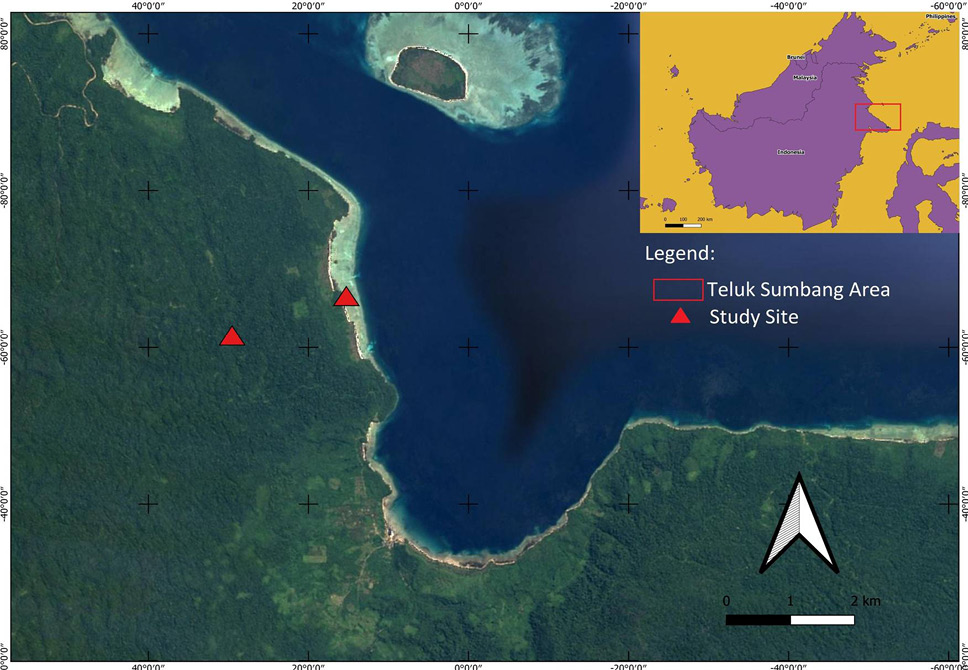
Study was conducted in the karst forests of Teluk Sumbang, Berau Regency, East Kalimantan (Fig. 1). The area is a small part of the Sangkulirang-Mangkalihat landscape protected by Governor Regulation of East Kalimantan No. 67/2012 with total area of 1.867.676 ha. Data collection was carried out in two distinct habitats: coastal and hill karst forests (200-300 above sea level). Coastal karst forests are typified by less abundant trees in comparison to hill karst. Vegetation is dominated by Cocos nucifera, Ficus spp., Sonneratia alba, and shrubs. Meanwhile, hill karst forests are mainly consisting of mix dipterocarp forests with dominant trees such as Shorea spp., Dryobalanops spp., Dipterocarpus spp., Ficus spp., and various pioneer trees like Macaranga spp., Acalypha caturus, and Trema tomentosa. Data were collected during August 2020.
Sampling
We used a point count method by following transect lines installed in each sampling location to record birds . According to this method, observers walked constantly along transect and stopped every distance of ± 200 m to record all sighted birds for 10-15 min. Each transect was 2 km in length. Transects situated in coastal karst forests were installed parallel to the shoreline. Meanwhile, for uphill karst forests, transects were placed vertically so that they cut contour lines. Birds were counted twice: morning (06.30-09.00) and evening (15.30-18.00). All time were in Central Indonesian Time setting (UTC + 08.00). We used MacKinnon et al. (2010), and Phillips and Phillips (2011) for bird identification.
Data analysis
Data were grouped into scientific name, family, and conservation status. The abundance of birds was counted according to formula from Bibby et al. (2000). We also calculated the Shannon Wienner diversity index (H’), the species richness index (R), and the evenness index (E). Similarity of birds between coastal and hill karst was analyzed using Sorensen formula. All analyses were run by using software PAST. 3.1 . A t-test was used to compare diversity, species richness, and dominance indices of birds between coastal and hill karst forests.
Results
Species composition
As many as 89 species of birds belonging to 41 families were identified (Table I). We found 33 species of birds in coastal karst forests and 67 species in hill karst forests. There was 11 species of birds found in the two habitats, which were Dicaeum trigonostigma, Chalcophaps indica, Chloropsis cyanopogon, Corvus enca, Haliastur indus, Lonchura fuscans, Orthotomus ruficeps, Pycnonotus goiavier, Eurylaimus ochromalus, Aerodramus fuciphagus, and Spilopelia chinensis.
Family Muscicapidae was dominant in hill karst forest which accounted for 8.96% bird species. Megalaimidae (7.46%) and Pycononotidae (7.46%) were the second and third most dominant bird species. Furthermore, Columbidae (9.38%) was the most abundant family of birds found in coastal karst forests. Other families with the same proportion (6.25%) were Alcedinicae, Anhingidae, Cuculidae, and Nectariniidae.
Community structure
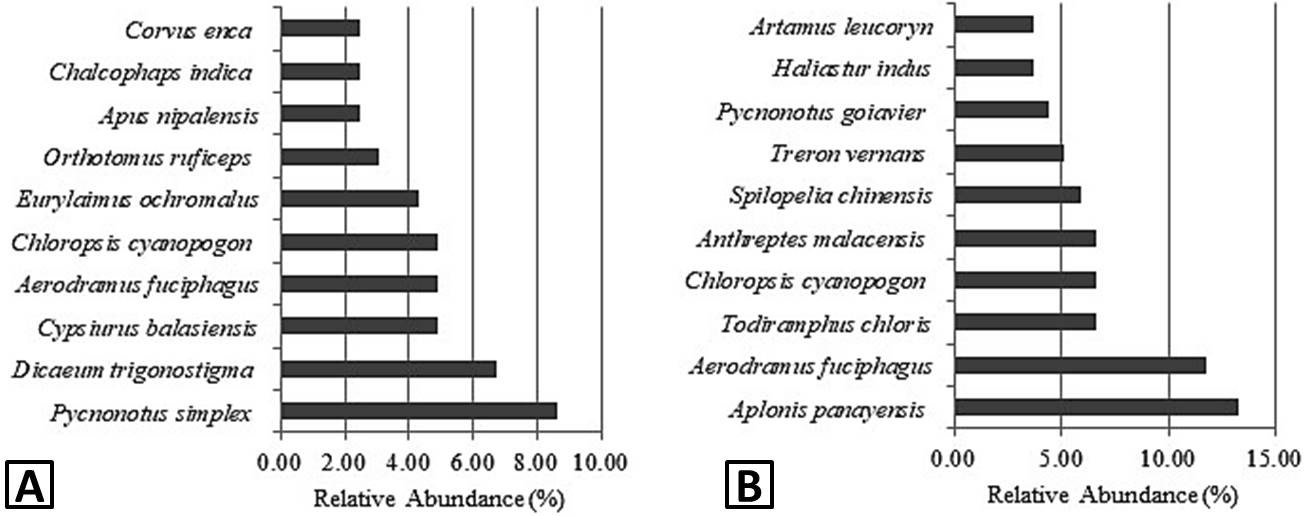
The relative abundance of bird species in the karst forests of Teluk Sumbang varied considerably (Fig. 2). We noted that Aplonis panayensis had the highest value of relative abundance (13.24%) in coastal karst forests, followed by Aerodramus fuciphagus (11.76%). Todiramphus chloris, Chloropsis cyanopogon, and Antrheptes malacensis had the same value of relative abundance, which was 6.62%. On the other hand, Pycnonotus simplex was the most abundant bird in the hill karst forests (8.59%). It was followed by Cypsiurus balasiensis (4.29%), Aerodramus fuciphagus (4.29%), Chloropsis cyanopogon (4.29%), and Eurylaimus ochromalus (4.29%).
Table I.- A list of birds in the karst forests of Teluk Sumbang.
| No | Family/ Scientific name | Common name | Site | Conservation status | |||
| Hill karst | Coastal karst | IUCN | P.LHK | CITES | |||
| Acanthizidae | |||||||
| 1 | Gerygone sulphurea | Golden-bellied gerygone | √ | LC |
|
| |
| Acciptridae | |||||||
| 2 | Nisaetus cirrhatus | Changeable hawk-eagle | √ | LC | √ | App II | |
| 3 | Haliastur indus | Brahminy kite | √ | √ | LC | √ | App II |
| 4 | Accipiter trivirgatus | Crested goshawk | √ | LC | √ | App II | |
| 5 | Aviceda jerdoni | Jerdon's baza | √ | LC | √ | App II | |
| Aegithinidae | |||||||
| 6 | Aegithina tiphia | Common Iora | √ | LC |
|
| |
| Alcedinidae | |||||||
| 7 | Ceyx erithaca | Black-backed dwarf-kingfisher | √ | LC |
|
| |
| 8 | Todiramphus chloris | Collared kingfisher | √ | LC |
|
| |
| 9 | Pelargopsis capensis | Stork-billed kingfisher | √ | LC |
|
| |
| Anhingidae | |||||||
| 10 | Anhinga melanogaster | Oriental darter | √ | NT | √ |
| |
| Apodidae | |||||||
| 11 | Cypsiurus balasiensis | Asian palm-swift | √ | LC |
|
| |
| 12 | Apus nipalensis | House swift | √ | LC |
|
| |
| 13 | Apus pacificus | Pacific swift | √ | LC |
|
| |
| 14 | Aerodramus fuciphagus | White-nest swiftlet | √ | √ | LC |
|
|
| Ardeidae | |||||||
| 15 | Ardea cinerea | Grey heron | √ | LC |
|
| |
| No | Family/ Scientific name | Common name | Site | Conservation status | |||
| Hill karst | Coastal karst | IUCN | P.LHK | CITES | |||
| Artamidae | |||||||
| 16 | Artamus leucoryn | White-breasted woodswallow | √ | LC |
|
| |
| Bucerotidae | |||||||
| 17 | Anthracoceros albirostris | Oriental pied-hornbill | √ | LC | √ | App II | |
| 18 | Anthracoceros malayanus | Black hornbill | √ | VU | √ | App II | |
| 19 | Buceros rhinoceros | Rhinoceros hornbill | √ | VU | √ | App II | |
| 20 | Rhyticeros undulatus | Wreathed hornbill | √ | VU | √ | App II | |
| Calyptomenidae | |||||||
| 21 | Calyptomena viridis | Green broadbill | √ | NT |
|
| |
| Chloropseidae | |||||||
| 22 | Chloropsis cyanopogon | Lesser green leafbird | √ | √ | NT | √ |
|
| 23 | Chloropsis sonnerati | Greater green leafbird | √ | EN | √ |
| |
| Ciconiidae | |||||||
| 24 | Leptoptilos javanicus | Lesser adjutant | √ | VU | √ | ||
| Cisticolidae | |||||||
| 25 | Orthotomus atrogularis | Dark-necked tailorbird | √ | LC |
|
| |
| 26 | Orthotomus ruficeps | Ashy tailorbird | √ | √ | LC |
|
|
| 27 | Prinia flaviventris | Yellow-bellied prinia | √ | LC |
|
| |
| Columbidae | |||||||
| 28 | Chalcophaps indica | Asian emerald dove | √ | √ | LC |
|
|
| 29 | Ducula aenea | Green imperial-pigeon | √ | LC |
|
| |
| 30 | Treron vernans | Pink-necked green-pigeon | √ | LC |
|
| |
| 31 | Spilopelia chinensis | Spotted dove | √ | √ | LC |
|
|
| Corvidae | |||||||
| 32 | Corvus enca | Slender-billed crow | √ | √ | LC |
|
|
| Cuculidae | |||||||
| 33 | Cacomantis sonneratii | Banded bay cuckoo | √ | LC |
|
| |
| 34 | Centropus bengalensis | Lesser coucal | √ | √ | LC |
|
|
| 35 | Centropus sinensis | Greater coucal | LC |
|
| ||
| 36 | Phaenicophaeus diardi | √ | NT |
|
| ||
| 37 | Zanclostomus javanicus | Red-billed malkoha | √ | LC |
|
| |
| 38 | Rhinortha chlorophaea | Raffles's malkoha | √ | LC |
|
| |
| Dicaeidae | |||||||
| 39 | Dicaeum trigonostigma | Orange-bellied flowerpecker | √ | √ | LC |
|
|
| Dicruridae | |||||||
| 40 | Dicrurus paradiseus | Greater racket-tailed drongo | √ | LC |
|
| |
| Eurylaimidae | |||||||
| 41 | Cymbirhynchus macrorhynchos | Black-and-red broadbill | √ | LC |
|
| |
| 42 | Eurylaimus ochromalus | Black-and-yellow broadbill | √ | √ | NT |
|
|
| No | Family/ Scientific name | Common name | Site | Conservation status | |||
| Hill karst | Coastal karst | IUCN | P.LHK | CITES | |||
| Estrildidae | |||||||
| 43 | Lonchura fuscans | Dusky munia | √ | √ | LC |
|
|
| 44 | Lonchura malacca | Tricolored munia | √ | LC |
|
| |
| Hirundinidae | |||||||
| 45 | Hirundo tahitica | Pacific swallow | √ | LC |
|
| |
| Laridae | |||||||
| 46 | Thalasseus bergii | Great crested tern | √ | LC |
|
| |
| Leiotrichidae | |||||||
| 47 | Alcippe brunneicauda | Brown fulvetta | √ | NT |
|
| |
| Megalaimidae | |||||||
| 48 | Psilopogon duvaucelii | Blue-eared barbet | √ | LC |
|
| |
| 49 | Psilopogon henricii | Yellow-crowned barbet | √ | NT | √ |
| |
| 50 | Psilopogon mystacophanos | Red-throated barbet | √ | NT | √ |
| |
| 51 | Psilopogon rafflesii | Red-crowned barbet | √ | NT | √ |
| |
| 52 | Psilopogon chrysopogon | Gold-whiskered barbet | √ | LC | √ |
| |
| Meropidae | |||||||
| 53 | Nyctyornis amictus | Red-bearded bee-eater | √ | LC |
|
| |
| 54 | Merops philippinus | Blue-tailed bee-eater | √ | LC |
|
| |
| Monarchidae | |||||||
| 55 | Terpsiphone paradisi | Indian paradise-flycatcher | √ | LC |
|
| |
| Muscicapidae | |||||||
| 56 | Kittacincla malabarica | White-rumped shama | √ | LC |
|
| |
| 57 | Copsychus saularis | Oriental magpie-robin | √ | LC |
|
| |
| 58 | Cyornis umbratilis | Gray-chested jungle-flycatcher | √ | NT |
|
| |
| 59 | Ficedula dumetoria | Rufous-chested flycatcher | √ | LC |
|
| |
| 60 | Cyanoptila cyanomelana | Blue-and-white flycatcher | √ | LC |
|
| |
| 61 | Enicurus ruficapillus | Chestnut-naped forktail | √ | NT |
|
| |
| Nectariniidae | |||||||
| 62 | Aethopyga siparaja | Crimson sunbird | √ | LC | √ |
| |
| 63 | Anthreptes malacensis | Brown-throated sunbird | √ | LC |
|
| |
| 64 | Arachnothera longirostra | Little spiderhunter | √ | LC |
|
| |
| Passeridae | |||||||
| 65 | Passer montanus | Eurasian tree sparrow | √ | LC |
|
| |
| Pellorneidae | |||||||
| 66 | Malacopteron affine | Sooty-capped babbler | √ | NT |
|
| |
| 67 | Malacocincla sepiaria | Horsfield's babbler | √ | LC |
|
| |
| Phasianidae | |||||||
| 68 | Argusianus argus | Great argus | √ | VU | √ | App II | |
| 69 | Rollulus rouloul | Crested partridge | √ | NT |
|
| |
| 70 | Lophura ignita | Crested fireback | √ | VU |
|
| |
| 71 | Synoicus chinensis | Blue-breasted quail | √ | LC |
|
| |
| No | Family/ Scientific name | Common name | Site | Conservation status | |||
| Hill karst | Coastal karst | IUCN | P.LHK | CITES | |||
| Picidae | |||||||
| 72 | Dryocopus javensis | White-bellied woodpecker | √ | LC |
| App I | |
| 73 | Meiglyptes tukki | Buff-necked woodpecker | √ | NT |
|
| |
| Pittidae | |||||||
| 74 | Erythropitta granatina | Garnett pitta | √ | NT | √ |
| |
| 75 | Pitta sordida | Hooded pitta | √ | LC | √ |
| |
| Psittaculidae | |||||||
| 76 | Loriculus galgulus | Blue-crowned hanging-parrot | √ | LC | √ | App II | |
| Pycnonotidae | |||||||
| 77 | Alophoixus finschii | Finsch's bulbul | √ | NT |
|
| |
| 78 | Brachypodius atriceps | Black-headed bulbul | √ | LC |
|
| |
| 79 | Pycnonotus goiavier | Yellow-vented bulbul | √ | √ | LC |
|
|
| 80 | Pycnonotus simplex | Cream-vented bulbul | √ | LC |
|
| |
| 81 | Pycnonotus plumosus | Olive-winged bulbul | √ | LC |
|
| |
| Rallidae | |||||||
| 82 | Rallina fasciata | Red-legged crake | √ | LC |
|
| |
| Rhipiduridae | |||||||
| 83 | Rhipidura javanica | Malaysian pied-fantail | √ | LC | √ |
| |
| Sturnidae | |||||||
| 84 | Aplonis panayensis | Asian glossy starling | √ | LC |
|
| |
| 85 | Gracula religiosa | Common hill myna | √ | LC | √ | App II | |
| 86 | Acridotheres javanicus | Javan myna | √ | VU |
|
| |
| Timaliidae | |||||||
| 87 | Pomatorhinus montanus | Chestnut-backed scimitar-babbler | √ | LC |
|
| |
| Trogonidae | |||||||
| 88 | Harpactes diardii | Diard's trogon | √ | NT | √ |
| |
| Turdidae | |||||||
| 89 | Geokichla interpres | Chestnut-capped thrush | √ | EN |
|
| |
P.LHK is a regulation which consists of lists of protected plants and animals based on P.LHK No.P.106/2018.
Table II.- Diversity, species richness, and evenness indices of birds on the study site.
| Index | Study site | t test | |
| Coastal karst | Hill karst | ||
| Shannon-Wiener diversity (H) | 2.47 ± 024 | 2.80 ± 0.39 | Significant |
| Species richness (R) | 3.91 ± 0.57 | 5.53 ± 1.51 | Not significant |
| Evenness (E) | 0.75 ± 0.14 | 0.79 ± 0.18 | Not significant |
The score of diversity, species richness, and evenness indices of hill karst forests was higher than that in coastal karst (Table II). A t-test revealed that there was a significant difference in diversity index between coastal and hill karst (T = 2.016, p = 0.039). Bird species between two types of habitats significantly differed, showed by the low similarity index value of 22.00%.
DISCUSSION
Birds observed in this study contribute to 13.30% of the total number of birds in Borneo (669 species) (Phillips and Phillips, 2011). This study complements Salas et al. (2005) who recorded 120 avian species in the southern Sangkulirang Peninsula. Nevertheless, some studies in karst forests of Borneo found lower bird species, such as in Padawan-Malaysia (80 species) , and Banggi-Malaysia (28 species) . The discrepancies are due to a wide variation of habitats, disturbance levels, size of sampling areas, and duration of observation. Teluk Sumbang is a small part of the Sangkulirang-Mangkalihat landscape covering an area of over 1 million ha. The number of bird species grows significantly if we broaden our coverage area of research.
Muscicapidae is the most dominant family of bird in hill karst. This is consistent with Mansor et al. (2011). Muscicapidae distributes in a wide range of habitats . In the Southeast Asia region, they occupy areas with low disturbances. Muscicapidae is an insectivorous bird. Their occurrence corresponds to thick litters, high humidity, and dense vegetation (Moradi et al., 2009; . Moreover, the family of Columbidae is the most abundant in coastal karst. Some of Columbidae occur in hill karst as well such as Chalcophaps indica and Spilopelia chinensis. As a frugivorous bird, they are benefitted by Ficus spp. growing from the coast to hill. Ficus spp. is key species yielding abundant fruits all year round, thereby attracting all frugivorous birds.
The bird family associated with wetlands can be seen in coastal karst, such as Alcedinidae, Anhingidae, Ardeidae, Ciconiidae, and Lariidae. Their presence follows tides in which they are foraging when the sea level falls. Shallow waters help water bird find food like fishes, crustaceans, aquatic insectivores, etc. ; . Teluk Sumbang is rich in fishes since it is situated within Indo-Pacific Coral Triangle . Coral reefs, which are a habitat for marine animals, are a high quality food source for birds. Its growth is enhanced by CaCo3 derived from karst. The fish abundance, aquatic ecosystems and birds are interwined, forming a complex food web .
The abundance of Pycnonotus simplex was the highest in hill karst. This species is widely distributed in Southeast Asia, particularly in Malaysia Peninsula, Sumatera, Java, and Borneo ; Phillips and Phillips, 2011). Pycnonotus simplex is a generalist bird tolerant to various habitat types like primary forests, secondary forests, and garden up to 1,300 above sea level . Furthermore, Aerodramus fuciphagus and Cypsiurus balasiensis are two typical birds of karst with the high abundance as well. Aerodramus fuciphagus is widespread over coast in comparison to the Asian palm swift which is only found in hill forests. Dolines, ponors, and caves in karst are ideal for swifts for breeding and nesting. Our findings are in line with Haryono et al. (2017) who reported that as of 61 caves located in the Sangkulirang-Mangkalihat landscape are nesting sites for swifts. Due to its economic value, swift’s nests are periodically harvested and sold by local community.
Aplonis panayensis is the most abundance bird species in coastal karst. The bird builds nest and forages on coconut trees and Ficus spp. grown along the coast. Naturally, Aplonis panayensis is an insect hunter bird visiting various fruit trees, but the abundance of Ficus spp. is sufficient enough to support the bird’s reproduction success. It is consistent with Shazali et al. (2016) who confirmed that 86% of Aplonis panayensis’s droppings in Kuching-Malaysia contained seeds of Ficus spp. Aplonis panayensis lives in group. Sometimes, each group is assembled, forming a flock. The bird has a wide distribution because of its ability to adapt in various habitat conditions: disturbed environments, cities, open areas, and secondary forests ; ; . Aplonis panayensis is native to Teluk Sumbang and other eastern parts of Borneo. However, in other locations, such as in Taiwan, the bird is considered as an exotic and invasive bird species .
The high abundance of Chloropsis cyanopogon both in hill karst and coastal karst forests is a good indicator. Besides, we also found Chloropsis sonnerati in hill karst, even though the bird’s abundance is lower than that of Chloropsis cyanopogon. We frequently noticed the two birds along edge forests containing fruiting trees, such as Acalypha caturus, Macaranga spp., and Trema tomentosa. Although Chloropsis spp. is protected, the bird is popular as pet in Indonesia. Its population declines dramatically due to illegal hunting. Chng et al. (2017) stated that Chloropsis spp. has been locally extinct in some parts of Borneo because of massive hunting. It is estimated that over 2000 individuals of birds are traded each year. Our observation indicated that Chloropsis spp. was also illegally poached in Teluk Sumbang. It was supported by a report concluding that Berau Regency is one of illegal hunting spots for Chloropsis spp. and other wildlife in East Kalimantan Province ; .
Diversity, richness, and evenness of bird species in hill karst forests are higher than that in coastal karst forests. However, only the diversity index is significantly different. It can be caused by a wide variation in physical conditions of hill karst forests, creating different microhabitats for birds. Dolines, ponors, and caves are predominantly found in hill karst. They are a suitable habitat for birds, especieally those which are sensitive to temperature change ; ; . In terms of vegetation, hill karst forests are diverse in vegetation composition and structure. For example Sitepu et al. (2020) recorded 89 species of plants in young and old secondary hill karst forests. The complexity of vegetation structure as well as species diversity is beneficial for birds in providing food and shelter. Costantini et al. (2016) mentioned that birds’ diversity and abundance in tropical forest of Borneo were associated with vegetation cover.
Furthermore, anthropogenic disturbances in hill karst forests are lower compared to the coastal karst forests. Some parts of hill karst experienced disturbances in the past such as illegal logging, but the impacts on vegetation are low. We found that the disturbed vegetation has regenerated, transforming into secondary forests which are characterized by Macaranga spp. and Duabanga moluccana. On the other hand, infrastructure development supporting tourism and settlements is concentrated around the coastal zone. Lack of vegetation on the coastal zone reduces habitat carrying capacity, affecting bird diversity. It is consistent with Putri et al. (2017) who concluded birds in Sulawesi’s karst showed negative responses towards habitat change in the form of number of individuals and species. In addition, birds with large body size are reduced.
Although there is a difference in habitat pressures between hill karst and coastal karst, both are connected and become an important habitat for avifauna. Acevedo and Aide (2008) argued that karst and wetland in spite of being patchy and surrounding by settlements and shrubs can still support resident and migrant birds. Doline, ponors, and caves have high conservation values for birds and other vertebrates . It is confirmed by a finding which recorded 24 threatened and protected bird species based on regulation in Indonesia. Some are sensitive birds so that they can be used as an indicator for habitat change in tropical forest, such as hornbill (Bucerotidae) and garnett (Pittidae). As of 4 out of 9 hornbills in Borneo are found in Teluk Sumbang. Pittidae, furthermore, which is the guild of terrestrial insectivorous birds, shows a considerably decline in its abundance once its habitat is disturbed ; ; .
Conclusion
There was a significant difference in bird communities between hill karst and coastal karst forests of Teluk Sumbang. The abundance and species richness of birs in hill karst forests were higher than that in coastal karst. Generally, dominant birds were those which had wide distribution and were adapted to various habitats, particularly secondary forests. Teluk Sumbang was essential home to threatened and protected birds. Therefore, Teluk Sumbang is crucial for conservation in the landscape scale. It is required efforts to conserve karst securing connectivity among habitat types from the coast to the hill.
Acknowledgements
We would like to thank and appreciate Warsidi, Jumri, Tutui, Bina Sitepu, Priyono, and Iman Suharja for their help during data collection. The authors also thank to Bpk. Ronald Lolang (Lamin Guntur) who has supported fieldwork in Teluk Sumbang. This research was funded by DIPA Balitek KSDA year of 2020.
Statement of conflict of interest
The authors declare no conflict of interest.
Figures
Map of the research area.
The top ten bird species with the highest relative abundance on Hill Karst Forests (A) and Coastal Karst Forests (B).
References
- Acevedo, M.A. and Aide, T.M., 2008. Bird community dynamics and habitat associations in karst, mangrove and pterocarpus forest fragments in an urban zone in Puerto Rico. Caribb. J. Sci., 44: 402-416. https://doi.org/10.18475/cjos.v44i3.a15[CrossRef]
- Battistia, C., Giardinic, M., Marini, F., Di Roccob, L., Dodarod, G. and Vignolie, L., 2017. Diversity metrics, species turnovers and nestedness of bird assemblages in a deep karst sinkhole. Isr. J. Ecol. Evol., 63: 1-9. https://doi.org/10.1163/22244662-06301009[CrossRef]
- Bátori, Z., Csiky, J., Farkas, T., Vojtkó, A.E., Erdős, L., Kovács, D., Wirth, T., Körmöczi, L. and Vojtkó, A., 2014. The conservation value of karst dolines for vascular plants in woodland habitats of Hungary: refugia and climate change. Int. J. Speleol., 43: 15-26. https://doi.org/10.5038/1827-806X.43.1.2[CrossRef]
- Bibby, C., Burgess, N.D., Hill, D.A. and Mustoe, S.H., 2000. Bird cencus technique. Academic Press, London.
- Burton, N.H.K., Musgrove, A.J. and Rehfisch, M.M., 2004. Tidal variation in numbers of waterbirds: how frequently should birds be counted to detect change and do low tide counts provide a realistic average? Bird Stud., 51: 48-57. https://doi.org/10.1080/00063650409461332[CrossRef]
- Caves, E.M., Jennings, S.B., Lambers, J.H. and Tewksbury, J.J., 2013. Natural experiment demonstrates that bird loss leads to cessation of dispersal of native seeds from intact to degraded forests. PLoS One, 8: e65618. https://doi.org/10.1371/journal.pone.0065618[CrossRef]
- Chng, S.C.L., Eaton, J.A. and Miller, A.E., 2017. Greater green leafbirds: The trade in South-East Asia with a focus in Indonesia. Traff. Bull., 29: 4-8
- Clements, R., Sodhi, N.S., Schilthuizen, M. and Ng, P.K.L., 2006. Limestone karsts of Southeast Asia: Imperiled arks of biodiversity. Bioscience, 56: 733-742. https://doi.org/10.1641/0006-3568(2006)56[733:LKOSAI]2.0.CO;2[CrossRef]
- Costantini, D., Edwards, D.P. and Simons, M.J.P., 2016. Life after logging in tropical forests of Borneo: A meta-analysis. Biol. Conserv., 196: 182-188. https://doi.org/10.1016/j.biocon.2016.02.020[CrossRef]
- Hamer, K.C., Newton, R.J., Edwards, F.A., Benedick, S., Bottrell, S.H. and Edwards, D.P., 2015. Impacts of selective logging on insectivorous birds in Borneo: The importance of trophic position, body size and foraging height. Biol. Conserv., 188: 82-88. https://doi.org/10.1016/j.biocon.2014.09.026[CrossRef]
- Hammer, Ø., Harper, D. and Ryan, P., 2001. PAST: Paleontological statistics software package for education and data analysis. Palaeontol. Electr., 4: 1-9.
- Haryono, E., Reinhart, H., Effendi, S., Irianto, P.A., Fathoni, W.A., Ardi, T.E., Putera, A., Setiawan, T., Dayatullah, M., Rinding, Y.S. and. Sulistiono, A., 2017. Cave exploration in Sangkulirang-Mangkalihat Peninsula, East Kalimantan-Indonesia. In: 17th International Congress of Speleology (K. Moore and S. White). Union Internationale de Speleologie, Sydney, Asutralia.
- Kusumoto, B., Costello, M.J., Kubota, Y., Shino, T., Wei, C.L., Yasuhara, M. and Chao, A., 2019. Global distribution of coral diversity: Biodiversity knowledge gradients related to spatial resolution. Ecol. Res., 2020: 1-12.
- Lambert, F.R. and Collar, N.J., 2002. The future for Sundaic lowland forest birds: Longterm effects of commercial logging and fragmentation. Forktail, 18: 127–146.
- Liu, B., Zhang, M., Bussmann, W.R., Liu, H.M, Liu, Y.Y., Peng, Y.D., Zu, K.L., Zhao, Y.M., Liu, Z.B. and Yu, S.X., 2018. Species richness and conservation gap analysis of karst areas: A case study of vascular plants from Guizhou, China. Glob. Ecol. Conserv., 16: e00460. https://doi.org/10.1016/j.gecco.2018.e00460[CrossRef]
- MacKinnon, K., Phillips, K. and Balen, B.V., 2010. Birds in Sumatra, Java, Bali, and Kalimantan. Burung Indonesia, Bogor.
- Mansor, M.S., Sah, S.A.M., Koon, L.C. and Rahman, M.A., 2011. Bird species diversity in the Padawan Limestone Area, Sarawak. Trop. Life Sci. Res., 22: 65–80.
- Moradi, H., Zakaria, M., Mohammad, A.B. and Yusof, E., 2010. Insectivorous bird and environmental across and edge-interior gradient in tropical rainforest of Malaysia. Int. J. Zool. Res., 6: 131-145. https://doi.org/10.3923/ijzr.2010.131.145[CrossRef]
- Mukhlisi, Atmoko, T. and Rifqi, M.A., 2020. Greenleaf, songbird that less sing in the nature. In: Indonesian rare animals and understand its conservation efforts (eds. T. Atmoko and H Gunawan). IPB Press, Bogor.
- Phillipps, Q. and Phillipps, K., 2011. Birds of Borneo Sabah, Sarawak, Brunei and Kalimantan. John Beaufoy Publishing, Oxford.
- Putri, I.A.S.L.P., Broto, B.W. and Ansari, F., 2017. Bird responses to habitat change in the karst area of Bantimurung Bulusaraung National Park. J.P.K. Wallacea, 6: 101-112. https://doi.org/10.18330/jwallacea.2017.vol6iss2pp101-112[CrossRef]
- Rahman, M.A. and Abdullah, T., 2002. Notes on birds and mammals in a limestone forest of Banggi Island, Sabah, Malaysia. Malayan Nat. J., 56: 145-152.
- Salas, L.A., Bedos, A., Deharveng, L. Fryer, S., Hadiaty, R., Heryanto., Munandar., Nardiyono., Noerdjito, M., Noerdjito, W., Rahmadi, C., Riyanto, A., Rofik, Ruskamdi, A., Struebig, M.J. Suhardjono, Y., Suyanto, A., Vermeulen, J.J., Walck, C., Wiriadinata, H., Meijaard, E. and Stanley, S., 2005. Biodiversity, endemism and the conservation of limestone Karsts in the Sangkulirang Peninsula, Borneo. Biodivers. J., 6: 15-23. https://doi.org/10.1080/14888386.2005.9712762[CrossRef]
- Sangster, G., Alstrom, P., Forsmark, E. and Olsson, U., 2010. Multi-locus phylogenetic analysis of OldWorld chats and flycatchers reveals extensive paraphyly at family, subfamily and genus level (Aves: Muscicapidae). Mol. Phylogen. Evol., 57: 380-392. https://doi.org/10.1016/j.ympev.2010.07.008[CrossRef]
- Satyanti, A. and Kusuma, Y.W.C., 2010. Ecological study in two quarried limestone karst hills in Bogor West Java: Vegetation structure and floristic composition. Biotropia, 17: 115-129. https://doi.org/10.11598/btb.2010.17.2.81[CrossRef]
- Shazali, N., Azlan, J.M. and Tuen, A.L., 2016. Bird diets in urban environments: The case of the Asian Glossy Starling, Aplonis panayensis. In; Naturalists, explorers and field scientists in South-East Asia and Australasia (eds. I. Das and A.L. Tuen). Springer International Publishing, Switzerland. https://doi.org/10.1007/978-3-319-26161-4_11[CrossRef]
- Shieh, B.S., Lin, C.J. and Liang, S.H., 2016. Breeding biology of the invasive Asian Glossy Starling (Aplonis panayensis) in urban parks of Kaohsiung City, Southern Taiwan. Taiwan J. For. Sci., 31: 63-70.
- Sitepu, B.S., Mukhlisi, Muslim, T., Priyono and Warsidi, 2020. Report of biodiversity assessment in the karst forest of Teluk Sumbang, Biduk-Biduk, Berau. Balitek KSDA, Samboja.
- Sountag, W.A. and Louette, M., 2007. The potential of particular starlings (Sturnidae) as indicators of habitat change. J. Ornithol., 148: 261–267. https://doi.org/10.1007/s10336-007-0163-z[CrossRef]
- Suwasono, R.A., Matius, P. and Sutedjo, 2018. Diversity of tree vegetation on different slopes in Sangkulirang – Mangkalihat exokarst area. IOP Conf. Ser. Earth environ. Sci., 144: 012059. https://doi.org/10.1088/1755-1315/144/1/012059[CrossRef]
- Thorburn, C., 2014. The edible bird’s nets booming in Indonesia and South-east Asia. Fd. Cult. Soc., 17: 535-553. https://doi.org/10.2752/175174414X14006746101439[CrossRef]
- Tolentino, P.J.S., Ryan, J.H., Navidad, L., Angeles, M.D., Antonette, D., Fernandez, P., Villanueva, E.L.C., Obeña, R.D.R. and Buot, I.E., 2020. Biodiversity of forests over limestone in Southeast Asia with emphasis on the Philippines. Biodiversitas, 21: 1597-1613. https://doi.org/10.13057/biodiv/d210441[CrossRef]
- Vilchis, L.I., Johnson, C.K., Evenson, J.R., Pearson, S.F., Barry, K.L., Davidson, D., Raphael, M.G. and Gaydos, J.K., 2014. Assessing ecological correlates of marine bird declines to inform marine conservation. Conserv. Biol., 29: 154-163. https://doi.org/10.1111/cobi.12378[CrossRef]
- Wielstra, B., Boorsma, T., Pieterse, S.M. and De Iongh, H.H., 2011. The use of avian feeding guilds to detect small-scale forest disturbance: A case study in East Kalimantan, Borneo. Kukila, 27: 55-62.
- Zakaria, M. and Rajpar, M.N., 2013. Density and diversity of water birds and terrestrial birds in man-made marsh, Malaysia. Sains Malays., 42: 1483-1492.
- Zhou, L., Wang, X., Wang, Z., Zhang, X., Chen, C. and Liu, H., 2020. The challenge of soil loss control and vegetation restoration in thekarst area of Southwestern China. Int. Soil Water Conserv. Res., 8: 26-34. https://doi.org/10.1016/j.iswcr.2019.12.001[CrossRef]
Services
Article usage statistics
Loading…