
The present study is to explore the effect of fasudil hydrochloride and H2 on the post-thaw viability of cryopreserved porcine adipose-derived stem cells. Four different combinations of cryoprotectants with and without hydrogen gas (H) (purified H2 was dissolved into normal cryopreservation solution for 2 hrs under 0.6 MPa were tested including the following groups: control (CK), 100µm GSH, 10µm fasudil hydrochloride (FH) and a combination of the two (GSH + FH). A solution of 10% (v/v) Me2SO + 20% FBS was used as the standard cryopreservation solution. After 2 months, MTT assay showed significant differences in the proportion of adherent viable cells in the FH group and GSH group compared with the control group (p < 0.05), and the FH+H group had a more beneficial effect on post-thaw survival of cryopreserved ADSCs compared with the GSH+H and GSH+FH+H groups. The use of FH and H in long-term storage has the potential to be helpful in commercial and clinical application of ADSCs.
Research Article · Volume 49, Issue 4, 12 June 2017 · Open Access
Effect of Fasudil Hydrochloride and H2 on the Post-Thaw Viability of Cryopreserved Porcine Adipose-Derived Stem Cells
· · · ·
Affiliations & Notes ⌄
- 1School of Life Science, FuYang Teachers College, Fuyang, Anhui 236041, China , * Corresponding author: qucq518@163.com ,
Article Info ⌄
- Journal:
- Pakistan Journal of Zoology
- Published:
- 12 June 2017

From the article
- In the present study, we found that the hydrogen-rich cryopreservation solution enhanced the post-thaw viability of cryopreserved ADSCs and reduced the number of apoptotic cells present after thawing.
- However, the effect on post-thaw apoptosis was not significantly different between GSH, FH and GSG + FH.
- Next, we will study the effects of hydrogen and GSH on ex-vivo cell culture and cryopreservation of sperm in order to provide a theoretical basis for application in medical practice.
Selected from the article's own text.
Abstract
INTRODUCTION
Adipose-derived stem cells (ADSCs) have generated a lot of interest in regenerative medicine. They have been reported to harbor significant differentiation capability and are relatively abundant as compared with bone marrow harvest . One major obstacle to the manufacturing of clinical grade stem cells is the need for good manufacturing practices for cryopreservation, storage and distribution of these cells. Developing effective techniques for the cryopreservation of ADSCs is an important step in the long-term storage of stem cells. ROS produced by mitochondria are known to be involved in cell death. Previous research has also shown that cooling and re-warming of cells results in increased generation of reactive-oxygen species (ROS) in the mitochondria and reduces the activity of ROS scavengers at low temperatures, resulting in the activation of caspases and downstream apoptosis .
Gauthaman et al. (2010) reported that the ROCK inhibitor Y-27632 inhibits apoptosis and increases proliferation of human Wharton ‘s Jelly stem cells that had undergone freezing and thawing. Rungsiwiwut et al. (2013) reported that Y-27632 enhances the post-thaw viability and physiological function of cryopreserved human embryonic stem cells (hESC) and MSCs. We found that fasudil hydrochloride, which is also a ROCK inhibitor, has a stronger effect on the viability of cryopreserved pADSC than Y27632. In addition, no changes were observed in the normal morphological state of adherent pADSCs maintained with FH ; .
GSH and hydrogen gas are potent antioxidants. Kim found that adding GSH to a cryoprotective solution and/or postthaw medium significantly improved the post-thaw viability of mouse embryonic stem cells . Hydrogen gas neutralizes free radicals and reduces oxidative stress. Ohsawa et al. (2008) discovered that hydrogen gas has the ability to protect the brain against ischemia reperfusion (I/R) injury by selectively eliminating toxic oxygen radicals. To date, many experiments have been carried out to confirm that properties associated with hydrogen including effects its antioxidant, antiapoptotic, anti-inflammatory, anti-allergy, and anti-cancer effects apply to the maintenance of ADSCs .
Hence, in this study we determined whether FH and H2 can also exert a cryoprotective effect on the post-thaw viability of cryopreserved pADSCs.
MATERIALS AND METHODS
Porcine ADSC separation and culture
Porcine adipose tissue was obtained, digested, filtered and centrifuged as described previously . ADSCs were trypsinized and passaged at a 1:3 split ratio. In this study, all experimental procedures were performed on cells in the 4th passage.
Cryopreservation solutions
Four different combinations of cryoprotectants with and without hydrogen gas (H2) were tested. In solutions containing H2, purified H2 was dissolved into normal cryopreservation solution for 2 h under 0.6 MPa. Groups included: control group (CK), GSH group, fasudil hydrochloride (FH) group, and a combination of GSH and FH (GSH+FH) group (Table I). A solution of 10% (v/v) Me2SO + 20% fetal bovine serum (FBS) was used as the standard cryopreservation solution. For all groups, aliquots of 1×10⁶ cells were transferred into 1 mL cryovials containing cryoprotectant solution.
Table I.- Preparation of cryoprotectant solutions.
| Solution | Me2SO (%v/v) | FBS (%v/v) | FH (µM) | GSH (µM) |
| CK | 10 | 20 | 0 | 0 |
| GSH | 10 | 20 | 0 | 100 |
| FH | 10 | 20 | 10 | 0 |
| GSH + FH | 10 | 20 | 10 | 100 |
Cryopreservation and thawing of ADSCs
Cultured ADSCs were cryopreserved and thawed as described previously . Briefly, isolated ADSCs were seeded in 24-well cell culture dishes with 5.0×10⁵ cells per well. Five days later, confluent cells were dissociated using 0.05% (w/v) trypsin. A few wells containing intact confluent ADSCs monolayers were retained as controls. Dissociated ADSCs from each well were centrifuged and resuspended in 1 ml cryopreservation solution supplemented with Y-27632, GSH, or both Y-27632 and GSH. This was performed within cryovials, after which cells were subjected to slow cooling within a -80°C freezer using isopropanol freezing containers (Fisher Scientific, Cat. No.15-350-50). After 2 h, the cell suspensions were frozen and the cryovials were immersed and stored in the vapor phase of liquid nitrogen for 2 h before being thawed within a water bath at 37°C for 1 min. Cryopreserved cells were stored in liquid nitrogen for just 2 h, instead of 24 h or several days to allow us to calculate the post-thaw survivability of ADSCs; the MTT assay utilized control wells that were seeded at the same cell density as the references. If the cryopreserved ADSCs were kept in liquid nitrogen for 24 h or longer the cells within the reference control wells would undergo cell division, whereas the cryopreserved ADSCs would not. Once thawed the ADSCs were transferred into sterile 10 mL centrifuge tubes and diluted with 6 mL DMEM/F12, centrifuged (300 g) for 5 min, and resuspended in 1 mL DMEM/F12 culture medium. Resuspended cells were plated at 1 × 10⁴ cells/well in 96-well plates and maintained in growth medium (DMEM/F12+10% FBS) at 37°C and 5% CO2. Growth media was supplemented with GSH, FH or FH+GSH in concurrence with the particular cryoprotectant the cells were frozen in.
Imaging and cell viability assays
Reseeded ADSCs were allowed to grow for 24 h or 48 h before being photographed. After imaging the ADSCs were subjected to the MTT [3-(4,5-dimethylthiazole -2-yl)-2,5-diphenyl tetrazolium bromide] assay as described previously . Briefly, MTT (Bio Basic Inc.) was added to each well to a final concentration of 0.5 mg/ml after which the cells were incubated at 37°C for 3.5 h. Formazan crystals that formed in the cells were solubilized with 100 µl dimethyl sulphoxide (DMSO) per well and the absorbance was read at 490 nm using a micro-plate spectrophotometer (Multiskan Go, Thermo Scientific, USA). Cell survival was expressed as the percentage of formazan absorbance. Results were expressed as mean values ± standard deviation (SD) from at least three different experiments performed in triplicate.
Statistical analysis
All experiments were performed a minimum of three times, and values are represented as the mean±standard deviation (SD). Statistical differences were determined by analysis of variance, followed by Dunnett ‘s test for pair-wise comparison (Graphpad Prism software version 5.0). A p-value < 0.05 was considered statistically significant.
RESULTS
Phenotypic characterization of cultured ADSCs
Isolated ADSCs plated in growth medium readily adhered to the plastic surfaces of culture flasks, initially exhibiting a heterogeneous population of spindle-shaped cells. After thawing, ADSCs were cultured in 1 mL growth medium at 37°C and 5% CO2 for 24 h and then imaged (Fig. 1).
Effects of GSH, FH and GSH + FH on the viability of cryopreserved ADSCs
MTT assay results identified significant differences in the post-thawing viability of cryopreserved ADSCs in all the three experimental groups, as compared to the controls (Fig. 3).
Effects of hydrogen gas on the viability of cryopreserved ADSCs
Detection of post-thawing apoptosis rate by annexinV/PI flow cytometry analysis
Normal viable cells are resistant to PI staining, whereas apoptotic cells are readily stained by PI. Chromosomal DNA can be stained by PI only when the cell membrane is damaged. Thus, in a dot plot of flow cytometry (Fig. 5), late-stage apoptotic cells are double positive for annexin V and PI (Annexin V+PI+) and distributed in the right upper quadrant (RU), normal viable cells are double negative for Annexin V and PI (Annexin V-PI-) and distributed in the left lower quadrant (LL), and early-stage apoptotic cells are Annexin V-positive and PI-negative (Annexin V+PI-), and are distributed in the right lower quadrant. As shown in Figure 5, cells treated with FH, GSH, and FH + GSH showed lower apoptotic rates compared with the control cells.
DISCUSSION
In the field of stem cell cryopreservation, basic techniques require the proper storage and shipping of cells for their application. Therefore, new methods for cryopreservation for the long-term storage of stem cells are required. Whilst effective methods for cryopreservation and storage have been developed for haematopoietic and bone marrow stem cells , no efficient cryopreservation protocols for ADSCs are available. In the current paper we present an evaluation of the effects of FH and hydrogen gas on the cryopreservation of ADSCs.
In recent years, oxidative stress has been assumed to play an important role in sperm and cell damage during cryopreservation . the cooling and re-warming of cells results in increased generation of elevated reactive-oxidative species (ROS) in the mitochondria and decreased antioxidants at low temperatures, resulting in the activation of caspases and downstream apoptosis ; . It is known that high ROS levels can damage proteins, lipids, and DNA, and thus could be responsible for reduced viability in cryopreserved cells. Previous research has also shown that GSH, a potent ROS scavenger, is the most abundant thiol in cells and is considered of vital importance for the maintenance of the intracellular redox balance . We found that GSH increased the viability of ADSCs.
Hydrogen gas is another potent antioxidant which neutralizes free radicals and reduces oxidative stress. Many initial and subsequent clinical studies have demonstrated that hydrogen can act as an important physiological regulatory factor in cells and organs in terms of antioxidant, anti-inflammatory, anti-apoptotic and other protective effects. The most accepted mechanism through which hydrogen could have such protective capacities is by the elective and direct scavenging of cytotoxic oxygen radicals, particularly the hydroxyl radical, which is the most cytotoxic of reactive oxygen species (ROS). In addition, hydrogen does not react with other ROS, including O2- and H2O2, which both possess important physiological roles as signaling molecules that are involved in numerous signal transduction cascades and also regulate biological processes such as apoptosis, cell proliferation and differentiation . In this study, we found that hydrogen gas can exert a cryoprotective effect on the post-thaw viability of cryopreserved pADSCs.
CONCLUSIONS
In the present study, we found that the hydrogen-rich cryopreservation solution enhanced the post-thaw viability of cryopreserved ADSCs and reduced the number of apoptotic cells present after thawing. Moreover, a combination of GSH and FH showed a better cryoprotective effect on post-thaw viability than either single agent. However, the effect on post-thaw apoptosis was not significantly different between GSH, FH and GSG + FH. Next, we will study the effects of hydrogen and GSH on ex-vivo cell culture and cryopreservation of sperm in order to provide a theoretical basis for application in medical practice.
ACKNOWLEDGEMENTS
This work was supported in part by grants from the National Youth Science Foundation of China (No.31201788), the National Natural Science Foundation of China (No.31172182) and Innovation team project of Anhui Scientific research platform (2015) and National Undergraduate Training Programs for Innovation and Entrepreneurship (201510371064, 201510371067, 201510371019, 201510371020).
Statement of conflict of interest
Authors have declared no conflict of interest.
Figures
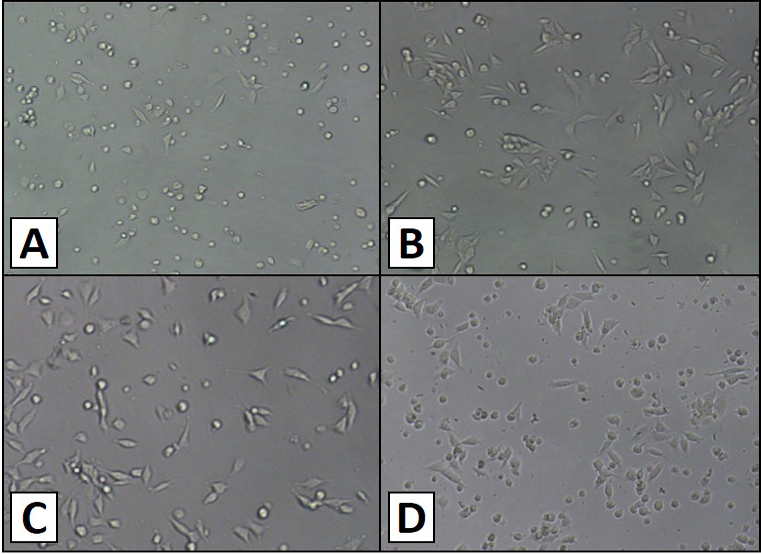
Morphological characteristics of ADSCs cultured for 24 h after thawing. A, control group (CK); B, GSH group (100×); C, FH group (100×); D, GSH + FH group (200×).
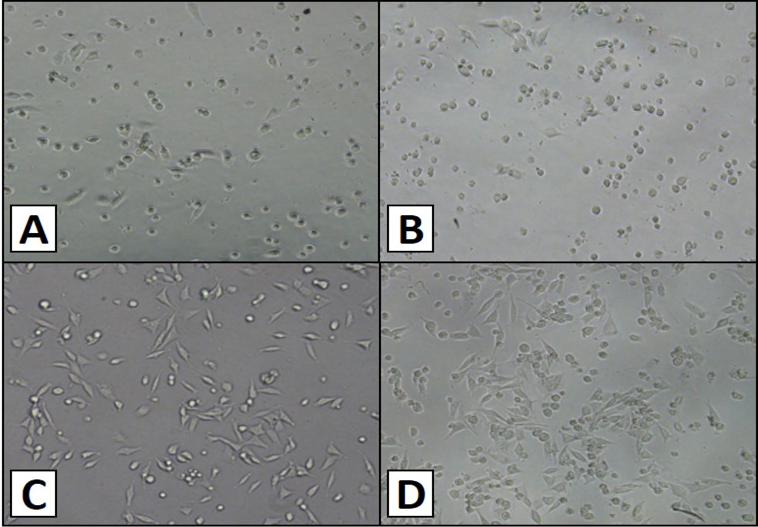
Morphological characteristics of ADSCs cultured for 24 h after thawing in which the cryopreservation solution contained H2. A, control group; B, GSH group (100×); C, FH group (100×); D, GSH + FH group (200×).
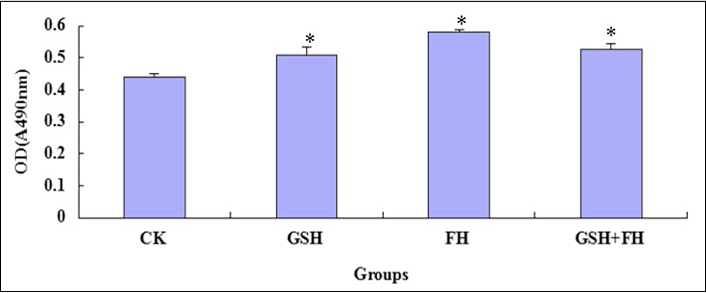
Values of MTT of post-thawed ADSCs treated with GSH and FH. Data are shown as mean values ± SD (n=3). *p<0.05 compared with the control. Control (CK), GSH (100 µM GSH group), FH (10 µM FH group) and GSH + FH (100 µM GSH+10 μM FH group).
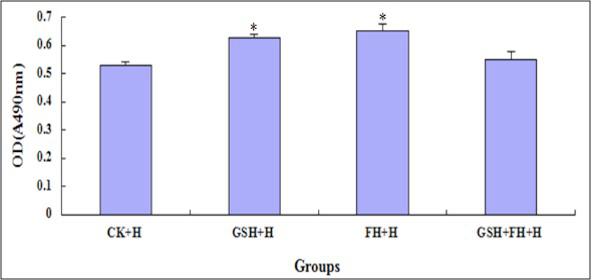
Values of MTT of post-thawed ADSCs treated with GSH, FH and Hydrogen gas. Data are shown as mean values ± SD (n=3). *p<0.05 compared with the control. Control (CK), GSH (100 µM GSH group), FH (10µM FH group) and GSH+FH (100 µM GSH+10μM FH group).
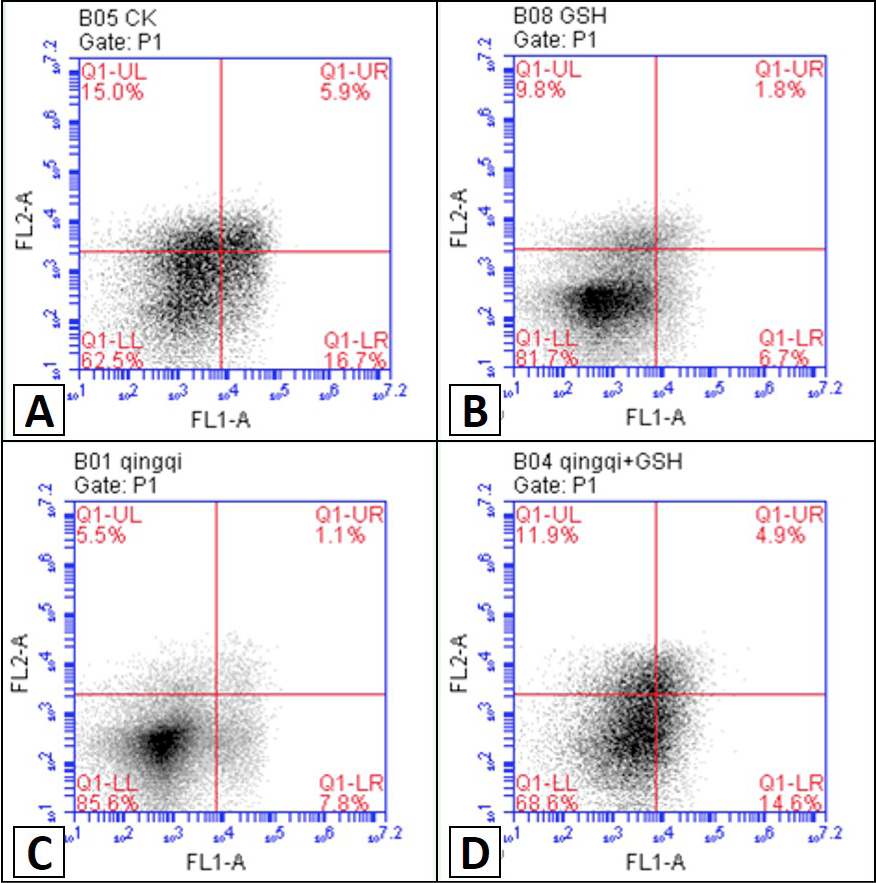
Analysis of apoptosis in post-thaw cells by flow cytometry. A, conventional cryopreservation solution (control); B, cryopreservation solution containing GSH; C, cryopreservation solution containing FH; D, cryopreservation solution containing GSH and FH.
References
- Ansari, M.S., Rakha, B.A., Andrabi, S.M.H., Ullah, N. and Akhter, S., 2010. Cryopreservation of Sahiwal bull epididymal spermatozoa. Pakistan J. Zool., 42: 741-743.
- BüyükleblebiCi, O., BüyükleblebiCi, S., Tuncer, P.B., Özgürtaş, T. and TaşDemiR, U., 2015. Effect of α-lipoic acid supplementation to extender on quality of frozen-thawed bull semen. Kafkas Üniv. Vet. Fak. Dergisi, 21: 307-311.
- De Ugarte, D.A., Morizono, K., Elbarbary, A., Alfonso, Z., Zuk, P.A., Zhu, M., Dragoo, J.L., Ashjian, P., Thomas, B., Benhaim, P., Chen, I., Fraser, J. and Hedrick, M.H., 2003. Comparison of multi-lineage cells from human adipose tissue and bone marrow. Cells Tissues Organs, 174: 101-109. https://doi.org/10.1159/000071150[CrossRef]
- Fu, W., Liu, Z., Feng, B., Hu, R., He, X. and Wang, H., 2014. Electrospun gelatin/pcl and collagen/plcl scaffolds for vascular tissue engineering. Int. J. Nanomed., 9: 2335-2344. https://doi.org/10.2147/IJN.S61375[CrossRef]
- Gauthaman, K., Fong, C.Y., Subramanian, A., Biswas, A. and Bongso, A., 2010. ROCK inhibitor Y-27632 increases thaw-survival rates and preserves stemness and differentiation potential of human Wharton ‘s jelly stem cells after cryopreservation. Stem Cell Rev. Rep., 6: 665-676. https://doi.org/10.1007/s12015-010-9184-8[CrossRef]
- Heng, B.C., 2009. Effect of rho-associated kinase (rock) inhibitor y-27632 on the post-thaw viability of cryopreserved human bone marrow-derived mesenchymal stem cells. Tissue Cell, 41: 376–380. https://doi.org/10.1016/j.tice.2009.01.004[CrossRef]
- Hosoyama, T., Ishiguro, N., Yamanouchi, K. and Nishihara, M., 2009. Degenerative muscle fiber accelerates adipogenesis of intramuscular cells via rhoa signaling pathway. Differentiation, 77: 350-359. https://doi.org/10.1016/j.diff.2008.11.001[CrossRef]
- Ji, Y., Chen, D., Jiang, S. and Qu, C., 2014. Effect of fasudil hydrochloride on the post-thaw viability of cryopreserved porcine adipose-derived stem. Cryo Lett., 35: 356-360.
- Kim, G.A., Lee, S.T., Ji, Y.A., Park, J.H. and Lim, J.M., 2010. Improved viability of freeze-thawed embryonic stem cells after exposure to glutathione. Fertil. Steril., 94: 2409-2412. https://doi.org/10.1016/j.fertnstert.2010.01.073[CrossRef]
- Liu, Z., Masuko, S., Solakyildirim, K., Pu, D., Linhardt, R.J. and Zhang, F., 2010. Glycosaminoglycans of the porcine central nervous system. Biochemistry, 49: 9839-9847. https://doi.org/10.1021/bi101305b[CrossRef]
- Noguchi, M., Hosoda, K., Fujikura, J., Fujimoto, M., Iwakura, H. and Tomita, T., 2007. Genetic and pharmacological inhibition of rho-associated kinase ii enhances adipogenesis. J. boil. Chem., 282: 29574-29583.
- Ohsawa, I., Nishimaki, K., Yamagata, K., Ishikawa, M. and Ohta, S., 2008. Consumption of hydrogen water prevents atherosclerosis in apolipoprotein e knockout mice. Biochem. biophys. Res. Commun., 377: 1195-1198. https://doi.org/10.1016/j.bbrc.2008.10.156[CrossRef]
- Ohsawa, I., Terasaki, Y. and Murakami, Y., 2013. Molecular hydrogen as a radioprotector: possible mechanisms of hydrogen antioxidant activity. J. Physiol. Sci., 63: S78.
- Peng, W., Lin, Z., Wang, L. and Wu, J., 2015. Effect of weakly alkaline salt pretreatment on bio-boards for medicine safety. J. Pure Appl. Microbiol., 9: 1913-1918.
- Qu, C.Q., Li, D.W., Jiangyang, J.H. and Ji, Y.T., 2014. Effect of glutathione and Y27632 on the viability of cryopreserved porcine adipose-derived stem cells. Cryo Lett., 35: 308-311.
- Rungsiwiwut, R., Manolertthewan, C., Numchaisrika, P., Ahnonkitpanit, V., Virutamasen, P. and Techakumphu, M., 2013. The rock inhibitor y-26732 enhances the survival and proliferation of human embryonic stem cell-derived neural progenitor cells upon dissociation. Cells Tissues Organs, 198: 127-138. https://doi.org/10.1159/000354031[CrossRef]
- Tapp, H., Hanley, E.N., Patt, J.C. and He, G., 2009. Adipose-derived stem cells: characterization and current application in orthopaedic tissue repair. Exp. Biol. Med., 234: 1-9. https://doi.org/10.3181/0805-MR-170[CrossRef]
- Thuwanut, P., Chatdarong, K., Techakumphu, M. and Axnér, E., 2008. The effect of antioxidants on motility, viability, acrosome integrity and DNA integrity of frozen-thawed epididymal cat spermatozoa. Theriogenology, 70: 233-240. https://doi.org/10.1016/j.theriogenology.2008.04.005[CrossRef]
- Xia, X., Cowley, S., Flaim, C.J., Seymour, L. and Cui, Z., 2010. The roles of apoptotic pathways in the low recovery rate after cryopreservation of dissociated human embryonic stem cells. Biotechnol. Prog., 26: 827–837. https://doi.org/10.1002/btpr.368[CrossRef]
- Zhao, M., Liu, M.D., Pu, Y.Y., Wang, D., Xie, Y., Xue, G.C. and Cao, L., 2016. Hydrogen-rich water improves neurological functional recovery in experimental autoimmune encephalomyelitis mice. J. Neuroimmunol., 294: 6-13. https://doi.org/10.1016/j.jneuroim.2016.03.006[CrossRef]
Services
Article usage statistics
Loading…