
Cryopreservation of ram semen is crucial for genetic improvement programs, but the process induces oxidative stress, compromising sperm quality. This is a significant challenge for conserving valuable indigenous breeds like the Kail sheep of Azad Jammu & Kashmir (AJ&K). This study aimed to evaluate the cryoprotective effects of green tea extract (GTE), a potent antioxidant, in an egg yolk-based extender for Kail ram semen. Pooled semen ejaculates from five Kail rams were diluted and cryopreserved in extenders supplemented with four different concentrations of GTE: 0% (control), 1%, 1.5%, and 2%. Post-thaw semen quality was assessed for motility and kinematic parameters using a Computer-Assisted Sperm Analyzer (CASA), alongside viability, plasma membrane integrity, and acrosome integrity. The results demonstrated that supplementation with 2% GTE yielded the highest post-thaw quality, showing significantly improved total motility (68±5.2%) and progressive motility (51±4.6%) compared to the control group (P < 0.05). Plasma membrane integrity, acrosome integrity, and viability were also maximal in the 2% GTE group. Conversely, straight-line velocity (VSL) and amplitude of lateral head displacement (ALH) were not significantly affected by GTE supplementation. It is concluded that adding 2% GTE to the extender significantly enhances the post-thaw quality of Kail ram semen, presenting a viable strategy to improve cryopreservation outcomes.
Research Article · Volume 58, Issue 4, 24 May 2026 · Open Access
Cryoprotective Effects of Green Tea (Camellia sinensis) Extract in Egg-Yolk Extenders during Cryopreservation of Kail Ram Semen
· · · · ·
Affiliations & Notes ⌄
- 1Department of Zoology, University of Poonch, Rawalakot, Azad Jammu and Kashmir, Pakistan 2Department of Veterinary Clinical Sciences, University of Poonch, Rawalakot, Azad Jammu and Kashmir, Pakistan 3Animal Sciences Institute, National Agricultural Research Centre, Islamabad, Pakistan 4Department of Zoology, King Abdullah Campus, University of Azad Jammu and Kashmir, Muzaffarabad, Pakistan 5Department of Livestock and Dairy Development, Azad Government of the State of Jammu and Kashmir, Muzaffa
Article Info ⌄
- Journal:
- Pakistan Journal of Zoology
- Published:
- 24 May 2026

Abstract
INTRODUCTION
Pakistan is an agricultural country, and livestock is a major subsector, contributing about 60.6% of agricultural yield and 11.7% to the gross domestic product (GDP). Globally, approximately 995 sheep breeds have been reported, with 265 breeds documented in Asia. Pakistan has a total sheep population of 33.1 million (Pakistan Economic Survey, 2025), and Azad Jammu and Kashmir (AJ&K) has a total sheep population of 0.251 million (AJ&K Bureau of Statistics, 2024). The Kail sheep of AJ&K provide valuable wool and meat, particularly in Neelum Valley.
Cryopreservation is the storage of biological material at the extremely low temperature of liquid nitrogen (-196°C) . At this temperature, metabolic processes in cells are halted, allowing samples to be stored for long periods . Sperm are often frozen and then thawed during the artificial insemination (AI) process . Over 50 years ago AI in sheep was developed in the Soviet Union and have since been adopted worldwide including France, Ireland, Australia, New Zealand, and Eastern European countries .
Semen extenders play a vital protective role during cooling, transport, and cryopreservation by diluting seminal plasma which can be toxic and shielding sperm from osmotic and cold-induced stress. They also buffer pH and provide essential energy substrates to preserve sperm function. Supplementation of antibiotics in extenders prevents contamination, while cryoprotective agents like glycerol or egg yolk maintain membrane integrity and prevent damage from freezing ; . These enriched extenders preserve sperm fertility and motility, membrane and acrosomal integrity, counteracting the negative effects of pH changes, and offering energy substrates . High-quality extenders help to increase fertilizing ability during semen storage .
The supplementation of antioxidant compounds in semen extenders enhances the rate of fertilization, speed up the sperm motility, preserve acrosome integrity, and minimize cellular damage induced by the freeze-thaw cycles . These compounds neutralize reactive oxygen species (ROS), protecting sperm membranes from lipid peroxidation, and maintaining structural and metabolic stability post-thaw . Increasingly, plant-derived antioxidants are being incorporated into reproductive media due to their potent free-radical scavenging properties, superior biocompatibility, and fewer side effects compared to synthetic alternatives .
Green tea leaves of Camellia sinensis, one of the oldest and most widely consumed beverages globally renowned for its rich content of bioactive compounds which exhibit antioxidants, antimutagenic, anti-inflammatory, and anticancer properties . Regular green tea consumption has been linked to modest reductions in total and LDL cholesterol and may support cardiovascular health, although evidence on long-term cancer prevention remains mixed . Beyond cardiovascular effects, green tea’s epigallocatechin-3-gallate (EGCG) consistently shows high free-radical scavenging activity in laboratory and animal studies, although human trials have varied in results ; . Emergent research also indicates that adding green tea extract into semen extenders can improve sperm motility, viability, membrane integrity, and DNA protection during liquid storage at low temperatures or after cryopreservation in many species including rams and goats ; , This suggests that green tea’s antioxidant compounds may help to maintain semen quality under storage stress.
Semen cryopreservation enables long-term storage and transport of genetic material, allowing centralized breeding without moving animals and reducing disease transmission risk-key factors in maintaining herd health. In small ruminants like sheep, cryopreserved semen support large-scale artificial insemination programs, helping improve genetic diversity and reproductive efficiency for important species that are under threat or near to instinct. Therefore, it is crucial to conserve these animal species using modern technologies, such as in vitro embryo production (IVEP) .
The objective of the present study was to evaluate the effects of different concentrations of green tea extract (0%, 1.0%, 1.5%, and 2.0%) on semen cryopreservation. Additionally, the effect of green tea extract (GTE) was assessed at 37°C, during equilibration at 4°C, and after freezing (post-thaw).
MATERIALS AND METHODS
Animals
The experiment was conducted at the Department of Veterinary Clinical Sciences (Animal Reproduction Laboratory), University of Poonch, Rawalakot (33.8584° N, 73.7654° E). Five mature Kail rams (2–3 years, body condition score = 3.5±0.1) were maintained at the university’s animal shed. The rams were fed dried grass, concentrate ICI Vanda, maize grain (200g per animal per day) and wheat bran (200g per animal per day). These animals were allowed 5–6 h for grazing and had access to clean water ad libitum.
Experimental design and semen processing
The study was conducted using a completely randomized design. Five clinically healthy, mature Kail rams (2–3 years old) were used as semen donors. A total of 20 ejaculates were collected using an artificial vagina, with four ejaculates collected from each ram. To minimize individual variation, all ejaculates that met the minimum quality standards were pooled. The pooled semen was then divided into four equal aliquots, which served as experimental replicates. Each aliquot was randomly assigned to one of four treatment groups by diluting it with a tris-citrate-egg-yolk-glycerol extender supplemented with different concentrations of GTE: Group 1 (Control): 0% GTE; Group 2: 1.0% GTE; Group 3: 1.5% GTE and Group 4: 2.0% GTE. All samples were diluted to a final sperm concentration of 25 × 10⁶ sperm/mL per 0.5 mL straw.
Cryopreservation protocol
The freezing process was conducted manually as described previously . Briefly, all four aliquots were chilled at 4°C for two h, loaded into 0.5 mL French straws, exposed to liquid nitrogen vapors (-80 °C) for 7-8 min at a height of about 2 inches above the liquid nitrogen before being transferred into liquid nitrogen gas (-196°C). Samples were stored for one week before analysis (Supplementary Fig. 1).
GTE and extender preparation
GTE was prepared following the protocol described by Khan et al. (2017). Briefly, 4 g of powdered green tea leaves were mixed with 200 mL of methanol (Product No. 322415, Sigma-Aldrich, St. Louis, MO, USA) and macerated for 18 h at room temperature. The Tris-Citrate egg yolk (TCEY) extender was prepared by mixing 80 mL of a buffer solution with 20 mL of fresh egg yolk. The buffer contained Tris-hydroxymethyl aminomethane (Product No. T1503, Sigma-Aldrich), citric acid monohydrate (Product No. C1909, Sigma-Aldrich), glucose (Product No. G8270, Sigma-Aldrich), and 5% (v/v) glycerol (Product No. G5516, Sigma-Aldrich) in distilled water. The extender was supplemented with penicillin (1000 IU/mL) and streptomycin (1.0 mg/mL) (Product No. P4333, Sigma-Aldrich).
Semen evaluation
Assessment of motility and motion kinematics
Semen was evaluated at 37°C, during equilibration at 4°C, and after freezing (post-thaw). Sperm quality was assessed at 37°C after one week of cryopreservation. Two straws from each group were thawed in a water bath at 37°C for 30 sec and pooled to avoid straw-to-straw variations during post-thaw analysis. Motility and kinematics were assessed using the motility and concentration module of SCA® software (version 6.2.0.1, Microptic S.L., Barcelona, Spain) of a computer-assisted sperm analyzer (CASA). The evaluation included various parameters: curvilinear velocity (VCL), average path velocity (VAP), straight-line velocity (VSL), amplitude of lateral head displacement (ALH), straightness of average special path (STR), linearity of the curvilinear trajectory (LIN), oscillation index value (WOB), and beat-cross frequency (BCF). A 5 µL sample of fresh diluted semen was placed on a pre-warmed glass slide (37°C), and the BCF was measured in five fields.
Assessment of plasma membrane integrity
The membrane function test was used to evaluate the plasma membrane integrity (PMI) of sperm. The solution was prepared by dissolving 0.7350g of sodium citrate and 1.350g of fructose in 100 mL of distilled water to achieve a 150 mOsm/L solution. A 50 µL semen sample was mixed with 500 µL of solution and incubated at 30°C for 30 min. A drop of the mixture was placed on a glass slide, and the sample was examined under a phase-contrast microscope (Olympus BX51, UK) at 400x magnification. A total of 100 sperm were counted for the presence of swollen coiled tails, which indicates an intact plasma membrane.
Assessment of acrosome integrity
The acrosome integrity was assessed as described previously . Briefly, the solution was prepared by mixing 2.9g trisodium citrate into 1% formaldehyde solution. An intact acrosome was identified by adding 50μl of formal citrate solution to 500 μl of the semen sample. Using a phase contrast microscope (1000 x, BX51, Olympus, Japan), 100 sperm were counted for the normal (crescent-shaped acrosome) at the apical ridge.
Assessment of viability
Sperm viability was assessed using the eosin-nigrosin dye method. A stain was prepared by combining 3g of sodium citrate dehydrate with 100 mL of double-distilled water. Then, 1g of eosin and 5g of nigrosin were added and mixed. Sperm viability was assessed by mixing one drop (10 µL) of semen sample with one drop of eosin-nigrosine stain on a glass slide. The eosin dye causes dead sperm to become pink while living sperm remains colorless. The nigrosin creates a dark background for better contrast.
Statistical analysis
Data are presented as mean±standard error of the mean (SEM). The normality of the data distribution was assessed using the Shapiro-Wilk test, which confirmed that all parameters were normally distributed (P > 0.05). The effects of different GTE concentrations on post-thaw sperm parameters were analyzed using a one-way analysis of variance (ANOVA), which is appropriate for comparing means across multiple independent groups in this experimental design. Tukey’s post hoc test was used for pairwise comparisons between treatment groups to identify specific differences. The effects of cryopreservation stage, GTE concentration, and their interaction were analyzed using a generalized linear model. Statistical significance was set at P ≤ 0.05. All analyses were performed using SPSS statistical software (version 20.0, IBM Corp., Armonk, NY).
RESULTS
The results are presented in two main sections. First, the primary outcomes of post-thaw semen quality are detailed. Second, the effects of GTE at different stages of the cryopreservation process are analyzed.
Post-thaw semen quality
Supplementation with GTE in the semen extender significantly improved the overall quality of Kail ram sperm
Table I. Effect of different stages (37°C, 4°C, post-thaw) and green tea extract on CASA motility during cryopreservation of Kail rams semen.
| Parameters | Treatments (GTE %) | P-value | |||||
| 0 % | 1% | 1.5% | 2% | SoC | Groups | SoC*Groups | |
| TM (%) | |||||||
| 37°C | 83±4.5aA | 95±5.2aA | 92±5.2Aa | 92±4.5aA | 0.00 | 0.00 | 0. 10 |
| 4°C | 72±5.2aB | 68±4.5aB | 74±4.5aB | 82±4.0bB | |||
| Post-thaw | 44±5.2aC | 53±4.5bC | 55±4.5bC | 68±5.2cC | |||
| PM (%) | |||||||
| 37°C | 69±4.0aA | 75±4.6aA | 78±4.6aA | 75±4.0aA | 0.00 | 0.00 | 0.03 |
| 4°C | 32±4.6aB | 45±3.5bB | 51±4.0bcB | 56±4.0cB | |||
| Post-thaw | 13±4.6aC | 33±4.0bC | 31±4.0bC | 51±4.6cC | |||
| RP sperm (%) | |||||||
| 37°C | 2±1.1aA | 8±1.3bA | 8±1.3bA | 9±1.1bA | 0.00 | 0.00 | 0.30 |
| 4°C | 1±1.3aB | 5±1.0bB | 7±1.1bB | 5±1.1bB | |||
| Post-thaw | 1±1.3aB | 3±1.3bC | 3±1.1bC | 4±1.1bC | |||
| MP sperm (%) | |||||||
| 37°C | 23±3.8aA | 67±4.4bA | 70±4.4cA | 70±3.8cA | 0.00 | 0.00 | 0.00 |
| 4°C | 29±4.4aB | 39±3.4bB | 43±3.8bcB | 48±3.8cB | |||
| Post-thaw | 11±4.9aC | 18±3.8bC | 17±3.8bC | 22±4.4bC | |||
TM, total motility; PM, progressive motility; RP, rapid progressive; MP, medium progressive; SoC, stage of cryopreservation; SoC groups, Stage of cryopreservation and group interaction. Different superscripts abc indicated significant differences within a row for each parameter and ABC indicated differences within each treatment during different stages of cryopreservation.
after thawing. The most substantial improvements were observed in the group treated with 2% GTE.
Sperm motility and kinematics
The addition of GTE resulted in a dose-dependent improvement in post-thaw sperm motility (Table I). Total motility (TM) and progressive motility (PM) were significantly enhanced in all GTE-treated groups compared to the control (P < 0.05). The 2% GTE group demonstrated the highest performance, with a TM of 68±5.2% and a PM of 51±4.6%, values significantly greater than all other groups. While the 1% and 1.5% GTE concentrations improved motility over the control, they were not significantly different from each other.
Key kinematic parameters, assessed by CASA, also showed significant improvements with GTE supplementation (Table II).
Velocity metrics
VCL and VAP were significantly higher in all GTE-treated groups than in the control group (P < 0.05). This indicates more vigorous and active sperm movement.
Motion pattern
Parameters related to the straightness and linearity of sperm movement, STR, LIN, WOB, and BCF, were all significantly improved in the presence of GTE compared to the control (P < 0.05). This suggests a more efficient and stable pattern of movement.
Unaffected parameters
In contrast, the straight-line velocity (VSL) and amplitude of lateral head displacement (ALH) were not significantly different among the treatment groups post-thaw (P > 0.05). This suggests that while GTE boosts overall sperm activity and motion efficiency, it does not alter the sperm’s direct path speed or head-wobble characteristics.
Sperm viability and structural integrity
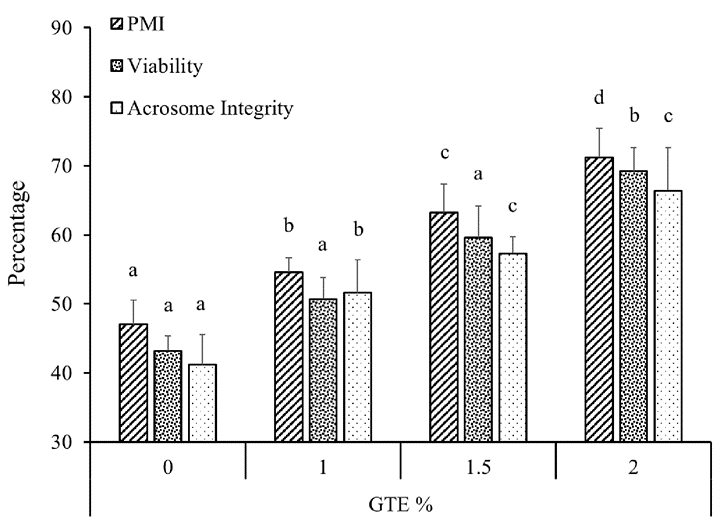
As illustrated in Figure 1, GTE provided significant protection to sperm structure and viability during cryopreservation.
Plasma membrane and acrosome integrity
All GTE concentrations resulted in significantly higher post-thaw PMI and acrosome integrity compared to the control group (P < 0.05). The 2% GTE group showed the highest PMI. For acrosome integrity, the 1.5% and 2% groups were equally effective and superior to the 1% group.
Sperm viability
Sperm viability was also significantly greater in all GTE-supplemented groups than in the control (P < 0.05). The 2% GTE group had the highest viability, although the 1% and 1.5% groups did not differ significantly from each other.
GTE effects across cryopreservation stages
The protective effects of GTE were evident throughout the cryopreservation process, from initial cooling to post-thawing (Tables I and II).
Similarly, for kinematic parameters like VCL and VAP, significant improvements in the GTE groups compared to the control were observed at all stages, including at 37°C, 4°C, and post-thaw. This indicates that GTE begins to enhance sperm vigor immediately upon addition to the extender. However, for most parameters, no significant differences were found among the 1%, 1.5%, and 2% GTE concentrations until after the freezing-thawing cycle, highlighting the 2% concentration’s superior ability to protect against cryo-damage.
Table II. Effect of different stages (37°C, 4°C, post-thaw) and green tea extract on semen CASA kinematics during cryopreservation of Kail ram semen. Values are presented as mean±SEM.
| Parameters | Treatments GTE % | P-value | |||||
| 0% | 1% | 1.5% | 2% | SoC | Groups | SoC* Groups | |
| VCL (μm/s) | |||||||
| 37°C | 49±4.5aA | 65±5.3bA | 67±5.3bA | 67±4.5bA | 0.00 | 0.00 | 0.86 |
| 4°C | 47±5.2aB | 58±4.5bB | 59±4.5bB | 61±4.0bB | |||
| Post-thaw | 30±5.2aC | 36±4.5bC | 37±4.5bC | 43±5.2bC | |||
| VAP (μm/s) | |||||||
| 37°C | 27±2.5aA | 34±2.8bA | 36±2.8bA | 35±2.5bA | 0.11 | 0.00 | 0.81 |
| 4°C | 26±2.8aB | 32±2.2bB | 33±2.5bB | 31±2.5bB | |||
| Post-thaw | 24±2.8aC | 28±2.5bC | 29±2.5bC | 34±2.8bC | |||
| VSL (μm/s) | |||||||
| 37°C | 17±2.1aA | 18±2.4aA | 19±2.4aA | 20±2.1aA | 0.01 | 0.02 | 0.43 |
| 4°C | 15±2.4aB | 18±1.9aB | 19±2.1aB | 18±2.1aB | |||
| Post-thaw | 15±4.6aC | 23±2.1aC | 23±2.1aC | 28±2.4aC | |||
| ALH (μm/s) | |||||||
| 37°C | 2±0.5aA | 5±0.5bA | 4±0.5b A | 5±0.6bA | 0.00 | 0.81 | 0.87 |
| 4°C | 2±0.6aB | 3±0.4bB | 3±0.5bB | 3±0.5bB | |||
| Post-thaw | 2±0.6aC | 3±0.6cC | 3±0.6bC | 3±0.5bC | |||
| STR | |||||||
| 37°C | 77±3.1aA | 54±3.5bA | 54±3.5bA | 57±3.1bA | 0.00 | 0.00 | 0.00 |
| 4°C | 63±3.5aB | 57±2.7bB | 59±3.1bB | 57±3.1bB | |||
| Post-thaw | 59±3.5aC | 80±3.1bC | 79±3.1bC | 80±3.5bC | |||
| Table continues on next page................. | |||||||
| Parameters | Treatments GTE % | P-value | |||||
| 0% | 1% | 1.5% | 2% | SoC | Groups | SoC* Groups | |
| LIN | |||||||
| 37°C | 61±3.3aA | 30±3.9bA | 30±3.9bA | 33±3.3bA | 0.00 | 0.04 | 0.00 |
| 4°C | 40±3.9aB | 33±3.0bB | 35±3.3bB | 34±3.3bB | |||
| Post-thaw | 31±3.9aC | 68±3.3bC | 67±3.3bC | 69±3.9bC | |||
| WOB | |||||||
| 37°C | 72±3.7aA | 53±4.2bA | 54±4.2bA | 56±3.7bA | 0.00 | 0.00 | 0.00 |
| 4°C | 58±4.3aB | 55±3.3bB | 56±3.7bB | 56±3.7Bb | |||
| Post-thaw | 19±4.2aC | 80±3.7bC | 81±3.7bC | 82±4.2Bc | |||
| BCF | |||||||
| 37°C | 6.9±0.5Aa | 5.6±0.6bA | 5.6±0.6bA | 5.6±0.5Ba | 0.00 | 0.04 | 0.00 |
| 4°C | 5.5±0.6aB | 5.2±0.4bB | 5.1±0.5bB | 5.6±0.5Bb | |||
| Post-thaw | 2±0.6aC | 5±0.5bC | 4±0.5bC | 5±0.6cC | |||
VCL, curvilinear velocity; VAP, straightness line velocity; VSL, straightness line velocity; ALH, Amplitude of lateral head displacement; STR, straightness of average special path; LIN, linearity of the curvilinear trajectory; WOB, oscillation index values; BCF, Beta-cross frequency; SoC, stage of Cryopreservation; SoC*Groups, stage of cryopreservation and groups interaction. Different superscripts abc indicate significant differences within a row for each parameter and ABC indicates differences within each treatment during different stages of cryopreservation.
DISCUSSION
The findings of this study have significant practical implications for the livestock sector in Pakistan. The Kail sheep is an economically important indigenous breed in the AJ&K region, valued for both wool and meat production. Enhancing cryopreservation success for this breed is a key step towards developing robust AI programs. The use of a low-cost, natural supplement like green tea extract can make advanced reproductive technologies more accessible and sustainable for local farmers. Successful cryopreservation allows for the long-term storage of elite genetic material, facilitates genetic exchange across different regions without transporting animals, and helps in conserving the unique genetic diversity of indigenous breeds like the Kail ram. This research provides a direct, applicable method to improve breeding strategies and support the genetic conservation of Pakistan’s valuable small ruminant resources.
This study evaluated the impact of GTE supplementation on the cryopreservation outcomes of Kail ram semen, focusing on motility, kinematic parameters, plasma membrane integrity, acrosomal integrity, and viability. The findings of the present study indicate that GTE supplementation significantly improved the quality of frozen-thawed semen. The reactive oxygen species (ROS) are generated during the process of cryopreservation that interrupts membrane structure, impairing motility, survival, and ultimately reduce the fertilizing ability of sperm . The supplementation of extenders with GTE as an antioxidant, containing catechins like epigallocatechin-3-gallate (EGCG) neutralize ROS and safeguard the lipid bilayer of sperm during freeze–thaw cycles . In this study it was observed that addition of 2% GTE extract to extender significantly (P < 0.05) increased total, progressive, and medium-progressive motility, particularly VCL and VAP in cryopreserved ram semen of Kail sheep breed. These finding of our study agree with earlier work by Mehdipour et al. (2016), who observed enhanced total and progressive motilities at an optimal GTE concentration (10 mg/L) in a soybean-lecithin extender. Our results, demonstrating improved motility and structural integrity, are consistent with and build upon very recent studies. For instance, the significant improvements in post-thaw quality align with findings by Susilowati et al. (2024), who also reported enhanced buck sperm quality using GTE nanoparticles. Similarly, the protective effects on membrane integrity correspond with work by Abdellatif et al. (2022) in Rahmani rams and Khattak et al. (2021) in bovine sperm, confirming the efficacy of GTE across different ruminant species and recent cryopreservation protocols. Furthermore, similar improvements in motility have been observed in other species such as in rooster and mouse sperm ; .
The metrics such as VCL and VAP are essential for efficient movement through the female reproductive tract and are strongly linked with fertilization potential . The positive influence on functional motility traits was confirmed by a significant difference (P < 0.05) between the control group and those treated with GTE. However, no significant (P > 0.05) difference was observed at a varying concentration of 1% and 1.5% GTE treatment groups. This pattern indicates a threshold effect, where increasing concentration beyond a certain limit fails to produce further enhancements. Similar trends were observed in other in vitro studies, where higher GTE doses did not enhance motility and occasionally resulted in reduced performance .
The data indicated that neither ALH nor VSL revealed statistically significant differences (P > 0.05) among different treatment groups. This suggests that these specific kinematic parameters may be governed more by intrinsic structural and functional traits of spermatozoa, which are less receptive to antioxidant supplementation. This understanding supports earlier observations by Mehdipour et al. (2016) and Masoudi et al. (2020), who also found no obvious improvements in ALH or VSL subsequent antioxidant treatment. Such findings imply that modifying ALH and VSL may depend on alternative physiological or biochemical factors beyond the reach of antioxidant-based interventions.
Structural and functional features of sperm flagella appear to play an overriding role in defining ALH and VSL, interpreting these kinematic parameters less receptive to antioxidant supplementation such as GTE. Hussain et al. (2018) noticed that ALH and VSL largely depend on the tail’s structural integrity and flagellar flexibility features are not easily changed by antioxidant agents. Rather antioxidants like GTE are more effective in mitigating oxidative damage that impairs velocity-focused measures such as VCL, which are vulnerable to lipid peroxidation of the tail membrane.
Lipid peroxidation adversely affects motility parameters sensitive to oxidative stress, especially VCL, VAP, and VSL. Therefore, intrinsic sperm morphology and biomechanical properties seem to dictate ALH and VSL, supporting observations by Baker et al. (1996) and Borges et al. (2020), where antioxidant treatment failed to significantly alter these specific motility traits. This strengthens the idea that these parameters may require interventions targeting structural or physiological pathways beyond antioxidant supplementation.
In treatment group with 2% GTE supplementation a significant improvement (P < 0.05) in plasma membrane and acrosomal integrity, as well as sperm viability was observed. The strong antioxidant effect of GTE helps to preserve the sperm’s lipid and protein structures against oxidative damage from ROS. Similar findings have been in bovine and ovine sperm, strengthening the notion that GTE effectively mitigates oxidative stress during cryopreservation.
The acrosomal integrity of frozen thawed semen has been significantly improved by GTE supplementation (P < 0.05), indicating its cryoprotective effectiveness in preserving sperm function. These results are supported by similar findings in buffalo bulls and bucks’ semen, where GTE-enriched extenders significantly improved both acrosomal and plasma membrane integrity during cryopreservation ; ; .
Abdellatif et al. (2022) documented that 1% methanolic GTE supplementation significantly improves motility, viability, and membrane integrity in Rahmani ram cryopreserved semen. Similarly, the enhancement in viability and membrane preservation in ram and bovine sperm was observed by antioxidant supplementation ; . However, findings of Bailey et al. (2000) warn that unnecessary antioxidant levels can be possibly genotoxic, underscoring the importance of determining an optimal GTE concentration window.
This study is one of the first to investigate the effects of GTE on cryopreserved semen from Kail rams. The observed improvements in key sperm quality parameters suggest that GTE could be a valuable tool for enhancing protocols for cryopreservation of ovine semen. Further study is required to investigate the dose–response pattern, where a thrash hold effect of an optimal concentration for precise calibration of GTE in extenders to maximize efficacy while avoiding oxidative stress.
Future work should aim to standardize GTE processing, including ethanol-based extractions or supercritical CO2 methods, to consistently quantify active catechins like EGCG. Investigating how GTE influences antioxidant pathways such as glutathione peroxidase (GPx), superoxide dismutase (SOD), total antioxidant capacity, and lipid peroxidation markers (e.g. malondialdehyde; MDA) will clarify its protective mechanisms during semen freezing. It’s also essential to assess compatibility between GTE and various extenders (egg-yolk, soy-lecithin, Tris-based), since performance may vary across species and cryopreservation protocols. Broader trials across goats, bulls, buffaloes, and differing equilibration or freezing techniques can establish GTE’s general utility in reproductive biotechnology.
CONCLUSION
The inclusion of 2% green tea extract (GTE) in an egg yolk–based extender significantly enhanced post-thaw semen quality of Kail rams by increasing total and progressive motility, plasma membrane integrity, viability, and acrosome integrity, while ALH and VSL remained unaffected. No meaningful improvements were observed between 1% and 1.5% GTE, indicating that 2% is the optimal concentration for maximum cryoprotective benefit. Further research is warranted to optimize green tea extract supplementation, particularly to identify which specific compounds contribute to its beneficial effects on sperm cryopreservation. Additionally, the varying impacts of different cryopreservation stages on sperm quality suggest that the processes of cooling and thawing may require tailored approaches to maximize the protective effects of antioxidants.
DECLARATIONS
Acknowledgement
Special thanks to the staff of NARC Islamabad for cooperation in designing this study.
Funding
Pakistan Agriculture Research Council (PARC) financially supported this research vide letter no F. No. 3–130/2019 (ALP)-PARC (P&DD) and grant no AS-159.
IRB approval
This study was approved by the Board Advanced Studies and Semester Affairs at the University of Poonch Rawalakot under approval number. UPR/AD/160/2024 dated 28-11-24.
Ethical approval
The study was approved by the University’s Human and Animal Ethics Committee. The ethics committees of the authors’ institutions have approved this study which is in accordance with the rules and regulations under notification number UPR/AEC/09/2024 dated 28-11-24.
Generative AI and AI-assisted technology statement
The authors declare that they have not used generative AI or AI-assisted technologies in this manuscript.
Supplementary material
There is supplementary material associated with this article. Access the material online at: https://dx.doi.org/10.17582/journal.pjz/20250731080523
Statement of conflict of interest
The authors have not declared any conflict of interest.
Figures
References
- Abdellatif, M.A., Gabr, S.A., El-Sherbieny, M.A. and Yousif, A.I.A., 2022. Effect of aqueous and methanolic green tea extracts on motility, normal forms, and kinetic parameters of spermatozoa in Rahmani ram semen equilibrated at 5°C for 4 h. J. Anim. Poult. Prod., 13: 63-70. https://doi.org/10.21608/jappmu.2022.145028.1041[CrossRef]
- Abshenas, J., Babaei, H., Zare, M.H., Allahbakhshi, A. and Sharififar, F., 2012. The effects of green tea (Camellia sinensis) extract on mouse semen quality after scrotal heat stress. Vet. Res. Forum, 2: 242-247. https://vrf.iranjournals.ir/article_1550.html
- Ahmadi, S., Bashiri, R., Gharidi-Anari, A. and Nadjarzadeh, A., 2016. Antioxidant supplements and semen parameters: An evidence-based review. Int. J. Reprod. Biomed., 14: 729-736. https://doi.org/10.29252/ijrm.14.12.729[CrossRef]
- Ahmed, H., Jahan, S., Khan, A., Khan, L., Khan, B.T., Ullah, H., Riaz, M. and Ullah, K., 2020. Supplementation of green tea extract (GTE) in extender improves structural and functional characteristics, total antioxidant capacity and in vivo fertility of buffalo (Bubalus bubalis) bull spermatozoa. Theriogenology, 145: 190-197. https://doi.org/10.1016/j.theriogenology.2019.10.024[CrossRef]
- AJ&K Bureau of Statistics, 2024. Statistical Year-book. Planning and Development Department (P&DD), Azad Government of the State of Jammu and Kashmir, Muzaffarabad.
- Al-Daraji, H.J., 2011. Effect of diluent supplementation with different levels of green tea on roosters’ semen quality during in vitro storage. Int. J. Pl. Anim. environ. Sci., 1: 51-56. https://scispace.com/pdf/effect-of-diluent-supplementation-with-different-levels-of-417l87n480.pdf
- Alenzey, E.S., Barakat, I.A.H. and Musayeib, N.M.A., 2019. Effect of wild marjoram (Origanum vulgare) plant extracts on capacitation of sheep spermatozoa in vitro. Adv. Biosci. Biotechnol., 10: 86-97. https://doi.org/10.4236/abb.2019.104006[CrossRef]
- Allai, L., Benmoula, A., Da Silva, M.M., Nasser, B. and Amiri, E.B., 2018. Supplementation of ram semen extender to improve seminal quality and fertility rate. Anim. Reprod. Sci., 192: 6-17. https://doi.org/10.1016/j.anireprosci.2018.03.019[CrossRef]
- Avdatek, F., Yeni, D., İnanç, M.E., Cil, B., Tuncer, P.B., Türkmen, R. and Taşdemir, U., 2018. Supplementation of quercetin for advanced DNA integrity in bull semen cryopreservation. Andrologia, 50: e12975. https://doi.org/10.1111/and.12975[CrossRef]
- Ba-Awadh, H.A., Olarinre, I.O., Alowaimer, A.N., Saadeldin, I.M. and Swelum, A.A., 2023. Comparison between rapid and slow cryopreservation protocols for ram semen. Slov. Vet. Res., 60: 249-257. https://doi.org/10.26873/SVR-1586-2022[CrossRef]
- Bailey, J.L., Bilodeau, J.F. and Cormier, N., 2000. Semen cryopreservation in domestic animals: A damaging and capacitating phenomenon. J. Androl., 21: 1-7. https://doi.org/10.1002/j.1939-4640.2000.tb03268.x[CrossRef]
- Baker, H.G., Brindle, J., Irvine, D.S. and Aitken, R.J., 1996. Protective effect of antioxidants on the impairment of sperm motility by activated polymorphonuclear leukocytes. Fertil. Steril., 65: 411-419. https://doi.org/10.1016/S0015-0282(16)58109-6[CrossRef]
- Borges, M.S.A., Born, J.L.B., Conti, L.M., Segabinazzi, L.G., Nichi, M., Kawai, G.K.V., Leite, R.F., Peixoto, K.d.C., Dell’Aqua, J.A. and Papa, F.O., 2020. Paradoxical effect of quercetin antioxidant on goat sperm parameters after cryopreservation. Cryo Lett., 41: 128-134. https://doi.org/10.1016/j.smallrumres.2007.09.002[CrossRef]
- Bucak, M.N., Atessahin, A. and Yuce, A., 2008. Effect of antioxidants and oxidative stress parameters on ram semen after the freeze-thawing process. Small Rumin. Res., 75: 128-134.
- Dcunha, R., Hussein, R.S., Ananda, H., Kumari, S., Adiga, S.K., Kannan, N., Zhao, Y. and Kalthur, G., 2022. Current insights and latest updates in sperm motility and associated applications in assisted reproduction. Reprod Sci., 29: 7-25. https://doi.org/10.1007/s43032-020-00408-y[CrossRef]
- Guo, Q., Zhao, B., Shen, S., Hou, J., Hu, J. and Xin, W., 1999. ESR study on the structure–antioxidant activity relationship of tea catechins and their epimers. Biochim. Biophys. Acta, 1427: 13-23. https://doi.org/10.1016/S0304-4165(98)00168-8[CrossRef]
- Hameed, N., Zubair, M., Ahmad, N., Durrani, A.Z. and Khan, M.I.u.R., 2023. Effects of extender type and storage time on sperm quality parameters of Kail ram semen stored at 5°C. Trop. Anim. Hlth. Prod., 55: 171. https://doi.org/10.1007/s11250-023-03594-4[CrossRef]
- Hameed, N., Zubair, M., Ahmad, N., Durrani, A.Z. and Khan, M.I.u.R., 2024. Effect of cooling rates and equilibration times on post-thaw sperm quality of Kail rams. Anim. Prod. Sci., 64. https://doi.org/10.1071/AN24013[CrossRef]
- Higdon, J.V. and Frei, B., 2003. Tea catechins and polyphenols: Health effects, metabolism, and antioxidant functions. Crit. Rev. Fd. Sci. Nutr., 43: 89-143. https://doi.org/10.1080/10408690390826464[CrossRef]
- Hussain, M., Begum, S.S., Kalita, M.K., Ahmed, K.U. and Nath, R., 2018. Additives used in semen preservation in animals: A short review. Int. J. Chem. Stud., 6: 354-361. https://www.researchgate.net/publication/334397724
- Khan, H., Khan, M., Qureshi, M.S., Ahmad, S., Gohar, A., Ullah, H., Ullah, F., Hussain, A., Khatri, P., Shah, S.S.A., Rahman, H. and Khan, A., 2017. Effect of green tea extract (Camellia sinensis) on fertility indicators of post-thawed bull spermatozoa. Pakistan J. Zool., 49: 1243-1249. https://doi.org/10.17582/journal.pjz/2017.49.4.1243.1249[CrossRef]
- Khattak, N.B.S., Khan, H., Tunio, M.T., Ahmad, S., Ahmad, N., Andrabi, S.M.H., Obaidullah, Ali, I. and Fang, N.Z., 2021. Dose dependent effect of green tea (Camellia sinensis) extract in the post-thawed fertility indicators of frozen bovine semen extender. Pakistan J. Zool., 64: 647-656. https://doi.org/10.17582/journal.pjz/20181230051216[Full text][CrossRef]
- MacKay, D.L. and Blumberg, J.B., 2000. The role of tea in human health: An update. J. Am. Coll. Nutr., 21: 1-13. https://doi.org/10.1080/07315724.2002.10719187[CrossRef]
- Masoudi, R., Asadzadeha, N. and Shahneh, A.Z., 2020. Supplementation of soybean lecithin-based cryopreservation medium with glutathione: Fertility and flow cytometry study of ram frozen-thawed semen. Small Rumin. Res., 190: e106169. https://doi.org/10.1016/j.smallrumres.2020.106169[CrossRef]
- Maxwell, W.M.C., 1984. Current problems and future potential of artificial insemination programmes. In: Reproduction in sheep (eds. D.R. Lindsay and D.T. Pearce). Cambridge: Cambridge University Press, pp. 291-298.
- Mehdipour, M., Kia, H.D., Najafi, A., Dodaran, H.V. and Alvarez, O.G., 2016. Effect of green tea (Camellia sinensis) extract and pre-freezing equilibration time on the post-thawing quality of ram semen cryopreserved in a soybean lecithin-based extender. Cryobiology, 73: 297-303. https://doi.org/10.1016/j.cryobiol.2016.10.008[CrossRef]
- Mustofa, I., Susilowatia, S., Wurlinaa, W., Hernawatia, T. and Oktanellab, Y., 2021. Green tea extract increases the quality and reduced DNA mutation of post-thawed Kacang buck sperm. Heliyon, 7: e06372. https://doi.org/10.1016/j.heliyon.2021.e06372[CrossRef]
- Pakistan Economic Survey, 2025. Finance division, ministry of finance, Islamabad, Government of Pakistan. Retrieved from https://jassaraftab.com/economic-survey-livestock-data-2025
- Rehman, F., Zhao, C., Shah, M.A., Qureshi, M.S. and Wang, X., 2013. Semen extenders and artificial insemination in ruminants. Veterinaria, 1: 1-8. https://www.academia.edu/12593134
- Setumo, M.A., Choma, S.S.R., Henkel, R. and Opuwari, C.S., 2022. Green tea (Camellia sinensis) aqueous extract improved human spermatozoa functions in vitro. J. Med. Pl. Econ. Dev., 6: a166. https://doi.org/10.4102/jomped.v6i1.166[CrossRef]
- Soltanpour, F., Moghaddam, G., Asadpour, R. and Rafat, S.A., 2014. Effect of antioxidant combinations on sperm quality of cross-breed rams during liquid storage. Int. J. Adv. Biol. Biomed. Res., 2: 732-740. https://www.ijabbr.com/article_7227.html
- Susilowati, S., Mustofa, I., Suparyogi, T.W., Akintunde, A.O., Purwanto, D.A., Wurlina, W., Utama, S. and Mulyati, S., 2024. Adding chitosan nanoparticles of green tea extract in diluent and thawing temperatures ameliorate the post-thawed quality of Boer buck semen. Asian Pac. J. Reprod., 13: 42-48. https://doi.org/10.4103/apjr.apjr_93_23[CrossRef]
- Swelum, A.A., Ba-Awadh, H.A., Olarinre, I.O., Saadeldin, I.M. and Alowaimer, A.N., 2023. Correlation between fatty acids levels in chicken, duck, goose, pigeon, quail and turkey egg yolks and post-thawed quality of ram semen. Reprod. Domes. Anim., 58: 1298-1310. https://doi.org/10.1111/rda.14434[CrossRef]
- Swelum, A.A., Ba-Awadh, H.A., Olarinre, I.O., Saadeldin, I.M. and Alowaimer, A.N., 2022. Effects of adding mixed chicken and quail egg yolks to the cryodiluent on the quality of ram semen before and after cryopreservation. Front. Vet. Sci., 9: 1013533. https://doi.org/10.3389/fvets.2022.1013533[CrossRef]
- Wittayarat, M., Ito, A., Kimura, T., Namula, Z., Luu, V.V.L., K.Do, L.T., Sato, Y., Taniguchi, M. and Otoi, T., 2013. Effects of green tea polyphenol on the quality of canine semen after long-term storage at 5°C. Reprod. Biol., 13: 251-254. https://doi.org/10.1016/j.repbio.2013.07.006[CrossRef]
Supplementary material
Services
Article usage statistics
Loading…