
We studied food preferences of the wireworm to understand which factors contributed to spatial distribution of insect in cropland landsacpe. The larva of click beetles (Agriotes fuscicollis Miwa) known as the wireworm is a serious underground pest in farmlands. The distribution of adults and larvae alternated between flower and corn growth stages in the field because food resources and foraging behaviors stimulated and restrained the acquisition of supplemental nutrients as a strategy for reproduction. To evaluate their food choices, wireworm were exposed to different types of plants associated with their farmland habitat, as follows: mixed pollen and nectar of flowers (Erigeron annuus, Trifolium repens, Heteropappus hispidus, Potentilla chinensis, Hibiscus trionum), or leaves of grasses (Poa annua, Echinochloa crusgalli), or maize leaves (Songyu 419, a hybrid variety) as food sources to feed the adult of A. fuscicollis. The larvae were reared on roots of the same grasses and germinated maize seedlings. Additionally, potato tuber the common food used to grew the beetles that was selected as a reference to demonstrate that blooming wildflowers through their pollen and nectar can control the A. fuscicollis population and distribution around the field. The greatest number of eggs were deposited by mated couples when the pollen, or nectar mixture was offered compared to the other foods. Each of the five food sources provided a high hatching rate, but particularly the pollen, nectar and potato. Maize seedlings were a better food for larvae than were grass roots, and larvae also consumed more maize in the field. Wild flowers were the most important factor which determined the abundance of A. fuscicollis. Maize, grasses and the wild flowers could explain the alternating distribution of A. fuscicollis between the maize field and the field margins in the farmland.
Research Article · Volume 51, Issue 5, 12 June 2019 · Open Access
Distinct Larva and Adult Food Preferences Drive the Spatial Distribution of Agriotes fuscicollis Miwa (Coleoptera: Elateridae) in the Crop Land, Northeast, China
· · · ·
Affiliations & Notes ⌄
- 1College of Earth Sciences, Jilin University, Changchun 130061, China, 2Department of Plant Sciences, Jilin Agricultural Science and Technology College, Jilin 132101, China 3Department of Soil Science, College of Agricultural and Bioresources, University of Saskatchewan, 51Campus Drive, Saskatoon, SK, S7N5A8, Canada, 4Key Laboratory of Wetland Ecology and Environment, Northeast Institute of Geography and Agroecology, Chinese Academy of Sciences, Changchun 130102, China , * Corresponding author: w
Article Info ⌄
- Journal:
- Pakistan Journal of Zoology
- Published:
- 12 June 2019

From the article
- We showed that adults preferred the pollen, or nectar from the five food preparation (Fig. 2A).
- In our study, the edaphic physicochemical factors (SWC, pH, SOMC) played a weaker role in affecting the adult distribution than did food (flowers), which possibly accounted for the small gap in the factors between the wildflowers and grasses belts and cultivated land.
- We conclude that wild flowers are the most important factor which determined the abundance of A. fuscicollis.
- Maize growth stage, grasses, and the wild flowers together could explain the alternating distribution of A. fuscicollis in the farmland.
Selected from the article's own text.
Abstract
INTRODUCTION
Agricultural landscape can regulate the biodiversity and spatial pattern of populations in the cropped land. Wireworm is one of the most serious root-feeding pests and is difficult to control in soil (Parker and Howard, 2001; Traugott et al., 2015). The wireworm Agriotes fuscicollis Miwa (Coleoptera: Elateridae) is a widespread maize root feeding pest in China. During its life cycle (2 to 3 years), this beetle spends most of the time as a larva living in the soil feeding on roots and only a short time as an adult beetle above ground (Guo et al., 1985). Larvae emerge from the soil between May and June. The adults forage for food in preparation for mating, and only a few newly emerging adults overwinter in the soil until the next year (Liu et al., 1989). The complementary nutrition from a mixed diet promotes the development of sexual organs before mating (Guo et al., 1985; Liu et al., 1988; Romeis et al., 2005). Based on this observation it is generally assumed that food quality should be proportional to fertility (Van-Herk et al., 2016).
Flowering plants are the primary food sources for pollinators, because the nectar and pollen act as attractants in the landscape which directly prompt their population in the habit (Kevan and Baker, 1983; Barber et al., 2012). In contrast to the other plant tissues, pollen and nectar have vital functions as supplemental nutrition for adult herbivorous insects that are pollinators (van Rijn et al., 2002; Wäckers et al., 2005; Sagers, 2007). For example, nectar can have a positive effect on the fecundity of insects (Winkler et al., 2006), and also provides additional energy sources for insects (Winkler et al., 2009). Non-essential amino acids are obtained from the nectar for insect reproduction (O’Brien et al., 2002), with some of the essential amino acids obtained from pollen (O’Brien et al., 2003). Therefore, among the nutrients assimilated from pollen, proteins are the primary component (Patt et al., 2003), which can particularly affect egg maturation, fecundity, feeding, longevity and survival among members of Coleoptera (Evans and Barratt, 1995; Rana and Charlet, 1997). For A. fuscicollis adults, they would laid more eggs after feeding the crop leaves, flowers (Guo et al., 1985; Liu et al., 1988). Additionally, herbivores can adjust their ability to assimilate certain nutrients in response to the changes in diet (Logan et al., 2004). In the habitat of Elateridae, grasses are often an available food that can foster wireworm populations (Parker et al., 1997).
To control pest damage and understand its life history, long-term research is being conducted to clarify the population and distribution dynamics, their survival and reproduction in the field (Edwards and Evans, 1950; Su et al., 1989; Furlan et al., 2010; Benefer et al., 2012). Adult click beetles (Agriotes sp.) are strongly attracted to synthetic sex pheromones, such as the mixture of geranyl hexanoate, geranyl octanoate, geranyl, geranyl butanoate, (E,E)-faruesyl ethanoate, (E,E)-farnesyl ethanoate, etc. (Kudryavtsev et al., 1993), so that their distribution is determined by pheromones to some extent (Blackshaw and Hicks, 2012). For instance, the distribution of adults is greatly affected by wind direction when pheromones are released into the air (Blackshaw et al., 2018b). Larvae are widely distributed in croplands, with the specific crop having a role on population spatial distribution (Blackshaw and Hicks, 2012). Adults prefer to migrate to cropland margins, or grassy field margins, because the uncropped field margins serve as a better environment for click beetles (Hermann et al., 2013; Blackshaw et al., 2018a) and therefore it is a factor affecting the distribution pattern. Moreover, some larvae of Agriotes species also have a strong preference for soil moisture (Campbell, 1937; Lees, 1943), do not ingest the soil organic matter (Campbell et al., 1971; Traugott et al., 2008), and soil pH (Ibbotson, 1958). A. fuscicollis is known to prefer the slightly acidic soils with higher organic matter content and soil water content of 20% to 25% (Guo et al., 1985, Wu, 1988). Seasonal vertical movements (40-50 cm) in soil have been attributed to temperature (Furlan, 2004).
As the previous studies have been suggested that the Agriotes spp. would be more inclined to move to the uncropped field margins (Blackshaw et al., 2018a). One of the most important reasons showed that food sources spurred on the movement of the Agriotes spp. (Schallhart et al., 2011; Sonnemann et al., 2014). The aim of this study was to assess whether flowers and corn would affect the periodic movements of adult A. fuscicollis. We measured the spatial distribution of adults and larvae in experimental field settings to determine food preferences under natural environmental conditions. We hypothesized that of the food resources (pollen, nectar, corn, and weeds) some might promote reproduction and fertility more than others. The food sources drived the regional biodiversity patterns through the management of agricultural landscape.
MATERIALS AND METHODS
Field landscape background
Cropland is the main typical agricultural landscape in Northeast China (Liu et al., 2002; Wang et al., 2009), and maize was mono-cultivated more than ten to thirty years by conventional tillage practice in most of this region. The experiment maize field was located at Jilin Agricultural Science and Technology University and cultivated maize more than ten years in our experiment. Herbicides and insecticides were used to control the weeds and pests in the field. Soil physical and chemical properties were as follows: pH 6.3-6.5; sandy loam of texture; 0.22-0.24% of soil organic matter content; 14-22% of soil water content.
Wireworm collection
Because of its overwintering migratory habits, the adults are found in flowers and the grass margin near cultivated land (Sonnemann et al., 2014). We trapped the overwintering adults using decomposing grass (2525-cm square) as bait traps to collect in early May, and we also dug for larvae in the field margin (Guo et al., 1985; Parker and Howard, 2001). The specimens were reared in the lab.
Maintaining beetles
We selected potato tuber (Favorita; Beijing Mercurius Technology Co., Ltd.) to compare with the other foods included in the test, because potato is a standard feed used in the lab to cultivate the adult and larvae Elateridae (Langenbuch, 1934; Liu et al., 1989). Each of five flowers from the beetle habitat, we collected pollen and nectar from June to August during the flowering period as food for the adult beetles. They were mixed together into the pollen, or nectar food preparation in the following proportions to mimic field composition: Erigeron annuus (L.) Pers. 20%; Trifolium repens L. 35%; Heteropappus hispidus (Thunb.) Less. 10%; Potentilla chinensis Ser. 15%; Hibiscus trionum Linn. 10%. Maize leaves (Zea mays L.; Songyu 419, a hybrid variety; Songhua River Seed Enterprises Co., Ltd., Jilin, China) at the trefoil stage and grass leaves were offered to adults, too. For larvae, germinated maize in the lab and the collecting roots of grasses from the field margin (Poa annua L. of 50%; Echinochloa crusgalli (L.) Beauv. of 50%) were prepared.
Females mate with males only once and then oviposit; males die after mating with 2-4 females. We checked females for eggs daily for 7 days to determine whether they had mated. When eggs were present or if a female died, we would remove those females and only used the unmated ones. Distilled water was applied to maintain 70-75% relative humidity (RH) at the temperature kept at 18-20 °C. Females and males were placed in separate plastic boxes with a little soil, a wet cotton ball and starved for 24 h in preparation for the food preference assays (McCutchan et al., 2003).
Population investigation
Because of the changing biological property of adult and larval feeding habits, the population distribution of A. fuscicollis was examined in a 1-ha (100×100-m) field during various flower stages (vegetative, blossom, withering) and corn growth stages (seedling, jointing, withering) in 2016 and 2017. We uniformly divided the field (flowers and grass belts (wildness), cultivated land (silty loam)) into 10 rows with 10 plots in each row, with each plot (50 cm length×50 cm width, and a 10 cm depth) at a 10 m interval. Because overwintering adults are only aboveground from May to June, the adults were collected using baited traps (rotten grass) in a 25´25-cm square. As these newly emerging adults can survive in the soil until the next year, soil cores and hand sorting were employed to collect adults and larvae (Parker and Howard, 2001). We sampled during the flower and corn growth stages in 2015-2016 to assess the distribution pattern. All specimens collected were preserved in 70% ethanol. We used standardized protocols to measure soil organic matter content (SOMC, sulfochromic oxidation (NF ISO 14235), soil water content (SWC, the mass basis gravimetric method (NF ISO 11465), and pH value, pH meter (NF ISO 10390), because they can affect A. fuscicollis distribution (Guo et al., 1985; Wu, 1988). To minimize the influence of tillage on the population distribution survey, we used the general-purpose plough to plow 30 cm deep only once in the middle of April.
Statistical analyses
To identify significant differences in biological properties for A. fuscicollis after feeding on different food resources, one-way analysis of variance (one-way ANOVA) was utilized using food as the fixed factor. Tukey’s honestly significant difference test model was employed for comparison of means. Untransformed data were tested by ANOVA, and the Kruskal-Wallis test was used when the test indicated non-normality at significance level of the statistical tests was P=0.05. To determine the distribution of larvae and adults in different growth stages, patterns of species distribution were explored using GIS spatial analysis of subsample species abundance data in ArcGIS 10.2 (ESRI, Redlands, CA). Additionally, variation partitioning analysis (VPA) and redundancy analysis (RDA) were applied to estimate the proportion of total variation explained by different factors (flowering plants, grasses, SWC, SOMC, pH) for wireworm distribution (Peres-Neto et al., 2006). Statistical analyses were performed using R statistical software (‘agricolae’ and ‘vegan’ packages) (R Core Team 2018).
RESULTS
Landscape and moving pattern of A. fuscicollis
The five mixed wildflowers in the field margins attracted the distribution of adults, while the grasses and maize positively affected the distribution of larvae in the field, and the effects of the food resources on different growth stages (spring and summer) determined this cycle (Fig. 1). SWC values were not different between the cultivated land and wildflowers and grasses belt at different stages (P>0.05). However, pH and SOMC values between corn seedling and the flower vegetative stage and corn and flower withering stage were significantly different (P<0.05; Table 1). During the stages of corn growth, the density of the larval population was larger in the field than it was in the flowers and grasses belt before the three-leaf stage (seedling stage, Fig. 3A’); however, at the four to eight-leaf stage (jointing stage, Fig. 3B’), larvae emigrated
Table I. The soil environmental factors (SOM, pH, SWC) in the cultivated land, wild flowers and grasses belt (Means±SEM)
| Soil environmental factors | Cultivated land | Wild flowers and grasses belt | ||||
| Germinating stage | Jointing stage | Withering stage | Vegetative stage | Blossom stage | Withering stage | |
| SOM(g·kg-1) | 22.24±0.25a | 23.63± 0.26a | 23.86± 0.25a | 22.99± 0.21b | 23.83± 0.17a | 24.60± 0.09b |
| pH | 6.63±0.03a | 6.39± 0.03a | 6.54± 0.03a | 6.39± 0.03b | 6.33± 0.03a | 6.40+ 0.03b |
| SWC (%) | 15.08±0.003a | 15.16± 0.01a | 20.92± 0.003a | 14.01± 0.004b | 14.26± 0.014a | 21.45± 0.002a |
Values followed by the identical letter are not statistically different from cultivated land to wild flowers and grasses belt in the corresponding stage at P<0.05. SOM, soil organism matter; pH, potential of hydrogen; SWC, soil water content.
from the field to the flowers and grasses in the margin. Moreover, the area of their distribution and density increased to a greater extent in the reproductive stage than in the jointing stage. Flowers also influenced adults during growth stages. Although there was little difference in the distribution of adults between the crop land and the wildflowers in the corn seedling and flower vegetative stages (Fig. 3A), most (50.7%) adults aggregated in the flowers and grasses belt for supplementary nutrition during the blossom stage (Fig. 3B). Additionally, the density in the field during the vegetative stage was larger (90.9%) compared with that in the corn withering stage (53.8%) (Fig. 3A and C). Overall, food resources (flowers and corn) were more essential for the distributions of adults and larvae than were environmental factors. For the different growth stages of the plant, the explanatory value of corn was significantly higher than that of soil environmental factors in the corn seedling and flower vegetative stages (P<0.001 and P<0.05, respectively), with both having a common interpretation (Fig. 4A’ and A). This result showed that corn presence attached the movement of larvae and adults. Wildflowers were the primary factors driving the distribution of larvae during the corn jointing and withering stages (P<0.05, Fig. 4B’ and C’) as well as the intensive tropism of adults in the flower blossom and withering stages (P<0.001, Fig. 4B and C). Indeed, soil environmental factors only had a weak effect on adults in the flower blossom stage (Value=0.08).
Reproduction
On average, each beetle couple produces 46 to 56 eggs without consuming food. In this study, we found that the quantity of eggs was significantly different according to the types of food, with the range of values in the following order: pollen>potato>nectar>maize>grass. After feeding on pollen and potato, oviposition rate increased by 29.26% and 17.42%, respectively, with these increases being significantly different from those of the other food sources (P<0.05, Fig. 2A). In contrast, the difference between maize and grass was not significant (P>0.05, Fig. 2A).
Hatchability
Each of the five food resources resulted in a high hatching rate, and all food resources led to hatching rates of more than 80%. In general, egg hatching rates were significantly different among the food resources, particularly for pollen (increase from 26.36% to 41.52%) and potato (increase from 15.18% to 26.48%) (P<0.05, Fig. 2B).
Larval feeding habits
After 7 days, germinated maize, weeds and potato had been used in different proportions. Compared with the initial 0.5 g offered, the consumption of potato was significantly higher than the other food types (P<0.05). The second most consumed food was maize seedlings, with the amount decreasing by 23.5%, and last only 13.4% of grass roots were consumed (Fig. 2C).
DISCUSSION
We showed that adults preferred the pollen, or nectar from the five food preparation (Fig. 2A). The number of eggs laid increased significantly, particularly for the insects that were fed pollen. For optimum reproductive conditions, insects’ mate after feeding, which indicates that wildflowers can maintain insect populations (Cinereski and Chiang, 1968; Wäckers et al., 2007). Food quality is important for the reproduction of A. fuscicollis adults because food is more attractive than other factors (Guo et al., 1985; Liu et al., 1989; Wu, 1988). Moreover, we found that although the adults lived for less than 20 d with adequate food under artificial environmental conditions, they can survive 40-50 d in the wild (Liu et al., 1988). This indicates that physiological activities, such as oviposition, mating, and longevity, are promoted when food resources are more diverse (Wheeler, 1996; Awmack and Simon, 2002; Bauerfeind and Fischer, 2005; Wong and Kölliker, 2014), and that reproductive strategy can change based on
the food sources. Supplemental nutrients are not a requirement in the adult stage of A. fuscicollis but can enhance reproduction and the fertility of offspring (Liu et al., 1988).
Wildflowers are desirable food resources, and phenological periods can also lead to an overlap between wildflower blossoming and the emergence of overwintering adults. As a result, the adults can consume pollen and nectar as supplemental nutrition when flowers are blooming. The intake of food is determined by its nutrient concentrations and digestibility (Prestidge, 1982; Broekhoven et al., 2015; Shahid et al., 2017), when the nutrient content is high, less food is consumed (House, 1965; Simpson and Raubenheimer, 1995). Nonetheless, Tenebrionidae larvae increase their fecundity by feeding on a favorite food (Broekhoven et al., 2015), which was the primary explanation for the greater interest of larvae for maize seedlings compared to grass roots in our study. On the one hand, the wildflowers on cultivated land provide a habitat for pollinator insects (Kearns et al., 1998; Tscharntke et al., 2002). On the other hand, wildflowers were important food sources for the parents and offspring of the population in our test. Therefore, we suggested that wildflowers in a habitat had a vital role in the development, population maintenance, distribution, and dispersal of these pest insects.
In our study, the edaphic physicochemical factors (SWC, pH, SOMC) played a weaker role in affecting the adult distribution than did food (flowers), which possibly accounted for the small gap in the factors between the wildflowers and grasses belts and cultivated land. Compared with the other multifactor functions, food resources can also force wireworms to migrate horizontally across a field (Hemerik et al., 2003; Schallhart et al., 2011; Sonnemann et al., 2014), and this migration cycled between the grass belt and cultivated land. This behavior is most likely the primary explanation for the large-scale migration of Agriotes spp. from the field margin to cultivated land (Blackshaw et al., 2018a). Nonetheless, sex also determines the adult distribution (Vernon et al., 2014). We found that more larvae were inclined to live among young maize seedlings, even though grasses were abundant. Besides the feeding preference on germinated maize, this observation could also be explained by the CO2 emitted by belowground plant tissue, which likely attracted the wireworms (Doane et al., 1975), in addition to the attraction of other relevant root exudates (Johnson and Nielsen, 2012; Azhar et al., 2017). The plant itself can also affect the root-feeding larvae rather than the root abundance (Schallhart et al., 2012; Sonnemann et al., 2012). However, the larvae returned to the flowers and grasses belt around the field in the corn withering stage, indicating that food, independent of quality, has the most important role in determining whether living conditions are suitable, as grasses would only serve as a food source in times of food shortage in a conventional cropland.
CONCLUSION
We conclude that wild flowers are the most important factor which determined the abundance of A. fuscicollis. Maize growth stage, grasses, and the wild flowers together could explain the alternating distribution of A. fuscicollis in the farmland.
ACKNOWLEDGEMENT
We thank the Insects Research Laboratory of Jilin Agricultural Science and Technology College for their help. The Key Program of the National Natural Science Foundation of China (41430857) and National Key Research and Development Program of China (2018YFD0300207-1, 2018YFD0300207-4) supported this research.
Statement of conflict of interest
We declare no conflicts of interest in this study.
Figures
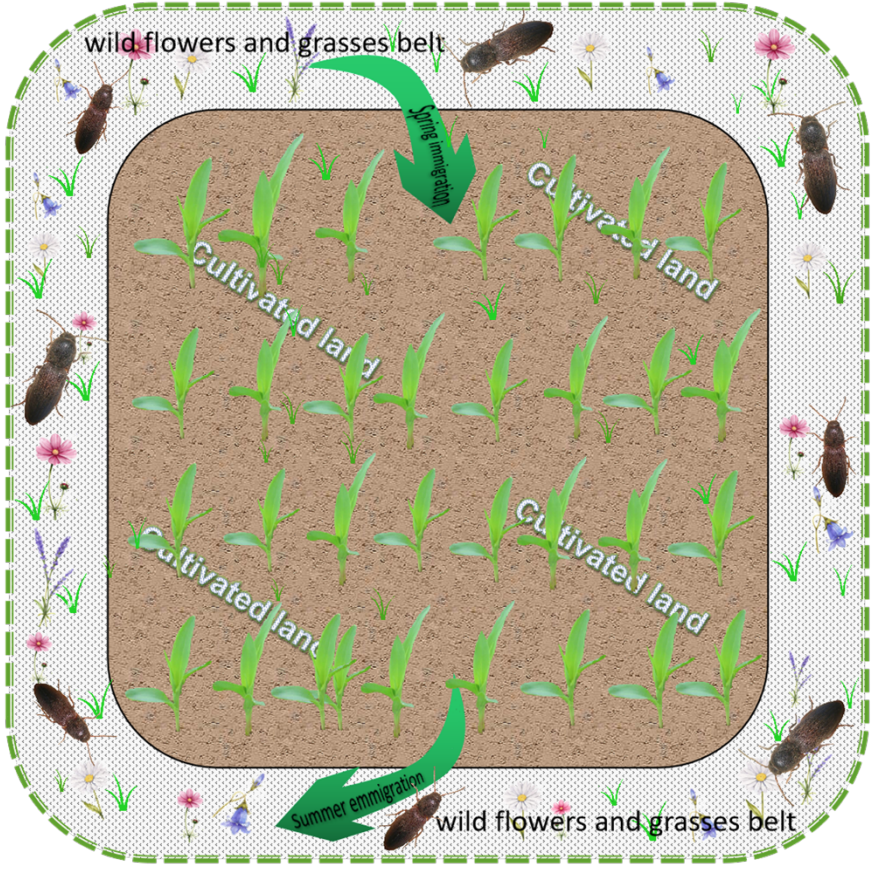
The edge represent the wildflowers and grasses belts around the field. The southern and western boundaries of the field are near to the road, and the other two edges neighbour another field. Sampling plots were evenly allocated at 10-m intervals in 1-ha field. Food sources, which included wildflowers, grasses, and maize, caused a seasonal migration of A. fuscicollis. Most adults mated in the wildflowers and grass belt after overwintering. The adults were able to feed on the flowers as their primary nutrition source before mating. The larvae immigrated to the field in the maize seedling stage in spring; however, they emigrated during the corn jointing stage in summer.
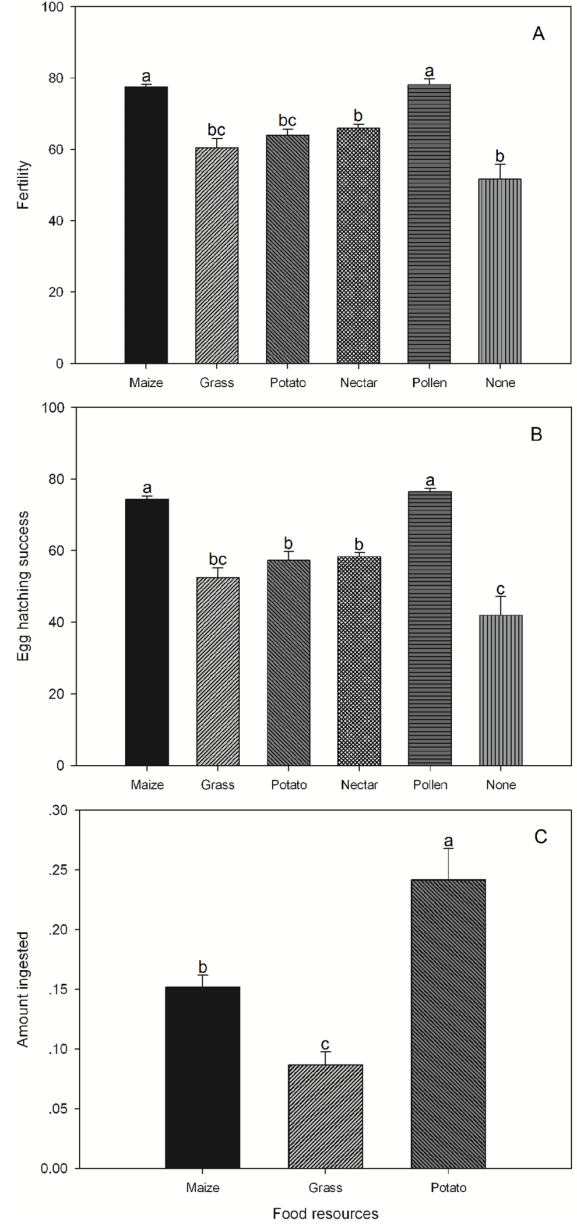
A, Reproductive quantity of A. fuscicollis after consuming different foods. The mean±SEM is shown; n=3. Bars with identical letters are not significantly different; B, Number of eggs hatching on different food sources. The mean±SEM is shown; n=3. Bars with identical letters are not significantly different; C, Amount of A. fuscicollis feeding after larvae consumed different foods. The mean±SEM is shown; and n=3. Bars with identical letters are not significantly different.
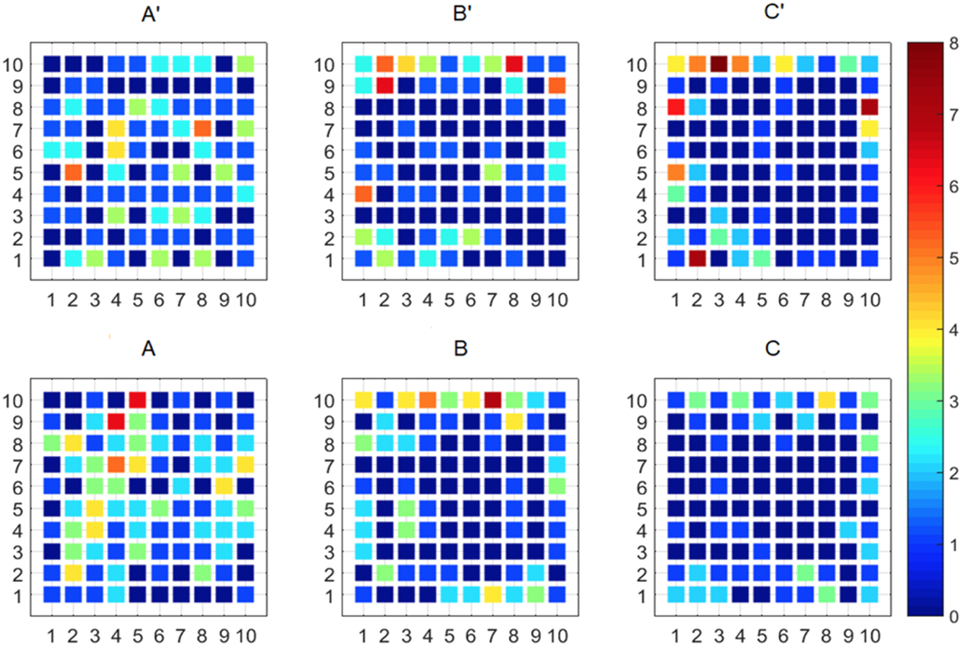
Larval and adult (A. fuscicollis) populations in various plant growth stages, including the corn germinating (A’) and flower vegetative (A) stages, the corn jointing (B’) and flower blossom (B) stages, and the corn (C’) and flower withering (C); average statistical data from 2016 to 2017. Different colors refer to the adult and larval densities in the field and flowers and grasses belt.
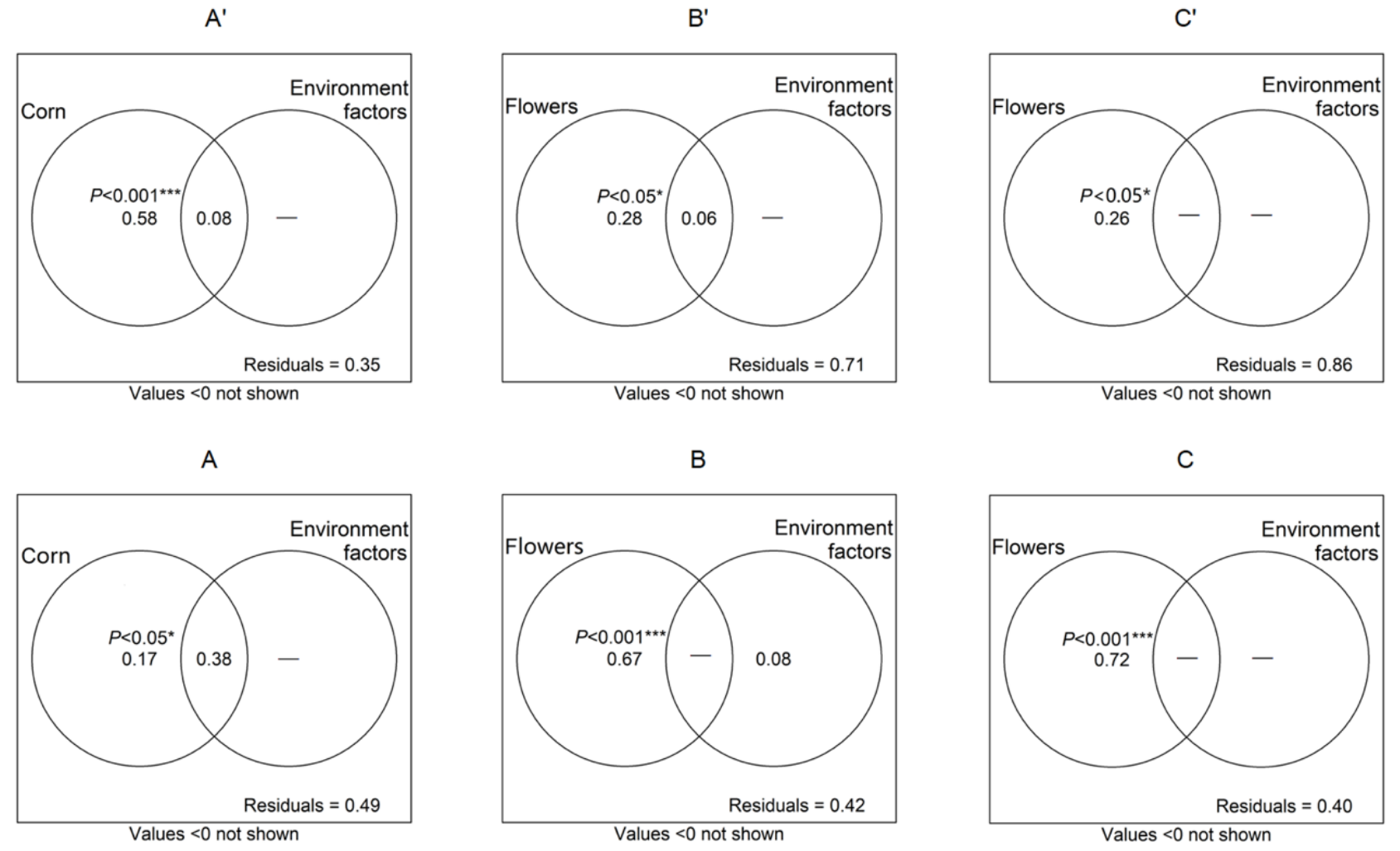
VPA analysis: Environmental factors (SWC, pH, SOMC) and food choices (wildflowers or corn) explain adult and larval spatial distributions. The intersection is the common explanation value of environmental factors and food. The other part of each circle is the separate explanation value. Explanatory values are statistically significant at * P<0.05; ** P<0.01; and *** P<0.001.
References
- The test was conducted in Petri dishes (60mm diameter, 15mm height) containing filter paper, a wet cotton ball, and a mating couple. We fed the couples with one of the food preparation: the pollen, or nectar, maize leaves, grass leaves and potato. To measure the fertility rate, we collected the eggs and recorded the quantity as fecundity for a total of ten replicates after feeding on each type of food. The eggs were placed on soaked filter paper for 10-14 days to hatch (Liu et al., 1988), after which we counted the number of eggs that hatched. Grass roots and germinated maize were used to evaluate the feeding preference of the third-instar larvae of the same body size as food consumption in 7 days, which were foods that could be obtained in the field, with potato as reference. For preference assessment, 0.5 g of the food was added to Petri dishes containing in situ soil.
Services
Article usage statistics
Loading…