Research Article · Volume 13, Issue 8, 8 August 2025 · Open Access
Dietary MCFAs and Lauric Acid as Antibiotic Alternatives: Effects on Growth, Immunity and Gut Health in Weaned Pigs
· · · ·
Affiliations & Notes ⌄
- 1Department of Animal Sciences, Faculty of Agriculture, Kasetsart University, Bangkok, Thailand. *Correspondence | Theerawit Poeikhampha, Department of Animal Sciences, Faculty of Agriculture, Kasetsart University, Bangkok, Thailand
- 2Email: theerawit.p@ku.th
Article Info ⌄
- Journal:
- Advances in Animal and Veterinary Sciences
- Published:
- 8 August 2025

From the article
- The finding in this study revealed that supplements with MCFAs and C12 were improved in piglet health as represented in WBC, villous height and crypt height.
- The results represent the role of MCFAs and C12 that they might be the alternatives to reduced using antibiotics in piglet diets.
Selected from the article's own text.
Abstract
INTRODUCTION
Weaning is regarded as one of the most important stages of pig production and related to the financial benefits of pig farms. One of the most difficult periods in a pig’s life is the immediate post-weaning phase . Piglets are separated from the sow, the dietary and environment changes. These factors affect weaning stress in many piglets. The stress in weaning often causes function and morphology in small intestines, digestion system and absorption abilities, damages intestinal barrier function, and leads to decrease feed intake, an increase in the rate of diarrhea, and growth retardation . Antibiotics (AB) are mostly used to control infectious illnesses in intensive pig production systems and are a major cause of antibiotic resistance. Their prophylactic usage in feed is currently being reviewed after the EU banned the use of ABs as growth boosters. This will directly affected on piglet health after removing AB from a diet . Short-term AB use and increasing weaning age decreased mortality and increased the weight sold per weaned pig . It is now commonly known that bacteria and genes resistant to antibiotics are carried from the environment and can have a negative impact on human and animal health . The increasing of reports related to antimicrobial resistance (AMR) in humans is recognized as one of the major health risks . Since then, colistin-resistant bacteria have been discovered in humans who have not used colistin. This is strongly related to the human and animal sectors regarding the spread of AMR .
Caprylic acid (C8), capric acid (C10), lauric acid (C12), and caproic acid (C6) are examples of MCFAs, which are saturated fatty acids with a carbon chain length varying from six to twelve carbons . Because their carbon chains are lipophilic and joined to a hydrophilic carboxyl group, MCFAs have a hydrophilic/lipophilic equilibrium with bacterial cell membranes . Coconut oil, milk fat, and palm kernel oil are the fat sources of MCFAs . MCFAs are utilized in animal feed formulations since triglycerides are supplied at higher rates to supply free fatty acids . MCFAs are known to have a high potential as antibacterial qualities such as against bacteria, viruses, fungus, and algae but their taste and odor are difficult to utilize in diet ; . Supplementation of MCFAs in the diet affected on intestinal morphology and gut microbiota by increasing villi heights and crypt depths, and also changed the microbiota ; . Supplements of MCFAs in diet has positive effects in pigs including increased immunity, improved gut health, promoted of gut microbial diversity and improve growth performance . Antimicrobial agents from MCFAs are naturally occurring and not harmful to humans or animals. It do not cause residues or the creation of cross-resistance. They are suggested as a beneficial substitute in-feed antibiotics, used to promote growth, and prevent gastrointestinal disorders .
Therefore, reducing antibiotics in animal feed by supplementing with medium-chain fatty acids (MCFAs) and lauric acid (C12) may promote piglet health. This may be a valuable alternative to in-feed antibiotics to promote animal growth and prevent gastrointestinal diseases.
MATERIALS AND METHODS
Ethical Approval
This study was approved by Kasetsart University Institutional Animal Care and Use Committee (ACKU67-AGR-035).
Animals and Experimental Treatments
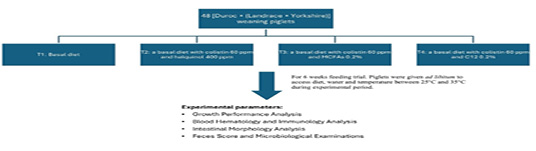
The study was conducted at the Animal Research Farm, Department of Animal Science, Faculty of Agriculture, Kasetsart University, Thailand. In total 48 [Duroc × (Landrace × Yorkshire)] piglets were randomly assigned into 4 groups: basal diet (T1), a basal diet with colistin 60 ppm and halquinol 400 ppm (T2), a basal diet with colistin 60 ppm and mixtures of MCFAs 0.2% (C6 to C12), was supplied by Nutrition Sciences NV, Drongen, Belgium (T3) and a basal diet with colistin 60 ppm and C12 0.2% (T4) (Figure 1). Diets were formulated based on the recommendations of NRC (2012) (Table 1). The piglets were assigned to 12 piglets per group. All pen sizes were approximately 0.35 square meters per piglet. Piglets were given ad libitum to access diet, water and temperature between 25°C and 35°C during experimental period.
Growth Performance Analysis
Feed intake was recorded daily and piglets were weight individual in every week to determine average daily gain (ADG), average daily feed intake (ADFI), and feed conversion ratio (FCR). The formulars were analyzed by the formula based on the research reference Yi et al. (2018).
Blood Hematology and Immunology Analysis
At 28 and 42 of trial, blood samples were collected into ethylenediaminetetraacetic acid-containing tubes to prevent blood coagulation. The hematological analyses including white blood cells (WBCs), neutrophil, lymphocyte, monocyte, eosinophil and basophil were performed using a hematological analyzer (Cell Dyn 3700, Wiesbaden Hesse, Germany).
For immunology analysis, blood samples were collected into vacutainer tubes through jugular vein puncture at 28 and 42 of trial. An 8 mL blood sample was collected in the red-top serum tubes (BD Vacutainer®, UK), then immediately centrifuged at 2,000×g at 4°C for 15 minutes. Serum was separated and stored at –20°C for further analysis.
Table 1: Composition of the experimental diets.
| Item | Pre-Starter Feed ١ | Pre-Starter Feed ٢ |
| Broken Rice | 40.00 | 35.00 |
| Corn | 15.22 | 25.76 |
| Soybean oil | 1.52 | 2.12 |
| SBM 4٨% CP | 27.54 | 25.44 |
| Soybean Full Fat | 5.00 | 0.00 |
| Rice Bran Defatted | 0.00 | 4.38 |
| DL-Methionine | 0.36 | 0.17 |
| L-Lysine HCL | 1.24 | 0.47 |
| L-Threonine | 0.13 | 0.13 |
| Calcium Carbonate | 0.92 | 0.98 |
| MDCP 21% P | 1.61 | 1.08 |
| Salt | 0.35 | 0.30 |
| Choline Chloride 60% | 0.08 | 0.07 |
| Vitamin & Mineral Premix | 0.50 | 0.50 |
| Sodium Bicarbonate | 0.50 | 0.60 |
| Milk Whey Permeate | 5.00 | 3.00 |
| Total | 100.00 | 100.00 |
| Nutrients | ||
| ME | 3,400.00 | 3,350.00 |
| Protein | 21.00 | 18.50 |
| Fat | 4.00 | 4.00 |
| Fiber | 2.02 | 2.20 |
| Calcium | 0.34 | 0.83 |
| Total Phosphorus | 0.65 | 0.70 |
| Avail. P | 0.40 | 0.33 |
| Salt | 0.34 | 0.29 |
| Lysine | 1.30 | 1.30 |
| Methionine + Cystine | 0.98 | 0.71 |
| Methionine | 0.68 | 0.45 |
| Phenylalanine + Tyrosine | 1.65 | |
| Phenylalanine | 0.96 | |
| Tryptophan | 0.26 | 0.27 |
| Threonine | 0.86 | 0.97 |
| Choline | 500.00 | 400.00 |
| Lactose | 4.00 | 2.40 |
Note: Provide per kg of complete diet: Vitamin A 4 MIU, D 0.64 MIU, E 24,000 IU, K3 1.4 g, B1 0.6 g, B2 0.3 g, B6 0.75 g, B12 14 mg, Nicotinic acid 20 g, Pantothenic acid 10 g, Folic acid 0.44 g, Biotin 0.04g, Choline 60 g, Fe 45 g, Cu 40 g, Mn 15 g, Zn 40 g, Co 0.2 g, I 0.4 g, Se 0.06 g, Carrier Added to 1 kg. Kcal/kg for ME. Percentage for Lysine, Methionine + Cystine, Methionine, Tryptophan, Threonine and Lactose. Mg/kg for Choline. SBM 4٨% CP = Soybean meal 48% crude protein , L-Lysine HCL = L-Lysine hydrochloride, MDCP 21% P = Monodicalciumphosphate 21% phosphorus, ME = Metabolizable energy, Avail. P = Available phosphorus.
ELISA kits were used for immunoglobulin analysis including IgG (CAS#E99-131, Bethyl Laboratories, Texas, USA) and IgA (CAS#E101-102, Bethyl Laboratories, Texas, USA). The IgG and IgA assay were quantified following the manufacturer’s protocol. The absorbance values were measured at 450 nm. Immunoglobulin concentrations were determined using a standard curve prepared with known concentrations of IgG and IgA.
Intestinal Morphology Analysis
The intestinal samples (duodenum, jejunum, and ileum) were cut under aseptic conditions (n= 12 per group), then immediately fixed in 10% buffered neutral formalin for 24 hours. After fixation, the small intestine sections were dehydrated and embedded in paraffin. Four transverse sections were cut from each embedded tissue, mounted on glass slides, and stained with hematoxylin and eosin. Morphological analysis was measured for the height of at least ten randomly oriented villi and their corresponding crypts within each section using a light microscope equipped with a calibrated eyepiece graticule (Olympus FSX100; Olympus, Tokyo, Japan).
Feces Score and Microbiological Examinations
Fecal scores were systematically recorded on a daily basis throughout the experimental period, specifically from days 1 to 10 and days 15 to 24. The fecal scoring system employed in this study categorized fecal samples into four distinct levels based on consistency and visual appearance, following the classification system described by : 0 = normal feces, characterized by a well-formed and solid structure; 1 = soft feces, which are less firm than normal but still retain some shape; 2 = mild diarrhea, defined by a liquid and milky consistency with minimal or no form; and 3 = severe diarrhea, marked by watery feces with no discernible structure, resembling dirty water. Following each daily data collection, the fecal areas and the hindquarters of the pigs were thoroughly cleaned to remove any remaining fecal residues.
The microbiological examinations were conducted according to . Quantification of total aerobic and anaerobic bacteria in fecal samples was performed using the spatula method to ensure a detection limit of 10² CFU/g of fecal matter. Bacterial counts were determined using microscopic examination, biochemical assays, and matrix-assisted laser desorption/ionization time-of-flight mass spectrometry (MALDI-TOF MS). Lactobacillus spp. and E. coli were determined according to .
Statistical Analysis
All data were statistically analyzed using analysis of variance (ANOVA) with the SAS software package (SAS Institute Inc., Cary, NC, USA). Significant differences among groups were determined using Duncan’s multiple comparison test within the PROC ANOVA procedure. A significance level was used at P<0.05 to identify statistically significant differences. Results are represented as means. The statistical model was used as the following model:
Where,
Yij: The observation of the traits.
μ: The overall mean.
τi: Effect of treatment (i = T1, T2, T3 and T4).
εij: The random residual error.
Table 2: Growth performance of piglets fed with diet supplementing antibiotic, plus MCFAs, plus C12 during nursery period.
| Item | Group | SEM | P- value | |||
| T1 | T2 | T3 | T4 | |||
| Initial BW, kg | 6.81 | 6.87 | 6.53 | 6.64 | 0.17 | 0.89 |
| Final BW, kg | 29.22 | 29.00 | 28.12 | 29.40 | 0.43 | 0.73 |
| BW Gain, kg | 22.42 | 22.11 | 21.59 | 22.76 | 0.31 | 0.61 |
| ADG, kg | 0.53 | 0.53 | 0.51 | 0.54 | 0.01 | 0.61 |
| ADFI, kg | 0.88 | 0.86 | 0.86 | 0.84 | 0.01 | 0.76 |
| FCR | 1.66 | 1.64 | 1.66 | 1.55 | 0.14 | 0.14 |
Note: T1 = a control diet without antibitotics and additives; T2 = a control diet with colistin 60 ppm and halquinol 400 ppm; T3 = a control diet with colistin 60 ppm and mixtures of medium-chain fatty acids (MCFAs) 0.2%; T4 = a control diet with colistin 60 ppm and mixtures of lauric acid (C12) 0.2%; BW = body wight; ADG = average daily gain; ADFI = average daily feed intake; FCR = feed conversion ratio.
RESULTS AND DISCUSSION
Growth Performance
There was no significant difference between groups for initial body weight, final body weight, body weight gain, average daily gain (ADG), average daily feed intake (ADFI), and feed conversion ratio (FCR) (P>0.05) (Table 2). The initial body weight for T1 to T4 were 6.81, 6.87, 6.53 and 6.64 kg, respectively. The final body weight for T1 to T4 were 29.22, 29.00, 28.12 and 29.40 kg, respectively. Body weight gain for T1 to T4 were 22.42, 22.11, 21.59 and 22.76 kg, respectively. ADG for T1 to T4 were 0.53, 0.53, 0.51 and 0.54 kg, respectively. ADFI for T1 to T4 were 0.88, 0.86, 0.86 and 0.84 kg, respectively. FCR for T1 to T4 were 1.66, 1.64, 1.66 and 1.55, respectively. This study observed similar trends in growth performance which is different from the previous studies ; ; ; . This study was not difference in growth performance because pigs fed at 0.2% MCFAs or 0.2% C12. MCFAs often used during the weaning periods and believed that MCFAs have impacted on the gut microbiota and decreases the gastrointestinal pathogen colonization . Growth performance and nutrient digestion have been demonstrated to be enhanced by dietary probiotic supplements and a high-nutrient diet. MCFAs and basal diet were not significantly difference on average daily gain (ADG) and gain-to-feed ratio . Pigs fed 0.3% MCFAs showed significant improvement in average daily gain (ADG) compared to those fed a basal diet. However, pigs fed with 0.3% MCFAs was similarly ADG with antibiotics supplementation . Piglets fed with MCFAs in diet grew more quickly than controls given soybean oil in the first two weeks. Piglets in the experimental and control groups have the same weight gain. This might be due to the absorption and solubility properties of MCFAs that are responsible for performance improvement . Sows fed coconut oil had higher development rate of piglets. They may have been more acclimated to MCFAs and consumed coconut oil until 28th day of age while still with the sows. Moreover, they able to utilize MCFAs .
Blood Hematology and Immunology
At 28 days of trial, blood hematology including neutrophil, lymphocyte, monocyte, eosinophil, basophil, IgA and IgG were not significantly different between groups (P>0.05) (Table 3). However, there were significant differences between groups in WBC (P<0.05). T4 was lower WBC than T2 (15, 937.50 VS 20,563.98 cell/mm2). At 42 days of trial, WBC, neutrophil, lymphocyte, monocyte, eosinophil, basophil, IgA and IgG were not significantly different between groups (P>0.05). Monoglycerides and medium-chain fatty acids (MCFAs) have become a viable alternative because of important molecular features and functions, such as ability to prevent bacterial and viral infections by enhancing immunity . White blood cells or Leucocytes are the body’s defense against invasive pathogens. They serve as the body’s primary defense against illness, preventing pathogen damage and eliminating poisons and damaged cells . This study represented that MCFAs and lauric acid have improved in immune of piglets as well. Lauric acid has been shown to have great potential to increase immunity . Dietary supplementation of lauric acid demonstrated diarrhea disease, which, after being appropriately treated, recovered rapidly. In contrast to the control group pigs, which died in weaned piglets . MCFAs supplementation increased the proportion of lymphocytes, decreased total leukocytes and the percentage of neutrophils. Moreover, MCFAs was significantly increased serum immunoglobulin M (IgM) and immunoglobulin G (IgG) levels on days 14 and 21 .
Table 3: Blood profiles and immunology of piglets fed with diet supplementing antibiotic, plus MCFAs, plus C12 during nursery period.
| Group | SEM | P- value | ||||
| T1 | T2 | T3 | T4 | |||
| Day – 28 | ||||||
| WBC (cell/mm2) | 18,379.94ab | 20,563.98a | 17,893.97ab | 15,937.50b | 684.90 | <0.05 |
| Neutrophill (%) | 34.50 | 33.83 | 28.33 | 38.25 | 1.76 | 0.27 |
| Lymphocyte (%) | 64.16 | 60.33 | 60.00 | 56.25 | 1.77 | 0.51 |
| Monocyte (%) | 4.50 | 4.00 | 3.83 | 3.50 | 0.49 | 0.93 |
| Eosinophill (%) | 1.50 | 1.67 | 2.67 | 1.50 | 0.34 | 0.55 |
| Basophil (%) | 0.50 | 0.33 | 0.33 | 0.00 | 0.10 | 0.53 |
| IgA (g/L) | 0.06 | 0.08 | 0.07 | 0.08 | 0.003 | 0.37 |
| IgG (g/L) | 1.97 | 1.86 | 1.70 | 1.28 | 0.18 | 0.30 |
| Day - 42 | ||||||
| WBC (cell/mm2) | 23,965.00 | 31,291.49 | 26,312.50 | 18,660.00 | 2,390.86 | 0.25 |
| Neutrophill (%) | 20.83 | 16.97 | 16.50 | 18.00 | 1.53 | 0.19 |
| Lymphocyte (%) | 78.25 | 76.50 | 76.43 | 75.33 | 1.58 | 0.94 |
| Monocyte (%) | 4.67 | 4.50 | 3.75 | 3.33 | 0.63 | 0.88 |
| Eosinophill (%) | 1.53 | 1.25 | 0.50 | 0.50 | 0.22 | 0.19 |
| Basophil (%) | 0.00 | 0.39 | 0.25 | 0.50 | 0.10 | 0.36 |
| IgA (g/L) | 0.07 | 0.08 | 0.10 | 0.10 | 0.005 | 0.17 |
| IgG (g/L) | 2.04 | 2.42 | 2.05 | 1.33 | 0.24 | 0.50 |
a–b Within a row, means without a common superscript differ (P < 0.05). Note: T1 = a control diet without antibitotics and additives; T2 = a control diet with colistin 60 ppm and halquinol 400 ppm; T3 = a control diet with colistin 60 ppm and mixtures of medium-chain fatty acids (MCFAs) 0.2%; T4 = a control diet with colistin 60 ppm and mixtures of lauric acid (C12) 0.2%; WBC = White blood cell.
Intestinal Morphology
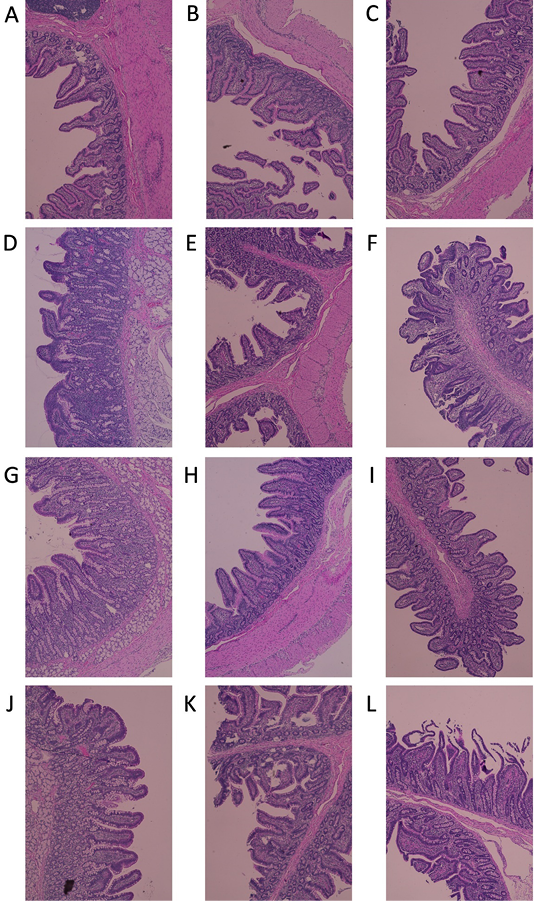
Intestinal morphology was analyzed for villous height, crypt depth and V/C ratio in duodenum, jejunum and ileum (Figure 2). The villous height and crypt depth in duodenum, jejunum and ileum were significantly different between groups (P<0.05) (Table 4). V/C ratio in duodenum was no significant differences between groups (P>0.05) but significant difference between groups in V/C ratio of jejunum and ileum (P<0.01). In duodenum, T4 had the highest villous height and crypt depth. In jejunum, T3 had the highest villous height. Crypt depth was the highest in T4. The V/C ratio was the highest in T2 and T3. In ileum, villous height was the highest in group 2. Crypt depth in T1 and T4 was higher than T3. The V/C ratio was the highest in T3. Among the biggest obstacles of pig production is decreased in antibiotic use. Medium-chain fatty acids are among the many compounds that the scientific community has investigated as alternatives to antibiotics because of their antibacterial and protective effects on the gut health of piglets . In addition to improving piglets’ energy supply and performance, medium-chain triglycerides and medium-chain fatty acids may also stabilise the intestinal flora and promote piglets’ health during the post-weaning phase . Villi heights and crypt depths were increased in diet supplemented with MCFAs ; . However, there were no significantly difference on the intestinal weight, ileum inflammatory infiltrates, epithelial regeneration, oedema and hyperaemia between the treatment groups (premix with or without short and medium chain fatty acids) after 7 days post-challenge . Feed basal diet supplemented with 0.2% of phytogenic premix (PHY1) and basal diet supplemented with 0.2% of phytogenic premix added with 2000 ppm of SCFAs and MCFAs (PHY2) were no significant differences in the histological analysis between the groups .
Feces Score and Microbiological Examinations
Feces score in pre-start period and start period were no significant differences between groups (P>0.05) (Table 5). Bacteria was analyzed including aerobic bacteria, anaerobic bacteria, Lactobacillus spp. and E. coli. There were no significant differences with anaerobic bacteria and Lactobacillus spp. (P>0.05) (Table 5). The aerobic bacteria and E. coli were significantly different between groups (P<0.01). Aerobic bacteria were the lowest in T4. T2 and T4 had higher E. coli than T1. Medium-chain fatty acids (MCFAs; C6–12) have shown antibacterial properties against a variety of pathogens, including Escherichia coli .
MCFAs are utilized for piglet feeding because they are more absorbed and metabolized. MCFAs influence on the gut microbiota and have an inhibitory effect on the bacterial concentrations in the digesta, especially on coliforms and Salmonella . MCFAs have become an alternative to replace antibiotics because of their function as ability to prevent bacterial and viral infections. Monoglycerides and MCFAs demonstrate potential in feed to stop the spread of disease. In pig production, MCFAs and monoglycerides may emerge as a feed additive for enhancing gut health and reducing feed pathogens .
Table 4: Intestinal morphology of piglets fed with diet supplementing antibiotic, plus MCFAs, plus C12 during nursery period.
| Item | Group | SEM | P- value | |||
| T1 | T2 | T3 | T4 | |||
| Duodenum | ||||||
| Villous Hight | 593.02d | 690.68c | 707.08c | 749.15c | 15.8 | <0.01 |
| Crypt Depth | 295.34b | 294.93b | 339.18ab | 352.45a | 9.12 | <0.05 |
| V/C ratio | 2.02 | 2.35 | 2.11 | 2.13 | 0.05 | 0.10 |
| Jejunum | ||||||
| Villous Hight | 635.21d | 667.31cd | 698.93c | 641.21d | 7.62 | <0.01 |
| Crypt Depth | 268.73ab | 240.26ab | 232.10b | 277.43a | 6.62 | <0.05 |
| V/C ratio | 2.36d | 2.78c | 3.07c | 2.34d | 0.08 | <0.01 |
| Ileum | ||||||
| Villous Hight | 532.73d | 587.17c | 558.16cd | 560.31cd | 7.13 | <0.01 |
| Crypt Depth | 257.93a | 247.75ab | 223.69b | 259.94a | 4.68 | <0.05 |
| V/C ratio | 2.07d | 2.37cd | 2.57c | 2.15d | 0.06 | <0.01 |
a–b Within a row, means without a common superscript differ (P < 0.05). c–d Within a row, means without a common superscript differ (P < 0.01). Note: T1 = a control diet without antibitotics and additives; T2 = a control diet with colistin 60 ppm and halquinol 400 ppm; T3 = a control diet with colistin 60 ppm and mixtures of medium-chain fatty acids (MCFAs) 0.2%; T4 = a control diet with colistin 60 ppm and mixtures of lauric acid (C12) 0.2%; V/C ratio = Villous Height/ Crypt Depth ratio.
Table 5: Feces score and bacteria of piglets fed with diet supplementing antibiotic, plus MCFAs, plus C12 during nursery period.
| Item | Group | SEM | P- value | |||
| T1 | T2 | T3 | T4 | |||
| Feces score Pre start | 0.54 | 1.01 | 0.96 | 0.64 | 0.09 | 0.17 |
| Feces score Start | 0.31 | 0.22 | 0.24 | 0.34 | 0.03 | 0.58 |
| Aerobic (Log CFU/g) | 6.55c | 6.73c | 6.72c | 5.96d | 0.32 | <0.01 |
| Anaerobic (Log CFU/g) | 7.61 | 7.40 | 7.29 | 7.77 | 0.03 | 0.41 |
| Lactobacillus spp. (Log CFU/g) | 6.41 | 6.35 | 6.25 | 6.31 | 0.03 | 0.41 |
| E. coli (Log CFU/g) | 2.83d | 5.50c | 5.47c | 4.02cd | 0.32 | <0.01 |
c–d Within a row, means without a common superscript differ (P < 0.01). Note: T1 = a control diet without antibitotics and additives; T2 = a control diet with colistin 60 ppm and halquinol 400 ppm; T3 = a control diet with colistin 60 ppm and mixtures of medium-chain fatty acids (MCFAs) 0.2%; T4 = a control diet with colistin 60 ppm and mixtures of lauric acid (C12) 0.2%.
CONCLUSIONS AND RECOMMENDATIONS
The finding in this study revealed that supplements with MCFAs and C12 were improved in piglet health as represented in WBC, villous height and crypt height. Supplement with C12 was decreased in E. Coli in feces. The results represent the role of MCFAs and C12 that they might be the alternatives to reduced using antibiotics in piglet diets. Further research should focus into MCFAs and biological mechanism related to animal health and production efficiency.
ACKNOWLEDGMENTS
The authors are thankful to the Department of Animal Science, Faculty of Agriculture, Kasetsart University, for providing the necessary facilities for this study. The authors did not receive any funding for this study. The authors also gratefully acknowledge the Technical and Scientific Departments of Nuscience for their valuable support and detailed information shared on MCFAs.
NOVELTY STATEMENTS
This study’s goal was to reduce antibiotics in animal feed by supplement with medium-chain fatty acids (MCFAs) and lauric acid (C12) to promote piglet health.
AUTHOR’S CONTRIBUTIONS
Kaweenuch Chiengsorn and Theerawit Poeikhampha: Conducted the study, data analysis, and drafted and revised the manuscript.
Sombat Prasongsook, Chaiyapoom Bunchasak and Autchara Kayan: Provided technical assistance during the experiments.
Theerawit Poeikhampha: Study conception and design and review the manuscript.
All authors have read and approved the final manuscript.
Conflict of Interest
The authors declare that they have no competing interests.
Figures

Animals and experimental treatments.

Intestinal histology of piglets fed with diet supplementing antibiotic, plus MCFAs, plus C12 during nursery period. T1 = a control diet without antibitotics and additives; T2 = a control diet with colistin 60 ppm and halquinol 400 ppm; T3 = a control diet with colistin 60 ppm and mixtures of medium-chain fatty acids (MCFAs) 0.2%; T4 = a control diet with colistin 60 ppm and mixtures of lauric acid (C12) 0.2%. (A) = Duodenum: T1; (B) = Jejunum: T1; (C) = Ileum: T1; (D) = Duodenum: T2; (E) = Jejunum: T2; (F) = Ileum: T2; (G) = Duodenum: T3; (H) = Jejunum: T3; (I) = Ileum: T3; (J) = Duodenum: T4; (K) = Jejunum: T4; (L) = Ileum: T4.
References
- Caprarulo V, Turin L, Hejna M, Reggi S, Dell’Anno M, Riccaboni P, Trevisi P, Luise D, Baldi A, Rossi L (2022). Protective effect of phytogenic based additives in enterotoxigenic Escherichia coli challenged piglets. PREPRINT (Version 1), available at Research Square. https://doi.org/10.21203/rs.3.rs-1207181/v1[CrossRef]
- Caprarulo V, Turin L, Hejna M, Reggi S, Dell’Anno M, Riccaboni P, Trevisi P, Luise D, Baldi A, Rossi L (2023). Protective effect of phytogenic plus short and medium-chain fatty acids-based additives in enterotoxigenic Escherichia coli challenged piglets. Vet. Res. Commun., 47: 217-31. https://doi.org/10.1007/s11259-022-09945-0[CrossRef]
- Decuypere J, Dierick N (2003). The combined use of triacylglycerols containing medium-chain fatty acids and exogenous lipolytic enzymes as an alternative to in-feed antibiotics in piglets: concept, possibilities and limitations. An overview. Nutr. Res. Rev., 16: 193-210. https://doi.org/10.1079/NRR200369[CrossRef]
- Devi SM, Kim I (2014). Effect of medium chain fatty acids (MCFA) and probiotic (Enterococcus faecium) supplementation on the growth performance, digestibility and blood profiles in weanling pigs. Vet. Med., 59(11): 527-535. https://doi.org/10.17221/7817-VETMED[CrossRef]
- Diana A, Manzanilla EG, Calderón Díaz JA, Leonard FC, Boyle LA (2017). Do weaner pigs need in-feed antibiotics to ensure good health and welfare? PLoS One, 12(10): e0185622. https://doi.org/10.1371/journal.pone.0185622[CrossRef]
- Faccin JE, Tokach MD, Allerson MW, Woodworth JC, DeRouchey JM, Dritz SS, Bortolozzo FP, Goodband RD (2020). Relationship between weaning age and antibiotic usage on pig growth performance and mortality. J. Anim. Sci., 98(12): skaa363. https://doi.org/10.1093/jas/skaa363[CrossRef]
- Glenn A, Armstrong CE (2019). Physiology of red and white blood cells. Anaest. Intens. Care M., 20(3): 170-4. https://doi.org/10.1016/j.mpaic.2019.01.001[CrossRef]
- Han Y, Zhan T, Zhao Q, Tang C, Zhang K, Han Y, Zhang J (2020). Effects of mixed organic acids and medium chain fatty acids as antibiotic alternatives on the performance, serum immunity, and intestinal health of weaned piglets orally challenged with Escherichia coli K88. Anim. Feed Sci. Technol., 269: 114617. https://doi.org/10.1016/j.anifeedsci.2020.114617[CrossRef]
- Hanczakowska E, Świątkiewicz M, Natonek-Wiśniewska M, Okoń K (2016). Medium chain fatty acids (MCFA) and/or probiotic Enterococcus faecium as a feed supplement for piglets. Livestock Sci., 192: 1-7. https://doi.org/10.1016/j.livsci.2016.08.002[CrossRef]
- Hartemink R, Rombouts FM (1999). Comparison of media for the detection of bifidobacteria, lactobacilli and total anaerobes from faecal samples. J. Microbiol. Methods, 36(3): 181-92. https://doi.org/10.1016/S0167-7012(99)00031-7[CrossRef]
- Hermans D, De Laet M (2014). Reaching genetic potential with medium chain fatty acids (MCFAs). Int. Poult. Prod., 22: 7-9.
- Hossain A, Habibullah-Al-Mamun M, Nagano I, Masunaga S, Kitazawa D, Matsuda H (2022). Antibiotics, antibiotic-resistant bacteria, and resistance genes in aquaculture: risks, current concern, and future thinking. Environ. Sci. Pollut. Res. Int., 29(8): 11054-11075. https://doi.org/10.1007/s11356-021-17825-4[CrossRef]
- Jackman JA, Boyd RD, Elrod CC (2020). Medium-chain fatty acids and monoglycerides as feed additives for pig production: towards gut health improvement and feed pathogen mitigation. J. Anim. Sci. Biotechnol., 11: 44. https://doi.org/10.1186/s40104-020-00446-1[CrossRef]
- Jadeja NB, Worrich A (2022). From gut to mud: dissemination of antimicrobial resistance between animal and agricultural niches. Environ. Microbiol., 24(8): 3290-306. https://doi.org/10.1111/1462-2920.15927[CrossRef]
- Jayaraman B, Nyachoti CM (2017). Husbandry practices and gut health outcomes in weaned piglets: A review. Anim. Nutr., 3(3): 205-11. https://doi.org/10.1016/j.aninu.2017.06.002[CrossRef]
- Kovanda L, Zhang W, Wei X, Luo J, Wu X, Atwill ER, Vaessen S, Li X, Liu Y (2019). In vitro antimicrobial activities of organic acids and their derivatives on several species of gram-negative and gram-positive bacteria. Molecules, 24(20): 3770. https://doi.org/10.3390/molecules24203770[CrossRef]
- Lauridsen C (2020). Effects of dietary fatty acids on gut health and function of pigs pre-and post-weaning. J. Anim. Sci., 98(4): skaa086. https://doi.org/10.1093/jas/skaa086[CrossRef]
- Lee YY, Tang TK, Chan ES, Phuah ET, Lai OM, Tan CP, Wang Y, Ab Karim NA, Mat Dian NH, Tan JS (2022). Medium chain triglyceride and medium-and long chain triglyceride: metabolism, production, health impacts and its applications–a review. Crit. Rev. Food Sci. Nutr., 62(15): 4169-85. https://doi.org/10.1080/10408398.2021.1873729[CrossRef]
- Li Y, Zhang H, Yang L, Zhang L, Wang T (2015). Effect of medium-chain triglycerides on growth performance, nutrient digestibility, plasma metabolites and antioxidant capacity in weanling pigs. Anim. Nutr., 1(1): 12-8. https://doi.org/10.1016/j.aninu.2015.02.001[CrossRef]
- National Research Council (2012). Nutrient requirements of swine. Washington, DC: The National Academies Press.
- Omachi DO, Aryee AN, Onuh JO (2024). Functional lipids and cardiovascular disease reduction: a concise review. Nutrients, 16(15): 2453. https://doi.org/10.3390/nu16152453[CrossRef]
- Pérez-Calvo E, Wicaksono AN, Canet E, Daulton E, Ens W, Hoeller U, Verlhac V, Celi P, Covington JA (2019). The measurement of volatile organic compounds in faeces of piglets as a tool to assess gastrointestinal functionality. Biosyst. Eng., 184: 122-9. https://doi.org/10.1016/j.biosystemseng.2019.06.005[CrossRef]
- Pluske J, Williams I, Aherne F, (1996). Villous height and crypt depth in piglets in response to increases in the intake of cows’ milk after weaning. Anim. Sci., 62(1): 145-58. https://doi.org/10.1017/S1357729800014429[CrossRef]
- Rebucci R, Comi M, Ghiringhelli M, Giorgi S, Cheli F, Bontempo V (2021). Lauric acid saponified with calcium ameliorates indices of intestinal function and gut health in weaned piglets. Ital. J. Anim. Sci., 20: 1479-90. https://doi.org/10.1080/1828051X.2021.1944338[CrossRef]
- Roopashree P, Shetty SS, Kumari NS (2021). Effect of medium chain fatty acid in human health and disease. J. Funct. Foods., 87: 104724. https://doi.org/10.1016/j.jff.2021.104724[CrossRef]
- Schwaiger K, Storch J, Bauer C, Bauer J (2020). Development of selected bacterial groups of the rectal microbiota of healthy calves during the first week postpartum. J. Appl. Microbiol., 128(2): 366-75. https://doi.org/10.1111/jam.14484[CrossRef]
- Świątkiewicz M, Hanczakowska E, Okoń K, Kowalczyk P, Grela ER (2020). Effect of maternal diet and medium chain fatty acids supplementation for piglets on their digestive tract development, structure, and chyme acidity as well as performance and health status. Animals, 10: 834. https://doi.org/10.3390/ani10050834[CrossRef]
- Tang X, Xiong K, Fang R, Li M (2022). Weaning stress and intestinal health of piglets: A review. Front. Immunol., 13: 1042778. https://doi.org/10.3389/fimmu.2022.1042778[CrossRef]
- Yacouba A, Olowo-Okere A (2020). Global trends and current status in colistin resistance research: a bibliometric analysis (1973-2019). F1000 Research. 9: 856. https://doi.org/10.12688/f1000research.25124.1[CrossRef]
- Yi Z, Li X, Luo W, Xu Z, Ji C, Zhang Y, Nie Q, Zhang D, Zhang X (2018). Feed conversion ratio, residual feed intake and cholecystokinin type A receptor gene polymorphisms are associated with feed intake and average daily gain in a Chinese local chicken population. J. Animal. Sci. Biotechnol., 9: 50. https://doi.org/10.1186/s40104-018-0261-1[CrossRef]
- Zentek J, Buchheit-Renko S, Ferrara F, Vahjen W, Van Kessel A, Pieper R (2011). Nutritional and physiological role of medium-chain triglycerides and medium-chain fatty acids in piglets. Anim. Health Res. Rev., 12(1): 83-93. https://doi.org/10.1017/S1466252311000089[CrossRef]
- Zhang JY, Baek DH, Kim IH (2019). Effect of dietary supplemental medium chain fatty acids instead of antibiotics on the growth performance, digestibility and blood profiles in growing pigs. J. Anim. Physiol. Anim. Nutr., 103(6): 1946-51. https://doi.org/10.1111/jpn.13175[CrossRef]
- Zheng L, Duarte ME, Sevarolli LA, Kim SW (2021). Intestinal Health of Pigs Upon Weaning: Challenges and Nutritional Intervention. Front. Vet. Sci., 8: 91. https://doi.org/10.3389/fvets.2021.628258[CrossRef]
- Zhou Z, Huang J, Hao H, Wei H, Zhou Y, Peng J (2019). Applications of new functions for inducing host defense peptides and synergy sterilization of medium chain fatty acids in substituting in-feed antibiotics. J. Funct. Foods., 52: 348-59. https://doi.org/10.1016/j.jff.2018.11.028[CrossRef]
Services
Article usage statistics
Loading…