
Hydropericardium hepatitis syndrome (HHS) in broilers is an emerging threat, causing huge economic loss to poultry industry every year. Fowl adenoviruses (FAdVs) associated with HHS could disturb growth, viability and immunity in commercial broilers. The main aim of the present study was to detect and characterize FAdVs. Liver tissues were collected from poultry flocks showing clinical signs of HHS and investigated using PCR assay for FAdVs. The FAdVs were detected in 8 samples collected from different flocks. Positive PCR amplicons were sequenced to genetically identify the FAdVs. Phylogenetic analysis revealed two distinct clusters among FAdVs. One cluster containing 3 strains belonged to the FAdV- C species and serotyped as FAdV-4 and showed close proximity at the nucleotide level. The other cluster containing three strains belonged to the FAdV-D species and serotyped as FAdV-11. Furthermore, the sequencing analysis of detected field strains revealed the high similarity and close clustering with FAdV-4 and FAdV-11 strains isolated from neighboring countries, suggesting geographic and temporal relationships among these strains. This evidence emphasizes the need of further detailed and more systemic approaches to evaluate FAdVs diffusion and characterization to design effective control strategies.
Research Article · Volume 51, Issue 6, 14 August 2019 · Open Access
Detection and Phylogeny of Fowl Adenovirus Associated with Hydropericardium Hepatitis Syndrome in Broilers
· · · · · · · · · ·
Affiliations & Notes ⌄
- 1Department of Biology, Virtual University, Lahore 2 Department of molecular Biology, Virtual University of Pakistan 3Department of Breeding and Genetics, Cholistan University of Veterinary and Animal Sciences, Bahawalpur 4Punjab Livestock & Dairy Development Department, Chakwal 5Poultry Research Ä°nstitute, Rawalpindi 6Research wing, Livestock and Dairy Development Department, Punjab 7 Department of Microbiology, Friedrich Loeffler Institute Jena, Germany 8Department of Pathology, PMAS Arid Agri
Article Info ⌄
- Journal:
- Pakistan Journal of Zoology
- Published:
- 14 August 2019

From the article
- FAdVs infection was only observed in broilers while no outbreaks were reported from flocks of layer birds.
- Furthermore, phylogenetic analysis of FAdV-4 strain isolated in this study showed close association and higher similarity with FAdVs-4 isolates reported from India, Pakistan, and China in the past.
- The results showed that FAdV-4 is the dominant pathogen in this HHS outbreak in Chakwal.
- Results of this study revealed the presence of FAdV-4 and FAdV-11 in Chakwal broiler flocks which closely clustered with previously reported strains in Pakistan and neighbouring countries.
Selected from the article's own text.
Abstract
Introduction
Poultry industry of Pakistan represents one of the largest agro based segment of Pakistan’s economy which is growing continuously, providing numerous opportunities for the spread of multiple diseases in the absence of control measurements. Disease out breaks of different diseases are continuing to cause heavy economic losses to the poultry producers. It is therefore important to control disease outbreaks among poultry flocks to maximize profit of the producer (Usman et al., 2017; Nisa et al., 2017).
Adenoviruses are non-enveloped icosahedral viruses in Adenoviridae family, containing a linear double-stranded DNA (25-46 kbp). The family Adenoviridae has been classified into five different genera namely: Aviadenovirus, Siadenovirus, astadenovirus, Atadenovirus and Ichtadenovirus. Ichtadenovirus. Fowl adenoviruses (FAdVs) or Aviadenoviruses are common contagious poultry viruses which have been detected throughout the world. Twelve serotypes of FAdVs (FAdV-1 to 8a and -8b to 11) have been identified to date. All serotypes of FAdVs have been isolated from chicken and classified into five species (FAdV A–E) based on restriction enzyme digest pattern and serum cross-neutralization test (Harrach et al., 2012). Nearly all FAdV serotypes cause disease, including Angara disease or hydropericardium hepatitis syndrome (HHS) and inclusion body hepatitis (IBH). Three main structural proteins of FAdVs capsids are hexon, fiber and penton base. The hexon gene is used for serotyping as it harbors the major neutralizing epitope while binding between viruses and hosts is mediated by the fiber protein. Whereas the penton protein play a significant role in the replication of the virus (Harrach et al., 2012).
HHS is usually known by the name of “Angara Disease” based on its first outbreak in 1987 on a broiler farm of Angara Goth situated near Karachi in Pakistan. The disease is also known as “leechi disease” in İndia because of characteristic clinical appearance of heart resembling peeled leechi fruit during the disease (Akhtar, 2007). Huge economic losses to the broiler industry have been reported in several countries due to higher mortality in young chicken. Moreover, FAdVs infections could also lead to immunosuppression and secondary infections in broilers.
FAdV-4 has been considered a primary cause of HHS and it affects 3 to 6-week-old broiler chickens. FAdV-4 has been reported to transmit easily to healthy chicken via horizontal (oral fecal route) and vertical transmission (Grafl et al., 2012). It is associated by hydropericardium that could leads to higher mortalities in broiler (30 to 70%). Pathognomonic necropsy findings include accumulation of pale straw coloured exudate in the pericardial sac, enlarged, pale friable liver and swollen and congested kidneys. Its clinical symptoms include anorexia, lethargic behavior, ruffled feathers and severe depression. However, hydropericarium is usually considered the main diagnostic features by veterinarians for HHS. İn additions, intranuclear inclusion bodies in the hepatocytes are usually seen during histopathological examination (Pan et al., 2017). Recently, HHS has been reported in several countries including Pakistan, India, Iraq, Japan, and China, resulting in considerable economic losses in these countries (Balamurugan and Kataria, 2004; Zhang et al., 2016; Meulemans et al., 2001; Mittal et al., 2017; Mase et al., 2009; Rehman et al., 2011; Kajal et al., 2014).
Serological and molecular assays have been used to detect and characterize FAdVs infections in poultry. However, the interpretation of results is usually the major issue linked with serological assays because both healthy and sick birds have revealed the presence of antibodies against FAdVs. Different regions of the FAdV viral gene have been used for recognition, differentiation, isolation, and phylogenetic analysis of FAdVs by PCR technique. The most variable region of hexon loop 1 (L1) is flanked by conserved pedestal regions (P1, P2) that is most successful to identify and differentiate a few or all of the 12 FAdV serotypes by using PCR coupled with DNA sequencing or restriction enzyme analysis (Zhang et al., 2016; Meulemans et al., 2001).
Several reports have used PCR of different regions of the FAdV viral gene for detection, differentiation, and phylogenetic analysis of FAdVs. Two onserved pedestal regions (P1, P2) and the variable loops (L1–L4) have been reported in the hexon gene of FADVs. The variable loops are being used as main target gene in PCR assays coupled with DNA sequencing or restriction enzyme analysis. These assays have been proved cost effective and reliable for detection, genotyping and differentiations of FAdVs serotypes (Niczyporuk et al ., 2016; Niu et al., 2016; Raue et al., 1998).
The risk of HHS outbreaks could be minimized by adopting proper managment and biosecurity maeasures. İn addition to this, vaccination might play a key role in preventing HHS. However, there is still dire need of a vaccine with higher efficacy and fewer side to counter FAdVs in poultry (Akhtar, 2007). Despite the random vaccination of commercial broiler flocks, outbreaks of HHS still occur in Pakistan. Therefore, there is an urgent need to develop a more stable and efficacious vaccine for HHS control in Pakistan. The frequent changes observed in the genomic sequence of the viruses sometimes lead to ineffective diagnostic and control measures. Therefore, it is important to investigate the distribution pattern of HHS in different regions and study mutations in its genome to develop better vaccines and risk based prevention measures against HHS infections. No data are available regarding HHS genotyping and phylogeny in commercial poultry in Chakwal Pakistan. To the best of our knowledge, this is the first attempt on HHS molecular detection and phylogeny in this region. The main goal of this study was to detect and characterize FAdvs associated with HHS, and to add a new piece of knowledge about its characterization in Pakistan which is the first step necessary before control measures can be implemented.
Materials and methods
Location and sample collection
The current study plan was approved by animal welfare, ethics and research committee of Virtual University of Lahore, Pakistan. The study was conducted on commercial broiler flocks in different areas (Dbab Kalan, Chakral, Minwal) of Chakwal District during the period from March 2018 to October 2018. Liver tissue samples collected from diseased broiler chicken after necropsy and transported under refrigeration to diagnostic laboratory.
DNA extraction
Liver homogenates from dead chickens were obtained and mixed with phosphate-buffered saline (PBS; 0.1 M, pH 7.2). Samples were vortexed and centrifuged at 12, 000xg for 15 min at 4C. The supernatant was immediately stored at -70C until use. Viral DNA was extracted from supernatant of Liver homogenates using QIAampR DNA Mini Kit (Qiagen GmbH, D-40724, Hilden, Germany) following the manufacturer’s protocols. The DNA was stored at -20°C until use as a template for PCR.
Detection of FAdVs using conventional PCR
To detect FAdVs in the samples, one primer pair (F: 5ʹ-AATTTCGACCCCATGACGCGCCAGG-3ʹ and R: 5ʹ-TGGCGA AAGGCGTACGGAAGTAAGC-3ʹ ) was designed based on the conserved sequence of the hexon gene of the Chicken embryo lethal orphan (CELO) strain (GenBank accession no. U46933), which contained diagnostically relevant sequences that can be used to identify the group and type of FAdV (Chiocca et al., 1996; Niu et al., 2016), and it successfully amplified a 508 bp viral DNA from liver samples. Conventional PCR was conducted to amplify Hexon gene (508 bp) in a 25 μl reaction volume. PCR reactions were performed in a buffer containing 1.5 mM MgCl2, 2.5 μM of each dNTP, 10 μM of each primer, 20 ng of template DNA, and 2.5 U of Taq polymerase (Applied Biosystems, ThermoFisher Scientific, Carlsbad, CA). PCR was performed in an automatic DNA thermal cycler (DNA Engine® Bio-Rad) as described by Niu et al (2016). Briefly, 5 minutes at 95C for initial denaturation followed by 30 cycles of denaturation (95C for 30 sec), annealing (56C for 30 sec) and extension (72C for 45 sec) and a final extension at 72 C for 10 min. Positive and Negative controls were also considered for each PCR reaction. Nuclease free water was used for negative controls in place of DNA template for all PCR reactions. A 100 bp DNA ladder was used to analyze PCR amplicons on 1.5% agarose gel.
Sequencing
Purification of PCR products was performed using PCR Clean-up kit (NucleoSpin®Gel and PCR Clean-up kit, Macherey-Nagel, Düren, Germany) and sent for Sequencing. A commercial company performed sequencing using the PCR primers as sequencing primers.
Statistical analysis and phylogeny
Bio Edit with Clustal W aligning methods was used for editing and alignment of raw nucleaotide sequences. After alignment of sequences in BioEdit software, MEGA5 software was used for phylogeny and evolutionary analysis of hexon gene of FAdVs. Neighbor-joining method was adopted for construction of phylogenetic tree of hexon gene-based sequences (Tamura et al., 2011). The nucleotide sequences of partial segment of the hypervariable region of the hexon gene were compared with reference sequences of the same genes from NCBI GenBank (Table I).
Results
Clinical signs and gross lesions
Sick birds showed depression, lethargy, anorexia and ruffled feathers. Necropsy findings included hydropericardium (straw colored jelly like fluid in pericardium of heart), pale swollen liver and kidney (data not shown).
Overall detection of FAdVs in broiler flocks
The adenovirus hexon gene is often used to study the taxonomy and antigenic properties of FAdVs. We used previsiouly reported primers to amplify the target
region of hexon gene. The designed primers amplified a DNA fragment of the expected size (508 bp) from clinical samples from infected flocks via reverse transcriptase polymerase chain reaction technique (Fig. 1). All positive controls resulted in the expected fragments and no fragment was observed in the negative control. Out of 57 samples, eight tested positive (14%) for FAdV. None of the broiler farms were vaccinated against FAdVs. Eight FAdV positive samples were also screened to find the presence of other viral pathogens of chicken as part of routine diagnostic work by using conventional PCR. None of the samples were positive for avian influenza, infectious bronchitis virus, infectious bursal disease virus and Newcastle disease virus.
Sequence and phylogenetic analyses
The specificity of the amplified fragment was confirmed by DNA sequencing and BLAST analysis. Following submission to NCBI nucleotide blast tool, only sequences from FAdV were returned with significant similarity scores. Only five sequences from positive samples were successfully sequenced and subjected for phylogeny by using MEGA 5 programme. The five sequences were deposited in the GenBank database under accession numbers (MK139650, MK139651, MK139652, MK139653, MK139654). According to phylogenetic analysis, 5 FAdV strains were found to cluster into two distinct clade (Fig. 2). One cluster containing 3 strains (MK139650, MK139651, MK139652) belonged to the FAdV- C species and serotyped as FAdV-4 and showed close proximity at the nucleotide level. The other cluster containing two strains (MK139653, MK139654) belonged to the FAdV- D species and serotyped as FAdV-11.They were closely related to the FAdV-C and FAdVs - D, detected in China, India and Pakistan in the previous years.
Discussion
Pakistan has one of the largest poultry farming operation in the world. İntensive commercial farming and improper control measures has led to rapid rise in viral infections. Thus, epidemiologic research is very important for monitoring disease outbreaks and developing vaccines. HHS has become a matter of great concern for poultry farmers worldwide (Akhtar, 2007; Balamurugan and Kataria, 2004; Niu et al., 2016). HHS not only cause mortality but can also leads to secondary bacterial infections due to its immunosuppressive nature, resulting in severe economic losses (Li et al., 2017). HHS was first reported in 1987 in Pakistan and since then sporadic outbreaks of HHS in chicken have been reported throughout the year. Unfortunately, there is no conclusive evidence regarding the prevalence of FAdVs in broilers due to lack of published data. This reinforces the necessity of promoting molecular surveys towards this emerging pathogen in broilers and need to study its actual role in clinically overt situations.
Higher number of clinical cases of FAdV infection have been reported in recent years, and multiple FAdV strains have been isolated from sick animals in many countries (Schachner et al., 2018; Li et al., 2017; Kim et al., 2008; Niu et al., 2016; Kajan et al., 2013; Mittal et al., 2014; Ojik et al., 2008). In Chakwal, the outbreaks of IBH or HHS displayed an increasing trend over the last five years and caused huge economic losses to the poultry farmers (Personal communication, Dr. Muhammad Usman). Clinical cases of HHS have been primarily observed in young broilers of 3 to 5 weeks of age while random cases HHS have been reported in 10 to 20 weeks old layers and breeder. Due to lack of organised laboratory diagnostic set up and facilities in Pakistan, poultry diseases are usually diagnosed on the basis of necropsy and clinical findings. These practices in the field often leads to misdiagnosis of serious poultry pathogens thus creating hindrance in the control of contagious pathogens. Thus, molecular diagnosis of avian diseases is very important for monitoring disease outbreaks and therefore, current study was designed. Some authors have used PCR and restriction enzyme assays to genotype FAdVs circulating in poultry flocks of Pakistan poultry. Shamim et al (2009) detected and genotyped FAdV-4 during HHS field outbreaks in broiler flocks Karachi. Similarly, Mansoor et al (2009) and Shah et al. (2011) have documented FAdV-4 linked with HHS outbreaks in Faisalabad by using PCR assays coupled with phylogenetic analysis. Jabeen et al. (2015) performed molecular detection, cloning and phylogeny of FAdVs associated with HHS outbreaks from broiler flocks in 2008 in Islamabad. The aim of this study is to detect and to characterize circulating FAdVs in poultry of district Chakwal, and to add a new piece of knowledge about its chacterization in Pakistan which is the first step necessary before control measures can be implemented.
In current study, out of 57 samples, eight tested positive (14%) for FAdV. None of the broiler farms were vaccinated against FAdV. FAdVs infection was only observed in broilers while no outbreaks were reported from flocks of layer birds. The mortality varied from 20% to 65% in various broiler farms due to FAdVs infection. Similarly, huge mortality rate (upto 90%) was reported by Rehman et al (2011) in broiler flocks. Mortality rate depends on several factors such as ventilation, weather and type of birds. Poor ventilation and high humidity have been suggested to enhance mortality rate in HHS affected flocks (Akhtar, 2007). Outbreaks of HHS in some flocks occurred after immunization with a moderately virulent bursal disease vaccine. This suggests that the virulence of this vaccine could have substantial immunosuppressive effect because of a relatively low level of maternal antibodies; therefore, bursa of Fabricius immunization may also be a causal factor in HHS outbreaks as reported previously by Niu et al (2016). In this study, 3 positive sample strains were found as serotype FAdV-4 (FAdVs C) and they exhibited close proximity at the nucleotide level. While, two strains were classified as serotype FAdV-11 (species FAdV-D). Furthermore, phylogenetic analysis of FAdV-4 strain isolated in this study showed close association and higher similarity with FAdVs-4 isolates reported from India, Pakistan, and China in the past. FAdV field strains detected in present study closely cluster among each other and with recent İndian, Chinese and Pakistani strains (Fig. 2), suggesting geographic and temporal relationships among these strains. Considering the geographic proximity and trade exchange among the neighbouring countries, detection of these strains is therefore not surprising. The availability of advanced diagnostic methods has prompted a better identification of the etiologic agents thus favouring molecular diagnosis over serology.
The results showed that FAdV-4 is the dominant pathogen in this HHS outbreak in Chakwal. All FAdV-4 strains obtained from Chakwal were identical, which suggests that they were derived from a common ancestor. Furthermore, All FAdV-4 strains were also identical to FAdV-4 viruses isolated from HHS cases in other countries (China, Russia, Korea, Austria, Canada and India) (Shahzad et al., 2016; Jabeen et al., 2015; Kim et al., 2008; Meulemans et al., 2001; Raue et al., 1998; Choi et al., 2012). This indicates that FAdV-4 may have spread entirely from a common ancestor, although epidemiological relationships are unknown.
In different regions of the world, the clade representing serotype FAdV-4 displays sequence variability depending on geographic origin. Strains from India, Europe, and the United States display 96.3%–99.2% sequence identity (Niczyporuk et al., 2016). Considering the geographic vicinity of these countries and the commercial exchanges, it is therefore not surprising that we detected FAdV-4 and FAdV-11 serotype in Pakistani broiler flocks. Serotype FAdV-4 (species fowl aviadenovirus C) is suspected to have caused outbreaks of HHS in China and other countries. Zhao et al. (2015) isolated the serotype FAdV-4 strain from chickens with hydropericardium syndrome in Jiangsu, and Chen et al. (2017) isolated the FAdV-4 strain in Cherry Valley Ducks. These results indicate that the adenovirus strains in Pakistan and neighboring countries (China, India etc) frequently belong to the serotype FAdV-4 (species fowl aviadenovirus C). To our knowledge, this is the first report of the FAdV-C and FAdV-D species and serotype FAdV-4 and 11 in Chakwal. İn contrast to our findings, the most frequently isolated serotype in Pakistan in recent years, was FAdV-11 (FAdV-D) followed by FAdV-4 (FAdV-D) (Shahzad et al., 2016; Jabeen et al., 2015). Strain HBQ12 and BJH13 cluster together, and they belong to the fowl adenoviruses D species that serotypes as FAdV-11. These results indicated that numerous genotypes or serotypes of FAdVs might be present in the chickens of Pakistan. FAdV strains are regularly detected from chickens. However, the pathogenic roles of most of these viruses are still unknown (Zhang et al., 2016, Kajan et al., 2013; Choi et al., 2012). Even the same serotype can have diverse effects on the animals. İndeed some strains of FAdVs are considered pathogenic and some are nonpathogenic exclusively based on pathological lesions in chicken (Niu et al., 2016). At present, there has been no specific FAdV vaccine available in Pakistan and inactivated liver homogenates from infected chickens are being regularly used as vaccine that is not very much effective. Grgic et al. (2013) developed a live FAdV-4 vaccine, but it lacked neutralizing antibodies. Considering that frequent outbreaks of avian adenovirus have occurred in recent years in Pakistan, a live vaccine may be a potential threat that deserves our full attention. This is the first epidemiologic investigation of FAdV-C and D (serotype 4 and 11) in Chakwal, Pakistan. These findings demonstrate that multiple genotypes and serotypes of FAdVs might cause HHS in chickens in Pakistan.
The aim of this work was to detect and charaterize FAdVs circulating in Chakwal broiler flocks and to add a new piece of knowledge to its epidemiology. This evidence emphasize the need of further detailed and more systemic approaches for FAdVs distribution and prevalence investigation to design effective control strategies. Results of this study revealed the presence of FAdV-4 and FAdV-11 in Chakwal broiler flocks which closely clustered with previously reported strains in Pakistan and neighbouring countries. A comprehensive epidemilogical surveys for the detection of the serotypes of FAdVs using molecular tools will improve the understandings of the global epidemiology of the infection and help in better control of the disease.
Acknowledgement
This study was partially funded by Virtual University, Pakistan.
Statement of conflict of interest
The authors declare no conflict of interest.
Figures
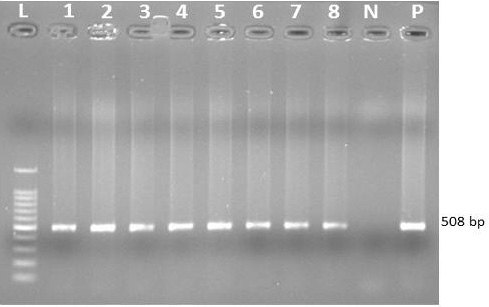
Electrophoresis of the hexon gene from FAdVs. L= 100 bp DNA Ladder, positive samples =1 to 8, P= Positive control. N= negative control
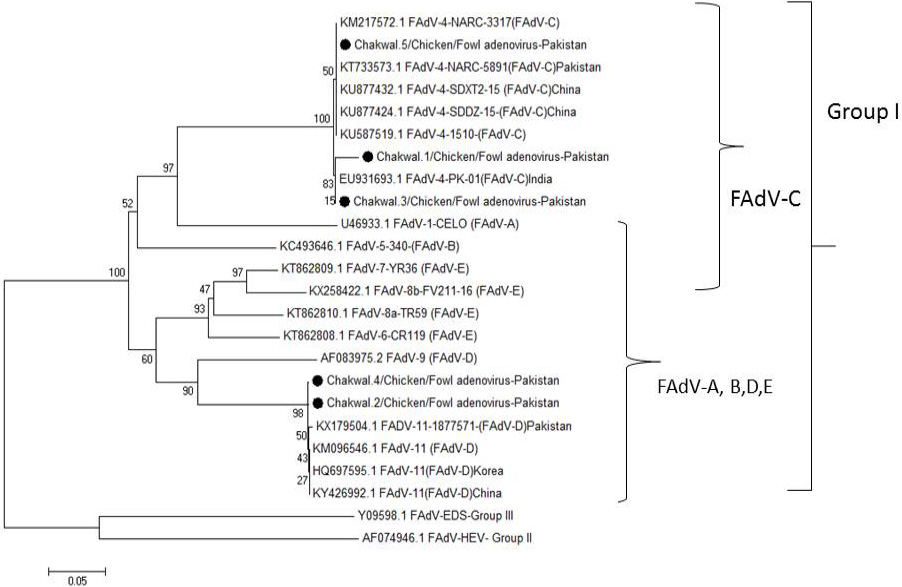
Hexon gene based phylogeny showing FAdVs in black circles which have been detected in present study. The evolutionary comparison was inferred sing Neighbor-Joining method. MEGA.5 software was used for evolutionary analysis and phylogeny.
References
- Strains ( Accession number)
Services
Article usage statistics
Loading…