
The phoretic mites are attached with various body parts of the insects viz., head, thorax, abdomen, acarinarium, legs, wings and antennae. The relationship is purely temporary and the mites opted mainly for the transportation. The phoretic mites are distributed almost all parts of the world. In this study, we describe one new species, Uroobovella tripophinae Sp. Nov. (Acarina: Uropodidae) phoretic attachment on grass hopper Trilophidia turpis Walker (Acrididae: Orthoptera) from Tamil Nadu, India. The attachment is purely phoretic and it attached on the thoracic region of grasshopper. Two long pectinate setae (distally) are present at the posterior end of idiosoma in the new species as against serrate in Uroobovella passalaephorae and Uroobovella bassilianae. The Uroobovella tripophinae is distributed in the tropical region of Tamil Nadu, India.
Short Communication · Volume 57, Issue 5, 29 August 2025 · Open Access
Description of Uroobovella tripophinae Sp. Nov. (Acarina: Uropodidae) Phoretic association with grasshopper Trilophidia turpis Walker (Acrididae: Orthoptera) from Tamil Nadu, India
· · · · · · · ·
Affiliations & Notes ⌄
- 1Institute of Agriculture, Tamil Nadu Agricultural University, Kumulur, Trichy, Tamil Nadu, India 2Department of Entomology, Tamil Nadu Agricultural University, Coimbatore,Tamil Nadu, India. 3Rice Research Station, Tamil Nadu Agricultural University, Ambasamudram, Tamil Nadu, India 4Krishi Vigyan Kendra, Tamil Nadu Agricultural University, Sandhiyur, Tamil Nadu, India 5Regional Research Station, Tamil Nadu Agricultural University, Vriddhachalam, Tamil Nadu, India 6ICAR-Krishi Vigyan Kendra, Tamil
Article Info ⌄
- Journal:
- Pakistan Journal of Zoology
- Published:
- 29 August 2025

From the article
- In this study, we described and illustrated a new Uroobovella tripophinae from India.
- Sometimes the Uropodina mites constitute with their deutonymphs and attached with anal pedicel associated with the host insects.
Selected from the article's own text.
Abstract
Materials and Methods
The grasshoppers were collected through direct survey and collection from various locations of Tamil Nadu, India. For this study, live and dead insect specimens were used for examining the presence of mites. After examination, the insect specimens containing mites were photographed with the help of image analyzer (GAIA Red software) and camera (Nikon F10). Special emphasis was given to visualize the exact place of attachment of mites in various insect specimens. The mite specimens were processed through clearing agent (Lactic acid-50ml, Phenol - 25 ml and distilled water - 25 ml) to soften internal tissues of preserved mites with little or no damage to the exoskeleton . The lactophenol treated mite specimens were cleaned 2-3 times in distilled water until the cloudy interface of lactophenol and water disappeared. Permanent slides were prepared using Hoyer’s medium distilled water, 50 ml; gum arabic (Crystals), 30 g; chloral hydrate, 200 g and glycerine, 20 g.
The exact location of the mite specimens on the slide was also marked on the back side of the slides as per the procedure adopted by Evans (2003). All the mite specimens on permanent slides were closely examined for taxonomic identification using a Carl zeiss phase contrast microscope (Model: Axiostar Plus). The dorsum, ventrum, legs, gnathosoma and other striking characters were drawn using a drawing tube. In this study, Zeiss drawing tube is used, which fits into the light path between the eyepiece and objective lens of a microscope. Drawing was initially done on a tracing sheet with a pencil and inking was performed by means of rotring isograph (0.1mm to 0.6 mm). Then, the measurements of the important taxonomic structures of mite specimens were made with the help of a calibrated ocular micrometer and expressed in microns. The taxonomic drawing was made with camera lucida and the measurements were are given in micrometers (µm) and the setal patter and abbreviation were followed by Evans (2003). The voucher slides have been retained in the collection curated by Dr. V. Radhakrishnan as mentioned in the deposition of materials at Department of Agricultural Entomology, Acarology laboratory, Tamil Nadu Agricultural University, Coimbatore, Tamil Nadu, India.
Family: Urodinychidae
Subfamily: Uropodinae
Tribe: Trichouropodini
Genus: Uroobovella Berlese, 1903
Uroobovella trilophinae sp. nov.
(Fig. 1)
Female deutonymph dorsum
Dorsum 368 long and 225 wide. The vs setae 65 long and pilose. The setae are simple, stout and serrate. 19 pairs of simple, stout setae in the middle of dorsum 15 long; 15 pairs of pilose setae (28-133 long) on the marginal surface of idiosoma. Dorsal surface finely ornamented and punctate in nature. Two pairs of distally pectinate setae present on the posterior end of idiosoma.
Venter
Sternal shield 133 long and 75 wide with five pairs of setae. Sternal setae I 13 long, sternal setae II, III and IV are 15 long and sternal setae V 35 long. Sternal setae V longer than other setae. The anal shield 85 long and 65 wide. Two pairs of long setae (58 and 82) and two pairs of small (8) simple, stout setae and two paranal and an adanal setae are present. Two pairs of simple setae present in between sternal shield and anal shield. The ornamentation is prominent. One pair of metapodal plate are present at the lateral side of anal shield 25 in width and the distance between the two metapodal plates is 133; 7 pairs of setae present at the lateral side of anal shield.
Legs
Leg I to IV measures 170, 203, 188 and 225 long, respectively.
Leg chaetotaxy
Leg I: 0-2-6-2-7-4; Leg II: 0-2-5-5-2-8; Leg III: 0-3-4-5-4-8 and Leg IV: 0-5-6-6-4-8.
Gnathosoma
Gnathosoma 130 long and 65 wide. Four pairs of setae are present on the hypostome; setae C3 prominent, pilose and very long. Palpal pretarsus consist of fine hair like setae.
Male
Not found
Types
The holotype (Female) marked on the slide, India: Tamil Nadu, Coimbatore. 17.VII.2006. Eg: Trilophidia turpis Walker (Acrididae: Orthoptera), Coll: V. Radhakrishnan,
(No: 221/1). Three paratype slides and collection data same as type.
Differential diagnosis
This new species differs from all other species of Uroobovella by the following characters. The length of the idiosoma is similar to Uroobovella phoenicicola , in contrast it differs from Uroobovella hungarica and Uroobovella bambicola . Number of sternal setae was also similar to U. hungarica and differs from all other two species (Table I). Width of the idiosoma also varies from all the three species (Table I). Two long pectinate setae (distally) are present at the posterior end of idiosoma in the new species as against serrate in U. passalaephorae and U. bassilianae. 19 pairs of simple short setae are present in the new species while in contrast to serrate setae (55) on Idiosoma of U. bassilianae.
Relationship to the host
The orange-coloured mites were found attached to the thoracic region of the grasshopper. These mites can attach their chelicerae on the host and the nature of attachment suggests phoresy.
Etymology
The mite species is named after the type host genus.
Discussion
In this study, we described and illustrated a new Uroobovella tripophinae from India. This mite species was belonging to the subfamily Uropodinae based on the distinct morphological characters. Sometimes the Uropodina mites constitute with their deutonymphs and attached with anal pedicel associated with the host insects. This particular new species belongs to the subfamily Uropodinae (Urodinychidae), based on the morphological characters viz., tortoise like uropodine mesostigmatans, typically oval to circular in the dorasal and ventral portion, marginal setae are fringe or basket like arrangement, anal opening with 2–5 circumanal setae, chelicerae typically slender, coeniculi horn-like .
These mites species will never parasitise with the host insects viz., beetles, flies, etc., and it utilizes as a transportation element , this was in accordance with the present study. Our new species was strongly attached with their chelicera in grasshopper as that of Szymkowiak et al. (2007). It possesses long marginal
Table I. Comparison of important traits among Uroobovella spp.
| Details | Uroobovella tripophinae Sp. Nov. | Uroobovella phoenicicola Kontschan et al. (2012) | Uroobovella hungarica Kontschan et al. (2013) | Uroobovella bambicola Kontschan et al. (2015) |
| Length of idiosoma (µm) | 368 | 370-380 | 650-670 | 370-390 |
| Width of idiosoma (µm) | 225 | 270-280 | 540-570 | 270-300 |
| Number of sternal setae | 5 | 8 | 5 | 6 |
| Hypostomal setae | h3 long | h1 long | h1 long | h1 and h3 long |
pilose setae as against small simple setae in Uroobovella passalaephorae Ram., Uroobovella bassilianae Ram., U. zairensis Hirschmann, U. californiana , U. plaumanni Sellnick (1962) and U. axana . The species Uroobovella trilophinae group can be found in tropical regions of India, therefore the first finding in India was no surprise.
Statement of conflict of interest
The authors have declared no conflict of interest.
Figures
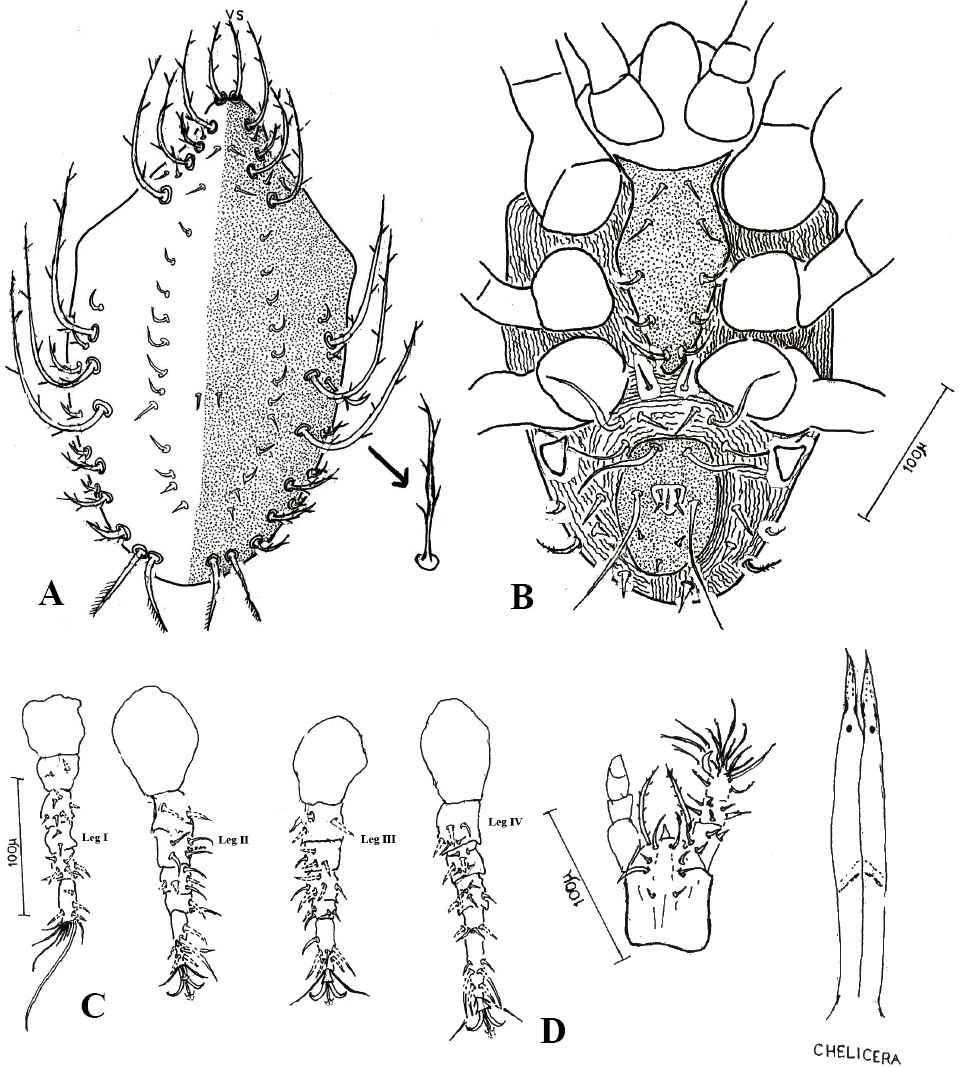
Uroobovella tripophinae, new species; A, dorsum; B, ventrum; C, Legs I – IV; D, gnathosoma
References
- Ainscough, B.D., 1981. Int. J. Acarol., 7: 47-56. https://doi.org/10.1080/01647958108683242[CrossRef]
- Evans, G.O., 2003. Principles of acarology. CAB International, Cambridge, UK. pp. 565.
- Kontschan, J., Wang, G-Q. and Nemenyi, A., 2015. Spixiana, 38: 263–272.
- Kontschan, J., Tambe, J.T. and Riolo, P., 2012. Afr. Inverteb., 53: 593–600. https://doi.org/10.5733/afin.053.0205[CrossRef]
- Kontschan, J., 2013.Opusc. Zool. Budapest., 44: 91-95.
- Krantz, G.W., 1968. A manual of acarology. 2nd edition. Oregon State University Bookstores, Corvallis. pp. 235.
- Lindquist, E.E., Krantz, G.W. and Walter, D.E., 2009. A manual of acarology, 3rd ed. Lubock, USA. pp. 124-232.
- Sellnick, R., 1962. Acarologia, 4: 520-531.
- Szymkowiak, P., Gorski, G. and Bajerlein, D., 2007. Biol. Lett., 44: 75-101.
- Wisniewski, V.J. and Hirschmann, W., 1992. Aus Polen. Acarol., 33: 5 –15.
- Wisniewski, V.J. and Hirschmann, W., 1993. Acarologia, 34: 313-322.
Cited by 1 article
In journals published by ResearchersLinks.
Services
Article usage statistics
Loading…