
The present study provides the morphological and morphometric characterization of some plant parasitic nematode populations, recovered from agricultural fields during surveys of the districts Gilgit and Nager, Gilgit-Baltistan, Pakistan. The analysis of samples yielded a new nematode species and two new reported species belonging to the order Tylenchida as new geographical records for Pakistan. Hemicycliophora pyri n. sp., is characterized by the broadly rounded lip region with two indistinct annuli, closely fitting sheath with 231-247 body annuli, stylet 95-100 µm long, non-raised and non-separated labial disc and gradually tapering long tail. Psilenchus vincigurrae Brzeski, 1991and Ditylenchus equilis Heyns, 1964 have been reported as new record species from Pakistan. These species are described and briefly re-described along with their morphometric data, photomicrographs and illustrations.
Research Article · Volume 55, Issue 4, 21 July 2023 · Open Access
Description of Hemicycliophora pyri n. sp., with Observations on Psilenchus vincigurrae Brzeski, 1991 and Ditylenchus equilis Heyns, 1964 (Nematoda: Tylenchida) from Gilgit-Baltistan, Pakistan
· · · · ·
Affiliations & Notes ⌄
- 1Department of Biological Sciences, Karakorum International University, Gilgit, Gilgit-Baltistan, Pakistan 2National Nematological Research Centre, University of Karachi, Karachi-75270, Pakistan * Corresponding author: erum_i@yahoo.com
Article Info ⌄
- Journal:
- Pakistan Journal of Zoology
- Published:
- 21 July 2023

From the article
- The present study provides the morphological and morphometric characterization of some plant parasitic nematode populations, recovered from agricultural fields during surveys of the districts Gilgit and Nager, Gilgit-Baltistan, Pakistan.
- The analysis of samples yielded a new nematode species and two new reported species belonging to the order Tylenchida as new geographical records for Pakistan.
- Psilenchus vincigurrae Brzeski, 1991and Ditylenchus equilis Heyns, 1964 have been reported as new record species from Pakistan.
- Two species of the genus Hemicycliophora have been reported from Pakistan so far.
Selected from the article's own text.
Abstract
Introduction
In the present study, systematic surveys were conducted of different areas of Gilgit, Baltistan to identify the economically important plant parasitic nematodes that damaged the crops. As a result, some plant parasitic nematode populations, recovered from the agricultural fields of the Districts Gilgit and Nager, Gilgit-Baltistan. The analysis of samples yielded a new nematode species Hemicycliophora pyri n. sp., and two new reported species Psilenchus vinciguerrae and Ditylenchus equilis belonging to order Tylenchida as new records for Pakistan.
Hemicycliophora pyri n. sp. belongs to the superfamily Hemicycliophoroidea that received the common name sheath nematodes due to the presence of an additional cuticle or sheath. The superfamily comprises two families, Hemicycliophoridae and Caloosiidae. The Hemicycliophoridae contain only a single genus Hemicycliophora, with 132 species while Caloosiidae comprises two genera Caloosia and Hemicaloosia with eight and nine species, respectively. They are obligate ectoparasites of plants and inhibit moist soil and aquatic environments. Several Hemicycliophora species are known to damage agricultural crops in different countries .
Members of Hemicycliophoroidea are vermiform, tapering at both extremities but more so posteriorly, rounded to truncate, slightly flattened at the anterior end with an attenuated or filiform tail. Body distinctly, slightly of not recessed immediately posterior to vulva. Two to three labial annuli not modified or separated. Vulva a transverse slit over 0.5 body diameter long, lips either modified and projecting, or not modified and rounded; vagina straight or curved. The male body is generally shorter and more slender than that of female, with a rounded anterior end, offset and tapering posterior end. Spicules arcuate, semi circular, or hook shaped,cloacal lip elongated to form a penial tube. Caudal alae covering less than one third of tail. Tail longer of female.
Two species of the genus Hemicycliophora have been reported from Pakistan so far. Akhtar (1962) reported a known species Hemicycliophora gracilis from Agrostis spp., for the first time from Lahore. A new species Hemicycliophoraveechi was described by Maqbool et al. (1986) as a new species from soil around the roots of herbaceous plants and grasses fromslopes of hill around the lake of Saiful Muluk, Naran, Pakistan . During the present study Hemicycliophora pyri n. sp., has been described from district Gilgit of Gilgit-Baltistan. Many species of the genus Psilenchus and Ditylenchus were reported earlier including new species viz., P. khuzdarensis and D. bilqeesae ; ; . Psilenchus vinciguerrae and Ditylenchus equilis have been reported as new records from district Nager for the first time from Gilgit, Baltistan.
Materials and Methods
Soil samples were collected from different agricultural fields of districts Gilgit and Nager, Gigit-Baltistan. Nematodes were extracted from soil samples by using Cobb sieving and decanting technique , followed by modified Baermann funnel method . Nematodes were then gently heat killed, fixed in TAF (Tri-ethanol-amine Formaldehyde) solution . From TAF, nematodes were transferred to glycerine and subsequently mounted on microscopic slides for identification . Measurements, including Demanian indices (de Man, 1880) and other ratios, were taken with the compound microscope Nikon Eclipse E400, equipped with a drawing tube (Camera Lucida) attached to it for illustrations. Photomicrographs were made with a Nikon DS, Film camera, attached to the same microscope.
Hemicycliophora pyri n.sp.
Description
Female
Body straight or very slightly curved ventrad. Cuticular sheath closely fitting, sheath annules slightly flattened than body annules. Lip region rounded with two annuli. Labial area with open amphids, labial disc not raised and merged with the lip annules. Labial frame work weakly sclerotized. Stylet slender, slightly curved dorsad. Metenchium 80-88µm long and telenchium 12-17µm long. Stylet knobs well-sloped anteriorly with a distinct cavity posteriorly. Oesophagus typical of the genus. Median oesophageal bulb amalgamated with procorpus 14-18µm wide with a distinct valve. Isthmus short encircled by nerve ring. Nerve ring 144-150µm from anterior end. Hemzonid not clearly seen. Excretory pore situated from two to four annuli posterior to base of oesophagus. Vulval lips elongated. Vulval sheath one to two annuli long, vagina thick walled. Gonad prodelphic, spermatheca round to oval, mostly filled with small round sperm cells. Oocytes arranged in a single row. Anus indistinct. Body posterior to vulva gradually narrows to about last quarter. Tail narrows uniformly, ending in a narrow rounded or sometimes slightly wider rounded terminus, annuli on last distinct and smaller than on rest of body.
Male
Not found.
Type habitat and locality
The specimens were collected from soil round the roots of apple (Pyrus malus L.) and cherry (Prunus avium L.) from district Gilgit (village Danyour), Gigit-Baltistan, Pakistan.
Table I. Morphometrics of Hemicycliophora pyri n.sp. (Measurments in µm except L).
| Morphological characters | Holotype female | Paratype females (n=15) Mean ±SD (range) |
| L | 0.99 | 1.02±0.05 (0.90-1.12) |
| a | 21.5 | 21.01±0.94 (19.8-23.0) |
| b | 5.8 | 5.9±0.50 (5.1-6.8) |
| c | 12.6 | 10.35±2.12 (10.7-12.6) |
| c’ | 3.1 | 3.28±0.29 (3.0-4.1) |
| V% | 85 | 83.05±2.00 (80.1-85.7) |
| O | 7.5 | 7.5±1.09 (6-9.3) |
| DGO | 6.5 | 7.3±1.10 (6-9) |
| Stylet length | 98 | 97.83±2.03 (95-100) |
| Metenchium length | 84 | 83.58±3.01 (80-88) |
| Telenchium length | 15.5 | 15.58± 1.32 (12-17) |
| Stylet knob width | 6.5 | 7.07±0.82 (6-8) |
| Stylet knob height | 4.5 | 4.54±0.44 (4-5) |
| Excretory pore from head end | 178 | 185.90±5.93 (177-196) |
| Width at mid body | 49.2 | 49.27±4.15 (45-58) |
| Lip region width | 16.6 | 16.61±1.07 (15-18) |
| Lip region height | 5.8 | 6.07±0.82 (5-7) |
| Annules width | 5.5 | 5.58±0.49 (5-6) |
| Tail length | 94.6 | 94.61±7.61 (80-108) |
| Oesophagus length | 176.8 | 176.81±3.2 (172-182) |
| Vulva- anus distance | 55 | 58.33±3.59 (54-66) |
| R | 232 | 238.54±10.44 (231-247) |
| Rst | 26 | 26.0±1.23 (24-28) |
| Roes | 44.5 | 44.58±1.97 (41-47) |
| Rex | 47 | 47.45±1.37 (44-49) |
| RV | 45 | 44.6±5.37 (36-49) |
| R Van | 18.1 | 18.1±1.58 (15-20) |
| Ran | 22 | 24.3±2.3 (21-29) |
| VL/VB | 3.5 | 3.52±0.33 (3.1-4.0) |
| St % L | 9.4 | 9.45±0.66 (8.4-11.0) |
| Vulval width | 44.5 | 46.2±2.18 (44-50) |
Type material
Holotype slide no NNRC 126/1 and paratypes slide Nos 126/2-6 (14 female) deposited in the National Nematode Collection of NNRC University of Karachi, Karachi 75270, Pakistan. Slide no 126/7 (one female) deposited in the British Nematode Collection at the Food and Environmental Research Agency, Sand Hutton York, England.
Diagnosis and relationship
Hemicycliophora pyri n. sp., is characterized by the presence of broadly rounded, continuous lip region with two indistinct annuli, closely fitting sheath with 231-247 body annuli, stylet 95-100µm long non raised and non-separated labial disc and long gradually tapering tails.
According to the dicotomus key proposed by Chitambar and Subbotin (2014), the new species comes close to H. subaolice. Jairajpuri and Bagri (1973) in body and stylet length and number of body annules (R), but differs from it in labial disc which is not elevated vs elevated; lateral field without anastomoses vs lateral field, marked with anastomoses and there are no delicate scratches outside the lateral field annuli vs outside later field without lateral field annuli may be marked with numerous delicate scratches. It also differs from it by slightly higher number of Rst and Rvan (24-28 vs 19-24 and 15-20 vs 10), respectively.
Psilenchus vinciguerrae
Table II. Morphometric data of Psilenchus vinciguerrae and Ditylenchus equilis. Measurements (except where indicated) are in µm and in the form mean ± SD (range).
| Morphological characters | P. vinciguerrae | D. equilis | |
| Female (n=5) | Male (n=5) | Female (n=8) | |
| L (mm) | 0.89 ± 0.10 (0.69-0.98) | 0.79 ± 0.07 (0.69-0.88) | 0.61±0.09 (0.54-0.84) |
| a | 49.23 ± 1.56 (46.6-51.63) | 42.94 ± 2.67 (39.15-46.2) | 32.38±2.81 (28.77-37.6) |
| b | 6.77 ± 0.49 (6.02-7.56) | 6.11 ± 0.29 (5.72-6.50) | 5.19±0.67 (4.21-6.39) |
| c | 8.04 ± 0.29 (7.94-8.76) | 6.90 ± 0.65 (6.50-8.05) | 12.19±1.51 (10.37-14.06) |
| c’ | 8.81 ± 1.05 (7.46-10.6) | 9.23 ± 1.09 (7.81-10.86) | 4.0±0.61 (2.85-4.72) |
| V % | 49.18 ± 0.57 (48.72-50.16) | - | 83.15±2.82 (81.06-90) |
| Stylet | 12.8 ± 1.16 (11-14) | 12.75 ± 0.82 (12-14) | 8.12±1.53 (7.0-12.0) |
| Excretory pore | 97.8 ± 6.46 (86-104) | 96 ± 10.08 (79-109) | 86.87 ± 12.38 (78.0-112.0) |
| Oesophagus | 132.4 ± 11.05 (116-148) | - | 119.37 ± 11.93 (101-132) |
| Tail length | 130.4 ± 192 (122-188) | - | 50.12 ± 5.10 (40.0-60.0) |
| Maximum body width | 18.2 ± 1.72 (18-20) | 18.5 ± 2.17 (15-21) | 12.75 ± 2.22 (11.0-18.0) |
| Anal body width | 12.4 ± 2.24 (10-15) | - | 19.12 ± 2.36 (15.0-24.0) |
| Spicule | - | 18.25 ± 1.78 (16-20) | |
| Gubernaculum | - | 6.75 ± 0.43 (6.0-7.0) | |
Morphological characterization
Female
After killing with the gentle heat, the body slightly to strongly ventrally curved and open c-shaped. The head continuous, 2-4µm high. Body has small annules less than 0.1 µm wide but below the anus 0.2-2.5µm. Lateral field with four lines and 1/2µm of the total body. Stylet 11-14 µm in length without knobs and lumen pass through median bulb towards basal bulb. Amphids aperture invisible. The length of procrpus 70-80µm from the head and the length from middle of the median bulb to base of basal bulb 54-60µm. Isthmus 30-32µm.The nerve ring 90-110µm from the anterior region. The distance of excretory pore 86-104µm from anterior end at the upper side of basal bulb. Basal bulb is flask like 20-22µm long and oval in shape. Hemizonid anterior to excretory pore. Ovary didelphic with vulval flaps at position of 48-50%. Spermatheca filled and 12-14µm long filled with sperms. Phasmids below the anus. Tail elongate filiform and 122-188µm in length.
Male
Males are similar to females and slightly smaller in body. Spicules ventrally curved and 16-20 µm in length. Gubernaculum below the specula with 6-7µm long.
Remarks
This species is reported for the first time from Pakistan. Specimens of Psilenchus vincigurrae were collected from the soil around the roots of potato from district Nager (village Hoper and Jaffarabad). Measurement and morphology of this population fit with the original description given by Brzeski, 1991. But the only difference was in body width (a= 37-43 vs 46-51µm).
Ditylenchus equilis
Morphological characterization
Female
After killing by gentle heat body slightly arcuate or opens “C” shaped but tail portion carved. Head 2-3µm high and 5-6µm wide, continuous with body. Body with small annuli 0.5-1µm at the vulval position. Stylet 8-12µm long, shaft 5-6 and conus 4-5µm long. DGO near the base of stylet at 1-2µm. Nerve ring 70µm from the head end. The length of isthmus 65-70µm. The length of median bulb 20-24µm and width 4-7µm, oval elongate in shape. Hemizonid near the excretory pore. Excretory pore 78-112µm from anterior end.
Ovary monodelphic. Vulva posterior 81-90%. The distance from vulva to anus 60-62µm. Lateral field with four incisures, 1/3 of the total body length, the maximum body width 15-24µm. The length of post uterine sac 12-14µm. The length of rectum 1µm. Tail length 40-60µm.
Male
Not found.
Remarks
This species is reported for the first time from Pakistan. Specimens of Ditylenchus equilis were collected from soil around the roots of pear district Nager (village Hoper). Measurement and morphology of this population fit with the original description given by Heyns (1964).
Statement of conflict of interest
The authors have declared no conflict of interest.
Figures
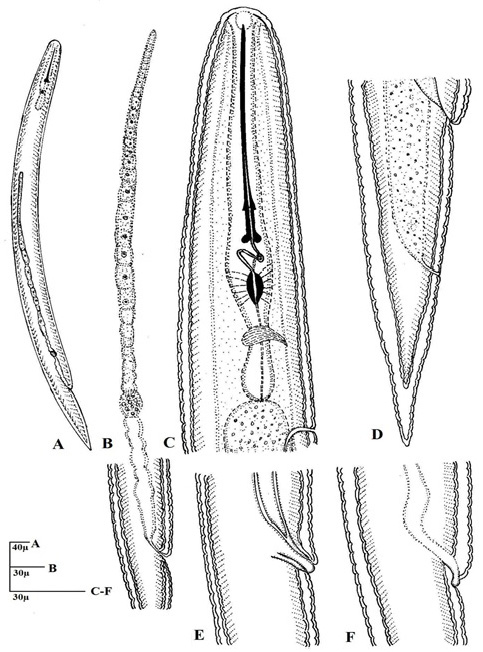
Hemicycliophora pyri n. sp., A, Whole body of female; B, Vulva and reproductive part; C, Oesophageal region of female; D, Vulva and anus with tail terminus; E, F, Variations of female vulvae shape.
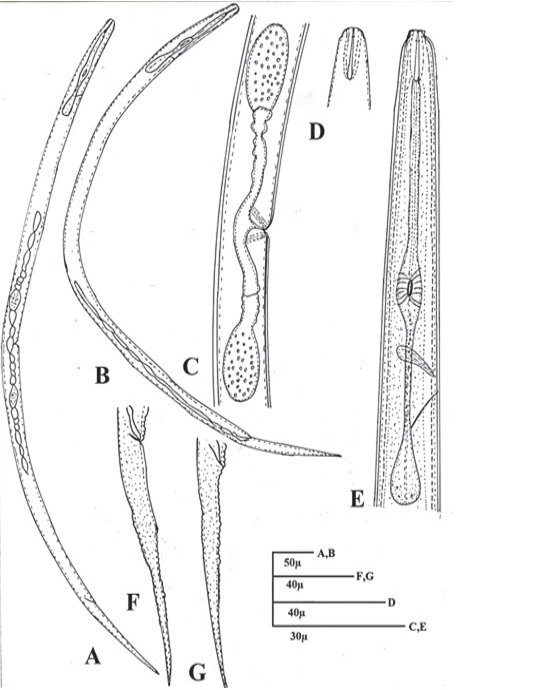
Psilenchus vinciguerrae. A, Female whole body; B, Male whole body; C, Vulval region; D, Head region; E, Oesophageal region; F, Male tail; G, Female tail.
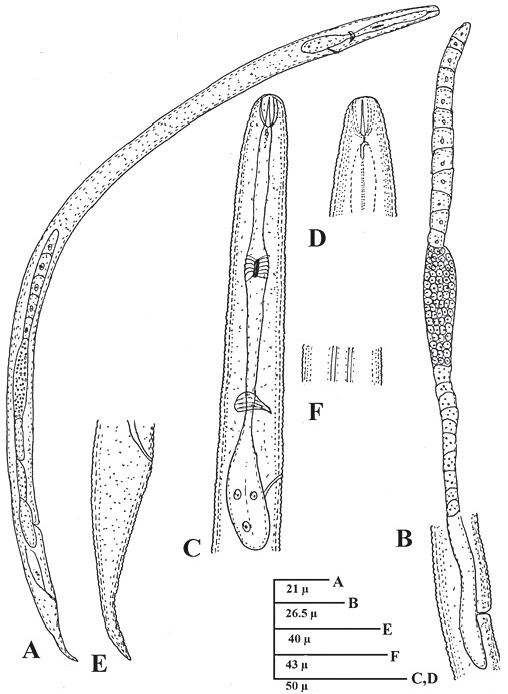
Ditylenchus equilis. A, Female whole body; B, Reproductive region; C, Oesopheageal region; D, Anterior region; E, Anus with tail terminus; F, Lateral lines.
References
- Akhtar, S.A., 1962. Free-living nematodes inhabiting Lahore soils. Agric. Pak., 13: 64-80.
- Baermann, G., 1917. Eineeinfache Method zur Affindung von Ankylostomum- (Nematoden)-larven in Erdprobem. Geneesk. Tijdschrift. Nederl. Indië, 57: 131-137.
- Brzeski, M.W., 1991. Psilenclus vinciguerrae n. sp. (Nematoda: Tylenchidae). Nematologica, 37: 1-7. https://doi.org/10.1163/187529291X00015[CrossRef]
- Chitambar, J.J., and Subbotin, S.A., 2014. Systematics of the sheath nematodes of the superfamily Hemicycliophoroidea. In: Nematology monograps and perspectives (eds. D.J. Hunt and R.N. Perry), 10, (Series Editors), Brill, Leiden, Boston, pp. 732. https://doi.org/10.1163/9789004187894[CrossRef]
- Cobb, N.A., 1918. Estimating the nema population of soil. Agric. Tech. Circ. Dept. Agric., 1: 48.
- Courtney, W.D., Polley, D. and Miller, V.L., 1955. TAF, an improved fixative in nematodes technique. Pl. Dis. Rep., 39: 570-571.
- de Man, J.G., 1880. Dieeinheimischen, frei in der reinenErde und imsüssen Wasserlebenden Nematoden. Vorläufiger Bericht und descriptive systematicher Theil. Tijdsch. Nederl. Dierk. Vereenig., 5: 1-104.
- Heyns, J., 1964. Aphelenchoides helices n. sp. and Ditylenchus equalis n. sp. two new soil inhabiting nematodes. South Afr. J. agric. Sci., 7: 147-150.
- Khan, A., Batool, S.K., and Khatoon, N., 2004. Two new species of Tylenchidae, Psilenchus khuzdarnsis n. sp. and Ditylenchus bilqeesae n. sp. (Nemaoda: Tylenchidae). Proc. Parasitol., 38: 81-87.
- Jairajpuri, M.S. and Baqri, Q.H., 1973. Four new species of Tylenchida. Nematodes of high altitudes in India. Nematologica, 19-30.
- Maqbool, M.A. and Shahina, F., 2001. Systematic and distribution: Biodiversity of nematode fauna in Pakistan. National Nematological Research Centre, University of Karachi, Karachi-75270 Pakistan, pp. 179.
- Maqbool, M.A., Shahina, F. and Zarina, B., 1986. Two new species of Hemicycliophorinae Skarbilovich, 1959 (Nematoda: Criconematidae) from Pakistan. Pak. J. Nematol., 4: 43-49.
- Seinhorst, J.W., 1959. A rapid method for the transfer of nematodes from fixative to anhydrous glycerin. Nematologica, 4: 67-69. https://doi.org/10.1163/187529259X00381[CrossRef]
- Shahina, F., Nasira, K., Firoza, K. and Erum, Y.I., 2019. Overview of the nematode fauna of Pakistan. Pak. J. Nematol., 37:171-243. https://doi.org/10.18681/pjn.v37.i02.p171-243[Full text][CrossRef]
- Siddiqi, M.R., 2000. Tylenchida: Parasites of plant and insect, 2nd Edition. CABI Publication, Wallingford, UK, pp. 833.
- Thorne, G., 1955. Fifteen new species of the genus Hemicycliophora with an emended description of H. typicade man (Tylenchida: Criconematidae). Proc. helminthol. Soc. Washington, 22: 1-16.
- Zarina, B., and Shahina, F., 2012. Annonated bibliography on nematology in Pakistan. 2nd Edition. National Nematological Research Centre, University of Karachi, Karachi-75270, Pakistan, pp. 850.
Services
Article usage statistics
Loading…