
Bokashi is an organic fertilizer fermented with organic waste, beneficial microbes, and sugar. Bokashi improved soil’s physical, chemical, and biological properties and eventually enhanced plant growth and yield production. Bokashi enhances the plant’s initial and later growth performance, including seed germination, seedling survival rate, fruit diameter, fruit size, fresh and dry matter, chlorophyll content, leaves the area, leaves number, plant nutrient, sugar, total soluble solid, organic acid, and ascorbic acid. No doubt, plant growth performance is closed related to soil properties. Bokashi is proper organic waste management and is easy to be implemented by household size. Bokashi can turn waste into the next food nutrient and ensure food security.
Review · Volume 38, Issue 4, 18 October 2022 · Open Access
Role of Organic Manure Bokashi Improving Plant Growth and Nutrition: A Review
· ·
Affiliations & Notes ⌄
- 1Department of Crop Science, Faculty of Agriculture, Universiti Putra Malaysia 43400 UPM Serdang, Malaysia
- 2Department of Land Management, Faculty of Agriculture, Universiti Putra Malaysia 43400 UPM Serdang, Malaysia
- 3Institut Tanah dan Ukur Negara (INSTUN), Muallim, Perak, Malaysia
Article Info ⌄
- Journal:
- Sarhad Journal of Agriculture
- Published:
- 18 October 2022
Abstract
Introduction
Soil, plant, and climate properties always affect plant growth and development. Plant growth performance is affected by the shifting of soil’s chemical, physical, and biological properties. Various approaches can be applied to modify soil properties to enhance soil productivity. Amendment with organic matter is a traditional way to enhance soil chemical (e.g., soil organic matter, cation exchange capacity, and plant nutrients availability), physical (e.g., soil colour, soil water holding capacity, and soil structure), and biological (e.g., soil microbes biomass, and enzyme activity) properties. The key factor for plant growth and yield production is the plant nutrients availability.
A good appearance and nutritive produce are always the wills of normal customers. Hence, producing good agronomical produce (e.g., attractive colour, large in size, high in weight, high in primary and secondary nutrients) is important for farmers to ensure their stable income. Besides, the campaign of support buying ugly food is arising currently. A lot of organic waste including domestic waste and plate waste was disposed of without proper management. It then causes environmental pollution and even affected the health of human beings. Therefore, an organic waste management-friendly method is required for environmental health and future food production.
Fermented raw materials like food waste Bokashi with beneficial microbes and sugar for 7 to 21 days provided a nutritive fertilizer for plant growth and development . Bokashi is extremely versatile as it can be recycled wasted nutrients such as fruit, vegetable, dairy, and meat in the food supply chain. Eventually, Bokashi will provide substrate and leachate and even future extraction tea. In the meanwhile, food security was ensured. Not like traditional composting required specific composition of green and brown . Therefore, Bokashi was able to turn waste into the next food nutrient (Figure 1). Furthermore, studies showed that organic waste Bokashi improved the plant growth performance in early and later growth, yield, and nutrient.
Bokashi to plant initiate growth
Bokashi improved the seedling survival rate (87-100 %) and seedling height of Pinus pseudostrobus by reducing transplanting shock in the reforestation project . Application of 60 % and 66% of Bokashi enhanced the production of coffee (Coffea arabica cv. ‘Bourbon’) ; 16% of Bokashi exhibited the greatest initial passion fruit (Passiflora edulis L.) growth and development . Besides, the input of compost with 25%, 50%, or 60% also enhanced the growth of coffee . Bokashi may allow the microbial interaction between soil and plant for nutrient and water absorption and thus allow better plant growth.
The standard Bokashi recipe includes soil, yeast, water, wheat bran, chopped corn stalks, cow dung, crushed charcoal, and brown sugar . Effective microorganism (EM) Bokashi is the use of a variety of anaerobic microbial inoculum. EM Bokashi had low tomato (Solanum lycopersicum) plant growth in the early stage as low nutrients were available at the beginning stage compared to chicken manure or inorganic fertilizer amendment ; . In contrast, the application of Bokashi delays the germination rate in passion fruit (Passiflora edulis L.) . Supplementation of Bokashi could be applied for different purposes such as reforestation and crop plantation. Still, the study on different crops such as oil crops (e.g., palm oil and coconut) and vegetable production should be further studied with the substrate and leachate of the Bokashi.
For example, Malabar spinach (Basella rubra) primed with Bokashi leachate displayed significant enhancement in root initiation and seed germination . More than 50% of the landfill leachate showed phytotoxic to the seed germination, where the acceptable concentration was 10% . On the flip side, some of the leachates presented an encouraging effect to plant growth and some are not. The suppressive effect shown in seed germination was shown in all concentrations of cigarette butt and ash leachate . In contrast, no phytotoxic effect showed in the compost tea seed germination , however, the effect of Bokashi leachate on seed germination (e.g., monocot and dicot) is unknown. The Bokashi leachate is still under discovery. However, it could be used for seed dormancy breaking by used by bio-nutri-priming techniques or pop-up fertilizer. Also, different used raw materials for Bokashi should be deeply discovered.
Bokashi to plant growth and development
Nitrate and available P concentration increased 50 days after transplanting in the amendment of EM Bokashi . Bokashi improved plant growth due to its rich composition, including bioactive compounds, ripening, and increased nutrient content ; . Rice husk and poultry manure based Bokashi, Organosuper® with Bokashi, and wood shavings and poultry manure base (without Bokashi) showed the highest Dickson quality index for development and growth stability, including high photosynthetic pigments, high mass production and growth attributes, and high quality in the young plants .
Co-composted biochar-Bokashi (60 t ha−1) was shown better than conventional and aerobic composting with improved biomass by 243 % compared to inorganic NPK fertilizer . The increasing total number of microbes (including fungi, bacteria, and actinomycetes) and macronutrients content [e.g., nitrogen (N), phosphorus (P), and potassium (K)], and micronutrients [e.g., iron (Fe), manganese (Mn) and zinc (Zn)] in Bokashi amended soil promotes root activity and cation exchange capacity . High micronutrient availability in soil enhanced the total chlorophyll and accumulated more carbohydrates, thus boosting mandarin fruit ripening ; Inal and Ozdem, 2021).
EM Bokashi can enhance chlorophyll content and photosynthetic capacity . The higher the amount of Bokashi application, the better the photosynthesis rate in Kalanchoe (Kalanchoe blossfeldiana) . The largest leaf area was shown in the amendment of Bokashi, rice husk and poultry manure base, and Organosuper® which is related to high chlorophyll content . High chlorophyll-a was enhanced by Bokashi, rice husk and poultry manure base, wood shavings and poultry manure base, Organosuper®; whereas Bokashi enhanced high chlorophyll-b and total chlorophyll with Organosuper®; those may affect its nutrient composition, especially magnesium (Mg) . A high concentration of calcium (Ca) and Mg were found in EM Bokashi amended soil and then supported tomato plant photosynthesis and fruit yield . Compared to chemical ones, the photosynthetic rate, transpiration rate, and mesophyll conductance were increased with EM Bokashi fertilizer in peanut plants .
Similarly, Bokashi leachate as a liquid fertilizer is still under discovery. Further study could be done to understand its effect on plant growth, nutrients, antioxidants, and yield.
Bokashi to plant yield
The application of Bokashi improved crop yields such as coffee , head lettuce (Lactuca sativa) , peanut (Arachis hypogaea) , and tomato . The bulb yield of shallot improved 145 % from 4.79 t ha-1 . Bokashi triggered the lettuce development, which improved total mass, commercial (after eliminating the damaged leaves), and commercial head diameter for two cycles . Bokashi and 10% boiled manure showed a significant increase of the first three trusses of one plant in tomato fruiting for two growing cycles .
Amendment of Bokashi enhanced plant height of marmelo-do-cerrado (Alibertia edulis) , maize (Zea mays), soybean (Glycine max) , onion (Allium cepa L.), jalapeño pepper (Capsicum annuum L.) . Amendment of 15 t ha-1 goat manure (N, P, K of 4.92% and C organic 30.81%) Bokashi amended, and half of the inorganic fertilizer recommended to provide the highest yield including number of leaves, leaf area, dry matter, number of branches, and plant height of the plant and hence the use of Bokashi as a fertilizer reduced the usage of inorganic fertilizer (urea, SP36, and KCl) by 50% in Kumis Kucing (Orthosiphon aristatus) .
The plant height and leaves number in jalapeño pepper (133 and 94 %) and onion (37 and 62 %) were significantly increased in Bokashi amended plants compared with the control plants . Amendment of 30 t ha-1 urban waste-based Bokashi and 100 ppm P rock phosphate increased plant height of maize and soybean; stimulate flowering of maize; increased the production of dried grain, number of branches per plant, and the weight of 100 dried grain and increased the yield of dried grain per plot and weight of 1000 dried grain soybean per plot .
The application of Bokashi had significantly enhanced nutrient and water uptake by plants . In tomatoes, plant-based bokashi increased the fruit diameter ; seed soaking with Bokashi tea improved (13 %) transplants’ stem diameter which allows plant nutrients uptake . Mandarin fruit weight and diameter have increased the application of Bokashi . The input of 25 %, 50 %, or 66 % Bokashi or compost improved shoot fresh weight 5, 8, or 10 times respectively compared to the coffee without organic fertilizer . High N and P concentrations, total biomass, and aerial biomass were determined in Bokashi with biosolids and fly ash amended maize plants .
Inorganically grown plants need to absorb more water when it is grown with excessive inorganic fertilizers . Instead, low and high dosages of vermicompost and Bokashi applications in low have no significant difference in leaf area, total leaf number, shoot dry matter, and Fe content of plants . The largest leaf and root dry matter was shown in the amendment of Bokashi, rice husk, poultry manure base, and Organosuper® . Hence, organic leafy vegetables (e.g., celeries), root vegetables (e.g., beetroots), fruits (e.g. pears and black currants), and tubers have higher dry matter contents ; ; nonetheless lower in organic apples and carrots . Still, some studies reported that dry matter in organically grown food was fewer than the inorganically grown ones. For instance, inorganically grown potatoes enclosed higher dry matter than organically grown ones .
Chickweed (Ageratum conyzoides L.) based Bokashi can replace the NPK inorganic fertilizer for tomato plant growth . In contrast, the application of NPK fertilizer on lettuce showed higher protein content than those fertilized by Bokashi in low and high dosage and vermicompost in high dosage; nevertheless, no significant difference in lettuce . The concentrations of amino acids, proteins, and N were lower in organically grown crops, which correlated to diminished N availability and N inputs in organic crop production systems ; ; .
Bokashi to plant nutrient
Bokashi improves the yield, nutrients content, fruit quality, fruit weight, dimensions, total sugars % and total soluble solid %, and decreases total acidity %. For instance, Bokashi increased the fresh matter and matter weight of foliage on average by 262 and 157 % in onions and 421 and 214 % in jalapeño pepper compared to no fertilizer amendment . The input of 100 g Bokashi fertilizer per plant to legume cover crops such as calopo (Calopogonium mucunoides), butterfly pea (Centrosema pubescens), and tropical kudzu (Pueraria javanica) had a positive outcome on soil organic carbon (C), P and K and enhance plant nutrient (Mn and Fe) uptake ; . The soil available K is induced by increasing organic C, which enhances soil microbial activity and leads to the shift of pH to neutral (around pH 7) vividly affecting the nutrients (P and K) available for plant uptake . Application of vermicompost and Bokashi in low and high dosages showed lower Fe content than the application of NPK . Application of NPK fertilizer on lettuce showed higher carotene content than those amended by Bokashi in low and high dosages .
Chicken manure (0.16 to 0.19 g kg-1) and Bokashi (0.12 to 0.14 g kg-1) amended plants have higher ascorbic acid (vitamin C) concentration than inorganic (0.11 to 0.12 g kg-1) fertilizer plants . The ascorbic acid concentration in fruit was increased by effective microorganisms (EM) inoculation from all fertilization amendments (0.12 to 0.19 g kg-1) . EM inoculation to the organic fertilizers significantly increased fruit quality and yield and applied directly to the soil . EM Bokashi had a high concentration of ascorbic acid, sugars, and organic acids . Application of low dosage Bokashi and high dosage vermicompost showed higher ascorbic acid content than the application of NPK, vermicompost in low dosage, and Bokashi in high dosage on lettuce and mustard green . Organic production food enriched macro and micronutrients such as [e.g., P, Mg, Fe, Zn, copper (Cu), and chromium (Cr)], isoflavones, carotenoids, ascorbic acid, anthocyanins, and other phenolic compounds, . In contrast, chickweed-based Bokashi had no significant positive effect on vitamin A and ascorbic acid . Swiss chards (Beta vulgaris L. var. cycla L.) were amended with EM Bokashi, and EM showed high P and Mg and low ascorbic acid and water control than the one without organic preharvest amendment .
Compared to chicken manure and inorganic fertilizer, higher concentrations of sugars (59.1 to 60.3 g kg-1) and organic acids (6.70 to 6.97 g kg-1) were shown in Bokashi fertilized tomato plants . With the Bokashi plus vermicompost leachate application, the content of soluble solids was 42 % higher in jalapeño pepper and onion, respectively . Both the soil amendments (Bokashi with biosolids and fly ash) and the tissue of maize plants had below the detection limits of cadmium and lead concentrations . The onion yield was improved from 6.4 to 21.0 t ha-1. The land use increased by 16 % is the land equivalent ratio increased by 15.7 % which is from 1.34 to 1.55 .
Bokashi to plant defence
Bokashi soil amendment significantly reduced the powdery mildew severity compared to unamended soil for the first growing cycle . In contrast, Bokashi significantly enhanced the incidence of damping-off in cucumber and powdery mildew in the second growing cycle ; . However, the studies on the response of Bokashi to the plant defence system are limited and have a blur effect on the plant. More studies could be carried out to confirm the effect of Bokashi substrate and leachate to plant health.
Conclusions and Recommendations
Bokashi can turn waste into the next food nutrient. Bokashi enhanced the plant growth performance, including seed germination, seedling survival rate, chlorophyll content, plant nutrient, and vitamin C. Bokashi substrate was wide studied; however, the study of leachate and tea was limited.
Novelty Statement
In this study, we have highlighted the effect of Bokashi to plant growth from the initial stage to the harvesting stage that not previously focused by the researchers.
Author’s Contribution
Chooi Lin Phooi: Conceptualization, writing original draft, writing review and editing.
Elisa Azura Azman and Roslan Ismail: Writing review and editing.
Conflict of interest
The authors have declared no conflict of interest.
Figures
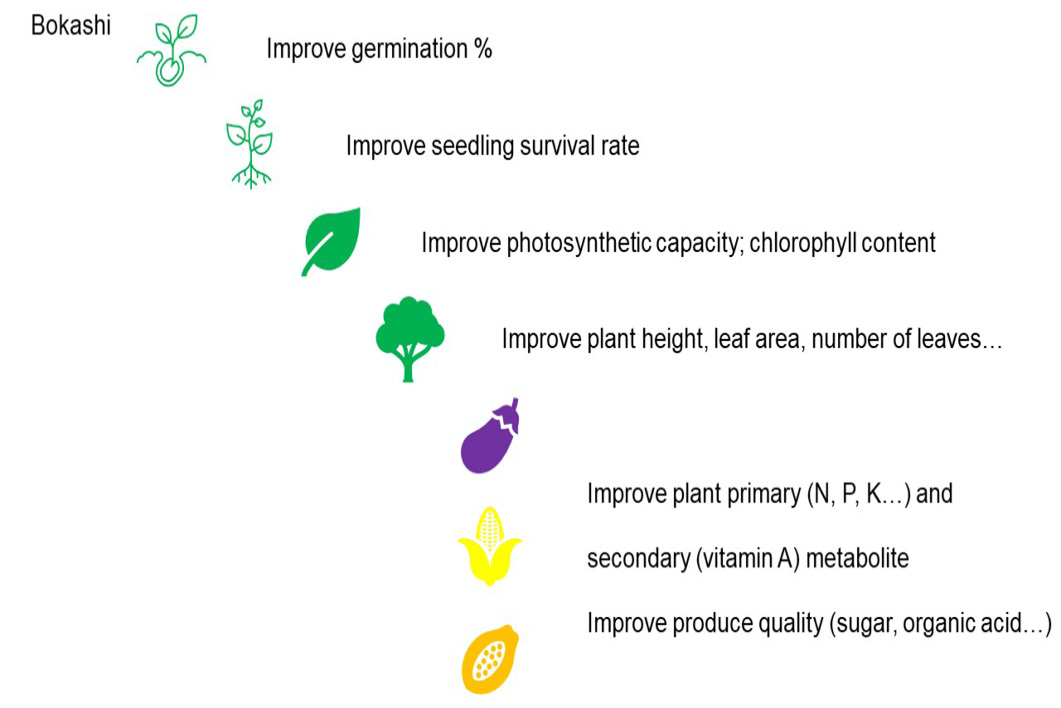
Overview of the benefit of Bokashi to plants (Xu et al., 2000; Gómez-Velasco et al., 2014; Olle, 2021; Verrillo et al., 2021).
References
- Abed El-Hamied, S.A. 2014. Effect of multi-ingredient of Bokashi on productivity of mandarin trees and soil properties under saline water irrigation. IOSR J. Agric. Vet. Sci., 7: 79–87. https://doi.org/10.9790/2380-071127987[CrossRef]
- Adiarti, Y.E., B. Pujiasmanto and W.S. Dewi. 2019. Effect balance of bokashi and inorganic fertilizer on growth, simplicia yield, and content of sinensetin of kumis kucing (Orthosiphon aristatus (Blume) Miq.). Sains Tanah J. Soil Sci. Agroclimatol., 16: 13. https://doi.org/10.20961/stjssa.v16i1.25102[CrossRef]
- Álvarez-Solís, J.D., J.A. Mendoza-Núñez, N.S. León-Martínez, J. Castellanos-Albores and F.A. Gutiérrez-Miceli. 2016. Effect of bokashi and vermicompost leachate on yield and quality of pepper (Capsicum annuum) and onion (Allium cepa) under monoculture and intercropping cultures. Cienc. e Investig. Agrar., 43: 243–252. https://doi.org/10.4067/S0718-16202016000200007[CrossRef]
- Anhar, A., R. Junialdi, A. Zein, L. Advinda and I. Leilani. 2018. Growth and tomato nutrition content with bandotan (Ageratum conyzoides L) Bokashi applied. IOP Conf. Ser. Mater. Sci. Eng. Inst. Phys. Publ., pp. 012017. https://doi.org/10.1088/1757-899X/335/1/012017[CrossRef]
- Barański, M., D. Średnicka-Tober, N. Volakakis, C. Seal, R. Sanderson, G.B. Stewart, C. Benbrook, B. Biavati, E. Markellou, C. Giotis, J. Gromadzka-Ostrowska, E. Rembiałkowska, K. Skwarło-Sońta, R. Tahvonen, D. Janovská, U. Niggli, P. Nicot and C. Leifert. 2014. Higher antioxidant and lower cadmium concentrations and lower incidence of pesticide residues in organically grown crops: A systematic literature review and meta-analyses. https://doi.org/10.1017/S0007114514001366[CrossRef]
- Batubara, S., 2015. Growth response and yield of maize and soybean in intercropping to the urban waste compost and rock phosphate. Int. J. Sci. Res., 6: 2319–7064.
- Bilsborrow, P., J. Cooper, C. Tétard-Jones, D. Średnicka-Tober, M. Barański, M. Eyre, C. Schmidt, P. Shotton, N. Volakakis, I. Cakmak, L. Ozturk, C. Leifert and S. Wilcockson. 2013. The effect of organic and conventional management on the yield and quality of wheat grown in a long-term field trial. Eur. J. Agron., 51: 71–80. https://doi.org/10.1016/j.eja.2013.06.003[CrossRef]
- Bócoli, F.A., J.A. Marcon, M. Izidoro, P. de T. Bortolon, S.E.R. de OLIVEIRA, V. Spalevic and P.S. de SOUZA. 2020. Bokashi use in the passionfruit (Passiflora edulis L.) germination and initial growth. Agric. For., 66: 101–111. https://doi.org/10.17707/AgricultForest.66.4.08[CrossRef]
- Brazinskiene, V., R. Asakaviciute, A. Miezeliene, G. Alencikiene, L. Ivanauskas, V. Jakstas, P. Viskelis and A. Razukas. 2014. Effect of farming systems on the yield, quality parameters and sensory properties of conventionally and organically grown potato (Solanum tuberosum L.) tubers. Food Chem., 145: 903–909. https://doi.org/10.1016/j.foodchem.2013.09.011[CrossRef]
- Cortés-Tello, K.E. and P.F. Jaramillo-López. 2020. Fermented soil amendments made from stabilized biosolids and fly ash improve maize (Zea mays L.) nutrition and growth. Int. J. Recycl. Org. Waste Agric., 9: 85–98.
- Daiss, N., M.G. Lobo, A.R. Socorro, U. Brückner, J. Heller and M. Gonzalez. 2008. The effect of three organic pre-harvest amendments on Swiss chard (Beta vulgaris L. var. Cycla L.) quality. Eur. Food Res. Technol., 226: 345–353. https://doi.org/10.1007/s00217-006-0543-2[CrossRef]
- Domenico, P. and D. Prisa. 2020. EM-Bokashi addition to the growing media for the quality improvement of kalanchoe blossfeldiana.
- Erdogan, P. and Z. Mustafa. 2021. Larvacidal effect of some plant extracts against tomato leaf miner (Tuta absoluta meyrick; lepidoptera: gelehiidae). J. Glob. Innov. Agric. Sci., 9: 101-107. https://doi.org/10.22194/JGIAS/9.933[CrossRef]
- Gąstoł, M., I. Domagała-Świątkiewicz and M. Krośniak. 2011. Organic versus conventional a comparative study on quality and nutritional value of fruit and vegetable juices. Biol. Agric. Hortic., 27: 310–319. https://doi.org/10.1080/01448765.2011.648726[CrossRef]
- Ginting, S., 2019. Promoting Bokashi as an organic fertilizer in Indonesia: A mini review. Int. J. Environ. Sci. Nat. Resour., 21(4): 556070. https://doi.org/10.19080/IJESNR.2019.21.556070[CrossRef]
- Gómez-Velasco, D.A., J.D. Álvarez-Solís, V.M. Ruiz-Valdiviezo, M. Abud-Archila, J.A. Montes-Molina, L. Dendooven and F.A. Gutiérrez-Miceli. 2014. Enzymatic activities in soil cultivated with coffee (Coffea arabica L. cv. ‘Bourbon’) and amended with organic material. Commun. Soil Sci. Plant Anal., 45: 2529–2538. https://doi.org/10.1080/00103624.2014.932375[CrossRef]
- Hata, F.T., F.A. Spagnuolo, M.T. de Paula, A.A. Moreira, M.U. Ventura, G.A.D.F. Fregonezi and A.L.M. de Oliveira. 2020. Bokashi compost and biofertilizer increase lettuce agronomic variables in protected cultivation and indicates substrate microbiological changes. Emirates J. Food Agric., 32: 640–646. https://doi.org/10.9755/ejfa.2020.v32.i9.2142[CrossRef]
- Hata, M.U. Ventura, G.A. de F. Fregonezi and R.F. de Lima. 2021. Bokashi, boiled manure and penergetic applications increased agronomic production variables and may enhance powdery mildew severity of organic tomato plants. Horticulturae, 7: 1–8. https://doi.org/10.3390/horticulturae7020027[CrossRef]
- Inal, B. and A. Ozdem. 2021. Oarius grisescens (Coleoptera: Curculionidae, Entiminae), a new pest of Prunus armeniaca in Turkey. J. Glob. Innov. Agric. Sci., 9: 97-100.
- Jaramillo-López, P.F., M.I. Ramírez and D.R. Pérez-Salicrup. 2015. Impacts of Bokashi on survival and growth rates of Pinus pseudostrobus in community reforestation projects. J. Environ. Manage., 150: 48–56. https://doi.org/10.1016/j.jenvman.2014.11.003[CrossRef]
- Karimuna, L., N.M. Rahni and D. Boer. 2016. The use of Bokashi to enhance agricultural Productivity of marginal soils in southeast Sulawesi, Indonesia. J. Trop. Crop Sci., 3: 1–6. https://doi.org/10.29244/jtcs.3.1.1-6[CrossRef]
- Lairon, D., 2010. Nutritional quality and safety of organic food. A review. Agron. Sustain. Dev., 30: 33–41. https://doi.org/10.1051/agro/2009019[CrossRef]
- Lasmini, S.A., B. Nasir, N. Hayati and N. Edy. 2018. Improvement of soil quality using bokashi composting and NPK fertilizer to increase shallot yield on dry land. Aust. J. Crop Sci., 12: 1743–1749. https://doi.org/10.21475/ajcs.18.12.11.p1435[CrossRef]
- Li, G., J. Chen, W. Yan and N. Sang. 2017. A comparison of the toxicity of landfill leachate exposure at the seed soaking and germination stages on Zea mays L. (maize). J. Environ. Sci. (China), 55: 206–213. https://doi.org/10.1016/j.jes.2016.06.031[CrossRef]
- Lueck, L., C. Schmidt, J. Cooper, C. Hall, P. Shotton and Leifert. 2006. Effect of organic, low-input and conventional production systems on yield and quality of winter wheat. Asp. Appl. Biol., 80: 135-140.
- Mansouri, N., M. Etebari, A. Ebrahimi, K. Ebrahimpour, B. Rahimi and A. Hassanzadeh. 2020. Genotoxicity and phytotoxicity comparison of cigarette butt with cigarette ash. Environ. Sci. Pollut. Res., 27: 40383–40391. https://doi.org/10.1007/s11356-020-10080-z[CrossRef]
- Marcon, F.A., J.A. Izidoro, M. Bortolon, P. Oliveira, S.E.R. Spalevic and V. Souza. 2020. Bokashi use in the Passionfruit (Passiflora edulis L.) germination and initial growth. Agric. For., 66: 101–111. https://doi.org/10.17707/AgricultForest.66.4.08[CrossRef]
- Olle, M., 2020. Short communication: The improvement of the growth of tomato transplants by bokashi tea. Agraarteadus, 31: 70–73.
- Olle, M., 2021. Review: Bokashi technology as a promising technology for crop production in Europe. https://doi.org/10.1080/14620316.2020.1810140[CrossRef]
- Pandit, N.R., H.P. Schmidt, J. Mulder, S.E. Hale, O. Husson and G. Cornelissen. 2020. Nutrient effect of various composting methods with and without biochar on soil fertility and maize growth. Arch. Agron. Soil Sci., 66: 250–265. https://doi.org/10.1080/03650340.2019.1610168[CrossRef]
- Pei-Sheng, Y. and X. Hui-Lian. 2002. Influence of EM bokashi on nodulation, physiological characters and yield of peanut in nature farming fields. J. Sustain. Agric., 19: 105–112. https://doi.org/10.1300/J064v19n04_10[CrossRef]
- Phooi, C.L., E.A. Azman and R. Ismail. 2021. Bokashi leachate as a biopriming on Basella rubra L. seed germination and root development.
- Prayogo, C. and M. Ihsan. 2018. Utilization of LCC (Legume cover crop) and bokashi fertilizer for the efficiency of Fe and Mn uptake of former coal mine land. J. Degrad. Min. Lands Manag., 6: 1527–1537. https://doi.org/10.15243/jdmlm.2018.061.1527[CrossRef]
- Quiroz, M. and C. Céspedes. 2019. Bokashi as an amendment and source of nitrogen in sustainable agricultural systems: A review. J. Soil Sci. Plant Nutr., 19: 237–248. https://doi.org/10.1007/s42729-019-0009-9[CrossRef]
- Santos, C.C., M. do C. Vieira, N.A.H. Zárate, T. de O. Carnevali and W.V. Gonçalves. 2020. Organic residues and bokashi influence in the growth of Alibertia edulis. Floresta Ambient, 27. https://doi.org/10.1590/2179-8087.103417[CrossRef]
- Shin, K., G. van Diepen, W. Blok and A.H.C. van Bruggen. 2017. Variability of effective micro-organisms (EM) in bokashi and soil and effects on soil-borne plant pathogens. Crop Prot., 99: 168–176. https://doi.org/10.1016/j.cropro.2017.05.025[CrossRef]
- Sunaryo, Y., 2010. Effect of vermicompost and bokashi on nutrient content of mustard green and lettuce. Int. Semin. Hortic. Support Food Secur., 22: 1–9.
- Verrillo, M., M. Salzano, V. Cozzolino, R. Spaccini and A. Piccolo. 2021. Bioactivity and antimicrobial properties of chemically characterized compost teas from different green composts. Waste Manag., 120: 98–107. https://doi.org/10.1016/j.wasman.2020.11.013[CrossRef]
- Xu, H.L., R. Wang and M.A.U. Mridha. 2000. Effects of organic fertilizers and a microbial inoculant on leaf photosynthesis and fruit yield and quality of tomato plants. J. Crop Prod., 3: 173–182. https://doi.org/10.1300/J144v03n01_15[CrossRef]
- Yu, X., L. Guo, G. Jiang, Y. Song and M.A. Muminov. 2018. Advances of organic products over conventional productions with respect to nutritional quality and food security. Acta Ecol. Sin., 38: 53–60. https://doi.org/10.1016/j.chnaes.2018.01.009[CrossRef]
Services
Article usage statistics
Loading…