
Bovine brucellosis is an important zoonotic and contagious disease targeting humans, domestic and wild animals all over the globe resulting in significant economic losses therefore, disease mitigation and control measures are of pronounced significance. The two available vaccines of Brucella abortus in Pakistan, RB51, and S19 have many limitations in the light of residual virulence, induction of abortion, diagnostic interference, and human pathogenic potential. In this study, we have developed a Brucella abortus pUC19-K-UP-DN plasmid cassette for the construction of ΔpurD deleted mutant by deleting the purD gene which is responsible for de novo purine synthesis. For this, the pUC19-K-UP-DN plasmid cassette was initially constructed using pUC19, kanamycin, and purD upstream and downstream fragments. Then the cassette was electroporated into electro competent Brucella abortus RB51. The ΔpurD mutant was confirmed using PCR analysis. Afterward, the growth kinetics of the mutant was compared with parent RB51. The mutant bacterial growth significantly reduces (P< 0.05) as compared to the parent non-mutant confirming its auxotroph inability towards purine pathway biosynthesis which serves as a crucial factor for disease induction and survival inside the host system revealing enhanced attenuation in the deleted mutant. However, after supplementation of purine bases, the ΔpurD mutant bacteria regain growth in enriched media. The results confirmed that the highly attenuated Brucella abortus ΔpurD mutant can be used successfully as a potential vaccine candidate for the control of bovine brucellosis.
Research Article · Volume 55, Issue 5, 17 September 2023 · Open Access
Construction and Characterization of purD Gene Deleted Brucella abortus
· · · · ·
Affiliations & Notes ⌄
- 1Institute of Microbiology, University of Veterinary and Animal Sciences, Lahore, Pakistan
- 2Institute of Biochemistry and Biotechnology, University of Veterinary and Animal Sciences, Lahore, Pakistan 3College of Agriculture, Department of Animal Sciences, Purdue University, West Lafayette, USA * Corresponding author: mrabbani@uvas.edu.pk
Article Info ⌄
- Journal:
- Pakistan Journal of Zoology
- Published:
- 17 September 2023

From the article
- In this study, the ΔpurD gene deleted mutant was constructed from the RB51 strain manifesting auxotrophy for the purine biosynthesis pathway which serves as an important source of bacterial DNA synthesis and requisite for multiplication and survival inside the host cell.
- The parent RB51 strain showed an elevated growth pattern as compared to the ΔpurD mutant in purine non-enriched media over different time duration.
- The current study findings concluded that the purD gene is required by bacteria for the de novo purine synthesis pathway and a key factor for RB51 virulence in the host.
- The ΔpurD deleted mutant was originally constructed from the RB51 strain so further studies are needed to check its attenuation status and immunogenic potential in the animal model in comparison to RB51.
Selected from the article's own text.
Abstract
INTRODUCTION
Brucellosis is an important zoonosis globally targeting both humans and livestock listed among the top-ranked bacterial problems in developing countries and it is positioned second among worldwide zoonotic problems by OIE ; . Every year more than 500,000 new human cases of brucellosis are reported by World Health Organization . From a public health and zoonotic viewpoint, brucellosis is considered an occupational disease that mainly affects farm workers, butchers, slaughterhouse workers, and veterinarians . According to published data, the first human brucellosis case in Pakistan was reported back in 1979 . Presently, higher disease cases were reported in Punjab province including hospital outdoor records showing 5.8-10.7% and 6.87-38.94% get infection via occupational exposure. After Punjab, Khyber Pakhtunkhwa province reported the highest number of cases ranging between 2-36.4% at different outdoor hospitals but is still recognized as one of the misdiagnosed and underreported human diseases in Pakistan .
Brucellosis is linked adversely to livestock reproductive potential and production losses in the form of milk and meat . Infection with Brucella abortus leads to reproductive failure especially abortion in the last trimester of gestation and placentitis, infertility and metritis in females and epididymitis, orchitis, seminal vesiculitis, and sterility in males .
Due to these serious economic impacts and public health-associated risks substantial eradication programs for brucellosis have been implemented to prevent, control, and eliminate the disease in animals. Among all of these, vaccination has been proven to be a crucial factor in the control and prevention of the disease. Vaccination with live attenuated Brucella abortus strains such as rough strain RB51 and smooth strain 19 have been extensively used for years and have been proven against the prevention and control of disease in field conditions . However, these vaccines have several constraints in the light of antibiotic resistance, residual virulence, and diagnostic interference and are pathogenic to humans .
Among different available vaccines, the RB51 rough vaccine strain of Br.abortus has been widely used in different countries including Pakistan for brucellosis control and it does not generate antibodies against the O-polysaccharide chain of smooth lipopolysaccharide of Br. abortus which provides clear serological differentiation between vaccinated and infected animals giving it a notable advantage for its use in the control of disease . However RB51 strain has some limitations because of its residual virulence and could be isolated from different animal body secretions including milk, vaginal fluid, and fetuses of vaccinated buffalo and cows showing its substantial replication in vaccinated animals .
To overcome these limitations extensive efforts have been made to identify some accessory vaccine targets for the development of potential live attenuated vaccines . In the present study, to improve the safety of the RB51 vaccine, we construct a more attenuated gene deleted mutant of RB51 by targeting the purD (phosphoribosylamine-glycine ligase) gene which played a crucial role in the de novo purine nucleotide synthesis during its replication through site-directed mutagenesis.
MATERIALS AND METHODS
Bacterial strain, its culturing, and identification
Brucella abortus RB51 (RB 51) was taken from Clinical Diagnostic Complex (CLC), UVAS and the entire work has been done by adopting strict biosafety practices recommended by Centers for Diseases Control and Prevention, Brucellosis Reference Guide, 2017 . The bacteria was cultured in Tryptone Soy Agar (TSA, Oxoid Ltd, Basingstoke, UK) by inoculating 0.2 mL on agar plate supplemented with rifampicin antibiotic (250 μg/ mL) and 1% fetal bovine serum (Gibco, Life Technologies Ltd, Paisley, UK) at 37oC in the incubator for 4-5 days under aerobic conditions and also on Tryptone Soy Broth (TSB, Oxoid Ltd, Basingstoke, UK) supplemented with rifampicin antibiotic (250 μg/ mL) and 1% fetal bovine serum in shaking incubator at 150 rpm, 37oC overnight . The isolated colonies of RB51 were identified for the characteristic colony morphology, Gram staining and coccobacilli characteristics of Brucella abortus. The final confirmation was done by PCR through amplification of IS711 repetitive region of the bacterial genome by using primers mentioned in Table I and bacterial DNA extraction was done using GF-1 Bacterial DNA Extraction Kit (Vivantis, Selangor Darul Ehsan, Malaysia) and PCR was performed by previously described method .
Kanamycin amplification and insertion in pUC19
The purD gene deletion cassette (pUC19-K-UP-DN) was constructed by using commercially purchased pUC19 vector (Thermoscientific, Vilnius, Lithuania). Firstly, Kanamycin (KM) gene was amplified using pEP- kan DNA as template through PCR by using its specific primers shown in Table I. The amplified product size of KM was confirmed on agarose gel and purified using the gel purification kit (Gene JET Gel Extraction, Thermoscientific, USA). The purified KM product and pUC19 plasmid was subjected to restriction enzyme digestion by using KpnI (Thermoscientific, Vilnius, Lithuania) and BamHI (Thermoscientific, Vilnius, Lithuania) restriction enzymes. The restriction enzyme digested pUC19 and KM products were run on agarose gel and subjected to gel purification. Afterward, enzyme digested confirmed products of pUC19 and KM were ligated by using T4 DNA Ligase (Thermoscientific, Vilnius, Lithuania), and the ligated product was transformed into Escherichia coli DH5α competent cells using the heat shock method. The positive KM clones were screened on KM supplemented Luria-Bertani (LB) agar plate and confirmed using restriction digest analysis and named pUC19-K.
purD UP and DN stream sequence cloning
purD gene upstream (UP) and downstream (DN) sequences were amplified through PCR by using UP and DN specific primers shown in Table I and Br. abortus DNA as a template. The amplified UP and DN PCR products were confirmed via agarose gel electrophoresis. The pUC19-K and UP PCR product were enzyme digested using Kpn1 and EcoRI (Thermoscientific, Vilnius, Lithuania) at 37oC. After 3 h the enzyme digested products were run on agarose gel and purified through gel purification kit. The purified products were ligated via T4 DNA ligase for overnight incubation at 4oC. The ligation mixture was transformed into competent E. coli DH5α cells and plated on LB agar plate supplemented with KM (30µg/mL) for 24 h at 37oC. The positive clones were confirmed using restriction digest analysis and named ad pUC19-K-UP.
Table I. List of primers used in this study.
| Primer | Name | Sequence (5’to 3’) | Product size (bp) | Target location |
| Br. abortus | B.A (F) | GACGAACGGAATTTTTCCAATCCC | 498 | IS711 genomic region |
| B.A (R) | TGCCGATCACTTAAGGGCCTTCAT | |||
| Kanamycin | KM (F) | GCGGTACCTAGGGATAACAGGGTAATCGATTT (Kpn1) | 1004 | KM |
| KM (R) | CGGGATCCGCCAGTGTTACAACCAATTAACC (BamH1) | |||
| Upstream | UP (F) | GCGAATTCTCCTGATCGACCAGATCATTATAG (EcoR1) | 492 | purD upstream |
| UP (R) | CGGGTACCCATGCCTTGCTCCCTGCGCTTAAGATC (Kpn1) | |||
| Downstream | DN (F) | GCGGATCCTGATCGGTTTATGTTTCAGGTTACATG (BamH1) | 482 | purD downstream |
| DN (R) | CGCTGCAGTCGCCGTGGCTTCGACCGTCACGT (Pstl) | |||
| purD | PD (F) | AACTGCAGGATGAAAGTTCTGTTGATC | 1280 | Detecting purD |
| PD (F) | GCTCTAGAGTCAGCGATTAGCCTTCTCA |
Bold letter indicates sequence of restriction sites inserted.
The DN amplified product and pUC19-K-UP were enzyme digested using BamHI and PstI (Thermoscientific, Vilnius, Lithuania) at 37oC for 3 h. The enzyme digested products were run on agarose gel and purified through gel purification kit. Afterward, the purified products were ligated via T4 DNA ligase at 4oC for the overnight period. The ligation mixture was transformed into competent E.coli DH5α cells and screened on KM added LB agar plate at 37oC for 24 h. The positive clones were confirmed using restriction digest analysis and named as pUC19-K-UP-DN deletion cassette.
Construction of ΔpurD mutant
For the construction of Br. abortus ΔpurD mutant, the electro competent cells of RB51were prepared by adopting the previously described method . The purD gene deletion cassette pUC19-K-UP-DN was electroporated into electrocompetent RB51 cells at 2.5 kV, 20 msec by using Gene Pulser Xcell TM (Biorad, California, USA) as per the protocol described earlier . The purD gene deleted mutants were screened after 5 days on KM added TSA agar medium and further cultured on KM supplemented TSB media. Afterward, the ΔpurD mutant colonies were selected and confirmed by using PCR for Br. abortus, KM, and the purD gene deletion using published primers mentioned in Table I.
Phenotypic characterization and growth kinetics of ΔpurD mutant
The growth kinetics and phenotypic characterization of the ΔpurD mutant was analyzed by developing a growth curve as described previously . Briefly, a single colony of both ΔpurD mutant and non-mutant RB51 were cultured in 5mL of TSB for 24 h in the shaking incubator at 37oC. A total of 200µL from 24 h broth culture was then inoculated in 19.8 mL TSB at 160 rpm shaking and 37oC for the period of 72 h. The ΔpurD mutant and parent RB51 strains were also subjected to growth analysis in purine supplemented TSB by adding 1mM adenine, 1mM guanine, 1mM hypoxanthine, and 0.05 mM thiamine (Sigma-Aldrich, Merck, Darmstadt, Germany) by adopting the previously described method at 37oC with shaking for 72 h. The growth kinetics was checked by estimating the OD value at 600 nm in the ELISA reader at different time intervals. For future usage, the deleted mutant was stored by using Microbank Microbial Storage Veils (Pro-Lab Diagnostics, Richmond Hill, Canada) at -80oC as per manufacturer instructions.
Statistical analysis and software used
The data of the growth curve was analyzed by using the software GraphPad Prism 5. Two-way analysis of variance (ANOVA) test was applied for comparison of the ΔpurD mutant group with the RB51 group. The P-value < 0.05 was considered statistically significant.
RESULTS
Br. abortus colonies on TSA agar showed characteristics morphology of small, round, 1-2mm diameter, smooth margins with pale honey color and Gram staining confirms Gram-negative pink coccobacilli rods when observed under oil immersion lens at (100X). The molecular conformation via PCR showed amplicon size of the IS711 repetitive region (498 bp) on agarose gel electrophoresis.
The pUC19-K-UP-DN plasmid cassette was developed and confirmed as shown in Figure 1 by adopting the following scheme. The KM amplified sequence showed (1004 bp) size as shown in (Fig. 1B I). The restriction enzyme digest analysis of pUC19-K transformed E.coli DH5α cells confirms two bands of (2686) bp (pUC19) and (986 bp) (KM) on agarose gel electrophoresis (Fig. 1B II). The UP stream sequence amplified product showed (492 bp) amplicon product (Fig. 1B III) and restriction enzyme digest analysis of pUC19-K-UP transformed E.coli DH5α cells confirms two different fragments of pUC19 (2686 bp) and K-UP (1455 bp) on agarose gel (Fig. 1B IV). The DN stream amplified product confirms (482 bp) amplicon size (Fig. 1B V), and restriction enzyme digest analysis of pUC19-K-UP-DN transformed E.coli DH5α cells showed two fragments of (2686bp) pUC19 and (1909bp) UP-K-DN fragment (Fig. 1B VI)
ΔpurD deleted mutant
The ΔpurD deleted mutant showed characteristic small, circular, pale color colony morphology of Br.abortus on KM supplemented TSA plate. The colony PCR of ΔpurD deleted showed (498bp) of IS711 region for Brucella abortus (Fig. 2A), (986bp) of KM (Fig. 2B), and absence of (1280 bp) purD gene ΔpurD mutant in comparison to parent RB51 strain (Fig. 2C).
The growth phenotype of ΔpurD deleted mutant
The growth kinetics of ΔpurD deleted mutant showed O.D values 0.052, 0.063, 0.158, 0.512 and 0.866 at 6, 12, 24, 48, and 72 h while RB51 showed O.D values 0.077, 0.344, 0.942, 1.512, and 1.364 in TSB culture media without purine bases supplementation. Therefore, the growth kinetics suggested that ΔpurD grows at a significantly reduced (P< 0.05) rate in comparison to parent strain over this period (Fig. 3A). As shown in (Fig. 3B) the ΔpurD deleted mutant showed reinstatement growth in adenine, guanine, thiamine, and hypoxanthine enriched TSB media showed O.D values 0.129, 0.374, 0.869, 1.207 and 1.398 and grows almost a similar rate showed O.D values 0.134, 0.418, 0.917, 1.218 and 1.417 at 6, 12, 24, 48, and 72 h in comparison to the parent RB51 strain.
DISCUSSION
Brucellosis is one of the foremost problems impacting both livestock and the human population globally because of its high zoonotic and infection potential reported 500,000 annual cases exclusively in humans by the World Health Organization . The most common approach adopted worldwide for disease mitigation and control is by application of live attenuated RB51 vaccinal strain to prevent bovine brucellosis . Although RB51 is considered very efficacious for disease prevention in vaccinated animals but also has many reported side effects in both animals and humans. ; .
The main objective of this study was to construct and evaluate a gene-deleted mutant from the RB51 strain to enhance its efficacy and down-turning side effects associated with this strain. In this study, we targeted the purD (phosphor ribosylamine-glycine ligase) gene which involves in the de novo purine synthesis during bacterial replication inside the host. To our knowledge, this is the first study in Pakistan to delete the purD gene and evaluate its growth kinetics in comparison to the parent RB51 strain of Br. abortus.
Purine biosynthesis pathways are considered a key factor in modulating bacterial virulence in different host systems and several studies have been conducted to explore these pathways in different bacterial species. Similarly, in different Brucella species, different virulence factors associated with purine biosynthesis genes have been recognized which play a critical role in bacterial replication and survival inside the host system ; . One similar study revealed that mutation in the purE gene remarkably attenuates the virulence capability of Br. melitensis in goats and mice and disease protection of this mutant’s vaccine proposed that purine biosynthesis pathways could be a great target to develop more attenuated and safest vaccines for brucellosis control .
In this study, the ΔpurD gene deleted mutant was constructed from the RB51 strain manifesting auxotrophy for the purine biosynthesis pathway which serves as an important source of bacterial DNA synthesis and requisite for multiplication and survival inside the host cell. We had constructed the pUC19-K-UP-DN gene deletion cassette and introduced into the RB51 electro competent cells via electroporation by adopting site-directed mutagenesis. The ΔpurD mutant showed similar colony characteristics as published in the previous study . The molecular confirmation ΔpurD mutant was done via three different PCR reactions showed (498 bp) for Br. abortus, (986 bp) KM, and no band in the ΔpurD mutant while (1280 bp) product was seen in parenteral RB51 bacterial strain which supported previous study .
In our study, we also determined the growth kinetics of the ΔpurD mutant in comparison to the parent strain to monitor the effect of purine pathway synthesis in enriched and non-enriched purine TSB media while comparing with the parent strain over different time points confirming the inability to de novo purine biosynthesis. The parent RB51 strain showed an elevated growth pattern as compared to the ΔpurD mutant in purine non-enriched media over different time duration. When appropriate supplementation with adenine, guanine, thymine, and hypoxanthine purine bases was done in growth media the ΔpurD mutant displayed the restoration of growth and grew at an almost similar rate to the parent RB51 strain confirming the re-establishment of de novo purine biosynthesis pathway in the deleted mutant which is correlated with the previous study published by . Similar phenotypic growth kinetics results were also observed in the Br. abortus deleted ΔS19 mutant in comparison to the wild S19 strain in the study published by .
CONCLUSION
The current study findings concluded that the purD gene is required by bacteria for the de novo purine synthesis pathway and a key factor for RB51 virulence in the host. This is the first study on Brucella gene deletion reported from Pakistan which will be very beneficial for identifying new vaccine candidate genes for more attenuated, safe, and effective indigenous Br. abortus vaccine development for brucellosis mitigation and control in the livestock sector both in local and international settings. The ΔpurD deleted mutant was originally constructed from the RB51 strain so further studies are needed to check its attenuation status and immunogenic potential in the animal model in comparison to RB51.
Statement of conflict of interest
The authors have declared no conflictof interest.
Figures
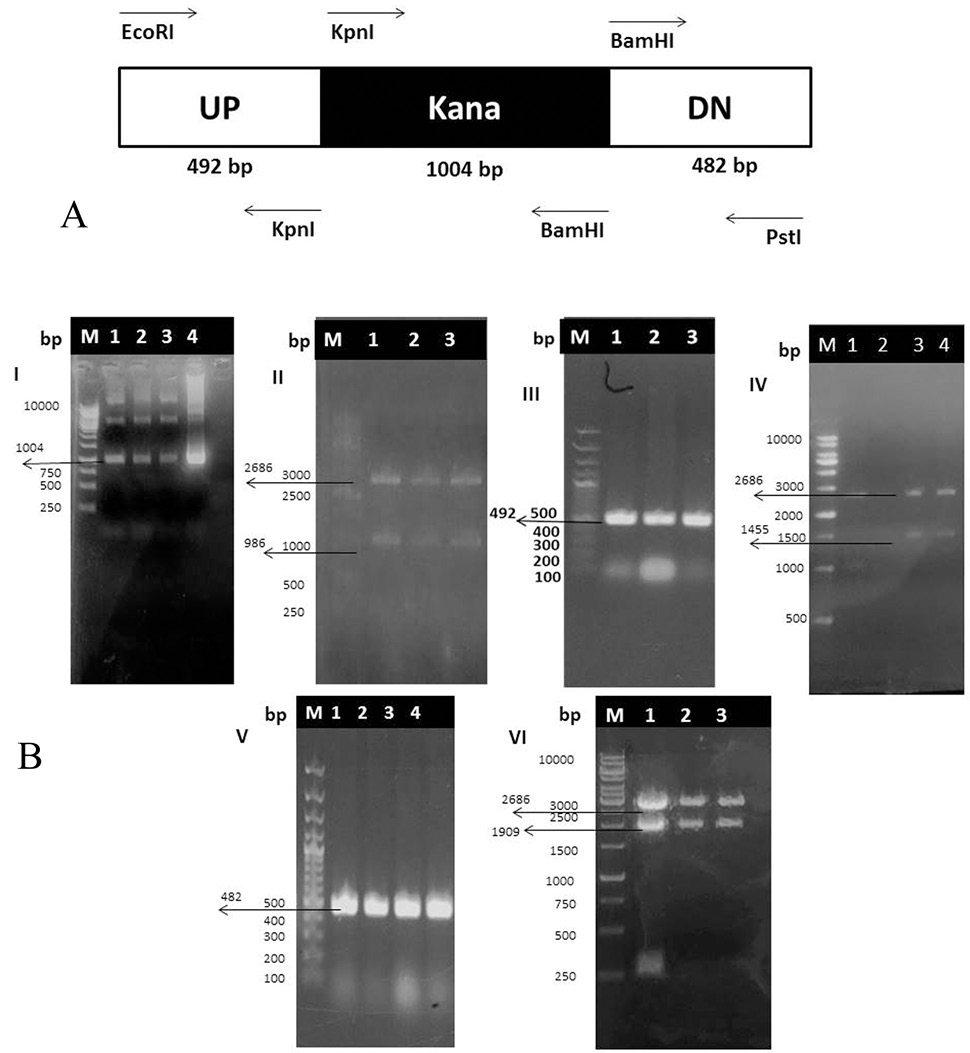
Construction and confirmation of pUC19-K-UP-DN gene deletion cassette. A, Illustration of map of pUC19-K-UP-DN gene deletion plasmid cassette; B I, Amplification of KM fragment. Line M showed 1Kb ladder; Line 1,2,3 showed 1004 bp KM amplicons; B II, Restriction digest analysis of pUC19-K. Line M showed 1Kb ladder; Line 1,2,3 showed transformed E.coli DH5α cells having 2686 bp band of pUC19 and 986 bp band of KM; B III, Amplification of UP fragment. Line M showed 100bp ladder; Line 1,2,3 showed 492 bp UP amplified amplicons; B IV, Restriction digest analysis of pUC19-K-UP. Line M showed 1Kb ladder; Line 1,2,3 showed transformed E. coli DH5α cells having 2686 bp band of pUC19 and 1455 bp band of K-UP fragment; B V, Amplification of DN fragment. Line M showed 100bp ladder; Line 1,2,3 showed 482 bp DN amplified amplicons; B VI, Restriction digest analysis of pUC19-K-UP-DN. Line M showed 1Kb ladder; Line 1,2,3 showed transformed E.coli DH5α cells having 2686 bp band of pUC19 and 1909 bp band of K-UP-DN fragment.
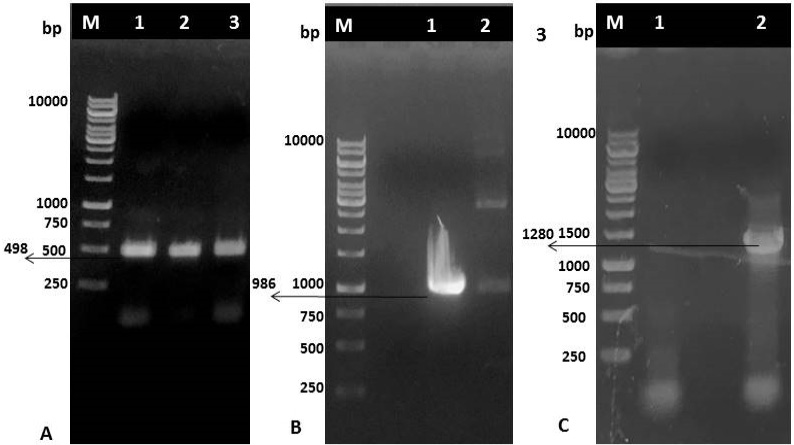
Confirmation of the ΔpurD gene deleted Br.abortus mutant. A, PCR for Br.abortus (498 bp). Line M showed 1Kb ladder; Line 1 1st Br. abortus transformed colony DNA; Line 2 2nd Br. abortus transformed colony DNA; Line 3 is the positive control. B, PCR for KM confirmation (986 bp). Line M showed 1Kb ladder; Line 1 ΔpurD deleted mutant DNA; Line 2 is the positive control. C, PCR for detection of purD gene (1280 bp). Line M showed 1Kb ladder; Line 1 ΔpurD deleted mutant DNA; Line 2 is the positive control.
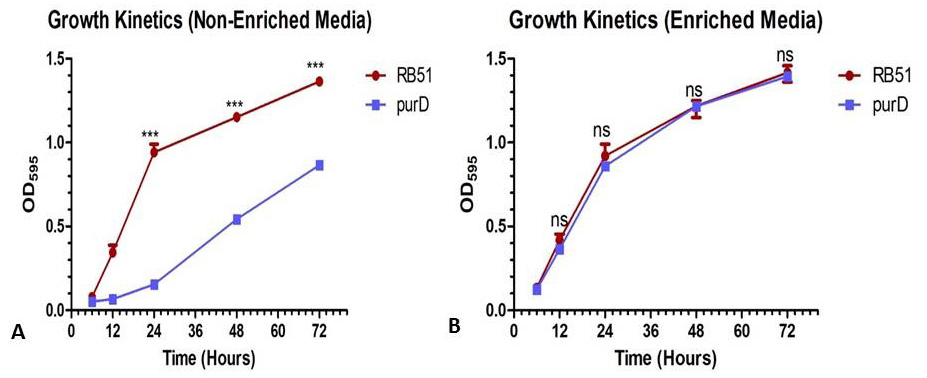
Growth kinetics comparison of the ΔpurD mutant and RB51 strain. O.D values at different time intervals when grow in non-enriched TSB medium without supplementation of adenine, guanine, thiamine and hypoxanthine. A, and in TSB enriched medium with supplementation of adenine, guanine, thiamine and hypoxanthine. B, Statistically significant differences in growth curve between parent RB51 strain and ΔpurD mutant was determined by using two-way ANOVA (***, P <0.05).
References
- Akhtar, R., Iqbal, M.Z., Ullah, A., Ali, M.M., Zahid, B., Ijaz, M., Ullah, A., and Taseer, M.S.A., 2019. Comparative association of slc11a1 (Nramp1) gene with susceptibility and resistance to brucellosis in various cattle and buffaloes breeds of Pakistan. Pak. Vet. J., 39: 612-614. https://doi.org/10.29261/pakvetj/2019.091[CrossRef]
- Alcantara, R.B., Read, R.D., Valderas, M.W., Brown, T.D., and Roop, R.M., 2004. Intact purine biosynthesis pathways are required for wild-type virulence of Brucella abortus 2308 in the BALB/c mouse model. Infect. Immun., 72: 4911-4917. https://doi.org/10.1128/IAI.72.8.4911-4917.2004[CrossRef]
- Ali, S., Nawaz, Z., Akhtar, A., Aslam, R., Zahoor, M.A., and Ashraf, M., 2018. Epidemiological investigation of human brucellosis in Pakistan. Jundishapur J. Microbiol., 11: 1-5. https://doi.org/10.5812/jjm.61764[CrossRef]
- Arellano-Reynoso, B., Dı́az-Aparicio, E., Leal-Hernández, M., Hernández, L., and Gorvel, J-P., 2004. Intracellular trafficking study of a RB51 B. abortus vaccinal strain isolated from cow milk. Vet. Microbiol., 98: 307-312. https://doi.org/10.1016/j.vetmic.2003.10.024[CrossRef]
- Ashford, D.A., Di Pietra, J., Lingappa, J., Woods, C., Noll, H., Neville, B., Weyant, R., Bragg, S.L., Spiegel, R.A., and Tappero, J., 2004. Adverse events in humans associated with accidental exposure to the livestock brucellosis vaccine RB51. Vaccine, 22: 3435-3439. https://doi.org/10.1016/j.vaccine.2004.02.041[CrossRef]
- Drazek, E.S., Houng, H., Crawford, R.M., Hadfield, T.L., Hoover, D.L. and Warren, R.L., 1995. Deletion of purE attenuates Brucella melitensis 16M for growth in human monocyte-derived macrophages. Infect. Immun., 63: 3297-3301. https://doi.org/10.1128/iai.63.9.3297-3301.1995[CrossRef]
- Ezama, A., Gonzalez, J.P., Majalija, S., and Bajunirwe, F., 2018. Assessing short evolution brucellosis in a highly brucella endemic cattle keeping population of Western Uganda: A complementary use of Rose Bengal test and IgM rapid diagnostic test. BMC Publ. Hlth., 18: 1-5. https://doi.org/10.1186/s12889-018-5228-9[CrossRef]
- Iqbal, M., Fatmi, Z., and Khan, M.A., 2020. Brucellosis in Pakistan: A neglected zoonotic disease. J. Pak. med. Assoc., 70: 1625. https://doi.org/10.5455/JPMA.24139[CrossRef]
- Khan, I., Ali, S., Hussain, R., Raza, A., Younus, M., Khan, N., and Faheem, M., 2021. Serosurvey and potential risk factors of brucellosis in dairy cattle in peri-urban production system in Punjab, Pakistan. Pak. Vet. J., 10: 459-462.
- Khurana, S.K., Sehrawat, A., Tiwari, R., Prasad, M., Gulati, B., Shabbir, M.Z., Chhabra, R., Karthik, K., Patel, S.K., and Pathak, M., 2021. Bovine brucellosis. A comprehensive review. Vet. Quart., 41: 61-88. https://doi.org/10.1080/01652176.2020.1868616[CrossRef]
- Kim, S., Watarai, M., Kondo, Y., Erdenebaatar, J., Makino, S.I., and Shirahata, T., 2003. Isolation and characterization of mini-Tn 5 Km2 insertion mutants of Brucella abortus deficient in internalization and intracellular growth in HeLa cells. Infect. Immun., 71: 3020-3027. https://doi.org/10.1128/IAI.71.6.3020-3027.2003[CrossRef]
- Lalsiamthara, J., Kaur, G., Gogia, N., Ali, S.A., Goswami, T.K., and Chaudhuri, P., 2020. Brucella abortus S19 rfbD mutant is highly attenuated, DIVA enable and confers protection against virulent challenge in mice. Biologicals, 63: 62-67. https://doi.org/10.1016/j.biologicals.2019.11.005[CrossRef]
- Lalsiamthara, J., Kaur, G., Gogia, N., Ali, S.A., Goswami, T.K., and Chaudhuri, P., 2020. Brucella abortus S19 rfbD mutant is highly attenuated, DIVA enable and confers protection against virulent challenge in mice. Int. Biol., 63: 62-67.
- Mahmood, R., Ali, T., Waheed, U., Asif, M., and Khan, Q.M., 2016. Application of serum based PCR and fluorescence polarization assay for diagnosis of brucellosis among people occupationally at risk to disease. Int. J. Agric. Biol., 18: 311-318. https://doi.org/10.17957/IJAB/15.0099[CrossRef]
- Manual, O.T., 2019. Brucellosis (Brucella abortus, B. melitensis and B. suis)(infection with B. abortus, B. melitensis and B. suis). Manual of diagnostic tests and vaccines for terrestrial animals. OIE, World Organisation for Animal Health.
- McQuiston, J.R., Schurig, G.G., Sriranganathan, N., and Boyle, S.M., 1995. Transformation of Brucella species with suicide and broad host-range plasmids. In: Electroporation protocols for microorganisms. (Springer), pp. 143-148. https://doi.org/10.1385/0-89603-310-4:143[CrossRef]
- O’Leary, S., Sheahan, M. and Sweeney, T., 2006. Brucella abortus detection by PCR assay in blood, milk and lymph tissue of serologically positive cows. Res. Vet. Sci., 81: 170-176. https://doi.org/10.1016/j.rvsc.2005.12.001[CrossRef]
- Park, J.H., Hwang, S.D., Acharya, D., Lee, S.H., Hwang, K.J., Yoo, S.J., and Lee, K., 2018. Seroreactivity and risk factors associated with Coxiella burnetii infection among cattle slaughterhouse workers in South Korea. Int. J. environ. Res. Publ. Hlth., 15: 2264. https://doi.org/10.3390/ijerph15102264[CrossRef]
- Raza, S., Deng, M., Shahin, F., Yang, K., Hu, C., Chen, Y., Chen, H., and Guo, A., 2016. A bovine herpesvirus 1 pUL51 deletion mutant shows impaired viral growth in vitro and reduced virulence in rabbits. Oncotarget, 7: 12235. https://doi.org/10.18632/oncotarget.7771[CrossRef]
- Saxena, H.M., and Raj, S., 2018. A novel immunotherapy of Brucellosis in cows monitored non invasively through a specific biomarker. PLoS Negl. Trop. Dis., 12: e0006393. https://doi.org/10.1371/journal.pntd.0006393[CrossRef]
- Schurig, G.G., Sriranganathan, N., and Corbel, M.J., 2002. Brucellosis vaccines: past, present and future. Vet. Microbiol., 90: 479-496. https://doi.org/10.1016/S0378-1135(02)00255-9[CrossRef]
- Sergueev, K.V., Filippov, A.A., and Nikolich, M.P., 2017. Highly sensitive bacteriophage-based detection of Brucella abortus in mixed culture and spiked blood. Viruses, 9:144. https://doi.org/10.3390/v9060144[CrossRef]
- Truong, Q.L., Cho, Y., Barate, A.K., Kim, S., Watarai, M., and Hahn, T.W., 2015. Mutation of purD and purF genes further attenuates Brucella abortus strain RB51. Microb. Pathog., 79: 1-7. https://doi.org/10.1016/j.micpath.2014.12.003[CrossRef]
- Truong, Q.L., Cho, Y., Park, S., Kim, K., and Hahn, T.W., 2016. Brucella abortus ΔcydCΔcydD and ΔcydCΔ purD double-mutants are highly attenuated and confer long-term protective immunity against virulent Brucella abortus . Vaccine, 34: 237-244. https://doi.org/10.1016/j.vaccine.2015.11.030[CrossRef]
- Wang, Z., and Wu, Q., 2013. Research progress in live attenuated Brucella vaccine development. Curr. Pharm. Biotechnol., 14: 887-896. https://doi.org/10.2174/1389201014666131226123016[CrossRef]
- Yazdi, H.S., Kafi, M., Haghkhah, M., Tamadon, A., Behroozikhah, A., and Ghane, M., 2009. Abortions in pregnant dairy cows after vaccination with Brucella abortus strain RB51. Vet. Rec., 165: 570. https://doi.org/10.1136/vr.165.19.570[CrossRef]
Services
Article usage statistics
Loading…