To analyze the effectiveness of anti-brucellosis measures without the use of specific prophylactic agents, we previously conducted production testing of a “vaccine-free regimen” for combating reindeer brucellosis in farms of the Magadan Region.
In the Magadan Region, 26 state farms with the primary livestock of 543.6 thousand deer (out of 39 deer-raising) were declared dysfunctional for brucellosis. Brucellosis recorded in 11 districts of the region (out of 15 in which there are reindeer herding farms).
To monitor changes in the epizootic situation of brucellosis in reindeer husbandry, veterinary specialists of the region systematically (quarterly) conducted a clinical examination of all animals, and from 15-20% of deer took blood for serological studies. Deer with clinical signs of the disease and aborted female deer were isolated from production teams in feeding herds for subsequent slaughter.
Despite the gigantic work done, only 8 (30.2%) farms that were outside the natural focus of deer brucellosis fully recovered. In 18 reindeer husbandry farms, despite the improvement work carried out, well-being could not be achieved. In some cases, the number of animals positively responding to brucellosis increased markedly.
In this regard, we developed a concept for optimizing the specific prevention of reindeer brucellosis from the perspective of theories of the epizootic process, self-regulation of parasitic systems, natural foci, technological features of the industry, and new socio-economic and epidemic conditions.
Initially, we tried to present possible variants of the development of the epizootic process in the absence of permanent immunity in the populations of domestic reindeer and wild animals, while focusing on the results of both our research and literature data.
The possibility of the presence of both reserve and epizootic strains in individual herds is a priori definite. Reservation strains, in our opinion, should include dissociates, as well as S-strains with reduced virulence.
The formation of epizootic strains occurs in the process of reversal of the pathogen into the S-form and the acquisition of increased virulence during passage through susceptible organisms. The materials of our production experiments and practical observations on the rehabilitation of reindeer husbandry from brucellosis without vaccines confirm this since it was not possible to obtain stable results according to the “vaccine-free regimen” in most herds.
Based on the above, a conceptual model for controlling the epizootic process of brucellosis in animal populations in the presence and absence of permanent immunity has proposed (Figure 1).
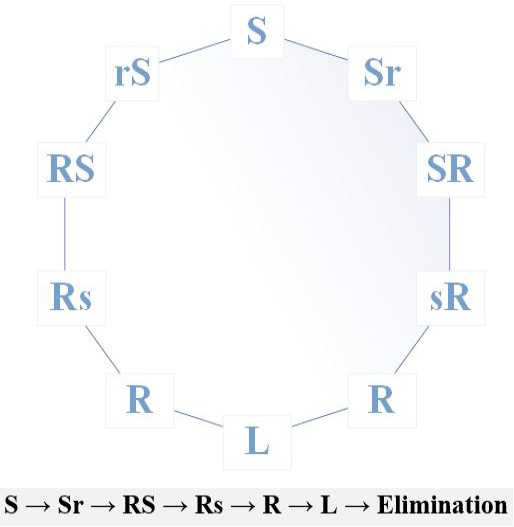
Figure 1: A conceptual model of development the epizootic process of brucellosis in animal populations with and without immunity. A: The population of non-immune animals with brucellosis circulating in them at different stages; B: Immune reindeer populations (permanent immunity), with flowing brucellosis.
According to the presented scheme, the formation of epizootic strains with 100% coverage of animals with immunization and reimmunization should not practically occur since, under the influence of immunity, an irreversible process of dissociation of pathogens occurs with their subsequent elimination. In populations of non-immune animals, the reservation phases replaced by aspects of the formation of epizootic strains with a certain periodicity.
From the above diagram, the role of permanent immunity in controlling the epizootic process of reindeer brucellosis is unambiguously clear. However, to positively answer the most fundamental question in our concept - is it necessary to create permanent immunity in populations of domestic reindeer, we faced the following issue: how to ensure this lifelong immunity with minimal costs in all herds of local reindeer since in each explicit or potential contacts with sources of the pathogen of brucellosis are not excluded from them, both inside the pack (re-generation of animals during periods of rutting, calving, etc.) and because of the widespread occurrence of natural foci (infection of wild reindeer populations, carnivores, rodents).
The widespread use of specific prophylactic prophylaxis in reindeer, especially in the adult population, has been restrained and continues to be controlled, in our opinion, due to the massive manifestation of the provocative properties of vaccines.
The fact is that in deer herds, where the re-fermentation process never seemed to stop, the pathogen reservation stage, as a rule, is not accompanied by any manifestation, primarily clinical.
Introduction vaccine makes it possible to provoke the transition of the pathogen from the reservation stage to the stage of formation of the epizootic strain and, thereby, to manifest the disease in many animals.
Most scientists and practitioners attributed this phenomenon to either high reactogenicity at a given dose of the vaccine, or increased sensitivity of deer to the vaccine.
Without completely denying this, it should noted that manifestation of the provocative properties of any vaccine, including anti-brucellosis, largely depends on the features of strain, and dose, and method of administration.
Therefore, it is possible to reduce the external manifestation of the “reactogenic” properties of the vaccine by optimizing the dose. As well as by administering the immunopreparation to lowering the level of herd infection before vaccination. Using general veterinary and sanitary measures (aimed at neutralizing the transmission mechanism), diagnostics (identification of brucellosis carriers), and body sanitation deer. These issues have studied in other animal species.
Table 1: The control system for the epizootic process of brucellosis in domestic reindeer (conceptual model).
When choosing anti-brucellosis immunotherapy (especially in the natural foci of brucellosis), it should emphasize that highly immunogenic vaccines should provide gross immunity and permanent immunity.
Grundimmunity is essential only due to the S-immune background. Subsequent reimmunization can also be with the help of others, including killed vaccines. However, in reindeer herding, these are distant prospects.
Diagnosis of reindeer brucellosis can be used only for epizootological control, and the use of an immunodiffusion reaction (RID with O-PS antigen) is promising in this regard.
When introducing specific prophylaxis means in reindeer herding, it is necessary to take into account the technological features of the industry: Year-round deer grazing, constant herds movement (roaming) to search new grazing areas, severe climatic conditions in the region sharply limits the possibilities and organization of mass diagnostic and therapeutic, preventive measures in reindeer husbandry.
Based on the conceptual model, we developed a system for controlling the epizootic process of brucellosis in domestic reindeer and methodological recommendations for monitoring the epizootic process of brucellosis in reindeer (from the standpoint of theories of the epizootic process, self-regulation of parasitic systems, natural foci, technological features of the industry, and new socio-economic and epidemic conditions (Table 1).
We believe that in the practical implementation of the concept of optimizing the control system for the epizootic process of reindeer brucellosis, the following sections should distinguished:
• Control of an epizootic situation: The decisive link in the assessment of the epizootic state of farms (teams) is the clinical examination and serological testing of adult deer blood for brucellosis.Mandatory conditions for clinical and serological studies: Quarterly clinical examination of the entire herd of deer in coral; annual serological monitoring of blood serum according to a set of serological studies (RBP, RA, RSK, RID with O PS antigen) from at least 15-20% of deer of each reindeer herding team.
• Protection of prosperous farms from the introduction of brucellosis infection: To avoid the introduction of brucellosis infection into prosperous farms (herds), it is necessary: to have information about the epizootic situation for brucellosis in neighboring reindeer husbandry farms and adjacent territories of grazing herds; receive systematic data on the ways of seasonal migration of wild reindeer in the region (district, okrug); organize strictly isolated deer grazing of brucellosis-free farms (brigades), excluding possible contacts with animals of dysfunctional squads (state farms), wild reindeer or visits to pastures located on the paths of seasonal migration of wild reindeer; to prohibit transport (on reindeer sledding) communications between employees of prosperous farms and brigades disadvantaged for brucellosis; to prevent the entry of deer (purchase, exchange of choirs) from unsuccessful farms (brigades) into safe farms (squads).• Improvement of reindeer husbandry dysfunctional for brucellosis: The methods for improving the health of brucellosis-deprived households (teams) are selected depending on the course of brucellosis infection in the family (group), taking into account the epizootic state of the district (district) in which this dysfunctional point located. If, during a mass serological examination for brucellosis, more than 30% of seropositive deer found in the herd, it recommended that all animals killed. In reindeer husbandry, where there are no clinically sick animals, and the number of seropositive is up to 3-5%, the use of anti-brucellosis vaccines recommended. We have studied vaccines from B. abortus strains 19 and 82 and the doses of their administration for the specific prevention of reindeer brucellosis. It found that the optimal dose of the vaccine from the B. abortus 19 strain is 2.5 billion mt. After its introduction, not a single case of post-vaccination complications revealed. The grafted deer recorded pronounced immunological response with appearance specific agglutinins and the complement of binding antibodies in the blood serum. During 360 days, all vaccinated animals responded negatively or doubtfully to RA. Revaccination of animals causes a secondary immune response, but the rate of decline of specific antibodies is higher. Immunity during six months after vaccination of all experimental deer was 91.6%, while in the control group, the introduction of a virulent strain caused 100% infection. For the vaccine from strain B. abortus 82, it found that a dose of 10 billion mt is optimal for use on reindeer. It did not cause post-vaccination complications in vaccinated deer after 180 days. Only doubtfully reacting animals registered in the RA. Immunity during 3 and 6 months after vaccination was 75%. Comparative tests of vaccines from B. abortus 19, 82 strains under production conditions indicate a high level of antiepizootic efficacy of the scheme for the use of vaccines from strain 19 and 82 in reindeer herding for both primary immunization and reimmunization: no clinically ill animals found. The number is positive reacting animals in herd No. 2 (pcs. 19) decreased by more than 6.5 times, and in herd No. 3 (pcs. 82) - 3 times.
