
The aim of the current study is to elucidate the structural information, infrared and raman spectra of N-Methyl Alkyl Benzothiazolium iodide through computational methods as well as to evaluate its antifungal properties. In order to achieve the goal, softwares like Avogadro, Gamess, Gabedit, Chimera and free online databases were used. The infrared and raman spectra were computed at the harmonic level with restricted Hartree-Fock in basis sets 3-21G and 6-31G. Molecular docking is calculated using online server with Lanosterol 14α-demethylase to know antifungal properties. The theoretically computed results of heterocyclic organic molecule gives us information regarding the structural arrangement of atoms. On the basis of outcome of computational based result, it is concluded that the title molecule is a suitable future antifungal candidate.
Research Article · Volume 38, Issue 4, 21 September 2022 · Open Access
Computational Structural Calculation of N-Methyl Benzothiazolium Iodide as an Antifungal Candidate
· · ·
Affiliations & Notes ⌄
- 1Chemistry Department, School of science, University of Management and Technology Lahore, Pakistan
- 2Institute of Biochemistry, University of Balochistan, Quetta, Pakistan. *Correspondence | Muhammad Aziz, Institute of Biochemistry University of Balochistan, Quetta, Pakistan
- 3Email: aziz1sh@hotmail.com
Article Info ⌄
- Journal:
- Sarhad Journal of Agriculture
- Published:
- 21 September 2022
From the article
- Current paper aim to investigate the antifungal biological activities and structural information of the title molecule.
- The I.R and Raman spectra of the N-Alkyl Benzothiazolium Iodides of N-C, C-C, C-H and S-C stretches are calculated by anharmonic calculations using ab initio potentials.
- The B3LYP potential is used in this calculation that gives the better results.
- The assignment of the vibrations to the spectral bands may be sensitive to the vibrational method and potential, but the detailed analysis provides a clearer picture about the role of the different functional groups in the molecule and their vibrations.
Selected from the article's own text.
Abstract
Introduction
Chemicals are widely used to control diseases but due to their hazardous effects farmers avoid the uses of different chemicals . But when these chemicals enhance the quality of crops and successfully saves them from fungi, bringing back farmers towards chemical use. A study shows that Benzothiazolium a mother compound also enhances the sugar content of plants ; . Methyl-Alkyl Benzothiazolium iodide is a well-known organic salt also propounded in literature as an ionic liquid. It is further added Methyl-Alkyl Benzothiazolium iodides are not true salt and not true ionic liquid but resemble with them. A large number of therapeutic agents are synthesized with the aid of Benzothiazolium . Ionic liquid and organic salts were a subject of great importance; because of the unique chemical and physical properties. Ionic liquids could be recycled, that made all the processes less costly and used as a catalyst in very less quantity and proved potentially as environment-friendly . Some investigations show that Methyl-Alkyl Benzothiazolium and its derivatives mainly tuned to its application in medicinal chemistry and as dye industry. Like 3-chloro-3-methylbenzothiazolium methyl sulfate has presented the highest inhibitory effect against fungal enzyme. When the inhibitory effect of the salt was studied, it seemed that, in the cell culture system, the benzothiazolium salts proved itself the best candidate that were evaluated in a chemical reactions because of the inhibitory effect and production of nitric oxide . Benzothiazolium contain a heterocyclic structure and present in several tautomeric forms which facilitate relocation of a proton on a molecule this cyclic ring played a vital role during the reaction. Like, the observation showed that it acted as “on-off” type leaving group during the production of different types of derivatives of ketones and carboxylic acid by reacting with a base under mild conditions to give ketones .
The fungus family contains almost 3.8 million species which causes damage to plants and is called fungal infection. The fungal damage can be easily seen on the plant surface. This visible effect can be spread quickly from one plant to nearby plant. Fungal spores are readily dispersed by many means like insect, soil, wind and water. In this way, fungus infests an entire cultivated field. According to estimate ten thousand plants belonging to more than 1,600 genera in Pakistan are effected by fungi. Lanosterol-14α-demethylase is an enzyme and acceptable target for antifungals compounds . Computational method was used to evaluate and identify antifungal properties.
Materials and Methods
The ab initio method was used to calculate the I.R (infrared) and Raman spectra by using the GAMESS program . According to author’s knowledge the structure of title compound is not reported and well explain yet. The electronic energies, serving as potential in the calculation of vibrational frequencies, which are calculated through B3LYP level of theory. The molecular 3D structure is drawn with the aid of Avogadro software . Result of vibration spectroscopy is viewed with the help of Gabedit spectroscopy spectrum visualization software .
In suit analysis
Online database is used to obtain a lanosterol 14α-demethylase structure (5ESJ). After this unwanted residue are removed from the structure. The 3D structure of ligand submitted for analysis to Swiss docking server . Visualization of result was view on chimera .
Results and Discussion
Structural taxonomy
Methyl is attached to the nitrogen of thiazolium ring and iodine is free as shown in Figure 1.
All the bonds have a bond order of 1D except C1-C2, C3-C4, C5-C6, and N-C7 that have the bond order of 2D. All the bonds are non-rotatable. The bond angles vary from minimum C-S-C of 92.8347˚ to the maximum of C-N-C and C-C-S of 127˚. Molecular weight is 278.133 g/Mol The chemical formula is C8H8INS. There are 19 atoms as shown in Figure 1. IUPAC name 3-methyl-1,3-benzothiazol-3-ium iodide.
Infrared spectra (I.R)
The importance of structural information in drug synthesis is gaining greater attention now a days and a basic knowledge of the subject will be necessary that’s why there is a need to know the exact structure of possible candidate . It is concerned with the study how molecules arrangement is affected by the way their atoms are arranged in space . From the I.R spectrum, it has been observed that Amine has a peak at 3314cm-1 while near at 3000cm-1 the peak is of CH stretch or bend in the molecule. While the benzene ring stretch is observed at 1062.74cm-1.
Raman spectra
Similarly, it has been observed from the Raman spectrum of the molecule that amine functional group has shown a peak at 3312.29cm-1. At 3000cm-1, a peak of CH stretch or bend is obtained.
Some low-intensity peaks are being observed in the I.R and Raman spectra and these can be due to the combination of vibrational modes. Most of the absorptions have been observed due to the CH symmetrical mode. While other symmetrical and asymmetric vibrational modes have also been frequently observed in this molecule at different frequencies. The iodine has given the peaks at a frequency of 586cm-1 in I.R spectrum and at 640cm-1 in Raman. In the above spectra, there is a peak at a frequency of 2990.33cm-1 that shows the alkane chain. The iodide ion gives a slight peak at 640.91cm-1. The low intensity of the peak may be due to the weak bonding of the atom with other atoms. The most of the vibrations are observed that involve CH- bonding and some also contain N and S in it. Even though it was possible to distinguish in principle, the same four basic types (CH3 symmetric, CH3 asymmetric, CH2 symmetric, and CH2 asymmetric), in reality, the modes are almost always overlap (e.g. CH2 and CH3 asymmetric).
As from the Figures 2 and 3, it can be seen that the normal modes of transition of IR and Raman frequencies are different because the transitions visible in I.R spectra are invisible in the Raman spectra and vice versa. While the difference between the frequencies of nearly degenerate modes of the same type is sometimes remarkable than the difference between some frequencies of different mode types.
Antifungal activity
Due to plethora use of chemicals; a living organism develop resistance to particular chemicals. So there is need to identify new reagents for the preparation of safer and more effective antifungal chemicals. There are lots of studies, which show lanosterol 14α-demethylase is a possible target for the development of antifungal drugs .
The title ligand (coloured as shown in Figure 4) show an interrelation with different amino acids of cytochrome enzyme. This enzyme plays a role in biosynthesis of essential Vitamin, Lipid and steroids in fungi. Computational platforms for drug design is an innovative and alternative method .
Conclusions and Recommendations
Current paper aim to investigate the antifungal biological activities and structural information of the title molecule. Antifungal activity was assayed through computational method. Targeting the same enzyme again and again (lanosterol 14α-demethylase) to kill a fungal species motivates the fungal family to develop a drug resistance which is becoming an upcoming threat to crops management. The I.R and Raman spectra of the N-Alkyl Benzothiazolium Iodides of N-C, C-C, C-H and S-C stretches are calculated by anharmonic calculations using ab initio potentials. The B3LYP potential is used in this calculation that gives the better results. The results are sufficient to explain the spectral features and the resulting spectra seem to be close in frequencies obtained from the literature. The assignment of the vibrations to the spectral bands may be sensitive to the vibrational method and potential, but the detailed analysis provides a clearer picture about the role of the different functional groups in the molecule and their vibrations.
Novelty Statement
The cost of development of new fungicide is very high. The advantages presented by the structure based and target based computational designs have powerful characteristics that have an impact on discovery and minimize the cost and time span.
Author’s Contribution
Muhammad Aziz: Molecular docking analysis.
Sohail Nadeem: Draft a manuscript.
Ayesha Mohy ud Din: Spectrophotometric interpretation.
Tayyaba Jamil: Chemical calculation.
All authors read and approved the final manuscript.
Conflict of interest
The authors have declared no conflict of interest.
Figures
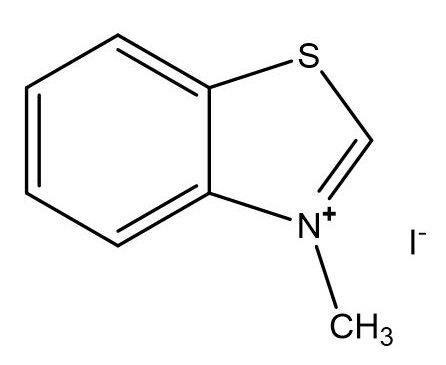
Structure of N-Methyl benzothiazolium iodide.
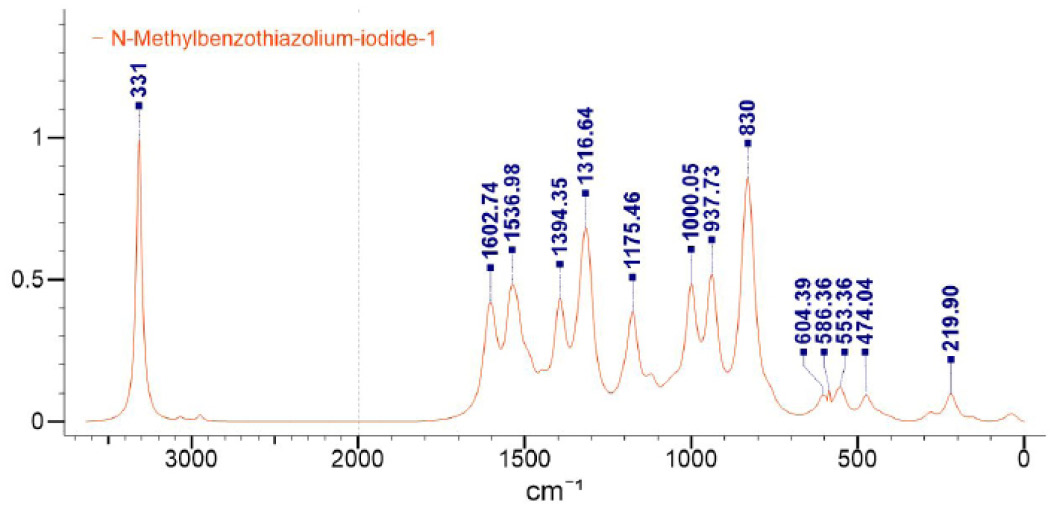
The I.R spectrum of N- methyl Benzothiazolium Iodide conformer calculated with B3LYP. The spectrum is plotted against frequency (x-axis) and intensities (y-axis).
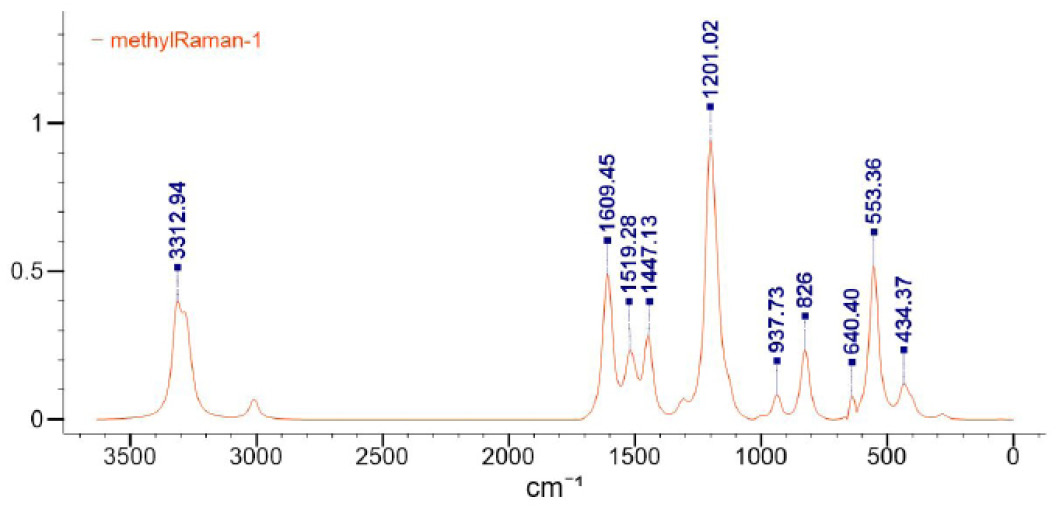
The Raman spectrum of N- methyl Benzothiazolium Iodide conformer calculated with B3LYP. The spectrum is plotted against frequency (x-axis) and intensities (y-axis).
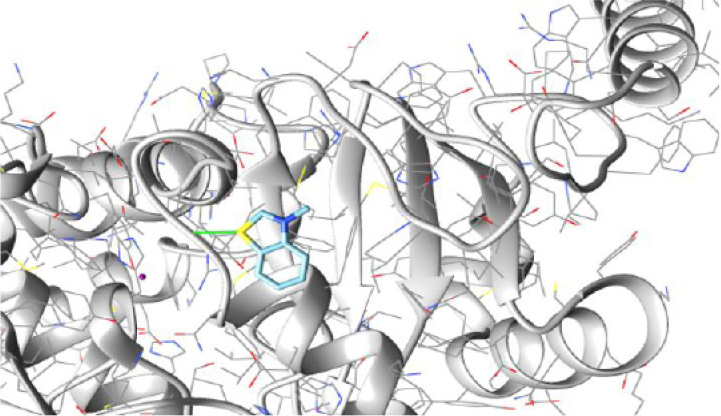
Show the interaction of N- methyl Benzothiazolium Iodide with lanosterol 14α-demethylase.
References
- Ali, R., and N. Siddiqui. 2013. Biological aspects of emerging benzothiazoles: A short review. J. Chem., pp. 345198. https://doi.org/10.1155/2013/345198[CrossRef]
- Allouche, A.R., 2011. Gabedit a graphical user interface for computational chemistry softwares. J. Comput. Chem., 32(1): 174-182. https://doi.org/10.1002/jcc.21600[CrossRef]
- Chikashita, H., M. Ishihara, K. Takigawa and K. Itoh. 1991. Synthetic application of benzothiazole ring system as an on-off type of leaving group. Synthesis of ketones and carboxylic acid derivatives from 2-(1-substituted 1-hydroxyalkyl) and 2-(1-hydroxyalkyl) benzothiazoles. Bull. Chem. Soc. Japan, 64(11): 3256-3261. https://doi.org/10.1246/bcsj.64.3256[CrossRef]
- Grosdidier, A., V. Zoete and O. Michielin. 2011. SwissDock, a protein-small molecule docking web service based on EADock DSS. Nucl. Acids Res., 39(suppl_2): W270-W277. https://doi.org/10.1093/nar/gkr366[CrossRef]
- Hanwell, M. D., D.E. Curtis, D.C. Lonie, T. Vandermeersch, E. Zurek and G.R. Hutchison. 2012. Avogadro: An advanced semantic chemical editor, visualization, and analysis platform. J. Cheminf., 4(1): 17. https://doi.org/10.1186/1758-2946-4-17[CrossRef]
- Hawksworth, D.L., and R. Lücking. 2017. Fungal diversity revisited: 2.2 to 3.8 million species. The fungal Kingdom, pp. 79-95. https://doi.org/10.1128/9781555819583.ch4[CrossRef]
- Ji, H., W. Zhang, Y. Zhou, M. Zhang, J. Zhu, Y. Song and J. Zhu. 2000. A three-dimensional model of lanosterol 14α-demethylase of Candida albicans and its interaction with azole antifungals. J. Med. Chem., 43(13): 2493-2505. https://doi.org/10.1021/jm990589g[CrossRef]
- Kuldeep, S., P. Shakya, A. Kumar, S. Alok, M. Kamal and S.P. Singh. 2014. Stereochemistry and Its role in drug design. Int. J. Pharm. Sci. Res., 5(11): 4644-4659. http://dx.doi.org/10.13040/IJPSR.0975-8232.5(11).4644-59[CrossRef]
- McConathy, J., and M.J. Owens. 2003. Stereochemistry in drug action. Prim. Care Compan. J. Clin. Psychiatry, 5(2): 70–73. https://doi.org/10.4088/PCC.v05n0202[CrossRef]
- Monk, B.C., A.A. Sagatova, P. Hosseini, Y.N. Ruma, R.K. Wilson and M.V. Keniya. 2020. Fungal lanosterol 14α-demethylase: A target for next-generation antifungal design. Biochim. Biophys. Acta Proteins Proteomics, 1868(3). https://doi.org/10.1016/j.bbapap.2019.02.008[CrossRef]
- Pettersen, E.F., T.D. Goddard, C.C. Huang, G.S. Couch, D.M. Greenblatt, E.C. Meng and T.E. Ferrin. 2004. UCSF Chimera a visualization system for exploratory research and analysis. J. Comput. Chem., 25(13): 1605-1612. https://doi.org/10.1002/jcc.20084[CrossRef]
- Kore, P., M. Mutha, R. Antre, R. Oswal and S. Kshirsagar. 2012. Computer-aided drug design: An innovative tool for modeling. Open J. Med. Chem., 2(4); 139-148. https://doi.org/10.4236/ojmc.2012.24017[CrossRef]
- Rashwan, R.S., and D.M. Hammad. 2020. Toxic effect of Spirulina platensis and Sargassum vulgar as natural pesticides on survival and biological characteristics of cotton leaf worm Spodoptera littoralis. Sci. Afr., pp. 8. https://doi.org/10.1016/j.sciaf.2020.e00323[CrossRef]
- Sekerka, V., and V. Sutoris. 1985. Benzothiazole salts derivatives inducing sugar content increase in plants. Polnohospodarstvo (Czechoslovakia).
- Schmidt, M.W., K.K. Baldridge, J.A. Boatz, S.T. Elbert, M.S. Gordon, J.H. Jensen and S. Su. 1993. General atomic and molecular electronic structure system. J. Comput. Chem., 14(11): 1347-1363. https://doi.org/10.1002/jcc.540141112[CrossRef]
- Shi, W., B.A. Nacev, S. Bhat and J.O. Liu. 2010. Impact of absolute stereochemistry on the antiangiogenic and antifungal activities of itraconazole. ACS Med. Chem. Lett., 1(4): 155-159. https://doi.org/10.1021/ml1000068[CrossRef]
- Talaty, E.R., S. Raja, V.J. Storhaug, A. Dölle and W.R. Carper. 2004. Raman and infrared spectra and ab initio calculations of C2-4MIM imidazolium hexafluorophosphate ionic liquids. J. Phys. Chem. B., 108(35): 13177-13184. https://doi.org/10.1021/jp040199s[CrossRef]
- Tseng, H.Y., S.H. Wu, E.H. Huang, S.F. Wang, Y.N. Yang, N. Mahindroo and S.J. Lee. 2005. Benzothiazolium compounds: novel classes of inhibitors that suppress the nitric oxide production in RAW264. 7 cells stimulated by LPS/IFNγ. Bioorg. Med. Chem. Lett., 15(8): 2027-2032. https://doi.org/10.1016/j.bmcl.2005.02.063[CrossRef]
- Sutoris, V., P. Bajči, V. Sekerka, and J. Halgaš.1988. Benzothiazole compounds XXXIII. Benzothiazolíum salts which increase sugar and chlorophyll contents in plants. Chem. Pap., 42(2): 249-261. https://www.chempap.org/file_access.php?file=422a249.pdf
- Zhou, M., and W. Wang. 2018. Recent advances in synthetic chemical inducers of plant immunity. Front. Plant Sci., 9: 1613-161. https://doi.org/10.3389/fpls.2018.01613[CrossRef]
Services
Article usage statistics
Loading…