
We compared venom yield in two medically important snake species, the black cobra (Naja naja) and the common krait (Bungarus caeruleus), under varying housing densities and feeding frequencies relative to the standard husbandry and venom extraction protocols of the National Institutes of Health (NIH) which is Pakistan’s primary antivenom production facility. Twenty captive individuals of each species were assigned to either a control group (n = 10), maintained and fed according to NIH routine, or an experimental group (n = 10), subjected to modified housing and feeding regimes. Across trials, control groups of both species showed progressive declines in venom yield, with N. naja decreasing from 1.9 to 0.9 mL and experiencing two mortalities, and B. caeruleus declining from 0.9 to 0.2 mL with no mortalities. In contrast, experimental groups exhibited higher and more variable venom yields, with maximum yields of 2.8 mL in N. naja and 0.7 mL in B. caeruleus during trials with intermediate extraction intervals (15–28 days). Study limitations include pooled venom samples, which precluded individual-level analyses, and potential seasonal effects, particularly in B. caeruleus. Future work should refine species-specific husbandry, improve venom quantification precision, and investigate physiological links between nutrition, stress, and venom production.
Research Article · Volume 58, Issue 6, 12 October 2026 · Open Access
Comparison of Venom Yield of Naja naja (Indian Black Cobra) and Bungarus caeruleus (Common Krait) through Housing and Diet Manipulation
· · · · · · ·
Affiliations & Notes ⌄
- 1Herpetology Lab, Department of Zoology, Wildlife and Fisheries, Pir Mehr Ali Shah-Arid Agriculture University, 46000 Rawalpindi, Pakistan. 2State Key Laboratory of Wetland Conservation and Restoration, National Observations and Research Station for Wetland Ecosystems of the Yangtze Estuary, Ministry of Education Key Laboratory for Biodiversity Science and Ecological Engineering, and Institute of Eco-Chongming, School of Life Sciences, Fudan, University, Songhu Road 2005, Shanghai, 200438, China
Article Info ⌄
- Journal:
- Pakistan Journal of Zoology
- Published:
- 12 October 2026

From the article
- The experimental group showed higher and more variable venom yields, ranging from 0.3 mL to a maximum of 0.7 mL.
- The highest venom production occurred in trials with moderate extraction intervals (16–28 days) (Fig. 2), whereas longer intervals were associated with a slight decline in yield.
- In Black Cobras, mean venom yield was higher under experimental husbandry conditions compared to the NIH control, indicating that enhanced feeding frequency, diet quality, and optimized housing conditions can directly support venom replenishment.
- Our findings suggest that krait may require species-specific feeding strategies, such as whole-prey items aligned with natural diet, nocturnal feeding schedules, and minimized handling stress, to achieve measurable improvements in venom yield.
Selected from the article's own text.
Abstract
Introduction
Venomous snakes pose substantial public health risks, but also offer potential biomedical resources ; . Snake bite is a neglected tropical disease declared by the World Health Organization (WHO, 2007). Millions of people worldwide experience snakebites each year, and a significant proportion develop clinical envenoming, resulting in thousands of deaths and long-term disabilities ; WHO, 2019; . The impact is even more severe in the remote regions of Africa and Asia, where the availability of care following a snake bite, or even antivenoms, is poor ; WHO, 2016; . Snake venom is a natural reservoir of bioactive molecules evolved to interact with human physiological targets ; ; . Venom components have contributed to the development of clinically useful medicines and continue to advance drug discovery, particularly for cardiovascular diseases, pain, inflammation, thrombosis, and cancer biology ; ; Zona-Rubio et al., 2005). The successful use of venom in the development of antivenom and drugs in adequate amounts, proper reflection of regional venom diversity, and appropriate scientific management for the animal source(s) from which the venom is derived are important goals that need to be addressed when working with venom ; .
Venom production units also experience challenges in terms of the capture as well as the identification of the snake, apart from the high mortality rates and low survival rates in the serpentariums . The World Health Organization’s technical information suggests that the management of serpentariums is an important factor for the quality of venom production, with attributes of quarantine, disease, and proper housing and feeding systems being of considerable interest to the same (WHO, 2023). Consequently, improvements in daily husbandry practices represent a central mechanism for enhancing both animal welfare and public health outcomes .
This study was conducted to quantitatively compare venom yields of two medically important snake species, the black cobra (Naja naja) and the common krait (Bungarus caeruleus), under varying housing densities and feeding frequencies, relative to the standard husbandry and venom extraction protocols of the National Institutes of Health (NIH) Islamabad, Pakistan.
Materials and Methods
We conducted this study at the National Institute of Health. We utilized institutional facilities dedicated to sera and anti-sera testing and production. The biological production division (BPD) of the NIH has been the only manufacturing unit of anti-snake venom serum (ASVS), as well as other varieties of sera, within the country since the year 1960 (https://bpd.nih.org.pk/).
We divided 20 captive snakes of the common krait and cobra each into two groups: 10 snakes in the control group (kept and fed as per NIH routine) and 10 snakes in the experimental group (kept and fed with manipulation as mentioned in the following section).
We housed the experimental group of common krait and cobra individuals in glass enclosures (each with 49″ × 23″ × 24″) and assigned each enclosure a unique ID (E1-E4). We housed one individual (each species separately) in Group 1 (E1), two individuals in Group 2 (E2), three individuals in Group 3 (E3), and four in Group 4 (E4) (Supplementary Figs. 1-3). We kept individuals as the control group together in one enclosure (each species separately). We provided sunlight during the daytime and maintained the ambient temperature between 26 and 30 °C for both groups. We ran five trials, based on venom extraction and feeding frequency, for each group of each species (Supplementary Table I). We fed snakes in the experimental groups at a feeding frequency lower than that of the control group, for which we followed the NIH routine (Supplementary Table I). The feed quantity in all experimental trials was 50 mL for the common krait and 60-70 mL for the black cobra, relative to their body mass. We maintained the feeding type almost the same in each case, i.e., a mixture of eggs (chicken) and fresh milk, except in the fourth trial. In the fourth trial, chicken soup, along with a mixture of eggs and milk, was fed to each snake in the experimental group (Supplementary Table I). We performed snake milking using the standard protocol mentioned in Santos et al. (2021). We then measured the quantity of venom in milliliters using a 5 mL plastic syringe. We pooled venom from multiple snakes (10 experimental pooled and 10 control pooled), resulting in a single mean value per group for each trial.
Results and Discussion
We found that in the control group, mean venom yield declined from 1.9 mL in the first trial to 0.9 mL in the fifth trial (Fig. 1), resulting in the mortality of two snakes. The decrease in venom yield in the control group appeared to correspond with longer extraction intervals in some trials (Fig. 2). In contrast, experimental snakes, which were
Table I. Effect of housing density and feeding frequency on venom intervals, sample size, and mean venom yield in the black cobra (Naja naja) and the common krait (Bungarus caeruleus).
|
Trial |
Cobra |
Common Krait |
|||||||
|
Date of venom extraction |
Time since last venom extraction (days) |
Number of snakes |
Mean venom yield (mL) |
Date of venom extraction |
Time since last venom extraction (days) |
Number of snakes |
Mean venom yield (mL) |
||
|
Control |
1 |
17/05/2024 |
NA |
10 |
1.9 |
6/5/2024 |
NA |
10 |
0.9 |
|
2 |
16/06/2024 |
30 |
10 |
1.5 |
11/6/2024 |
36 |
10 |
0.4 |
|
|
3 |
30/06/2024 |
14 |
10 |
1.2 |
12/7/2024 |
31 |
10 |
0.3 |
|
|
4 |
1/8/2024 |
32 |
8* |
1 |
11/8/2024 |
30 |
10 |
0.3 |
|
|
5 |
4/9/2024 |
34 |
8* |
0.9 |
3/9/2024 |
23 |
10 |
0.2 |
|
|
Experimental |
1 |
21/03/2024 |
NA |
10 |
1.5 |
19/03/2024 |
NA |
10 |
0.3 |
|
2 |
5/4/2024 |
15 |
10 |
2.1 |
4/4/2024 |
16 |
10 |
0.45 |
|
|
3 |
27/04/2024 |
22 |
10 |
2.8 |
23/04/2024 |
19 |
10 |
0.5 |
|
|
4 |
17/05/2024 |
20 |
10 |
2.2 |
27/05/2024 |
34 |
10 |
0.4 |
|
|
5 |
26/06/2024 |
40 |
10 |
1.2 |
24/06/2024 |
28 |
10 |
0.7 |
|
Cobra: Control mean = 1.30; experimental mean = 1.96; Krait: Control mean = 0.42; experimental mean = 0.47. *Number after mortality
subjected to control housing and feeding manipulations, showed higher and more variable venom yields, ranging from 1.5 mL to a maximum of 2.8 mL. The highest venom production in the experimental group occurred in trials with intermediate extraction intervals (15–22 days) under the modified feeding regime (Table I).
We found that the mean venom yield declined from 0.9 mL in the first trial to 0.2 mL in the fifth trial in the control group with no mortality (Fig. 1). The experimental group showed higher and more variable venom yields, ranging from 0.3 mL to a maximum of 0.7 mL. The highest venom production occurred in trials with moderate extraction intervals (16–28 days) (Fig. 2), whereas longer intervals were associated with a slight decline in yield.
This study examined whether practical husbandry modifications, such as snake housing density, feeding schedule, and a standardized supplement diet, could enhance venom yield and survival in two medically important elapids: the black cobra and the common krait. This work addresses a gap in venom production management.
The availability of antivenoms is influenced not only by species-specific biology but also by husbandry practices, including handling, feeding, enclosure design, and stress experienced in captivity ; ; . In Black Cobras, mean venom yield was higher under experimental husbandry conditions compared to the NIH control, indicating that enhanced feeding frequency, diet quality, and optimized housing conditions can directly support venom replenishment. Venom production is physiologically costly and depends on energy and nutrient availability , and standardized prey diets in serpentariums are known to maintain snake condition and venom output ; . Although our experimental diet (egg-milk paste) did not replicate natural prey, its high protein and energy content, combined with increased feeding frequency, likely facilitated improved physiological condition and venom regeneration after extractions .
The common krait did not show a clear increase in venom yield under experimental conditions. Several factors may explain this outcome. First, venom production in krait is influenced by seasonal physiology and feeding status, and our experimental and control data were collected at different times, potentially confounding the effects of husbandry ; . Second, krait is ecologically and behaviorally distinct from cobra, exhibiting nocturnal habits and specific prey preferences, which complicates captive maintenance and feeding ; .
These factors, combined with irregular acceptance of experimental diets, may have limited body condition recovery and, consequently, venom production. Third, krait possesses venom systems that differ markedly from cobra, with highly neurotoxic components such as phospholipase A₂ and β-three-finger toxins ; ; , which may respond differently to feeding state, stress physiology, and replenishment dynamics. Our findings suggest that krait may require species-specific feeding strategies, such as whole-prey items aligned with natural diet, nocturnal feeding schedules, and minimized handling stress, to achieve measurable improvements in venom yield.
Limitations of this study include the pooling of venom, which prevented measurement of per-individual venom yield and precluded standard statistical tests at the snake level. The seasonal variation may have influenced outcomes, particularly for the common krait. Future research should aim to refine species-specific feeding and housing strategies, use of equipment with a precision to measure small quantities, explore alternative diets that better mimic natural prey, and investigate the physiological mechanisms linking nutrition, stress, and venom synthesis.
Declarations
Acknowledgment
We thank the National Institutes of Health for supporting this study by providing the snakes, all necessary personnel, equipment, and resources. No external funding was received for this work.
Funding
The study did not receive any external funding.
Ethical/ Animal use permit
We followed institutional animal-care, ethics, and biosafety guidelines and performed the experiment after obtaining the required ethical approval (dated 18th December, 2023).
Supplementary material
There is supplementary material associated with this article. Access the material online at: https://dx.doi.org/10.17582/journal.pjz/20260308154408
Generative AI and AI assisted technology statement
The authors declare that no generative AI and AI assisted technology was used in the creation of this manuscript.
Statement of conflict of interest
The authors have declared no conflict of interest.
Figures
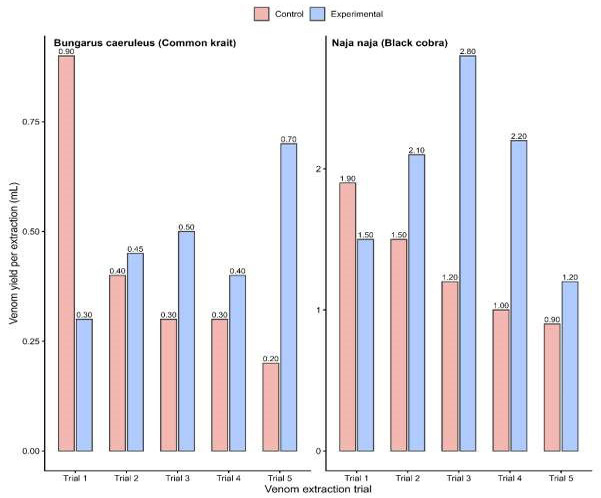
Effect of varying housing density and feeding frequency of black cobra (Naja naja) and common krait (Bungarus caeruleus) on the mean venom yield per extraction (mL).
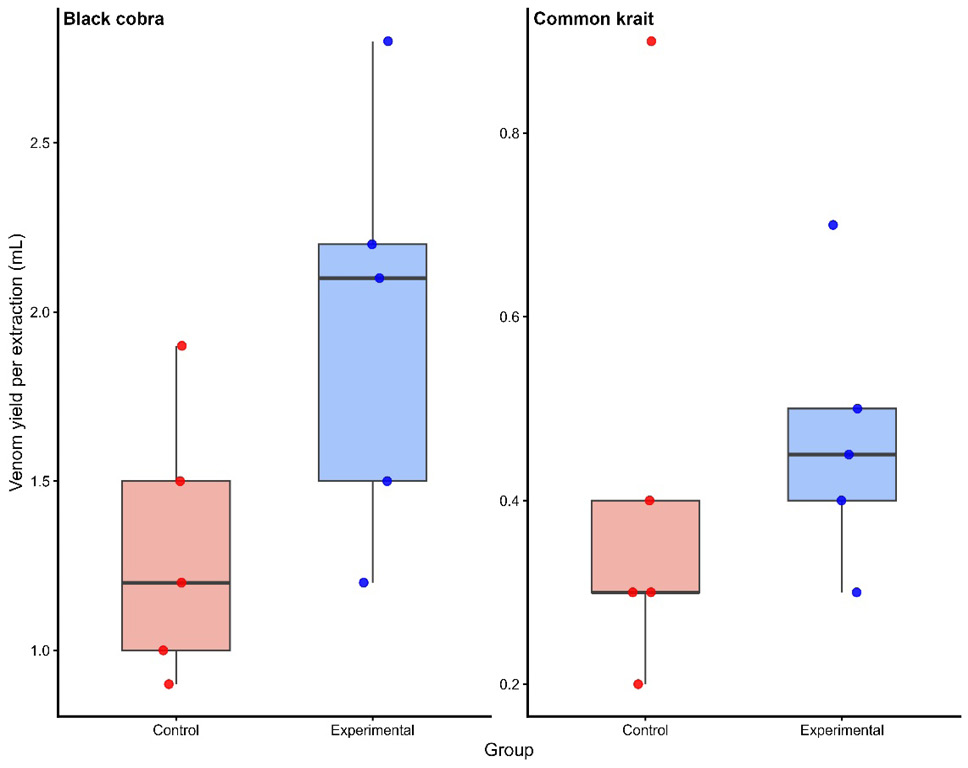
Effect of varying housing density and feeding frequency of black cobra (Naja naja) and common krait (Bungarus caeruleus) on the mean venom yield per extraction for each trial in the control and experimental groups.
References
- Abd El-Aziz, M.T., Soares, A.G. and Stockand, J.D., 2019. Snake venoms in drug discovery: Valuable therapeutic tools for life saving. Toxins, 11: 564. https://doi.org/10.3390/toxins11100564[CrossRef]
- Afroz, A., Siddiquea, B.N., Chowdhury, H.A., Jackson, T.N.W. and Watt, A.D., 2024. Snakebite envenoming: A systematic review and meta-analysis of global morbidity and mortality. PLoS Negl. Trop. Dis., 18: e0012080. https://doi.org/10.1371/journal.pntd.0012080[CrossRef]
- Alirol, E., Sharma, S.K., Bawaskar, H.S., Kuch, U. and Chappuis, F., 2010. Snake bite in South Asia: A review. PLoS Negl. Trop. Dis., 4: e603. https://doi.org/10.1371/journal.pntd.0000603[CrossRef]
- Bedraoui, A., Suntravat, M., El-Mejjad, S., Enezari, S., Oukkache, N., Sanchez, E.E., Galan, J.A., El-Fatimy, R. and Daouda, T., 2024. Therapeutic potential of snake venom: Toxin distribution and opportunities in deep learning for novel drug discovery. Med. Drug Discov., 21: 100175. https://doi.org/10.1016/j.medidd.2023.100175[CrossRef]
- Chippaux, J.P., 2010. Guidelines for the production, control and regulation of snake antivenom immunoglobulins. Biol. Aujourdhui, 204: 87-91. https://doi.org/10.1051/jbio/2009043[CrossRef]
- Chippaux, J.P., Williams, V. and White, J., 1991. Snake venom variability: Methods of study, results and interpretation. Toxicon, 29: 1279-1303. https://doi.org/10.1016/0041-0101(91)90116-9[CrossRef]
- Cooper, A.M., Fox, G.A., Nelsen, D.R. and Hayes, W.K., 2014. Variation in venom yield and protein concentration of the centipedes Scolopendra polymorpha and Scolopendra subspinipes. Toxicon, 82: 30-51. https://doi.org/10.1016/j.toxicon.2014.02.003[CrossRef]
- da Silva, J.R., Castro-Amorim, J., Mukherjee, A.K., Ramos, M.J. and Fernandes, P.A., 2025. The application of snake venom in anticancer drug discovery: An overview of the latest developments. Expert. Opin. Drug Discov., 20: 317-335. https://doi.org/10.1080/17460441.2025.2465364[CrossRef]
- Grego, K.F., Vieira, S.E.M., Vidueiros, J.P., Serapicos, E.O., Barbarini, C.C., Silveira, G.P.M., Rodrigues, F.S., Alves, L.C.F., Stuginski, D.R. and Rameh-deAlbuquerque, L.C., 2021. Maintenance of venomous snakes in captivity for venom production at Butantan Institute from 1908 to the present: A scoping history. J. Venom Anim. Toxins Incl. Trop. Dis., 27: e20200068. https://doi.org/10.1590/1678-9199-JVATITD-2020-0068[CrossRef]
- Gutiérrez, J.M., Calvete, J.J., Habib, A.G., Harrison, R.A., Williams, D.J. and Warrell, D.A., 2017. Snakebite envenoming. Nat. Rev. Dis. Primers, 3: 17063. https://doi.org/10.1038/nrdp.2017.63[CrossRef]
- Gutiérrez, J.M., 2012. Snakebite envenoming: A public health perspective. In: Public health methodology, environmental and systems issues (ed. J. Maddock). InTech, Rijeka. pp. 131-162.
- Halm, D., 2024. Neglected tropical diseases and long-term captive animals: Ethical considerations with venom lab snakes. J. appl. Anim. Ethics Res., 6: 92-113. https://doi.org/10.1163/25889567-bja10049[CrossRef]
- Harris, R.J., Zdenek, C.N., Harrich, D., Frank, N. and Fry, B.G., 2020. An appetite for destruction: Detecting prey-selective binding of alpha-neurotoxins in the venom of Afro-Asian elapids. Toxins, 12: 205. https://doi.org/10.3390/toxins12030205[CrossRef]
- Hayes, W.K., Herbert, S.S., Rehling, G.C. and Gennaro, J.F., 2002. Factors that influence venom expenditure in viperids and other snake species during predatory and defensive contexts. In: Biology of the vipers (eds. G.W. Schuett, M. Höggren, M.E. Douglas, H.W. Greene). Eagle Mountain Publishing, Eagle Mountain (UT). pp. 207-233.
- Koh, D.C.I., Armugam, A. and Jeyaseelan, K., 2006. Snake venom components and their applications in biomedicine. Cell. Mol. Life Sci., 63: 3030-3041. https://doi.org/10.1007/s00018-006-6315-0[CrossRef]
- Lewis, R.J. and Garcia, M.L., 2003. Therapeutic potential of venom peptides. Nat. Rev. Drug Discov., 2: 790-802. https://doi.org/10.1038/nrd1197. PMID: 14526382[CrossRef]
- Liang, Q., Huynh, T.M., Ng, Y.Z., Isbister, G.K. and Hodgson, W.C., 2021. In vitro neurotoxicity of Chinese krait (Bungarus multicinctus) venom and neutralization by antivenoms. Toxins, 13: 49. https://doi.org/10.3390/toxins13010049[CrossRef]
- Mirtschin, P.J., Shine, R., Nias, T.J., Dunstan, N.L., Hough, B.J. and Mirtschin, M., 2002. Influences on venom yield in Australian tigersnakes (Notechis scutatus) and brown snakes (Pseudonaja textilis: Elapidae, Serpentes). Toxicon, 40: 1581-1592. https://doi.org/10.1016/S0041-0101(02)00175-7[CrossRef]
- National Institute of Health (NIH), 2018. Anti-snake venom serum (product document). Available at: https://www.nih.org.pk/wp-content/uploads/2018/04/anti-snake-venom.pdf
- Oh, A.M.F., Tan, C.H., Ariaranee, G.C., Quraishi, N. and Tan, N.H., 2017. Venomics of Bungarus caeruleus (Indian krait): Comparable venom profiles, variable immunoreactivities among specimens from Sri Lanka, India and Pakistan. J. Proteomics, 164: 1-18. https://doi.org/10.1016/j.jprot.2017.04.018[CrossRef]
- Oliveira, A.L., Viegas, M.F., da Silva, S.L., Soares, A.M., Ramos, M.J. and Fernandes, P.A., 2022. The chemistry of snake venom and its medicinal potential. Nat. Rev. Chem., 6: 451-469. https://doi.org/10.1038/s41570-022-00393-7[CrossRef]
- WHO, 2007. Rabies and envenomings: A neglected public health issue. Report of a consultative meeting, World Health Organization, Geneva, 10 January 2007. World Health Organization, Geneva.
- WHO, 2016. Guidelines for the management of snakebites. 2nd edn. World Health Organization, Regional Office for South-East Asia, New Delhi.
- WHO, 2019. Snakebite envenoming: A strategy for prevention and control. World Health Organization, Geneva.
- WHO, 2023. Target product profiles for animal plasma-derived antivenoms: Antivenoms for treatment of snakebite envenoming in sub-Saharan Africa. World Health Organization, Geneva.
- Pandey, D.P., Bhattarai, P. and Piya, R.C., 2020. Food spectrum of common kraits (Bungarus caeruleus): An implication for snakebite prevention and snake conservation. J. Herpetol., 54: 87-96. https://doi.org/10.1670/18-054[CrossRef]
- Pintor, A.F.V., Krockenberger, A.K. and Seymour, J.E., 2010. Costs of venom production in the common death adder (Acanthophis antarcticus). Toxicon, 56: 1035-1042. https://doi.org/10.1016/j.toxicon.2010.07.008[CrossRef]
- Pintor, A.F.V., Winter, K.L., Krockenberger, A.K. and Seymour, J.E., 2011. Venom physiology and composition in a litter of common death adders (Acanthophis antarcticus) and their parents. Toxicon, 57: 68-75. https://doi.org/10.1016/j.toxicon.2010.10.001[CrossRef]
- Roberts, N.L.S., Johnson, E.K., Zeng, S.M., et al., 2022. Global mortality of snakebite envenoming between 1990 and 2019. Nat. Commun., 13: 6160.
- Roque, L.A., 2025. Advancements in antivenom therapy: Historical perspectives, current challenges, and ongoing clinical trials. Innov. Med. Omics, 2: 13-20. https://doi.org/10.36922/IMO025240026[CrossRef]
- Santos, L., Oliveira, C., Vasconcelos, B.M., Vilela, D., Melo, L., Ambrósio, L., da Silva, A., Murback, L., Kurissio, J. and Cavalcante, J., 2021. Good management practices of venomous snakes in captivity to produce biological venom-based medicines: Achieving replicability and contributing to pharmaceutical industry. J. Toxicol. environ. Hlth. B, 24: 30-50. https://doi.org/10.1080/10937404.2020.1855279[CrossRef]
- Siang, A.S., Doley, R., Vonk, F.J.M. and Kini, R.M., 2010. Transcriptomic analysis of the venom gland of the red-headed krait (Bungarus flaviceps) using expressed sequence tags. BMC mol. Biol., 11: 24. https://doi.org/10.1186/1471-2199-11-24[CrossRef]
- Theakston, R.D.G., Phillips, R.E., Warrell, D.A., Galagedera, Y., Abeysekera, D.T.D.J., Dissanayaka, P., de Silva, A. and Aloysius, D.J., 1990. Envenoming by the common krait (Bungarus caeruleus) and Sri Lankan cobra (Naja naja naja): Efficacy and complications of therapy with Haffkine antivenom. Trans. R. Soc. trop. Med. Hyg., 84: 301-308. https://doi.org/10.1016/0035-9203(90)90297-R[CrossRef]
- Weiss, M. and Kalki, Y., 2023. Trophic niche partitioning between sympatric Naja naja and Ptyas mucosa: Crowdsourced data in application to community ecology. J. Herpetol., 57: 107-115. https://doi.org/10.1670/22-013[CrossRef]
- Zona-Rubio, D.C., Aragón, D.M. and Alves, I.A., 2025. Innovations in snake venom- derived therapeutics: A systematic review of global patents and their pharmacological applications. Toxins, 17: 136. https://doi.org/10.3390/toxins17030136[CrossRef]
Supplementary material
Services
Article usage statistics
Loading…