
The suitability of entomopathogenic nematodes as biological control agents of specific target insects is affected by their level of infectivity and reproductive capacity. Therefore, in the present study the productivity of five entomopathogenic nematodes (Steinernema feltiae, S. kraussei, S. carpocapsae, Heterorhabditis bacteriophora and H. indica) were compared in Galleria mellonella larvae. The production of infective juveniles (IJ) in G. mellonella was significantly affected by nematode species. Significantly higher numbers of IJ were produced by Heterorhabditid species than Steinernematid species in the cadaver. The production of IJ was the maximum in the case of H. bacteriophora which was not statistically different form H. indica. Minimum IJ were produced by S. feltiae. The IJ produced by S. kraussei and S. carpocapsae were statistically similar. The emergence of Steinernematids started from the 14th day and that of Heterorhabditids from the 17th day. In case of Heterorhabditids, the maximum emergence of H. bacteriophora IJ (199,894) was recorded on the 23rd day and that of H. indica on the 20th day (99,495). On the other hand, in case of Steinernematids, the maximum emergence of IJ of S. feltiae and S. kraussei was recorded on the 17th day (36,180 and 45,225 respectively) and that of S. carpocapsae on the 20th day (21,407). It is concluded that there was greater emergence of IJ from the Heterorhabditid species than those from the Steinernematid species and hence can be used for the management of insect pests.
Research Article · Volume 50, Issue 2, 15 March 2018 · Open Access
Comparing the Productivity of Five Entomopathogenic Nematodes in Galleria mellonella
· · · ·
Affiliations & Notes ⌄
- 1School of Agriculture, Policy and Development, University of Reading, Reading RG6 6AR, United Kingdom 2Wheat Research Institute, Sakrand, Sindh, Pakistan 3Department of Plant Pathology, Pir Mehr Ali Shah Arid Agriculture University, Rawalpindi, Pakistan 4Department of Soil Science, Sindh Agriculture University, Tandojam, Pakistan 5Department of Zoology, University of Sindh, Jamshoro, Pakistan 6Institute of Plant Sciences, University of Sindh, Jamshoro, Pakistan , * Corresponding author: alirahoo
Article Info ⌄
- Journal:
- Pakistan Journal of Zoology
- Published:
- 15 March 2018

Abstract
Introduction
The biological control potential of entomopathogenic nematodes (EPN) has now become well established because the ability to mass produce them has allowed the development techniques for their inundative application . Production of EPN on large scale involving techniques based on fermentation technology is an industrial process ; Ehlers and Shapiro-Ilan, 2005a). In developing countries like Pakistan, such technologies are not yet available and in vivo mass production of EPN is done in host insects (Ehlers and Shapiro-Ilan, 2005b). These techniques are laborious and are only feasible where labour costs are low. In Pakistan, preliminary field evaluation of EPN is done with in vivo produced nematodes in hosts like Galleria mellonella , 2017a). As biological control becomes more prevalent in pest management, it will become increasingly important to anticipate interactions between biological control agents ; ; .
Features of EPN that affect their suitability as biological control agents of specific target insects are their level of infectivity and reproductive capacity. Infectivity refers to the ability of nematodes to cause infection in a target insect (Tanda and Fuxa, 1989) and has been shown to vary among nematodes within specific target hosts ; ; ; and among hosts for a given nematode species or strain ; . The reproductive capacity of nematodes has also been shown to differ among nematodes within target insects ; and among hosts within specific nematode species or strains . Nematodes with higher levels of infectivity and reproduction within a specific target host may be more effective in controlling a particular insect under field conditions. The reproductive capacity is also central to long-term persistence. Morris et al. (1990) noted that a high infection rate of soil insects followed by a high rate of reproduction is critical to ensure re-infestation of the habitat by nematode progeny.
There can be differences in the production of infective juveniles (IJ) among different nematode genera. Mannion (1992) found that Heterorhabditis spp. had the lowest LC50 and LC90 values, produced more progeny per cadaver, had higher levels of infectivity in sand, soil and Petri plates, killed more hosts within sweet potato storage roots and had a greater ability to exit infected weevil cadavers within storage roots and infect new hosts in the soil than Steinernema spp. Jansson et al. (1990, 1991, 1993) found Heterorhabditis spp. to be more efficacious against sweet potato weevil Cylas formicarius. Jansson et al. (1993) also found that Heterorhabditids persisted longer than Steinernematids in the field. It was hypothesized that the production of IJ from G. mellonella cadavers would not differ among different species of EPN. Therefore, the objective of conducting the present study was to compare the productivity of five entomopathogenic nematodes (Steinernema carpocapsae, S. feltiae, S. kraussei, Heterorhabditis bacteriophora and H. indica) in Galleria mellonella larvae.
Materials and methods
Nematode cultures
Entomopathogenic nematodes (Steinernema carpocapsae, S. feltiae, S. kraussei, Heterorhabditis bacteriophora and H. indica) used in the study were obtained from stock cultures supplied by CABI Bioscience and were maintained in the laboratory at the Department of Agriculture, University of Reading, United Kingdom. The nematodes were cultured in the last instar larvae of greater wax moth, Galleria mellonella (Lepidoptera: Pyralidae) (Livefoods Direct Ltd. Sheffield, UK) at 25°C. Ten G. mellonella larvae were placed on each 9 cm Petri dishes lined with a Whatman® No. 1 filter paper. The larvae in dishes were individually inoculated with approximately 2000 infective juveniles (IJ) of abovementioned five EPN contained in 1 ml of tap water. The Petri dishes were sealed with Nescofilm® sealing film (Azwell Inc., Osaka, Japan) and placed in an incubator at 20°C .
After incubation at 20°C for 10 days, the infected G. mellonella larvae were taken from the Petri dishes and placed on modified white traps . After some days, nematodes moved from the G. mellonella cadavers to the water. Water containing the IJ was transferred to a clean beaker filled with fresh tap water and the IJ were allowed to settle for 30 min. The supernatant was decanted, the beaker was refilled with fresh tap water and the process was repeated three times until a clean suspension was obtained. Excess water was discarded and nematodes were kept at 10°C and used within two weeks . IJ of the nematode species were acclimatized at room temperature (21-23°C) for an hour and their viability was tested under a stereomicroscope before use.
Productivity of five EPN species in G. mellonella larvae
Fifty late instar larvae of G. mellonella weighing between 0.25-0.35 g were selected and individual weights recorded. Each larva was inoculated with 0.15 ml of suspension of S. carpocapsae, S. feltiae, S. kraussei, H. bacteriophora and H. indica containing a mean of 50, 67, 73, 55 and 47 IJ, respectively. This was done in 30 mm Petri dishes as previously described. The dishes were stored in an incubator at 20ºC for four days in which time all larvae succumbed to nematode infection. Fifty 30 mm Petri dishes containing 5 g of dry silver sand were prepared to which 1 ml of tap water was added. An infected larva (cadaver) killed by one of the above mentioned species was added to each dish which was sealed and then kept in an incubator at 20ºC. To facilitate counting, the nematodes were divided into two groups (Steinernematids and Heterorhabditids) and were evaluated on different days. One week after inoculation each cadaver was moved on the supporting Netlon and transferred to new Petri dish containing 5 g silver sand plus 1 ml water. The Petri dishes were then re-sealed and returned to the incubator. The sand from the original dish was moved to a modified miniature Baermann extraction tray made from a 50 mm Petri dish, to recover any nematodes that may have emerged from the cadavers. This procedure was repeated after every three days until no more nematodes were recovered. Each Petri dish was monitored daily to observe when nematodes first emerged from cadavers.
Statistical analysis
All the data were found normally distributed and did not require transformation. The data were subjected to Analysis of Variance (ANOVA) using GenStat package 2009, (12th edition) version 12.1.0.3278 (www.vsni.co.uk). The differences among means were compared by Fisher’s protected least significant difference test at (P≤0.05). Standard errors of means were calculated in Microsoft Excel 2007.
Results
Productivity of EPN species in G. mellonella larvae
The production of IJ in G. mellonella was significantly affected by nematode species. Significantly higher numbers of IJ were produced by Heterorhabditid species than Steinernematid species in the cadaver. The production of IJ was the maximum in the case of H. bacteriophora which was not statistically different form H. indica. The minimum IJ were produced by S. feltiae. The IJ produced by S. kraussei and S. carpocapsae were statistically similar (Fig. 1).
The emergence of Steinernematids started from the 14th day and those of Heterorhabditids from the 17th day. In case of Heterorhabditids, the maximum emergence of H. bacteriophora IJ (199,894) was recorded on the 23rd day and that of H. indica on the 20th day (99,495). On the other hand, in case of Steinernematids, the maximum emergence of IJ of S. feltiae and S. kraussei was recorded on the 17th day (36,180 and 45,22, respectively) and that of S. carpocapsae on the 20th day (21,407). The number of S. feltiae emerging from the larvae was between 14,094 and 35,120 on the 14th and 17th days, respectively whereas the number of S. kraussei was 6,167 and 45,200 on the 14th and 17th days, respectively. Similarly, the number of S. carpocapsae was 4 on the 14th day and 21,570 on the 20th day (Fig. 2A). On the other hand, H. bacteriophora yielded 114 and 203,000 IJ on the 17th and 23rd days, respectively whereas H. indica gave 2,300 and 101,536 IJ on the 17th and 20th days, respectively (Fig. 2B).
Discussion
In the present study that compared the productivity of different EPN species in the larvae of G. mellonella, greater numbers of H. bacteriophora IJ were recovered than other species. The smallest number of IJ was with S. carpocapsae. There was a difference in the time of emergence of the IJ from the host cadaver; Steinernematids emerged from cadavers sooner than Heterorhabditids. The reason may be that the size of Steinernematid IJ is greater than those of Heterorhabditis spp. The larger size of Steinernematids would occupy more space inside the cadavers and require more nutrient resources and so produce less progeny. It is known that emergence of IJ is related to depletion of food reserves and crowding within the host cadavers , 1987) and possibly build-up of ammonia . Patterns in total reproduction of nematodes differed among the five species. Heterorhabditis species consistently produced more progeny than the Steinernema species. Patterns of emergence from cadavers of G. mellonella were consistent. As noted earlier, emergence of infective juveniles is related to depletion of food reserves and crowding , 1987). These factors may have been less apparent to emerging infective juveniles from all species from G. mellonella larvae. It is recognized that a laboratory bioassay that predicts performance of EPN in the field is needed to facilitate selection of nematodes in biological control programmes ; . Mannion (1992) conducted Petri dish, sand, soil and simulated field bioassays to select suitable EPN for biological control of C. formicarius and consistently found that Heterorhabditids were superior to Steinernematids in all bioassay systems tested.
Differences between the reproduction potential of EPN may also be related to the isolates, species, and host susceptibility, number of bacteria per infective stage, invasion rate, temperature and humidity (Rahoo et al., 2016a, b, 2017b; . The life cycles of Steinernematid and Heterorhabditid nematodes are different. The mode of reproduction of the first generation adults is bisexual for Steinernema spp. ; , while it is hermaphroditic for Heterorhabditis spp. which begins sexual reproduction from the second generation ; . In most of the previous studies, attention has been placed mainly on the production and/or pathogenicity of IJ ; ; ; . Contrarily, not so much attention has been placed on the origin of juveniles via endotokia matricida (intrauterine larval development leading to the destruction of the female by the juveniles) which is generally considered as the failure of normally oviparous nematodes to deposit their eggs which may then accumulate and continue development within the female body. In the comparison between H. bacteriophora and S. feltiae, the former differed from the latter in the occurrence rate of endotokia matricida and the production of IJ. Generally the Heterorhabditids produced more IJ than the Steinernematids. It is concluded from the present study that Heterorhabditis species produced more IJ, hence can be used for the management of insect pests and root-knot nematodes ; ; Javed et al., 2017a, b; Kassi et al., 2018; ; ; Mukhtar et al., 2017a, b; .
Conclusion
As heterorhabditid species produced greater numbers of infective juveniles in Galleria mellonella larvae than steinernematid species and are recommended for use as biological control agents of insect pests in Pakistan.
Statement of conflict of interest
Authors have declared no conflict of interest.
Figures
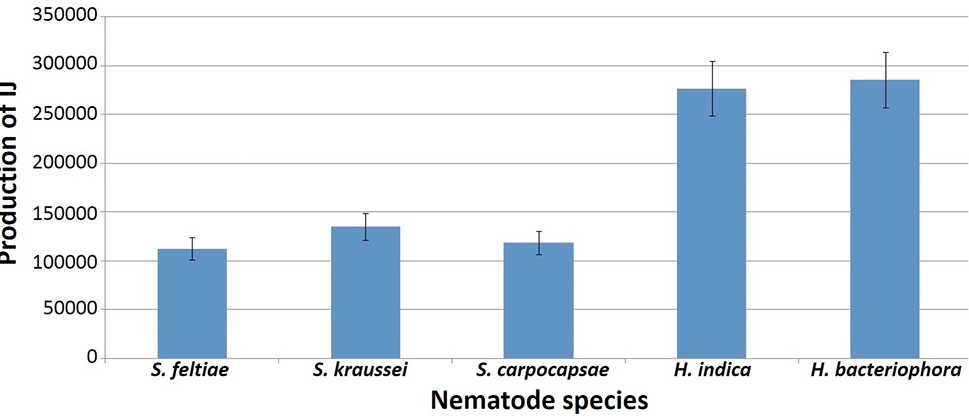
Production of infective juveniles of five EPN in G. mellonella.
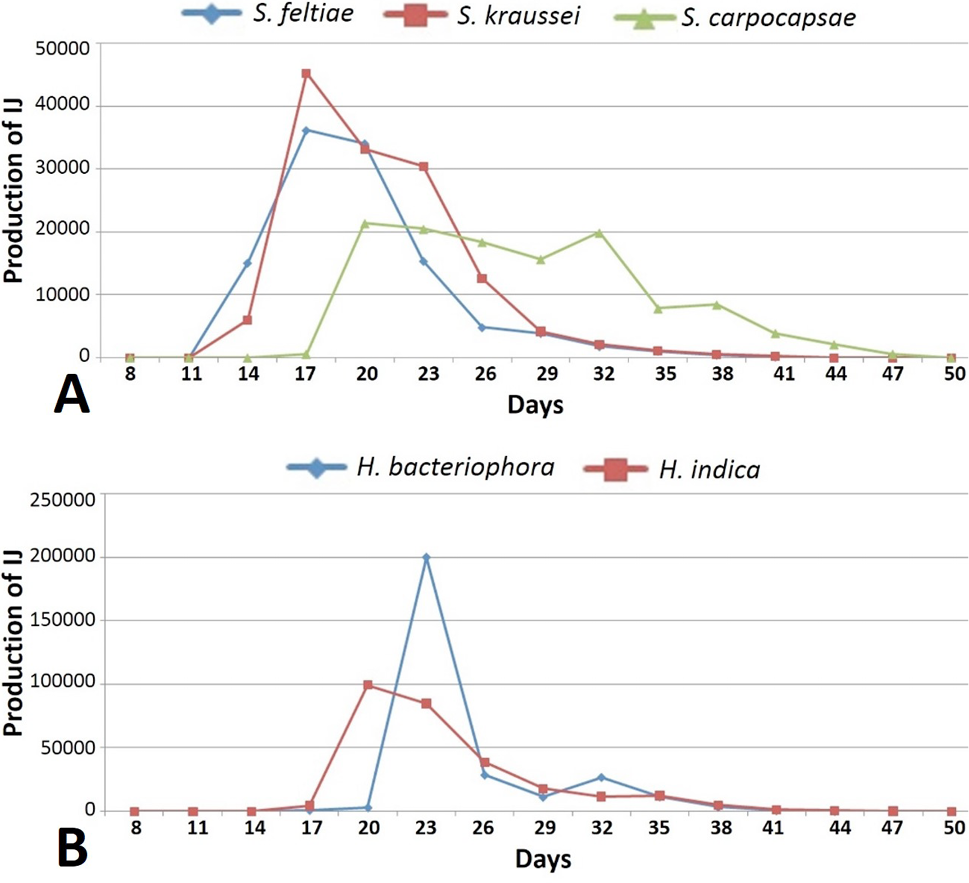
Days-wise production of infective juveniles of three Steinernematids (A) and two Heterorhabditids (B) in G. mellonella.
References
- Bedding, R.A., Molyneux, A.S. and Akhurst, R.J., 1983. Heterorhabditis spp., Neoaplectana spp., and Steinernema kraussei: interspecific and intraspecific difference in the infectivity for insect hosts. Exp. Parasitol., 55: 249-257. https://doi.org/10.1016/0014-4894(83)90019-X[CrossRef]
- Dunphy, G.B., Rutherford, T.A. and Webster, J.M., 1985. Growth and virulence of Steinernema glaseri influenced by different subspecies of Xenorhabdus nematophilus. J. Parasitol., 73: 584-588. https://doi.org/10.2307/3282140[CrossRef]
- Dutky, S.R., Thompson, J.V. and Cantwel, G.E., 1964. A technique for the mass propagation of the DD-136 nematode. J. Insect Pathol., 6: 417-422.
- Ehlers, R.U. and Shapiro-Ilan, D., 2005a. Mass production. In: Nematodes as biocontrol agents (eds. P.S. Grewal, R.U. Ehlers and D. Shapiro-Ilan). CABI, Wallingford, UK, pp. 65-78. https://doi.org/10.1079/9780851990170.0065[CrossRef]
- Ehlers, R.U. and Shapiro-Ilan, D., 2005b. Forum on safety and regulation. In: Nematodes as biocontrol agents (eds. P.S. Grewal, R.U. Ehlers and D. Shapiro-Ilan). CABI, Wallingford, UK, pp. 107-114. https://doi.org/10.1079/9780851990170.0107[CrossRef]
- Fateh, F.S., Mukhtar, T., Kazmi, M.R., Abbassi, N.A. and Arif, A.M., 2017. Prevalence of citrus decline in district Sargodha. Pak. J. agric. Sci., 54: 9-13.
- Gaugler, R. and Han, R., 2002. Production technology. In: Entomopathogenic nematology (ed. R. Gaugler). CABI Wallingford, UK, pp. 289-310. https://doi.org/10.1079/9780851995670.0289[CrossRef]
- Glazer, I., Koltai, H., Zioni, C.N.S. and Segal, D., 1994. Life cycle and reproduction in Heterorhabditis. In: Genetics of entomopathogenic nematodes-bacterium complex (eds. A.M. Burnell, R.U. Ehlers and J.P. Masson). pp. 80-89.
- Griffin, C.T., Boemare, N.E. and Lewis, E.E., 2005. Biology and Behaviour. In: Nematodes as biocontrol agents (eds. P.S. Grewal, R.U. Ehlers and D. Shapiro-Ilan). CABI, Wallingford, UK, pp. 47-64. https://doi.org/10.1079/9780851990170.0047[CrossRef]
- Hominick, W.M., 1990. Entomopathogenic Rhabditid nematodes and pest control. Parasitol. Today, 6: 148-152. https://doi.org/10.1016/0169-4758(90)90332-X[CrossRef]
- Hussain, M.A., Mukhtar, T. and Kayani, M.Z., 2016. Reproduction of Meloidogyne incognita on resistant and susceptible okra cultivars. Pak. J. agric. Sci., 53: 371-375. https://doi.org/10.21162/PAKJAS/16.4175[CrossRef]
- Jansson, R.K., Lecrone, S.H. and Gaugler, R., 1991. Comparison of single and multiple releases of Heterorhabditis bacteriophora Poinar (Nematoda: Heterorhabditidae) for control of Cylas formicarius (F.) (Coleoptera: Apionidae). Biol. Control, 1: 320-328. https://doi.org/10.1016/1049-9644(91)90085-E[CrossRef]
- Jansson, R.K., Lecrone, S.H. and Gaugler, R., 1993. Field efficacy and persistence of entomopathogenic nematodes (Nematoda: Steinermatidae, Heterorhabditidae) for the control of sweet potato weevil (Coleoptera: Apionidae) in southern Florida. J. econ. Ent., 86: 1055-1063.
- Jansson, R.K., Lecrone, S.H., Gaugler, R. and Smart, Jr. G.C., 1990. Potential of entomopathogenic nematodes for biological control agent of sweet potato weevil (Coleoptera: Curculionidae). J. econ. Ent., 83: 1818-1126.
- Javed, H., Hussain, S.S., Javed, K., Mukhtar, T. and Abbasi, N.A., 2017a. Comparative infestation of brinjal stem borer (Euzophera perticella) on six aubergine cultivars and correlation with some morphological characters. Pakistan J. agric. Sci., 54: 763-768.
- Javed, H., Mukhtar, T., Javed, K. and Ata-ul-Mohsin, 2017b. Management of eggplant shoot and fruit borer (Leucinodes orbonalis guenee) by integrating different non-chemical approaches. Pakistan J. agric. Sci., 54: 65-70.
- Kassi, A.K., Javed, H. and Mukhtar, T., 2018. Screening of okra varieties for resistance against Helicoverpa armigera. Pakistan J. Zool., 50: 91-95. https://doi.org/10.17582/journal.pjz/2018.50.1.91.95[CrossRef]
- Kaya, H.K. and Stock, S.P., 1997. Techniques in insect nematology. In: Manual of techniques in insect pathology (ed. L. Lacey). Academic Press, San Diego, Canada, pp. 281-324. https://doi.org/10.1016/B978-012432555-5/50016-6[CrossRef]
- Kaya, H.K., 1985. Entomogenous nematodes for insect control in IPM systems. In: Biological control in agricultural IPM systems (eds. M.A. Hoy and D.C. Herzog). Academic Press, New York, pp. 283-302. https://doi.org/10.1016/B978-0-12-357030-7.50022-3[CrossRef]
- Kaya, H.K., 1987. Diseases caused by nematodes. In: Epizootiology of insect diseases (eds. J.R. Fuxa and Y. Tanada). J. Wiley, New York, pp. 453-470.
- Kaya, H.K., 1990. Soil ecology. In: Entomopathogenic nematodes in biological control (eds. R. Gaugler and H.K. Kaya). CRC Press, Boca Raton, Florida, pp. 93-115.
- Kaya, H.K., Burlando, T.M. and Choo, H.Y., 1995. Integration of entmopathogenic nematodes with Bacillus thuringiensis or pesticidal soap for control of insects. Biol. Control, 5: 432-441. https://doi.org/10.1006/bcon.1995.1052[CrossRef]
- Kayani, M.Z., Mukhtar, T. and Hussain, M.A., 2017. Effects of southern root knot nematode population densities and plant age on growth and yield parameters of cucumber. Crop Prot., 92: 207-212. https://doi.org/10.1016/j.cropro.2016.09.007[CrossRef]
- Khan, A.R., Javed, N., Sahi, S.T., Mukhtar, T., Khan, S.A. and Ashraf, W., 2017. Glomus mosseae (Gerd&Trappe) and neemex reduce invasion and development of Meloidogyne incognita. Pakistan J. Zool., 49: 841-847. https://doi.org/10.17582/journal.pjz/2017.49.3.841.847[CrossRef]
- Kondo, E. and Ishibashi, N., 1987. Comparative infectivity and development of the entomopathogenic nematodes Steinernema spp. on the lepidopterous insect larvae, Spodoptera litura (Noctuidae) and Galleria mellonella (Galleridae). Jpn. J. Nematol., 17: 35-41.
- Mannion, C.M. and Jansson, R.K., 1992. Comparison of ten entomopathogenic nematodes for biological control of the sweet potato weevil (Coleoptera: Apionidae). J. econ. Ent., 85: 1642-1650.
- Mannion, C.M., 1992. Selection of suitable entomopathogenic nematodes for biological control of Cylas formicarius (Coleoptera: Apionidae). Ph. D. thesis, University of Florida, Gainesville, FL.
- Molyneux, A.S., Bedding, R.A. and Akhurst, R.J., 1983. Suecsptiblity of larvae of the sheep blowfly Lucinia cuprina to various Heterorhabditis spp. Neoaplectana spp. and an undescribed steinernematid (Nematoda). J. Inverteb. Pathol., 55: 239-257.
- Morris, O.N., Converse, V. and Harding, J., 1990. Virulence of entomopathogenic nematode-bacteria complex for larvae of noctuids, a geometrid, and a pyralid. Can. Entomol., 122: 309-319. https://doi.org/10.4039/Ent122309-3[CrossRef]
- Mracek, Z., Hanzal, R. and Kodrik, D., 1988. Sites of penetration of juvenile steinernematids and heterorhabditids (Nematoda) into the larvae of Galleria mellonella (Lepidoptera). J. Inverteb. Pathol., 52: 477-478. https://doi.org/10.1016/0022-2011(88)90062-6[CrossRef]
- Mukhtar, T., Arooj, M., Ashfaq, M. and Gulzar, A., 2017a. Resistance evaluation and host status of selected green gram genotypes against Meloidogyne incognita. Crop Prot., 92: 198-202. https://doi.org/10.1016/j.cropro.2016.10.004[CrossRef]
- Mukhtar, T., Hussain, M.A. and Kayani, M.Z., 2017b. Yield responses of twelve okra cultivars to southern root-knot nematode (Meloidogyne incognita). Bragantia, 75: 108-112. https://doi.org/10.1590/1678-4499.005[CrossRef]
- Nabeel, M., Javed, H. and Mukhtar, T., 2018. Occurrence of Chilo partellus on maize in major maize growing areas of Punjab, Pakistan. Pakistan J. Zool., 50: 317-323. http://dx.doi.org/10.17582/journal.pjz/2018.50.1.317.323[Full text][CrossRef]
- Rahoo, A.M., Mukhtar, T., Abro, S.I., Gowen, S.R. and Bughio, B.A., 2016a. Effect of temperature on emergence of Steinernema feltiae from infected Galleria mellonella cadavers under moist and dry conditions. Pak. J. Nematol., 34: 171-176. https://doi.org/10.18681/pjn.v34.i02.p171[Full text][CrossRef]
- Rahoo, A.M., Mukhtar, T., Bughio, B.A., Gowen S.R. and Rahoo, R.K., 2017b. Infection of Galleria mellonella larvae by Steinernema affine and production of infective juveniles. Pak. J. Nematol., 35: 65-71. https://doi.org/10.18681/pjn.v35.i01.p65-71[Full text][CrossRef]
- Rahoo, A.M., Mukhtar, T., Gowen S.R. and Pembroke, B., 2011. Virulence of entomopathogenic bacteria Xenorhabdus bovienii and Photorhabdus luminescens against Galleria mellonella larvae. Pakistan J. Zool., 43: 543-548.
- Rahoo, A.M., Mukhtar, T., Gowen, S.R., Pembroke, B. and Rahu, M.A., 2016b. Emergence of Steinernema feltiae from infected Galleria mellonella cadavers in moist and dry conditions. Pak. J. Nematol., 34: 81-86.
- Rahoo, A.M., Mukhtar, T., Gowen, S.R., Rahoo, R.K. and Abro, S.I., 2017a. Reproductive potential and host searching ability of entomopathogenic nematode, Steinernema feltiae. Pakistan J. Zool., 49: 229-234. https://doi.org/10.17582/journal.pjz/2017.49.1.229.234[CrossRef]
- Rosenheim, J.A., Kaya, H.K., Ehlers, L.E., Marois, J.J. and Jaffee, B.A., 1995. Intraguild predation among biological control agents theory and evidence. Biol. Control, 5: 303-335. https://doi.org/10.1006/bcon.1995.1038[CrossRef]
- San-Blas, E., Gowen, S.R. and Pembroke, B., 2008. Steinernema feltiae: Ammonia triggers the emergence of their infective juveniles. Exp. Parasitol., 119: 180-185. https://doi.org/10.1016/j.exppara.2008.01.008[CrossRef]
- Selvan, S., Campbell, J.F. and Gaugler, R., 1993. Density-dependant effects on entomopathogenic nematodes (Heterorhabditis and Steinernematidae) within an insect host. J. Inverteb. Pathol., 62: 278-284. https://doi.org/10.1006/jipa.1993.1113[CrossRef]
- Tanada, Y. and Fuxa, J.R., 1989. The pathogen population. In: Epizootiology of insect diseases (eds. J.R. Fuxa and Y. Tanada). J. Wiley, New York, pp. 113-157.
- Tariq-Khan, M., Munir, A., Mukhtar, T., Hallmann, J. and Heuer, H., 2017. Distribution of root-knot nematode species and their virulence on vegetables in northern temperate agro-ecosystems of the Pakistani-administered territories of Azad Jammu and Kashmir. J. Pl. Dis. Prot., 124: 201-212. https://doi.org/10.1007/s41348-016-0045-9[CrossRef]
- White, G.F., 1927. A method for obtaining infective juveniles from cultures. Science, 66: 302-303. https://doi.org/10.1126/science.66.1709.302-a[CrossRef]
- Wouts, W.M., 1984. The biology, life cycle and redescription of Neoaplectana bibionis Bovien, 1937 (Nematoda: Steinernematidae). J. Nematol., 12: 62-72.
- Zioni, S., Glazer, I. and Segal, D., 1992. Life cycle and reproductive potential of the nematodes Heterorhabditis bacteriophora strain HP 88. J. Nematol., 24: 352-358.
Cited by 10 articles
In journals published by ResearchersLinks.
- Resistance or Susceptibility of Eight Aubergine Cultivars to Meloidogyne javanicaPakistan Journal of Zoology · 2019
- In Vitro Effectiveness of Silver Nanoparticles against Root-Knot Nematode (Meloidogyne incognita)Pakistan Journal of Zoology · 2019
- Pathogenic Potential of Javanese Root-knot Nematode on Susceptible and Resistant Okra CultivarsPakistan Journal of Zoology · 2019
- Root-Knot Nematodes Infecting Okra in Major Vegetable Growing Districts of Punjab, PakistanPakistan Journal of Zoology · 2019
- Relationship of Physico-Morphic Characters of Okra Cultivars with their Resistance to Helicoverpa armigeraPakistan Journal of Zoology · 2019
- Comparison of Infectivity and Productivity of Steinernema feltiae and Heterorhabditis bacteriophora in Galleria mellonella and Tenebrio molitorPakistan Journal of Zoology · 2019
- Screening of Different Aubergine Cultivars against Infestation of Brinjal Fruit and Shoot Borer (Leucinodes orbonalis Guenee)Pakistan Journal of Zoology · 2019
- Relationship Between the Size of Galleria mellonella Larvae and the Production of Steinernema feltiae and Heterorhabditis bacteriophoraPakistan Journal of Zoology · 2018
- Reproductivity of Meloidogyne incognita on Fifteen Cucumber CultivarsPakistan Journal of Zoology · 2018
- Management of Root-Knot Nematode, Meloidogyne incognita, in Tomato with Two Trichoderma SpeciesPakistan Journal of Zoology · 2018
Services
Article usage statistics
Loading…