Gwang Joo Jeon1,2,*, Sanghwan Kim2, Jihye Lee2, Hyemyoung Jang1, Tae Eun Kim3, Inkwon Han4, Youngik Ko5, Yoon Dong Choi6, Duk Ho Kim7
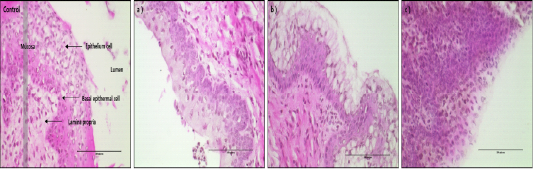
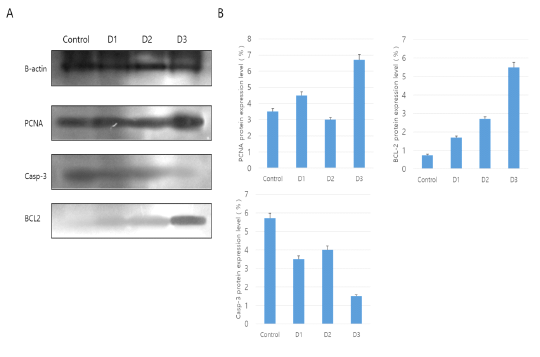
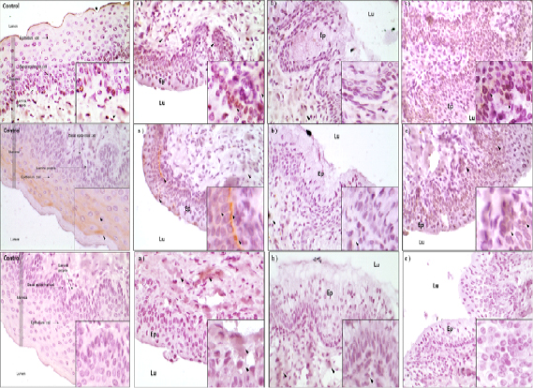
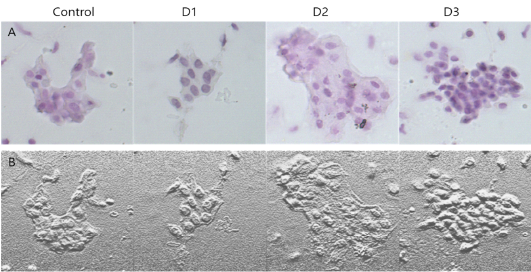
1Department of Biotechnology, Hankyong National University, Ansung, Korea; 2Genomic Informatics Center, Hankyong National University, Ansung, Korea; 3Eun Skin Clinic, Seoul, Korea; 4KMP Health Care Seoul Clinic, Seoul, Korea; 5Michaewon Clinic, Korea; 6Seoul Hoseo Occupational Training College, Seoul, Korea; 7DK Costech Co., Ltd. Korea.Abstract | In current experiment, three Korean native plants (Dendropanax morbifera LEV (DM), Astragalus membranaceus (AM) and Aralia elata (AE) in three different combination groups (D1=DM only, D2=DM+AM, D3=DM+AE) were tested for their effects on epithelial cells of mouse vagina, as an alternative model for human cells. A total of 100 ICR mice (14 weeks old) were equally divided into four groups. One group served as a control while the other groups were treated with methanolic extract of plants. One ml solution of either of plant extract (D1, D2 or D3) was inserted into mouse vagina at depth of 1 mm using a round tip needle. After 24 h of treatment, the mouse vaginal endothelial cells were analyzed for expression of various proteins like PCNA, BCL-2 and caspase-3. The immunohistochemistry, western blot and microscopic results showed that PCNA protein localization detected in epithelium cells of mouse vagina, furthermore, PCNA protein was highly detected in basal and mucosa epithelium cells in D3 group compared to group D1 and D2. Cell survival factors were highly expressed in mucosa epithelium cells of D3 group compared to other treatment groups (D1 and D2) but apoptosis factor was more expressed in D1 and D2 than the D3 groups. Western blot analysis showed that protein detection of cell survival PCNA is highly expressed compare to β-actin, BCL2, and Casp-3. Cellular responses of vaginal epithelial cells demonstrated hypertrophy, hyperplasia and other patterns of cell adaptation. It was concluded that external stimuli of DM alone and its’ combination with AM and AE showed hypertrophy, hyperplasia and other related protein expressions depending upon the plant combinations.
Keywords | PCNA, BCL-2, Caspase-3, Korea native plants