
Cadmium (Cd) is a very poisonous and non-essential heavy metal which is easily absorbed by plants. The metal makes living organisms susceptible to its acute and chronic toxicity through plant food. Similarly, Cd hinders the growth of plants by causing the loss of chlorophyll, which in turn negatively impacts the activities of photosynthesis. Therefore, this current study aims to evaluate the effects of Cd on the germination behaviour, morphology, growth and development of Pak Choi plants. The sterilized Pak Choi seeds were germinated on a soaked filter paper of a petri dish. The petri dish included seven different treatments of Cd chloride with concentrations of 0, 0.01, 0.05, 0.1, 0.2, 0.3, and 0.4 mM. Each treatment was replicated five times. The germination and growth of the seeds were observed for 15 days. Pak Choi seedlings were also planted under hydroponic conditions to investigate their morphological characteristics, growth and development. After two weeks of growth, the application of CdCl2 was made with four treatments consisting of nutrient solution without CdCl2 (control) and 0.1, 0.5 and 1.0 mM CdCl2-nutrient solution. Two weeks of plant growth were allowed before the experiment was terminated. At the end of the experiment, the chlorophyll content (SPAD), root and shoot length (cm), and fresh and dry weight (g) of plants were quantified accordingly. The increase in CdCl2 concentration led to a significant decrease in the length of root and shoot of germinated seedlings significantly. The seedling’s growth of Pak Choi was inhibited three days after germination, and the seedling’s height (root and shoot) in higher concentrations of CdCl2 was lower than lower doses of Cd. Chlorosis symptoms in the leaf were visible in hydroponic Pak Choi containing Cd. The growth of Cd-treated hydroponic Pak Choi was adversely affected by Cd treatment. The Cd treatment also reduced SPAD, biomass content (fresh and dry), and length of root and leaves number significantly. It can be concluded that exogenous Cd inhibits the Pak Choi germination and growth under hydroponic conditions.
Special Issue (UniSZA), Malaysia: ICAFT 2023: 3rd International Conference on Agriculture, Animal Sciences & Food Technology · Volume 40, Issue 1, 2 September 2024 · Open Access
Cadmium Uptake, Accumulation and Tolerance in Hydroponic Brassica chinensis (Pak Choi)
· · · · ·
Affiliations & Notes ⌄
- 1Universiti Sultan Zainal Abidin, Faculty of Bioresources and Food Industry, School of Agricultural Science and Biotechnology, Campus Besut, 22200 Besut, Terengganu, Malaysia
- 2Faculty of Applied Science, Universiti Teknologi Mara (UiTM), 40450 Selangor, Shah Alam, Malaysia
- 3Department of Biology, Faculty of Science, Taif Universiti, P. O. Box11099, Taif 21944, Saudi Arabia. , *Correspondence | Mohammed Moneruzzaman Khandaker,Universiti Sultan Zainal Abidin, Faculty of Bioresources and Food Industry, School of Agricultural Science and Biotechnology, Campus Besut, 22200 Besut, Terengganu, Malaysia
- 4Email: moneruzzaman@unisza.edu.my
Article Info ⌄
- Journal:
- Sarhad Journal of Agriculture
- Published:
- 2 September 2024
From the article
- The study reported that the cadmium chloride (CdCl2) treatment does inhibit the seed germination, and decreased the growth and development of hydroponic Pak Choi.
- From this study, it is concluded that higher concentration of cadmium (> 0.2 mM CdCl2) produced significant negative effects on seed germination, length of root and shoot, root and shoot fresh weight, leaves number, biomass content and chlorophyll biosynthesis in hydroponic conditions.
Selected from the article's own text.
Abstract
Introduction
Cadmium (Cd) is the most important hazardous heavy metal due to its great mobility and exceptional toxicity to living organisms and the environment ; . Cadmium can bioaccumulate and thereafter accumulate in the food chain at a rate that is greater than that of any other trace element due to its higher mobility in soil. Despite such low concentrations, cadmium has been reported to be carcinogenic and highly toxic to living cells ; . There are about 13,330 ha of farmlands in China already been polluted by cadmium, which has caused a severe problem for the production of healthy food ; ATSDR, 2012). This problem has arisen consequence of the expansion of industrialization and modern agriculture in the country . The exposure of Cd in humans can result in skin cancer, damage to the testicles, dysfunction of the kidneys and liver, and other organs . In addition, Cd has been correlated to the development of cancer and has been discovered to be phytotoxic at greater doses . Plants have the potential to absorb significant amounts of Cd that have been translocated from polluted soil (WHO, 1992). Therefore, foods that are grown in cadmium-contaminated soils may not be suitable for human and animal consumption, and may even be harmful to their health.
Vegetables are a vital part of a healthy diet since they include protein, carbohydrates, minerals, and vitamins; nevertheless, they are also an important route for heavy metals into the food chain, which can have negative impacts on human health and environment . The leafy vegetables can absorb a larger amount of Cd in their edible parts when they are grown in less Cd-contaminated soils . Pak Choi is a leafy vegetable commonly known as Chinese cabbage that is grown and consumed throughout the world. It is scientifically classified as Brassica chinensis under the Brassicaceae family. For this reason, it is necessary to have strict control over the concentrations of cadmium in Pak Choi, particularly in the parts of the plant that are edible, to make safer food production. The higher amount of cadmium causes growth inhibition , chlorosis (Kubis et al., 2024), necrosis , reduction of photosynthesis and biomass production .
Cd, a toxic heavy metal that is poisonous and inhibits plant growth, is introduced into the plants and environment through a variety of anthropogenic ways . Cd poisoning may occur as a consequence of interference with plant metabolism uncertainty there is a disruption in the absorption and mobilization of nutrient elements from soil or growing media. Both plant nutrients and Cd compete with one another for the same transporters. The presence of cadmium or other heavy metals consequently leads to a shortage of mineral nutrients . In terms of the capacity for Cd uptake and translocation, leafy vegetables have a pretty high ability. Several health problems, including cancer and toxicity in organ systems, can be brought on by prolonged exposure to Cd, which can be absorbed through the air, water, food, and soil. Although Pak Choi grows soil that contains low concentrations of Cd, there is nevertheless an accumulation of overlimit Cd quantities in vegetables and fruits. It was estimated that exposure can be caused by the eating of vegetables, which accounts for between 70% and 90% of the total Cd intake by humans . It is essential to have a solid understanding Cd uptake mechanism, tolerance, and the reduction of its distribution in plants to mitigate the exposure risk to human beings.
Materials and Methods
Cadmium exposure on Pak Choi’s seeds
Pak Choi seed’s uniform size and healthy were chosen and 10% NaOCl (sodium hypochlorite) solution was used for sterilization. The seeds were placed on a moistened filter paper of a petri dish after repeated wash with distilled water. Seeds were incubated at 26°C for four days to germination. After four days of seed germination, the medium of germination was moistened with seven different concentrations (0, 0.01, 0.05, 0.1, 0.2, 0.3 and 0.4 mM) of cadmium chloride (CdCl2). The Petri dishes containing treated seeds were resumed for incubation in the same environment and condition. The seedling’s growth and morphological characteristics were observed and measured every 3 days for 15 days of treatments.
Cadmium exposure on Pak Choi’s seedlings under hydroponic
The sterilization of Pak Choi’s seeds was done using 10% NaOCl solution before seed germination and transplanting. Four days old germinated seedlings were moved into 5 L plastic tanks containing the following nutrient solution. The nutrient solution contains 1.5 mM Potassium Nitrate (KNO3), 1 mM calcium nitrate Ca (NO3)2, 500 μM magnesium sulphate (MgSO4), 250 μM Ammonium dihydrogen phosphate (NH4H2PO4), 25 μM 25 μM Ferric-EDTA (Fe-EDTA), 46 μM Boric Acid (H3BO3), 9 μM Manganese Chloride (MnCl2), 0.8 μM Zinc Sulphate (ZnSO4), 0.3μM Copper Sulphate (CuSO4), and 0.1 μM Ammonium heptamolybdate Tetrahydrate (NH4)6 Mo7O24. The hydroponic nutrient solution pH was maintained at around 6.25. The experimental seedlings were grown for 10 days in a plant growth chamber. The temperature (26 ± 2°C), relative humidity (70-80%), photoperiod (16/8) and photon flux density (400 μ mol m-2 s-1) were maintained in the plant growth chamber. On the 11th day nutrient solution was provided with 0.05, 0.2 and 0.4 mM of CdCl2 for 2 weeks along with control (treated with distilled water). The nutrient solution of each plastic tank was replaced every second day to mitigate nutrient depletion. The roots of treated Pak Choi seedlings after harvesting were washed in 5 millimole ice-cold calcium chloride (CaCl2) for 15 mins to remove extracellular Cd according to the procedure described by Rauser (1987). The roots and shoots of harvested seedlings were washed with distilled water and gently blotted on dry paper towels. The collected samples (roots and shoots) were kept separately for further measurement and analysis. Pak Choi plant height, weight (fresh and dry) and leaf number were measured and recorded two weeks after treatment application. The chlorophyll content of the Cd treated and control group was determined using a SPAD-502 meter (Konica Minolta, Japan).
Results and Discussion
The effects of cadmium on the germination behaviour of Pak Choi
The treatment of cadmium significantly decreased germination and after-growth of Pak Choi seedlings (Figure 1). The results showed that shoot length decreased with the cadmium concentrations increased (Figure 2a). Higher concentrations of Cd, such as 0.3 and 0.4 mM, resulted in a much more decreased shoot length. Cadmium concentration delays seed germination and reduces seedling growth ; . It has been reported that exogenous cadmium during germination inhibits water absorption and translocation in the xylem vessels of the embryo which reduces the seedling development and growth .
The exogenous growth-promoting chemicals also can regulate plant growth and development, leaves and fruit formation . This failure of water uptake phenomenon is associated with germinative metabolism disorders. In this study, Cd treatments significantly affect the length of seedlings’ roots. Treated seedling’s root length decreased with the cadmium chloride (CdCl2) concentration increase (Figure 2b). The results showed that root and shoot lengths show some degree of tolerance to cadmium treatments. However, the growth of the shoot was more sensitive to cadmium concentration compared to root growth. The negative impacts of cadmium on root and shoot lengths may be due to PS II activity impairment, inhibition of cell division, enlargement, photosynthesis, respiration, water uptake, and normal cell activities. All these inhibitory activities resulted in poor growth and low biomass production. Roots limited elongation under the cadmium treatments resulted in decreased cell wall components synthesis, damaged Golgi apparatus, and inhibited and disrupted polysaccharides metabolism in the area of root cap and cell division. It was also found that cadmium treatment induced root morphological changes such as reduced number of side roots, fragility and browning.
Cadmium on growth and morphology of hydroponic Pak Choi
Our results showed that the control treatment produced the highest fresh weight of Pak Choi shoots (2.60 ± 1.06 g), followed by 0.05 mM (CdCl2) treatment (1.67 ± 0.45 g), 0.2 mM (CdCl2) treatment (1.00 ± 0.28 g) and lastly 0.4 mM CdCl2 treatment (0.69 ± 0.29 g). As shown in Figure 3a, the decreasing trend of the fresh shoots can be observed with an increment of CdCl2 concentration. The reduction of Pak Choi shoot weight in treated plants was statistically significant compared to the control group. The same pattern can be seen in the fresh weight of roots of Pak Choi (Figure 3b) with control treatment (8.54 ± 0.052 g), 0.05 mM (CdCl2) treatment (5.21 ± 0.057 g), 0.2 mM (CdCl2) treatment (4.62 ± 0.063 g) and lastly 0.4 mM CdCl2 treatment (4.03 ± 0.069 g). Control showed the highest fresh weight of Pak Choi root followed by 0.05, 0.2 and 0.4 mM of CdCl2 treatments. Higher concentrations of cadmium may cause a reduction of plant biomass, reduce plant growth and negatively affect plant physiology .
After harvesting of Pak Choi Plants, the root and shoot length were measured as indicators of plant growth and development. Cadmium treatments significantly reduced the shoot length (Figure 3c). The highest shoot length was recorded in the control treatment, whereas, the lowest root was found in plants grown in 0.2 mM CdCl2 treatment. The control portrayed the longest root measurement (17.40±5.69 cm) compared to other Cd-treated plants (Figure 3d). On the other hand, the decreasing trend of shoot length was determined with 0.05 mM (CdCl2) treatment (8.74 ± 5.77 cm), 0.2 mM CdCl2 treatment (5.74 ± 3.27 cm) and 0.4 mM (CdCl2) treatment (6.48 ± 1.40). The lowest root length was recorded in 0.2 mM (CdCl2) treatment. It has been reported that a lower concentration of cadmium retards the root growth and development without toxic effects in leaves, however, moderate or higher concentrations of cadmium retard the root growth and cause bioaccumulation in leaves . A higher concentration of cadmium in plants reduces root and shoot growth, and causes chlorosis and leaf rolling .
Figure 4a shows the leaf number of treated and untreated Pak Choi Plants. The finding demonstrates that 0.05 mM of CdCl2 treatment produced the highest leaf number (11.40±1.67) compared to the control with a value of 11.20±0.83 leaf number. The differences were statistically insignificant. In this study, the leaf number of the Pak Choi Plant was decreased as the concentration of CdCl2 increased. The control treatment produced a leaf number of (11.20±0.83) followed by 0.2 mM and 0.4 mM CdCl2 treatments with a value of 9.80±1.48 and 8.20±1.10, respectively (Figure 4a). Besides nutrient absorption, the number of leaves indicates the photosynthesis capacity of the plants. Maybe a very low concentration of cadmium did not produce significant effects on photosynthesis and plant growth. That, 0.05 mM of CdCl2 concentration treatment has a slightly higher mean number of leaves compared to the control, is probably due to cadmium tolerance in plants and adaptation. However, a higher concentration of cadmium produced significant effects on leaf number . Plants can easily accumulate cadmium in all parts of the soil or growing media which causes chlorosis, leaf epinasty, inhibit photosynthesis and stunted growth ; .
Figure 4b shows the graphs of chlorophyll content for each treatment after two weeks of cadmium exposure. The highest leaf chlorophyll content was found in the untreated group with a value of 27.26 ± 3.57 SPAD, followed by 0.2 mM and 0.05 mM CdCl2 treatments with 12.67 ± 3.36 SPAD and 8.63 ± 4.48 SPAD, respectfully. Whereas, the treatment 0.4 mM CdCl2 treatment produced the lowest amount of chlorophyll 4.35 ± 2.69 SPAD. Aggarwal et al. (2012) also reported that Cd, Cu, Cr, Hg and Zn decrease the chlorophyll content of various crop plants. The high redox potential of heavy metals produces inhibitory effects on the reductive steps of biosynthetic pathways of photosynthetic pigments which decline the chlorophyll content in leaves ; . Cadmium causes chlorophyll loss, negatively affects photosynthesis and inhibits plant growth .
Conclusions and Recommendations
The study reported that the cadmium chloride (CdCl2) treatment does inhibit the seed germination, and decreased the growth and development of hydroponic Pak Choi. Most of the parameters were affected significantly by the different concentrations of CdCl2. It also found that Pak Choi seeds can tolerate a lower concentration of cadmium (0.01 mM – 0.05 mM) and perform normal germination. From this study, it is concluded that higher concentration of cadmium (> 0.2 mM CdCl2) produced significant negative effects on seed germination, length of root and shoot, root and shoot fresh weight, leaves number, biomass content and chlorophyll biosynthesis in hydroponic conditions. Cadmium also induces mineral nutrient deficiencies by taking imbalanced nutrients from the growing media.
Acknowledgements
The study was supported by the KPT project (FRGS/1/2019/WAB01/UNISZA/02/2), Malaysia and we are thankful to Universiti Sultan Zainal Abidin (UniSZA) for lab facilities and publication support.
Novelty Statement
The study provides essential information on cadmium toxicity towards Pak Choi seed germination and seedlings growth under hydroponic conditions.
Author’s Contribution
Mohammed Moneruzzaman Khandaker: Data analysis, manuscript writing and editing.
Nuratiqah Emran: Performed the experiment.
Nurul Elyni Mat Shaari and Ali Majrashi: Review and editing.
Arba Aleem: Revised the manuscript.
Zanariah Mohd Nor: Editing the manuscript.
Conflict of interest
The authors have declared no conflict of interest.
Figures
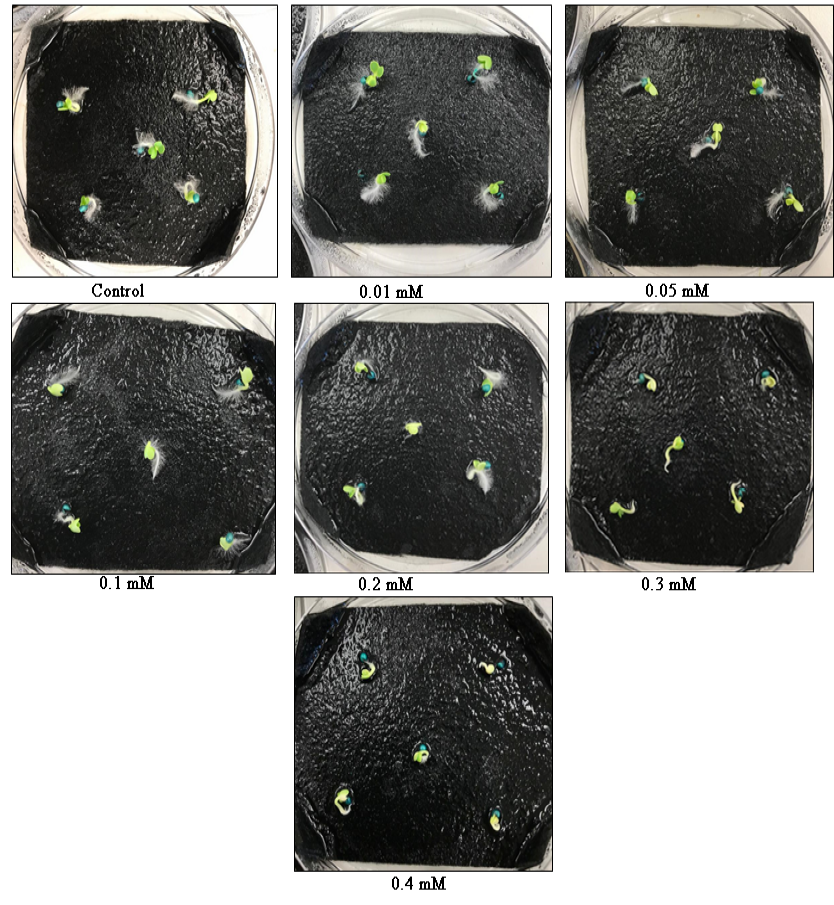
The effect of cadmium on the seed germination of Pak Choi (at day 3). CdCl2 at 0.4 mM concentration reduced seed germination significantly.
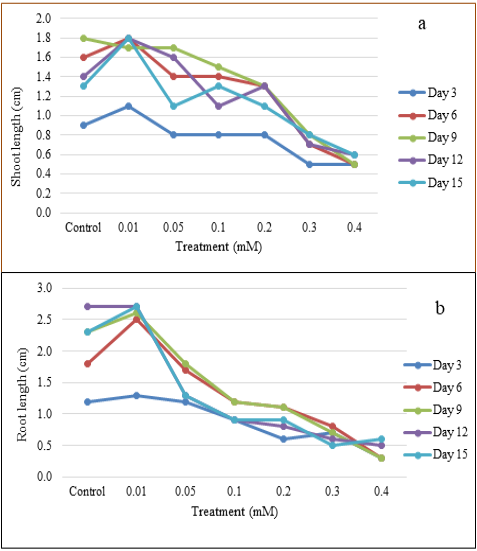
The effects of different concentrations of cadmium on (a) Shoot length and (b) root length of Pak Choi Grown in hydroponic conditions.
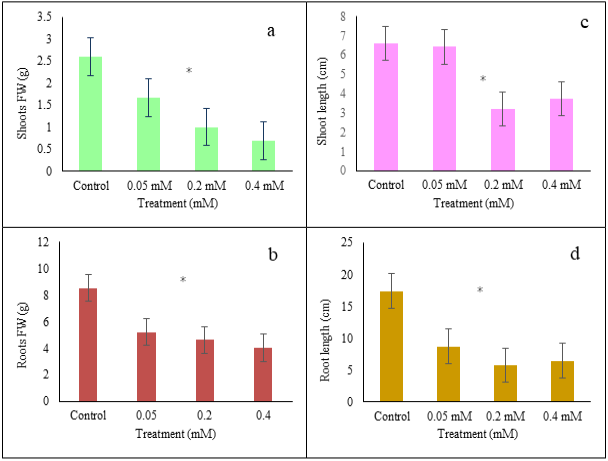
Fresh weight of Pak Choi shoot (a) and root (b), and the length of (c) shoot and (d) root as affected by different treatments of Cd. * Denote significant difference among treatments.
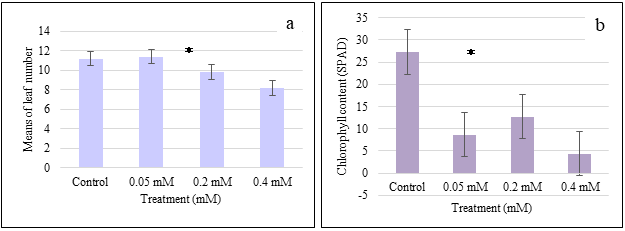
The leaf number (a) and chlorophyll content (b) of hydroponic Pak Choi as affected by different concentrations of cadmium. * Denote significant difference among treatments.
References
- Abdullahi, U.A., M.M. Khandaker, M.M. Alenazi, N.E.M. Shaari, and N. Alias, 2022. Ameliorative effects of Sargassum stolonifolium amendment on physiological and biochemical parameters in Brassica chinensis L. under cadmium contaminated soil. Sem. Ci. Agric., 43: 1907–1940. https://doi.org/10.5433/1679-0359.2021v43n5p1907[CrossRef]
- Agency for Toxic Substances and Disease Registry (ATSDR), 2012. Toxicological profile for cadmium. Atlanta, GA: U.S. Department of Health and Human Services, Public Health Service. https://www.atsdr.cdc.gov/ToxProfiles/tp5-p.pdf
- Aggarwal, A., I. Sharma, B.N. Tripati, A.K. Munjal, M. Baunthiyal and V. Sharma, 2012. Metal toxicity and photosynthesis. In: Photosynthesis: overviews on recent progress and future perspectives. (1st ed.) New Delhi: I K International Publishing House Pvt. Ltd (pp. 229-236).
- Benavides, M.P., S.M. Gallego and M.L. Tomaro. 2005. Cadmium toxicity in plants. Braz. J. Plant Physiol., 17: 49–55. https://doi.org/10.1590/S1677-04202005000100003[CrossRef]
- Chen, Y., T. Li, X. Han, Z. Ding, X. Yang and Y. Jin, 2012. Cadmium accumulation in different Pak choi cultivars and screening for pollution-safe cultivars. J. Zhejiang Univ. Sci. B, 13: 494–502. https://doi.org/10.1631/jzus.B1100356[CrossRef]
- Correa, A.X.R., L.R. Rorig, M.A. Verdinelli, S. Cotelle, J.F. Ferard and C.M. Radetsk. 2006. Cadmium phytotoxicity: Quantitative sensitivity relationships between classical endpoints and antioxidative enzyme biomarkers. Sci. Total Environ., 357: 120-127. https://doi.org/10.1016/j.scitotenv.2005.05.002[CrossRef]
- Drava, G., E. Roccotiello, V. Minganti, A. Manfredi and L. Cornara, 2012. Effects of cadmium and arsenic on Pteris vittata under hydroponic conditions. Environ. Toxicol. Chem. 31: 1375–1380. https://doi.org/10.1002/etc.1835[CrossRef]
- Grifferty, A. and S. Barrington, 2000. Zinc uptake by young wheat plants under two transpiration regimes. J. Environ. Qual., 29(2): 443–446. https://doi.org/10.2134/jeq2000.00472425002900020011x[CrossRef]
- Haider, F.U., C. Liqun, J.A. Coulter, S.A. Cheema, J. Wu, R. Zhang, M. Wenjun and M. Farooq. 2021. Cadmium toxicity in plants: Impacts and remediation strategies. Ecotoxicol. Environ. Saf., 211: 111887. https://doi.org/10.1016/j.ecoenv.2020.111887[CrossRef]
- Huang, S.S., Q.L. Liao and M. Hua, 2007. Survey of heavy metal pollution and assessment of agricultural soil in Yangzhong District, Jiangsu Province, China. Chemosphere, 67(11): 2148–2155. https://doi.org/10.1016/j.chemosphere.2006.12.043[CrossRef]
- Jun-yu, H., R. Yan-fang, Z. Cheng and J. De-an. 2008. Effects of cadmium stress on seed germination, seedling growth and seed amylase activities in rice (Oryza sativa). Rice Sci., 15: 319-325. https://doi.org/10.1016/S1672-6308(09)60010-X[CrossRef]
- Järup, L., M. Berglund, C.G. Elinder, G. Nordberg and M. Vahter. 1998. Health effects of cadmium exposure. A review of the literature and a risk estimate. Scand. J. Work. Environ. Health, 24(1): 52. https://pubmed.ncbi.nlm.nih.gov/9569444/
- Lysenko, E.A., A.A. Klaus, N.L. Pshybytko and V.V. Kusnetsov. 2015. Cadmium accumulation in chloroplasts and its impact on chloroplastic processes in barley and maize. Photosynth. Res., 125(1-2): 291-303. https://doi.org/10.1007/s11120-014-0047-z[CrossRef]
- Khandaker, M.M., H.M. Azam, J. Rosnah, D. Tahir and M. Nashriyah. 2018. The effects of application of exogenous IAA and GA3 on the physiological activities and quality of Abelmoschus esculentus (Okra) var. Singa 979. Pertanika J. Trop. Agric. Sci., 41(1): 209–224.
- Kubis, S., R. Patel, J. Combe, J. Bédard, S. Kovacheva, K. Lilley, A. Biehl, D. Leister, G. Riéos, C. Koncz and P. Jarvis. 2004. Functional specialization amongst the Arabidopsis Toc159 family of chloroplast protein import receptors. Plant Cell, 16(8): 2059-2077. https://doi.org/10.1105/tpc.104.023309[CrossRef]
- Kresovich, J.K., M. Argos and M.E. Turyk. 2015. Associations of lead and cadmium with sex hormones in adult males. Environ. Res., 142: 25–33. https://doi.org/10.1016/j.envres.2015.05.026[CrossRef]
- Li, T.Q., X.E. Yang, L.L. Lu, E. Islam and Z.L. He. 2009. Effects of zinc and cadmium interactions on root morphology and metal translocation in a hyperaccumulating species under hydroponic conditions. J. Hazard. Mater., 169(1-3): 734–741. https://doi.org/10.1016/j.jhazmat.2009.04.004[CrossRef]
- Liu, F., T. Shen, W. Kong, J. Peng, C. Zhang, K. Song and Y. He. 2018. Quantitative analysis of cadmium in tobacco roots using laser-induced breakdown spectroscopy with variable index and chemometrics. Front. Plant Sci., 9: 1316. https://doi.org/10.3389/fpls.2018.01316[CrossRef]
- Gouia, H., A. Suzuki, J. Brulfert and H. Ghorbal. 2004. Effect of cadmium on the co-ordination of nitrogen and carbon metabolism in bean seedlings. Plant Physiol., 160: 367-376. https://doi.org/10.1078/0176-1617-00785[CrossRef]
- Prasad, M.N.V., 1995. Cadmium toxicity and tolerance in vascular plants. Environ. Exp. Bot., 35: 525-545. https://doi.org/10.1016/0098-8472(95)00024-0[CrossRef]
- Rauser, W. E. 1987. Compartmental efflux analysis and removal of extracellular cadmium from roots. Plant Physiol., 85: 62–65. https://doi.org/10.1104%2Fpp.85.1.62
- Raziuddin, F., G. Hassan, M. Akmal, S.S. Shah, F. Mohammad, M. Shafi, J. Bakht and W. Zhou. 2011. Effects of cadmium and salinity on growth and photosynthesis parameters of brassica species. Pak. J. Bot., 43(1): 333-340. http://www.pakbs.org/pjbot/PDFs/43(1)/PJB43(1)333.pdf
- Rahoui, S., A. Chaoui and E. El-Ferjani, 2010. Differential sensitivity to cadmium in germinating seeds of three cultivars of faba bean (Vicia faba L.). Acta Physiol. Plant, 30(4): 451-456. https://doi.org/10.1007/s11738-008-0142-x[CrossRef]
- Santtr, P. and R. Gabbrielli, 2013. Response to cadmium in higher plants. Environ. Exp. Bot., 41: 105–130. https://doi.org/10.1016/S0098-8472(98)00058-6[CrossRef]
- Shaari, N.E.M., M.M. Khandaker, M.T.F.M. Tajudin, A. Majrashi, M.M. Alenazi, N.A. Badaluddin, A.F.M. Adnan, N. Osman and K.S. Mohd. 2023. Enhancing the growth performance, cellular structure, and rubisco gene expression of cadmium treated brassica chinensis using sargassum polycystum and spirulina platensis extracts. Horticulturae, 9: 738. https://doi.org/10.3390/horticulturae9070738[CrossRef]
- Souza, V.L., A.A. Almeida, B.T. Hora Júnior, A.S. Gesteira and J.C. Cascardo. 2008. Preliminary analysis of expressed sequences of genes in Genipa americana L. Plant root exposed to cadmium in nutrient solution. Gen. Mol. Res., 7(4): 1282-1288. https://doi.org/10.4238/vol7-4gmr516[CrossRef]
- Tewari, A., R. Singh, N.K. Singh and U.N. Rai. 2008. Amelioration of municipal sludge by Pistia stratiotes L.: Role of antioxidant enzymes in detoxification of metals. Biores. Technol., 99: 8715–8721. https://doi.org/10.1016/j.biortech.2008.04.018[CrossRef]
- Van Doorn, W.G., E.P. Beers, J.L. Dangl, V.E. Franklin-Tong, P. Gallois, I. Hara-Nishimura, A.M. Jones, M. Kawai Yamada, E. Lam, J. Mundy, L.A. Mur, M. Petersen, A. Smertenko, M. Taliansky, F. Van Breusegem, T. Wolpert, E. Woltering, B. Zhivotovsky and P.V. Bozhkov. 2011. Morphological classification of plant cell deaths. Cell Death Diff., 18(8): 1241-1246. https://doi.org/10.1038/cdd.2011.36[CrossRef]
- Vijayaragavan, M., C. Prabhahar, J. Sureshkumar, A. Natarajan, P. Vijayarengan, and S. Sharavanan. 2011. Toxic Effect of Cadmium on Seed Germination, Growth and Biochemical Contents of Cowpea (Vigna unguiculata L.) plants. Int. Multi. Res. J., 1(5): 01-06.
- Waalkes, M.P., 2000. Cadmium carcinogenesis in review. J. Inorg. Biochem., 79: 240-244. https://doi.org/10.1016/S0162-0134(00)00009-X[CrossRef]
- WHO, 1992. Cadmium. Environmental Health Criteria 134. World Health Organisation, International Programme on Chemical Safety (IPCS), Geneva, Switzerland.
- Yan, S., Q. Ling, Z. Bao, Z. Chen, S. Yan, Z. Dong and B. Deng, 2009. Cadmium accumulation in Pak Choi (Brassica chinensis L.) and estimated dietary intake in the suburb of Hangzhou City, China. Food Add. Cont.: Part B, 2(1): 74–78. https://doi.org/10.1080/02652030902991649[CrossRef]
- Zhang, S.J., Z.H. Hu, J. Chen, F. Chen, Y.Y. Zheng and W. J. Song, 2005. Effects of Pb pollution on seed vigour of three rice varieties. Rice Sci., 12: 197-202.
Services
Article usage statistics
Loading…