
The crested ibis Nipponia nippon formerly occurred throughout East Asia, but since 1981 its unique population has been confined to a narrow band in transborder area of Yangxian, Chenggu and Xixiang County of Shaanxi Province, Central China, on the south slope of the Qinling Mountains. During 2004-2005, 23 crested ibises were experimentally reintroduced to an isolated basin in Qinling Mountains, where they and their offspring exhibited breeding variation never observed in wild population in the following 9 breeding seasons. Crested ibis has been considered a monogamous species, and breeding pair is solitary and territorial. However, 3.4% of breeding females exhibited polyandry and 43.1% of nests were observed colonial in single tree in the reintroduced population, probably due to male-biased sex ratio and better nesting conditions. First nest failure in reintroduced population occurred much earlier than that in wild, which resulted in significantly higher probability of re-nesting. The phenotypic plasticity in crested ibis may play important role in future reintroduction of this critically endangered species under a changing environment.
Short Communication · Volume 52, Issue 4, 22 April 2020 · Open Access
Breeding Variation in a Reintroduced Crested Ibis Nipponia nippon Population in Central China
· · · ·
Affiliations & Notes ⌄
- 1Key Laboratory of Forest Protection of State Forestry Administration, Research Institute of Forest Ecology and Environment Protection, Chinese Academy of Forestry, Beijing 100091, China 2Shaanxi Hanzhong Crested Ibis National Nature Reserve, Hanzhong 723300, China , * Corresponding author: lujunmail@vip.sina.com
Article Info ⌄
- Journal:
- Pakistan Journal of Zoology
- Published:
- 22 April 2020

From the article
- During 2006-2014, no significant differences of Clutch sizes (Independent-sample T test, t = 1.660, P = 0.098), breeding success (t = 0.106, P = 0.916) and productivity (t = 0.645, P = 0.519) were observed between the reintroduced and wild populations (Table I).
- The probability of re-nesting after nest failure in the reintroduced population was 0.36, significantly higher than that in the wild population (Binomial test, P = 0.034, Table I).
- By contrast, two females (3.4%, n = 59) were observed to exhibit polyandry in the reintroduced population (Table I).
- The reintroduced crested ibis exhibited widespread colonial nesting never observed in the wild population.
Selected from the article's own text.
Abstract
Materials and methods
The study was conducted in the transborder area of Yangxian, Chenggu and Xixiang County (32°30′-33°40′N, 107°05′-107°50E) of Shaanxi Province, Central China, on the south slope of the Qinling Mountains (Fig. 1). The breeding areas of wild crested ibis, ranging from 500 to 1200 m in altitude, are dominated by deciduous broadleaved forests and mixed broadleaf-conifer forests, with rice paddies, reservoirs, rivers, and farmlands in valleys. The experimental reintroduction of crested ibis was performed at Huayang town (33°34′ N, 107°31′ E; elevation averages 1100 m), which is an isolated basin on the southern slope of Qinling Mountains, 30 km from the main distribution area of wild population and supporting two pairs of wild crested ibises.
For breeding surveys all of the 23 released birds were given unique numbered plastic bands, and 11 of them were collared with 11-g radio transmitters (type RI-2D; Holohil Systems Ltd., Canada; , 2008). During 2006-2014, 65 nests of released crested ibis and their offsprings were located either by homing on transmitter signals using receivers and handheld antennas (Wildlife Materials International, Inc., USA; , or by investigation of breeding pairs’ distinct territorial displays including copulation, vocalizing and flying around nest sites ; . Regular observations were conducted from an elevated hide or from high ground near the nest, to determine the clutch size, brood size and number of chicks fledging from each nest. Nestlings, if accessible, were color banded at 20-25 days of age.
For wild population, most of nestlings have been color marked since 1987 , which enables us to identify individuals. Comparisons to reintroduced population are based on data of wild population collected through the same methods and during the same period. Statistics were reported as mean ± SD.
Table I.- Reproductive traits of reintroduced and wild crested ibis.
| Trait | Reintroduced | Wild |
| Clutch size | 2.56 ± 0.67 (41) | 2.73 ± 0.61 (323) |
| Breeding success | 69.4 ± 23.7% (37) | 69.0 ± 22.1% (291) |
| Productivity | 1.81 ± 0.61 (48) | 1.87 ± 0.64 (1031) |
| Failed first nest | 0.19 (59) | 0.17 (1248) |
| Re-nesting* | 0.36 (11) | 0.12 (217) |
| Colonial nesting* | 43.1% (65) | 0 (1280) |
| Polyandry* | 3.4% (59) | 0 (1248) |
*Significant difference between the reintroduced and wild populations. Failed first nest, the probability of failure for the first nest; re-nesting, the probability of re-nesting after nest failure; colonial nesting, the percentage of nests observed in colony; polyandry, the percentage of breeding females exhibited polyandry. Sample size is presented in parentheses.
Results
During 2006-2014, no significant differences of Clutch sizes (Independent-sample T test, t = 1.660, P = 0.098), breeding success (t = 0.106, P = 0.916) and productivity (t = 0.645, P = 0.519) were observed between the reintroduced and wild populations (Table I). 43.1% of nests were observed colonial in single tree in the reintroduced population (Table I), while this occurrence was not recorded in wild population. The colonial nesting trees had significantly larger diameter at breast height (DBH) than solitary nesting trees (t = 8.229, P < 0.001; Fig. 2). The number of colonial nests averaged 3.1 ± 0.9 (n = 9, range 2-5) per tree, with an average distance of 3.5 ± 1.3 m (n = 26, range 2-6 m).
The probability of failure of the first nest was similar in the reintroduced and wild populations (Binomial test, P = 0.421, Table I); 72.8% of nest failures in the reintroduced population occurred during March and April, while 36.0% in the wild population (Fig. 3). The probability of re-nesting after nest failure in the reintroduced population was 0.36, significantly higher than that in the wild population (Binomial test, P = 0.034, Table I).
Wild crested ibis showed monogamous behavior. Both the male and female wild crested ibis contributed to nesting, hatching and feeding chicks. By contrast, two females (3.4%, n = 59) were observed to exhibit polyandry in the reintroduced population (Table I). In both cases, the female deserted her first clutch immediately after egg laying, and formed pair bond with another male to produce a new clutch. The male-only care for the first clutch or brood caused nesting failure in both cases.
Discussion
The reintroduced crested ibis exhibited widespread colonial nesting never observed in the wild population. Archibald and Lantis (1979) once speculated that crested ibis probably nested in colony in Central China before 1950s when large trees were available, whereas it was solitary in Siberia and Japan due to scarcity of food. The nationwide logging of mature trees in China during late 1950s resulted in dramatic population decline ; , and the last remnant population survived in remote Qinling Mountains where only a small amounts of nest trees and paddy fields were available. The crested ibis exhibited territorial in the breeding season, and each pair occupied a territory of about 1-2 km2 . As the population increased, the breeding region of crested ibis gradually expanded to lower mountains, where the nests were getting concentrated and were as close as 10 m due to high quality of food supply . Moreover, the species was recorded to colonially nest with Little Egret (Egretta garzetta) and Chinese Pond Heron (Ardeola bacchus) in single Quercus variabilis, a relative large nest tree species available . Based on this information, our result indicated that a reasonable proximate explanation of the colonial nesting is the availability of large nest trees in Huayang basin with abundant food.
Re-nesting is an important breeding strategy used by birds to compensate for the nest loss. Re-nesting propensity is affected by many factors including seasonal timing ; . In our study, 23% of unsuccessful pairs re-nested if their first nests failed before April but only 5% re-nested after May, showing remarkable temporal correlation. Thus, significantly different timing in first nest failure contributed to the different possibility of re-nesting between the wild and reintroduced populations. In the wild population, death of altricial chicks due to shortage of food, predation, parasites and adverse weather conditions in early stage is the primary factor affecting breeding success ; . As a result, more than half of nest failures occurred at nestling stage after May. In the reintroduced population, however, nest failure was mainly attributed to egg loss caused by parent treading, and occurred much earlier, which raised the possibility of initiating a re-nest.
Adult sex ratio plays a central role in mating systems, and females are more polygamous when males outnumber females , 2014; . Our observation of polyandry in reintroduced crested ibis population supports this theory. Female crested ibis shows significantly greater dispersal distance than male both in the wild and reintroduced populations ; Ministry of Environment of Japan, 2014), which may have significant impact on adult sex ratio of small isolated population. In our reintroduction, 13 of 23 released birds inhabited in Huayang basin of the Qinling Mountain in spring of 2006, of which five were female. As a result, mating system flexibility occurred in this isolated population with male-biased sex ratio, which acted as a buffer mechanism to reduce the impact of environmental and demographic noise in the small population . Nesting failure in polyandrous females indicated that biparental care of nestling stages is probably necessary for successful breeding in crested ibis.
Thus, the reintroduced crested ibis showed phenotypic plasticity which is the ability of one genotype to produce more than one phenotype when exposed to different environments . The phenotypic plasticity may play an important role in the restoration of this endangered species, especially under a changing environment in China. Currently, reintroduction activities of crested ibis are being conducted at several sites in China and Japan, which provide opportunities to understand the degree and cost of adaptive phenotypic plasticity.
Acknowledgments
The study is supported by Central Public-interest Scientific Institution Basal Research Fund (No. CAFYBB2016SY016) and Wildlife Conservation Grant from State Forestry Administration of China. The capture and color marking of crested ibis was granted by State Forestry Administration of China [No. 33 Forest Protection (2002)]. We thank Yi Liu, Wenming Ren, Li Ke, Youping Chen, Wenqing Bai, Baoling Wang, and Hongxing Su for their help in the fieldwork.
Statement of conflict of interest
The authors declare there is no conflict of interests.
Figures
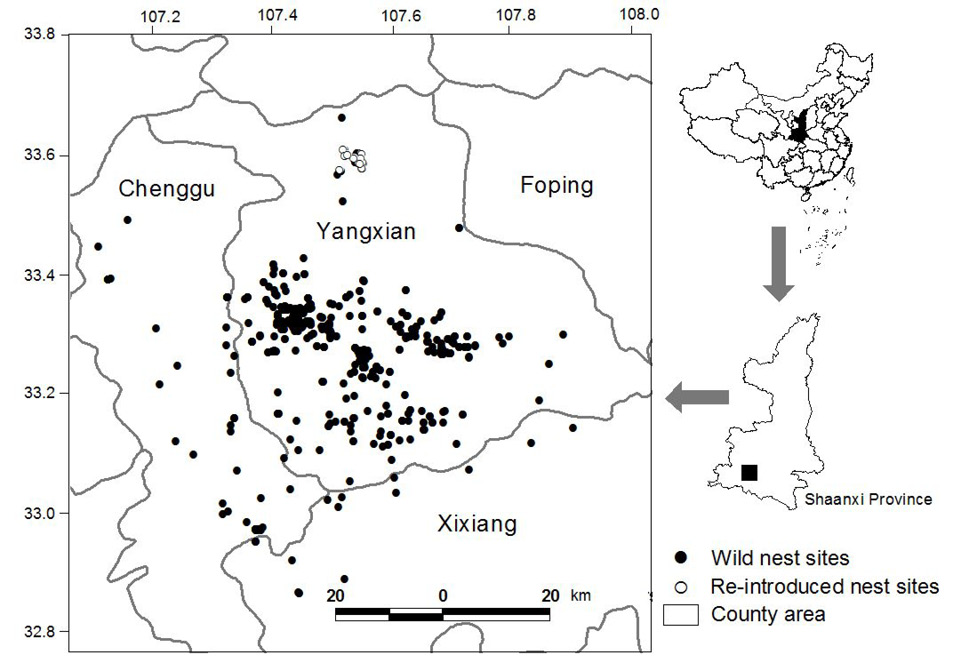
Map of the study area and the nest sites of wild and reintroduced crested ibis during 2006-2014.
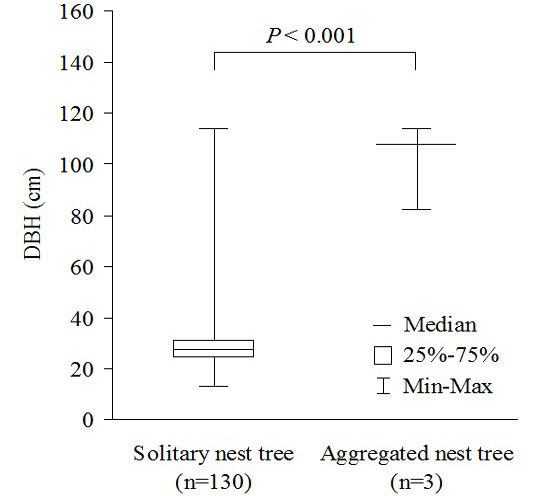
Diameter at breast height (DBH) of solitary and colonial nest trees in crested ibis.
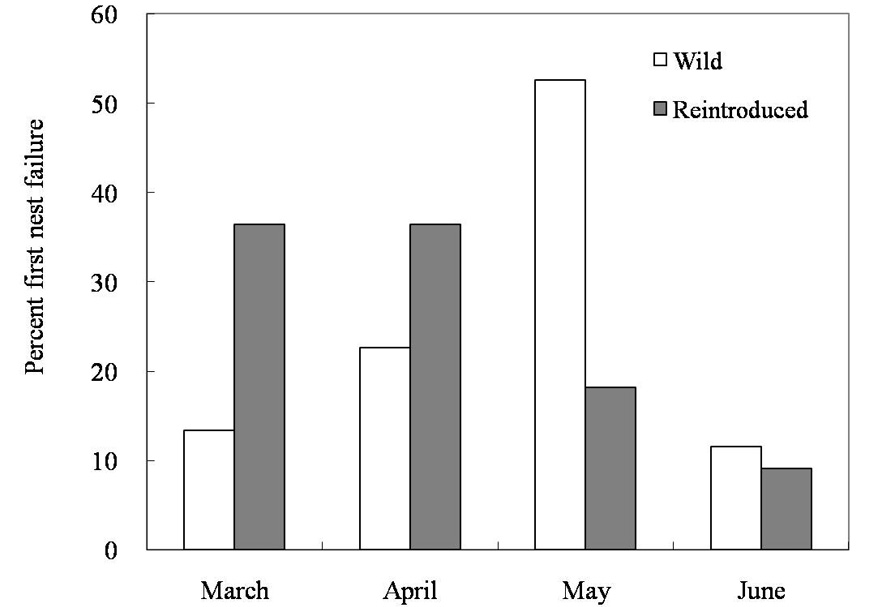
Percentage of first nest failure in wild and reintroduced crested ibis population by month during 2006-2014.
References
- Archibald, G.W. and Lantis, S.D.H., 1979. Proc. Conf. Colonial Waterbirds, 3: 1-15.
- Arnold, T.W., Devries, J.H. and Howerter, D.W., 2010. Auk, 127: 212-221. https://doi.org/10.1525/auk.2009.09028[CrossRef]
- BirdLife International, 2001. Threatened birds of Asia: the BirdLife International Red Data Book. Cambridge, UK: BirdLife International.
- BirdLife International, 2016. Species factsheet: Nipponia nippon. Available at: http://www.birdlife.org/datazone/speciesfactsheet.php?id=3801 (accessed 10 January, 2016).
- Ding, C., 2004. Research on the crested ibis. Shanghai Science, Technology and Education Press, Shanghai.
- Gates, H.R., Lanctot, R.B. and Powell, A.N., 2013. Auk, 130: 372-380. https://doi.org/10.1525/auk.2013.12052[CrossRef]
- Liker, A., Freckleton, R.P. and Szekely, T., 2013. Nat. Commun., 4: 1587. https://doi.org/10.1038/ncomms2600[CrossRef]
- Liker, A., Freckleton, R.P. and Szekely, T., 2014. Curr. Biol., 24: 880-884. https://doi.org/10.1016/j.cub.2014.02.059[CrossRef]
- Liu, Y., 1981. Acta Zool. Sin., 27: 273.
- Liu, D., Ding C. and Chu, G., 2003. Acta Zool. Sin., 49: 755-763.
- Liu, D., Ding, H., Zhang, G., Lu, B., Chu, G., Wang, C., Liu, Y. and Ren, W., 2008. Sci. Silvae Sin., 44: 88-93.
- Liu, D., Lu, B. and Chu, G., 2005. An experimental reintroduction of crested ibis in Yang County, Shaanxi Province. Available at: http://www.doc88.com/p-0116174153473.html (accessed 28 June, 2015).
- Liu, D., Wang, C., Qing, B., Ding, H. and Lu, J., 2014. Sichuan J. Zool., 33: 612-619.
- Lu, B., Zhai, T., Zhang, Y. and Geng, Z., 1997. J. Shaanxi Norm. Univ., 25(Suppl.): 98-104.
- Maqsood, I. and Rong, K., 2019. Pakistan J. Zool., 51: 1169-1177. http://dx.doi.org/10.17582/journal.pjz/2019.51.3.rev2[Full text][CrossRef]
- Mech, L.D. and Barber, S.M., 2002. A critique of wildlife radio-tracking and its use in national parks: A report to the U.S. National Park Service. Available at: http://www.npwrc.usgs.gov/resource/wildlife/radiotrk/radiotrk.pdf (accessed 12 July, 2015).
- Ministry of Environment of Japan, 2014. Status of the reintroduction of crested ibis in Japan. Available at: http://www.env.go.jp/nature/toki/pam ph/1403/full.pdf (accessed 22 November 2015).
- Price, T.D., Qvarnstrom, A. and Irwin, D.E., 2003. Proc. R. Soc. B: Biol. Sci., 270: 1433-1440. https://doi.org/10.1098/rspb.2003.2372[CrossRef]
- Rossmanith, E., Grimm, V., Blaum, N. and Jeltsch, F., 2006. J. Anim. Ecol., 75: 540–548. https://doi.org/10.1111/j.1365-2656.2006.01074.x[CrossRef]
- Shi, D. and Cao, Y., 2001. The crested ibis of China. China Forestry Publishing House, Beijing.
- Shi, D., Yu, X., Chang, X. and Lu, B., 1989. Zool. Res., 10: 327-332.
- Wang, C., Liu, D., Qing, B., Ding, H., Cui, Y., Ye, Y., Lu, J., Yan, L., Ke, L. and Ding, C., 2014. Chin. J. Zool., 49: 666-671.
- Yu, X., Liu, N., Xi, Y. and Lu, B., 2006. Bird Conserv. Int., 16: 325-343. https://doi.org/10.1017/S0959270906000499[CrossRef]
- Yu, X., Lu, B., Lu, X. and Liu, N., 2007. Acta Zool. Sin., 53: 812-818.
- Yu, X., Xi, Y., Lu, B., Li, X., Gong, M., Shi, L. and Dong, R., 2010. Wilson J. Ornithol., 122: 228-235. https://doi.org/10.1676/09-012.1[CrossRef]
- Zhai, T., Lu, X., Lu, B., Zhang, Y. and Wang, H., 2001. Acta Zool. Sin., 47: 508-511.
- Zheng, G., 2000. In: Rare bird: The crested ibis. China Wildlife Conservation Association, China Ornithological Society and Wildlife Conservation Association of Shaanxi Province, China Forestry Publishing House, Beijing, pp. 19-23.
Services
Article usage statistics
Loading…