
Cattle egret is considered as biological insect pest control agent in our agricultural ecosystem. To analyze this activity present work was planned to collect the preliminary information about habitat requirements and different breeding aspects of Cattle egret (Bubulcus ibis). The fieldwork was performed for two years (2012, 2013) at three different stations in the surrounding area of Faisalabad. Based on results it was concluded that Cattle egrets are colonial breeders and colonies were monospecific with no other ardeidae members nesting in the neighborhood. They prefer sites for nest building, which have regular accessibility of water, and usual human activities are common nearby. The breeding period was discerned to be start from April to August and Acacia nilotica was observed as most preferred tree for nesting followed by Syzygium cuminii. At three selected sites, 30 nests from each were marked and regularly monitored to get data on nesting behavior (nest height and diameter), birds plumage variations, courtship behavior, eggs measurements (clutch size, eggs length, breadth and weight), incubation and hatching. The hatching of the chicks was observed to be an asynchronous one i.e., chicks did not hatch at the same time but at an interval of a day (20-25 h). Role of parents during weaning period i.e. feeding and parental care of nestlings was performed by both partners. It may be said that Cattle egret is an insectivorous bird and take food from the agricultural fields in surroundings of study sites. Therefore, an awareness program about the beneficial status of Cattle egret in agro-ecosystem is recommended to protect and promote their habitats from anthropogenic activities.
Research Article · Volume 49, Issue 5, 20 September 2017 · Open Access
Habitat Ecology and Breeding Performance of Cattle Egret (Bubulcus ibis) in Faisalabad, Pakistan
· · · · · · ·
Affiliations & Notes ⌄
- 1Cholistan Institute of Desert Studies, The Islamia University of Bahawalpur, Bahawalpur, Pakistan 2Department of Forestry and Range Management, University of Agriculture, Faisalabad, Pakistan 3Department of Forestry, Range and Wildlife Management, The Islamia University of Bahawalpur, Bahawalpur, Pakistan 4Department of Life Sciences, The Islamia University of Bahawalpur, Bahawalpur, Pakistan 5Department of Environmental Sciences, COMSATS Institute of Information and Technology, Vehari Campus, P
Article Info ⌄
- Journal:
- Pakistan Journal of Zoology
- Published:
- 20 September 2017

From the article
- Cattle egrets are common birds seen around human settlement, rural and urban set up and seem to be not much bothered by humans.
- Cattle egret is an insectivorous bird, also considered as biological insect pest-controlling agent, hence is an important bird in agro-ecosystems.
- Therefore, awareness program about the beneficial status of cattle egret is suggested to protect their heronries from anthropogenic activities.
Selected from the article's own text.
Abstract
Introduction
Herons are wading birds of considerable significance, because they act as indicator species in wetland areas. They have been remained important in extensive number of studies concerning their habitat, distribution pattern, breeding biology, foraging behavior and as indicators of pollution ; ; ; Goutner et al., 2001a, b). Heronries are the sources of breeding population of herons, egrets and other associate water birds, also play very vital role in the conservation of these birds. For successful conservation and recovery of aquatic birds an extensive understanding of eco biological requirements of these birds are essential ; .
Cattle egret (Bubulcus ibis) belongs to the order Ciconiiformes and family Ardeidae . It has a wide-ranging distribution around the globe. Cattle egret is native to old world common from Africa to humid Asian tropics, from India to japan and northern Australia . It is well known that from 19th century the cattle egret has extended its breeding range from Africa to Europe, Asia, America and Australasia ; . In last century, the range of this bird expanded enormously and now it found on all continents excluding the Antarctica (Martinez-Vilalta and Motis, 1992).
The worldwide success of cattle egrets is credited to high habitat versatility due to capability to associate with anthropogenic habitats and feed on diversity of prey . Cattle egret appears to be most adaptive of all, possibly due to its versatile feeding behavior and non-specificity of the nesting environment. This bird have been described to nest in agro-ecosystems, in rural as well as urban environment, which depends upon safe nesting places, food availability, and other environmental factors ; . A good nesting site generally provides protection against predators, necessary support to construct the nest, and access to feeding sites within foraging areas ; . More, nesting sites also support the hatching success and positive rearing of chicks that is imperative for species survival .
As one of the most terrestrial ardeids, Cattle egrets show dietary flexibility, feeding on large variety of prey in a given environment . Numerous studies have showed that the diet of Cattle egrets changes with season, time of day, prey availability and abundance . Cattle egret can also be seen in large flocks feeding on insects from freshly ploughed fields . Its ability to use human inhibited habitats and being scavengers is playing a vital role for its success . The prominence of this bird in insect pest management in different agro ecosystems has also been reported . It is a gregarious bird, seen in small gatherings nearby grazing livestock, following energetically the animals, riding upon their backs, running in and out between their legs, and attacking the insects disturbed by their movements .
The foraging ecology of egrets such as food intake, prey capture rate, and percentage of successful pecks had been studied in numerous habitats such as freshwater marshes, salt marshes, rice fields, river and estuaries ; . Egrets are good issue for foraging study as they are large, abundant and consume easily identified prey. Due to its primarily insectivorous behavior, cattle egret is considered as a biological insect pest control agent in an agro-ecosystem ; . Availability of food resources and foraging environments influence the selection of habitat by the birds and is main factor of the breeding success in cattle egrets .
Detailed and comprehensive studies of bird’s species are obligatory when creating the conservation measures. This information can be used to properly manage biodiversity and propose effective conservation programs ; . In this paper, we provide some data on the eco biology, of the cattle egret in Faisalabad area of Pakistan. Accordingly, information about this bird species will be vital for their effective saving and management. Till now no inclusive studies have been carried to scan the eco biological studies of egrets in Pakistan. This study provides an understanding in the ecological significance of cattle egrets into our ecosystem.
Materials and Methods
Study area
The study was conducted in “Faisalabad District” located at 31°21′52″N, 72°59′40″E and an elevation of 184.5 m from mean sea level. The climate of Faisalabad possess the dry semi-arid agro-climatic characteristics but well managed canal irrigation system has placed it among the highly crop productive zones. The mean maximum and minimum temperature in summer are 39°C (102°F) and 27°C (81°F), respectively. In winter it peaks at around 17°C (63°F) and 6°C (43°F), respectively. The average yearly rainfall lies only at about 300 mm (12 in) and is highly seasonal with approximately half of yearly rainfall in two months July and August (Fig. 1). The Chenab River flows about 30 km to the north-west while the Ravi River meanders about 40 km southeast of the city. The lower Chenab canal is the main source of irrigation water, which meets the requirements of 80 % of cultivated land. The soil of Faisalabad comprises alluvial deposits mixed with loess having calcareous characteristics, making it very fertile. Land surface near the study site consist of agriculture fields rotated among wheat, rice, cotton and many other seasonal crops .
The following three stations were selected for field observations:
Site A: Satiana Bangla: The station is present at latitude of 31ᴼ12ʹ21.32ʹʹ N and a longitude of 73ᴼ10ʹ22.26ʹʹ E with an elevation of 609 ft. from mean sea level. It is situated at a distance of about 12 km from Faisalabad city and have Gogera canal as main source of water.
Site B: Gatwala Park: This station is present between the latitude and longitude of 31ᴼ28ʹ37.59ʹʹ N, 73ᴼ12ʹ45.86ʹʹ E respectively with an elevation 625 ft. from mean sea level. It is situated at a distance of 06 km from Faisalabad city and Gatwala stream is the main source of water.
Site C: Pul Dengru: It is present between latitude and longitude of 31ᴼ35ʹ10.96ʹʹ N and 73ᴼ02ʹ27.60ʹʹ E, at an elevation of 621 ft. from mean sea level. It is at a distance of almost 10 km from the Faisalabad city and Jhang canal is the main source of water.
Methodology
In order to record various eco-biological aspects of cattle egrets (Bubulcus ibis) periodic surveys were undertaken for two consecutive years (2012 and 2013) from April to August. Some qualitative data was also collected by interviewing the local peoples around breeding sites. The ecology of breeding habitats was studied during field visits by observing the size of breeding territory, kind of upper story vegetation and ground cover, cropping pattern, type of water sources met and other localized conditions, which make the site attractive for breeding . Different breeding aspects as bird appearance, nesting behavior, courtship displays and copulation, clutch size, incubation period and hatching success, feeding and weaning period were based on direct visual observations and by using binocular (Nikon Action 16x50 EX ATB) ; . The nests in colony were counted using Point Count Method . Eggs were measured for length and weight with Vernier caliper and weighing balance respectively. Nesting and hatching success were calculated by following the method of Fazili (2002). First, nesting success was calculated as NS/ (Ns+Nu) X100, where Ns is number of successful nests (i.e., nests in which at least, one nestling survived beyond 10 days of age), Nu is number of unsuccessful nests. Hatching success was calculated as: No of eggs hatched/total no of eggs laid or clutch size X 100. Breeding success was calculated by the formula, no of fledglings survived/no of eggs incubated X 100 . The geographic coordinate’s latitude, longitude, and altitude were taken from each site by a GPS (global positioning system) named Garmin eTrex. Mean and standard deviation were calculated for each parameter and statistical analyses were carried out using SPSS (Statistical Package for the Social Sciences).
Results and discussion
Ecology of breeding habitats
The data collected revealed that total area of breeding territory “A” was 0.1 square kilometer and upper story vegetation was consisting of kikar (Acacia nilotica), sufaida (Eucalyptus camaldulensis), simbal (Bombax cieba) on which maximum nests were located. The main species on ground was submerged bansi grass (Panicum antidotale), palwan (Dicanthium anulatum) on dry places, mesquite (Prosopis juliflora) and ak (Calotropis procera). Cropping pattern followed in vicinity consisted of sugarcane, wheat, rice and cotton. The main source of water was almost 12 m wide gogera canal. This breeding territory was close to human habitation along Sithana Bangla (Table I).
The total area of site “B” was 0.025 square kilometer. Key tree species was jaman (Syzygium cuminii) preferred by egret for nesting followed by kikar (Acacia nilotica) and bakain (Melia azedarach). Ground vegetation cover was mainly comprised of khabal grass (Cynodon dyctylon). Cropping pattern followed in vicinity of study sites consisted of wheat and rice. Crocodile breeding ponds were present within breeding territory and a tributary of gogrea branch canal was also passing by the area. Characteristic feature of human habitation was offices of Wildlife Department and the visitors coming there for recreation purpose (Table I).
The site “C” comprised of total 0.064 square kilometer area. The dominant tree species was kikar (Acacia nilotica) other co-dominant trees species such as sufaida (Eucalyptus camaldulensis) and shisham (Dalbergia sissoo) were also present on canal sides. The main ground cover was khabal (Cynodon dyctylon) grass and sirkanda (Saccharam munja). Cropping design followed in locality was sugarcane, wheat and rice. Jang canal was also passing by the area. Occasionally built farm houses were presenting a good sign of human habitations within this breeding territory (Table I).
Results revealed that preferred tree species for nest making include kikar (Acacia nilotica) while presence of nearby aquatic source in the form of canal or pond was another essential element. Ecological conditions at breeding territory were found to be almost similar as expressed by Hafner (1997) and Peterson (1980). Presently, kikar (Acacia nilotica) tree is important species for nesting which might be due to the facts that predation is rather difficult at such thorny trees. Similarly, presence of human beings can have repellent effect for predators.
Appearance of bird at breeding
In this study, breeding period of cattle egrets was observed from April to August, which is in line with the results of Patankar et al. (2007) who stated from April to July and Kour and Sahi (2013) who reported from March to July. However, various results revealed that breeding season of cattle egret (Bubulcus ibis) varies from place to place. Proceedings from different parts of the world portray that its breeding is closely related with the monsoon season ; . It was noted that both male and female cattle egrets produce conspicuous plumes during breeding season. Results depict that in non-breeding dress, the plumage was completely white, bill was yellow; legs were yellowish green in both male and female birds. Whereas during the breeding season (April and May) white color plumes converted orange buff at head, neck and back of the body, however bill and legs developed into yellow reddish color. These breeding plumes are used mainly in courtship behavior and are lacking in non-breeding season. The observations were recorded in field visits, which were in accordance as explained by Ali and Ripley (1983), Robert (1991) and Joshi and Shrivastava (2012).
Table II.- Nest parameters (Mean+ SD) of Cattle egret at selected study sites.
| Sr. No. | Site | Total nest (N) | Nest height (m) | Nest diameter (cm) |
| 1 2 3 | A B C | 94 53 76 | 7.45 + 2.09 7.19 + 1.45 8.01 + 1.31 | 30.07 + 2.86 28.35 + 1.01 27.99 + 2.21 |
Nesting behavior
The process of nest building was observed in the month of May. However, the practice of nest repairing was seen to be continued even after eggs laying, during incubation and hatching, though rate of collection of nesting material was slowly decreased. These observations were in agreement with Kour and Sahi (2013). It was observed that cattle egrets build their colonies where the area was not wild and preferably almost near water availability, road side and human vicinity. It was observed at each study site A, B and C, that male birds establish the breeding territory. Nests were typically built in kikar (Acacia nilotica) trees (as observed at three study sites) followed by jaman (Syzygium cuminii) trees (as observed at one study site). On average, the nests were built at the height of mean 7.19 + 1.45 to 8.01 + 1.31 m above ground and mean nest diameter was 27.99 + 2.21 to 30.07 + 2.86 cm (Table II). Nests were made up of rough unlined structures of sticks, reeds, shrubs and twigs retained in wedge of branches in trees. The cattle egrets started the nest building much before they had mate. The cattle egrets were seen to collect twigs from the nearby fields, stealing from old nests and collecting from ground, fallen from other nests. Results revealed that nests of cattle egrets were in the shape of multilayered round untidy platforms with dead, stout sticks at base and soft, live and gentle twigs on top of platform; these observations are similar to the remarks of McKilligan (2005). In all study sites, most of the nests were usually completed within 05 to 06 days and both partner participated in nest making. It was noticed to construct nest on previous places, re-nesting in old nests and cleaning the debris of previously fledged chicks with their beaks. In this study nesting colonies were documented to be wholly monospecific with only cattle egrets nesting on sites. This statement was opposing to Ali and Ripley (1968) and Maccarone and Parsons (1988) who noticed cattle egrets nest in mixed colonies but our results were in line with Arendt and Arendt (1988), Patankar et al. (2007) and Kour and Sahi (2013) that no other ardeidae member nesting in the neighborhood.
Courtship behavior
Courtship and mating performance was noted after they had assembled their nests in the months of May. Mating in cattle egrets is believed to occur at or near the nesting sites and indeed, all observations in this study occurred around the one-meter range of the nest . Results revealed that before creating pair bond the male birds were found to flutter around female to win its attention. The male partner generally after getting nesting territory showed a varied range of courtship displays like twig shake, flap flight, stretch display, wing preening and head flicks to female who exercised her will of selecting the suitable male with her neck extended thus leading to pair formation ; . During breeding season, frequent and aggressive encounters between nesting pairs were noted. After mating, the process of nest building again started and this continued even after egg laying . During the present notes, mating behavior was seen at the mid-day as observed by Joshi and Shrivastava (2012), but Kler et al. (2014) has given opposed statement that mating was mostly observed at early morning.
Clutch size
Egg laying started after nest building and observations regarding the egg laying behavior of cattle egret revealed that time period between two successive laying was approximately 20-25 h and is almost similar as stated by Patankar et al. (2007).
At each study site (A, B, C) thirty nest were marked and monitored regularly. Results described that clutch size was (Mean+ SD) 3.7 ± 0.50, 3.5 ± 0.06, and 3.6 ± 0.71, respectively. The range of the clutch size was recorded as 03 to 04 eggs (n=218), 03 being the commonest and exceptionally 05 (Table III). Thus, the present results are almost in line with Kour and Sahi (2013) and Kler et al. (2014).
At site “A” (n=79) eggs were monitored and mean weight, length, and breadth was found as 21.18 ± 1.01gm, 45.21 ± 1.90mm, and 33.02 ± 0.11mm, respectively. At site “B” (n=64) eggs measurements for mean weight, length, and breadth were 22.04 ± 1.79gm, 45.04 ± 1.81mm, and 32.52 ± 0.09mm, respectively. Similarly at cite “C” mean weight, length, breadth (n=75) was 21.23 ± 1.61gm, 44.87 ± 1.01 mm, and 32.06 ± 0.16mm, respectively (Table III) and these results are almost in line with Patankar et al. (2007).
The shape of eggs was oval, medium sized, mono colored and milky- blue without any markings. The color of egg becomes slightly faded with the passage of time. Kour and Sahi (2013) have reported almost similar studies about eggs characteristics.
Incubation period and hatching success
The incubation periods started with the laying of first egg and during incubation one of the two partners sat on the eggs but mostly female. The incubation period was varied from 22-25 days. Joshi and Shrivastava (2012) and Kour and Sahi (2013) has reported incubation periods from 21-24, and 21-23, respectively.
Table III.- Breeding performance of cattle egret at three study sites.
| Sr. No. | Study site | Marked nest | Clutch size (Mean+ SD) | Total eggs Monit ored (n) | Egg measurements (Mean+ SD) | No. of chicks hatched | No. of chicks fledged | Nes ting Succ ess % | ||
| Weight (gm) | Length (mm) | Breadth (mm) | ||||||||
| 1 2 3 | A B C | 30 30 30 | 3.7 ± 0.50 3.5 ± 0.06 3.6 ± 0.71 | 79 64 75 | 21.18 ± 1.01 22.04 ± 1.79 21.23 ± 1.61 | 45.21 ± 1.90 45.04 ± 1.81 44.87 ± 1.01 | 33.02 ± 0.11 32.52 ± 0.09 32.06 ± 0.16 | 42 36 31 | 28 19 20 | 35.44 29.68 26.66 |
Table IV.- Chronological breeding events of cattle egrets in the study area.
| Sr. No. | Date | Duration | Remarks |
| 1 2 3 4 5 6 7 8 9 10 11 | 15.03.2012 01.04.2012 15.04.2012 01.05.2012 15.05.2012 01.06.2012 15.06.2012 01.07.2012 15.07.2012 01.08.2012 15.08.2012 | Third to fourth week of March First to second week of April Third to fourth week of April First to second week of May Third to fourth week of May First to second week of June Third to fourth week of June First to second week of July Third to fourth week of July First to second week of August Third to fourth week of August | No breeding activity at three sites Procurement of nesting territory Body color started changes, breeding plumage was appeared Courtship displays and birds pairing was observed Recommencement of nest building and mating Egg laying and incubation was started Incubation was continued and hatching started Hatching and parental care was continued Parental care Fledgling chicks were observed Breeding sites started to convert into roosting sites |
The hatching process was found regular with the chicks hatching out in successive days in same order in which the eggs were laid. Based on results mean number of chicks hatched at study sites A, B, C were 42, 36, 31 and mean number of chicks fledged were 28, 19, 20, respectively. Further nesting success was highest at site A- 35.44 % followed by 29.68 % at site B and 26.66 % at site C. Dusi and Dusi (1970) has recorded nesting success of cattle egrets to be 30 %.
In cattle egrets, hatching of chicks was observed as an asynchronous one i.e., chicks did not hatch at the same time but at break of a day (18-24 h). This observation is in agreement with that of Ploger and Mock (1986). The asynchronous hatching was obvious from the fact that in nests chicks of different sizes could be easily seen .
Feeding and weaning period
Results showed that cattle egrets provide an excellent example of parental care and both partners perform their role in weaning of their chicks. Soon after hatching, parents taught chick to eat regurgitated food in their partially opened beak. As newly chicks grew feeding method was noticed to change from direct feeding to feeding onto the nest floor. However, Weber (1975) reported two methods of feeding i.e., beak grab feeding and feeding onto the nest floor in herons. The hatching was followed by the weaning period of 25-30 days, whereas a weaning period of 21-28 days and 21-23 days was recorded by Patankar et al. (2007) and Kour and Sahi (2013), respectively.
In parental care, cattle egrets search their food for their chicks from nearby areas. In daytime, chicks tried to fly within the branches of trees or around the nests. After the age of 500 days, juveniles were able to fly.
Conclusion
Cattle egrets are common birds seen around human settlement, rural and urban set up and seem to be not much bothered by humans. Safe nesting area, availability of water, food and nesting material are the major needs of this species for nest site selection. Cattle egret is an insectivorous bird, also considered as biological insect pest-controlling agent, hence is an important bird in agro-ecosystems. Therefore, awareness program about the beneficial status of cattle egret is suggested to protect their heronries from anthropogenic activities. By enhancing such farmer friendly bird, we can minimize the use of pesticides, which have toxic effects on our environment.
Acknowledgement
We acknowledge the support and cooperation of Department of Forestry and Range Management, University of Agriculture, Faisalabad, Pakistan throughout this work.
Statement of conflict of interest
Authors have declared no conflict of interest.
Figures
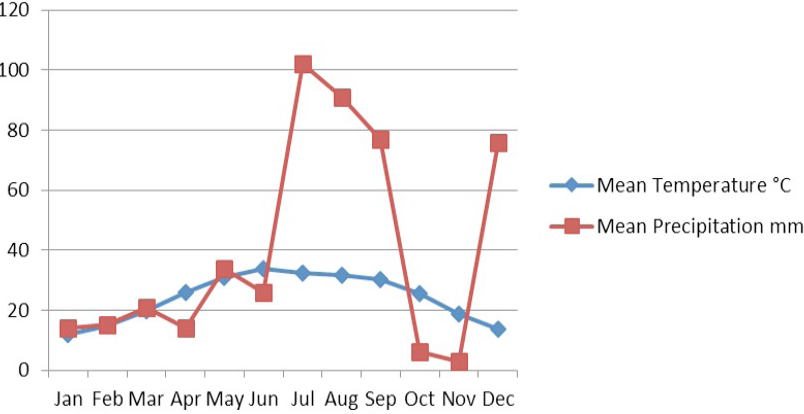
Climatic data (temperature and rainfall) of study area (Faisalabad). Source: http://www.pakmet.com.pk/latest%20news/Latest%20News-old.html
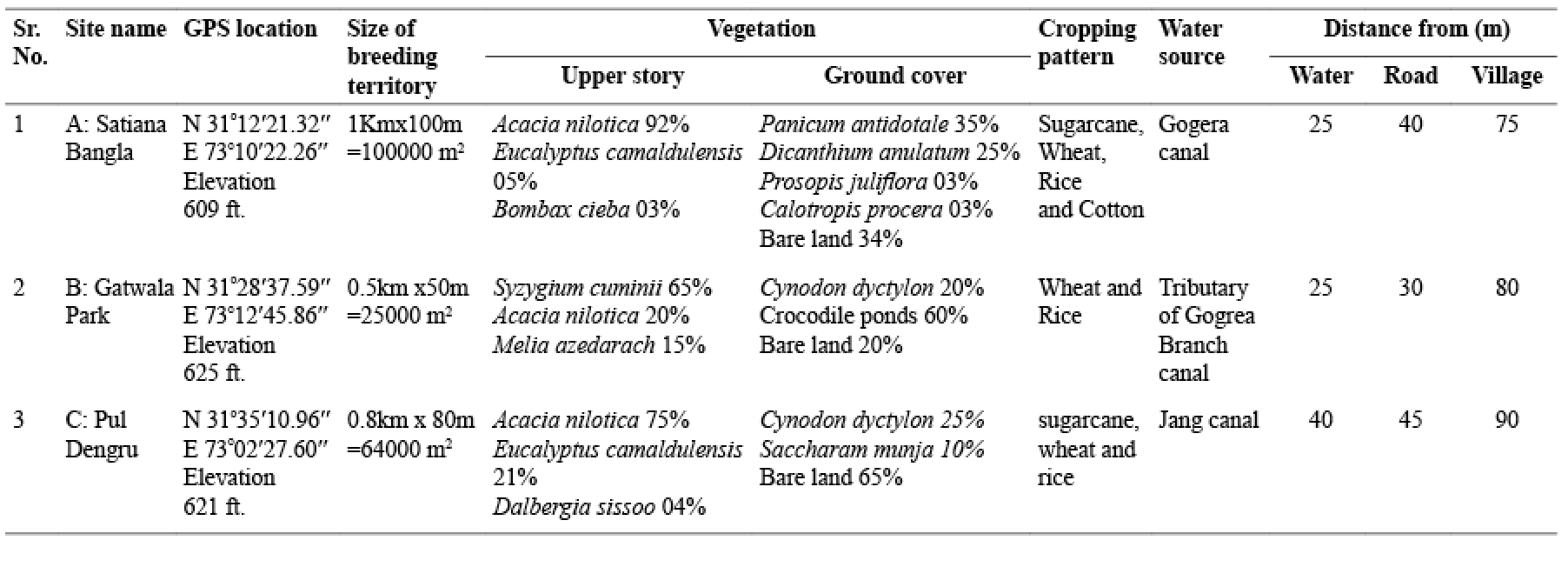
Habitat ecology of cattle egret at three different breeding sites in Faisalabad.
References
- Abdullah, M., 2007. Eco-biology and insectivorous activity of cattle egret (Bubulcus ibis) in croplands. M. Sc. (Hons.) thesis. Department of Forestry, University of Agriculture, Faisalabad, Pakistan.
- Ali, S., 1941. The book of Indian birds, 12th revised edition. Bombay Natural History Society, Oxford University Press, Mumbai, pp. 72.
- Ali, S., 1996. The book of Indian birds, 1st edition. Oxford University Press, New Delhi.
- Ali, S. and Ripley, S.D., 1968. Handbook of the birds of India and Pakistan. Oxford University Press, Bombay, pp. 66-68.
- Ali, S. and Ripley, S.D., 1983. Handbook of birds of India and Pakistan together with those of Bangladesh, Nepal, Bhutan and Srilanka. Oxford University Press, Delhi.
- Arendt, W.J. and Arendt, A.I., 1988. Aspects of the breeding biology of the Cattle Egret (Bubulcus ibis) in Montserrat, West Indies and its impact on nest vegetation. Colon. Waterb., 11: 72-84. https://doi.org/10.2307/1521172[CrossRef]
- Brown, L.H., Urban, E.K. and Newman, K., 1982. The birds of Africa, Volume I. Academic Press, London, pp. 145-149.
- Carter, M.F., Hunter, W.C., Pashley, D.N. and Rosenberg, K.V., 2000. Setting conservation priorities for landbirds in the United States: The partners in flight approach. Auk, 117: 541-548. https://doi.org/10.2307/4089748[CrossRef]
- Dodd, M.G., 1995. Accuracy and precision of techniques for counting Great Blue Heron nests. J. Wildl. Manage., 59: 667-673. https://doi.org/10.2307/3801942[CrossRef]
- Ducommun, M., Dela, P., Quirogaa, M.A., Beltzera, A.H. and Schnack, J.A., 2008. Diet of cattle egrets (Bubulcus ibis) in the flood valley of the Parana River. N. Arg. Avian Biol. Res., 1: 145-151. https://doi.org/10.3184/175815508X402419[CrossRef]
- Dusi, J.L. and Dusi, R.D., 1970. Nestling success and mortality of nestlings in a cattle egret colony. The Wilson Bull., 82: 458-460.
- Fazili, M.F., 2002. Studies on annual cycle of some birds of Wular Lake, Kashmir. Ph.D. thesis submitted to University of Kashmir.
- Fellowes, J.R., Fang, Z., Shing, L.K., Hau, B.C., Lau, M.W. and Lam, V.W., 2001. Status updates of white eared night heron Gorsachius magnificus in South China. Bird Conserv. Int., 11: 101-111. https://doi.org/10.1017/S0959270901000193[CrossRef]
- Goutner, V., Furness, R. and Papakpostas, G., 2001a. Mercury in feathers of squacco heron (Ardeola ralloides) chicks in relation to age, hatching order, growth and sampling dates. Environ. Pollut., 11: 107-115. https://doi.org/10.1016/S0269-7491(99)00329-2[CrossRef]
- Goutner, V., Papagiannis, I. and Kalfakakou, V., 2001b. Lead and cadmium in eggs of colonially nesting waterbirds of different position in the food chain of Greek wetlands of international importance. Sci. Total Environ., 267: 169-176. https://doi.org/10.1016/S0048-9697(00)00808-1[CrossRef]
- Hafner, H., 1997. Ecology of wading birds. Colon. Waterb., 20: 115-120. https://doi.org/10.2307/1521773[CrossRef]
- Hafner, H., 2000. Heron nest site conservation. In: Heron conservation (eds. A.J. Kushlan and H. Hafner). Academic Press, U.S.A., pp. 201-215.
- Hafner, H. and Fasola, M., 1992. The relationship between feeding habitat and colonially nesting ardeidae. In: Managing Mediterranean wetlands and their birds (eds. M. Finlayson, T. Hollis and T. Davis). Proceedings of an IWRB International Symposium, Grado, Italy, February 1991. IWRB Special Publication No. 20, Slimbridge, UK, pp. 194-201.
- Jehle, G., Adams, A.A.Y., Savidge, J.A. and Skagen, S.K., 2004. Nest survival estimation: a review of alternatives to the Mayfield estimator. Condor, 106: 472-484. https://doi.org/10.1650/7411[CrossRef]
- Joshi, P. and Shrivastava, V.K., 2012. Breeding biology and nest site selection of cattle egret (Bubulcus ibis) in Tawa Reservoir and surrounding area of Hoshangabad District (M.P). Asian J. exp. biol. Sci., 3: 525-530.
- Kazantzidis, S., 1998. The breeding ecology of the little egret Egretta g. garzetta L. 1766 at the Axios delta, Greece.
- Kazantzidis, S. and Goutner, V., 1996. Foraging ecology and conservation of feeding habitats of little egrets (Egretta garzetta) in the Axios river delta, Macedonia, Greece. Colon. Waterb., 19: 115-121. https://doi.org/10.2307/1521954[CrossRef]
- Kler, T.K., Kumar, M. and Mehta, P., 2014. Breeding biology of cattle egret Bubulcus ibis in villages of Ludhiana, Punjab. Indian J. appl. Res., 4: 2249.
- Kour, D.N. and Sahi, D.N., 2013. Aspects of breeding biology of cattle egret, bubulcus ibis coromandus (boddaert) in Jammu, India. Int. J. environ. Sci., 3: 1547-1561.
- Kushlan, J.A. and Hafner, H., 2000. Heron conservation. Academic Press, London, UK.
- Li, X., Xian, Z., Xinrong, X., Shicheng, L., Yongqiang, Z., Danxi, C., Chenxi, H., Bingyao, C. and Guang, Y., 2016. Bird diversity in the buffer zone of the largest coastal nature reserve of China and conservation implications. Pakistan J. Zool., 48: 1193-1199.
- Lowe-McConnell, R.H., 1967. Biology of the immigrant cattle egret Ardeola ibis in Guyana, South America. Ibis, 109: 168-179. https://doi.org/10.1111/j.1474-919X.1967.tb00416.x[CrossRef]
- Ludwig, E., Vanicsek, L., Torok, J. and Csorgo, T., 1994. The effect of nest height on the seasonal pattern of breeding success in blackbirds, Tardus merula. Ardea, 83: 411-418.
- Maccarone, A.D. and Parsons, K.C., 1988. Differences in flight patterns among nesting ibises and egrets. Colon. Waterb., 11: 67-71. https://doi.org/10.2307/1521171[CrossRef]
- Maddock, M. and Geering, D., 1993. Cattle Egret migration in south-eastern Australia and New Zealand: An update. Notornis, 40: 109-122.
- Martínez-Vilalta, A. and Motis, A., 1992. Family Ardeidae (Herons), In: Handbook of the birds of the World (eds. J. del Hoyo, A. Elliott and J. Sargatal), Vol. 1. Lynx Editions, Barcelona, pp. 376-429.
- Mathew, K.L. and Gadvi, I.R., 2004. Distribution pattern and the size of cattle egret Bubulcus ibis heronries in Saurashtra region of Gujarat, India. International Conference on Bird and Environment, Haridwar, India.
- McKilligan, N.G., 1990. Promiscuity in the cattle egret (Bubulcus ibis). Auk, 107: 334-341. https://doi.org/10.2307/4087617[CrossRef]
- McKilligan, N.G., 2005. Herons, egrets and bitterns: Their biology and conservation in Australia. CSIRO Publishing, pp. 144.
- Parejo, D., Sánchez-Guzmán, J.M. and Avilés, J.M., 2010. Breeding biology of the cattle egret Bubulcus ibis in southwest Spain. Bird Study, 48: 367-372. https://doi.org/10.1080/00063650109461236[CrossRef]
- Patankar, P., Desai, I., Shinde, K. and Suresh, B., 2007. Ecology and breeding biology of the cattle egret (Bubulcus ibis) in an industrial area at Vadodara, Gujarat. Zoos’ Print J., 22: 2885-2888. https://doi.org/10.11609/JoTT.ZPJ.1566.2885-8[CrossRef]
- Peterson, R.T., 1980. A field guide to the birds. Houghton Mifflin Company, Boston, pp. 384.
- Ploger, B.J. and Mok, D.W., 1986. Role of sibling aggression in food distribution to nestling cattle egrets (Bubulcus ibis). The Auk, 103: 768-776.
- Rao, V.V., 2004. Egrets and their role in environment. International Conference on Bird and Environment, Haridwar, India, pp. 40.
- Robert, T.J., 1991. The birds of Pakistan, Vol. 1. Oxford University Press, pp. 83-85.
- Samraoui, F., Menaï, R. and Samraoui. B., 2007. Reproductive ecology of the cattle egret (Bubulcus ibis) at Sidi Achour, North-Eastern Algeria. Ostrich, 78: 481-487. https://doi.org/10.2989/OSTRICH.2007.78.2.58.172[CrossRef]
- Subramanya, S., 1996. Distribution, status and conservation of Indian herons. J. Bombay Nat. Hist. Soc., 93: 459-486.
- Taylor, I.R. and Schultz, M.C., 2008. Breeding season diets of egrets in Southeast Australia: implications for future population viability. Waterbirds, 31: 593-601.
- Thomas, J., Chellappan, M. and Bhaskar, H., 2004. Role of insectivorous birds in rice pest management. International Conference on Bird and Environment, Haridwar, India.
- Thompson, W.L., 2002. Towards reliable bird surveys: Accounting for individuals present but not detected. Auk, 119: 18-25. https://doi.org/10.2307/4090008[CrossRef]
- Trocki, C.L. and Paton, P.W.C., 2006. Assessing habitat selection by foraging egrets in salt marshes at multiple spatial scales. Wetlands, 26: 307–312. https://doi.org/10.1672/0277-5212(2006)26[307:AHSBFE]2.0.CO;2[CrossRef]
- Weber, W.J., 1975. Notes on cattle egret breeding. The Auk, 92: 111-117. https://doi.org/10.2307/4084422[CrossRef]
- Yadav, D.N., 2000. All India Network Project on Agricultural Ornithology. Annual Report, Gujarat Agricultural University, Anand, pp. l-l4.
Services
Article usage statistics
Loading…