Research Article · Volume 13, Issue 3, 13 September 2025 · Open Access
Biochemical and Histological Change of Rutin on Liver in Rats Treated with Ciprofloxacin
· · · ·
Affiliations & Notes ⌄
1Collage of Pharmacy, University of Anbar, Anbar, Iraq
22 Faculty of Medicine, Department of Physiology and Medical Physics Jaber bin Hayyan University of Medical and Pharmaceutical Sciences, Ira
33Biotechnology Research Center, Al-Nahrain University, Baghdad, Iraq. *Correspondence | Azhar Azher Alankooshi, Faculty of Medicine, Department of Physiology and Medical Physics, Jaber bin Hayyan University of Medical and Pharmaceutical Sciences, Iraq
Ciprofloxacin-induced hepatitis frequently results in a unique response that necrotizes hepatocytes.
By maintaining the integrity of the liver histomorphology structure, rutin pretreatment at different dosages had protective benefits on the liver.
However, our investigation indicated that the most appropriate amount of rutin for preventing heaptic damages and dysfunctions caused by drug-induced harm was 50 mg/kg,Note that (short duration, small sample size).
Selected from the article's own text.
Abstract
The purpose of this study is to assess how well rutin prevents and treats liver damage in rats caused by ciprofloxacin. There were six groups in the trial, each with five male albino rats receiving a daily oral dose: For 14 days, the control group received a dose of regular drinking water. The first treatment group (T1) received a dose of rutin at a concentration of 50 mg/kg of body weight. The second treatment group (T2) received a dose of the antibiotic ciprofloxacin at a concentration of the following: 14 milligrams per kilogram of body weight for 14 days, For a duration of 14 days, the third treatment group (T3) received a dosage of 50 mg/kg body weight of rutin, followed by an oral dosage of 14 mg/kg body weight of ciprofloxacin. The fourth treatment group (T4) received a 14 mg/kg body weight dose of the antibiotic ciprofloxacin, followed by an oral dose of 50 mg/kg body weight of rutin, for a total of 14 days. Five rats in the fifth treatment group (T5) received ciprofloxacin antibiotics at a dose of 14 mg/kg body weight for 14 days, followed by rutin at a dose of 50 mg/kg body weight. According to the statistical analysis of the current results, the concentration of liver enzymes (AST, ALT, and ALP) was significantly higher (P<0.05) in the second treatment T2 group than in the control and other treatments. The animals in the T2 group also had histopathological changes in their livers, which included cellular dissociation, congestion in the central vein, fatty necrosis, loss of the normal hexagonal arrangement of hepatocytes, and lymphoid infiltration, lowering oxidative stress, and maintaining the integrity of the liver histomorphology structure, rutin pretreatment at different dosages had protective benefits on the liver. This study found that rutin, at 50 mg/kg, had a significant therapeutic impact against ciprofloxacin-induced liver damage.
Keywords | Rutin, Ciprofloxacin, ALP, ALT, AST
INTRODUCTION
Ciprofloxacin is a fluoroquinolone that is widely prescribed, has a broad antibacterial coverage, and has a broad oral bioavailability impact ; . Numerous negative effects are associated with its usage, including hepatitis, tendon rupture, interstitial renal damage, and Stevens-Johnson syndrome ; . Ciprofloxacin-induced liver damage is primarily restricted to asymptomatic increase of liver enzymes. Rarely, it could also show up as acute hepatitis. Even if society has advanced and man is now living in an industrial age,such as drugs, which harm one organ while also endangering other organs.
Ciprofloxacin side effects are a well-known paradigm for studying liver dysfunction and damage. Similar to clinical viral hepatitis, ciprofloxacin damages the liver. Therefore, hepatoprotective variables are explored and developed using this model . Acute hepatitis can occasionally be brought on by ciprofloxacin two days to two weeks after beginning antibiotic therapy. Hepatocellular necrosis resulting in elevated liver enzymes has been empirically demonstrated, despite the fact that the precise mechanism of ciprofloxacin-induced hepatitis is yet unclear. Hepatocellular, mixed, or cholestasis might be the paradigm of damage. Hepatocellular is the most prevalent pattern in the acute situation and is linked to markedly increased alanine transferase levels. Usually, prolonged antibiotic use results in the cholestatic form of liver damage . According to Schmid et al., the direct harmful impact of medications and toxins or their own interaction is the mechanism by which they produce hepatitis. Specific responses that might be immunological or metabolic, dosage dependent, and occur at any dose are known as the direct toxic impact. Most of the time, the short latency period, recurring immune-susceptibility traits, and severe sickness following re-exposure make the hypersensitive reaction particularly likely .
Plants used in traditional medicine are known to support the internal organs’ natural healing process . Due to the presence of polyphenols, a class of secondary metabolites that have generated a lot of attention in research on medication expansion . It has been determined that plants produce over 4000 different secondary metabolites and categorized as flavones, flavonoids, flavanols, etc., as of right now . Human health is impacted by flavonoids by offering a high degree of defense against ROS . One of the most prevalent flavanol glycosides, rutin, also known as vitamin P, is found in a variety of plants and vegetables that are often consumed by humans, researchers have recently been interested in investigating its potential as an antioxidant in medicine antiproliferative and vascular preventive . Rutin’s diverse range of biological and pharmacological properties have been investigated using a number of experimental paradigms ; . This clearly indicates that rutin may be a crucial chemical for advanced therapeutic use. Further research on the pharmacological effects and mechanisms of action of rutin against a range of disorders is desperately needed in order to harness its potential for safer therapeutic usage in the treatment of multi-organ damage. This passionate aspect prompted us to further empirically verify Rutin’s pharmacological capacity. Thus, an effort was undertaken in the current study to look into the therapeutic and protective potential of rutin against exposure to ciprofloxacin-induced liver defects.
Materials and Methods
Study design
30 female albino rats that were healthy, sexually mature, six weeks old, and weighed an average of 180–200 g were used in the study, which was conducted at the biology department of the education college at the University of Al-Qadisiyah. Animals were gathered in plastic cages at a room (12 m2) and kept in comparable circumstances, with the air conditioner controlling the temperature (20–25 ºC) and the lighting rate (12 hours light, 12 hours dark).
Animals were given a free, intensive feed and water, then randomly distributed and allowed to settle for a week before being weighed to establish the appropriate dosage; it divided into:
Control group (C) included: For 14 days, five animals were given regular drinking water.
The first treatment group (T1) include: Five animals with a body weight concentration of rutin (50 mg/kg) for 14 days According to .
The second treatment group (T2) included : For 14 days, five rats with a body weight concentration of the antibiotic ciprofloxacin (14 mg/kg) According to .
The third treatment group (T3) included: Five rats received oral ciprofloxacin at a dosage of 14 mg/kg of body weight for 14 days after receiving a dose of rutin at a concentration of 50 mg/kg of body weight for 14 days.
The fourth treatment group (T4) included: Over the course of 14 days, five rats received oral rutin at a dose of 50 mg/kg body weight and ciprofloxacin antibiotic at a concentration of 14 mg/kg body weight.
The fifth treatment group (T5) included: Five rats were treated for 14 days with a concentration of the antibiotic ciprofloxacin (14 mg/kg) of body weight, followed by a concentration of rutin (50 mg/kg) of body weight.
Chemicals
Sigma-Aldrich Chemical Company (St. Louis, MO, USA) provided the rutin.
Drug
The dosage of the antibiotic ciprofloxacin (1.4 mg/kg/day) was established in accordance with the Food and Drug Administration’s (FDA) recommended human therapeutic dose (Guidance for Industry and Reviewers, 2002). The ciprofloxacin and rutin were weighed and dissolved in water based on body weight. The animals were then given dosages via stomach tube at a rate of 1 milliliter per animal.
Determination of transaminases (ALT, AST and ALP)
Commercial kits (COBAS, COBAS E, ELECSYS, and PRECICONTROL Roche) were used to test the activity of transaminases (ALT, AST, and ALP) in plasma.
Histological and morphometric analysis
Using a light microscope, histological analyses were regularly carried out in accordance with the conventional technique . Using the systematic random sample procedure, 15 sections from each block were taken into consideration for the histological and morphometric study of each tissue.
Data analysis
To determine the significance of the differences between the C-group and treatment groups, the data from the current study was statistically analyzed using the F-test at a probability threshold of 0.05 . The least significant difference (LSD) was used to test for differences.
RESULTS AND DISCUSSION
Physiological study
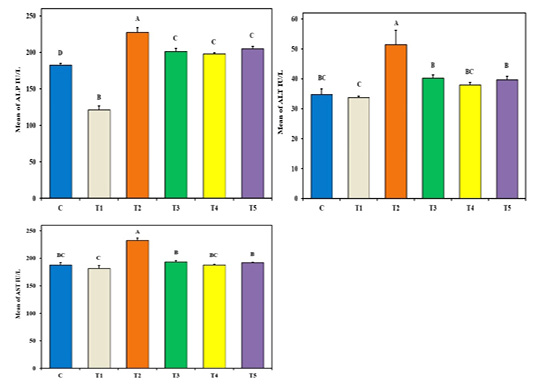
According to the statistical analysis of the current results (Figure 1), the concentration of liver enzymes (AST, ALT, and ALP) increased significantly (P<0.05) in the second treatment T2, which involved administering 14 mg/kg body weight of the antibiotic ciprofloxacin for 14 days, in comparison to the control and other treatments. The liver enzyme concentrations in treatment groups T3, T4, and T5 were likewise significantly lower than those in treatment group T2, which did not exhibit any discernible changes.
However, the results indicated that the concentrations of AST and ALT in the treatment groups T3, T4, and T5 did not change significantly from those in the control group. Additionally, we found no discernible difference between the therapy.
Histological study
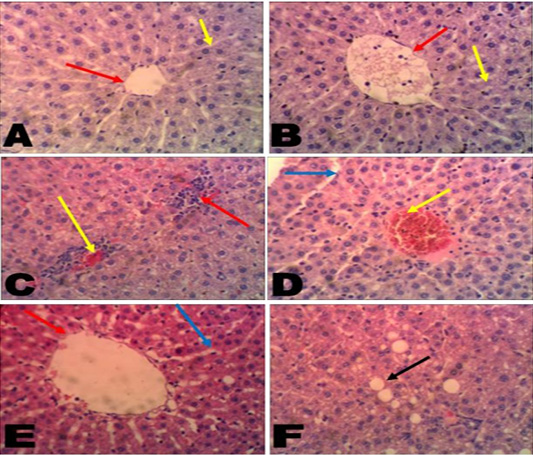
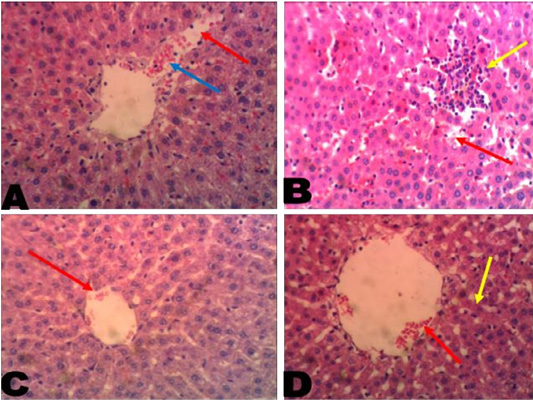
The results were compared with those of the control group and the other groups. However, histological examination also revealed slight histopathological changes in the liver tissues, with some development in the liver tissue when Rutin was used for 14 days followed by ciprofloxacin for another 14 days (T3) (Figure 2). These changes included hemorrhage and constriction of blood vessels in the central vein, as well as the loss of the hepatocytes’ normal pattern and the development of sebaceous cysts, necrosis, and the accumulation of inflammatory cells ,The histological analysis in Figure 2 revealed that the liver tissue in the T4 group (dosage of ciprofloxacin 14 days and subsequent Rutin combination 14 days) and T5 group (dosage of ciprofloxacin 14 days/Rutin combination) had been repaired to a level that was nearly identical to normal liver tissue. The T5 group also had minor blood congestion and dilatation in the blood capillaries.
For 14 days, the second group (T2) of five animals in the current investigation received a dosage of the antibiotic ciprofloxacin at a rate of 14 mg/kg body weight. In addition to the development of sebaceous cysts, necrosis and the buildup of inflammatory cells, hepatocyte dissociation, and hemorrhage and constriction of blood vessels in the central vein, the liver tissues also showed histopathological changes. Furthermore, the average AST ± SD in this group was 232.50±4.40, and the average ALT ± SD in this group was 51.50±4.73 IU/L. These two transaminases were elevated, and the histology result showed that ciprofloxacin caused hepatocyte fractionation, which indicates hepatocellular injury (Figures 2, 3), ; . Validated the findings of the current investigation in animals, stating that higher liver function tests can indicate the sort of damage caused by ciprofloxacin and other medications in people. Cholestatic hepatitis is indicated if ALP is higher than ALT/ALP. When elevated blood transaminase levels are combined with bilirubin levels that grow more than twice their normal level, the prognosis deteriorates. The current study’s findings support the notion that fluorinated quinolones, such as ciprofloxacin, are metabolized by the liver and excreted by the kidneys. It has been established that ciprofloxacin temporarily raises liver enzyme levels by 1% to 3%. The symptoms of acute liver damage brought on by ciprofloxacin are identical to those of acute liver damage brought on by other drugs. These include stomach discomfort in the upper right quadrant, exhaustion, appetite loss, low-grade fever, nausea, vomiting, and concentrated urine. In many cases, thrombosis and/or hepatic coma may also be present. A physical examination may reveal jaundice and an enlarged liver, we retained our animals in the current investigation and administered ciprofloxacin to them for a period of 14 days. According to research from the National Institutes of Health and Schmid et al. ciprofloxacin can occasionally result in acute liver damage two days to two weeks after beginning antibiotic medication. This should be enough time for liver damage to develop or occur. Although the precise mechanism by which ciprofloxacin causes liver damage is yet understood, hepatocellular necrosis resulting in elevated hepatic enzymes has been seen. The damage may be mixed, cholestasis, or hepatocellular. Hepatocyte disintegration is the most prevalent form in the acute state, and it is correlated with markedly elevated alanine transferase levels, much like in our research rats. Long-term antibiotic treatment is typically the cause of biliary liver damage. Thus, either a particular interaction or a direct toxic impact is the origin of the hepatic damage pathway brought on by medications and toxins. While the particular responses, whether metabolic or immunological, can occur at any pharmacological dosage, the direct harmful impact is dose dependant. Most of the time, the short latency period, recurring immune-susceptibility traits, and severe sickness upon re-exposure make the hypersensitive response particularly likely. Researchers have discovered that fluoroquinolone-induced hepatitis is typically non-fatal and resolves on its own after the medication is stopped and symptoms are managed in humans. There have only been four prior reports of liver injury caused by ciprofloxacin in the literature . A 74-years old lady receiving treatment for a urinary tract infection has been reported to have died from ciprofloxacin-induced hepatitis at least once. In her case, taking ciprofloxacin caused symptoms to appear. However, because of an unresolved urinary tract infection, she was prescribed a second round of the medicine .
Hepatic enzymes should be continuously monitored until they stabilize. Including corticosteroids can have varying degrees of effectiveness. In humans, instances where hypersensitivity is a significant feature may reveal that corticosteroids are more effective in easing complaints. Since ciprofloxacin-induced acute hepatitis is a common side effect, patients who have liver damage from ciprofloxacin-induced hepatitis should be counseled to refrain from using both ciprofloxacin and fluoroquinolones in the future. Five rats made up the treatment group (T4), which received oral rutin at a dosage of 50 mg/kg b/w for 14 days after receiving ciprofloxacin at a concentration of 14 mg/kg b/w for 14 days. Significant reductions in AST and ALT were seen, and histological analysis revealed minor histological alterations in liver tissue, suggesting that rutin had a therapeutic impact by halting the antibiotic’s ability to break down hepatocytes. Rutin’s hepatoprotective and renal protective properties, antioxidant, vascular prophylactic, antiproliferative, and anticoagulant, cell protector, anti-inflammatory, antibacterial, antiviral, and antiulcerogenic, properties were all confirmed by researchers in a recent study. Cardioprotective, and neuroprotective, According to the researchers, rutin possesses a broad range of biological and pharmacological properties and might be a crucial molecule for future practical applications, Rutin’s protective and neutralizing action in mitigating the toxicity of ciprofloxacin on the liver was demonstrated in this study by the treatment groups (T4) and (T5) (Figure 1 and 2). These findings are comparable to those that Rakshit et al. reported. Rutin (5, 10, 20 mg/kg) was administered continuously to test animals for six days before a single dose of D-galactosamine (300 mg/kg) was administered to assess the preventative effectiveness of rutin on compromised hepatic, renal, and mental function. kg i.p.) and, on day 6, lipopolysaccharide (50 μg/kg i.p., Because of its potent antioxidant qualities, it may be administered as a preventative measure to shield important organs from ciprofloxacin-induced damage and to raise the level of diagnostic variables toward control .
CONCLUSIONS
Ciprofloxacin-induced hepatitis frequently results in a unique response that necrotizes hepatocytes. By maintaining the integrity of the liver histomorphology structure, rutin pretreatment at different dosages had protective benefits on the liver. However, our investigation indicated that the most appropriate amount of rutin for preventing heaptic damages and dysfunctions caused by drug-induced harm was 50 mg/kg,Note that (short duration, small sample size).
Acknowledgment
No entity or institution provided support for the manuscript. All support came from the authors.
Novelty Statement
The study examined how well Ciprofloxacin, at a dosage of 14 mg/kg body weight, protected liver rats from rutin-induced damage.
Author’s Contribution
Azhar Azher Alankooshi and ZainabFalah Alesawi: completed the statistical analysis and wrote the manuscript’s initial draft. Each author oversaw the study’s analysis, conducted the literature search, and reviewed and approved the finished product.
Sameer Abed Mohammed and Tameem Riyadh WaheedAlesawi:Each author oversaw the study’s analysis, conducted the literature search, and reviewed and approved the finished product.
Ahmed Flayyih Hasan: created the protocol and planned the study. Each author oversaw the study’s analysis, conducted the literature search, and reviewed and approved the finished product.
Ethical approval
This study was conducted under the ethical approval obtained from (Faculty of Medicine/Deparment of physiology and medical physics Jaber bin Hayyan University of Medical and Pharmaceutical Sciences, Iraq).
Funding
No funding.
Generative AI or AI-assisted Technology Statement
The authors declare that no Genrative AI was used in the creation of this manuscript.
Declaration of conflicting interests
The authors have declared no conflict of interest.
Figures
Figure 1:.
The effect of ciprofloxacin and rutin on ALP, ALT, AST.
Figure 2:.
Liver tissue in rats: picture (A) is the control group demonstrate normal arrangement of the hepatic cells (Yellow arrow) around the central vein (red arrow). picture (B) T1 group shows Normal cellular arrangement pattern, (Yellow arrow) regularly arranged around the central vein and the blood capillaries seen clearly (red arrow). picture (C,D and F) T2 group shows Loss of the normal hexagonal arrangement of hepatocytes, cellular dissociation (blue arrow) , congestion in central vein (Yellow arrow) , fatty necrosis (black arrow) and lymphoid infiltration (red arrow). Picture E T3 group shows A minor dilation in the blood capillaries (blue arrow) and in the central vein (red arrow).
Figure 3:.
(A and B) is the T2 group shows lymphoid infiltration (yellow arrow), necrosis (red arrow) and bleeding (blue arrow); C, T4 group shows Nearly normal cellular arrangement and normal distribution around the central vein; D, T5 group shows Minor blood congestion (red arrow) and minor dilation in the blood capillaries (yellow arrow).
References
Al-Hamadawi HA, Al-Ankoshy AAM, Alqershi KA (2022). Studying the protective and therapeutic role of Rutin on the histological structure of the liver and some physiological parameters in Rats treated with ciprofloxacin. BNIHS, 140: 1113-1122.
Al-Rawi, K. M., and Khalaf Allah, A. M. (2000). Design and Analysis of Agricultural Experiments. University of Mosul. Ministry of Higher Education and Scientific Research. Dar Al Kuttab for printing and publishing. Mosul. Iraq.
Al-Rejaie SS, Aleisa AM, Sayed-Ahmed MM, Al-Shabanah OA, Abuohashish HM, Ahmed MM, Hafez MM (2013). Protective effect of rutin on the antioxidant genes expression in hypercholestrolemic male Westar rat. BMC Complement. Altern. Med., 13: 1-9. https://doi.org/10.1186/1472-6882-13-136[CrossRef]
Andrade RJ, Lucena MI, Fernández MC, Pelaez G, Pachkoria K, García-Ruiz E, Martin-Vivaldi R (2005). Drug-induced liver injury: An analysis of 461 incidences submitted to the Spanish registry over a 10-year period. Gastroenterology, 129(2): 512-521. https://doi.org/10.1016/j.gastro.2005.05.006[CrossRef]
Baloch ZQ, Raza MA, Abbas SA, Bukhari S, Abbas SA (2017). Ciprofloxacin-induced hepatotoxicity in a healthy young adult. Cureus, 9(2).
Bertino Jr, J, Fish D (2000). The safety profile of the fluoroquinolones. Clin. Therapeut., 22(7): 798-817. https://doi.org/10.1016/S0149-2918(00)80053-3[CrossRef]
Björnsson E, Olsson R (2005). Outcome and prognostic markers in severe drug‐induced liver disease. Hepatology, 42(2): 481-489. https://doi.org/10.1002/hep.20800[CrossRef]
Çelik H, Kandemir FM, Caglayan C, Özdemir S, Çomaklı S, Kucukler S, Yardım A (2020). Neuroprotective effect of rutin against colistin-induced oxidative stress, inflammation and apoptosis in rat brain associated with the CREB/BDNF expressions. Mol. Biol. Rep., 47: 2023-2034. https://doi.org/10.1007/s11033-020-05302-z[CrossRef]
Chalasani N, Fontana RJ, Bonkovsky HL, Watkins PB, Davern T, Serrano J, Drug Induced Liver Injury Network (DILIN) (2008). Causes, clinical features, and outcomes from a prospective study of drug-induced liver injury in the United States. Gastroenterology, 135(6): 1924-1934. https://doi.org/10.1053/j.gastro.2008.09.011[CrossRef]
Działo M, Mierziak J, Korzun U, Preisner M, Szopa J, Kulma A (2016). The potential of plant phenolics in prevention and therapy of skin disorders. Int. J. Mol. Sci., 17(2): 160. https://doi.org/10.3390/ijms17020160[CrossRef]
El-Ghonemy MM, El-Kashak WA, Mohamed TK, Omara EA, Hussein J, Farrag ARH, El-Kady MY (2019). Hepatoprotective activity of Dypsis lutescens against D-galactosamine-induced hepatotoxicity in rats and its phytoconstituents. Asian Pac. J. Trop. Biomed., 9(11): 467-473. https://doi.org/10.4103/2221-1691.270979[CrossRef]
Ganeshpurkar A, Saluja AK (2017). The pharmacological potential of rutin. Saudi Pharma. J., 25(2): 149-164. https://doi.org/10.1016/j.jsps.2016.04.025[CrossRef]
Guardia T, Rotelli AE, Juarez AO, Pelzer LE (2001). Anti-inflammatory properties of plant flavonoids. Effects of rutin, quercetin and hesperidin on adjuvant arthritis in rat. Il Farmaco, 56(9): 683-687. https://doi.org/10.1016/S0014-827X(01)01111-9[CrossRef]
Hausmann O, Schnyder B, Pichler WJ (2010). Drug hypersensitivity reactions involving skin. Adverse Drug React., pp. 29-55. https://doi.org/10.1007/978-3-642-00663-0_2[CrossRef]
Heim KE, Tagliaferro AR, Bobilya DJ (2002). Flavonoid antioxidants: chemistry, metabolism and structure-activity relationships. J. Nutr. Biochem., 13(10): 572-584. https://doi.org/10.1016/S0955-2863(02)00208-5[CrossRef]
Khaki A, Heidari M, Novin MG, Khaki AA (2009). Adverse effects of ciprofloxacin on testis apoptosis and sperm parameters in rats.
Rakshit S, Shukla P, Verma A, Kumar NS, Bhadauria M (2021). Protective role of rutin against combined exposure to lipopolysaccharide and D‐galactosamine induced dysfunctions in liver, kidney, and brain: Hematological, biochemical, and histological evidences. J. Food Biochem., 45(2): e13605. https://doi.org/10.1111/jfbc.13605[CrossRef]
Savic S, Vojinovic K, Milenkovic S, Smelcerovic A, Lamshoeft M, Petronijevic Z (2013). Enzymatic oxidation of rutin by horseradish peroxidase: Kinetic mechanism and identification of a dimeric product by LC–Orbitrap mass spectrometry. Food Chem., 141(4): 4194-4199. https://doi.org/10.1016/j.foodchem.2013.07.010[CrossRef]
Suvarna KS, Layton C, Bancroft JD (2018). Bancroft’s theory and practice of histological techniques E-Book. Elsevier health sciences.
Terp DK, Rybak MJ (1987). Ciprofloxacin. Drug Intell. Clin. Pharma., 21(7-8): 568-574. https://doi.org/10.1177/1060028087021007-801[CrossRef]
Unger C, Al-Jashaami LS (2016). Ciprofloxacin exposure leading to fatal hepatotoxicity: An unusual correlation. Am. J. Case Rep., 17: 676. https://doi.org/10.12659/AJCR.899080[CrossRef]
Volunteers, A. H. (2002). Guidance for industry and reviewers. Center for Biologics Evaluation and Research (CBER).
Ziaee A, Zamansoltani F, Nassiri‐Asl M, Abbasi E (2009). Effects of rutin on lipid profile in hypercholesterolaemic rats. Basic Clin. Pharmacol. Toxicol., 104(3): 253-258. https://doi.org/10.1111/j.1742-7843.2008.00368.x[CrossRef]