
The eri silkworm (Samia ricini) is a major non-mulberry species whose pupae remain an underused byproduct despite their rich nutritional and bioactive profile. Recent studies show they contain high-quality proteins, essential amino acids, polyunsaturated fatty acids, vitamins, and minerals, along with functional compounds such as peptides, sterols, tocopherols, and chitosan. These compounds exhibit diverse biological activities, including antioxidant, anti-inflammatory, antimicrobial, and hypolipidemic effects, supported by both in vitro and in vivo studies. The nutritional versatility of eri pupae supports their incorporation into functional foods, nutraceuticals, and animal feed formulations, while emerging evidence points to pharmaceutical applications in wound healing, metabolic regulation, and biomaterial development. However, their large-scale utilization is constrained by variability in composition, lack of standardized processing, and limited toxicological or clinical validation. This review synthesizes current knowledge on the nutritional and pharmacological potentials of Samia ricini pupae, emphasizing their role as a sustainable bioresource that bridges food and pharmaceutical domains. The strategic integration of advanced bio-processing approaches with cutting-edge bioengineering platforms is poised to substantially augment the functional potential of these biological systems, thereby catalyzing transformative advancements in functional food technology and biomedical innovation.
Review · Volume 58, Issue 6, 12 October 2026 · Open Access
Bio-Nutritional and Pharmacological Applications of Eri Silkworm Pupae (Samia ricini)
· · · · · ·
Affiliations & Notes ⌄
- 1Department of Sericulture, Forest College and Research Institute, Tamil Nadu Agricultural University, Mettupalayam, Coimbatore, Tamil Nadu, India * Corresponding author: priyadharshini.p@tnau.ac.in
Article Info ⌄
- Journal:
- Pakistan Journal of Zoology
- Published:
- 12 October 2026

From the article
- Eri silkworm (Samia ricini) pupae are a nutrient- and bioactive-rich, underutilized resource with significant pharmacological potential.
- They offer high-quality proteins, essential fatty acids, and compounds supporting antioxidant, hypolipidemic, anti-inflammatory, and wound-healing activities, making them promising candidates for functional foods, nutraceuticals, and biomedical applications.
- Industrial and clinical translation is constrained by inconsistent composition, lack of standardized extraction, and limited toxicological data.
Selected from the article's own text.
Abstract
INTRODUCTION
The eri silkworm, Samia ricini (Boisd.), represents a key non-mulberry sericulture species, particularly in the northeastern regions of India, where it has long been reared for its production of Eri silk and, in many cases, the pupae are also used as a food source ; . The life-cycle, host-plant flexibility and favourable rearing traits of S. ricini contribute to its sericultural significance. Eco-race evaluations revealed that certain strains achieved superior larval and pupal weights and shell-ratios under local castor-leaf feeding regimes, underscoring the viability of S. ricini in integrated sericulture systems ; .
In addition to their conventional utilization in sericulture, Samia ricini pupae remain an underexploited biomaterial endowed with high nutritional quality and a broad spectrum of bioactive compounds with potential value for health-promoting applications. Analyses have shown that eri pupae contain high levels of protein, essential amino acids, lipids, vitamins and minerals when compared to conventional protein sources ; . Quantitative compositional analyses indicate that eri pupae contain approximately 40–55% crude protein (dry-matter basis), 25–33% total lipids and all essential amino acids including lysine, threonine, valine and leucine in nutritionally relevant proportions ; . Mineral profiling further shows appreciable levels of iron (4.8–6.1 mg/100 g), zinc (5–7 mg/100 g), phosphorus (~280–320 mg/100 g) and B-group vitamins, confirming their value as a micronutrient-dense food ingredient ; .
Recent investigations have further demonstrated that the biochemical richness of S. ricini pupae aligns with current interests in sustainable bioproduct development, positioning them as promising candidates for food, feed, nutraceutical, and biomaterial applications ; . In fact, in one nutrient-composition study, eri pupae displayed a protein content of ~49 % (dry matter basis) and a broad aminoacid profile, thereby lending support to their valorisation in food and feed sectors ; . Lipid analyses show that the pupal oil fraction is enriched in polyunsaturated fatty acids (PUFAs), particularly linoleic (C18:2) and α-linolenic acid (C18:3), yielding PUFA:SFA ratios favourable for cardiometabolic health applications .
Interest in insect-derived ingredients for food, feed and pharmaceutical applications has grown rapidly in recent years, driven by global challenges of sustainability, food security and the need for novel bioactive compounds ; . Insects such as S. ricini offer advantages of efficient feed-conversion, lower land and water use, and high-quality nutrients, while also presenting unique bioactive constituents such as antioxidant peptides and hypolipidaemic lipids . Sericulture insect pupae therefore represent a valuable avenue for nutritional and pharmaceutical valorization, transforming a low-value waste stream into a high-value bioresource ; .
S. ricini pupae contain antioxidant peptide fractions, PUFA-rich oils with measurable hypolipidaemic effects, and chitin/chitosan suitable for developing antimicrobial and wound-healing biomaterials, confirming their functional and biotechnological value ; ; . Accordingly, this review consolidates experimentally validated evidence on the nutritional composition and pharmacological attributes of S. ricini pupae, highlighting their potential as a sustainable and multifunctional bioresource for food, feed, nutraceutical and biomedical applications.
NUTRITIONAL COMPOSITION AND FUNCTIONAL PROPERTIES
Proximate composition
Eri silkworm (Samia ricini) pupae are a nutrient-dense biological material with high crude protein and lipid contents, making them attractive for both food and feed uses. Quantitative analyses report pupal protein ranging from 40–55% of dry weight, with defatted pupal meals consistently exceeding 60% protein, reflecting concentration effects during processing. The amino acid profile that contains all indispensable amino acids and a favourable essential to non-essential ratio comparable to conventional animal proteins ; . Lipid fractions of eri pupae are rich in unsaturated fatty acids, especially linoleic (C18:2, omega-6) and α-linolenic (C18:3, omega-3) acids. Reports indicate PUFA:SFA ratios above 2.0, which is favourable for cardiometabolic health ; . In one compositional analysis, linoleic acid contributed ~23.4% of total fatty acids and oleic acid ~36.5%, resulting in an overall unsaturated fatty acid fraction exceeding 65%, as summarised in Table I.
Table I. Fatty acid composition of eri silkworm pupal oil.
|
Fatty acid |
Content (% of total lipid) |
Classification |
Physiological role |
Reference |
|
Palmitic acid |
24.3 |
Saturated fatty acid (SFA) |
Energy storage; structural lipid component |
Das et al. (2024) |
|
Stearic acid |
5.6 |
Saturated fatty acid (SFA) |
Neutral effect on plasma cholesterol |
Longvah et al. (2011) |
|
Oleic acid |
36.5 |
Monounsaturated fatty acid (MUFA) |
Supports cardiovascular health |
Das et al. (2024) |
|
Linoleic acid |
23.4 |
Polyunsaturated fatty acid (PUFA) |
Essential fatty acid; regulates inflammation |
Longvah et al. (2011) |
|
α-Linolenic acid |
5.8 |
Polyunsaturated fatty acid (PUFA) |
Anti-inflammatory; improves lipid metabolism |
Das et al. (2024) |
|
Total unsaturated fatty acids |
65.7 |
MUFA + PUFA |
Favorable for human nutrition |
Das et al. (2024) |
Table II. Proximate and micronutrient composition of eri silkworm (Samia ricini) pupae and their contribution to adult nutrient requirements.
|
Component |
Content (per 100 g dry weight) |
Major function |
% Recommended dietary allowance (RDA) contribution (adult) |
Reference |
|
Protein |
49.2 g |
Tissue building; enzyme and hormone synthesis |
82 % |
Kongsup et al. (2022); Longvah et al. (2011) |
|
Lipid (total fat) |
26.4 g |
Energy source; carrier of fat-soluble vitamins |
53 % |
Hăbeanu et al. (2023); Zhou et al. (2022) |
|
Carbohydrate |
8.7 g |
Energy metabolism |
- |
Longvah et al. (2011) |
|
Ash (total minerals) |
5.3 g |
Mineral reserve |
- |
Longvah et al. (2011) |
|
Iron (Fe) |
5.0 mg |
Oxygen transport; haemoglobin synthesis |
29 % |
Hăbeanu et al. (2023); Ray and Gangopadhyay (2021) |
|
Zinc (Zn) |
6.2 mg |
Enzyme activation; immune function |
52 % |
Ray and Gangopadhyay (2021) |
|
Calcium (Ca) |
128 mg |
Bone and teeth formation; muscle function |
13 % |
Zhou et al. (2022) |
|
Phosphorus (P) |
290 mg |
Bone mineralisation; energy transfer (ATP) |
41 % |
Ray and Gangopadhyay (2021); Longvah et al. (2011) |
|
Vitamin B₂ (Riboflavin) |
1.1 mg |
Energy metabolism; redox coenzyme |
85 % |
Zhou et al. (2022); Hăbeanu et al. (2023) |
|
Niacin (Vitamin B₃) |
11.8 mg |
Coenzyme in metabolic reactions |
74 % |
Hăbeanu et al. (2023); Zhou et al. (2022) |
Micronutrient surveys indicate appreciable levels of B-group vitamins (notably riboflavin and niacin), fat-soluble vitamins in oil fractions, and essential minerals such as iron (~5 mg/100 g dw), zinc (~6.2 mg/100 g dw), calcium (~128 mg/100 g dw), and phosphorus (~290 mg/100 g dw), although values differ according to strain, host plant, and processing variables ; . These nutrient densities position S. ricini pupae as a credible alternative to conventional protein sources in regions facing micronutrient deficiencies. The overall proximate and micronutrient composition of Samia ricini pupae and their approximate contribution to adult nutrient requirements are presented in Table II.
Functional components
Beyond macronutrients, eri pupae contain several functional constituents with documented bioactivities. Proteolytic hydrolysates yield antioxidant and angiotensin-converting enzyme (ACE)-inhibitory peptides that show in vitro radical-scavenging and enzyme-modulating activities, suggesting nutraceutical potential ; . The lipid fraction is a source of tocopherols and phytosterols, compounds associated with antioxidant protection and cholesterol-modulating effects when included in foods or extracts ; . The exoskeletal chitin and its deacetylated derivative chitosan, present in pupal cuticle, offer functional properties for food structuring and biomedical applications (wound dressings, delivery matrices) and can be retrived as a value-added co-product ; .
Determinants of compositional variability: Roles of sex, diet, rearing conditions, and processing
The compositional attributes of eri pupae exhibit intrinsic variability rather than a fixed profile. Biological factors such as sex and developmental stage alter proximate and micronutrient profiles. Males and females may differ in lipid and vitamin content at pupation, and maturation stage affects amino acid concentrations ; . The biochemical composition of eri pupae is strongly modulated by environmental and husbandry factors including host plant species, seasonal forage quality, rearing density, and temperature, reflecting the pivotal role of larval diet in determining stored lipids and key micronutrients. . Post-harvest processing (drying, blanching, defatting, extraction) profoundly modifies both nutrient retention and functional-compound yield. Defatting consistently increases protein content (on a dry-weight basis), whereas heat treatments may reduce heat-labile vitamins yet enhance microbiological safety ; . These sources of variability mandate standardised rearing and processing protocols when pupal material is proposed for food or pharmaceutical use.
Assessment of digestibility and nutritional equivalence to conventional animal proteins
Digestibility studies and protein-quality assessments indicate that eri pupal protein is highly bioavailable and often compares favourably with traditional animal proteins. In vitro and in vivo measures (protein digestibility, PDCAAS/NPU proxies) show good digestibility and an essential amino-acid balance that supports nutritional claims for complementary feeding and feed replacement, although values vary with processing and defatting ; . Feeding trials in poultry and aquaculture demonstrate that 5–15% inclusion of pupal meal can safely substitute a portion of conventional protein feeds (soybean meal or fishmeal) without compromising growth performance, and sometimes with improved carcass or product quality . Nonetheless, controlled human clinical data are limited; therefore, translating in vitro and animal-model findings into validated dietary recommendations for humans will require targeted clinical and safety studies.
Bioactive compounds and its mechanisms
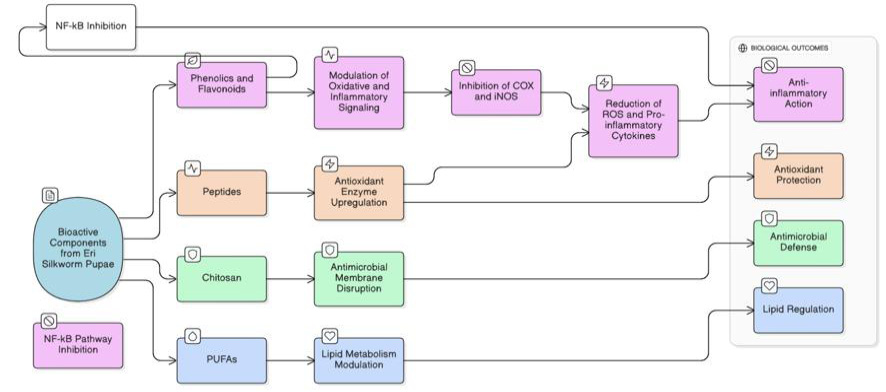
Eri silkworm (Samia ricini) pupae harbour a concentrated set of bioactive constituents that span peptide fractions, polyunsaturated fatty acids (PUFAs), low-molecular phenolics/flavonoids and chitin-derived polymers (chitosan). Hydrolysates and peptide fractions from pupal proteins contain antioxidant and ACE-inhibitory peptides that scavenge free radicals and modulate key enzymes. Lipid fractions are rich in PUFAs (notably linoleic and α-linolenic acids) and contain tocopherols and sterols that contribute antioxidant and cholesterol-modulating potential. The pupal cuticle and shell are a practical source of chitin and chitosan, which combine structural, antimicrobial and biofunctional properties useful in food and biomedical formulations ; ; .
Biochemically mechanistic insights, suggest that these compounds act through a small set of well-characterised pathways. Antioxidant peptides neutralise free radicals directly and upregulate cellular antioxidant systems (e.g., increased activities of superoxide dismutase (SOD), catalase (CAT), and glutathione peroxidase (GPx)) while lowering lipid peroxidation markers. PUFAs and phytosterols modulate lipid metabolism via effects on hepatic lipid handling and regulatory transcription factors, producing hypolipidaemic outcomes in animal models. Chitosan exerts antimicrobial action through electrostatic interactions with microbial cell envelopes and can enhance wound healing and barrier functions when formulated as films or hydrogels. Phenolic constituents contribute further antioxidant and anti-inflammatory effects through inhibition of pro-inflammatory mediators (e.g., cyclooxygenase [COX], inducible nitric oxide synthase [iNOS]) and suppression of nuclear factor kappa-light-chain-enhancer of activated B cells (NF-κB) signalling in cell models ; ; .
Evidence supporting this has been demonstrated through both in vitro and in vivo models. In vitro work has isolated and characterised antioxidant peptides from silkworm pupae hydrolysates showing DPPH/ABTS scavenging, FRAP activity and cellular ROS attenuation ; . In vivo studies demonstrate that pupal protein fractions or peptide preparations reduce oxidative stress and inflammatory responses in rodent models (improved enzyme markers, reduced edema and lowered MDA), and topical/supplement formulations have shown protective effects against skin photo-aging and hepatic oxidative injury ; ; . Antimicrobial and antipathogen activity are supported by studies of plasma and chitosan extracts that inhibit bacterial growth in vitro and improve infection outcomes in insect infection models; chitosan derived from pupae shows promising activity as an antimicrobial coating in food-preservation assays ; ; . Collectively, these data indicate multi-modal bioactivity but also highlight variable potency depending on extraction, fractionation and processing conditions.
Eri pupae provide a rich mix of bioactives such as peptides, polyunsaturated fatty acids, phenolics, and chitosan that act through antioxidant, anti-inflammatory, antimicrobial, and hypolipidemic pathways. While preclinical studies demonstrate strong biological activity, the evidence remains inconsistent. Advancing their use in nutraceuticals and pharmaceuticals will require standardised extraction methods, dose–response evaluations, safety assessments, and clinical validation ; . The interrelated mechanisms through which peptides, polyunsaturated fatty acids (PUFAs), chitosan, and phenolic compounds from Samia ricini pupae exert antioxidant, antimicrobial, lipid-regulatory, and anti-inflammatory effects Figure 1.
NUTRITIONAL AND FUNCTIONAL FOOD APPLICATIONS
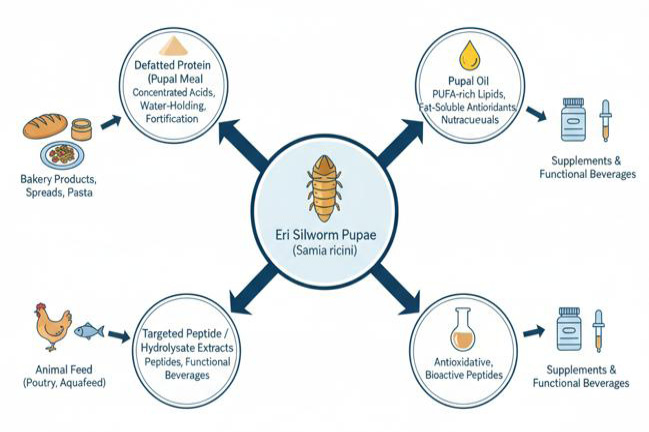
Eri silkworm (Samia ricini) pupae can be processed into several value-added ingredients such as defatted protein powder (pupal meal), pupal oil, and targeted peptide or hydrolysate extracts. These formats are optimized to meet distinct formulation objectives. Protein powders provide concentrated amino acids and functional technofunctional properties (water-holding, emulsification) useful for fortification; oils supply PUFA-rich lipids and fat-soluble antioxidants for nutraceutical use; enzymatic hydrolysates yield antioxidative and bioactive peptides that can be incorporated into supplements or functional beverages ; . Recent compositional studies report that defatted S. ricini pupae contain ~72–78% crude protein, while whole pupae typically contain 40–55% protein and 25–32% lipids, enabling their use as a concentrated nutrient source in food and feed matrices ; . The main processing routes and practical food and feed applications of eri silkworm pupae are illustrated in Figure 2.
Practical applications demonstrated fortification of bakery products, spreads and pasta, and partial replacement of conventional proteins in feed formulations. Fortified bakery goods and ready-to-eat pastas with silkworm pupae show higher protein content and acceptable taste at 15–20% inclusion levels. Quantitative sensory trials show that incorporating 10–15% pupae powder increases protein content by 18–30% in bread and spreads, while maintaining hedonic scores above 6.5/9 on consumer panels ; ; .
For animal feed, studies on eri pupal meal show promising performance as a partial substitute for fishmeal or soybean meal. Inclusion of 4–8% S. ricini pupae in broiler diets supported growth rates comparable to conventional diets, with feed-conversion ratios (FCR) remaining within optimal ranges (1.7–1.9) and no adverse physiological effects. Aquaculture trials have similarly shown that replacing up to 25% fishmeal with fermented pupal meal maintains growth performance and protein efficiency ratio (PER) in carp and tilapia species ; .
Safety, processing and regulatory challenges must be addressed before broad food use. Key issues include allergenicity (cross-reactivity with crustacean/house-dust-mite allergens), microbial safety, heavy-metal monitoring, and standardisation of processing (defatting, heat-treatment, drying) to control lipid oxidation and off-flavours ; . Techniques like defatting, enzymatic hydrolysis, and microencapsulation help improve taste and stability, though they raise production costs ; . Regulatory status also varies regionally, and consumer acceptance remains a major barrier that is eased when insect ingredients are presented as powders or incorporated into familiar products ; . Controlled sensory studies confirm that pupae-fortified cookies retain acceptability at ≤10% inclusion, while pasta fortified at 15% achieves a 25–28% rise in protein content and maintains favourable texture scores when drying and extrusion parameters are optimized ; .
Sensory and nutritional studies demonstrates that low-level fortification with pupae powder significantly increases protein, lipid, and micronutrient content, while retaining acceptable sensory quality when flavour and textural parameters are properly optimised. Silkworm-fortified spreads and cookies retained consumer acceptability at low–moderate inclusion levels and improved protein density; similar findings appear for pasta and other staple matrices, where nutritional gains are clear but product optimisation is essential to avoid bitterness or oiliness ; ; . These studies show the technical feasibility of using pupal ingredients in human foods, and they support stepped approaches to product development such as starting with low inclusion levels, masking off-notes, and ensuring proper labelling and safety testing ; ; .
PHARMACEUTICAL AND BIOMEDICAL PROSPECTS
Eri silkworm (Samia ricini) pupae and their derivatives (oil, protein fractions, sericin and chitin/chitosan) have attracted growing attention as sources of pharmacologically active materials with applications that span antioxidant therapy, lipid-modulating nutraceuticals, wound care, immune modulation and metabolic health. Recent studies collectively portray pupal biomass as a multifunctional, low-cost feedstock for developing bioactive extracts and biomaterials for both topical and systemic uses ; ; . Recent research provides quantitative evidence that these bioactive fractions can modulate oxidative stress, inflammatory pathways, tissue regeneration, and metabolic biomarkers.
Antioxidant and hypolipidemic activities
Pupal oil and protein extracts reduce oxidative stress markers and improve lipid profiles in preclinical models. Supplementation with silkworm pupal oil improved serum lipid parameters and lowered markers of oxidative damage in hypercholesterolaemic rats . Oil extraction studies report high contents of α-linolenic and other PUFAs plus tocopherols, which plausibly underlie these effects . Proteolytic hydrolysates or peptide fractions from pupal proteins also demonstrate in vitro antioxidant activity and, in some in vivo rodent models, reduce lipid peroxidation and improve hepatic oxidative markers ; .
Wound healing, sericin and biomaterials
Chitosan derived from pupal cuticle are actively explored for wound dressings, barrier films and tissue engineering scaffolds ; . Chitosan isolated from silkworm pupae shows antimicrobial action and can be formulated into films or coatings suitable for wound care and controlled-release matrices; recent reviews on chitosan biomaterials summarise its value as a drug-carrier and tissue-engineering polymer ; .
Immune modulation and metabolic effects (including anti-diabetic signals)
Preclinical data indicate immunomodulatory and anti-inflammatory actions from pupal protein preparations and modified derivatives. Arginine-modified silkworm-derived formulations demonstrated protective effects on intestinal inflammation in vivo, suggesting modulatory effects on mucosal immunity . Protein hydrolysates/peptides have shown inhibition of carbohydrate-digesting enzymes (α-amylase), antioxidant-driven reductions in inflammatory markers and improvements in experimental models of inflammation and metabolic stress, supporting exploration of pupal extracts as adjuncts for metabolic health ; . Quantitative assays show that pupal peptide extracts inhibit α-amylase activity by 41–55%, while reducing TNF-α and IL-6 levels by up to 30% in inflammation-induced rodents .
Table III. Industrial and pharmaceutical applications of eri silkworm (Samia ricini) pupae and their derivatives.
|
Derivative/ Component |
Application area |
Key function |
Representative evidence |
References |
|
Pupal oil |
Nutraceuticals, functional foods |
Antioxidant and lipid-lowering effects |
Improved lipid profile and reduced oxidative stress |
Zou et al. (2017); Tangsanthatkun et al. (2022) |
|
Protein hydrolysates/ peptides |
Functional foods, nutraceuticals |
Antioxidant and ACE-inhibitory activity |
Enhanced antioxidant status and enzyme inhibition |
Zhou et al. (2022); Sinha and Choudhury (2025); Sadat et al. (2022) |
|
Defatted pupal meal |
Animal feed |
Sustainable protein source |
Maintained growth and feed efficiency |
Kongsup et al. (2022); Bora et al. (2025) |
|
Sericin |
Wound healing, cosmetics |
Moisturising and healing properties |
Promoted fibroblast growth and wound closure |
Li et al. (2023); Endrawati et al. (2023) |
|
Chitin / Chitosan |
Biomedical and packaging uses |
Antimicrobial and biocompatible |
Inhibited bacterial growth and supported tissue repair |
Wang et al. (2023); Sagala et al. (2024); Beniwal et al. (2024) |
|
Pupal oil or peptide encapsulates |
Delivery systems |
Improved stability and bioavailability |
Enhanced oxidative stability and sensory quality |
Rodríguez-Ortiz et al. (2024); Hăbeanu et al. (2023) |
|
Protein hydrolysates (modified) |
Metabolic and immune health |
Anti-diabetic and anti-inflammatory |
Inhibited α-amylase and reduced gut inflammation |
Yuan et al. (2025); Sinha and Choudhury (2025) |
|
Sericin–chitosan composites |
Biomaterials |
Drug delivery and scaffold formation |
Supported controlled release and cell growth |
Wang et al. (2023); Beniwal et al. (2024) |
Applications in drug delivery and nutraceutical formulations
The combined presence of functional proteins, lipids and polysaccharides makes pupal biomass a flexible feedstock for nutraceuticals and delivery systems. Encapsulation of pupal oil or peptides to stabilise PUFAs and mask flavour, and development of chitosan-based nanoparticles or films for controlled release of antimicrobials or growth factors ; . These emerging platforms demonstrate that pupal oil microcapsules enhanced oxidative stability, while chitosan nanoparticles enabled sustained-release delivery of therapeutic compounds. Encapsulation studies show that microencapsulated pupal oil increases PUFA stability by nearly 45% during storage, while chitosan nanoparticles provide controlled-release profiles extending up to 72 hours ; . The industrial and pharmaceutical applications derived from eri silkworm pupae and their components is summarised in Table III.
Current evidence highlights diverse pharmacological potentials of eri silkworm pupal derivatives, including antioxidant and hypolipidemic effects from pupal oil, enzyme-inhibitory and anti-inflammatory activities from protein-derived peptides, and antimicrobial and wound-healing properties from sericin- and chitosan-based biomaterials. Emerging studies also indicate immunomodulatory potential in modified pupal formulations ; ; ; ; . Despite these promising findings, existing data remain inconsistent due to variations in extraction techniques, dosages, and experimental endpoints. Standardised extraction protocols, dose–response validation, and rigorous toxicity assessments are required before clinical translation.
FUTURE PERSPECTIVES
Eri (Samia ricini) pupae should focus on standardizing processing and compositional profiling to ensure reproducibility across different rearing systems and environmental conditions ; . Although current findings highlight their nutritional and pharmacological value, more work is needed to address safety concerns, allergenicity, and regulatory validation for food and pharmaceutical applications . Integrating multi-omics tools such as proteomics and metabolomics could uncover key bioactive markers and optimize production through selective breeding or feed modification ; . At the same time, bioprocess engineering approaches like enzymatic hydrolysis, fermentation, and encapsulation can improve the functional stability and bioavailability of eri pupal extracts ; . Future advancements in drug delivery technologies, biomaterial development, and nutraceutical design are expected to elevate eri pupae to a high-value, sustainable bioresource with diverse applications that reach well beyond the boundaries of traditional sericulture.
CONCLUSION
Eri silkworm (Samia ricini) pupae are a nutrient- and bioactive-rich, underutilized resource with significant pharmacological potential. They offer high-quality proteins, essential fatty acids, and compounds supporting antioxidant, hypolipidemic, anti-inflammatory, and wound-healing activities, making them promising candidates for functional foods, nutraceuticals, and biomedical applications. Industrial and clinical translation is constrained by inconsistent composition, lack of standardized extraction, and limited toxicological data. Integrating omics technologies, optimized bioprocessing, clinical evaluation, and regulatory frameworks will be key to unlocking their value as a sustainable bioresource for nutrition, healthcare, and the circular bioeconomy.
Declarations
Acknowledgment
We place our sincere gratitude to Dr. M.Tilak, Associate Professor (Agrl Microbiology), Forest College and Research Institute, TNAU, Mettupalayam for providing us technical guidance.
Funding
The authors received no financial support for the authorship and publication of this article
Generative AI and AI assisted technology statement
The authors declare that no generative AI and AI assisted technology was used in the creation of this manuscript.
Statement of conflict of interest
The authors have declared no conflict of interest.
Figures
Bioactivity of eri silkworm pupae.
Nutritional and functional food applications of eri silkworm pupae.
References
- Akande, A.O., Jolayemi, O.S., Adelugba, V.A. and Akande, S.T., 2020. Silkworm pupae (Bombyx mori) and locusts as alternative protein sources for high-energy biscuits. J. Asia-Pac. Ent., 23: 234-241. https://doi.org/10.1016/j.aspen.2020.01.003[CrossRef]
- Beniwal, A., Mahapatara, D., Das, M., Acharjee, S., Sarma, J., Shome, A. and Baruah, A.M., 2024. A comprehensive review on the multifaceted applications of mulberry silkworm pupae: A sustainable resource. J. Asia-Pac. Ent., 27: 102312. https://doi.org/10.1016/j.aspen.2024.102312[CrossRef]
- Birari, V.V., Siddhapara, M.R. and Patel, D.H., 2019. Biology of eri silkworm, Samia ricini (Donovan) on castor, Ricinus communis L. Entomon, 44: 229-234. https://doi.org/10.33307/entomon.v44i3.469[CrossRef]
- Bora, N., Gogoi, D., Singha, T.A. and Marak, M., 2024. Rearing performances of different eco-races of eri silkworm (Samia ricini Boisd.) in Jorhat, Assam. J. Adv. Biol. Biotechnol., 27: 556-560. https://doi.org/10.9734/jabb/2024/v27i91328[CrossRef]
- Bora, S., Murugesh, K.A. and Priyadharshini, P., 2025. Nutritional enhancement of deoiled silkworm pupae through microbial fermentation for sustainable aquafeed development. J. Adv. Biol. Biotechnol., 28: 753-762. https://doi.org/10.9734/jabb/2025/v28i92923[CrossRef]
- Cermeno, M., Bascón, C., Amigo-Benavent, M., Felix, M. and FitzGerald, R.J., 2022. Identification of peptides from edible silkworm pupae (Bombyx mori) protein hydrolysates with antioxidant activity. J. Funct. Foods, 92: 105052. https://doi.org/10.1016/j.jff.2022.105052[CrossRef]
- Chukiatsiri, S., Wongsrangsap, N., Kiatwuthinon, P. and Phonphoem, W., 2024. Purification and identification of novel antioxidant peptides derived from Bombyx mori pupae hydrolysates. Biochem. Biophys. Rep., 38: 101707. https://doi.org/10.1016/j.bbrep.2024.101707[CrossRef]
- Das, S., Das, B. and Kalita, T., 2024. Nutritional evaluation of eri silkworm pupa strains: Addressing entomophobia and promoting entomophagy. Uttar Pradesh J. Zool., 45: 639-646. https://doi.org/10.56557/upjoz/2024/v45i174409[CrossRef]
- David-Birman, T., Romano, A., Aga, A., Pascoviche, D., Davidovich-Pinhas, M. and Lesmes, U., 2022. Impact of silkworm pupae (Bombyx mori) powder on cream foaming, ice cream properties and palatability. Innov. Fd. Sci. Emerg. Technol., 75: 102874. https://doi.org/10.1016/j.ifset.2021.102874[CrossRef]
- Endrawati, Y.C., Solihin, D.D., Suryani, A.S., Darmawan, N.D., Suparto, I.H. and Rahmantika, B.F., 2023. Optimization of silkworm sericin extraction Attacus atlas and Samia cynthia ricini using response surface methodology. AgriTec, 43:64-73. https://doi.org/10.22146/agritech.71950[CrossRef]
- Gangopadhyay, D., Ray, M. and Sinha, S., 2022. Comparison of amino acid profiles and vitamin contents of male and female prepupae and pupae of eri silkworm, Samia ricini. J. Fd. Compos. Anal., 113: 104723. https://doi.org/10.1016/j.jfca.2022.104723[CrossRef]
- Gao, Y., Wang, D., Xu, M.L., Shi, S.S. and Xiong, J.F., 2018. Toxicological characteristics of edible insects in China: A historical review. Fd. Chem. Toxicol., 119: 237-251. https://doi.org/10.1016/j.fct.2018.04.016[CrossRef]
- Gogoi, D., Bora, N., Singha, T.A. and Marak, M., 2024. Impact of host plants on growth, development and economic characters of eri silkworm (Samia ricini Boisd.). J. Adv. Biol. Biotechnol., 27: 1229-1235. https://doi.org/10.9734/jabb/2024/v27i91393[CrossRef]
- Hăbeanu, M., Gheorghe, A. and Mihalcea, T., 2023. Nutritional value of silkworm pupae (Bombyx mori) with emphases on fatty acids profile and their potential applications for humans and animals. Insects, 14: 254. https://doi.org/10.3390/insects14030254[CrossRef]
- Hegde, S. and Selvaraj, S., 2024. Chitosan: An in-depth analysis of its extraction, applications, constraints, and future prospects. J. Microbiol. Biotechnol. Fd. Sci., 14: e10563-e10563. https://doi.org/10.55251/jmbfs.10563[CrossRef]
- Herman, R.A., Yan, C.H., Wang, J.Z., Xun, X.M., Wu, C.K., Li, Z.N. and Wang, J., 2022. Insight into the silkworm pupae: Modification technologies and functionality of the protein and lipids. Trends Fd. Sci. Technol., 129: 408-420. https://doi.org/10.1016/j.tifs.2022.10.003[CrossRef]
- Karnjanapratum, S., Kaewthong, P., Indriani, S., Petsong, K. and Takeungwongtrakul, S., 2022. Characteristics and nutritional value of silkworm (Bombyx mori) pupae-fortified chicken bread spread. Sci. Rep., 12: 1492. https://doi.org/10.1038/s41598-022-05462-x[CrossRef]
- Kongsup, P., Lertjirakul, S., Chotimanothum, B., Chundang, P. and Kovitvadhi, A., 2022. Effects of eri silkworm (Samia ricini) pupae inclusion in broiler diets on growth performances, health, carcass characteristics and meat quality. Anim. Biosci., 35: 711. https://doi.org/10.5713/ab.21.0323[CrossRef]
- Kumar, L.P., Moulidharshan, R., Nandha, K.R., Savitha, G., Pavithra, M.R., Sabarish, M., Tamizharasu, T. and Purad, B.S., 2025. Valorisation of Bombyx mori pupae as a sustainable source of functional protein: Advances in extraction technologies, nutritional profiling and application potential. Eur. J. Nutr. Fd. Saf., 17: 316–328. https://doi.org/10.9734/ejnfs/2025/v17i71788[CrossRef]
- Li, Y., Wu, T., Zhang, G., Fang, A., Li, Y., Wang, S. and Zhang, Y. 2023. A native sericin wound dressing spun directly from silkworms enhances wound healing. Colloids Surfaces B: Biointerfaces, 225: 113228. https://doi.org/10.1016/j.colsurfb.2023.113228[CrossRef]
- Liang, Z., Zhu, Y., Leonard, W. and Fang, Z., 2024. Recent advances in edible insect processing technologies. Fd. Res. Int., 182: 114137. https://doi.org/10.1016/j.foodres.2024.114137[CrossRef]
- Lin, X., Fan, Y., Li, L., Chen, J., Huang, S., Yue, W. and Wu, X., 2024. The protective effects of silkworm (Bombyx mori) pupae peptides on UV-induced skin photoaging in mice. Foods, 13: 1971. https://doi.org/10.3390/foods13131971[CrossRef]
- Lisboa, H.M., Nascimento, A., Arruda, A., Sarinho, A., Lima, J., Batista, L. and Andrade, R., 2024. Unlocking the potential of insect-based proteins: Sustainable solutions for global food security and nutrition. Foods, 13: 1846. https://doi.org/10.3390/foods13121846[CrossRef]
- Longvah, T., Mangthya, K. and Ramulu, P.J.F.C., 2011. Nutrient composition and protein quality evaluation of eri silkworm (Samia ricini) prepupae and pupae. Fd. Chem., 128: 400-403. https://doi.org/10.1016/j.foodchem.2011.03.041[CrossRef]
- Ma, Z., Mondor, M., Valencia, F.G. and Hernández-Álvarez, A.J., 2023. Current state of insect proteins: Extraction technologies, bioactive peptides and allergenicity of edible insect proteins. Fd. Funct., 14: 8129-8156. https://doi.org/10.1039/D3FO02865H[CrossRef]
- Mastore, M., Quadroni, S., Caramella, S. and Brivio, M.F., 2021. The silkworm as a source of natural antimicrobial preparations: Efficacy on various bacterial strains. Antibiotics, 10: 1339. https://doi.org/10.3390/antibiotics10111339[CrossRef]
- Okaiyeto, S.A., Yu, S.H., Deng, L.Z., Wang, Q.H., Sutar, P.P., Wang, H. and Xiao, H.W., 2024. How to enhance the acceptability of insects food. A review. Fd. Front., 5: 311-328. https://doi.org/10.1002/fft2.349[CrossRef]
- Piazza, L., Ratti, S., Girotto, F. and Cappellozza, S., 2023. Silkworm pupae derivatives as source of high value protein intended for pasta fortification. J. Fd. Sci., 88: 341-355. https://doi.org/10.1111/1750-3841.16420[CrossRef]
- Ray, M. and Gangopadhyay, D., 2021. Effect of maturation stage and sex on proximate, fatty acid and mineral composition of eri silkworm (Samia ricini) from India. J. Fd. Compos. Anal., 100: 103898. https://doi.org/10.1016/j.jfca.2021.103898[CrossRef]
- Rodríguez-Ortiz, L.M., Hincapié, C.A., Hincapié-Llanos, G.A. and Osorio, M., 2024. Potential uses of silkworm pupae (Bombyx mori L.) in food, feed, and other industries: A systematic review. Front. Insect Sci., 4: 1445636. https://doi.org/10.3389/finsc.2024.1445636[CrossRef]
- Sadat, A., Biswas, T., Cardoso, M.H., Mondal, R., Ghosh, A., Dam, P. and Mandal, A.K., 2022. Silkworm pupae as a future food with nutritional and medicinal benefits. Curr. Opin. Fd. Sci., 44: 100818. https://doi.org/10.1016/j.cofs.2022.100818[CrossRef]
- Sagala, Y.G., Andadari, L., Handayani, T.H., Sholikin, M.M., Fitri, A., Fidriyanto, R. and Sarwono, K.A., 2024. The effect of silkworms (Bombyx mori) chitosan on rumen fermentation, methanogenesis, and microbial population in vitro. Vet. World, 17: 1216. https://doi.org/10.14202/vetworld.2024.1216-1226[CrossRef]
- Sinha, B. and Choudhury, Y., 2025. Antioxidant, anti-inflammatory, α-amylase inhibitory, and thrombolytic properties of proteins derived from the edible pupae of the eri silkworm (Samia ricini): A potential source of functional foods. Int. J. Fd. Sci. Technol., 60: 114. https://doi.org/10.1093/ijfood/vvaf114[CrossRef]
- Tanga, C.M., Mokaya, H.O., Kasiera, W. and Subramanian, S., 2023. Potential of insect life stages as functional ingredients for improved nutrition and health. Insects, 14: 136. https://doi.org/10.3390/insects14020136[CrossRef]
- Tangsanthatkun, J., Peanparkdee, M., Katekhong, W., Harnsilawat, T., Tan, C.P. and Klinkesorn, U., 2022. Application of aqueous saline process to extract silkworm pupae oil (Bombyx mori): Process optimization and composition analysis. Foods, 11: 291. https://doi.org/10.3390/foods11030291[CrossRef]
- Wang, L., Xu, Z., Zhang, H. and Yao, C., 2023. A review on chitosan-based biomaterial as carrier in tissue engineering and medical applications. Eur. Polym. J., 191: 112059. https://doi.org/10.1016/j.eurpolymj.2023.112059[CrossRef]
- Yuan, R., Wang, T., Zhang, L., Jeevithan, L., Wang, C., Li, X. and Wu, W. 2025. Immunomodulatory effects of L-arginine-modified silkworm pupae protein enteral nutrition on murine intestinal morphology and immunity. Int. J. mol. Sci., 26: 3209. https://doi.org/10.3390/ijms26073209[CrossRef]
- Zhou, Y., Zhou, S., Duan, H., Wang, J. and Yan, W., 2022. Silkworm pupae: A functional food with health benefits for humans. Foods, 11: 1594. https://doi.org/10.3390/foods11111594[CrossRef]
- Zou, Y., Hu, T., Shi, Y., Liao, S., Liu, J., Mu, L. and Chen, C.Y.O., 2017. Silkworm pupae oil exerts hypercholesterolemic and antioxidant effects in high-cholesterol diet-fed rats. J. Sci. Fd. Agric., 97: 2050-2056. https://doi.org/10.1002/jsfa.8009[CrossRef]
Services
Article usage statistics
Loading…