
Land use type changes the carrying capacity of habitats to support species diversity and maintain viable population. Avian studies provide substantial information about these changes as birds are predictor of ecological disturbances. The current research explored the avian diversity, richness, abundance and their feeding habit in selected habitats of Khyber Pakhtunkhwa (KP) and Gilgit Baltistan (GB). Data were collected from May 2017 to October 2017 using point count technique. Thirty points were selected from each habitat. A total of 175 species and 24,933 individuals belonging to 16 orders and 55 families were recorded. Human settlements had the highest species richness (106) while Dry Temperate habitat had the highest value of species diversity (H’=3.71). The most abundant species were Common Myna Acridotheres tristis (RA=8.599), Carrion Crow Corvus corone (7.486), Large-billed Crow Corvus macrorhynchos (6.240). Two threatened bird species Steppe Eagle Aquila nipalensis and Western Tragopan Tragopan melanocephalus were observed. Habitat suitability index (HSI) of former species was maximum in rangelands (0.82) even though it was also observed in six habitats. Furthermore, Western Tragopan was found only in moist temperate habitat with HSI 0.70. The current study revealed that suitable habitat of these species is shrinking mainly due to habitat loss, its fragmentation and hunting pressure. Species prefer habitat with specific characteristics and this paper provides recommendations for the conservation and management of Steppe Eagle and Western Tragopan. Primary and secondary data based further studies are needed to manage the population of threatened species.
Research Article · Volume 55, Issue 5, 26 July 2023 · Open Access
Avian Diversity, Abundance and Habitat Suitability Index for Threatened Species in Selected Areas of Northern Pakistan
· · · · · · · ·
Affiliations & Notes ⌄
- 1Department of Zoology, Lahore College for Women University, Lahore, Pakistan 2Environmental Health and Wildlife Laboratory, Institute of Zoology, University of the Punjab, Lahore, Pakistan 3College of Earth and Environmental Sciences, University of the Punjab, Lahore, Pakistan 4Department of Wildlife and Ecology, University of Veterinary and Animal Sciences, Lahore, Pakistan * Corresponding author: ridaahmad411@gmail.com, zali.zool@pu.edu.pk
Article Info ⌄
- Journal:
- Pakistan Journal of Zoology
- Published:
- 26 July 2023

From the article
- Some species were found in more than one selected habitat while some species were found in only one habitat.
- The abundance and number of species varied with reference to habitat, because food availability and diversity changed with habitat.
- The HSI was estimated to be 0.70 suggesting that the habitat was moderately suitable for the species.
- Species vary in different habitats based on their specific requirements for food, shelter, breeding grounds etc. It is important to conserve their natural habitat for species conservation.
Selected from the article's own text.
Abstract
INTRODUCTION
The association between different habitat types and avian diversity is an important topic and for that matter, various researchers have explored the avian diversity in different rural and urban areas ; and forestland . With the time, overexploitation, pollution, habitat destruction and climate change have caused reduction in biodiversity , and comparative analysis of different geographical regions gives perceptions to the mechanisms involved with the change in biodiversity .
In avian studies, species richness and relative abundance are common to measure the diversity along with metrics that take relative abundance into account . Furthermore, species richness is an important factor for biological community and the factors affecting biodiversity need to be understood . It must also be kept in mind that species richness has various technical limitations to be considered as a metric for biodiversity change (Hillebrand et al., 2017). In the current study, we have used it to report number of species in different habitats sampled within the same time period.
Furthermore, to study the spatial ecology, it is important to understand the relationship between species diversity and habitat heterogeneity , as the latter is important predictor of species richness and affects the ecological processes in many ways . It includes increase or decrease in size of species population and fluctuations in the composition of feeding guilds .
Bird abundance and composition vary with the change in vegetation and habitat characteristics . Habitat structure influences diet, microhabitat and body size; feeding guilds can be used to predict the impact of habitat change on species . Furthermore, habitat structure is an important factor that contributes to fluctuations in species richness, diversity, distribution and habitat selection ; . Habitat is a vital component for the survival of any species and as ecosystems are experiencing a variety of challenges such as, deforestation, over exploitation, over grazing and loss of natural habitat , their extent needs to be studied and evaluation of status and patterns of these ecological systems in different geographic regions is also important. Habitat suitability Index helps in assessing the capacity of a specific habitat to support a particular species in existing conditions .
Pakistan is blessed with a variety of vegetation, climatic conditions and endemic species and classified among the countries that support more than 400 migratory bird species per year . Kohistan meaning “The Land of Mountains”, in Khyber Pakhtunkhwa province of Pakistan is having the most diverse geomorphic mountainous terrains, as it is located in an area where the Eurasian land plate and Indian subcontinent collide . The current research was focused on avian species distribution in eleven habitats of the study area, which are defined on the basis of land cover which is extracted from Pakistan Forest Institute “Land Cover Atlas of Pakistan” and to study the habitat suitability of threatened species in the area.
MATERIALS AND METHODS
Study area
The study area extends from Raikot Bridge to Thakot Bridge downstream of River Indus in Gilgit Baltistan (GB) and KP province of Pakistan. The study was primarily focused along the River Indus and Karakoram Highway (KKH) along with associated valleys with elevation range of 871 to 3668m above sea level and it traverses district Diamer of Gilgit Baltistan and Kohistan and Shangla districts of Khyber Pakhtunkhwa. Geographically, the study area lies between 35.75510 N and 74.38260 E, and is very diverse in geomorphological terms. The annual mean temperature ranges from 2.15 to 18.55°C in different habitats of the study area. The range of precipitation is 344.94 to 922.12 mm while elevation varies from 871.99 to 3668.82 m.
Equipment
The equipment used for this study included GPS, binoculars, digital camera (Nikon p-900), spotting scope and field Guides of Roberts (1991, 1992); Mirza and Wasiq (2007) and Grimmett et al. (2008).
Survey method
Point count method was used to observe species in different habitats of study area (Fig. 1). Around 330 survey points (thirty points from each habitat) were covered during the course of six months covering a total area of 11,407 km2. The surveys were conducted mainly at dawn and dusk. All habitat types were covered in each visit and repeated sampling was done during the course of six months. At each point, we spent ten minutes for observation. Area of each habitat is given in Table I. During the survey, species name, time, count and location were recorded on the field data sheets.
In addition, targeted surveys were conducted for threatened species based on the known distribution areas available through literature. Western Tragopan Tragopan melanocephalus was of major concern, being a range-restricted species. Total 130 interviews were also conducted with regional wildlife department officials and local community to acquire information about different species.
Table I. Environmental parameters of each habitat.
| Sr. No. | Habitat | Area (km2) | Temperature (oC) | Precipitation mm | Elevation (m) | |
| Min. | Max. | |||||
| 1 | Rangeland | 9.91 | 531.55 | 464.53 | 4783.88 | |
| 2 | Dry temperate | 3,446 | 9.04 | 641.94 | 668.33 | 4213.61 |
| 3 | Shrubs and Bushes | 1,596 | 10.48 | 721.47 | 504.26 | 4391.93 |
| 4 | Moist temperate | 619 | 9.87 | 687.26 | 512.62 | 4120.36 |
| 5 | Alpine pasture | 525 | 3.76 | 633.08 | 1542.27 | 4632.75 |
| 6 | Sub-tropical chir pine | 501 | 12.98 | 922.12 | 566.35 | 3775.09 |
| 7 | Snow and glaciers | 396 | 2.15 | 524.81 | 1935.27 | 4955.56 |
| 8 | Sub-tropical broad-leaved | 350 | 12.09 | 705.61 | 700.83 | 3806.62 |
| 9 | Agriculture land | 175 | 13.49 | 544.94 | 566.43 | 3194.10 |
| 10 | Settlements | 55 | 15.97 | 344.97 | 511.77 | 3773.23 |
| 11 | Water bodies | 45 | 18.55 | 462.69 | 461.77 | 1279.13 |
The feeding habits of the species were acquired from available published literature and the species status and trends from official website of International Union for Conservation of Nature (IUCN).
Habitat types
For current study, eleven habitat types (Fig. 1) were selected after consulting Pakistan Forest Institute land use from Land Cover Atlas of Pakistan . These habitats include Agriculture Land, Alpine Pastures, Dry Temperate forests, Moist Temperate forests, Rangelands, Settlements, Shrubs and Bushes, Snow and Glaciers, Sub-tropical Broad-leaved forest, Sub-tropical Chir Pine forest and Water Bodies (see details in Supplementary Table SI).
Data analysis
Relative abundance (RA) was calculated by dividing number (count) of individual birds by total number of birds in the area.
Shannon wiener index (H’ was calculated using the following formula.
H’ = [Ʃ pi ln pi]
Where pi is the ratio of individual species count and total number of individuals observed in the area.
Habitat suitability index of threatened species was estimated using the following formula :
HSI= (SI1+SI2+SI3+SI4…………+SIn)/n
The score ranged from 0 (least suitable) to 1 (highly suitable). Further categorization of the score is given in Table II. Different parameters were selected for each species to calculate the index. Parameters for Steppe Eagle included cultivated land, presence of lake/wetland, food availability, vegetation cover, presence of scattered trees/grassland, disturbances, geographic location and presence of breeding sites. On the other hand, for Western Tragopan the variables included, influence of human population, water availability, food availability, vegetation cover, hunting pressure, habitat fragmentation, disturbance and presence of breeding sites. The weightage for each parameter was assigned based on sightings, filed observations, species biology and wildlife experts’ opinion .
Table II. Habitat suitability index score categorization.
| Category | HSI score | Suitability |
| Poor | < 0.50 | Least suitable |
| Below average | 0.50 - 0.59 | |
| Average | 0.60 - 0.69 | Less suitable |
| Good | 0.70 - 0.79 | Moderately suitable |
| Excellent | > 0.8 | Highly suitable |
RESULTS
A total of 24,933 individuals of 175 species (Supplementary Table SII) were observed in the study area belonging to 16 orders (Fig. 2) and 55 families. Species richness was maximum (106) in settlements followed by agriculture land (Fig. 3). Maximum abundance was observed in rangelands (4,387/24,933, 17.59%) followed by settlements (4,357/24,933, 17.47%) while least number of individuals were observed in snow and glaciers (21/24,933, 0.08%). The bird abundance in descending order is given as: rangeland > settlements > agriculture land > dry temperate > moist temperate > alpine pasture > sub-tropical broad-leaved > shrubs and bushes > sub-tropical chir pine > water bodies > snow and glaciers. The details of environmental parameters such as elevation, temperature and precipitation of each habitat are provided in Table I. The most abundant species in the study area were common myna Acridotheres tristis (RA=8.599), carrion crow Corvus corone (7.486), large-billed crow Corvus macrorhynchos (6.240), Himalayan bulbul or white-cheeked bulbul Pycnonotus leucogenys (5.905) and red-vented bulbul Pycnonotus cafer (5.801). Dry temperate had the highest species diversity values (H’=3.71) followed by settlements (H’=3.53) (Fig. 4). According to the current study, the area supports 71 summer breeders, 51 year-round resident, 35 winter migrants, 17 passage migrants while status of one species is unknown.
Different species have different vegetation preferences. Some species were found in more than one selected habitat while some species were found in only one habitat. Plumbeous water redstart Phoenicurus fuliginosus and red-vented bulbul were common in ten habitats while four species were common in nine habitats that included common myna, grey wagtail Motacilla cinerea, white wagtail Motacilla alba and Yellow-billed Blue Magpie Urocissa flavirostris. Forty-three species were recorded in only one habitat (Supplementary Table SII).
The foraging habits of birds were assessed to find the variation in avifauna composition in various habitat types. Among five feeding habits assessed in the study, insectivorous species were the most abundant specially in settlements followed by agriculture land. Out of total, 50% species were insectivorous while 20% species were granivorous followed by 14% carnivorous. Only 10% species were omnivorous while only 6% frugivorous species were found in the study area.
The abundance and number of species varied with reference to habitat, because food availability and diversity changed with habitat. Distribution of species on the basis of food habits is provided in Table III.
According to the IUCN Red list, 168 species are least concern while five species are near threatened and two are endangered. Among threatened species, Western Tragopan is categorized as vulnerable and steppe eagle is endangered. The habitat suitability index was also estimated for these two species. During the study, Steppe eagle was observed in six habitats including agriculture land, moist temperate, rangeland, settlements, shrubs and bushes and sub-tropical broad leaved forest. Rangeland was estimated to be highly suitable with value 0.82 followed by agriculture land (0.78, suitable) and shrubs and bushes (0.61, less suitable). Settlements was the least suitable habitat while sub-tropical broad-leaved and moist temperate fell under the “poor” category with score 0.48 and 0.45, respectively.
Western tragopan is a range-restricted species and it was found only in one habitat (moist temperate). The HSI was estimated to be 0.70 suggesting that the habitat was moderately suitable for the species.
Table III. Species distribution on the basis of food habit in different land use types.
| Habitat | Feeding guild | ||||
| Carnivore | Frugivore | Granivore | Insectivore | Omnivore | |
| Agriculture land | 13 | 5 | 20 | 54 | 11 |
| Alpine pasture | 4 | 1 | 10 | 29 | 5 |
| Dry temperate | 9 | 5 | 15 | 50 | 11 |
| Moist temperate | 12 | 4 | 21 | 51 | 10 |
| Rangeland | 9 | 5 | 17 | 50 | 8 |
| Settlements | 12 | 4 | 19 | 57 | 14 |
| Shrubs and Bushes | 7 | 2 | 11 | 22 | 6 |
| Snow and Glaciers | 0 | 0 | 1 | 2 | 0 |
| Sub-tropical broad-leaved | 3 | 1 | 2 | 8 | 3 |
| Sub-tropical chir pine | 0 | 1 | 1 | 1 | 2 |
| Water bodies | 6 | 3 | 3 | 25 | 4 |
DISCUSSION
Determining the relationship among various habitats and avian diversity is a very important aspects of research. Among the selected habitats, maximum number of species were recorded in human settlements. Gatesire et al. (2014) also recorded maximum number of species in informal settlements in Northern Rwanda. The presence of maximum species in a habitat depends on variety of factors, primarily food availability, shelter or security and nesting-space. Settlements provide abundant food and more scavenging opportunities . In the study area, agriculture land also supports many resident and migratory birds. High abundance of birds in agriculture landscape has also been observed in other studies . Topographic variability along with geomorphological variation of the habitats can be a significant factor for variability in species richness and diversity in different habitats . Also, diversity in grazing-patterns in different habitats is one of the factors in varying species richness .
Results showed that rangelands supported maximum number of individuals while snow and glaciers supported the least number of individuals. The reason of the least number being the small proportion of snow and glaciers terrain within the overall study area as compared to other habitats. Change in vegetation and urban developments impact the species richness and diversity causing threat to some species ; . The most abundant species of study area were common myna, carrion crow, large-billed crow and Himalayan bulbul. These species were also reported by Roberts (1992) in the study area. Aforementioned species were found in all habitats due to their stability in various habitats and these must survive the changes in the habitat . It has also been observed that structure of vegetation impacts the species diversity and there is positive correlation between species diversity, richness and vegetation structure . Fluctuation in species richness and decrease in number of individuals can be due to threat of predation, lower heterogeneity or diversity of habitat and absence of adequate foraging trees ; . According to McWethy et al. (2009) and Correia et al. (2020), bird abundance can also decrease due to canopy cover in forests.
Insectivorous birds were the most abundant especially in agriculture land, as birds play an important role as predators of insect pests in agriculture land as natural helpers of farmers ; ; . In accordance with the current study, Girma et al. (2017) have also observed that maximum abundance of granivores was also found in agriculture land. The habitat provided vegetation cover for breeding, foraging and resting for different avian species. Inputs or intensification by the workers maintaining the agriculture landscape can also cause an increase in bird richness and diversity in forest areas ; .
Alpine pastures are found at relatively higher elevation i.e., above tree-line, support diverse vegetation and invertebrate species providing the food for mammals, reptiles and birds. Western tragopan was also observed in the study area by Raja et al. (1999) according to IUCN red list . These pheasants were found in internationally recognized biodiversity hotspot in the study area i.e., Palas valley, which is also an important bird area. This species is restricted range and such species are more likely to get extinct due to loss of respective habitats . The habitat suitability index of western tragopan was estimated to be 0.70 and the major factors that caused decline in HSI were habitat loss and hunting pressure.
Rangelands supported a great number of individuals because of its temperature and habitat conditions for various plant, animal, reptile and invertebrate species making the area appropriate for bird foraging, resting and breeding ; . Shrubs and bushes provided foraging, breeding and resting habitat for avian species and suggested that these could also serve as important foraging habitats . Steppe eagle is a globally endangered species found also in the two aforementioned habitats because of their varied vegetation height, sedges, forbs and grasses ; ; .
Although steppe eagle was found in six habitats but only one habitat (rangeland) fell under the category of highly suitable as per HSI score. The species prefers the habitat with scattered trees, open country, bare lands and feeds on lizards, insects etc., . As compared to other habitats Rangelands fulfil most of these requirements. The major factor that may decrease the HSI score of this habitat would be reduction in breeding sites and increase in disturbance.
Moreover, Water bodies was one of the main habitats of the study area that provided food for various insectivorous and carnivorous species ; ; . Information about relationship of bird abundance and their association with habitat based on habitat preference is lacking in previous studies . However, studies have provided the linkage of species distribution with water bodies . It was noticed that the structure of habitat and its vegetation is the key determinant of habitat selection for birds ; . Birds associated with water bodies have adapted to specific vegetation structure and composition that also influences the species diversity and richness of specific habitat .
Conclusions
In conclusion, the study area is diversity rich and efforts are needed to explore it further. Species vary in different habitats based on their specific requirements for food, shelter, breeding grounds etc. It is important to conserve their natural habitat for species conservation.
Recommendations
The following recommendations have been devised for threatened species on the basis of extensive baseline surveys of the study area and the species ecology.
Western Tragopan is a range restricted species and there must be law enforcement to reduce the habitat destruction and illegal hunting. This species is very shy and for that matter, it is important to minimize the disturbance in its core habitat and awareness campaigns may be an initiative.
Steppe eagle was found in six habitats; the species became endangered mainly because of reduced breeding sites and habitat fragmentation. The safety of breeding sites must be ensured by officials of wildlife department and through community awareness campaign because the community is not aware of this species and its significance.
Supplementary material
There is supplementary material associated with this article. Access the material online at: https://dx.doi.org/10.17582/journal.pjz/20220224070218
Statement of conflict of interest
The authors have declared no conflict of interest.
Figures
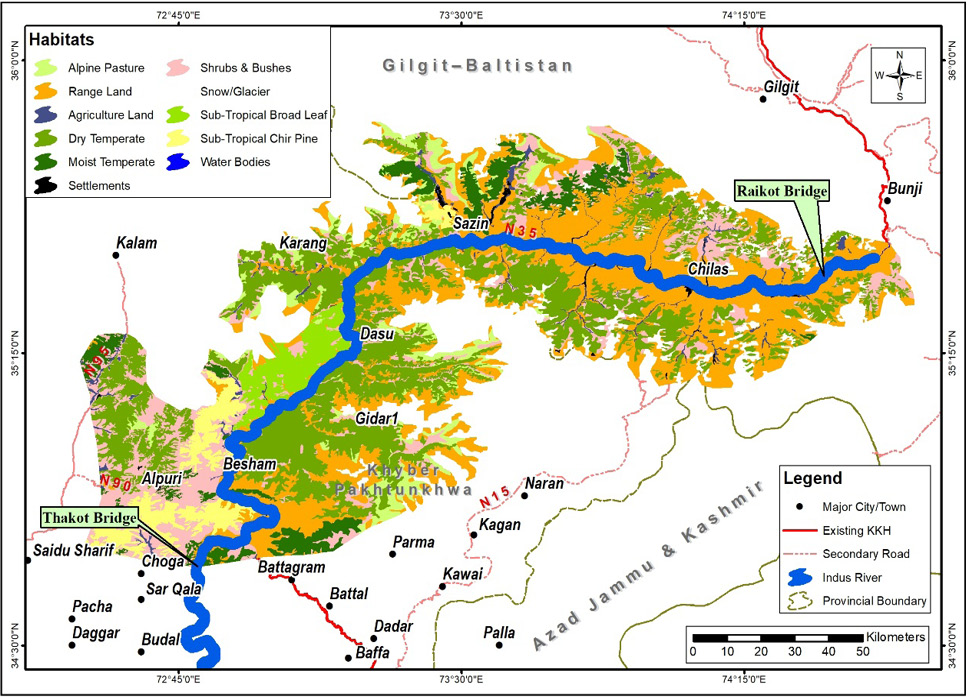
Different habitat types in the study area.
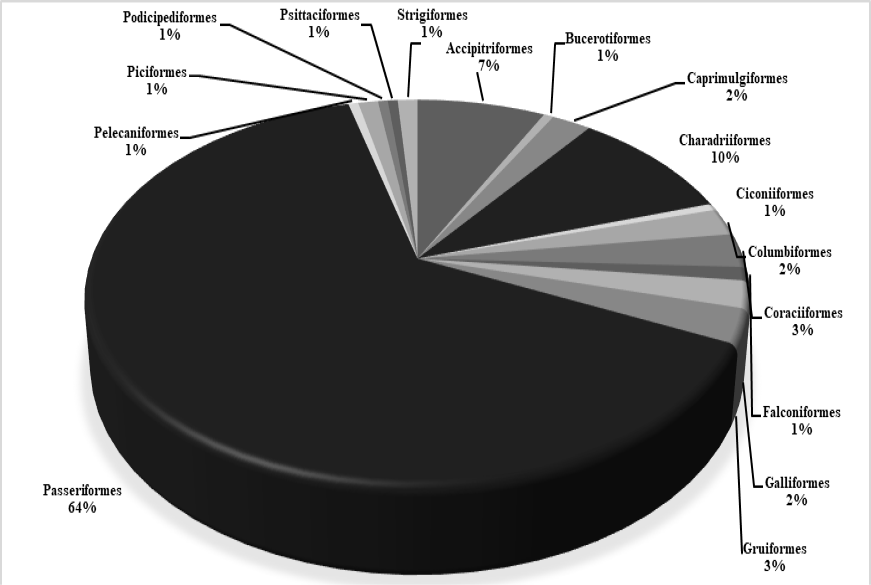
Species distribution based on taxonomic orders.
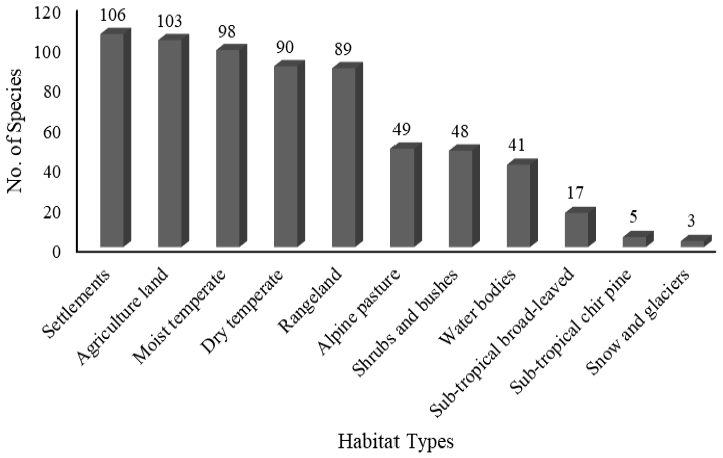
Species richness in various habitats of study area.
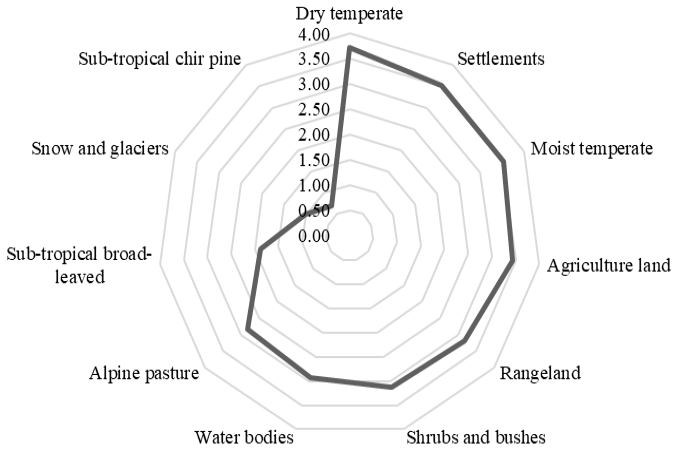
Shannon wiener diversity index of elven habitats.
References
- Baig, M.B. and Al-Subaiee, F.S., 2009. Biodiversity in Pakistan: Key issues. Biodiversity, 10: 20-29. https://doi.org/10.1080/14888386.2009.9712858[CrossRef]
- Barbaro, L., Brockerhoff, E.G., Giffard, B. and van Halder, I., 2012. Edge and area effects on avian assemblages and insectivory in fragmented native forests. Landsc. Ecol., 27: 1451-1463. https://doi.org/10.1007/s10980-012-9800-x[CrossRef]
- Barth, B.J., Gibbon, S.I. and Wilson, R.S., 2015. New urban developments that retain more remnant trees have greater bird diversity. Landsc. Urban Plan., 136: 122-129. https://doi.org/10.1016/j.landurbplan.2014.11.003[CrossRef]
- Benton, T.G., Vickery, J.A. and Wilson, J.D., 2003. Farmland biodiversity: is habitat heterogeneity the key? Trends Ecol. Evol., 18: 182-188. https://doi.org/10.1016/S0169-5347(03)00011-9[CrossRef]
- Blake, J.G. 2007. Neotropical forest bird communities: A comparison of species richness and composition at local and regional scales. Condor, 109: 237-255. https://doi.org/10.1093/condor/109.2.237[CrossRef]
- Brown, M. and Dinsmore, J.J., 1986. Implications of marsh size and isolation for marsh bird management. J. Wildl. Manage., 50: 392-397. https://doi.org/10.2307/3801093[CrossRef]
- Bukhari, S., Haider, A. and Laeeq, M., 2012. Land cover atlas of Pakistan: Pakistan Forest Institute Peshawar. The Printman Peshawar, Pakistan.
- Butchart, S.H.M. Stattersfield, A.J., Bennun, L.A., Akçakaya, H.R., Baillie, J.E.M., Stuart, S.N., Hilton-Taylor, C. and Mace, G.M., 2005. Using Red List Indices to measure progress towards the 2010 target and beyond. Philos. Trans. R. Soc. Lond. B Biol. Sci., 360: 255–268. https://doi.org/10.1098/rstb.2004.1583[CrossRef]
- Cody, M.L., 1968. On the methods of resource division in grassland bird communities. Am. Nat., 102: 107-147. https://doi.org/10.1086/282531[CrossRef]
- Correia, I., do Nascimento, E.R. and Gouveia, S.F., 2020. Effects of climate and land use gradients on avian phylogenetic and functional diversity in a tropical dry forest. J. Arid Environ., 173: 104024. https://doi.org/10.1016/j.jaridenv.2019.104024[CrossRef]
- Cramer, M.J. and Willig, M.R., 2005. Habitat heterogeneity, species diversity and null models. Oikos, 108: 209-218. https://doi.org/10.1111/j.0030-1299.2005.12944.x[CrossRef]
- de Bonilla, E.P. León-Cortés, J.L. and Rangel-Salazar, J.L., 2012. Diversity of bird feeding guilds in relation to habitat heterogeneity and land-use cover in a human-modified landscape in southern Mexico. J. trop. Ecol., 28: 369-376. https://doi.org/10.1017/S026646741200034X[CrossRef]
- Dornelas, M., Gotelli, N.J., McGill, B., Shimadzu, H., Moyes, F., Sievers, C. and Magurran, A.E., 2014. Assemblage time series reveal biodiversity change but not systematic loss. Science, 344: 296-299. https://doi.org/10.1126/science.1248484[CrossRef]
- Fahrig, L. and Nuttle, W.K., 2005. Population ecology in spatially heterogeneous environments. In: Ecosystem function in heterogeneous landscapes (eds. G.M. Lovett, M.G. Turner, C.G. Jones and K.C. Weathers). Springer, New York.
- Fisher, R.J. and Davis, S.K., 2010. From Wiens to Robel: a review of grassland-bird habitat selection. J. Wildl. Manage., 74: 265-273. https://doi.org/10.2193/2009-020[CrossRef]
- Food and Agriculture Organization, 2017. Land cover atlas of Pakistan: The Punjab Province, the Khyber Pakhtunkhwa Province and federally administered tribal areas. Food and Agriculture Organization of the United Nations (FAO), Rome, Italy.
- Galbraith, C.A., 2014. A review of migratory bird flyways and priorities for management. Bonn, Germany: UNEP/CMS Secretariat.
- Gatesire, T., Nsabimana, D., Nyiramana, A., Seburanga, J. and Mirville, M., 2014. Bird diversity and distribution in relation to urban landscape types in Northern Rwanda. Sci. World J., Article ID 157824. https://doi.org/10.1155/2014/157824[CrossRef]
- Girma, Z., Mamo, Y., Mengesha, G., Verma, A. and Asfaw, T., 2017. Seasonal abundance and habitat use of bird species in and around Wondo Genet Forest, south-central Ethiopia. Ecol. Evol., 7: 3397-3405. https://doi.org/10.1002/ece3.2926[CrossRef]
- Goerck, J.M., 1997. Patterns of rarity in the birds of the Atlantic forest of Brazil. Biol. Conserv., 11: 112-118. https://doi.org/10.1046/j.1523-1739.1997.95314.x[CrossRef]
- Grimmett, R., Roberts, T.J., Inskipp, T. and Byers, C., 2008. Birds of Pakistan. A and C Black.
- Harisha, M. and Hosetti, B., 2009. Diversity and distribution of avifauna of Lakkavalli range forest, Bhadra wildlife sanctuary, Western Ghat, India. Ecoprint. Int. J. Ecol., 16: 21-27. https://doi.org/10.3126/eco.v16i0.3469[CrossRef]
- Hess, G. R. and Bay, J. M., 2000. A regional assessment of windbreak habitat suitability. Environ. Monit. Assess., 6: 239-256. https://doi.org/10.1023/A:1006175323330[CrossRef]
- Hillebrand, H., Blasius, B., Borer, E.T., Chase, J.M., Downing, J.A., Eriksson, B.K., Filstrup, C.T., Harpole, W.S., Hodapp, D., Larsen, S. and Lewandowska, A.M., 2018. Biodiversity change is uncoupled from species richness trends: Consequences for conservation and monitoring. J. appl. Ecol., 55: 169-184. https://doi.org/10.1111/1365-2664.12959[CrossRef]
- Hurlbert, A.H., 2004. Species energy relationships and habitat complexity in bird communities. Ecol. Lett., 7: 714-720. https://doi.org/10.1111/j.1461-0248.2004.00630.x[CrossRef]
- IUCN, 2018. The IUCN red list of threatened species. Version 2018-1. International Union for Conservation of Nature and Natural Resources. Available at: https://www.iucnredlist.org/ (assessed on 24 June 2018)
- Jedlicka, J.A., Greenberg, R., and Letourneau, D.K., 2011. Avian conservation practices strengthen ecosystem services in California vineyards. PLoS One, 6: e27347. https://doi.org/10.1371/journal.pone.0027347[CrossRef]
- Koh, C.N., Lee, P.F. and Lin, R.S., 2006. Bird species richness patterns of northern Taiwan: Primary productivity, human population density, and habitat heterogeneity. Divers. Distrib., 12: 546-554. https://doi.org/10.1111/j.1366-9516.2006.00238.x[CrossRef]
- Krausman, P.R., Naugle, D.E., Frisina, M.R., Northrup, R., Bleich, V.C. and Block, W.M., 2009. Livestock grazing, wildlife habitat, and rangeland values. Rangelands, 31: 15-19. https://doi.org/10.2111/1551-501X-31.5.15[CrossRef]
- Kremen, C. and Miles, A., 2012. Ecosystem services in biologically diversified versus conventional farming systems: benefits, externalities, and trade-offs. Ecol. Soc., 17: 40. https://doi.org/10.5751/ES-05035-170440[CrossRef]
- Kross, S.M., Kelsey, T.R., McColl, C.J. and Townsend, J.M., 2016. Field-scale habitat complexity enhances avian conservation and avian-mediated pest-control services in an intensive agricultural crop. Agric. Ecosyst. Environ., 225: 140-149. https://doi.org/10.1016/j.agee.2016.03.043[CrossRef]
- Lancaster, R.K. and Rees, W.E., 1979. Bird communities and the structure of urban habitats. Can. J. Zool., 57: 2358-2368. https://doi.org/10.1139/z79-307[CrossRef]
- Lee, P.Y. and Rotenberry, J.T., 2005. Relationships between bird species and tree species assemblages in forested habitats of eastern North America. J. Biogeogr., 32: 1139-1150. https://doi.org/10.1111/j.1365-2699.2005.01254.x[CrossRef]
- Lerman, S.B., Nislow, K.H., Nowak, D.J., DeStefano, S., King, D.I. and Jones-Farrand, D.T., 2014. Using urban forest assessment tools to model bird habitat potential. Landsc. Urban Plan., 122: 29-40. https://doi.org/10.1016/j.landurbplan.2013.10.006[CrossRef]
- Lewis, K.P. and Starzomski, B.M., 2015. Bird communities and vegetation associations across a treeline ecotone in the Mealy Mountains, Labrador, which is an understudied part of the boreal forest. Can. J. Zool., 93: 477-486. https://doi.org/10.1139/cjz-2014-0309[CrossRef]
- Masifwa, W.F., Twongo, T. and Denny, P., 2001. The impact of water hyacinth, Eichhornia crassipes (Mart) Solms on the abundance and diversity of aquatic macroinvertebrates along the shores of northern Lake Victoria, Uganda. Hydrobiologia, 452: 79-88. https://doi.org/10.1023/A:1011923926911[CrossRef]
- McCain, C.M., 2009. Global analysis of bird elevational diversity. Glob. Ecol. Biogeogr., 18: 346-360. https://doi.org/10.1111/j.1466-8238.2008.00443.x[CrossRef]
- McKinney, M.L., 1997. How do rare species avoid extinction? A paleontological view. Biol. Rarity Springer Dordrecht, 17: 110-129. https://doi.org/10.1007/978-94-011-5874-9_7[CrossRef]
- McWethy, D.B., Hansen, A.J. and Verschuyl, J.P., 2009. Edge effects for songbirds vary with forest productivity. For. Ecol. Manage., 257: 665-678. https://doi.org/10.1016/j.foreco.2008.09.046[CrossRef]
- Meerhoff, S.M., Mazzeo, B.N., Moss, B. and Rodríguez-Gallego, L., 2003. The structuring role of free-floating versus submerged plants in a subtropical shallow lake. Springer Nat., 37: 377–391. https://doi.org/10.1023/B:AECO.0000007041.57843.0b[CrossRef]
- Mikusiński, G., Gromadzki, M. and Chylarecki, P., 2001. Woodpeckers as indicators of forest bird diversity. Conserv. Biol., 15: 208-217. https://doi.org/10.1111/j.1523-1739.2001.99236.x[CrossRef]
- Mirza, Z. and Wasiq, H., 2007. A field guide to birds of Pakistan Bookland. Lahore.
- Mohd-Azlan, J., Noske, R.A., and Lawes, M.J., 2015. The role of habitat heterogeneity in structuring mangrove bird assemblages. Diversity, 7: 118-136. https://doi.org/10.3390/d7020118[CrossRef]
- Möltgen, J., Schmidt, B. and Kuhn, W.,1999. Landscape editing with knowledge-based measure deductions for ecological planning. International Workshop on Integrated Spatial Databases, Springer, pp. 139-152. https://doi.org/10.1007/3-540-46621-5_9[CrossRef]
- Muñoz-Sáez, A., Perez-Quezada, J.F. and Estades, C.F., 2017. Agricultural landscapes as habitat for birds in central Chile. Rev. Chil. Hist. Nat., 90: 3. https://doi.org/10.1186/s40693-017-0067-0[CrossRef]
- Pennington, D.N. and Blair, R.B., 2011. Habitat selection of breeding riparian birds in an urban environment: untangling the relative importance of biophysical elements and spatial scale. Divers. Distrib., 17: 506-518. https://doi.org/10.1111/j.1472-4642.2011.00750.x[CrossRef]
- Raja, N.A., Davidson, P., Bean, N., Drijvers, R., Showler, D. and Barker, C., 1999. The birds of Palas, North-West Frontier Province, Pakistan. Forktail, pp. 77-86.
- Rajpar, M.N. and Zakaria, M., 2011. Bird species abundance and their correlationship with microclimate and habitat variables at Natural Wetland Reserve, Peninsular Malaysia. Int. J. Zool., Article ID 758573. https://doi.org/10.1155/2011/758573[CrossRef]
- Raman, T.S., 1998. Recovery of tropical rainforest avifauna in relation to vegetation succession following shifting cultivation in Mizoram, north-east India. J. appl. Ecol., 35: 214-231. https://doi.org/10.1046/j.1365-2664.1998.00297.x[CrossRef]
- Roberts, T.J., 1991. The birds of Pakistan, Non-Passeriformes. Oxford Univ. Press, Karachi, 1: 598.
- Roberts, T.J., 1992. Birds of Pakistan, The passeriformes: Pittas to buntings. Oxford University Press.
- Sekercioglu, С.H., Daily, G.C. and Ehrlich, P.R., 2004. Ecosystem consequences of bird declines. Proc. natl. Acad. Sci. U.S.A., 101:18042-18047. https://doi.org/10.1073/pnas.0408049101[CrossRef]
- Shochat, E., Lerman, S. and Fernández-Juricic, E., 2010. Birds in urban ecosystems: Population dynamics, community structure, biodiversity, and conservation. Urban Ecosyst., 55: 75-86. https://doi.org/10.2134/agronmonogr55.c4[CrossRef]
- Stevenson, T. and Fanshawe, J., 2004. Birds of East Africa: Kenya, Tanzania, Uganda, Rwanda, Burundi. A and C Black.
- Strohbach, M.W., Lerman, S.B. and Warren, P.S., 2013. Are small greening areas enhancing bird diversity? Insights from community-driven greening projects in Boston. Landsc. Urban Plan., 114: 69-79. https://doi.org/10.1016/j.landurbplan.2013.02.007[CrossRef]
- Theuerkauf, S.J. and Lipcius, R.N., 2016. Quantitative validation of a habitat suitability index for oyster restoration. Front. Mar. Sci., 3: 64. https://doi.org/10.3389/fmars.2016.00064[CrossRef]
- Toft, J.D. Simenstad, C.A., Cordell, J.R. and Grimaldo, L.F., 2003. The effects of introduced water hyacinth on habitat structure, invertebrate assemblages, and fish diets. Estuaries, 26: 746-758. https://doi.org/10.1007/BF02711985[CrossRef]
- Tu, H.M., Fan, M.W. and Ko, J.C.J., 2020. Different habitat types affect bird richness and evenness. Sci. Rep., 10: 1-10. https://doi.org/10.1038/s41598-020-58202-4[CrossRef]
- Tuck, S.L. Winqvist, C., Mota, F., Ahnström, J., Turnbull, L.A. and Bengtsson, J., 2014. Landuse intensity and the effects of organic farming on biodiversity: A hierarchical meta analysis. J. appl. Ecol., 51: 746-755. https://doi.org/10.1111/1365-2664.12219[CrossRef]
- Verner, J., 1985. In: Current ornithology: Assessment of counting techniques. Plenum. Press, 2: 247-302. https://doi.org/10.1007/978-1-4613-2385-3_8[CrossRef]
- Warren, P. and Baines, D., 2004. Black grouse in northern England: stemming the decline. Br. Birds, 97: 183-189.
- Watson, J.E.M., Whittaker, R.J. and Dawson, T.P., 2004. Avifaunal response to habitat fragmentation in the threatened littoral forest of south-eastern Madagascar. J. Biogeogr., 31: 1791–1807. https://doi.org/10.1111/j.1365-2699.2004.01142.x[CrossRef]
- Wiens, J.A., 1969. An approach to the study of ecological relationships among grassland birds. Ornithol. Monogr., 8: 1-93. https://doi.org/10.2307/40166677[CrossRef]
Supplementary material
Cited by 2 articles
In journals published by ResearchersLinks.
Services
Article usage statistics
Loading…