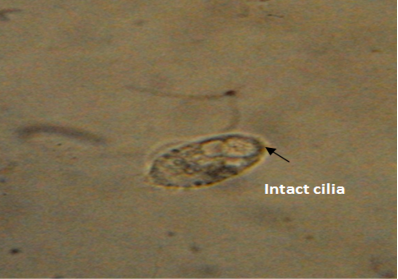
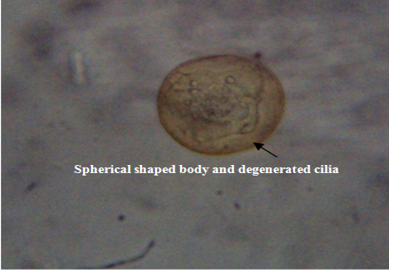
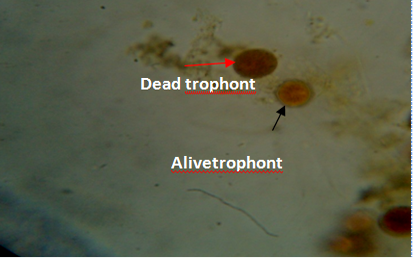
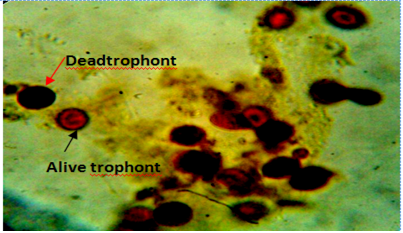
The trophont burdens on the experimental fish were determined at one time points, 1h after initial infestation, when only the triplicate set of tanks (C - G) received treatment. The level of decrease in the number of trophonts present in the body smear was concentration and time dependent (Table 1). It was also observed that trophonts present in body smear during pre-treatment were significantly (P<0.05) higher in all the experimental groups. The lowest number of trophonts in the body smear of the infested fish was seen in group F (Table 3). However, at the end of the post-treatment, the number of trophonts in the negative treatment increased significantly (P<0.05) compared to the ALEMO treated groups. The data indicated that there were significant differences in I. multifiliis infestation of the skin between the standard drug and ALEMO groups at the end of the dip treatment. Moreover, the trophont decreased in a concentration and time dependent manner.
The number of trophonts present in the gill after treatment with ALEMO and Fish cure (standard drug), showed no significant differences (P>0.05) whereas the negative control had highest trophonts infestation in the gill. Meanwhile, it was observed that the number of infestation in the gills of the negative control was statistically significant (P<0.05). The infestation with I. multifiliis decreased in the ALEMO group, while the infestation in the ALEMO-exposed group D, E and F had a mixed trend of infestation reduction potency as shown in Table 2. The curative potency of aqueous leaves extract of M. oleifera in the trophonts infestation present in the body and gill of the fish were significantly different at (P<0.05). The curative potentials of the ALEMO treated groups and standard drug in eliminating the adult parasite was significant. The standard drug demonstrated a significant efficacy by reducing the parasitic infestation by 99.32%. However, the ALEMO treated groups showed similar efficacy by reducing the parasitic infestation in a dip bath treatment for 1h. Similar findings were also observed in the gills of the infested fish where the positive control group reduced the parasitic infestation by 88.33% (Table 3).
Table 1: Changes in the trophont number in the body smear of Clarias gariepinus infested with Ichthyophthirius multifiliis before and after dip treatment (1h) with aqueous leaves extract of Moringa oleifera and standard drug (fish cure).
Mean value with the same alphabets as superscript in a column are not significantly different (P>0.05). Mean values with different numbers as superscript in a row are significantly different (P<0.05).
Table 2: Changes in the trophont number in the gill of Clarias gariepinus infested with Ichthyophthirius multifiliis before and after dip treatment (1h) with aqueous leaves extract of Moringa oleifera and standard drug (fish cure).
Mean value with the same alphabets as superscript in a column are not significantly different (P>0.05). Mean values with different alphabets as superscript in a column are significantly different (P<0.05).
Table 3: Changes in the curative potential of aqueous leaves extract of Moringa oleifera and standard drug (fish cure) in eliminating the adult parasite trophonts from the body smear of the infested fish, after dip treatment
Mean value with the same alphabets as superscript in a column are not significantly different (P>0.05). Mean values with different numbers as superscript in a row are significantly different (P<0.05).
Antiprotozoal Activity of Aqueous Leaves Extract of Moringa Oleifera Leaves on the Key Life Stage (Theront) of Ichthyophthirius Multifiliis
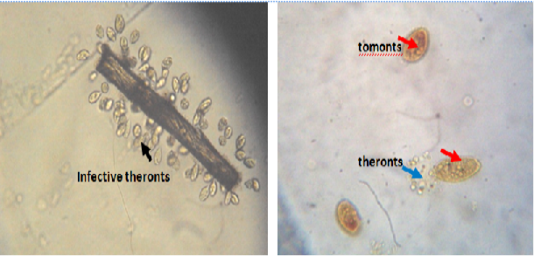
Infective stage of the parasite was exposed to varied concentration of aqueous leaves extract of M. oleifera extract (B-G). The number of theronts surviving each concentration of the extract displayed a clear dose response, survival decreasing with the increasing concentration of the extract. The number of theronts surviving each concentration, given as the mean number of theronts that survived at the end of 24h of exposure was concentration and time dependent. The percentage number of theronts that survived during the antiprotozoal activity of M. oleifera on the infective stage of the parasite, given as the mean percentage followed by the standard deviation was concentration and time dependent. The number of theronts that survived the ALEMO-exposure were significantly different (P<0.05). The level of mortality that occurred in theronts exposed to graded concentration of aqueous leaves extract of M. oleifera at the end of 24h was highest in the group F (Table 4). The mortality of the theronts was concentration depen-
Table 4: Antiprotozoalactivity of aqueous leaves extract of Moringa oleifera on the key life stage (theront) of Ichthyophthirius multifiliis
Mean value with the same alphabets as superscript in a column are not significantly different (P>0.05). Mean values with different alphabets as superscript in a column are significantly different (P<0.05).
Table 5: Changes in the viability of infective theronts pretreated with 0.5g/L of Moringa oleifera leaves for 1h in infectivity potential in Healthy Clarias gariepinus for 14 days.
Table 6: Infective prevalence and intensity of theronts pretreated for 1h with aqueous leaves extract of Moringa oleifera (mean±SD of 3 tanks)
Infective prevalence (%) = number of infected catfish/number of total catfish X 100; infective intensity=number of white spots on catfish body/number of infected catfish; values marked by different letters with the same column are significantly different (P<0.05).
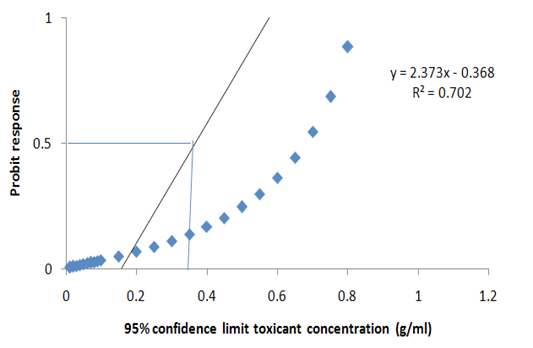
dent and it differed significantly at P>0.05. More so, no significant death was recorded in the group A (Negative control) (Table 4). Meanwhile, the LC50 of the extract was estimated at 95% confidence limit for concentration as 0.247g/ml (Figure 2). Meanwhile, the model explains the data at 70.0% i.e. the model is efficient.


 x