
Stress is a state of threatened homeostasis that causes the body to release the hormone cortisol produced by the adrenal glands. Oviductus ranae (OR) is an animal based raw material of folk medicine which plays a variety of activities. However, its anti-stress effects mechanism has not been fully revealed. In this work, based on network pharmacology, the potential targets of OR were screened, and an protein-protein interaction (PPI) network between the target of OR and anti-stress target was constructed using STRING database. Kyoto Encyclopedia of Genes and Genomes (KEGG) was used for analyzing the pathways of target gene. To further verify this, total 96 ICR mice were used, forced swim test and anoxic tolerance test were performed. The effect of OR on levels of monoamine neurotransmitters and phosphorylation of p38 which closely related to anti-stress were examined. The results showed that, 203 potential OR targets and 126 stress-related gene targets were obtained, in which there were 15 common targets. Pathway enrichment analysis showed that there were 20 critical pathways. The results revealed that OR could increase the total swimming time, increase the survival time of enduring anoxia, and regulate monoamine neurotransmitters such as 5-hydroxytryptamine (5-HT), 5-hydroxyindoleacetic acid (5-HIAA), norepinephrine (NE) and dopamine (DA). Western blot analyses indicated that OR may decrease the phosphorylation of p38. In conclusion, the results revealed that OR may play the anti-stress effects by inhibiting mitogen-activated protein kinase (MAPK) pathway, thus promote the normalization of acute stress. This study revealed the possible mechanism of OR as a potential material for the treatment of acute stress-related problems, and laid a foundation for the further development and utilization of OR.
Research Article · Volume 55, Issue 3, 19 March 2023 · Open Access
Anti-Stress Activity of Oviductus Ranae in Mice with Acute Stress Based on Network Pharmacology
· · · · · · ·
Affiliations & Notes ⌄
- 1College of Pharmacy, Changchun University of Chinese Medicine, Changchun 130117, China 2Jilin Ginseng Academy, Changchun University of Chinese Medicine, Changchun 130117, China 3The Third Affiliated Hospital, Changchun University of Chinese Medicine, Changchun 130117, China * Corresponding author: linhe@ccucm.edu.cn
- 2yuzhun0908@126.com
Article Info ⌄
- Journal:
- Pakistan Journal of Zoology
- Published:
- 19 March 2023

From the article
- In this study, we constructed a comprehensive PPI network based on OR-related and stress-related networks, the result showed total 15 core targets involved in the anti-stress pharmacological action of OR were identified.
- It is suggested that the anti-stress effect of OR may be caused by regulating key signaling pathways of oxidative stress, inflammation, and cell proliferation.
- Our study also found that OR significantly modulates monoamine transmitters in the brain tissue of stressed mice during anti-stress.
- In conclusion, a total of 14 active components in OR corresponding to 15 anti-stress related targets were found, and through forced swimming endurance and anoxic tolerance test, it suggested that the regulation of monoamine neurotransmitters and the phosphorylation of p38 play a crucial part in the anti-stress process.
Selected from the article's own text.
Abstract
Introduction
Stress is regarded as the body’s nonspecific response to external stimuli, which threatens homeostasis that interferes with the normal physiological balance and endangers the survival of the individual ; . Both acute and chronic stress stimuli can cause changes in daily behavior, regulate the function of hypothalamic-pituitary-adrenal axis (HPA axis) and autonomic nerve levels . Stress response is affected by the duration and intensity of different stressors. Acute stress plays a vital part in various brain diseases and symptoms, including Parkinson’s disease, depression and neuroinflammation ; . In addition to an important role against brain diseases, stress is also a risk factor for cardiovascular and skin diseases .
Oviductus ranae (OR), also called R. chensinensis oil, is the dry oviduct of Rana chensinensis. It has been for hundreds of years as a traditional medicine in China. It can be used to treat various diseases, such as frailty, night sweat, menopause syndrome, insomnia and neurasthenia ; . In recent years, more and more studies have reported the active function of OR, and conducted in-depth studies on its mechanism of action in immune regulation, anti-oxidation, anti-fatigue, anti-aging, estrogen-like, liver protection, lowering blood lipid, anti-osteoporosis, anti-depression, anti-tumor, antitussive, expectorant, anti-inflammatory, antiasthmatic and other aspects ; ; . It has been showed that OR has good antioxidant and immunomodulatory effects, and can stimulate the activity of macrophages by regulating NF-κB pathway, and inhibit the ovarian cell apoptosis in rats induced by oxidative stress injury by declining the production of ROS and increasing mitochondrial membrane potential ; Ling et al., 2019). These results demonstrate that OR has great potential and is worthy of further explore and development. In recent two decades based on the development of systems biology, the concept of network pharmacology began to rise. The methods of omics data integration and multi-target drug development and related databases were applied ; , especially in the research of traditional Chinese medicine ; ; .
In this study, the potential effect and mechanism of OR anti-stress were investigated by network pharmacology. The major activated components of OR were screened, the possible targets were predicted, and stress-related targets were gathered following by the intersecting and potential biological functional ones, and the anti-stress effect of OR was preliminarily evaluated through forced swimming test and hypoxia test, to further explore the effects of OR on monoamine transmitter and p38 phosphorylation. This study aims to provide a reference for the basic function research of OR; and to further realize the value of Rana chensinensis to promote its breeding industry, and the research and development of related biological products.
Materials and Methods
Materials and oviductus ranae extraction
Oviductus ranae were collected from adult female Rana chensinensis, which were obtained from Fusong, Jilin, China. After freeze-drying, OR was pulverized through 80 mesh sieve, weighed the powder, put it into a beaker, added distilled water at 70°C, and stirred evenly. After leaving at room temperature for 12 h till the OR powder was completely dissolved and expanded, added distilled water to a constant volume to prepare the concentration required for administration. ELISA kits were from Enzyme-linked Biotechnology Co. Ltd (Shanghai, China). The bicinchoninic acid (BCA) commercial kit was from Thermo Scientific (Pittsburgh, PA, USA). The Anti-phospho-p38, Anti-p38 and β-Actin antibodies kits were from Santa Cruz Biotechnology Inc. (Dallas, TX, USA).
Acquisition of OR potential active ingredients and targets
The chemical compounds of OR were screened from traditional Chinese medicine systems pharmacology database (TCMSP), with the active ingredients selected based on oral bioavailability (OB) ≥30% and drug similarity (DL) ≥0.18 . Potential targets related to bioactive compounds of OR were further analyzed, and transformed to UniProt IDS through UniProtKB database. Stress-related targets were collected using Drugbank and GeneCards database. On this basis, two sets of indicators were compiled: potential targets of OR and stress-related indicators. All the details of databases and bioinformatics tools were listed in Supplementary Table SI.
Construction of PPI network
To explore the interaction of OR therapeutic targets and stress-related targets by constructing protein-protein interaction (PPI) networks. The analysis of PPI networks was performed with the Search Tool for Retrieval of interaction Genes/Proteins platform (STRING) , and the criterion was limited to Homo sapiens with a confidence level of 0.7.
KEGG pathway and gene ontology enrichment analyses
To clarify the OR therapeutic targets at the system level role in the biological mechanisms of anti-stress, Gene Ontology (GO) and Kyoto Encyclopedia of Genomes (KEGG) pathway were executed with the ClueGO 2.5.4 plugin in Cytoscape (Li et al., 2021). The minimum number of enriched genes per GO or KEGG term was set to 3.
Animals and experimental groups
Total 96 ICR mice (6-week-old, half male and half female) were obtained from Changsheng Biotechnology Co. Ltd. (Shenyang, China), and were previously housed (12-h light and dark cycle, 22°C, 70% humidity) in pathogen-free conditions, 6 mice per cage, with food and water were freely available. Then, mice were divided into two same parts. In each part, total 48 mice were randomized into four groups (n=12): the control (20 mL/kg of distilled water), OR doze groups at 100, 200 and 400 mg/ kg. Mice in each group were administered orally once a day for 14 consecutive days.
Forced swimming test
The forced swimming test was performed according to the method described by Aluko et al. (2015) and Yan and Hao (2016). In brief, one h after the last administration, each mice was forced to swim individually in a transparent tank (30, 45 and 40 cm in length, width, and height, respectively) filled with fresh water to a depth of 30 cm and the water was maintained at 17±1°C. Exhaustion was determined by observing the loss of coordinated movements and failure to return to the surface within 10 s. The parameter measured were total time spent in active swimming, that is, the total duration during which the animal swims throughout the experimental period.
Anoxic tolerance test
The other part of 48 mice were used for anoxic tolerance test, according to the method described by Caillard et al. (1979) and Aluko et al. (2015). Before the experiment, 250 mL conical flasks were sealed with rubber cork. one hour after the last administration, the mice were placed in conical flask and the anoxic tolerance time was recorded. After that, the mice were removed immediately for recovery. The anoxic tolerance time was defined as the latency to the first appearance of anoxic convulsions.
ELISA test
After forced swimming test, mice brain tissues were taken from each group. The levels of monoamine neurotransmitters (5-hydroxyindoleacetic acid, 5-HIAA; 5-hydroxytryptamine, 5-HT; dopamine, DA and norepinephrine, NE) in brain tissues were measured by ELISA kit according to the kit instructions. The absorbance of each sample was measured at 450 nm using a multiskan spectrum (Thermo Fisher Scientific, USA). All experiments were performed in triplicate and repeated three times.
Western blot analysis
After forced swimming test, the proteins of brain tissues were extracted and the expression levels of p-p38 and p38 were analyzed by western blot. Brain tissue were reaped and lysed with RIPA buffer cracking 30 minutes on the ice, and the protein concentration was evaluated with the BCA assay kit. Those cerebrum tissue proteins (15 μL) were loaded onto 12% SDS-polyacrylamide gel. After electrophoresis, these gels were imprinted onto polyvinylidene fluoride (PVDF) membranes and sealed with 5% (W/V) skim milk for 1 h. Then, the transferred membrane and the primary antibody were incubated overnight at 4°C. The conjugation of primary antibody was detected by HRP coupled secondary antibody, and enhanced chemiluminescence (ECL) imaging was utilized.
Statistical analysis
All data were expressed as mean ± SD and SPSS 19.0 was used for statistical analysis. One-way analysis of variance (ANOVA) was used to evaluate the differences between groups. Differences at p <0.05 were considered statistically significant.
Results
Potential active ingredients and targets of OR
All the active ingredients and related targets were searched in TCMSP database. In the result, a total of 14 active components were obtained from OR, corresponding to 203 target genes. Using “Stress” as the key word, 126 disease-related targets were obtained after screening, and 15 convergence targets then afterward the convergence of the two, which may be potential targets of OR anti-stress (Supplementary Fig. S1A, B).
Construction of the PPI network
The PPI network of OR interacting with anti-stress-related proteins was constructed in String database (Supplementary Fig. S1C). As shown in the result, there were SLC6A2, IL10, JUN, CAT, AKT1, VEGFA, CAV1, RELA, SOD1, IL1B, GSTP1, HSF1, APOA1, NR3C1 and FOS that to be considered as the key targets of OR against stress (Table I).
Table I. The key targets of OR anti-stress targets by PPI network.
| Items | Details |
| SLC6A2 | Solute carrier family 6 member 2 |
| IL10 | Interleukin 10 |
| JUN | Jjun proto-oncogene |
| CAT | Catenin |
| AKT1 | Serine/threonine kinase 1 |
| VEGFA | Vascular endothelial growth factor A |
| CAV1 | Caveolin-1 |
| RELA | v-rel avian reticuloendotheliosis viral oncogene homolog A |
| SOD1 | Superoxide dismutase 1 |
| IL1B | Interleukin 1B |
| GSTP1 | Glutathione S-transferaz pi |
| HSF1 | Heat shock transcription factor 1 |
| APOA1 | Apolipoprotein A1 |
| NR3C1 | Nuclear receptor subfamily 3 group C member 1 |
| FOS | Fructooligosaccharides |
GO function enrichment analysis and KEGG pathway
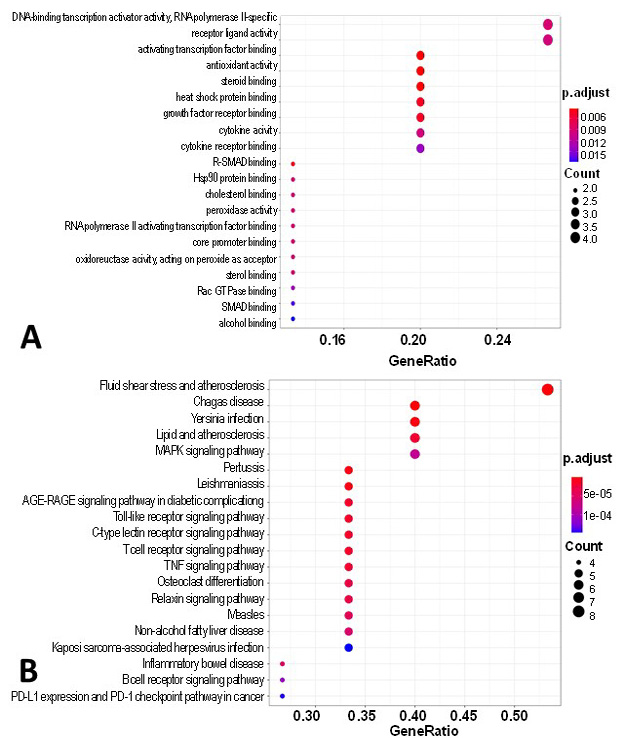
Total 141 proteins involved in the target network of named components were analyzed. In GO enrichment analysis, 55 GO items and 20 biological process related items were identified, the results revealed that the critical targets of effective compounds in OR are enriched significantly and the main biological functions were transcription factor binding, antioxidant activity and steroid binding in Figure 1A.
The KEGG pathway enrichment analysis showed that, OR mainly involved in the signaling pathways of toll-like receptor, C-type lectin receptor, T cell receptor, TNF, Relaxin, MAPK and B cell receptor; the involved 20 critical pathways were shown in Figure 1B. The results suggest that, the higher the order of enrichment results, the more likely the OR is to exert its antipyretic effect through these pathways. The top five enriched KEGG pathways include Fluid shear stress and atherosclerosis, Chagas disease, Yersinia infection, lipid and atherosclerosis and MAPK signaling pathway.
The circle size represents the count of therapeutic targets enriched in a certain pathway; the associated genes (%) means the percentage of target genes to the background genes of a certain pathway.
Effect of OR on the forced swim endurance and anoxic tolerance tests
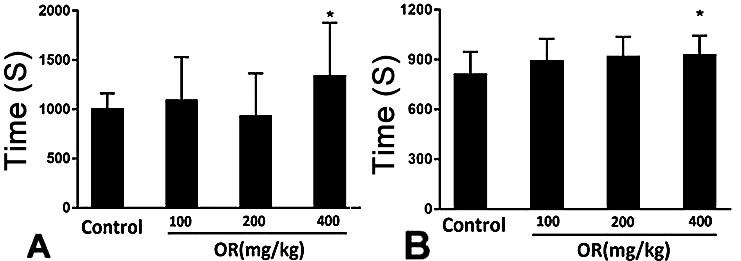
The total swimming time of 400 mg/kg OR group significantly increased, the 100 mg/kg OR group also increased compared with the control group, but there was no significant difference (Fig. 2A), indicating that OR could enhance the endurance of mice by prolonging swimming time, thus improving their stress ability. The convulsion latency (400 mg/kg OR group) increased significantly comparing to the control group, the 200 and 100 mg/kg OR group also increased but no significant difference (Fig. 2B), revealing that OR could enhance mice tolerance to hypoxia by prolonging the convulsion latency, thus improving their anti-stress ability.
Effects of OR on the monoamine neurotransmitters
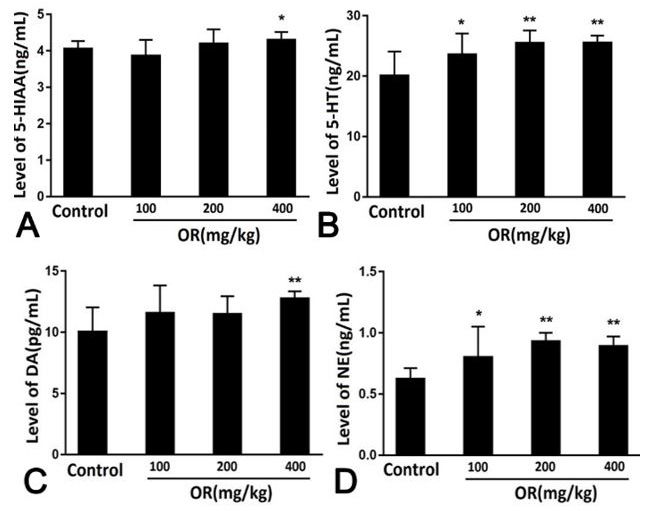
The expressions of 5-HT, 5-HIAA, NE and DA in the brain tissues were detected. The results showed that, the levels of 5-HIAA and DA in 400 mg/kg OR group increased markedly (p <0.05), compared with control group. The contents of 5-HT and NE in 100, 200 and 400 mg/kg OR groups also increased significantly (p <0.05 or p <0.01); while the levels of 5-HIAA, 5-HT, DA and NE in other groups all have an increasing trend with no significant difference (Fig. 3). It revealed that OR could improve the anti-stress ability of mice by increasing the content of various monoamine transmitters in brain.
Effects of OR on phosphorylation of p38
The mitogen-activated protein kinases (MAPK) mediate a variety of cellular behaviors that in response to extracellular stimuli. The p38 group, as a main sub-groups of MAPK, serves as a junction for signal transduction, and play a crucial role in many biological processes . The expression of p-p38 and p38 from the brain tissues in 400 mg/kg OR group was clearly increased (Fig. 4) comparing to the control group. It indicated that OR could increase phosphorylation of p38 in mice brains.
Discussion
The method of network pharmacology has been widely used in the research of traditional Chinese medicine ; ; . In this study, we constructed a comprehensive PPI network based on OR-related and stress-related networks, the result showed total 15 core targets involved in the anti-stress pharmacological action of OR were identified. Subsequent analysis of GO and KEGG signaling pathway enrichment of these key targets were performed. It is suggested that the anti-stress effect of OR may be caused by regulating key signaling pathways of oxidative stress, inflammation, and cell proliferation. To our knowledge, there are no similar studies base on network pharmacology for OR. Notably, over the top oxidative stress produces oxidative radicals, for example, ROS, that might animate MAPK course phosphorylation ; . Some evidence suggests that acute stress is associated with the release of oxidative free radicals that promote phosphorylation of MAPK cascade in the hippocampus of stressed rats . And Inhibition of oxidative-stress-induced MAPK phosphorylation relieves the stress response in a rat stress model ; . In fact, in this study, the western blot showed that brain tissue p-p38 levels were significantly reduced after the OR treatment, which was similar to an earlier study , and also the predictions of network pharmacology were preliminarily validated.
The regulation of monoamine transmitters is an important mechanism of drug resistance to stress . Exposure to stress causes certain regions of the brain (mainly the hippocampus, amygdala, prefrontal cortex, and nucleus accumbens) to rapidly release monoamines such as dopamine, norepinephrine, and serotonin ; ; . Stress-induced release of monoamines typically occurs within minutes of the onset of stress and may persist throughout the duration of stress . Our study also found that OR significantly modulates monoamine transmitters in the brain tissue of stressed mice during anti-stress. It showed that the content of 5-HIAA, 5-HT, DA and NE in the brain was significantly increased.
At present, studies on the biological activities of OR mainly focus on antioxidant, anti-inflammatory, immune regulation and bone metabolism ; . Among them, some researchers have preliminarily investigated its anti-oxidative stress effect at the cellular level, and found that serum containing OR can down-regulate negative regulatory factors of cell proliferation, activate ERK1/2, inhibit JNK and p38 activities, reduce ROS production, improve mitochondrial membrane potential, and inhibit H2O2-induced apoptosis of rat ovarian cells (Ling et al., 2019). Our recent study also proved that OR has effect on improving cognitive disorder . In this work, the anti-stress effect of OR was confirmed by network pharmacology prediction and animal experimental verification, which further confirmed the aforementioned reports and provided a reference for its in-depth research and development.
Conclusion
In conclusion, a total of 14 active components in OR corresponding to 15 anti-stress related targets were found, and through forced swimming endurance and anoxic tolerance test, it suggested that the regulation of monoamine neurotransmitters and the phosphorylation of p38 play a crucial part in the anti-stress process. This study aims to provide a reference for the basic function research of OR, and the development of its related biological products.
Acknowledgments
This study was supported by Jilin Province Industrial Technology Project (No. 20200032-2), Jilin Province Health and Health Technology Innovation Project (No. 2020J068) and Jilin Province Educational Project (No. JJKH20200901KJ).
Ethical compliance
Research experiments conducted in this article with animals were approved by the Animal Experiment Ethics Committee of Changchun University of Chinese Medicine (Ethic code 2020217) following all guidelines, regulations, legal, and ethical standards as required for humans or animals.
Supplementary material
There is supplementary material associated with this article. Access the material online at: https://dx.doi.org/10.17582/journal.pjz/20210818020819
Statement of conflict of interest
The authors have declared no conflict of interest.
Figures
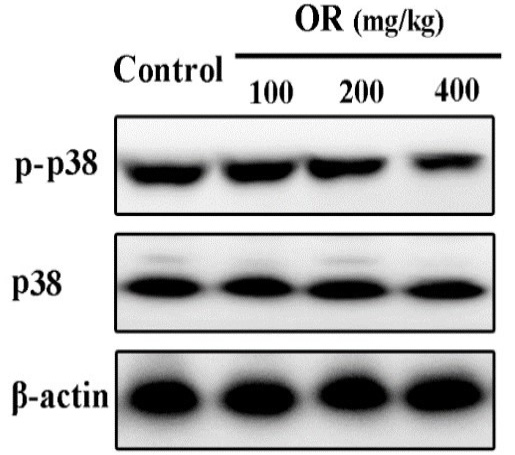
Effects of OR on phosphorylation levels of p38 in the brain tissues by western blot.
References
- Adamec, R., Holmes, A. and Blundell, J., 2008. Vulnerability to lasting anxiogenic effects of brief exposure to predator stimuli: Sex, serotonin and other factors-relevance to PTSD. Neurosci. Biobehav. Rev., 32: 1287-1292. https://doi.org/10.1016/j.neubiorev.2008.05.005[CrossRef]
- Ahmad, A., Rasheed, N., Chand, K., Maurya, R., Banu, N. and Palit, G., 2012. Restraint stress-induced central monoaminergic and oxidative changes in rats and their prevention by novel Ocimum sanctum compounds. Indian J. med. Res., 135: 548-554.
- Aluko, O.M., Umukoro, S., Annafi, O.S., Adewole, F.A., and Omorogbe, O., 2015. Effects of methyl jasmonate on acute stress responses in mice subjected to forced swim and anoxic tests. Sci. Pharm., 83: 635-644. https://doi.org/10.3797/scipharm.1504-04[CrossRef]
- Aston-Jones, G., and Cohen, J.D., 2005. An integrative theory of locus coeruleus-norepinephrine function: Adaptive gain and optimal performance. Annu. Rev. Neurosci., 28: 403-450. https://doi.org/10.1146/annurev.neuro.28.061604.135709[CrossRef]
- Caillard, C., Menu, A., Plotkine, M., and Rassignol, P., 1979. Do anticonvulsant drugs exert protective effect against hypoxia? Life Sci., 16: 1607-1611. https://doi.org/10.1016/0024-3205(75)90078-8[CrossRef]
- Chen, W.P., Jin, G.J., Xiong, Y., Hu, P.F., Bao, J.P., and Wu, L.D., 2018. Rosmarinic acid down-regulates NO and PGE2 expression via MAPK pathway in rat chondrocytes. J. cell. mol. Med., 22: 346-353. https://doi.org/10.1111/jcmm.13322[CrossRef]
- Chen, H.Y., Yin, P.C., Lu, Y.N., Li, H.Y. and Shan, Y., 2020. Bioinformatics analysis identified the key genes of aspirin and redox damaged yeast cells. Pakistan J. Zool., 52: 1841-1848 https://10.17582/journal.pjz/20200217140237
- Gispen-de Wied, C.C., 2000. Stress in schizophrenia: An integrative view. Eur. J. Pharmacol., 405: 375-384. https://doi.org/10.1016/S0014-2999(00)00567-7[CrossRef]
- Huang D., Yang L., Wang C., Ma S., Cui L., Huang S., Sheng X., Weng Q. and Xu M., 2014 Immunostimulatory activity of protein hydrolysate from Oviductus Ranae on macrophage in vitro. Evid. Based Complement. Altern. Med., 180234. https://doi.org/10.1155/2014/180234[CrossRef]
- Joëls, M. and Baram, T.Z., 2009. The neuro-symphony of stress. Nat. Rev. Neurosci., 10: 459-466. https://doi.org/10.1038/nrn2632[CrossRef]
- Joëls, M., Karst, H., Krugers, H.J., and Lucassen, P.J., 2007. Chronic stress: Implications for neuronal morphology, function and neurogenesis. Front. Neuroendocrinol., 28: 72-96. https://doi.org/10.1016/j.yfrne.2007.04.001[CrossRef]
- Li, X., Sui, X., Yang, Q., Li, Y., Li, N., Shi, X., Han, D., Li, Y., Huang, X., Yu, P., and Qu, X., 2019. Oviductus Ranae protein hydrolyzate prevents menopausal osteoporosis by regulating TGFβ/BMP2 signaling. Arch. Gynecol. Obstet., 299: 873-882. https://doi.org/10.1007/s00404-018-5033-9[CrossRef]
- Li, J., Chu, S.R., Yang, M., Yue, J.G., Wang, L., Chen, F. and Xu, D.L., 2021. Molecular biological mechanism of Bletilla striata on neuropsychiatric system by network pharmacology and experimental validation. J. Biobased Mater. Bioenergy, 15: 663–670. https://doi.org/10.1166/jbmb.2021.2105[CrossRef]
- Li, Y.C., Li, Y.M., Zhuang, X.F., Lv, G.F., Huang, X.W., Lin, Z., Wang, Y.C. and Lin, H., 2022. Oviductus ranae improves cognitive disorder and suppresses oxidative stress in aging mice by activating Nrf2 pathway. Pakistan J. Zool., 54: 2153-2158. https://doi.org/10.17582/journal.pjz/20210219060252[Full text][CrossRef]
- Ling, X.M., Zhang, X.H., Tan, Y., Yang, J.J., Ji, B., Wu, X.R., Yi, Y.K. and Liang, L., 2019. Protective effects of Oviductus Ranae-containing serum on oxidative stress-induced apoptosis in rat ovarian granulosa cells. J. Ethnopharmacol., 208: 138-148. https://doi.org/10.1016/j.jep.2017.05.035[CrossRef]
- Lupien, S.J., McEwen, B.S., Gunnar, M.R., and Heim, C., 2009. Effects of stress throughout the lifespan on the brain, behaviour and cognition. Nat. Rev. Neurosci., 10: 434-445. https://doi.org/10.1038/nrn2639[CrossRef]
- Madrigal, J.L., Moro, M.A., Lizasoain, I., Lorenzo, P., Castrillo, A., Boscá, L., and Leza, J.C., 2001. Inducible nitric oxide synthase expression in brain cortex after acute restraint stress is regulated by nuclear factor kappaB-mediated mechanisms. J. Neurochem., 76: 532-538. https://doi.org/10.1046/j.1471-4159.2001.00108.x[CrossRef]
- Madrigal, J.L., Moro, M.A., Lizasoain, I., Lorenzo, P., Fernández, A.P., Rodrigo, J., Boscá, L., and Leza, J.C., 2003. Induction of cyclooxygenase-2 accounts for restraint stress-induced oxidative status in rat brain. Neuropsychopharmacology, 28: 1579-1588. https://doi.org/10.1038/sj.npp.1300187[CrossRef]
- Mastrangelo, M., Caputi, C., Galosi, S., Giannini, M.T., and Leuzzi, V., 2013. Transdermal rotigotine in the treatment of aromatic L-amino acid decarboxylase deficiency. Mov. Disord., 28: 556-557. https://doi.org/10.1002/mds.25303[CrossRef]
- McEwen, B.S., 2007. Physiology and neurobiology of stress and adaptation: Central role of the brain. Physiol. Rev., 87: 873-904. https://doi.org/10.1152/physrev.00041.2006[CrossRef]
- Mora, F., Segovia, G., Del Arco, A., de Blas, M. and Garrido, P., 2012. Stress, neurotransmitters, corticosterone and body-brain integration. Brain Res., 1476: 71-85. https://doi.org/10.1016/j.brainres.2011.12.049[CrossRef]
- Ramadan, K.S., and Alshamrani, S.A., 2015. Effects of Salvadora persica extract on the hematological and biochemical alterations against immobilization-induced rats. Scientifica (Cairo), 2015: 253195(1)-253195(5). https://doi.org/10.1155/2015/253195[CrossRef]
- Sasaguri, K., Kikuchi, M., Hori, N., Yuyama, N., Onozuka, M., and Sato, S., 2005. Suppression of stress immobilization-induced phosphorylation of ERK 1/2 by biting in the rat hypothalamic paraventricular nucleus. Neurosci. Lett., 383: 160-164. https://doi.org/10.1016/j.neulet.2005.04.011[CrossRef]
- Sheng, Z.L., Wu, S.Y., Wang, D.Y., Wang, Y.H., Piao, C.H., Yu, H.S. and Liu, J.M., 2020. Isolation and physicochemical characterization of melanin from ova of Rana chensinensis. J. Biobased Mater. Bioener., 14: 651-656. https://doi.org/10.1166/jbmb.2020.2002[CrossRef]
- Subramaniam, S. and Unsicker, K., 2010. ERK and cell death: ERK1/2 in neuronal death. FEBS J., 277: 22-29. https://doi.org/10.1111/j.1742-4658.2009.07367.x[CrossRef]
- Wang, Y., Wang, L., Hu, Y., Zhang, L. and Wang, Z., 2010. Isolation and identification of two steroid compounds from Oviductus Ranae. Nat. Prod. Res., 24: 1518-1522. https://doi.org/10.1080/14786419.2010.484391[CrossRef]
- Xiao, J. and Jiang, D., 2010. On origin of Oviductus Ranae in Chinese pharmacopoeia. China J. Chin. Mater. Med., 35: 2931-2933.
- Yan, F. and Hao, H., 2016. Effects of Laminaria japonica polysaccharides on exercise endurance and oxidative stress in forced swimming mouse model. J. Biol. Res. Thessalon., 23: 7. https://doi.org/10.1186/s40709-016-0049-4[CrossRef]
- Yang, M., Chu, S.R., Chen, F., Lan, Y.M., Yue, J.G., Li, J. and Xu, D.L., 2020. Network pharmacology reveals hub bioactive ingredients and possible mechanisms of a Chinese herbal prescription Ru-Kang-Yin against breast cancer. J. Biobased Mater. Bioenergy, 14: 698–705.
- Yin, M.F., Dai, L.J., Lin, W.P., Luo, C.Y., Qin, S.Z., and Zhao, C.G., 2021. The mechanism of radix paeoniae rubra in treatment of myocardial ischemia-reperfusion injury based on network pharmacology and molecular docking. Mater. Express, 11: 1354–1365. https://doi.org/10.1166/mex.2021.2052[CrossRef]
- Zarubin, T., Han, J., 2005. Activation and signaling of the p38 MAP kinase pathway. Cell Res., 15: 11–18. https://doi.org/10.1038/sj.cr.7290257[CrossRef]
- Zhang, W., Tao, Q., Guo, Z., Fu, Y., Chen, X., Shar, P.A., Shahen, M., Zhu, J., Xue, J., Bai, Y., Wu, Z., Wang, Z., Xiao, W., and Wang, Y., 2016. Systems pharmacology dissection of the integrated treatment for cardiovascular and gastrointestinal disorders by traditional Chinese medicine. Sci. Rep., 6: 32400. https://doi.org/10.1038/srep32400[CrossRef]
- Zhang, Y., Wang, Y., Li, M., Liu, S., Yu, J., Yan, Z., and Zhou, H., 2019. Traditional uses, bioactive constituents, biological functions, and safety properties of Oviductus ranae as functional foods in China. Oxid. Med. Cell. Longev., 2019: 4739450. https://doi.org/10.1155/2019/4739450[CrossRef]
- Zhang, R., Zhu, X., Bai, H., and Ning, K., 2019. Network pharmacology databases for traditional Chinese medicine: Review and assessment. Front. Pharmacol., 10: 123. https://doi.org/10.3389/fphar.2019.00123[CrossRef]
- Zhao, C.G., Ling, W.P., Luo, C.Y., Yin, M.F., and Qin, S.Z., 2020. Study on the mechanism of paeoniflorin against atherosclerosis through network pharmacology and molecular docking. J. Biobased Mater. Bioenergy, 14: 467–475. https://doi.org/10.1166/jbmb.2020.1993[CrossRef]
- Zhao, C.G., Yin, M.F., Lin, F., Ling, W.P., Luo, C.Y., and Qin, S.Z., 2021. Mechanisms of Paeoniflorin against myocardial ischemia reperfusion injury based on network pharmacology. Mater. Express, 11: 1505–1515. https://doi.org/10.1166/mex.2021.2061[CrossRef]
- Zuo, J.H., Ye, H.B., Lin, H., Lv, G.F., Wang, Y.C., Huang, X.W., and Lin, Z., 2021. Study on the antipyretic mechanism of Baihu Decoction: Network pharmacology prediction and experimental verification. J. Biobased Mater. Bioenergy, 15: 334–341. https://doi.org/10.1166/jbmb.2021.2070[CrossRef]
Supplementary material
Services
Article usage statistics
Loading…