
Collagen is the amplest animal protein polymer and makes up about 30% of the total protein in the animal body. Collagen extracted from fish waste is not associated with serious infectious diseases nor is there religious objection. Here, we investigated the collagen genes relative expression (col 1a2 and col 1a1) in the skin of Nile tilapia at 5, 7, 9 and 12 months of age as well as the effect of infection with Aeromonas hydrophila on regulating collagen genes to study the correlation between the transcription levels of collagen genes (col 1a1 and col 1a2) and the immune-related genes (IL-1 β, IFN- γ and TGF-β) in order to demonstrate the association between them. Additionally, the immune-related genes regulation levels in control and infected groups (P<0.05) were tested to comprehend that association. The highest regulation levels of collagen genes had been noticed in 9 months age group. Noticeably the infection triggered a response which significantly reduced collagen genes expression that was indicated with the significant upregulation of both of IL-1β, INF-γ. However, TGF-β transcription was downregulated. For collagen industry and research purposes, collagen protein is isolated from 9 months age un-infected Nile tilapia fish is recommended for the best quality and quantity.
Research Article · Volume 57, Issue 4, 14 June 2025 · Open Access
Aging and Infection-Based Alterations in Collagen Type 1 of Nile Tilapia (Oreochromis niloticus L.) Skin
· · ·
Affiliations & Notes ⌄
- 1Department of Fish Processing and Biotechnology, Faculty of Aquatic and Fisheries Sciences, Kafrelsheikh University, Egypt. 2Department of Aquaculture, Faculty of Aquatic and Fisheries Sciences, Kafrelsheikh University, Egypt. 3Institute of Aquaculture, Faculty of Natural Sciences, University of Stirling, Stirling FK9 4LA, UK. * Corresponding author: Hossam_ismaeel@fsh.kfs.edu.eg, hoskadira@gmail.com
Article Info ⌄
- Journal:
- Pakistan Journal of Zoology
- Published:
- 14 June 2025

From the article
- In our study, collagen was highly and significantly expressed at 9 months of age, where the Nile tilapia is mature, and started to decline at 12 months of age.
- Our findings revealed that collagen type I genes, as a major constituent of the extracellular matrix is orchestrated with immune response in bacterial infection.
- Infection’s effect on ECM could result in cell death and dysregulation of ECM expression, or even tissue deposition as the case in our study where infection with A. hydrophila resulted insignificant decrease in col 1a1 and col 1a2 regulation levels compared to control non-infected groups.
- It is suggested that in fish that are sensitive to mycobacteria infection, TGF-β down-regulation may play a role in the down-regulation of inflammatory reactions that lead to extensive organ damage.
Selected from the article's own text.
Abstract
Introduction
In connective tissue from animal skin and bone, collagen is the dominant structural protein ; . Importantly, collagen polymer comprises three polypeptide chains that form a triple helix. All collagens substantially differ in terms of their size, function, and tissue settlement . Nearly 28 types of collagens, namely type I to XXVIII have been defined yet . Type I collagen is the amplest fibrillar collagen type in tetrapods widely distributed in bone tissue, cartilage, dentine, and plays a crucial role as structural support and as a biological signal to the surrounding cells. This extracellular matrix protein is encoded by the genes, col 1a2 and col 1a1 that express the α2 (I) and α1 (I) chain, respectively .
The perpetual development of natural biomaterials from non-mammalian sources such as marine collagen could enhance the safety of its use in regenerative medicine, because collagen extracted from fish waste, contrary to bovine and poultry collagen, is not associated with serious zoonotic risks including bovine spongiform encephalopathy, foot and mouth disease, Ebola hemorrhagic fever, avian and swine influenza, and Zika fever that could be transmitted from other sources of collagen ; .
Collagen generated from both porcine and bovine sources cannot be used in some countries due to religious objections (e.g., both Islam and Judaism prohibit the eating of any pork-derived products, while Hindus do not eat any cow-derived products) . Thus, to minimize the potential transmission of zoonotic diseases and, in addition to the use of recombinant technology, marine collagen is a safe and cost-effective alternative source of type I collagen .
As the global demand for collagen has risen dramatically in recent years, fishes, which are considered the most genetically distant relatives in the lineage of mammals, have recently drawn attention as a promising source with low immunogenicity as well as getting an additional value for economic returns in the fishery industry by optimizing the use of fish wastes .
Marine collagens were proposed as a feasible ingredient in the manufacturing process of functional food, cosmetics, biomedical as well as pharmaceutical applications. In particular, the most common sources of marine collagen were extracted from Nile tilapia skin (Oreochromis niloticus) ; sea cucumber (Stichopus vastus) , pangasius catfish (Pangasianodon hypophtalamus) , mullet (Mugil cephalis), Atlantic flying fish species (Cypselurus melanurus), Synodontidae (Saurida spp.), jack mackerel (Trachurus japonicus); yellowback seabream (Dentex tumifrons) and Atlantic salmon (Salmo salar) .
Nile tilapia (Oreochromis niloticus) is between the most economically valuable and widely cultured freshwater fish types, due to its superior meat quality, growing market demand, and well-established rearing protocols . Tilapia is one of the most used fish in the filleting industry .
In tilapia filleting, non-edible tissues such as skin, bones, and scales can contain up to 80% protein, which can trigger potential environmental concerns if not properly processed . Importantly, from these non-edibles, highly bioavailable marine collagen can be extracted.
Fish skin is considered a critical regulatory organ that acts not only as a physical barrier against pathogen invasion, but also as a complicated integrator of both environmental and nutritional clues through roles in osmoregulation, immunity, and endocrine signaling. The mucus layer, secreted by epidermal goblet cells, is essential for the physiological complexity of teleost skin . In this context, collagen is considered the key extracellular protein involved in the skin defense mechanism. Because of the unique marine ecological ecosystem, such as low temperature, high salinity and high pressure, isolated marine collagen differs apparently from terrestrial sources collagen in both physicochemical characteristics and amino acid profiling , Furthermore, prominent physiological functions including antibacterial , antioxidant (Wang et al., 2008, 2013), anti-hypertensives , neuroprotective agent and anti-skin aging activities.
It is widely reported that throughout aging, the dermal extracellular matrix is progressively degraded with alterations in the physiological function of resident fibroblast cells . As fragmentation of collagen causes attachment sites loss, which results in a reduction of fibroblast distribution, which is recognized in elderly human skin. This contracted state, along with collateral affected mechanical force, is combined with the down-transcription of collagen synthesis in human skin ; ; therefore, the role of exogenous collagen has a promising role to counteract the effect of aging.
According to El Deen et al. (2014), Aeromonas hydrophila is one of the most opportunistic pathogens in fish which is commonly distributed in tropical regions (Egypt as well as other countries) aquaculture (both fresh and seawater), it has been indicated to trigger diseases in warm water fish especially Nile tilapia. Gestational infection with the zika virus suppresses the expression of collagen genes (col 1a2, col 1a1, col 5a1, col 3a1, col 6a3, col 5a2, col 14a1, and col 12a1) which are crucial for the formation of blood-brain barrier in newly born along with the downstream inhibition of proteins involved in collagen formation in (col 1a1 and col 1a2) of patients with Zika virus congenital syndrome .
A new study examined the transcriptome analysis of Atlantic salmon skin in response to the infectious salmon anemia Virus and sea lice (Lepeophtheirus salmonis) co-infection, collagen genes transcription (e.g., col 10a1, col 11a1, col 12a1, and col 24a1) were significantly downregulated in the co-infection compared to pre-infection.
Another study concluded that the capacity of fibroblasts to express both type I and type III collagen and fibronectin is diminished in response to infection with Chlamydia pneumoniae. These findings reveal that infected host cells principally release cytokines that employ restraining effects on the formation of matrix proteins. Thus, the current study’s goal is to determine the best age for Nile tilapia collagen extraction based on the expression levels of the col 1a1 and col 1a2 genes and the effect of infection on collagen regulation in fish via the association of collagen type 1 and immune-related genes.
Materials and Methods
Sample collection
Forty monosex male Nile Tilapia fish (Oreochromis niloticus), at age stages intervals of 5, 7, 9 and 12 months (10 fish for each age stage) with average body weight of 58±16g, 92±2.4g, 162±6.2g and 234±7.89, respectively from the same fish population from a private farm in Kafrelsheikh, Egypt, were transported alive for adaption to laboratory conditions for 2 weeks for further collection of skin samples.
In a separate container, fish were euthanized with an overdose of buffered MS-222 (200 mg/L MS-222 + 400 mg/L sodium bicarbonate), Skin samples were collected from all fish using a sterile scalpel and placed in sterile 2mL-Eppendorf tubes before being shocked in liquid nitrogen and stored at -80 oC until further gene expression analysis. For challenge trial, a PCR- identified pathogenic Aeromonas hydrophila strain obtained from the Department of Fish Diseases of the University was used for induction of fish infection. Sixty healthy Nile tilapia (aged 9 months) were obtained from the farm and were acclimated to the laboratory conditions, then divided into two groups, distributed in 6 glass aquaria (80×50×40 cm) with three replicates for each group. Each tank was filled with 130 liters of dechlorinated tap water and stocked with 10 fish (164 ± 6.1g). Fish in both groups were fed a basal diet of 3% of their body weight twice daily.
Fish were anaesthetized with MS-222 ® (Sigma-Aldrich®, USA) prior to the challenge, and the scales were gently scraped off with a scalpel between the caudal peduncle and the pectoral fin, as described by . The abraded fish were then immersed in a 1000ml suspension containing A. hydrophila at dose of 2×10⁷ CFU/mL for 1 h. Furthermore, the abraded fish of the control group were dipped in 0.85% saline instead of bacterial suspension for 1 h. Seven days post-challenge, the control and the challenged group were sampled (10 fish /group) to examine the differential expression of the studied genes in the skin after anaesthetization with MS-222 ® (Sigma-Aldrich®, USA), then samples were kept in sterile 2mL- Eppendorf tubes before snap shocking in liquid nitrogen tank and stored at – 80 °c for subsequent total RNA extraction.
Total RNA extraction and cDNA synthesis
TRIzolTM (iNtRON Biotechnology, Inc., South Korea) was used to extract total RNA from 100 mg of skin tissue according to the manufacturer’s instructions. A nanodrop spectrophotometer (BioDrop®, USA) was used to ensure the quantity and quality of the extracted RNA, and RNA samples were run on an agarose gel stained with ethidium bromide (EtBr) to ensure their integrity. The presence of sharp, high-intensity bands of 28S and 18S rRNA was thought to indicate integrity, with the 28S rRNA band being roughly twice as intense as the 18S rRNA band. 2 L of extracted RNA was reverse transcribed into cDNA using the MaximeTM RT PreMix Kit (iNtRON Biotechnology, Inc., South Korea) according to the manufacturer’s instructions.
Primer design
Tilapia collagen type 1 gene primers (col 1a1 and col 1a2) were designed using the primer-BLAST online tool (https://www.ncbi.nlm.nih.gov/tools/primer-blast/), while other primer sequences (IL-1β, IFN-γ, TGF-β, 18s rRNA and β-actin) were reviewed from previous literatures, as shown in Table I. Internal control reference genes -actin and 18s rRNA were used.
Table I. Sequence of tilapia primers used for qPCR analysis.
| Gene* | Primer sequence 5′–3′ | An-nealing tempe-rature (°C) | Ampli-con size (bp) | Ampli-fication effi-ciency (%) | NCBI gene bank accession no. | Reference |
| col 1a1 | F: CAGCCTGGAGTCATGGGATT R: CGCCAACATCACCATCCTTTC | 57 | 127 | 0.98 | NM_ 001279444.1 | This study |
| col 1a2 | F: ACCCAATGGATACAGCGGAC R: GGCTGGTCAGCTCTGTACTC | 56 | 123 | 0.99 | NM_ 001282897.1 | This study |
| F: CAAGGATGACGACAAGCCAACC R: AGCGGACAGACATGAGAGTGC | 61 | 149 | 0.81 | XM_ 003460625.2 | ||
| F: AAGAATCGCAGCTCTGCACCAT R: GTGTCGTATTGCTGTGGCTTCC | 61 | 116 | 0.84 | XM_ 005448319.1 | ||
| F: GTTTGAACTTCGGCGGTACTG R: TCCTGCTCATAGTCCCAGAGA | 60 | 81 | 0.88 | XM_ 003459454.2 | ||
| F: CCACACAGTGCCCATCTACGA R: CCACGCTCTGTCAGGATCTTCA | 63 | 217 | 0.98 | XM_ 003455949.1 | ||
| F: GGACACGGAAAGGATTGACAG R: GTTCGTTATCGGAATTAACCAGAC | 65 | 111 | 0.92 | JF698683 |
col 1a1, collagen type 1 alpha 1; col 1a2, collagen type 1 alpha 2; IL-1β, Interleukin 1 beta; IFN- γ, Interferon gamma; TGF β, transforming growth factor beta.
Relative gene expression analysis
The Mic-qPCR thermocycler (Bio-molecular systems, USA) was used to profile gene expression in a 25- μl reaction volume. The qPCR mixture contains 12.5 μl of 2× SYBR Green/no-ROX rtPCR master mix (SensiFAST cDNA kit, Bioline, UK), 2 μl of cDNA template, 1 μl of forward primer, 1 μl of reverse primer, and 8.5 μl of nuclease-free water.
qPCR reaction was directed according to the following protocol: preliminary denaturation at 95°C for 10 min, followed by 40 cycles: 15 s at 95°C, 35 s at the specific annealing temperature as described in table (2), and extension for 20 s at 72 °C. To ensure primer specificity, melting curve of 0.5°C increment in temperature range from 65-95°C was finished with the end of qPCR reaction. Amplification efficiency was calculated based on the qPCR slope via the formula: E = -1+10(-1/slope) . QPCR data normalization was performed using the geometric averaging of the two reference genes used in this study 18 s rRNA and β-actin genes for accurate calculation of fold change.
Relative expression of collagen type 1 genes and at different Nile tilapia age stages was calculated according to the -∆Ct method according to . However, relative expression of collagen type 1 genes and immune-related genes in challenge trial were normalized against the control group using the 2–∆∆Ct method according to .
Statistical analysis
All data are presented as Means ± SEM. The statistical significance difference of the relative expression at different Nile tilapia ages were estimated by One-way analysis of variance (ANOVA) test tracked by Tukey’s multiple comparison as post-hoc test using (GraphPad Software, San Diego, California USA) version 8.00, however the statistical significance difference of the Relative expression of collagen type 1 genes and immune-related genes in challenge trial was evaluated using t-test (unpaired t-test). The correlation between collagen type 1 genes and immune-related genes post-infection was evaluated by Pearson correlation matrix analysis. Differences were considered as significant at p ≤ 0.05.
Results
Collagen type 1 genes regulation at different Nile tilapia ages
Importantly, col 1a1 showed the highest regulation level at 9 months age compared to the other ages, while the lowest level was observed in 7 months age. Synchronously, similar finding was noticed for col 1a2. The expression levels between 9 months and the other age stages in both (col 1a1 and col 1a2) are statistically significant at p<0.05 (Fig. 1).
In challenge trial, as concluded in Figure 2, bacterial infection triggered a response which significantly reduced the expression of both col 1a1 at (p> 0.001) and col 1a2 at (p > 0.01) genes between the control and the infected groups. As indicated in Figure 3, both of IL-1β at (p> 0.05), INF-γ at (p> 0.01) regulation significantly upregulated between the control and infected groups, noteworthy TGF-β transcription downregulated, however the differences are non-significant.
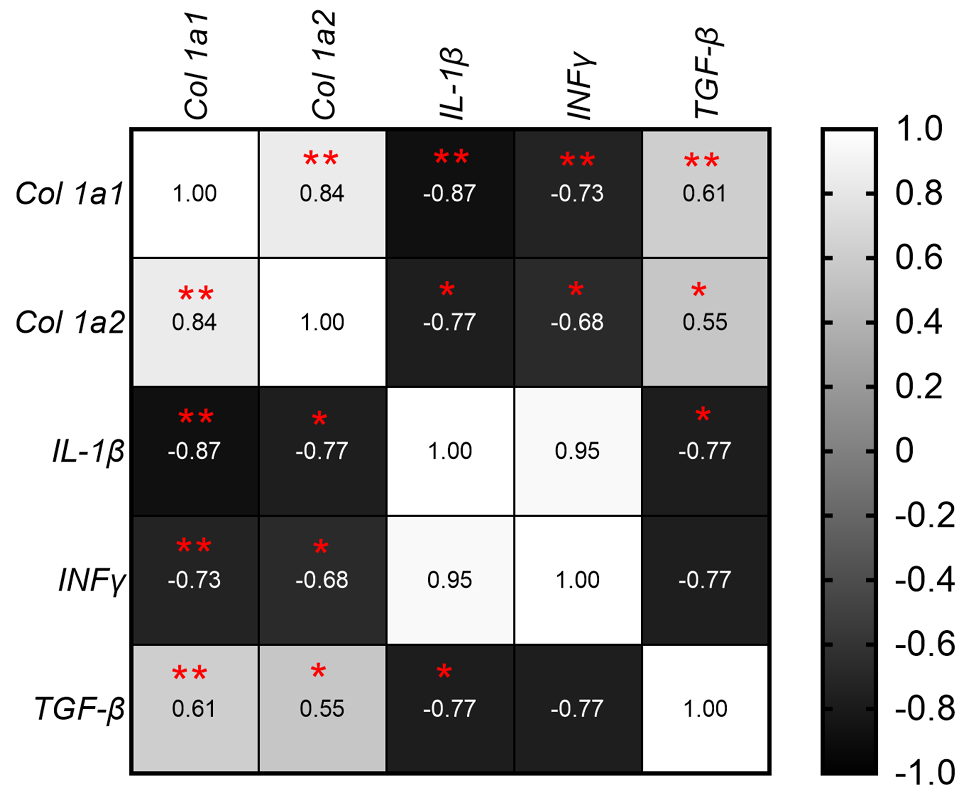
In infection trial, Significantly the regulation levels of both col 1a2 and col 1a1 is positively associated with each other (correlation coefficient =0.84). Both of col 1a2 and col 1a1 transcription levels were inversely correlated to both IL-1 β and IFN- γ genes, despite of their directional proportion to TGF-β expression. Importantly, IL-1 β expression pattern revealed an inverse correlation with TGF-β. The stated correlation between col 1a1 and immune-related genes were significantly different (p<0.01), as well as between col 1a2 and immune-related genes (P<0.05) according to asterisk demonstrated by (Fig. 4).
Discussion
Collagen is between the most abundant proteins in animal kingdom. However, it is not existing in plants as well as unicellular creatures as polysaccharides along with cellulose achieve its role . Collagen provides protect the skin by delaying absorption of both pathogens and toxins . Collagens play an important role in cellular biological functions such as cell survival, proliferation, and differentiation. They also aid in the healing of damaged bones or blood vessels and protect tissue structural integrity .
Several age-related modifications have been discovered in skin fibroblast cells in vivo that may be responsible for a decrease in collagen production in the form of collagen fibril fragmentation .
In our study, collagen was highly and significantly expressed at 9 months of age, where the Nile tilapia is mature, and started to decline at 12 months of age. Our results are in consistence with those of Takatsu et al. (1999) who stated that the mRNA level of collagen type I, which is one of the major components of collagen fibers in ligaments, declined with age that could be assigned to increased methylation sites of collagen genes. They explained their as deacetylation of histones located at the positions where DNA is methylated could be involved in suppression of gene transcription via making the chromatin structure unavailable to transcription factors .
In the same context, Fisher et al. (2008) hypothesized that old fibroblast cells have an age-dependent decrease in their capacity for collagen synthesis and jointly experience a loss of mechanical stimulation that results from diminished intact collagen fibers.
The same results were demonstrated by Podolsky et al. (2020) who demonstrated that collagen turnover decreased over the life span of tested mice, and this decrease is characterized by decreased collagen transcription, cell-mediated collagen internalization, and MRC2 degradation (mannose receptor, C-type 2), which agree with our results regarding age-related decline in collagen expression.
Our findings revealed that collagen type I genes, as a major constituent of the extracellular matrix is orchestrated with immune response in bacterial infection.
These results are in agreement with Aguiar et al. (2019) who claimed that low levels of ECM proteins (fibronectin and collagen IV) increased the permeability of the blood-brain barrier, allowing ZIKV to reach developing neural progenitor cells and disrupt neural development in infected children. Infection’s effect on ECM could result in cell death and dysregulation of ECM expression, or even tissue deposition as the case in our study where infection with A. hydrophila resulted insignificant decrease in col 1a1 and col 1a2 regulation levels compared to control non-infected groups. Concurrently, previous studies according to Bateman et al. (2009) indicated that mutations in collagen type I can affect the extracellular matrix by reducing the amount of produced collagens, which can impair molecular and supramolecular assembly via mutant collagen production or induction of endoplasmic reticulum stress, as well as the unfolded protein response. Our findings are also in line with Baumert et al. (2009) who indicated that the capacity of fibroblast cells to express both type I and III collagen and fibronectin is diminished in response to infection with C. pneumonia.
IL-1β is an important pro-inflammatory cytokine which play a major role in the bacterial infection early responses by encouraging phagocytosis, lymphocyte activation, apoptosis, and leucocytes migration . Infection studies with Gyrodactylus salaris compared IL-1β regulation in the skin of infected and healthy salmon . According to our findings, the infected salmon population had significantly higher levels of IL-1β to boost mucus secretion and thereby to enhance the possibilities for infection propagation, however the less infected population reported no significant increase , additionally, after 7 days of amoebic gill disease infection, IL-1β1 in the gills and the liver of rainbow trout significantly upregulated . IL-1β late up-regulation was also stated in Atlantic Cod at (7–60) days post-infection, and the authors propose that transcription of this gene initially depend on the differences in the challenge dosages , which support the production of IL-1β1 until 7 days post infection in different fish organs.
IFN-γ is one of the chief cytokines that plays a crucial role against intracellular bacterial infection . Our result is in consistence to IFN-γ elevated level in the skin of Atlantic cod which have uncovered the significance of these molecules, even in the quiescent state of the host cells which has a vital role in macrophages activation for expanded killing of pathogens .
TGF-β is an eminent suppressive cytokine that provides immune tolerance and controls autoimmunity . TGF-β did not follow the common transcriptional change patterns observed in the other genes studied has been reported that TGF-β revealed changes in the expression level which slightly varied from other cytokines included IL-1β1. TGF-β pathway could be repressed by IL-1β was confirmed by , which agrees with TGF-β non-significance down-regulation in this study. TGF-β might be pro- or anti-inflammatory in line with its concentration, target cells differentiation state, and the concentration of other pro-inflammatory compounds .
Infection with Mycobacterium marinum in striped bass revealed intense inflammatory reactions in collaboration with TGF-β transcription down-regulation , however, infected tilapia showed less inflammation and no more significant changes in TGF-β transcription, which is consistent with our findings. It is suggested that in fish that are sensitive to mycobacteria infection, TGF-β down-regulation may play a role in the down-regulation of inflammatory reactions that lead to extensive organ damage.
Col 1a1 regulation level is positively associated to thus of col 1a2 which is in consistence with Gistelinck et al. (2018), which showed that collagen type 1 is the main constituent of the extracellular matrix protein which is encoded by both col 1a2 and col 1a1 genes through the regulation of both the α1 and α2 chains, respectively. Besides Thiele et al. (2004) indicated that hnRNP-E is a common mRNA-binding protein factor, which has a key role in type I collagen two subunits (col 1a2 and col 1a1) mRNA stabilization.
Significantly, the transcription levels of both of col 1a2 and col 1a1 post-infection skin cells are positively correlated to TGF β which is in accordance with Ghosh et al. (2007), who demonstrated that TGF-β signals modulate the transcription levels of collagen Type I genes through Smad pathway stimulation in the skin fibroblasts, and maintain wound healing by stimulating fibrosis and extracellular matrix formation by fibroblasts .
The overall findings reveal that infected host cells principally release inflammatory IL 1β and IFN γ cytokines that employ inhibitory effects on matrix protein and fibronectin synthesis
Infection-associated IL 1β signals downregulated the transcription levels of both col 1a2 and col 1a1 (negative correlations) which is explained by Mia et al. (2014) IL 1β provokes the expression level of collagenolytic MMP1 enzyme which has a potent anti-fibrotic effect.
IFN γ upregulation decreases fibroblast proliferation and type I collagen production primarily through destabilization of collagen type 1 mRNA , which emphasis the negative association between them in this work.
TGF β regulatory properties are primarily suppressive, including antagonism of pro-inflammatory cytokines such as IL-1β, activation of NK cells, and inhibition of macrophage activation , which explain the negative association between both IL 1β and TGF β genes.
Despite the current study’s small sample size due to the lack of fund, our results gave an insight about the importance of ECM proteins (collagen type I) in tilapia different age stages and its association with immune-activity, so further studies on the other types of collagen genes and chemical analysis of collagen protein will be intended.
Conclusion
This work is the first reported study to investigate the impact of age progression and bacterial infection on the expression pattern of collagen type I genes in Nile tilapia fish (Oreochromis niloticus) and to describe the correlation between immune-related genes and ECM proteins (col 1a1- and col 1a2) in skin tissue exposed to bacterial infection. based on those findings, it is recommended to extract ECM proteins (collagen type I) from 9 months age healthy (non-infected) Nile tilapia skin for different research or/and bioindustries.
Acknowledgement
The authors wish to acknowledge the support of the Biotechnology Lab., Faculty of Aquatic and Fisheries Science, Kafrelsheikh University, Egypt, where the laboratory investigations were carried out.
Data availability statement
The paper includes all of the data that supports the results or analyses.
Funding
No funding organization provided financial support for this study.
Ethical approval
The Ethical Committee of the Institutional Animal Care and Animal Ethics Committee, Faculty of Aquatic and Fisheries Sciences, Kafrelsheikh University, approved all animal treatments and experimental procedures (approval number: IAACUC-KSU-41-2020).
Statement of conflict of interest
The authors have declared no conflict of interest.
Figures
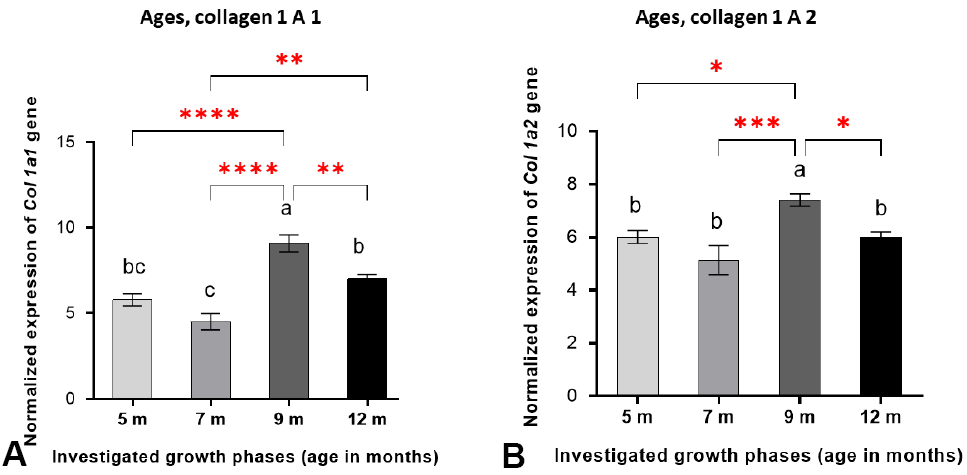
Relative expression of collagen type 1 genes at different Nile tilapia age stages skin. A) relative expression of col 1a1 gene B) relative expression of col 1a2 gene. Groups with different asterisks indicate a significance difference between them, (* when p<0.05), (** when p<0.01), (*** when p<0.001)
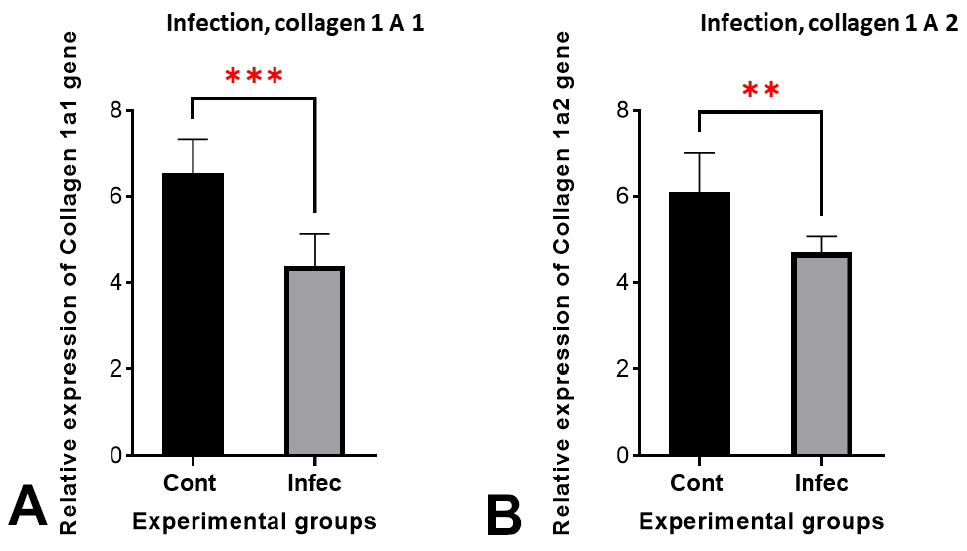
Relative expression of collagen type 1 genes in response to Aeromonas hydrophila infection. (A) col 1a1 expression in both the control and the infected group. (B) col 1a2 expression in both the control and the infected group. (** when p<0.01), (*** when p<0.001).
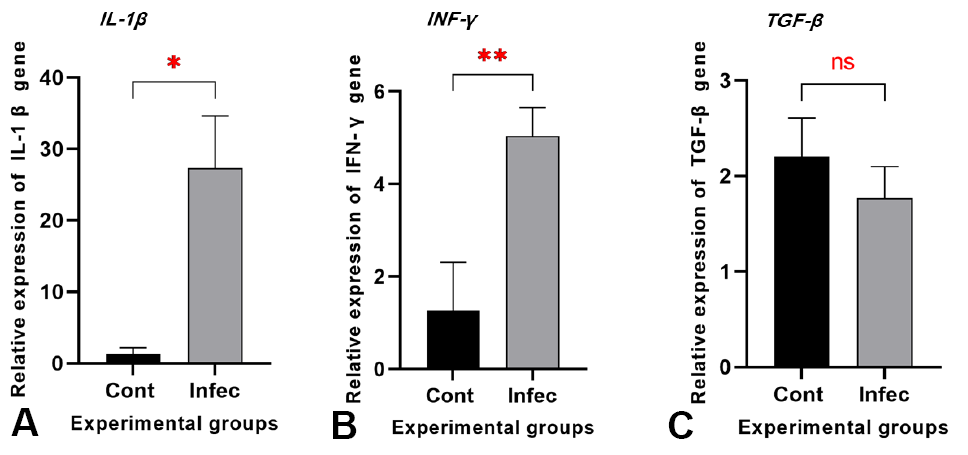
Relative expression of immune-related genes in response to Aeromonas hydrophila infection in both the control and the infected group. (A) IL-1β expression. (B) INF-γ expression. (C) TGF-β expression. Significance difference between Aeromonas hydrophila infection and control is indicated with asterisks. (p>. 0.05) for 1 asterisk, while (p> 0.01) for 2 asterisks.
References
- Abedin, M.Z., Karim, A.A., Ahmed, F., Latiff, A.A., Gan, C.Y., Che Ghazali, F. and Islam, S.M.Z., 2013. Isolation and characterization of pepsin-solubilized collagen from the integument of sea cucumber (Stichopus vastus). J. Sci. Fd. Agric., 93: 1083-1088. https://doi.org/10.1002/jsfa.5854[CrossRef]
- Adikesavalu, H., Patra, A., Banerjee, S., Sarkar, A. and Abraham, T.J., 2015. Phenotypic and molecular characterization and pathology of Flectobacillus roseus causing flectobacillosis in captive held carp Labeo rohita (Ham.) fingerlings. Aquaculture, 439: 60-65. https://doi.org/10.1016/j.aquaculture.2014.12.036[CrossRef]
- Aguiar, R.S., Pohl, F., Morais, G.L., Nogueira, F.C., Carvalho, J.B., Guida, L., Arge, L.W., Melo, A., Moreira, M.E. and Cunha, D.P., 2019. The potential role of collagens in congenital Zika syndrome: A systems biology approach. bioRxiv, 541268. https://doi.org/10.1101/541268[CrossRef]
- Bateman, J.F., Boot-Handford, R.P. and Lamande, S.R., 2009. Genetic diseases of connective tissues: Cellular and extracellular effects of ECM mutations. Nat. Rev. Genet., 10: 173-183. https://doi.org/10.1038/nrg2520[CrossRef]
- Baumert, J.R., Schmidt, K.H., Eitner, A., Straube, E. and Rödel, J.R., 2009. Host cell cytokines induced by Chlamydia pneumoniae decrease the expression of interstitial collagens and fibronectin in fibroblasts. Infect. Immun., 77: 867-876. https://doi.org/10.1128/IAI.00566-08[CrossRef]
- Benus, G.F., Wierenga, A.T., De Gorter, D.J., Schuringa, J.J., Van Bennekum, A.M., Drenth-Diephuis, L., Vellenga, E. and Eggen, B.J., 2005. Inhibition of the transforming growth factor β (TGFβ) pathway by interleukin-1β is mediated through TGFβ-activated kinase 1 phosphorylation of SMAD3. Mol. Biol. Cell, 16: 3501-3510. https://doi.org/10.1091/mbc.e04-11-1033[CrossRef]
- Bou-Gharios, G., Abraham, D. and De Crombrugghe, B. 2020. Type I collagen structure, synthesis, and regulation. In: Principles of bone biology. Elsevier. https://doi.org/10.1016/B978-0-12-814841-9.00013-0[CrossRef]
- Bridle, A.R., Morrison, R.N. and Nowak, B.F., 2006. The expression of immune-regulatory genes in rainbow trout, Oncorhynchus mykiss, during amoebic gill disease (AGD). Fish Shellfish Immunol., 20: 346-364. https://doi.org/10.1016/j.fsi.2005.05.014[CrossRef]
- Buehler, M.J., 2006. Nature designs tough collagen: Explaining the nanostructure of collagen fibrils. Proc. natl. Acad. Sci., 103: 12285-12290. https://doi.org/10.1073/pnas.0603216103[CrossRef]
- Cai, W., Kumar, S., Navaneethaiyer, U., Caballero-Solares, A., Carvalho, L.A., Whyte, S.K., Purcell, S.L., Gagne, N., Hori, T.S. and Allen, M., 2022. Transcriptome analysis of atlantic salmon (Salmo salar) skin in response to sea lice and infectious salmon anemia virus co-infection under different experimental functional diets. Front. Immunol., 5535. https://doi.org/10.3389/fimmu.2021.787033[CrossRef]
- Caipang, C.M.A., Lazado, C.C., Brinchmann, M.F., Rombout, J.H. and Kiron, V., 2011. Differential expression of immune and stress genes in the skin of Atlantic cod (Gadus morhua). Comp. Biochem. Physiol. D Genom. Proteom., 6: 158-162. https://doi.org/10.1016/j.cbd.2011.01.001[CrossRef]
- Capati, M.L.F., Nakazono, A., Yamamoto, K., Sugimoto, K., Yanagiguchi, K., Yamada, S. and Hayashi, Y., 2016. Fish collagen promotes the expression of genes related to osteoblastic activity. Int. J. Polymer Sci., 2016. https://doi.org/10.1155/2016/5785819[CrossRef]
- Dawood, M.A., Moustafa, E.M., Elbialy, Z.I., Farrag, F., Lolo, E.E., Abdel-Daim, H.A., Abdel-Daim, M.M. and Van Doan, H., 2020. Lactobacillus plantarum L-137 and/or β-glucan impacted the histopathological, antioxidant, immune-related genes and resistance of Nile tilapia (Oreochromis niloticus) against Aeromonas hydrophila. Res. Vet. Sci., 130: 212-221. https://doi.org/10.1016/j.rvsc.2020.03.019[CrossRef]
- El-Deen, A.N., Dorgham-Sohad, M., Hassan-Azza, H. and Hakim, A., 2014. Studies on Aeromonas hydrophila in cultured Oreochromis niloticus at Kafr El Sheikh Governorate, Egypt with reference to histopathological alterations in some vital organs. World J. Fish Mar. Sci., 6: 233-240.
- Elbialy, Z.I., Salah, A.S., Elsheshtawy, A., Rizk, M., Abualreesh, M.H., Abdel-Daim, M.M., Salem, S.M., Askary, A.E. and Assar, D.H., 2021. Exploring the multimodal role of yucca schidigera extract in protection against chronic ammonia exposure targeting: Growth, metabolic, stress and inflammatory responses in nile tilapia (Oreochromis niloticus L.). Animals, 11: 2072. https://doi.org/10.3390/ani11072072[CrossRef]
- Ellingsen, T., Inami, M., Gjessing, M.C., Van Nieuwenhove, K., Larsen, R., Seppola, M., Lund, V. and Schrøder, M.B., 2011. Francisella noatunensis in Atlantic cod (Gadus morhua L.); waterborne transmission and immune responses. Fish Shellfish Immunol., 31: 326-333. https://doi.org/10.1016/j.fsi.2011.05.021[CrossRef]
- Ennaas, N., Hammami, R., Gomaa, A., Bedard, F., Biron, É., Subirade, M., Beaulieu, L. and Fliss, I., 2016. Collagencin, an antibacterial peptide from fish collagen: Activity, structure and interaction dynamics with membrane. Biochem. Biophys. Res. Commun., 473: 642-647. https://doi.org/10.1016/j.bbrc.2016.03.121[CrossRef]
- Fisher, G.J., Varani, J. and Voorhees, J.J., 2008. Looking older: Fibroblast collapse and therapeutic implications. Arch. Dermatol., 144: 666-672. https://doi.org/10.1001/archderm.144.5.666[CrossRef]
- Fratzl, P., 2008. Collagen: Structure and mechanics, an introduction. Collagen. Springer. https://doi.org/10.1007/978-0-387-73906-9[CrossRef]
- Gelse, K., Pöschl, E. and Aigner, T., 2003. Collagens structure, function, and biosynthesis. Adv. Drug Delivery Rev., 55: 1531-1546. https://doi.org/10.1016/j.addr.2003.08.002[CrossRef]
- Ghosh, A.K., Mori, Y., Dowling, E. and Varga, J., 2007. Trichostatin A blocks TGF-β-induced collagen gene expression in skin fibroblasts: Involvement of Sp1. Biochem. biophys. Res. Commun., 354: 420-426. https://doi.org/10.1016/j.bbrc.2006.12.204[CrossRef]
- Gistelinck, C., Kwon, R.Y., Malfait, F., Symoens, S., Harris, M.P., Henke, K., Hawkins, M.B., Fisher, S., Sips, P. and Guillemyn, B., 2018. Zebrafish type I collagen mutants faithfully recapitulate human type I collagenopathies. Proc. natl. Acad. Sci., 115: E8037-E8046. https://doi.org/10.1073/pnas.1722200115[CrossRef]
- Gordon, M.K. and Hahn, R.A., 2010. Collagens. Cell Tissue Res., 339: 247-257. https://doi.org/10.1007/s00441-009-0844-4[CrossRef]
- Harms, C.A., Howard, K.E., Wolf, J.C., Smith, S.A. and Kennedy-Stoskopf, S., 2003. Transforming growth factor-β response to mycobacterial infection in striped bass Morone saxatilis and hybrid tilapia Oreochromis spp. Vet. Immunol. Immunopathol., 95: 155-163. https://doi.org/10.1016/S0165-2427(03)00138-7[CrossRef]
- Hayashi, Y., Yamada, S., Guchi, K.Y., Koyama, Z. and Ikeda, T., 2012. Chitosan and fish collagen as biomaterials for regenerative medicine. Adv. Fd. Nutr. Res., 65: 107-120. https://doi.org/10.1016/B978-0-12-416003-3.00006-8[CrossRef]
- Hu, Z., Yang, P., Zhou, C., Li, S. and Hong, P., 2017. Marine collagen peptides from the skin of Nile tilapia (Oreochromis niloticus): Characterization and wound healing evaluation. Mar. Drugs, 15: 102. https://doi.org/10.3390/md15040102[CrossRef]
- Huang, C.Y., Kuo, J.M., Wu, S.J. and Tsai, H.T., 2016. Isolation and characterization of fish scale collagen from tilapia (Oreochromis sp.) by a novel extrusion hydro extraction process. Fd. Chem., 190: 997-1006. https://doi.org/10.1016/j.foodchem.2015.06.066[CrossRef]
- Kim, S.K., Ngo, D.H. and Vo, T.S., 2012. Marine fish-derived bioactive peptides as potential antihypertensive agents. Adv. Fd. Nutr. Res., 65: 249-260. https://doi.org/10.1016/B978-0-12-416003-3.00016-0[CrossRef]
- Li, C., Beck, B., Su, B., Terhune, J. and Peatman, E., 2013. Early mucosal responses in blue catfish (Ictalurus furcatus) skin to Aeromonas hydrophila infection. Fish Shellfish Immunol., 34: 920-928. https://doi.org/10.1016/j.fsi.2013.01.002[CrossRef]
- Li, Y., Lei, D., Swindell, W.R., Xia, W., Weng, S., Fu, J., Worthen, C.A., Okubo, T., Johnston, A. and Gudjonsson, J.E., 2015. Age-associated increase in skin fibroblast–derived prostaglandin E2 contributes to reduced collagen levels in elderly human skin. J. Invest. Dermatol., 135: 2181-2188. https://doi.org/10.1038/jid.2015.157[CrossRef]
- Lin, H.C., Alashi, A.M., Aluko, R.E., Sun Pan, B. and Chang, Y.W., 2017. Antihypertensive properties of tilapia (Oreochromis spp.) frame and skin enzymatic protein hydrolysates. Fd. Nutr. Res., 61: 1391666. https://doi.org/10.1080/16546628.2017.1391666[CrossRef]
- Lindenstrøm, T., Sigh, J., Dalgaard, M. and Buchmann, K., 2006. Skin expression of IL-1β in East Atlantic salmon, Salmo salar L., highly susceptible to Gyrodactylus salaris infection is enhanced compared to a low susceptibility Baltic stock. J. Fish Dis., 29: 123-128. https://doi.org/10.1111/j.1365-2761.2006.00696.x[CrossRef]
- Mia, M.M., Boersema, M. and Bank, R.A., 2014. Interleukin-1β attenuates myofibroblast formation and extracellular matrix production in dermal and lung fibroblasts exposed to transforming growth factor-β1. PLoS One, 9: e91559. https://doi.org/10.1371/journal.pone.0091559[CrossRef]
- Moreno, C.H.M., Montero, G.P., Guillen, G., Fernández, M.F., Mørkøre, T. and Borderías, A.J., 2012. Collagen characteristics of farmed Atlantic salmon with firm and soft fillet texture. https://doi.org/10.1016/j.foodchem.2012.02.160[CrossRef]
- Nan, X., Ng, H.H., Johnson, C.A., Laherty, C.D., Turner, B.M., Eisenman, R.N. and Bird, A., 1998. Transcriptional repression by the methyl-CpG-binding protein MeCP2 involves a histone deacetylase complex. Nature, 393: 386-389. https://doi.org/10.1038/30764[CrossRef]
- Okazaki, E. and Osako, K., 2014. Isolation and characterization of acid-soluble collagen from the scales of marine fishes from Japan and Vietnam. Fd. Chem., 149: 264-270. https://doi.org/10.1016/j.foodchem.2013.10.094[CrossRef]
- Pfaffl, M.W., 2001. A new mathematical model for relative quantification in real-time RT–PCR. Nucl. Acids Res., 29: e45-e45. https://doi.org/10.1093/nar/29.9.e45[CrossRef]
- Podolsky, M.J., Yang, C.D., Valenzuela, C.L., Datta, R., Huang, S.K., Nishimura, S.L., Dallas, S.L., Wolters, P.J., Le Saux, C.J. and Atabai, K., 2020. Age-dependent regulation of cell-mediated collagen turnover. JCI Insight, 5. https://doi.org/10.1172/jci.insight.137519[CrossRef]
- Qiang, J., He, J., Yang, H., Xu, P., Habte-Tsion, H.M., Ma, X. and Zhu, Z., 2016. The changes in cortisol and expression of immune genes of GIFT tilapia Oreochromis niloticus (L.) at different rearing densities under Streptococcus iniae infection. Aquacult. Int., 24: 1365-1378. https://doi.org/10.1007/s10499-016-9995-y[CrossRef]
- Rasmussen, R., 2001. Quantification on the light cycler. Rapid cycle real-time PCR. Springer. https://doi.org/10.1007/978-3-642-59524-0_3[CrossRef]
- Reyes-Cerpa, S., Maisey, K., Reyes-López, F., Toro-Ascuy, D., Sandino, A.M. and Imarai, M., 2012. Fish cytokines and immune response. New Adv. Contrib. Fish Biol., pp. 3-57. https://doi.org/10.5772/53504[CrossRef]
- Severin, V.I. and El-Matbouli, M., 2007. Relative quantification of immune-regulatory genes in two rainbow trout strains, Oncorhynchus mykiss, after exposure to Myxobolus cerebralis, the causative agent of whirling disease. Parasitol. Res., 101: 1019-1027. https://doi.org/10.1007/s00436-007-0582-z[CrossRef]
- Silvipriya, K., Kumar, K.K., Bhat, A., Kumar, B.D., John, A. and Lakshmanan, P., 2015. Collagen: Animal sources and biomedical application. J. appl. Pharm. Sci., 5: 123-127. https://doi.org/10.7324/JAPS.2015.50322[CrossRef]
- Singh, P., Benjakul, S., Maqsood, S. and Kishimura, H., 2011. Isolation and characterisation of collagen extracted from the skin of striped catfish (Pangasianodon hypophthalmus). Fd. Chem., 124: 97-105. https://doi.org/10.1016/j.foodchem.2010.05.111[CrossRef]
- Standen, B., 2015. The effect of dietary probiotics on Nile tilapia, Oreochromis niloticus, health and growth performance. PhD thesis, Faculty of Science and Environment, Plymouth University, UK. https://dx.doi.org/10.24382/3312[CrossRef]
- Swain, B., Basu, M., Lenka, S.S., Das, S., Jayasankar, P. and Samanta, M., 2015. Characterization and inductive expression analysis of interferon gamma-related gene in the Indian major carp, rohu (Labeo rohita). DNA Cell Biol., 34: 367-378. https://doi.org/10.1089/dna.2014.2656[CrossRef]
- Takatsu, M., Uyeno, S., Komura, J.I., Watanabe, M. and Ono, T., 1999. Age-dependent alterations in mRNA level and promoter methylation of collagen α1 (I) gene in human periodontal ligament. Mech. Ageing Dev., 110: 37-48. https://doi.org/10.1016/S0047-6374(99)00041-X[CrossRef]
- Tang, J. and Saito, T., 2015. Effect of type I collagen derived from tilapia scale on odontoblast-like cells. Tissue Eng. Regenerat. Med., 12: 231-238. https://doi.org/10.1007/s13770-014-0114-8[CrossRef]
- Thiele, B.J., Doller, A., Kähne, T., Pregla, R., Hetzer, R. and Regitz-Zagrosek, V., 2004. RNA-binding proteins heterogeneous nuclear ribonucleoprotein A1, E1, and K are involved in post-transcriptional control of collagen I and III synthesis. Circ. Res., 95: 1058-1066. https://doi.org/10.1161/01.RES.0000149166.33833.08[CrossRef]
- Wang, B., Wang, Y.M., Chi, C.F., Luo, H.Y., Deng, S.G. and Ma, J.Y., 2013. Isolation and characterization of collagen and antioxidant collagen peptides from scales of croceine croaker (Pseudosciaena crocea). Mar. Drugs, 11: 4641-4661. https://doi.org/10.3390/md11114641[CrossRef]
- Wang, L., An, X., Yang, F., Xin, Z., Zhao, L. and Hu, Q., 2008. Isolation and characterisation of collagens from the skin, scale and bone of deep-sea redfish (Sebastes mentella). Fd. Chem., 108: 616-623. https://doi.org/10.1016/j.foodchem.2007.11.017[CrossRef]
- Xia, W., Hammerberg, C., Li, Y., He, T., Quan, T., Voorhees, J.J. and Fisher, G.J., 2013. Expression of catalytically active matrix metalloproteinase-1 in dermal fibroblasts induces collagen fragmentation and functional alterations that resemble aged human skin. Aging Cell, 12: 661-671. https://doi.org/10.1111/acel.12089[CrossRef]
- Xu, L., Dong, W., Zhao, J. and Xu, Y., 2015. Effect of marine collagen peptides on physiological and neurobehavioral development of male rats with perinatal asphyxia. Mar. Drugs, 13: 3653-3671. https://doi.org/10.3390/md13063653[CrossRef]
- Yamada, S., Yamamoto, K., Ikeda, T., Yanagiguchi, K. and Hayashi, Y., 2014. Potency of fish collagen as a scaffold for regenerative medicine. BioMed. Res. Int., 2014. https://doi.org/10.1155/2014/302932[CrossRef]
- Yang, C.G., Wang, X.L., Tian, J., Liu, W., Wu, F., Jiang, M. and Wen, H., 2013. Evaluation of reference genes for quantitative real-time RT-PCR analysis of gene expression in Nile tilapia (Oreochromis niloticus). Gene, 527: 183-192. https://doi.org/10.1016/j.gene.2013.06.013[CrossRef]
- Yuan, J.S., Reed, A., Chen, F. and Stewart, C.N., 2006. Statistical analysis of real-time PCR data. BMC Bioinf., 7: 1-12. https://doi.org/10.1186/1471-2105-7-85[CrossRef]
- Zarini, A.N., 2016. Using fruit enzymes for extraction and characterisation of collagen from black Tilapia (Oreochromis niloticus) skin. Universiti Sains Malaysia.
Services
Article usage statistics
Loading…