ResearchersLinks

Research Article · Volume 4, Issue 4, Pages 118–122, 22 November 2016 · Open Access

Age at First Calving for Crossbreed Cows in Urban and Suburban Areas of Bobo-Dioulasso in Burkina Faso

· · ·

Article Info ⌄
Journal:
Journal of Animal Health and Production
Published:
22 November 2016

From the article

  • This study done in Bobo-Dioulasso urban and suburban areas on the crossbreed cows from the local inseminated cows with the exotic breed bull semen helps to assess the age at first calving, to identify the different crossbreeding types and study the influence of different factors on AFC.
  • Crossing the Montbeliard and the Fulani Zebu on the one hand, and on the other hand the Alps Brown and the Fulani Zebu gave more sexually precocious crossbreeds.
  • Among the local breed cows used, the Fulani zebu is better suited to crossbreeding.
  • Thus, to optimize the dairy farms profitability and calf per cow, cattle-breeders must promote inseminations of Fulani Zebu cows with especially the Montbeliard and Alp Brown bull semens.

Selected from the article's own text.

Abstract

Madjina Tellah, Seydou Blagna, Youssouf Mopaté Logténé, Hamidou Boly

Higher National Institute of Sciences and Techniques of Abéché (INSTA) ex University Institute of Sciences and Techniques of Abéché (IUSTA), BP 130 Abéché, CHAD; 2Polytechnic University of Bobo-Dioulasso (UPB). 01 BP 1091 Bobo-Dioulasso, BURKINA FASO; 3Research in Livestock Development Institut (IRED) ex Veterinary Research and Zootechnical Laboratory (LRVZ) Farcha BP. 433, N’Djamena, CHAD.
 
Abstract | Age at first calving for twenty crossbreed cows was estimated at 35.62 ± 11.04 months by using artificial inseminations sheets and calving records on three cattle farms in urban and suburban areas of Bobo-Dioulasso. The effects of crossbreeding type, bull races, crossbreed cow generations and farm sites were analyzed. However, crossbreeds have been more precocious than the local cattles. In addition, the inseminations of Fulani zebu using Montbeliard and Alps Brown semens, the 2nd generation of crossbreed cows and the increase in farm level intensification were favourable for crossbreeds sexual precocity (p <0.05). However, to the better selection guide of cattle-breeders, calving interval and the milk production level must be assessed in order to identify the crossbreed type for optimal and profitable operations.

Keywords | First calving, Crossbreed cow, Artificial insemination, Bobo-Dioulasso, Burkina Faso


Introduction

Cows in African tropical areas are known to have low reproductive performances. Age at first calving reported by several authors happens after 45 months , 2015b; ; ; . This sexual precocity delay results from a combination of genetic, biological, environmental factors and those associated with herd management (Adamou N’Diaye et al., 2003). The suburban farming development geared towards milk production with concern for return on investment in this sector requires very high improved reproductive and productive factors to sustain these operations. Investment in Artificial Insemination (AI) program and the associated reproduction control techniques have reduced the age at first calving among the cattle in Africa and the duration of the unproductive period in ruminants after dropping . Therefore, the heifer precocities at first calving are a critical factor in improving all product types (milk, meat etc.) and genetic improvement in cattle .

This study aims to assess the Age at First Calving (AFC) of crossbreed cows in the sub humid area of Bobo-Dioulasso in Burkina Faso. Specifically, it is to identify the main types of crossbreeding used with a view to promote those effective ones to be recommended to the producers.

Material and Methods

Study Zone

The study regards the suburban area of Bobo-Dioulasso (Burkina Faso) where an improved cattle rearing is booming. This city is the administrative centre of the Hauts-Bassins Region in the western part of the country. The climate is of south Sudanese type with two seasons: 6-months (May to October) of rainy season and 6 months (from November to April) of dry season. The annual rainfall ranges from 900 to 1200 mm and temperatures between 10°C and 37°C. The most important hydrographical system consists of the Mouhoum basin that drains the entire region with a permanent water source, widely used for agriculture and livestock. It is a high grass area dominated by Andropogon ascinodi, Loudetia togoensis, Diheteropogon hagerupii, Imperata cylindrica, Schizachyrium brevifolium, Oryza barthii and Acroceras amplectens. It is a well wooded area with woodlands infested by tsetse flies, the African animal trypanosomiasis vectors. The region is major cotton, cereals (sorghum, millet and maize) and yam producers. Moreover, the presence of large orchards (mango, citrus and cashew trees, etc.) and seasonal migrants in the area during the dry season, make it an area for agrosylvopastoral activities and corresponds to the area of sedentary local breed rearing.

Animals and Cattle Management

The study focused on the reproduction monitoring of twenty (20) crossbreed cows resulting from the interbreeding through the artificial insemination between local breed cows (Gudali Zebu and Fulani Zebu) and exotic breed bulls (Holstein, Alps Brown, Tarentaise, Montbeliard). These crossbreeds were born between 1999 and 2010 and gave their first calf between 2002 and 2012 on three improved stock farms in urban and suburban areas of Bobo-Dioulasso. Each of these farms has about fifty crossbreed cows in production. The first farm is located in an urban area, the second 10 Km away at the south exit and the third 60 Km away at the east exit of Bobo-Dioulasso. Preliminary surveys between July and November 2012 in these areas helped to select these three farms which have a cattle register (heat and artificial insemination monitoring sheets). Events related to individual monitoring of animal reproduction such as calving dates, dates of the first heats and inseminations were recorded daily by the cattlemen and the inseminators. The exploitation of these documents made it possible to choose twenty (20) first calving’s corresponding to the first services. These farms are characterized by the presence of shed, a herd health monitoring, a guided reproduction mode (mainly AI, for lack of a selected bull), the concentrate supplies (cotton cake or cottonseed and industrial malt) in the ration feeding and intensive distribution of silage and agricultural by products. The only aim of this operation type is the production and marketing of manually processed milk, twice a day (morning and evening). The concentrates are served to the animals on their return from grazing and in the morning at milking time.

Statistical Analysis

Data extracted from the analysis of herd records were entered in Excel. The descriptive statistical analysis of the age at first calving (calculation of frequencies, means, standard deviations, minimum and maximum) was made with the XLSTAT software (6.1.9 release). In order to better understand the effect of the crossbreeding on sexual precocity of hybrid animals, the AFC was analyzed according to: crossbreed type, race of sire parents (bull and inseminated local cows), hybridization level and stock farms. These parameters were analyzed by ANOVA and the results were compared using the Newman-Keuls test. Differences were considered significant for p < 0.05.

Results and Discussion

The mean age at first calving for all breeds put together was 35.62 ± 11.04 months, representing approximately 3 years (2 years 11 months 19 days ± 11 months 1 day). The minimum was 21.20 months and the maximum was 38.58 months. The most precocious heifers calved within 2 years (21.20 months). For 50% of heifers, first calving is at 26.98 months. The first services were held on average at 26.79 ± 10.01 months (13.30 to 44.83 months).

The mean AFC of the crossbreeds was lower than those reported among the Zebu under the tropics at more than 40 months reported in many studies ; , 2015b; ; ; . This shows that crossbreed cows are sexually more precocious than tropical cattle . Some authors have reported results very close to our observation on different crossbreeds in Africa, notwithstanding cow breeds used in the experiment: 34 months among the Montbeliard crossbreeds in Algeria and Morocco , 35.26 ± 0.43 months in the Girolando crossbreed in Benin . It was the same with the Holstein-Friesian crossbreed cows in Ethiopia at 36.4 ± 1.7 months, the Borgou and Lagunaire breeds at 36.1 ± 6.30 months in Benin (Adamou-Ndiaye et al., 2003) and in the Azawak Zebu at 36.5 ± 4.10 and 36.97 ± 13 months in Niger , 1997).

Our observation was greater than those reported by Genzebu et al. (2016) among crossbreed cows in Kenya (26.9 ± 5.4 and 27.0 ± 3.7 months). It was slightly better than the observations by Ngodigha et al. (2009) of 30.7 ± 2.5 months among crossbreeds (Holstein x Bunadji) in Nigeria, Ben Salem et al. (2009) of 30.7 ± 4.12 months in Holstein in Tunisia and Sraïri and Mousili (2014) of 30 months in Montbeliard in Morocco. Some variation factors of this AFC were analyzed in order to attain the comments.

Crossbreeding Type

Among the different crossbreeding types identified (Table 1), the Fulani Zebu (FZ) inseminated with semen from Montbeliard (MB x FZ) and Alps Brown (AB x FZ) have produced the most precocious corssbreeds (first calving at 2 years) (5%). While, the inseminations of Fulani Zebu cows with the semen from Holstein (HT x FZ) and from Tarentaise (T x FZ) then the insemination of Gudali Zebu cows with semen from Montbeliard (MB x GZ) have produced the latest precocious crossbreed cows.

Table 1: Age at first calving (months) according to crossbreeding type in dairy cattle farms in the area of Bobo-Dioulasso in Burkina Faso

Crossing

AFC

(Means ± SD)

Min

Max

Montbeliarde x

Fulani Zebu (n=4)

23.95a ± 1.26

21.20

32.100

Alps Brown x

Fulani Zebu (n=4)

24.51a ± 4.66

21.47

32.53

Holstein x Fulani Zebu (n=4)

33.90ab ± 8.09

26.10

44.67

Monbeliarde x

Gudali Zebu (n=4)

43.34b ± 13.94

32.90

63.90

Tarentaise x

Fulani Zebu (n=4)

45.09b ± 8.73

36.87

54.33

AFC: Age at First Calving; Min: Minimum; Max: Maximum; SD: Standard Deviation; n: No. of animals; a, b: Means with different superscript vary significantly (P< 0.05)

These observations were below 30 months reported among Montbeliard in Morocco , 30.7 ± 2.5 months among Holstein x Bunadji crossbreeds in Nigeria and 30.7 ± 4.12 months in Holstein in Tunisia (Ben Salem et al., 2009). Hybrids from H x FZ crossing had their first calf at 3 years while those from MB x GZ and T x FZ crossings were the latest with first calving at about 4 years. Sexual maturity of these last two categories of crossbreeds was similar to what has been reported among the crossbreeds in Ethiopia .

Race of Sire Bulls

Considering the bull breeds for different hybridization types, the crossbreeds from the Alp Brown semens are sexually more precocious than other ameliorative breeds (Table 2).

Table 2: Age at first calving (months) according to breed of sire bull in dairy cattle farms in the area of Bobo-Dioulasso in Burkina Faso

Bulls breed

AFC

(Means ± SD)

Min

Max

Alps Brown (n=4)

24.51a ± 2.91

21.47

27.27

Hostein (n=4)

33.90ab ± 8.09

26.70

63.90

Montbeliard (n=8)

36.88ab ± 14.83

21.20

63.90

Tarentaise (n=4)

45.09b ± 8.73

36.87

54.33

For abbreviations see Table 1

The first calving by crossbreed cows from Alp Brown bulls had their first calving at 24.51 ± 2.91 months against 45.09 ± 8.73 months by those from Tarentaise bulls. The difference between the sire bull breeds shows a significant improvement in sexual precocity of heifers from the Alp Brown bulls (p <0.05). Crossbreeds from Alps Brown were considered the most precocious due to MB x GZ crossing. However, Gudali Zebu blood may be the cause of delayed sexual maturity of the crossbreeds compared to MB x FZ crossing which was the best interbreeding (Table 1).

However, precocity in the Alp Brown bulls was slightly lower than that of the crossbreeds in Kenya (26.9 ± 5.4 and 27.0 ± 3.7 months) reported by Genzebu et al. (2016). This precocity was better than that reported by other authors on different crossbreeds: 30 months in Montbeliard in Morocco , 30.7 ± 2.5 months in Holstein crossbreeds in Nigeria and 30.7 ± 4.12 months in the Holstein in Tunisia (Ben Salem et al., 2009). After analyzing the benefits of local breeds in the crossings, cattle-breeders in Bobo-Dioulasso could have possible crossbreeding choices to promote for their profitable operations.

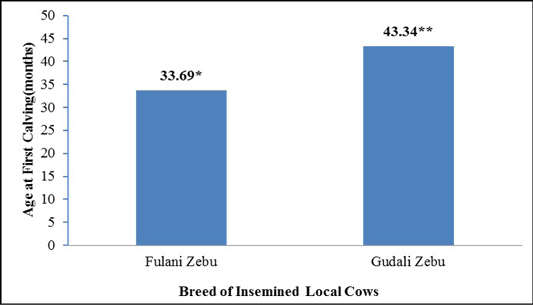
Figure 1: Age at first calving of crossbreeds according to breed of local cows in dairy cattle farms in the area of Bobo-Dioulasso (Burkina Faso). Label bars with the different number of asterisks (*) vary significantly (P< 0.05)

Breed of Inseminated Local Cows

Figure 1 indicates that the crossbreeds from Fulani Zebu were more precocious (33.69 months at first calving) than those from Gudali zebu (43.34 months) (p < 0.05). Crossbreeding exotic bulls with Fulani Zebu cows accelerates sexual precocity compared with the Gudali Zebu. The Fulani Zebu is better suited to the crossbreeding. The cattle breed effects on the AFC duration was in agreement with the other author observations on African cattles (Adamou-Ndiaye et al., 2002; .

Crossbreed Generation

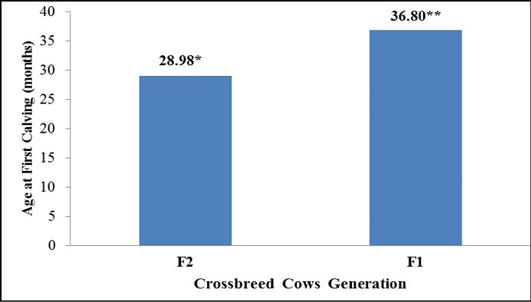
The interbreeding level indicated that the 2nd generation (G2) crossbreeds were more precocious than those of the 1st generation (G1) (p <0.05; Figure 2).

The results of Figure 2 show a lower AFC in the 2nd generation than the first one. This is explained by the increase in the percentage of improved breed genes. Rahman et al. (2016) reported this difference of AFC following the cattle genotypes in Bangladesh.

Figure 2: Age at first calving based on crossbreed generations in dairy cattle farms in the area of Bobo-Dioulasso (Burkina Faso). Label bars with the different number of asterisks (*) vary significantly (P< 0.05)

The Farm

Depending on stock farms, it appears in Table 3 that heifers on farm 3 were more precocious (28.43 months at first calving) than those on the other two farms (over 40 months) and the AFC was closely correlated with the first services (R² = 0.99; p <0.0001).

Table 3: Age at first calving (months) according to dairy stock farms in the Bobo-Dioulasso area (Burkina Faso)

Farm

AFC (Means ± SD)

Min

Max

1 (n=5)

40.01a ± 14.18

26.70

63.90

2 (n=6)

42.75a ± 8.73

31.47

54.33

3 (n=9)

28.43b ± 5.74

21.20

38.33

For abbreviations see Table 1

This result is explained by the stock farm intensification levels. The farm 3 has more feed input available than the other two farms. Sexual precocity in cattle is also linked to the breeding conditions but especially to the herd feeding habit. Several authors have reported the rearing environment influence on the reproductive performances in Africa , 2003; . The influence of the stockbreeding bad handling on crossbreed sexual precocities was observed by Genzebu et al. (2016). These authors reported that the genetic improvement of cattle reproductive performances must go through livestock management control.

Conclusion

This study done in Bobo-Dioulasso urban and suburban areas on the crossbreed cows from the local inseminated cows with the exotic breed bull semen helps to assess the age at first calving, to identify the different crossbreeding types and study the influence of different factors on AFC. The general conclusion is that the crossbreeding has reduced the age at first calving. Crossing the Montbeliard and the Fulani Zebu on the one hand, and on the other hand the Alps Brown and the Fulani Zebu gave more sexually precocious crossbreeds. Those from Holstein bulls and Fulani Zebu then the Montbeliard and Gudali zebu were relatively precocious. Crossbreeds from the Tarentaise and Fulani Zebu crossing were much late. Among the local breed cows used, the Fulani zebu is better suited to crossbreeding. Thus, to optimize the dairy farms profitability and calf per cow, cattle-breeders must promote inseminations of Fulani Zebu cows with especially the Montbeliard and Alp Brown bull semens. Furthermore, special attention should be paid to the food monitoring in order to enhance the crossbreed growths and reduce unproductive periods. However, further studies to assess the level of milk production and calving interval will be needed to better guide the cattle-breeders on the judicious choice of animals to exploit. Notwithstanding the small sample in this study, the results will be useful for further investigations on large sample of animals in order to reach a more definite conclusion.

Acknowledgements

We express our gratitude to the cattle-breeders and drovers in the study area for taking part in the realization of this survey and to Dr Alexis Mouangué Nanimina for English proofreading.

Conflict of Interest

No conflict of interest.

Authors’ Contribution

The survey formularies preparation, the data collection in farms, the data processing, the manuscript writing and submission were assured by Madjina Tellah. The farm identifications to be assured by Seydou Blagna. Then, he was associated in the survey and the manuscript writing. The manuscript writing plan was validated by Mopate Logtane Youssouf who assured afterward the manuscript revision up to its final version and proposed the review in which the manuscript should be submitted. The research protocol was validated by Boly Hamidou and he oversaw of the survey and approved the manuscript before its submission.

References

  1. Achard E, Chanono M (1997). Mortalité et performances de reproduction chez le zébu Azaouak à la station de Toukounous, Niger (1986-1992). Revue d’Élevage et de Médecine vétérinaire des Pays tropicaux. 50(4): 325-333.
  2. Achard E, Chanono M (2006). Exemple d’une gestion pastorale réussie au Sahel: la station d’élevage de Toukounous (Niger). Sécheresse. 17(1-2): 76-82.
  3. Adamou-N’Diaye M, Gbangboché AB, Daouda I (2003). Effet du système de production sur l’âge au premier vêlage chez la vache Borgou au Bénin. – Étude rétrospective. Tropicultura. 21(2): 51-55.
  4. Adamou-N’Diaye M, Gbangboché AB, Ogodja OJ, Hanzen C (2002). Fécondité de la vache Borgou au Bénin: effet de l’âge au premier vêlage sur l’intervalle entre vêlages. Revue d’Élevage et de Médecine vétérinaire des Pays tropicaux. 55(2): 159-163.
  5. Bashir HHA, El Zubeir IEM (2013). Milk production and reproduction performance of Baggara cattle raised under extensive and semi-extensive systems in South Kordofan State, Sudan. J. Anim. Prod. Adv. 3(5): 192-202.
  6. Bayemi PH, Bryant MJ, Perera BMAO, Mbanya JN, Cavestany D, Webb EC (2005). Milk production in Cameroon: A review. Livest. Res. Rural Develop. 17(6): 60. Retrieved from http://www.Irrd.org/Irrd17/6/baye17060.htm. (Accessed on November 26, 2014,)
  7. Ben-Salem M, Bouraoui R, Hammami M. (2009). Performances reproductives et longévité moyennes de la vache Frisonne-Holstein en Tunisie. Rencontre Recherche Ruminants.16: 321.
  8. Bodin L, Elsen JM, Hanocq E, François D, Lajous D, Manfredi E, Mialon MM, Boichard D, Foulley JL, San-Cristobal-Gaudy M, Teyssier J, Thimonnier J, Chemineau P (1999). Génétique de la reproduction chez les ruminants. INRA Prod. Anim. 12(2): 87-100.
  9. Doko AS, Gbégo-Tossa I, Tobada P, Mama-Yari H, Lokossou R, Tchobo A, Alkoiret TI (2012). Performances de reproduction et de production laitière des bovins Girolando à la ferme d’élevage de Kpinnou au sud-ouest du Bénin, Bulletin de la Recherche Agronomique du Bénin (BRAB), (Numéro spécial: élevage et faune): 1840-7099. http://www.slire.net (Accessed on 20.07.2013).
  10. Genzebu D, Tamir B, Berhane G (2016). Study of reproductive and production performance of cross breed dairy cattle under small holder’s management system in Bishoftu and Akaki Towns. Global J. Anim. Sci. Livest. Prod. Anim. Breed. 4(1): 243-247.
  11. Kumar N, Tkui K (2014). Reproductive performance of crossbred dairy cows in Mekelle, Ethiopia. Scientific J. Anim. Sci. 3(2): 35-40.
  12. Madani T, Mouffok C (2008). Production laitière et performances de reproduction des vaches Montbéliardes en région semi-aride algérienne. Revue d’Élevage et de Médecine vétérinaire des Pays tropicaux. 61(2): 97-107.
  13. Ngodigha EM, Etokeren E, Mgbéré O (2009). Evaluation of age at first calving and number of services per conception traits milk yield potentials of Hostein-Friesian x Bunadji crossbreed cows. Res. J. Anim. Sci. 3(1): 6-9.
  14. Panicker SS, Kanjirakuzhiyil P, Koodathil R, Kanakkaparambil R (2015). Estrous response and conception rate in Malabari cross-bred goats following two different estrus synchronization protocols. J. Anim. Health Prod. 3(2): 39-42. http://dx.doi.org/10.14737/journal.jahp/2015/3.2.39.42[Full text][CrossRef]
  15. Rahman MM, Gofur MR, Rahman MS, Bari FY, Juyena NS (2016). Effect of Genotype on Reproductive and Productive Performances of Dairy Cows under Rural Context in Bangladesh. Int. J. Livest. Res. 6(6): 9-24. http://dx.doi.org/10.5455/ijlr.20160412082206[CrossRef]
  16. Sraïri MT, Mousili N (2014). Effets de la conduite zootechnique sur les performances de deux élevages bovins laitiers en zone semi-aride au Maroc. Revue Nature and Technologie. B-Sciences Agronomiques et Biologiques. 10: 50-55.
  17. Sokouri DP, Yapi-Gnaoré CV, N’Guetta ASP, Loukou NE, Kouao BJ, Touré G, Kouassi A, Sangaré A (2010). Performances de reproduction des races bovines locales de Côte d’Ivoire. J. Appl. Biosci. 36: 2353-2359.
  18. Sokouri DP, Gbodjo ZL, N’Goran KE, Soro B (2014). Performances de reproduction et production laitière de croisés Montbéliarde x N’Dama du ‘‘Projet Laitier Sud’’ (Côte d’Ivoire). Int. J. Biol. Chem. Sci. 8(3): 925-936. http://dx.doi.org/10.4314/ijbcs.v8i3.9[CrossRef]
  19. Tellah M, Mbaïndingatoloum FM, Mopaté Logtené Y, Boly H (2015a). Age au premier vêlage et intervalle entre vêlages de quatre races bovines en zone périurbaine de N’Djaména, Tchad. Afrique Sci. 11(3): 229-240. http://www.afriquescience.info.
  20. Tellah M, Zeuh V, Mopaté Logtené Y, Mbaïndingatoloum FM, Boly H (2015b). Paramètres de reproduction des vaches Kouri au Lac Tchad. J. Appl. Biosci. 90: 8387-8396. http://dx.doi.org/10.4314/jab.v90i1.4[CrossRef]
  21. Wassie T, Mekuriaw G, Mekuriaw Z (2015). Reproductive performance for Holstein Friesian × Arsi and Holstein Friesian × Boran crossbred cattle. Iran. J. Appl. Anim. Sci. 5(1): 35-40. www.ijas.ir.

Services

Article usage statistics

Loading…

Age at First Calving for Crossbreed Cows in Urban and Suburban Areas of Bobo-Dioulasso in Burkina Faso · ResearchersLinks