
This study investigates the influence of Sustainable Business Model (SBM) on Sustainable Business Performance (SBP) in the Indonesian vegetable seed industry, with Knowledge Management (KMN) as a mediating variable. A quantitative method was applied involving 262 respondents from vegetable seed companies across Indonesia. Data were analyzed using Structural Equation Modelling–Partial Least Squares (SEM–PLS). The results reveal that SBM significantly improves SBP both directly (β = 0.321, p < 0.01) and indirectly through KMN (β = 0.328, p < 0.01), with Value Creation emerging as the most influential SBM element (loading = 0.882). The model explains 52.6% of the variance in SBP, indicating strong predictive power. The study concludes that an integrated business model emphasizing tangible value creation, supported by effective knowledge management, is fundamental to achieving sustainable performance. These findings provide a validated framework for managers and policymakers to strengthen industry resilience through knowledge-driven sustainability strategies.
Research Article · Volume 43, Issue 1, 22 October 2026 · Open Access
Achieving Competitive Advantage: How Sustainable Business Models Enhance Performance through Knowledge Management
·
Affiliations & Notes ⌄
- 1Departement of Conrado Benitez School of Business Education, Philippine Womens University, Philippine. *Correspondence | Nur Fajrina, Departement of Conrado Benitez School of Business Education, Philippine Womens University, Philippine
- 2Email: nurfajrina1303@gmail.com
Article Info ⌄
- Journal:
- Sarhad Journal of Agriculture
- Published:
- 22 October 2026
From the article
- Finally, hypothesis testing is conducted to verify the proposed theoretical relationships and interpret their implications for sustainable business model development in the seed industry.
- This study investigated the influence of Sustainable Business Model (SBM) elements on Sustainable Business Performance (SBP) in the Indonesian vegetable seed industry, considering the mediating role of Knowledge Management (KMN).
- Using structural equation modeling, the findings show that SBM significantly enhances SBP both directly and indirectly through KMN.
- This study contributes to the sustainable business literature by confirming KMN’s mediating role in agribusiness and by offering actionable guidance for firms and policymakers to achieve resilient, sustainable vegetable seed production in Indonesia.
Selected from the article's own text.
Abstract
Introduction
The vegetable seed industry serves as a foundation of agricultural productivity and food system resilience. High-quality seeds determine crop yield, quality, and adaptability while enhancing farmers’ efficiency, pest resistance, and resilience to climate change ; . Beyond agronomic benefits, quality seeds support a stable and sustainable food supply, reinforcing global food security ; . The seed production process—spanning breeding, field testing, and certification—ensures varietal integrity and aligns with environmentally responsible farming practices that reduce chemical dependency ; .
The vegetable seed sector holds strategic potential but remains constrained by limited domestic production capacity and dependence on imports in Indonesia. Data from the Directorate General of Horticulture (2015–2019) show an increasing demand for shallots, potatoes, and chillies, while supply lags. This gap persists despite a 49% rise in horticultural exports in early 2025, signalling opportunities for strengthening seed sector competitiveness . However, agricultural policies that prioritize rice and other staple crops have unintentionally diverted land, labor, and investment away from horticultural development. Recent initiatives such as the National Horticulture Development Program (2023–2025) and Good Agricultural Practices (GAP) aim to rebalance these priorities through sustainability and diversification.
In response to these challenges, integrating sustainability into business strategy is essential for the vegetable seed industry to address resource inefficiency, climate risks, and social inequities. A Sustainable Business Model (SBM) provides a holistic framework that balances profitability with environmental stewardship and social inclusion . Economically, SBMs foster innovation and efficient resource use; socially, they enhance farmer welfare through training and fair labor practices ; environmentally, they promote ecosystem protection and biodiversity conservation . Embedding Knowledge Management (KMN) within this framework strengthens innovation and organizational learning, improving overall performance and adaptability .
Empirical evidence on how Indonesian seed companies operationalize SBMs remains limited. Prior studies have mostly examined agronomic aspects, leaving organizational mechanisms underexplored. Therefore, this study investigates how SBMs influence Sustainable Business Performance through the mediating role of Knowledge Management in the Indonesian vegetable seed industry, offering both theoretical insights and strategic implications for sustainable agribusiness transformation.
Transforming business logic: The shift toward sustainable models in the vegetable seeds industry
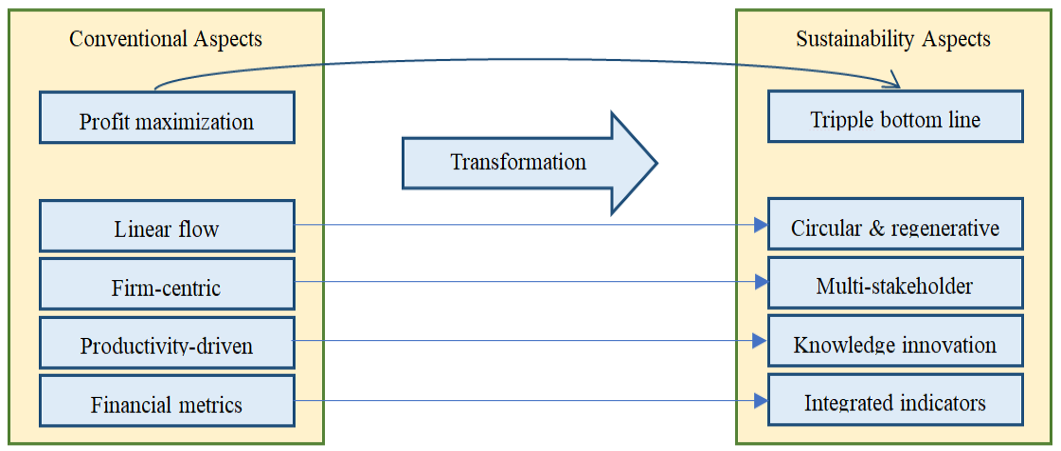
The transformation from conventional business models (BM) to sustainable business models (SBM) represents a fundamental shift in how agribusinesses perceive value creation, competitiveness, and responsibility. Conventional models mainly emphasize productivity and profit, often neglecting ecological and social impacts . SBMs integrate environmental, social, and economic goals into strategic frameworks, which are particularly relevant for the vegetable seed industry, which faces climate risks, declining soil fertility, and resource scarcity. identify nine key SBM elements—sustainability, information technology, circular economy, value chain, core values, value creation, organizational values, performance management, and stakeholder engagement—that collectively improve resilience and long-term performance. These elements promote resource efficiency, digital traceability, waste minimization, ethical governance, and collaborative value creation with farmers.
Transforming the vegetable seed industry toward SBM not only enhances competitiveness and productivity but also strengthens food security and inclusivity. The SBM thus serves as a theoretical foundation for sustainable growth, where profitability aligns with environmental stewardship and social well-being presented in Figure 1.
SEM–PLS Approach using warpPLS 8.0 in sustainable business model analysis
The Structural Equation Modelling–Partial Least Squares (SEM–PLS) approach provides a robust and flexible framework for analyzing complex causal relationships among sustainability-oriented constructs . Unlike traditional covariance-based SEM, SEM-PLS emphasizes prediction and theory development, making it particularly suitable for exploratory studies in emerging fields such as sustainable agribusiness . It allows researchers to estimate multiple relationships simultaneously, integrating constructs like Sustainable Business Models (SBM), Knowledge Management (KMN), and Sustainable Business Performance (SBP) into a comprehensive analytical model.
In this study, WarpPLS software was employed to estimate both linear and nonlinear relationships among latent variables, offering higher accuracy and interpretability . WarpPLS enables the detection of mediating effects, moderating interactions, and model fit indices even under conditions of non-normal data—a frequent challenge in agricultural research . By applying SEM–PLS through WarpPLS, this study captures the dynamic interlinkages between knowledge-driven innovation and sustainability implementation, thereby providing empirical validation for how integrated business models enhance economic, social, and environmental performance in the seed industry.
Research objectives and contribution
This study investigates the transformation of conventional business models toward SBM in the Indonesian vegetable seed industry. By integrating KMN as a mediating factor, this research aims to:
- Identify and analyze the key elements of SBM that drive sustainability, competitiveness, and long-term performance in the vegetable seed sector.
- Examine the mediating role of KMN in linking sustainable business strategies to SBP.
- Develop an integrative framework that supports the adoption of sustainability-oriented practices across the seed supply chain.
To achieve these objectives, the study employs SEM-PLS using WarpPLS 8.0, which allows simultaneous analysis of complex causal relationships among latent variables and tests both direct and indirect effects within the SBM–KMN–SBP framework. This study contributes to the literature by contextualizing the Sustainable Business Model framework proposed by Goni et al. (2021) within the agribusiness sector, emphasizing how sustainability, innovation, and knowledge integration shape firm performance. Theoretically, it advances the understanding of SBM–KMN–SBP linkages in agricultural industries facing climate and market uncertainty. The findings provide strategic insights for seed companies, policymakers, and farming communities to enhance resilience, inclusivity, and environmental stewardship through knowledge-driven sustainability initiatives.
Materials and Methods
This study adopted a mixed-method approach combining quantitative and qualitative analyses to explore the structure and implementation of Sustainable Business Models (SBM) in Indonesia’s vegetable seed industry. The quantitative phase served as the primary method, utilizing a structured questionnaire distributed to small-, medium-, and large-scale seed companies and partner farmers. Each item was measured using a 4-point Likert scale ranging from 1 (not implemented) to 4 (intensively implemented).
Items were developed and adapted from previous studies on Sustainable Business Models , knowledge management , and business performance . Academic experts in agribusiness sustainability validated the instrument. Reliability and validity tests (Cronbach’s Alpha, Composite Reliability, and Average Variance Extracted) ensured the robustness of measurement.
Data gathering
The data collection was conducted across six provinces in Indonesia—West Java, Central Java, East Java, North Sumatra, South Sulawesi, and Lampung, which represent the major vegetable production centers and seed industry hubs in the country. The survey was administered over a five-month period from January to May 2024.
The research was conducted in Indonesia’s small-, medium-, and large-scale seed companies. Classification of companies in Indonesia based on their authorized capital and paid-up capital, following the provisions under Law No. 40 of 2007 on Limited Liability Companies (UUPT) and Government Regulation (PP) No. 7 of 2021 on the Ease, Protection, and Empowerment of Cooperatives and Micro, Small, and Medium Enterprises (MSMEs).
The target population of this study comprised all vegetable seed companies registered under the Indonesian Seed Producers Association (ASBENINDO) and the Indonesian Horticulture Association (HORTINDO), totaling approximately 450 companies operating across Java, Sumatra, and Sulawesi. A purposive sampling technique was employed to select respondents based on specific criteria: (1) companies must have been operating for at least three years, (2) respondents must hold strategic positions (owner, director, or manager) with direct involvement in sustainability and knowledge management practices, and (3) companies must actively engage in seed production and distribution.
From the initial population, 113 companies were invited to participate via official letters and direct coordination with industry associations. A total of 278 questionnaires were returned, of which 16 were incomplete or invalid, yielding a final sample of 262 valid responses (effective response rate of 81.9%). This sample size exceeds the minimum requirement of 157 suggested by Hair et al. (2020) for SEM-PLS analysis with six arrows pointing to a construct, ensuring adequate statistical power.
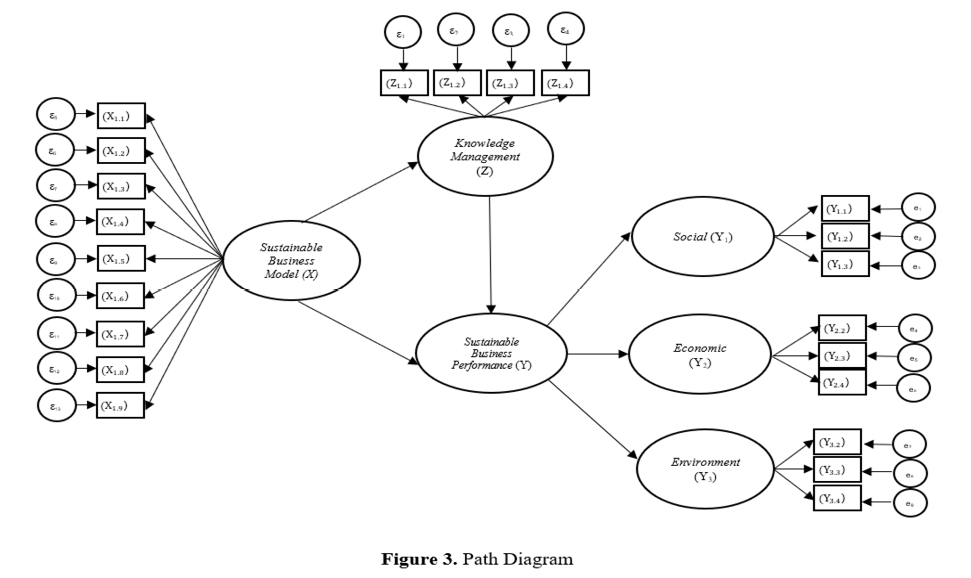
The SEM-PLS analysis method, using the WarpPLS 8.0 application, will be used to examine relationships among variables and provide an in-depth evaluation of causal relationships within the theoretical framework of the vegetable seed industry. Variables and indicators are shown in Table 1.
Table 1: List of variables and indicators
|
Variables |
Indicators |
|
|
Sustainable Business Model (X) |
X1 |
Sustainability |
|
X2 |
Value chain |
|
|
X3 |
Core value |
|
|
X4 |
Value creation |
|
|
X5 |
Organizational value |
|
|
X6 |
Circular economy |
|
|
X7 |
Stakeholder engagement |
|
|
X8 |
Performance management |
|
|
X9 |
Information technology |
|
|
Knowledge Management (Z) |
Z1 |
Localization |
|
Z2 |
Knowledge usage |
|
|
Z3 |
Knowledge acquisition and development |
|
|
Z4 |
Knowledge codification |
|
|
Sustainable Business Performance (Y) |
Y1 |
Social |
|
Y2 |
Economic |
|
|
Y3 |
Environmental |
|
Source: Authors’ own elaboration (2025)
*Note: All items in table 1 were measured using a 4-point Likert scale to avoid neutral responses, where 1 indicates “not implemented/very low” and 4 indicates “intensively implemented/very high”.
Parameter estimation
Estimation in the PLS algorithm is conducted in three primary stages using the WarpPLS 8.0 software.
Weight Estimation: The process begins with an iterative procedure based on multiple or straightforward regression, estimating the relationships among the inner (structural) model, and the outer (measurement) model.
Latent Variable Score Calculation: The estimated weights are used to compute latent-variable scores, which are linear combinations of the manifest variables. These scores represent the composite values of each construct derived from its indicators.
Model Coefficient Estimation: After obtaining the latent variable scores, the algorithm estimates the inner model path coefficients and the outer loadings for each measurement model. This step provides the basis for evaluating the significance, strength, and validity of the hypothesized relationships.
The use of WarpPLS allows the model to handle non-linear relationships, moderating effects, and complex mediation structures, offering a more realistic representation of interactions among constructs in agribusiness systems. This analytical approach ensures that the empirical testing accurately reflects the conceptual relationships proposed in the path diagram (Figure 2).
Hypothesis of the research
This study establishes four hypotheses based on the theoretical framework linking Sustainable Business Model Elements (SBM), Knowledge Management (KMN), and Sustainable Business Performance (SBP). The Sustainable Business Model integrates sustainability principles into business operations to generate economic, environmental, and social value. Within the vegetable seed industry, such integration ensures long-term viability through efficient resource use, innovation in production, and stakeholder collaboration.
Sustainability-oriented business models have been shown to promote systematic knowledge acquisition and dissemination, enhancing organizational learning and adaptability. Accordingly, it is hypothesized that SBM elements significantly influence KMN:
- H1: γᵢ ≠ 0, Sustainable Business Model elements significantly impact Knowledge Management.
- Moreover, SBM structures that emphasize efficiency, innovation, and stakeholder engagement are expected to enhance business sustainability outcomes:
- H2: γᵢ ≠ 0, Sustainable Business Model elements significantly impact Sustainable Business Performance.
- Knowledge Management, as a strategic enabler, enhances firms’ capacity to achieve sustainability-oriented outcomes:
- H3: γᵢ ≠ 0, Knowledge Management significantly impacts Sustainable Business Performance.
- KMN is proposed to act as a mediating mechanism linking SBM elements and performance:
- H4: γᵢ ≠ 0, Knowledge Management positively mediates the relationship between SBM elements and Sustainable Business Performance.
- All hypotheses will be tested to evaluate the significance, direction, and strength of relationships among latent constructs.
Result and Discussion
The analysis process begins with a descriptive analysis to illustrate the respondents’ characteristics and provide an overview of the research variables. Subsequently, the measurement model (outer model) is evaluated to assess the validity and reliability of the indicators representing each construct. The next step is to evaluate the structural model (inner model) to determine the significance and strength of the relationships among latent variables. Finally, hypothesis testing is conducted to verify the proposed theoretical relationships and interpret their implications for sustainable business model development in the seed industry. The results and discussion are structured as follows: (1) Descriptive Statistics, (2) Evaluation of Measurement Model, (3) Evaluation of Structural Model, and (4) Hypothesis Testing and Discussion.
Respondents characteristics
A total of 262 respondents from the Indonesian vegetable seed industry participated in this study. All respondents held managerial or supervisory roles, ensuring adequate knowledge of seed production, sustainability initiatives, and knowledge management practices. The sample exceeded Cohen (1992) minimum requirement, providing sufficient power for structural equation modeling (Table 2).
Table 2: Respondents characteristics
|
Profile |
Category |
Frequency |
Percentage (%) |
|
Age |
26 – 45 years old |
144 |
54,96 |
|
46 – 65 years old |
103 |
39,31 |
|
|
>66 years old |
15 |
5,73 |
|
|
Total |
262 |
100 |
|
|
Sex |
Male |
204 |
77,86 |
|
Female |
58 |
22,14 |
|
|
Total |
262 |
100 |
|
|
Educational background |
Basic Education (Completed Elementary/Junior/Senior High School) |
9 |
3,44 |
|
Higher education (Diploma/Bachelor’s) |
176 |
67,18 |
|
|
Postgraduate (Master’s/Doctoral) |
77 |
29,39 |
|
|
Total |
262 |
100 |
|
|
Positions |
Owner / CEO / Director |
31 |
11,83 |
|
Operational department |
101 |
38,55 |
|
|
Research & Development (R&D) Department |
55 |
20,99 |
|
|
Human Resources Department |
17 |
6,49 |
|
|
Finance & Information & Communication technology Department |
6 |
2,29 |
|
|
Sales & Marketing department |
44 |
16,79 |
|
|
Others |
8 |
3,05 |
|
|
Total |
262 |
100 |
|
|
Length of Service |
Less than 5 years |
72 |
27,48 |
|
5–10 years |
76 |
29,01 |
|
|
More than 10 years |
114 |
43,51 |
|
|
Total |
262 |
100 |
|
|
Type of Company |
Large (authorized capital > IDR 10 billion) |
108 |
41,22 |
|
Small- to Medium-sized (authorized capital between IDR 500 million and IDR 10 billion) |
154 |
58,78 |
|
|
Total |
262 |
100 |
|
Source: Primary data processed (2025).
As shown in Table 2, most respondents were aged 26–45 years (54.96%), male (77.86%), and held higher education degrees (67.18%). The majority worked in operational (38.55%) and R&D (20.99%) departments, with 43.51% having more than 10 years of experience. Small- to medium-sized companies accounted for 58.78% of the sample, while large firms accounted for 41.22%.
Parameter estimation
Validity and reliability test
The validity and reliability assessment aimed to confirm that all indicators accurately represent their respective latent constructs—Sustainable Business Model (X), Knowledge Management (Z), and Sustainable Business Performance (Y). Convergent validity was examined using factor loadings and the Average Variance Extracted (AVE), while discriminant validity was evaluated through the Fornell–Larcker criterion. Construct reliability was determined using Composite Reliability (CR) and Cronbach’s Alpha (CA).
Table 3: Summary of validity and reliability results
|
Construct |
Loading range |
AVE |
CR |
CA |
R² |
Q² |
|
Sustainable business model (X) |
0.692–0.882 |
0.785 |
0.935 |
0.921 |
– |
– |
|
Knowledge management (Z) |
0.831–0.853 |
0.840 |
0.905 |
0.861 |
0.507 |
0.510 |
|
Sustainable business performance (Y) |
0.828–0.870 |
0.849 |
0.886 |
0.807 |
0.526 |
0.536 |
Source: Primary data processed (2025).
As shown in Table 3, all constructs meet the recommended thresholds . The AVE values ranged from 0.785 to 0.849—indicating strong discriminant validity. CR values (0.886–0.935) and CA values (0.807–0.921) confirm high internal consistency. The coefficient of determination (R²) values for Knowledge Management (0.507) and Sustainable Business Performance (0.526) indicate moderate explanatory power, suggesting that the Sustainable Business Model accounts for approximately half of the variance in both constructs. Predictive relevance (Q² = 0.510–0.536) also indicates strong predictive capability.
The effect size (f²) results provide further insights into the substantive importance of each path. The Sustainable Business Model strongly influences Knowledge Management (f² = 0.481, large effect) and moderately affects Sustainable Business Performance (f² = 0.208). Meanwhile, Knowledge Management exhibits a large impact on Sustainable Business Performance (f² = 0.317). These patterns suggest partial mediation, with Knowledge Management acting as an intervening mechanism through which sustainability-oriented practices enhance performance outcomes.
Table 4: Evaluation results of reflective measurement model (First and second order)
|
Construct |
Indicator |
Loading |
P-value |
Model order |
|
Sustainable business model (X) |
Sustainability (X1) |
0.734 |
<0.001 |
Second-order |
|
Value chain (X2) |
0.723 |
<0.001 |
||
|
Core value (X3) |
0.789 |
<0.001 |
||
|
Value creation (X4) |
0.882 |
<0.001 |
||
|
Organizational value (X5) |
0.824 |
<0.001 |
||
|
Circular economy (X6) |
0.803 |
<0.001 |
||
|
Stakeholder engagement (X7) |
0.817 |
<0.001 |
||
|
Performance management (X8) |
0.787 |
<0.001 |
||
|
Information technology (X9) |
0.692 |
<0.001 |
||
|
Knowledge management (Z) |
Localization (Z1) |
0.836 |
<0.001 |
First-order |
|
Usage of knowledge (Z2) |
0.831 |
<0.001 |
||
|
Knowledge acquisition and development (Z3) |
0.839 |
<0.001 |
||
|
Knowledge codification (Z4) |
0.853 |
<0.001 |
||
|
Sustainable Business Performance (Y) |
Social (Y1) |
0.850 |
<0.001 |
Second-order |
|
Economic (Y2) |
0.828 |
<0.001 |
||
|
Environment (Y3) |
0.870 |
<0.001 |
Source: Primary data processed (2025).
Measurement model analysis
The measurement model evaluation was conducted to assess the validity and reliability of all latent constructs before testing the structural model. The Sustainable Business Model (X) and Sustainable Business Performance (Y) were conceptualized as second-order constructs, whereas Knowledge Management (Z) was modeled as a first-order construct. The results for the indicator loadings and significance values are presented in Table 4, all of which demonstrate acceptable reliability and convergent validity.
The highest loading values for each construct—Value Creation (X4 = 0.882), Knowledge Codification (Z4 = 0.853), and Environmental Performance (Y3 = 0.870)—indicate that these dimensions are the most dominant in shaping the perception of sustainable business model, knowledge management, and business performance, respectively.
Goodness of fit
The Goodness of Fit (GoF) test was performed to evaluate the overall quality and validity of the structural model using ten indices: APC, ARS, AARS, AVIF, AFVIF, Tenenhaus GoF, SPR, RSCR, SSR, and NLBCDR . The results are presented in Table 5.
|
Model fit and quality indices |
Fit criteria |
Result |
Category |
|
Average Path Coefficient (APC) |
p < 0.05 |
0.498 (p < 0.001) |
Fit |
|
Average R-squared (ARS) |
p < 0.05 |
0.517 (p < 0.001) |
Fit |
|
Average Adjusted R-squared (AARS) |
p < 0.05 |
0.514 (p < 0.001) |
Fit |
|
Average block VIF (AVIF) |
≤ 5 (ideal ≤ 3.3) |
2.021 |
Ideal |
|
Average full collinearity VIF (AFVIF) |
≤ 5 (ideal ≤ 3.3) |
2.521 |
Ideal |
|
Tenenhaus GoF (GoF) |
Large ≥ 0.36 |
0.593 |
Large |
|
Sympson’s paradox ratio (SPR) |
≥ 0.7 (ideal = 1) |
1 |
Ideal |
|
R-squared contribution ratio (RSCR) |
≥ 0.9 (ideal = 1) |
1 |
Ideal |
|
Statistical suppression ratio (SSR) |
≥ 0.7 |
1 |
Ideal |
|
Nonlinear bivariate causality direction ratio (NLBCDR) |
≥ 0.7 |
1 |
Ideal |
Source: Primary data processed (2025).
All indicators meet the recommended thresholds, confirming that the structural model is statistically sound and free from multicollinearity or suppression effects. The significant APC (0.498; p < 0.001) and ARS (0.517; p < 0.001) indicate that the relationships among variables are both meaningful and robust. The considerable Tenenhaus GoF value (0.593) further supports strong model adequacy and predictive relevance. These results imply that sustainable business model elements, knowledge management, and business performance are well-connected within the Indonesian vegetable seed industry. Firms that actively implement sustainability-driven strategies—such as circular economy practices or structured knowledge sharing—tend to demonstrate measurable improvements in environmental, social, and economic performance. The ideal fit indices (SPR, RSCR, SSR, and NLBCDR = 1) reinforce that the proposed model accurately represents the fundamental behavioral and managerial dynamics occurring across the industry.
Hypothesis testing
To validate the proposed structural model, hypothesis testing was conducted to evaluate the causal relationships among the Sustainable Business Model (X), Knowledge Management (Z), and Sustainable Business Performance (Y). Within the framework of Partial Least Squares Structural Equation Modelling (PLS-SEM), hypothesis testing is essential for assessing the magnitude and significance of each structural path, thereby confirming whether the empirical relationships align with the theoretical propositions . The results of the hypothesis testing are presented in Table 6.
|
Path |
Path coefficient |
P-value |
Category |
Decision |
|
X → Z |
0,712 |
<0.01 |
Highly significant |
Accepted |
|
Z → Y |
0,461 |
<0.01 |
Highly significant |
Accepted |
|
X → Y |
0,321 |
<0.01 |
Highly significant |
Accepted |
|
X → Z → Y (Mediating effect) |
0,328 |
<0.01 |
Highly significant |
Accepted |
Source: Primary data processed (2025).
The results indicate that all hypothesized paths are statistically significant at the 1% level (p < 0.01). The Sustainable Business Model (X) exerts a strong and positive influence on both Knowledge Management (Z) and Sustainable Business Performance (Y). Furthermore, Knowledge Management (Z) has a significant positive effect on Y, suggesting that effective knowledge practices enhance overall business sustainability. The mediating effect of Z between X and Y is also substantial, implying that Knowledge Management partially mediates the relationship between the Sustainable Business Model and Sustainable Business Performance.
This pattern suggests that firms implementing sustainability-oriented business models not only achieve direct performance improvements—such as enhanced operational efficiency, market competitiveness, and stakeholder trust—but also strengthen their internal knowledge systems. The institutionalization of sustainability practices generates, codifies, and disseminates knowledge that supports innovation and long-term performance. Hence, Knowledge Management operates as a strategic mechanism that amplifies the value derived from the Sustainable Business Model, reinforcing the organization’s capacity to achieve enduring sustainability outcomes.
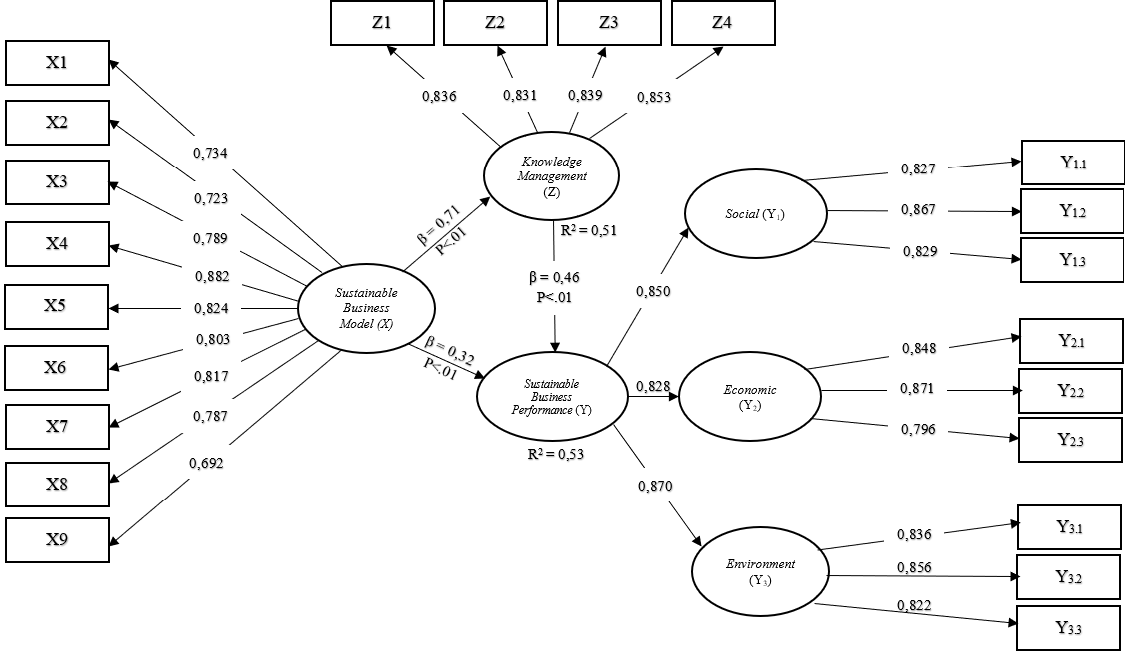
The substantial path coefficients derived from the hypothesis testing indicate a consistent, practically meaningful structural relationship. The coefficient values presented in Table 6 are further illustrated in the path diagram shown in Figure 3.
The path coefficient of 0.321 (p < 0.01) shows a moderate yet meaningful direct effect of SBM elements (X) on sustainable business performance (Y). Firms incorporating practices such as eco-friendly input use, efficient resource management, and structured performance measurement experience improved outcomes across social, economic, and environmental dimensions—even without the mediation of knowledge management. This finding aligns with the notion that sustainability-oriented business models can generate operational gains (e.g., cost savings, stronger stakeholder relationships, market differentiation) independently of intermediary capabilities. Recent literature supports the positive link between sustainable business model practices and firm performance ; . The moderate effect size indicates that complementary capabilities (especially knowledge management, digital systems, and contextual enablers) remain essential.
With a path coefficient of 0.461 (p < 0.01), knowledge management (Z) emerges as a strong predictor of sustainable business performance (Y). Firms that systematically acquire, codify, localize, and apply knowledge in their operations tend to achieve higher performance across environmental, social, and economic outcomes. Consistent with the knowledge-based view (KBV) and organizational learning theories, which posit that internalcapabilities for managing knowledge mediate sustainable performance. Recent studies highlight how green knowledge sharing and codification support sustainable performance ; . KMN is not simply operational but strategic—it translates sustainability intent into measurable performance gains.
The indirect effect of X → Z → Y (β = 0.328, p < 0.01) combined with the direct effect (β = 0.321) indicates partial mediation. In practical terms, this means that some of the impact of SBM elements on performance is transmitted via knowledge management, while another portion acts directly. The result underscores two pathways: one immediate—where SBM changes pay off operationally; and one capability-driven—where knowledge management amplifies and sustains those gains. This pattern is theoretically credible and empirically familiar in sustainability research ; Zairbani and J.P., 2025). Practitioners should adopt a dual approach: introduce sustainability initiatives (X) and simultaneously build knowledge-management systems (Z) to capture sustainable performance benefits fully.
Business model structure and implementation
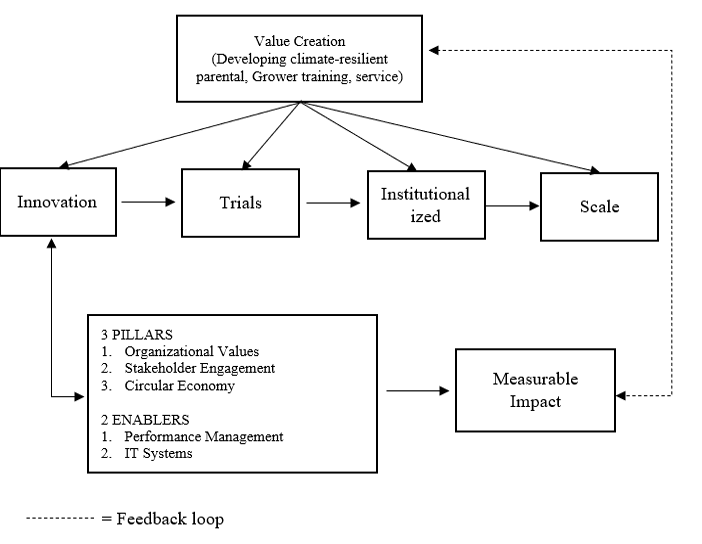
The business model structure and implementation within the Indonesian vegetable seed industry are designed to integrate innovation, sustainability, and inclusivity into a unified framework. At its core lies value creation, emphasizing the development of climate-resilient and adaptable seed varieties, improved farmer income through training and buy-back programs, and bundled service offerings. These initiatives are supported by organizational values, stakeholder engagement, and circular economy practices, which collectively strengthen sustainable operations and long-term resilience. Furthermore, companies employ performance management and information technology systems to monitor progress and facilitate knowledge exchange across internal teams and external partners.
The implementation process unfolds through four critical stages: innovation in product development, trial on selected farmer groups, institutionalization of successful practices through standardization, and scaling across wider regions. Structured sequence ensures that innovative practices are not isolated efforts but part of a continuous system that adapts and evolves. The framework is anchored by three pillars—organizational values, stakeholder engagement, and circular economy—while two enabling systems—performance management and information technology—ensure effective execution and learning.
The model generates measurable impact across the triple bottom line: improving farmers’ social well-being, enhancing companies’ economic performance, and reducing environmental footprints. A feedback loop continuously refines the process by integrating performance data and stakeholder input, ensuring adaptability to shifting market and environmental conditions. A dynamic and interconnected model demonstrates how Indonesian vegetable seed companies operationalize sustainability through innovation, collaboration, and data-driven decision-making.
Discussion
The central role of value creation in sustainable business models
The finding that Value Creation (X4) emerged as the most dominant element (loading = 0.882) warrants deeper interpretation. In the context of Indonesia’s vegetable seed industry, value creation is not merely about profit generation. Still, it encompasses the development of climate-resilient seed varieties, bundled service offerings for farmers, and buy-back guarantee programs. This finding aligns with Velter et al. (2020), who argued that SBMs must demonstrate tangible benefits to stakeholders to gain traction. For practitioners, this implies that sustainability initiatives should be framed not as compliance burdens but as value-enhancing strategies—for instance, seeds that require less water directly reduce farmers’ operational costs while contributing to environmental conservation.
Knowledge management as a strategic amplifier
The significant mediating role of KMN (β = 0.328) confirms that sustainability practices yield maximum impact when embedded within systematic knowledge processes. To make this accessible for general readers: think of SBM as the “engine” of a car and KMN as the “transmission system.” The engine generates power (sustainability initiatives), but without the transmission (knowledge sharing and codification), that power cannot effectively reach the wheels (business performance). In practice, leading seed companies in our study institutionalize knowledge through farmer field schools, digital apps for pest diagnosis, and regular cross-departmental meetings—mechanisms that translate sustainability intent into daily operations.
Balancing environmental, Social, and Economic performance
The strong loading of Environmental Performance (Y3 = 0.870) indicates that Indonesian seed companies are increasingly recognizing sustainability as a competitive differentiator. This result challenges the conventional view that environmental investments are cost centers. Instead, firms implementing circular economy practices—such as reusing packaging materials and reducing chemical inputs—report improved operational efficiency and stronger trust from international buyers. For policymakers, this suggests that incentives for green certification and waste reduction technologies could accelerate industry-wide transformation.
Practical implications for non-academic audiences
While the statistical model (Figure 3) provides rigorous validation, the operational framework (Figure 4) offers a more intuitive roadmap. The four-stage process—innovation, trial, institutionalization, and scaling—represents a “how-to” guide for seed companies. For example, a company developing a new drought-tolerant variety should: (1) innovate through R&D, (2) trial with progressive farmer groups, (3) institutionalize through standardized protocols, and (4) scale via government partnerships and extension services. This stepwise approach demystifies sustainability implementation and makes it accessible to managers without specialized research backgrounds.
Conclusions and Recommendations
This study investigated the influence of Sustainable Business Model (SBM) elements on Sustainable Business Performance (SBP) in the Indonesian vegetable seed industry, considering the mediating role of Knowledge Management (KMN). Using structural equation modeling, the findings show that SBM significantly enhances SBP both directly and indirectly through KMN. Value Creation emerged as the most influential SBM element, enabling firms to develop climate-resilient seed varieties, integrate technology, and generate economic, social, and environmental value. KMN, particularly codification and knowledge sharing, supports the adoption of sustainable practices, while environmental initiatives, such as circular-economy measures and waste reduction, drive operational efficiency and stakeholder trust. Integrating SBM strategies with effective KMN ensures superior sustainability outcomes across multiple dimensions.
Indonesian seed companies align these approaches with national policies, including the Green Economy Roadmap and the National Seed Program, promoting superior seed production, food sovereignty, and emission reduction. Implementation challenges remain, such as institutional coordination gaps, seed quality disparities, and policy changes.
Recommendations for firms include participatory farmer training, scalable digital solutions, and modular production protocols. For policymakers, it is essential to facilitate multi-stakeholder platforms, provide targeted incentives, establish sustainability standards, and support market differentiation.
Future research should examine the model across other crops and conduct longitudinal studies to monitor sustainability adoption over time. This study contributes to the sustainable business literature by confirming KMN’s mediating role in agribusiness and by offering actionable guidance for firms and policymakers to achieve resilient, sustainable vegetable seed production in Indonesia.
Acknowledgments
The authors sincerely thank all participating vegetable seed companies in Indonesia for their cooperation and valuable insights during the data collection process. We also acknowledge the support from APBH, HORTINDO, and ASBENINDO that facilitated access to industry data. This research was conducted without external funding, and all findings represent the independent work of the authors.
Novelty Statement
This study provides a novel contribution by integrating the Sustainable Business Model (SBM) framework with Knowledge Management (KMN) to assess Sustainable Business Performance (SBP) in the Indonesian vegetable seed industry. Unlike previous research that only examined Business Model (SBM or KMN separately, this study highlights KMN’s mediating role in transforming SBM practices into measurable social, economic, and environmental outcomes. Additionally, it demonstrates how private-sector initiatives align with national policies to promote sustainability. The research extends the resource-based view theory in a developing economy context and offers practical strategies for climate-resilient seed production and knowledge-driven sustainability implementation.
Authors Contributions
Nur Fajrina: Conceptualization, methodology, data collection, formal analysis, writing, editing – original draft
Felina C Young: Supervision, review & editing
Generative AI and AI-assisted technology statement
The authors declare that no generative AI and AI assisted technology was used in the creation of this manuscript.
Conflict of interest
The authors have declared no conflict of interest.
Figures
Transition from conventional to sustainable business models in the vegetable seed industry
Research model
Path coefficients
Business model structure and implementation
References
- Abdelkafi, N., J. Xu, M. Pero, F. Ciccullo, and A. Masi. 2023. Does the combination of sustainable business model patterns lead to truly sustainable business models? Critical analysis of existing frameworks and extensions. J. Bus. Econ., 93(4),: 597–634. https://doi.org/10.1007/s11573-023-01140-0[CrossRef]
- Ali, Q., C. Yu, A. Hussain, M. Ali, S. Ahmar, M.A. Sohail, M. Riaz, M.F. Ashraf, D. Abdalmegeed, X. Wang, M. Imran, H. Manghwar, and L. Zhou. 2022. Genome Engineering Technology for Durable Disease Resistance: Recent Progress and Future Outlooks for Sustainable Agriculture. Front. Plant Sci., 13. https://doi.org/10.3389/fpls.2022.860281[CrossRef]
- Alkathiri, N.A., F. Said, Ben, N. Meyer, and M. Soliman. 2024. Knowledge management and sustainable entrepreneurship: a bibliometric overview and research agenda. J. Innov. Entrepreneur., 13(1): 38. https://doi.org/10.1186/s13731-024-00387-3[CrossRef]
- Amanullah, S.K. 2020. Agronomy: Climate Change. BoD – Books on Demand.
- Chen, S., L. Huang, and A. Zhou. 2025. How Knowledge Management Capability Drives Sustainable Business Model Innovation: A Combination of Symmetric and Asymmetric Approaches. Sustain., 17(15): 6714. https://doi.org/10.3390/su17156714[CrossRef]
- CNBC Indonesia. 2025. August. Bikin Bangga! Ekspor Hortikultura RI Terbang 49%, Tembus Rp 55 Triliun. CNBC INDONESIA RESEARCH.
- Cohen, J. 1992. A power primer. Psychological Bulletin, 112(1): 155–159. https://doi.org/10.1037/0033-2909.112.1.155[CrossRef]
- Fiore, M., A. Galati, J. Gołębiewski, and N. Drejerska. 2020. Stakeholders’ involvement in establishing sustainable business models. Brit. Food J., 122(5): 1671–1691. https://doi.org/10.1108/BFJ-04-2019-0263[CrossRef]
- Fobbe, L. and P. Hilletofth. 2021. The role of stakeholder interaction in sustainable business models. A systematic literature review. J. Clean. Prod., 327: 129510. https://doi.org/10.1016/j.jclepro.2021.129510[CrossRef]
- Gazzola, P., C. Drago, E. Pavione, and N. Pignoni. 2024. Sustainable Business Models: An Empirical Analysis of Environmental Sustainability in Leading Manufacturing Companies. Sustaina., 16(19): 8282. https://doi.org/10.3390/su16198282[CrossRef]
- Goni, F.A., A. Gholamzadeh Chofreh, Z. Estaki Orakani, J.J. Klemeš, M. Davoudi, and A. Mardani. 2021. Sustainable business model: A review and framework development. Clean Technol. Environ. Polic., 23(3): 889–897. https://doi.org/10.1007/s10098-020-01886-z[CrossRef]
- Hair Jr, J.F. 2020. Next-generation prediction metrics for composite-based PLS-SEM. Indust. Manag. Data Syst., 121(1): 5–11. https://doi.org/10.1108/IMDS-08-2020-0505[CrossRef]
- Kalenska, S. 2022. Food security and innovative solutions in crop production. PLANT SOIL SCI., 13(2). https://doi.org/10.31548/agr.13(2).2022.14-26[CrossRef]
- Kapoor, N., M. Pant, and P. Praanjal. 2023. Principles of Quality Seed Production in Vegetable Crops. In TREND. AGRIC., (1st ed., 9). Vital Biotech Publication .
- Kartikasari, D. 2024. Comparing PLS-SEM Statistical Technologies for Educating the Importance of Linearity (pp. 240–261). https://doi.org/10.4018/979-8-3693-2865-1.ch013[CrossRef]
- Lamichhane, J.R., M.P. You, V. Laudinot, M.J. Barbetti, and J.N. Aubertot. 2020. Revisiting Sustainability of Fungicide Seed Treatments for Field Crops. Plant Diseas., 104(3): 610–623. https://doi.org/10.1094/PDIS-06-19-1157-FE[CrossRef]
- Lamolinara, B., M.S. Teixeira, C.G. Marreiros, and V.H. Ferreira, S. dos 2023. Sustainable vs circular business models in agribusiness: a comparative bibliometric analysis. Revis. de Econ. Sociol. Rur., 61 (spe). https://doi.org/10.1590/1806-9479.2023.275416[CrossRef]
- Lee, S. 2020. Role of social and solidarity economy in localizing the sustainable development goals. Int. J. Sustain. Develop. World Ecol., 27(1): 65–71. https://doi.org/10.1080/13504509.2019.1670274[CrossRef]
- Nosratabadi, S., A. Mosavi, E. Shamshirband, S. Kazimieras Zavadskas, A. Rakotonirainy, and K.W. Chau. 2019. Sustainable Business Models: A Review. Sustain., 11(6): 1663. https://doi.org/10.3390/su11061663[CrossRef]
- Pratap, A., C. Douglas, U. Prajapati, G. Kumari, A.R. War, R. Tomar, A.K. Pandey, and S. Dubey. 2020. Breeding Progress and Future Challenges: Biotic Stresses (pp. 55–80). https://doi.org/10.1007/978-3-030-20008-4_5[CrossRef]
- Ringle, C.M., M. Sarstedt, N. Sinkovics, and R.R. Sinkovics. 2023. A perspective on using partial least squares structural equation modelling in data articles. Data Brief., 48: 109074. https://doi.org/10.1016/j.dib.2023.109074[CrossRef]
- Sapta, I.K.S., I.N. Sudja, I.N. Landra, and N.W. Rustiarini. 2021. Sustainability Performance of Organization: Mediating Role of Knowledge Management. Econom., 9(3): 97. https://doi.org/10.3390/economies9030097[CrossRef]
- Şengül, Z. 2025. Analyzing risk perception, risk attitude, and management strategy using Partial Least Squares Structural Equation Modeling (PLS-SEM) in pistachio production: the case of Siirt Province, Türkiye. Humanit. Soc. Sci. Commun., 12(1): 660. https://doi.org/10.1057/s41599-025-04983-w[CrossRef]
- Solimun, A.A.R. Fernandes, and Nurjannah. 2017. Metode Statistika Multivariat Pemodelan Persamaan Struktural (SEM) Pendekatan WarpPLS. In Metode Statistika Multivariat Pemodelan Persamaan Struktural (SEM) Pendekatan WarpPLS.
- Velter, M.G.E., V. Bitzer, N.M.P. Bocken, and R. Kemp. 2020. Sustainable business model innovation: The role of boundary work for multi-stakeholder alignment. J. Clean. Prod., 247: 119497. https://doi.org/10.1016/j.jclepro.2019.119497[CrossRef]
- Zairbani, A. and J.P. S.K. 2025. How Does Green Knowledge Sharing Improve Sustainable Business Performance? Knowled. Proc. Manage., 32(1): 42–53. https://doi.org/10.1002/kpm.1796[CrossRef]
- Zhang, Y., Y. Mao, L. Jiao, C. Shuai, and H. Zhang, 2021. Eco-efficiency, eco-technology innovation and eco-well-being performance to improve global sustainable development. Environ. Impact Assess. Rev., 89: 106580. https://doi.org/10.1016/j.eiar.2021.106580[CrossRef]
Services
Article usage statistics
Loading…