
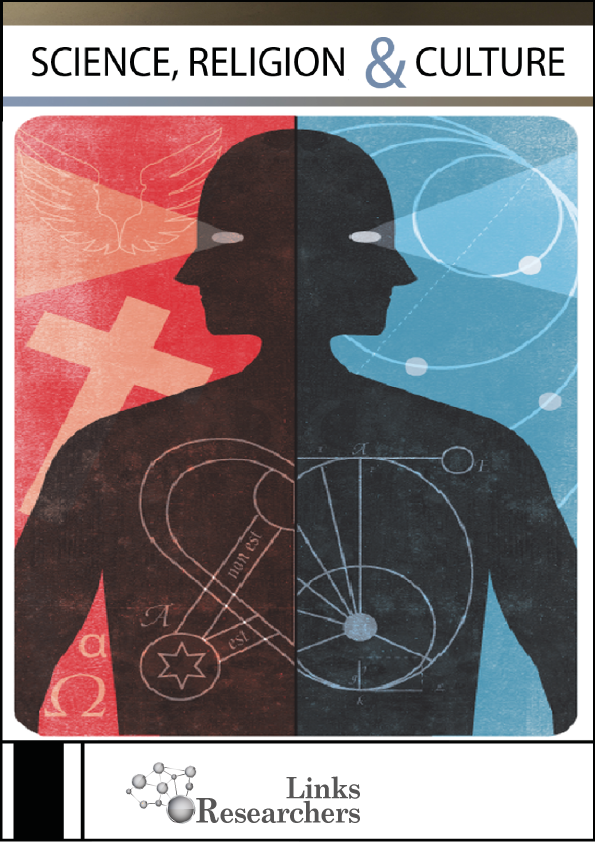
Weinberg’s lament is the rather gloomy conclusion that the existence of the universe, and of intelligence in particular, appears to have no meaning. This essay explores the epistemological basis of this lament.
Articles · Volume 3, Issue 1, 21 October 2016 · Open Access
Weinbergs Lament: Science and Religion
Affiliations & Notes ⌄
- 1General Relativity, Applied Physics, Climate Change, Argonne National Laboratory (Retired), USA. gemarsh@uchicago.edu
Article Info ⌄
- Journal:
- Science, Religion and Culture
- Published:
- 21 October 2016
From the article
- Could the methods of science discover a meaning for the existence of the universe?
- To address these questions one must understand the limits of science both in terms of observation and theory.
- This is true in the sense that it led to modern science, which transformed the western world in a mere a few hundred years; nothing comparable has occurred in human history.
- There is no morality implicit in science, and the methods of science have led to much quantification but few advances in the understanding of the economic, political and social aspects of human existence.
Selected from the article's own text.
Abstract
Observation and Theory
Human beings have a variety of senses including the obvious ones of sight, hearing, touch, smell, and taste. Many other animals have different suites of senses, some in common with humans and some not—like the ability to sense and use electric or magnetic fields for practical purposes such as finding prey and navigation, or having extended, or at least different, visual or hearing ranges than human beings. Animal interpretation of the world around them can be very different from each other and from human perception.
One of the great achievements of modern science has been to transcend the biological limits of observation by the use of sophisticated instruments. The data acquired from observation are then “explained” by unifying them into a logical theoretical framework, usually mathematical in nature. Is a mathematical framework necessary, and is it adequate? This question brings to mind Wigner’s (1967) essay “The Unreasonable Effectiveness of Mathematics in the Natural Sciences”, which can be found in his book Symmetries and Reflections. As put by him, “The miracle of the appropriateness of the language of mathematics for the formulation of the laws of physics is a wonderful gift which we neither understand nor deserve. We should be grateful for it and hope that it will remain valid in future research and that it will extend, for better or for worse, to our pleasure, even though perhaps also to our bafflement, to wide branches of learning”.
Implicit here is what it means to understand something. Yet this is rarely if ever clearly defined. To understand something new, one must relate the new information to what is already known; e.g., the idea of force comes directly from our senses and it is a relatively easy step to relate such experience to two objects that interact through a force. In mathematics, one relates knowledge gained from arithmetic to the abstraction of algebra. Ultimately, however, mathematics has its limitations and its reflection in reality is not really understood, although it has been studied since ancient times.
In classical electromagnetism electric and magnetic fields are defined in terms of observations of the forces they produce. These fields are then related to each other by Maxwell’s equations, which also predict electromagnetic radiation. Maxwell’s equations are a quintessential example of a physical theory. Theory unites and unifies observations by constructing a mathematical model that can often be communicated in an intuitive way through the use of geometrical and other types of figures. Poincaré (1905) expressed the implicit limitation of this method in his book La Valeur de la Science as follows: “Science is, in other words, a system of relations. It is only in relations that we should attempt to find objectivity; it would be futile to search for it in the things themselves instead of in their relations to one another. The assertion that science can have no objective value because it provides us only with knowledge of the relations would be wrong, for it is just these relations which are to be regarded as objective”.
It is the radiation predicted by Maxwell’s equations, in the form of black body radiation, which led to the discovery of the limitations of classical electromagnetism. In order to explain the observed spectral distribution of intensity for heat radiation, Planck introduced the idea that radiated electromagnetic energy must come in multiples of a minimum energy given by a constant times the frequency. This idea coupled with Einstein’s special relativity led to quantum mechanics and much of modern physics.
Nevertheless, there have been questions about the meaning of quantum mechanics and quantum field theory since their inception. Generally, these are ignored by most physicists who simply use the formalism as a tool for making calculations for physical systems. Much of the contention over many years in the twentieth century can be summed up by the question, “Is radiation composed of elementary particles or is it a wave?” Of course, as pointed out by Niels Bohr many years ago in his elephant parable, it is neither. It is interesting and somewhat amusing to note that Bohr was Knighted in 1947 by Fredrick IX conferring on him the Order of the Elephant—the highest Order of Denmark.
Mathematics and Physics
The role of mathematics in physics reached a new height in the use of group theory in the Standard Model of particle physics. Groups are abstract entities that are defined very broadly. They consist of a set of elements along with an operation that can combine any two elements into a third. The operation must in addition meet certain requirements.
Group theoretical methods did not receive a warm reception when introduced into the physics community. As put by Slater (1975) in his autobiography, “Wigner, Hund, Heitler, and Weil entered the picture with their ‘Groupenpest’. The authors of the ‘Groupenpest ‘wrote papers which were incomprehensible to those like me who had not studied group theory. The practical consequences appeared to be negligible, but everyone felt that to be in the mainstream one had to learn about it. It was a frustrating experience, worthy of the name of a pest.” The “pest” was never vanquished. Today group theory is fundamental to the Standard Model of particle physics and plays an important role in many other areas of physics as well.
The Standard Model is based on the work of Wigner who classified the irreducible representations of the relevant group in terms of the parameters of spin and the non-negative rest mass of the particle. Sternberg (1994) in his book Group Theory and Physics, summarizes one of the key points of Wigner’s work as stating that an elementary particle ‘is’ a representation of this group! Thus, a real elementary particle is identified with a representation of an abstract group!
If it were possible to identify all of reality with a mathematical structure, then reality itself would have to be subject to the limitations of that structure. If this were the case, one of the most fundamental limitations would come from the Gödel incompleteness theorems , which in essence say that any logical system that includes a certain amount of elementary arithmetic contains statements that can neither be proved or disproved in that system; and that the consistency of the system itself cannot be proven within that system. Are these theorems reflected in physical reality? It turns out that there is indeed a class of dynamical systems that appear to offer some examples of where this is true ; .
Weinberg’s Lament
That the universe seems pointless to those who do not hold to the traditional faiths may be the inevitable consequence of the reductionist approach implicit in the scientific method used by scientists. Attempts have been made to transcend the limitations imposed by reductionism, the concept that the nature of complex phenomena can always be reduced to, or explained by, simpler more fundamental ideas. Perhaps the most promising is what is known today as emergent behavior. Such an approach offers hope to many thoughtful people that there may be a way to transcend Weinberg’s lament—the rather gloomy conclusion that the existence of the universe, and of intelligence in particular, appears to have no meaning.
Science has been able to reveal the evolution of the universe back to the first moment of its coming into existence, but cannot offer any explanation for what Fred Hoyle derogatorily called the “big bang,” other than it might have been a random and meaningless quantum fluctuation. What this “fluctuation” was supposed to have taken place in, since neither space nor time, as we understand it, had yet come into existence, is left unanswered. The problem is that the universe’s coming into existence is a sui generis event, which places it outside the domain of the scientific method.
I said earlier that the Enlightenment had an impact on society that was ultimately to liberate most people in the western world from the terrible fear generated by rampant superstition. This is true in the sense that it led to modern science, which transformed the western world in a mere a few hundred years; nothing comparable has occurred in human history. But the Enlightenment has also been extended to other branches of knowledge and misinterpreted to mean that there are eternal, timeless truths that implicitly govern moral, economic, political and the social spheres of human activity. All such theories are contradictory to the fundamental precepts of science.
The concept of timeless truths has a long intellectual history. Plato strongly emphasized timeless truths and Aristotle in the Nicomachean Ethics maintained that one of the highest virtues was the contemplation of such timeless truths. Pre-Enlightenment religious thought was also based on eternal truths, as were more modern social theories. Hegel believed that objective concepts and principles that govern human society exist, and that history evolves as a dialectical process. Marx identified these principles as material relations between classes, which were governed by general laws.
These moral and political constructs based on scientific theories of economics, sociology and psychology have failed abysmally in the 20th century causing far too much suffering and many humanitarian crises. Hopefully we won’t repeat them in the 21st century.
History has shown that the concept of empiricism and the inductive method of scientific inquiry have only limited applications in other areas of human endeavor. There is no morality implicit in science, and the methods of science have led to much quantification but few advances in the understanding of the economic, political and social aspects of human existence.
That science cannot provide a moral framework does not mean that scientists do not have an ethical responsibility to clearly inform the general public about the implications for society of their discoveries. This was true in the 20th century, for example, with regard to the discovery of nuclear fission and fusion and is especially true in the 21st century with the ongoing revolution in biology and the growing ability to modify existing organisms and create new ones.
Weinberg’s lament, and the expectation that science can find some meaning for the creation of the universe, is essentially a category error. Science can no more explain its existence—in the sense of first causes—than theology can explain electromagnetism or gravitation. But if the sole reliable method of gaining knowledge is through the autonomy of reason and the methods of the natural sciences, where does that leave us?.
It leaves us with our ignorance about the meaning behind the existence of the universe. Faith and tradition can offer solace, but the validity of any “truths” offered by faith cannot be proven by science or reason alone. Weinberg (1999) has given his view on science and religion in one of his articles in the New York Review of Books: “I am all in favor of a dialogue between science and religion, but not a constructive dialogue. One of the great achievements of science has been, if not to make it impossible for intelligent people to be religious, then at least to make it possible for them not to be religious. We should not retreat from this accomplishment.”
More than half a century ago, Smith (1955) wrote a beautiful book called Man and His Gods. In the Epilogue, Smith captures what must happen if the modern world is to avoid what might well be characterized as a social form of Armageddon:
“As a fallen angel, man would be ludicrous. As an intelligent animal, he has reason to be proud because he is the first who can ask himself, “Whither, Why, and Whence?’ and confident because he can know himself as a creature of earth who has risen by his own efforts from a low estate. If he would rise higher he must be true to earth, he must accept that he is its creature, unplanned, unprotected and unfavored, co-natural with all other living creatures and with the air and water and sunlight and black soil from which their dynamic pattern has been fabricated by impersonal and indifferent forces. In every wish, thought and action he is seeking to escape the same protoplasmic disquietude that impels the meanest flesh crawling beneath his feet. He must find his values and his ends entirely within this frame of reference”.
References
- • Agnes, C. and Rasetti, M. 1987. Undecidability and chaos: A class of dynamical systems with fractal orbits. In: Workshop on chaos and complexity (eds. Livi, R.) Torino, October 5-11, 1987.
- • Berlin, I. 1998. The Proper Study of Mankind. Farrar, Straus and Giroux, New York. pp. 243.
- • Carroll, J. 2001. Constantine’s Sword: The Church and the Jews. Houghton Mifflin Co., Boston. pp. 172.
- • Eiseley, L. 1970. The Invisible Pyramid. Charles Scribner’s Sons, New York. pp. 68.
- • Eiseley, L. 1973. The Man Who Saw Through Time. Charles Scribner’s Sons, New York.
- • Moore, C. 1990. Unpredictability and Undecidability in Dynamical Systems. Physical Review Letter 64: 2354. http://dx.doi.org/10.1103/PhysRevLett.64.2354[CrossRef]
- • Poincaré, H. 1905. La Valeur de la Science (Paris 1905), Chapter xi, Page 6. (As quoted in: Yourgrau, W. and Mandelstam, S. 1968. Variational principles in dynamics and quantum theory. 3rd Edition, Sir Isaac Pitman & Sons Ltd., London. pp. 170.
- • Russell, B. 1960. A History of Western Philosophy. Simon and Schuster, New York. pp. 571.
- • Slater, J.C. 1975. Solid state and molecular theory: A Scientific Biography. John Wiley & Sons Inc., New Jersey. pp. 60-62 (As quoted in Sternberg, S. 1994. Group Theory and Physics. Cambridge University Press, Cambridge).
- • Smith, H.W. 1955. Man and his Gods. Littlel Brown and Company, Boston. pp. 441.
- • Sternberg, S. 1994. Group Theory and Physics. Cambridge University Press, Cambridge.
- • van Heusden, E.F.G. 2016. On Undecidability and the Laws of Physics. Journal of Physics: Conference Series 701: 012025. http://dx.doi.org/10.1088/1742-6596/701/1/012025[CrossRef]
- • Weinberg, S. 1983. The First Three Minutes. Bantam Books, Toronto. pp. 144.
- • Weinberg, S. 1999. A Designer Universe? New York Review of Books (21 October 1999). pp. 46.
- • Wigner, E.P. 1967. Symmetries and Reflections. Indiana University Press, Bloomington, p. 222.
Services
Article usage statistics
Loading…