ResearchersLinks

Review · Volume 40, Issue 2, 8 December 2025 · Open Access

Use of Drone Technology for Precision Monitoring and Sustainable Management of Insect Pests: A Bibliometric Review

· · · · · · · · ·

Affiliations & Notes ⌄
  1. 1Department of Entomology, University of Sargodha, 40100, Sargodha, Pakistan. Corresponding author: Nimra Altaf altaf.nimra@gmail.com
Article Info ⌄
Journal:
Punjab University Journal of Zoology
Published:
8 December 2025

From the article

  • In summary, this bibliometric analysis demonstrates how drones have the potential to revolutionize insect pest monitoring and management, as demonstrated by the notable increase in research effort and the wide range of uses for this technology.
  • Over the past ten years, a notable and steady increase in scholarly interest in the use of drones for insect pest monitoring and management has been observed.
  • The substantial increase in publications suggests that drone technology is set to become more significant in managing insect pests, especially when considering precision agriculture and sustainable farming.

Selected from the article's own text.

Abstract

Drones, also known as Unmanned Aerial Vehicles (UAVs), have emerged as a revolutionary tool in the modern agriculture, offering innovative ways to enhance precision, efficiency, and sustainability. Their use in insect pest monitoring and management has significantly increased over the past decade. This bibliometric review explores recent trends, research directions, and evolution in drone applications in insect pest management over the last ten years. The analysis reveals a significant rise in publications from 2020, with a maximum number of publications in the year 2024 based on the current indexing data. This growth shows an increasing interest in the adoption of drone technology for pest detection and control for sustainable farming practices. The analysis of keyword co-occurrence highlights “drones” and “UAVs” as core terms associated with precision agriculture, and integrated pest management (IPM). The wide distribution of research across reputable journals such as Drones, Journal of Economic Entomology, and Insects showcases its interdisciplinary nature and convergence with agricultural, technological, and environmental disciplines. This review highlights the transformative potential of drones in pest management practices, and emphasizes the need for further research, interdisciplinary collaboration, and the integration of emerging technologies like artificial intelligence to overcome existing limitations and fully realize the benefits of drone-based solutions for sustainable agriculture. 
 
Novelty Statement | The study provides the comprehensive bibliometric analysis of drone applications in insect pest management. It identifies emerging research hotspots, key publication trends, and interdisciplinary linkages shaping this evolving field. This study highlights the accelerating integration of UAV technology with precision agriculture and pest control strategies.
Introduction

Food security is one of the main concerns of the global agriculture sector at present times. Due to a rapidly growing population, this sector is facing significant challenges . The threat of insect pests’ damage is one of them. Insect pests significantly affect crops, which results in reduced productivity and major economic losses . Manual pesticide application is a conventional practice but raises growing concerns about environmental degradation, pesticide resistance and harm to non-target organisms (Dhananjayan et al., 2019). This excessive use of pesticides through manual application is promoting the need for more sustainable and precise pest management strategies. In this regard, the integration of advanced technologies, such as drones or UAVs, have emerged as an alternative and more effective solution for enhancing the efficiency and sustainability of insect pests monitoring and management .

Drones have a unique capability to capture high-resolution, real-time data across large agricultural areas . Drones equipped with high-resolution cameras, multispectral sensors, and other advanced technologies help in early pest infestation detection, and precise mapping of affected zones, ultimately reducing the need for excessive pesticide application. The use of drones in agriculture is not limited to pest monitoring; they are also being employed for direct pest control, such as the precise application of biological control agents or insecticides, further enhancing their utility in integrated pest management (IPM) systems ; . As a result, drones are increasingly recognized as a transformative tool in precision agriculture, with the potential to revolutionize traditional pest management practices.

Over the last ten years, the researchers, policy makers, and agricultural practitioners have put significant attention on the application of drones in insect pest monitoring and management . The increasing number of scholarly articles on this topic explores various aspects of drone technology, including its technical capabilities, operational challenges, and practical application of drones in insect pest monitoring and management. Despite this progress, there remains a need to comprehensively analyze the evolution of this research domain, identify key trends, and highlight future directions to fully harness the potential of drone technology in agriculture.

To investigate the trends, patterns, and thematic focus of research on the use of drones in insect pest monitoring and management, this study uses bibliometric analysis. Through the examination of publication growth, keyword co-occurrence networks, and research dispersion across journals, the goal of this study is to present a comprehensive picture of the state of the field and its consequences for sustainable agriculture. Researchers, practitioners, and policymakers looking to use drone technology for efficient and environmentally friendly pest management solutions will find great value in the analysis’s conclusions, which will also highlight the field’s developments and limitations. Through this investigation, the study highlights how drones can revolutionize agriculture by tackling one of its most important problems and opening the door to a more productive and sustainable future.

Materials and Methods

To address the research questions, we analyzed past and present trends, as well as research hotspots related to drone applications in insect pest monitoring and management, thereby providing a systematic direction for future studies in this field. The study uses bibliometric analysis as a core methodological framework to collect the data. For processing and visualizing data, the VOS viewer analytical tool was used as used in previous bibliometric studies that allow for comprehensive mapping of research trends, keyword co-occurrence networks, and author collaborations.

Keywords selection

For a comprehensive dataset, keywords were selected based on existing literature in the field of entomology, agriculture, and precision pest management. The following keywords were used to save relevant articles: drones, unmanned aerial vehicles (UAVs), insect pest monitoring, precision pest management, remote sensing for pest control, aerial pest surveillance, and integrated pest management (IPM) using UAVs. Using a combination of these keywords, articles were searched and included for further analysis.

Selection of database

Data were collected from Google Scholar and the Elicit AI-literature research tool for retrieving scholarly literature, such as journal articles, books, and conference papers. Google scholar is chosen due to its large coverage of academic materials, accessibility, and interdisciplinary scope. The Google scholar research tool was already used by many researchers . Similarly, Elicit is useful for the systematic review articles to assist researchers with specific tasks . To improve the quality, we manually selected articles from peer-reviewed sources and high-impact journals. The collected literature data were exported in RIS format and converted to CSV for further analysis.

Initial search and data collection, refinement, and processing

According to the initial search, approximately 200 relevant journal articles were retrieved as per the given keywords. However, the inclusion criteria were applied as follows: articles published in the English language, articles focusing on agriculture and entomology, studies related to the role of UAVs in pest detection, or management and research published in peer-reviewed journals. The conference papers, articles other than English language, and non-scientific sources were excluded. After excluding irrelevant papers, the final dataset consisted of almost 161 articles. The bibliographic information, such as authors, titles, and sources were extracted and processed further. VOS viewer was used for data analysis and visualization. The refinement was done by standardizing author names and journal sources, eliminating non-relevant and duplicate articles, and filtering by year of publication to analyze research trends over time.

Analytical framework

A structured analytical approach was followed consisting of bibliometric analysis (number of published articles per year and identifying the most influential journals in the field) and network analysis (keyword co-occurrence mapping to identify research emerging trends).

Results and Discussion

Data metrics

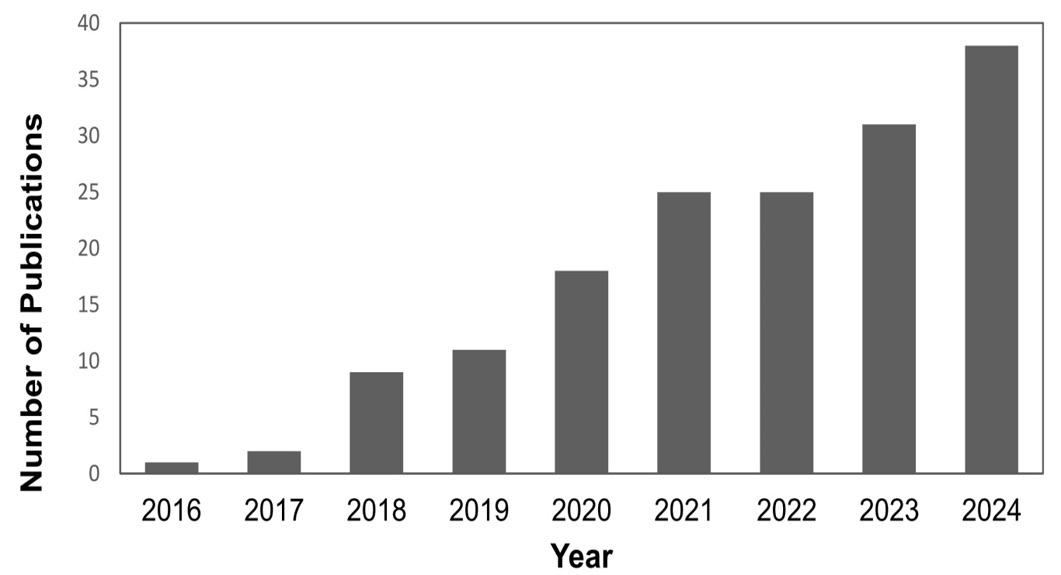
The number of articles on drone technology in insect monitoring and management has shown an upward trend over the past decade, beginning with a noticeable increase in 2018 when 9 articles were published, doubling to 18 in 2020, and continuing to rise with 31 publications in 2023 and 38 in 2024, which represents the highest output during the study period (Figure 1).

Over the past ten years, there has been a notable and steady increase in scholarly interest in the use of drones for insect pest monitoring and management, according to the bibliometric analysis of research publications. This pattern demonstrates how drones are increasingly being acknowledged as a game-changing technology in agriculture, especially in the area of precision pest control. The results show how this topic has developed from its early years in 2016 and 2017 to its current state as a quickly growing field of study, reaching a peak of 38 articles in 2024. This exponential rise is a result of the growing use of drone technology to address important issues in pest monitoring and management, which is fueled by the demand for effective and sustainable farming methods.

There are many reasons for the notable increase in publications starting in 2020. First, advancements in sensor technology, battery efficiency, and onboard data processing have made drones more accessible and effective for agricultural applications. Second, interest in drone-based targeted treatments and real-time, high-resolution monitoring has increased due to the increased focus on precision agriculture and integrated pest management (IPM). Using field observations, Lee and Yu (2023) established and tested a drone-assisted extermination system for the hornet Vespa Velutina nigrithorax, featuring a UAV equipped with a pesticide-spraying system and a nest-perforating mechanism. Third, Patil et al. (2024) reported that the global drive for environmentally sustainable farming methods has brought attention to how drones might lessen the need for chemical pesticides, which would minimize the damage to the environment and support ecological balance.

Keyword statistics

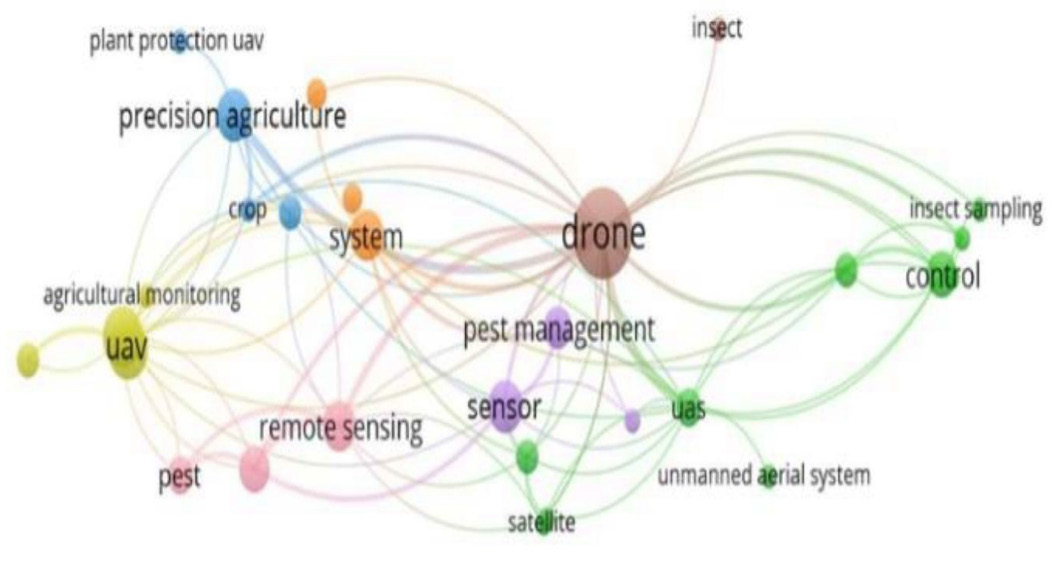
The co-occurrence of keyword network analysis showed drone as the central theme, with strong associations to precision agriculture, pest monitoring, and control strategies. The presence of remote sensing, UAVs, and sensors showed that drones are widely being used for early pest detection and integrated pest management. This network visualization endorses the interdisciplinary nature of drone-based pest management, representing its potential to enhance precision agriculture and sustainable pest control techniques (Figure 2).

The keyword co-occurrence network analysis offers important information about this study domain’s topic focus. While related phrases like “precision agriculture,” “pest monitoring,” and “control strategies” reflect the variety of uses of this technology, the term “drone’s centrality in the network emphasizes its crucial role in insect pest management. Strong connections between “UAV,” “remote sensing,” and “sensors” highlight the use of cutting-edge technologies for crop health evaluation and early pest detection. Additionally, the usage of phrases like “insect sampling,” “control,” and “unmanned aerial system (UAS)” implies that drones are employed for direct pest control interventions like precision insecticide application and biological control in addition to monitoring. The application of UAS in insect pest management has been the subject of prior research ; ; ; . The addition of “satellite” to the network emphasizes even more how drones can be used in conjunction with GIS technology to provide extensive pest surveillance, allowing for more thorough and effective management plans.

Journal-wise contribution to publications

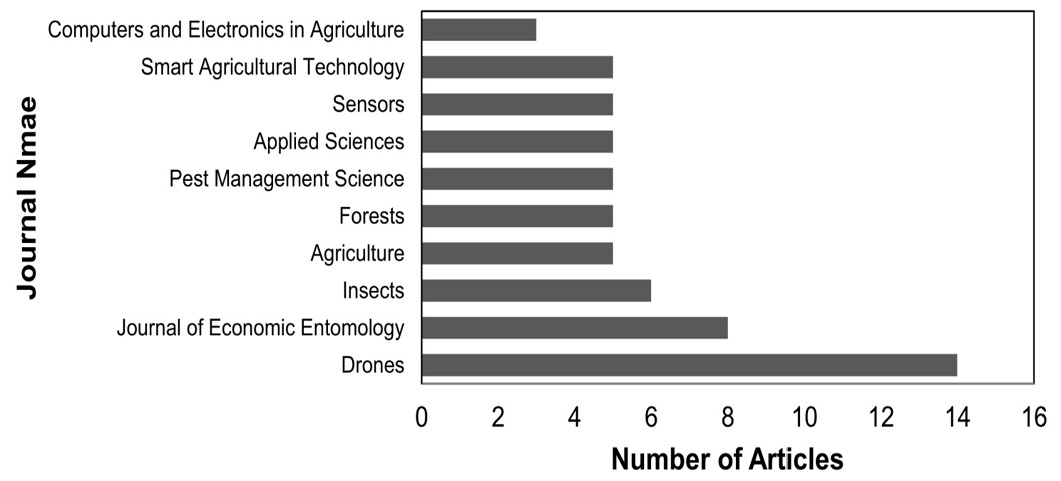
The bibliometric analysis showed that studies available on the use of drone applications in insect monitoring and management are distributed among multiple journals. However, the journal’s highest numbers of articles (14) are published in Drones, showing its leading role in publishing research on this topic. Further, 8 articles are published in the Journal of Economic Entomology and 6 articles in Insects (MDPI). Other journals, including Agriculture, Forests, Pest Management Science, Applied Sciences, Sensors, and Smart Agricultural Technology, each contributed 5 articles. Additionally, 3 articles are published in Computers and Electronics in Agriculture (Figure 3).

The interdisciplinary nature of drone applications in insect pest management is reflected in the distribution of research across several journals. With 14 articles, the journal Drones stands out as a premier venue for sharing research in this area. The Journal of Economic Entomology and Insects, which focuses on entomological and pest management research, comes next. In developing drone-based pest management solutions, agricultural, technological, and environmental disciplines are coming together, as seen by the contributions of journals like Pest Management Science, Applied Sciences, Agriculture, Forests, Sensors, and Smart Agricultural Technology. Furthermore, the significance of combining computational tools (such as, small unmanned aerial robots, or small drones, vector machines (SVMs) and extreme learning machines (ELMs), pre-programmed and remotely controlled UAVs) with drone technology for improved pest management is further highlighted by the role of computers and electronics in agriculture in publishing research on digital and precision agriculture technologies (Iost Filho et al., 2020; .

Future directions

To overcome current limitations, such as the high upfront costs of drone technology, regulatory constraints, and the requirement for specialized operator training, further research and policy support are essential . Second, the development of standardized protocols like data quality and availability, species identification complexity, computational cost, regulatory frameworks and best practices for drone-based pest management will require enhanced collaboration among researchers, practitioners, and policymakers. Finally, there is a great deal of promise for improving the precision and effectiveness of pest monitoring and control methods through the integration of drones with other cutting-edge technologies like artificial intelligence (AI) and machine learning .

Conclusion

In summary, this bibliometric analysis demonstrates how drones have the potential to revolutionize insect pest monitoring and management, as demonstrated by the notable increase in research effort and the wide range of uses for this technology. Drones technology has become a research hotspot, and the numbers of publications have continued to grow steadily since 2018. Over the past ten years, a notable and steady increase in scholarly interest in the use of drones for insect pest monitoring and management has been observed. The study’s conclusions have many outcomes for further investigation and application. The substantial increase in publications suggests that drone technology is set to become more significant in managing insect pests, especially when considering precision agriculture and sustainable farming.

Declarations

Acknowledgement

Authors are grateful to the Department of Entomology, College of Agriculture for the support throughout the study.

Funding

No funding was received for this study.

IRB approval

Ethical approval for this study was granted by the Institutional Review Board (IRB) of the University of Sargodha, Sargodha, Pakistan.

Generative AI and AI-assisted technology statement

No Generative AI and AI-assisted technologies were used in the writing process.

Conflict of interest

The authors have declared no conflict of interest.

Figures

Figure 1:
Figure 1:.

Number of publications on drone’s technology in pest monitoring and management.

Figure 2:
Figure 2:.

Word clouds of keywords from research published on drones used in agriculture and entomology in 2016-24.

Figure 3:
Figure 3:.

Top ten prominent journals that published articles on drone’s technology for monitoring and management of insect pests during 2016-24.

References

  1. Aziz, D., Rafiq, S., Saini, P., Ahad, I., Gonal, B., Rehman, S.A., Rashid, S., Saini, P., Rohela, G.K., Aalum, K., Singh, G., Gnanesh, B.N. and Nabila, I.M., 2025. Remote sensing and artificial intelligence: revolutionizing pest management in agriculture. Front. Sustain. Fd. Syst., 9: 1551460. https://doi.org/10.3389/fsufs.2025.1551460[CrossRef]
  2. Bernard, N., Sagawa, J.R., Bier, Y., Lihoreau, N.T., Pazart, L. and Tannou, T., 2025. Using artificial intelligence for systematic review: The example of elicit. BMC Med. Res. Methodol., 25: https://doi.org/10.1186/s12874-025-02528-y[CrossRef]
  3. Chimi, P.M., Fobane, J.L., Onguene, E.M.A., Nkoué, B.B., Kamdem, M.E.K., Pokam, E.Y.N., Guillaine Yonga, B.L.T., Dikoume, A.M.N., Abdel, K.N. and Mala, A.W., 2025. A bibliometric analysis of agroecological practices: trends, impacts, and future directions. Environ. Syst. Res., 14: 4. https://doi.org/10.1186/s40068-025-00395-6[CrossRef]
  4. Dhananjaya, V., Jayakumar, S. and Ravichandran, B., 2019. Conventional methods of pesticide application in agricultural field and fate of the pesticides in the environment and human health. In: Controlled release of pesticides for sustainable agriculture (eds. K.R.,R. Thomas and S. Volova). Springer, Cham., https://doi.org/10.1007/978-3-030-23396-9_1[CrossRef]
  5. García-Munguía, A., Guerra-Ávila, P.L., Islas-Ojeda, E., Flores-Sánchez, J.L., Vázquez-Martínez, O., García-Munguía, A.M. and García-Munguía, O., 2024. A review of drone technology and operation processes in Agricultural crop spraying. Drones, 8. https://doi.org/10.3390/drones8110674[CrossRef]
  6. Guebsi, R., Mami, S. and Chokmani, K., 2024. Drones in precision agriculture: A comprehensive review of applications, technologies, and challenges. Drones, 8. https://doi.org/10.3390/drones8110686[CrossRef]
  7. Iost-Filho, F.H., Heldens, W.B., Kong, Z. and De Lange, E.S., 2020. Drones: Innovative technology for use in precision pest management. J. Econ. Entomol., 113: 1-25. https://doi.org/10.1093/jee/toz268[CrossRef]
  8. Ivezić, A., Trudić, B., Stamenković, Z., Kuzmanović, B., Perić, S., Ivošević, B., Buden, M. and Petrović, K., 2023. Drone-related agrotechnologies for precise plant protection in western balkans: Applications, possibilities, and legal framework limitations. Agronomy, 13: 2615. https://doi.org/10.3390/agronomy13102615[CrossRef]
  9. Lee, C.G. and Yu, S.H., 2023. Exterminator for the nests of Vespa velutina nigrithorax using an unmanned aerial vehicle. Drones, 7: https://doi.org/10.3390/drones7040281[CrossRef]
  10. Mandeep, R. and Pradeep, D., 2018. Global food security- issues, challenges and technological solutions. Trends Fd. Sci. Technol., 80: 267-281.
  11. Mohsan, S.A.H., Othman, N.Q.H., Li, Y., Alsharif, M.H. and Khan, M.A., 2023. Unmanned aerial vehicles (UAVs): practical aspects, applications, open challenges, security issues, and future trends. Intell. Serv. Robot., 16: 109-137. https://doi.org/10.1007/s11370-022-00452-4[CrossRef]
  12. Nazarov, D., Nazarov, A. and Kulikova, E., 2023. Drones in agriculture: Analysis of different countries. BIO Web Conf., 67: 02029. https://doi.org/10.1051/bioconf/20236702029[CrossRef]
  13. Nordin, M.N., Mat Jusoh, M.S., Abu Bakar, B.H., Hassan Basri, M.S., Kamal, F., Ahmad, M.T., Mail, M.F., Masarudin, M.F., Misman, S.N. and Teo, C.C., 2021. Preliminary study on pesticide application in paddy field using drone sprayer. Adv. Agric. Fd. Res. J., 2: https://doi.org/10.36877/aafrj.a0000147[CrossRef]
  14. Patil, A.S., Mailapalli, D.R. and Singh, P.K., 2024. Drone technology reshaping Agriculture: A meta-review and bibliometric analysis on fertilizer and pesticide deployment. J. Biosyst. Eng., 16: 382-398. https://doi.org/10.1007/s42853-024-00240-1[CrossRef]
  15. Quamar, M.M., Al-Ramadan, B., Khan, K.A., Shafiullah, M.D. and El Ferik, S., 2023. Advancements and applications of drone-integrated geographic information system technology; A review. Remote Sens., 15: https://doi.org/10.3390/rs15205039[CrossRef]
  16. Radwan, M., Abdel-Hameed, I. and Noureddine, A., 2024. The impact of various climate change factors on agricultural insect pests, crop production, and their management strategy in India: A review. Zagazig J. Agric. Res., 51: 697-714. https://doi.org/10.21608/zjar.2024.380609[CrossRef]
  17. Ragiman, R., Talluri, K.B., Verma, N. and Vidya, S.B., 2025. Unmanned aerial vehicle (UAV)-assisted pesticide application for pest and disease prevention and control in rice. Int. J. Agric. Biol. Eng., 18:
  18. Raj, A.K., Arulkumar, M., Saravanan, S. and Muthukumar, V., 2025. Artificial Intelligence-based autonomous pesticide spraying drone management for sustainable agriculture. In: International conference on advanced materials, manufacturing and sustainable development (ICAMMSD 2024). Atlantis Press. pp. 1076-1089. https://doi.org/10.2991/978-94-6463-662-8_84[CrossRef]
  19. Subramanian, K.S., Pazhanivelan, S., Govindasamy, S., Santhi, R. and Sathiah, N., 2021. Drones in insect pest management. Front. Agron., 3: https://doi.org/10.3389/fagro.2021.640885[CrossRef]
  20. Wang, P., Hanif, A.S., Yu, S.H., Lee, C.G., Kang, Y.H., Lee, D.H. and Han, X., 2024. Development of an autonomous drone spraying control system based on the coefficient of variation of spray distribution. Comput. Electron. Agric., 227: https://doi.org/10.1016/j.compag.2024.109529[CrossRef]

Services

Article usage statistics

Loading…

Use of Drone Technology for Precision Monitoring and Sustainable Management of Insect Pests: A Bibliometric Review · ResearchersLinks