ResearchersLinks

Case Report · Volume 4, Issue 2, Pages 39–41, 3 September 2016 · Open Access

Therapeutic Options in Management of a Clinical Case of Chorioptic Mange in a Goat

· · · · · · · ·

Article Info ⌄
Journal:
Research Journal for Veterinary Practitioners
Published:
3 September 2016

From the article

  • Based on the clinical examination and laboratory findings, this case report was a definitive case of Chorioptic mange infestation.
  • However, the treatment of Chorioptic mange with ivermectin has proved to be less effective in this study as lesions persisted even after the completion of the recommended treatment regime.
  • Amitraz generally has the ability to wash off scabs when applied topically as in this case, it washed off the layers of crusts and scabs which gave protection to the mites, thereby exposing the mites to the effects of Amitraz and their subsequent eradication.
  • Therefore, combination of ectoparasiticide drugs and compounds that can digest the layers of crusts and scabs is highly suggested in order to achieve an effective treatment regimen.

Selected from the article's own text.

Abstract

Faez Firdaus Abdullah Jesse1*, Idris Umar Hambali1,3, Yusuf Abba2,4, Muhammad Abubakar Sadiq2,3, Asinamai Athliamai Bitrus2, Eric Lim Teik Chung1, Mohd Azmi Mohd Lila2, Abd Wahid Haron1, Abdul Aziz Saharee1

Department of Veterinary Clinical Studies; 2Department of Veterinary Pathology and Microbiology, Faculty of Veterinary Medicine, Universiti Putra Malaysia, 43400 Serdang, Selangor, Malaysia; 3Department of Veterinary Public Health and Preventive Medicine; 4Department of Veterinary Pathology, Faculty of Veterinary Medicine, University of Maiduguri, PMB1069, Borno State, Nigeria.

Abstract | A Jamnapari buck was presented during a farm visit with a history of skin itching and loss of hair. Physical examination revealed the presence of generalized skin lesions characterized by alopecic, crusty and pruritic dermatitis at bilateral hind limbs and ears. Deep skin scrapings was done and microscopical examination revealed the presence of Chorioptes mites. A definitive diagnosis of Chorioptic mange was made. Treatment was initiated with ivermectin (0.2 mg/kg), administered subcutaneously weekly, for 3 weeks, but the lesions still persisted.. Thereafter, treatment was carried out with Amitraz (0.05%) bath, weekly for 3 weeks. One week post treatment, the lesions resolved. In this case, Amitraz proved to be more effective in managing the Chorioptic mange infestation. Management of mange infestation may be challenging and warrant the use of several treatment options as was observed in this case. 
 
Keywords Skin lesions, Mange, Chorioptes mites, Ivermectin, Amitraz, Therapeutic option


CASE HISTORY

An adult male Jamnapari goat was presented with the history of skin itching and apparent loss of hair around the hind limbs and ears. The vaccination and deworming status of the patient were up-to-date.

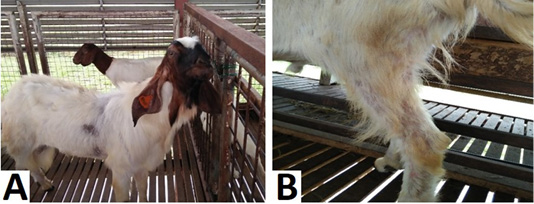
Figure 1: A) Animal rubbing body against pen; B) Alopecia on the hind limb

CLINICAL EXAMINATION

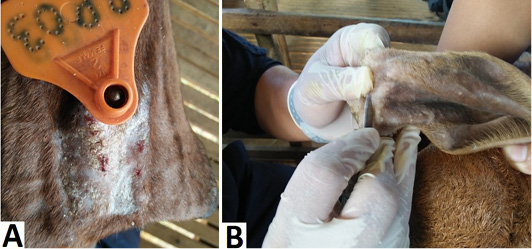
Upon examination, the goat was observed frequently rubbing its body against the wall of the pen (Figure 1A). Examination of the limbs revealed bilateral crusty lesions on the hind limbs (Figure 1B) and there were also hard crusty patches on both ears (Figure 2A).

Figure 2: A) Hard brown crusty lesion on the ear; B) Scrapings from the affected ear

DIAGNOSTIC WORKUPS

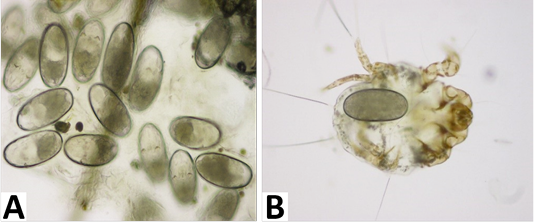
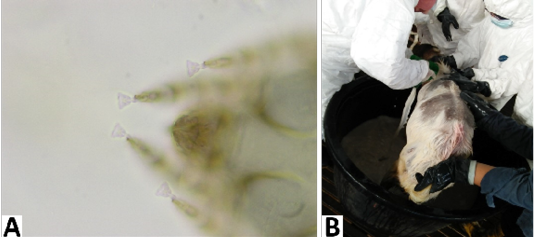
Skin scraping samples were collected from the affected regions (Figure 2B) and the samples were prepared and then examined under a light microscope at 40x and 100x magnification. Clusters of mite eggs were observed (Figure 3A), Active mites and a few female mites with an egg inside the body were also identified (Figure 3B). Examination of the mite pedicles revealed short pedicles and the presence of cup-shaped suckers on the legs (Figure 4A). Based on these findings, a definitive diagnosis of Chorioptic mange was made.

Figure 3: A) Clusters of mite eggs; B) Gravid female mite

TREATMENT

Initial treatment was instituted with three weekly doses of ivermectin (0.2 mg/kg), subcutaneously as an ectoparasiticide. Unfortunately, one week after the treatment regime, the lesions of mange still persisted. Further treatment was thereafter instituted with Amitraz (0.05%) bath as topical ectoparasiticide (Figure 4B), weekly for 3 weeks. Examination of the goat after a week post-treatment revealed resolution of the lesions, hence a good prognosis.

Figure 4: A) Mite with rounded head and cup-shaped suckers; B) Bathing procedure with Amitraz (0.05%) starting from the head and ending at the tail region

DISCUSSION

Based on the clinical examination and laboratory findings, this case report was a definitive case of Chorioptic mange infestation. There was no evidence of pyrexia reported, which rules out the possibility of a systemic secondary bacterial infection, even though skin abrasions were apparent. The animal was stable but the frequent rubbing of the body on the wall of the pen might lead to exhaustion due to an expected drop in appetite and subsequent emaciation as reported by . Ivermectin, a broad spectrum non hygroscopic, semisynthetic, anthehelmintic, antiparasitic drug has been proven to be effective against endo and ectoparasites ; . In this case, ivermectin was used as ectoparasiticide at one dose weekly for three weeks . The weekly interval of administration was simply to halt the parasite’s life cycle by inactivating the viable stages of the parasite on the animal , hence, avoiding the growth of the parasite to maturity.

Selective administration of ivermectin has been reported to be successful in treating mange infestation in goats ; . However, the treatment of Chorioptic mange with ivermectin has proved to be less effective in this study as lesions persisted even after the completion of the recommended treatment regime. This may be due to low systemic levels of the drug or due to re-infestation of the goat by mites from the environment . Mites can survive in the environment such as the wall of the pen, the bedding and floor for up to 12 weeks . Hence, spraying of the pens with acaricides after such treatments is of paramount importance in order to halt the reoccurrence of the parasitic infestation .

Scabs provide a safe haven for mites where they get protection and escape drug therapy. Subsequently they mature into adult and result in more infestation. In such kind of situation, topical treatment is strictly recommended . In this case, the use of Amitraz bath was able to successfully resolve the mange infestation in the goat. The success achieved with the bath is because it was applied topically and Chorioptes mites are non-burrowing and surface living mites . Amitraz generally has the ability to wash off scabs when applied topically as in this case, it washed off the layers of crusts and scabs which gave protection to the mites, thereby exposing the mites to the effects of Amitraz and their subsequent eradication.

CONCLUSION

In conclusion, ivermectin is an effective antiparasitic drug used to treat mange in goats, but in cases of re-infestation from the environment and/or presence of thick crusts and scabs, the use of topical bath with Amitraz proved more effective as it was able to wash off the scabs and resolve the condition as was observed in this case report.. Therefore, combination of ectoparasiticide drugs and compounds that can digest the layers of crusts and scabs is highly suggested in order to achieve an effective treatment regimen.

ACKNOWLEDGEMENTS

The authors wish to appreciate the management and staff of the University Veterinary Hospital (UVH) and Taman Pertanianuniversiti (TPU) of the Universiti Putra Malaysia (UPM) for their cooperation throughout the course of this case.

Conflict of interests

None to declare.

Authors’ contribution

All authors contributed equally and approved the final manuscript.

References

  1. • Asmare K, Abebe R, Sheferaw D , Krontveit RI, Barbara W (2016). Mange mite infestation in small ruminants in Ethiopia: Systematic review and meta-analysis. Vet. Parasitol. 218: 73-81. http://dx.doi.org/10.1016/j.vetpar.2016.01.017[CrossRef]
  2. • Bates P, Rankin M, Clifford D, Stubbings L (2005). Shower dipping in diazinon or cypermethrin dipwash to control ovine psoroptic mange (sheep scab). Vet. Rec. 156(20): 655. http://dx.doi.org/10.1136/vr.156.20.655[CrossRef]
  3. • Brugger M, Braun U (2000). Demodicosis in a Toggenburg goat. Schweiz Arch. Tierheilkd. 142(11): 639-642.
  4. • Chanie M, Negash T, Sirak A (2010). Ectoparasites are the major causes of various types of skin lesions in small ruminants in Ethiopia. Trop. Anim. Health Prod. 42(6): 1103-1109. http://dx.doi.org/10.1007/s11250-010-9531-4[CrossRef]
  5. • Cornall K, Wall R (2015). Ectoparasites of goats in the UK. Vet. Parasitol. 207(1-2): 176-179. http://dx.doi.org/10.1016/j.vetpar.2014.11.005[CrossRef]
  6. • Demite PR, Feres RJ, Lofego AC (2015). Influence of agricultural environment on the plant mite community in forest fragments. Braz. J. Biol. 75(2): 396-404. http://dx.doi.org/10.1590/1519-6984.14913[CrossRef]
  7. • Jarmuda S, O’Reilly N, Zaba R, Jakubowicz O , Szkaradkiewicz A, Kavanagh K (2012). Potential role of Demodex mites and bacteria in the induction of rosacea. J. Med. Microbiol. 61(11): 1504-1510. http://dx.doi.org/10.1099/jmm.0.048090-0[CrossRef]
  8. • Leon-Vizcaino L, Cubero MJ, Gonzalez-Capitel E, Simon MA, Perez L, Rocio Ruiz deYbanez M, Ortiz JM, Gonzalez Candela M, Alonso F (2001). Experimental ivermectin treatment of sarcoptic mange and establishment of a mange-free population of Spanish ibex. J. Wildl. Dis. 37(4): 775-785. http://dx.doi.org/10.7589/0090-3558-37.4.775[CrossRef]
  9. • Lughano K, Dominic K (2006). Diseases of small ruminants, A handbook of common diseases of sheep and goats in Sub-Saharan Africa. International Managers of the Livestock Production Programme (LPP) funded by DFID. Vet Aid, Scotland; 102-105
  10. • Marimuthu M, Abdullah FFJ, Mohammed K, Adamu L, Tijjani A, Abba Y, Sadiq MA, Ting LY, Saharee AA, Haron AW (2015). Comparative treatment approach for Sarcoptes and Psoroptes mite infestation in a Boer cross. Journal of Adv. Vet. Anim. Res; 2(1):84-88
  11. • Seid K, Amare S, Tolossa YH (2016). Mange mites of sheep and goats in selected sites of Eastern Amhara region, Ethiopia. J. Parasit. Dis. 40(1): 132-137. http://dx.doi.org/10.1007/s12639-014-0463-1[CrossRef]
  12. • Tabassam SM , Iqbal Z, Jabbar A, Sindhu ZU, Chattha AI (2008). Efficacy of crude neem seed kernel extracts against natural infestation of Sarcoptes scabiei var. ovis. J. Ethnopharmacol. 115(2): 284-287. http://dx.doi.org/10.1016/j.jep.2007.10.003[CrossRef]
  13. • Vieira MI, Bordin T, Dall’Agnol B, Zanchin F, Motta AC, Noro M (2014). Re-emergence of Chorioptes bovis (Acari: Psoroptidae) in cattle in the state of Rio Grande do Sul, Brazil. Rev. Bras. Parasitol. Vet. 23(4): 530-533. http://dx.doi.org/10.1590/S1984-29612014090[CrossRef]

Services

Article usage statistics

Loading…

Therapeutic Options in Management of a Clinical Case of Chorioptic Mange in a Goat · ResearchersLinks