In the current study 21 species belonging to 12 families and six orders of mammals were recorded (Table I).
However, most of the species from the family Bovidae were recorded in wildlife parks.
The most dominant and frequently occurring species recorded in the current study were wild boar Sus scrofa, followed by grey mongoose Herpestes edwardsii, wild rabbit Lepus nigricollis and golden jackal Canis aureus.
Keeping in view the conservation status of these species and threats they are facing, the current level of protection of mammalian species must be strengthened and strictly applied to Nowshera district.
Selected from the article's own text.
Abstract
Natural wildlife habitats are regularly encroached by humans for different purposes, which are heading the biodiversity towards dramatic falls. The presence of several endangered species in many areas remains unveiled due to the lack of faunal inventories. In such situations, it is imperative to make proper records of the existing fauna on local scales to strengthen the conservation practices. Twenty-one species representing 18 genera, 12 families and six orders of mammals were recorded in Nowshera district, Khyber Pakhtunkhwa province (KP), Pakistan from an inventory conducted from November 2018 to July 2019. Selected locations were scanned by walking and grey literature was used. Five of the recorded species were found in captive breeding facilities while rest of the species were recorded exclusively from the wild. Order Artiodactyla was the most diverse group represented by 7 species from 5 genera in 3 families. Critically endangered Common leopard Panthera pardus an imperceptible resident species of the area was revealed for the first time by using grey literature. Wild boar Sus scrofa was the most dominant and frequently occurring species of the area. Based on the regional conservation status of the recorded species, 3 species are near threatened, 2 species are vulnerable, one endangered and one species is critically endangered. Four species are protected under the Khyber Pakhtunkhwa Wildlife and Biodiversity (Protection, Preservation, Conservation and Management) Act, 2015. Threats being faced by the reported mammalian fauna from human activities are emphasized.
INTRODUCTION
The fast-growing human population and the immediate developmental processes are destroying the natural wildlife habitats , heading the biodiversity towards alarming depletions. It is predicted that biodiversity will face a continuous decline over the 21st century . Due to anthropogenic activities events, extinction rates are rising 100-1000 folds higher than natural rates, vanishing 150 species from the world in a single day (Ahmad, 2007; .
Faunal inventories are of prodigious significance in conservation practices predominantly in areas facing severe anthropogenic pressures . Biodiversity in many areas remains elusive due to the lack of faunal inventories due to which implementation of effective conservation strategies becomes almost impossible .
Pakistan is a country having diverse geographical zones, including the majestic mountain ranges of Hindukush, Himalayas and Karakorum, Indus plains, Deserts, and coastal areas . This country harbors a vast variety of wildlife habitats and their associated flora and fauna. These habitats include the glaciers, dry alpine and cold deserts, Himalayan dry coniferous, Himalayan moist temperate forest, sub-tropical pine forest, subtropical dry mixed deciduous scrub forest, Balochistan juniper scrub forest, dry sub-tropical and temperate semi-evergreen forest, tropical thorn forest, mangrove forests and desert ecosystems .
Pakistan is home to 195 mammal species belonging to 10 orders (Roberts, 2005a, b). Out of the total 195 species, 44 species are declared as critically endangered or near-threatened, several are regionally extinct and many species are still data deficient. Khyber Pakhtunkhwa (KP) province of Pakistan, formerly known as the North West Frontier Province, harbors rich wildlife fauna including some charismatic and iconic wild mammals like snow leopard (Panthera uncia), Himalayn lynx (Lynx lynx isabellinus), common leopard (Panthera pardus), Kashmir markhor (Capra falconeri cashmiriensis), Himalayan ibex (Capra ibex sibirica) and urial (Ovis vignei). However, the continuous drastic declines of the wildlife in Pakistan are of great trepidation (GOP, 2015).
The current study is a step towards filling critical information gaps concerning the mammalian fauna of Nowshera District, providing benchmark data for protection and better conservation strategies of these natural resources.
MATERIALS AND METHODS
Study area
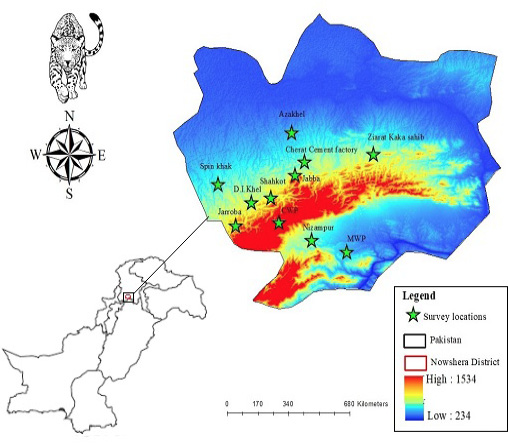
The current study was conducted within Nowshera district of KP province, Pakistan (34°0′55″N, 71°58′29″E), having undulating landscape with different elevation ranges (234-1534m) above sea level ASL (Fig. 1). This district encompasses an area of 1,748 km2, divided into 47 union councils (UC) of which the largest one in terms of area is Nizampur and the smallest is Pabbi. In the east Nowshera district is bordered by Attock district of Punjab Province, in the North Nowshera district shares boundaries with Mardan district, Charsadda district in the northwest, Peshawar district lies in west and the Federally Administered Tribal Areas (Darra Adam khel); (FATA, now merged in KP) in the south and south west. River Kabul flows through Nowshera district and makes its confluence with magnificent River Indus at Khair Abad, which is the boundary of KP province with Punjab province.
Climate
The study area has a prevailing local steppe or semi-arid climate. The average annual temperature recorded is 24.4°C with an average rainfall of 532 mm. January is the coldest month with average monthly temperatures lower than 10°C while the warmest month is June with average monthly temperature up to 33.6 °C. In the areas like Cherat with higher elevations (1534 m ASL) and occasionally receiving mild snowfall the winter temperature goes down below 0°C (GOP, 2019).
Habitats
Three wildlife Parks, Manglot Wildlife Park (MWP), Nizampur Wildlife Park and Cherat Wildlife Park (CWP) are located in Nowshera district. The habitat in these parks is broad-leaved evergreen scrub Forests. The dominant species are Olea ferruginea (Olive, Zaithoon), Acacia modesta (Phulai), Vachellia nilotica (Kikar), Zizyphus mauratiana (Ber), Monotheca buxifolia (Gurgurah) and Dodonaea viscosa (Sanatha, Ghwarahsky). Many small irrigated forest plantations of Eucalyptus camadulensis (Laachi) planted by KP Forest department and by private farmers can be seen throughout the district.
Study methods and data collection
The current study was conducted from November 2018 to July 2019. Keeping in view the habitat potentials, we primarily selected hotspot areas for assessing the wild fauna. These areas included the Parks and their peripheries, Nizampur, plains of Azkakhel, hillocks of Dak Ismail khel, Ziarat kaka sahib, Spin khak, Jarroba, Shah kot and Jabba. Inventories were mostly conducted between 7:00–11:00h and between 15:00–18:00h . Nocturnal animals were also surveyed using search lights. We covered these areas by walking randomly using direct and indirect methods. Binoculars (10×50mm) were used to examine animals (Khattak et al., 2019a). For recording aero-mammalian fauna, we used mist nets (9m high), and erected them before sunset in different areas including water bodies, narrow passages and plains . Live traps were used to capture small mammals unharmed. At each study site live traps were regularly checked every morning to prevent any possible mortality. Rodents presence was also confirmed by their colonies. Furthermore, in methodology we assumed not to conduct surveys on rainy days or in bad weather like strong winds (Khattak et al., 2019a). Along with direct sighting of animals, we also recorded the signs or marks (scats, droppings, dens and hairs) to identify and document the presence of the species in the area. To correctly identify the animals up to the species level we consulted field guides .
We noted human activities and other factors that can be potential threats to the existing fauna. We also searched and gathered all the possibly existing grey literature about the fauna of the study area. GPS was used to record the locations and Arc-GIS 10.2.1 was used for map development. The Digital Elevation Model for the area was downloaded from USGS (Glovis, https://glovis.usgs.gov).
RESULTS
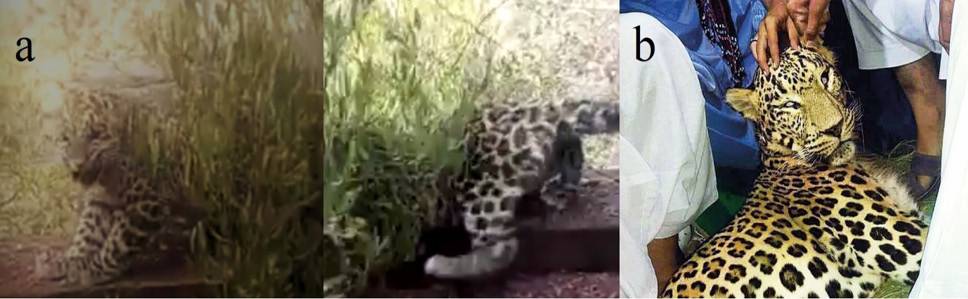
In the current study 21 species belonging to 12 families and six orders of mammals were recorded (Table I). Out of all six orders Artiodactyla, Carnivora and Rodentia were represented by 3 families each, while rest of the orders were represented by a single family. In terms of wilderness Muridae and Vespertilionidae were the most prominent families reported in the current study, each represented by three species. Family Suidae, Felidae, Herpestidae, Sciuridae, Soricidae and Leporidae were represented by single species each. Canidae was represented by two species. Family Bovidae and Cervidae were represented by four and two species respectively. However, most of the species from the family Bovidae were recorded in wildlife parks. The most dominant and frequently occurring species recorded in the current study were wild boar Sus scrofa, followed by grey mongoose Herpestes edwardsii, wild rabbit Lepus nigricollis and golden jackal Canis aureus. First-ever photographs of critically endangered common leopard from the area were obtained and presented.
DISCUSSION
The current study is the most comprehensive mammalian faunal inventory of Noswhera district, Khyber Pakhtunkhwa Pakistan. Some of the species reported in this inventory are of great concern in terms of their conservation.
Table I. List of mammalian species observed in Nowshera District along with their IUCN and regional conservation status, * represents species in ex-situ conservation, ** Represent exotic species in captive breeding.
Order /Family
Species
Common name
IUCN status
Regional status
Observation
Artiodactyla
Suidae
Sus scrofa
Wild boar
LC
LC
Direct Sighting
Bovidae
Gazella bennettii
Chinkara
LC
VU
Direct Sighting
Ovis vignei *
Urial
VU
EN
Direct Sighting
Ovis orientalis **
Antilope cervicapra *
Mouflon sheep
Black buck
VU
LC
-
RE
Direct Sighting
Direct Sighting
Cervidae
Axis porcinus *
Axis axis **
Hog deer
Chital
EN
LC
VU
-
Direct Sighting
Direct Sighting
Carnivora
Canidae
Felidae
Herpestidae
Canis aureus
Vulpes vulpes
Panthera pardus
Herpestes edwardsii
Golden jackal
Red fox
Common leopard
Grey Mongoose
LC
LC
VU
LC
NT
NT
CE
LC
Direct Sighting + Scats
Direct Sighting +Scats
Grey literature
Direct Sighting
Rodentia
Hystricidae
Hystrix indica
Porcupine
LC
NT
Quills Sighted
Sciuridae
Funambulus pennantii
Five-striped palm squirrel
LC
LC
Direct Sighting
Muridae
Mus musculus
House Mouse
LC
LC
Direct Sighting
Rattus rattus
Black house rat
LC
LC
Direct Sighting
Rattus tanezumi
Asian house rat
LC
LC
Direct Sighting
Eulipotyphla
Soricidae
Suncus murinus
House shrew
LC
LC
Direct Sighting
Lagomorpha
Leporidae
Lepus nigricollis
Wild rabbit
LC
LC
Direct Sighting +Pellets
Chiroptera
Vespertilionidae
Scotophilus kuhlii
Lesser Asiatic yellow bat
LC
LC
Direct Sighting
Pipistrellus coromandra
Indian pipistrelle
LC
LC
Direct Sighting
Hipposideros fulvus
Fulvus Leaf-nosed Bat
LC
LC
Direct Sighting
CE, Critically Endangered, EN, Endangered, NT, Near Threatened, VU, Vulnerable, LC, Least Concern, RE, Regionally Extinct (Regional status is based on .
They are declared as protected under Schedule 3, section 22 of Khyber Pakhtunkhwa Wildlife and Biodiversity (Protection, Preservation, Conservation and Management) Act, 2015. In the current study, we found the wild boar as the most frequently occurring and uniformly distributed species in all the surveyed locations. Wild boar is a highly adaptable pest species and often propagates in almost all types of habitats, including plains, swamps, mountains, coastal areas, and almost all kinds of forests ; . In Pakistan, the wild boar mostly occurs at an elevation up to and lower than 1000 m above sea level . In Pakistan, the wild boar is not hunted for meat or trophy because of strict religious prohibition. This immunity has favoured the exponential increase of the wild boar population across Pakistan. Wild boars were frequently seen in the night near human settlements. Wild boars, being highly adaptable to the human-dominated landscapes ; , has a deadly capacity of causing significant economic losses by destroying forests, crops and transmitting diseases to livestock ; ; . Sporadic efforts have been made in previous years to control wild boar populations, even bounty hunting was allowed in the Punjab province. Some sport hunting of wild boar is also practiced in some areas. However, these activities do not match the reproductive rate of the animal.
Among small mammals, grey mongoose and wild rabbits were abundant. Mongoose was recorded throughout the study area. However, the wild rabbit was found more frequently in areas with less human disturbance. Small mammals were rarely observed in regions with mongoose’ presence. Negative impacts of mongoose on small mammal communities have been reported . The wild rabbit was mostly found in hilly areas. However, specimens were recorded from the plains of Azakhel. To avoid predators, wild hare prefers to invade hilly and plain habitats with large tracts of shrubs and bushes, or forest cover. Wild rabbits are abundant in the Tarakai Game reserve, Dak Ismail Khel having hilly habitat, rich with tall grasses and thick thorny forests (Khattak et al. 2019a). Golden jackals were observed either directly or indirectly (scats) in all survey locations. Golden jackal is widespread species in Balochistan and KP Province inhabiting all types of habitats ; . In Pakistan Jackal is declared as a near threatened species .
Red fox declared as near threatened species of Pakistan , was recorded at Dak Ismail Khel, and areas nearby CWP. In a recent study, red fox was reported from Miangan Tarakai Game Reserve situated in Dak Ismail Khel (Khattak et al., 2019a). It has a widespread distribution and adapted to varied habitats from the tropical and temperate forests up to high elevated rugged terrain across its home range . It plays a significant role as it is omnivorous and thus feeds on a variety of foods, including rodents to insects and fruits. Therefore, they not only have a check on the population of certain rodent pest species but also ecologically play a vital role in seed dispersal as they store their food and scavenged carrion of dead animals .
Porcupine has been recorded during this study from a four locations (Dak ismail khel, Nizampur, MWP and Jarroba) in the study area. It has a diverse distribution range and occupies riverine forests, irrigated forest-plantations and intensively cultivated croplands and as herbivorous species poses serious threat to cultivated crops and trees inflicting huge economic losses . Five-striped squirrel or Northern palm squirrel is an abundant species in the study area. It is very agile species adapted to arboreal mode of life and widespread in mountainous regions to sandhill deserts and feeds on fruit orchards and seeds of trees . Among rodents, the most prevalent species documented was house mouse Mus musculus and was frequently encountered. This member of class Rodentia has an omnivorous diet varying from seeds, fleshy roots, leaves, stems, and other vegetation material in the wild up to beetle larvae, caterpillars, and cockroaches as well as meat, including occasional carrion as supplementary diet . Two sympatric species of class Rodentia were reported in this study viz., black house rat Rattus rattus and Asian house rat Rattus tanezumi. They are widespread and pest species not only posing a threat to crops and stores grains in their hides but also a vector of various diseases ; .
While conducting the current inventory, we have heard reports from locals about the presence of common leopard Panthera pardus and grey wolf Canis lupus in the area. In Pakistan common leopard and wolf are declared as “critically endangered” and “endangered” species, respectively . Although we tried our best to record these species either by physical observation or signs (scats and scratches), but due to budget constraints and lack of field gears like camera traps, it was almost impossible to observe such elusive species . To overcome such limitations, grey literature was recently used to document the current status and distribution of Persian leopard in Iran . By gathering and reviewing the grey literature, we found the first photographs of common leopard cubs near CWP. Besides, leopard retaliatory killing records by locals in Nizampur area and the adjacent tribal areas confirmed the presence of this large felid (Fig. 2). According to the wildlife department KP, common leopard is present in the area (Khattak et al., 2019a).
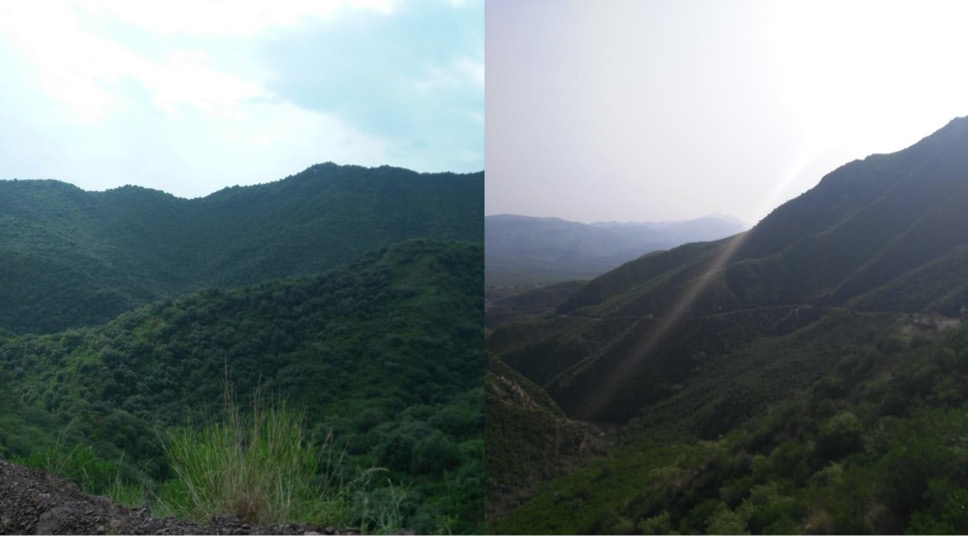
The successful ex-situ conservation shows that the climate and habitat (Fig. 3) in Nowshera district are very suitable for the wild ungulates. Chinkara, now found in semi-wild habitats of Nizampur area, was reintroduced by the wildlife department KP. Likewise, Urial are also flourishing in ex-situ conservation with the aim of reintroduction under the auspices of wildlife department KP (Khattak et al., 2019b, 2020). The presences of both these species was once confirmed in Noswhera District by Malik (1987). Three species of bats reported in the current inventory were also confirmed by .
In the current study, anthropogenic activities like illegal hunting, road construction, over-extraction of forest resources, and human-wildlife conflicts were recorded. Among all these recorded activities killing animals and cutting of forests as firewood were notable and seem potential lethal emerging concerns for the existing fauna.
CONCLUSIONS AND RECOMMENDATIONS
The results obtained in the current study provide benchmark information about the mammalian fauna of Nowshera district, KP Pakistan. Of the recorded species, many are regionally threatened. Keeping in view the conservation status of these species and threats they are facing, the current level of protection of mammalian species must be strengthened and strictly applied to Nowshera district. Deforestation and poaching should be strictly monitored and banned. Based on the observation regarding the exotic species like Mouflon sheep and Chital, we recommend to strongly monitor their effects on native species, in case of their successful propagation. To properly document and validate the existing fauna, we recommend conducting further detailed studies by using modern and robust techniques like camera traps and human-wildlife conflict surveys.
ACKNOWLEDGEMENTS
We are thankful to Wildlife Department Khyber Pakhtunkhwa Pakistan, for allowing us to conduct this study and supporting us throughout the study. This study was supported by the National Nature Science Foundation of China (31870512), and the fundamental research funds for the central universities (2572014CA03). This study also got financial support from Heilongjiang Touyan innovation team program for forest ecology and conservation, Ningxia Helan Mountains National Nature Reserve.
Statement of conflict of interest
The authors have declared no conflict of interest.
Figures
Fig. 1..
Map of Nowshera district showing the inventory locations.
Fig. 2..
(a) Leopard cubs sighted and photographed near CWP, (b) Leopard killed by locals in the adjacent tribal areas (Source: Gulf News https://gulfnews.com/world/asia/pakistan/video-furore-as-leopard-is-brutally-killed-by-people-in-pakistan-1.6638067).
Fig. 3..
Habitat potential of Nowshera District.
References
Ahmed, D., 2007. Convention on biological diversity, United Nations environment programme. https://www.cbd.int/doc/speech/2007/sp-2007-05-22-es-en.pdf
Altaf, M., Javid, A., Irfan, M.A., Ashraf, S., Umair, M., Iqbal, K.J. and Ali, Z., 2014. Diversity of wild mammalian fauna of Chenab riverine forest, Punjab, Pakistan. J. Anim. Pl. Sci., 24: 1342-1347.
Castillo-Contreras, R., Carvalho, J., Serrano, E., Mentaberre, G., Fernández-Aguilar, X., Colom, A., González-Crespo, C., Lavín, S and López-Olvera, J.R., 2018. Urban wild boars prefer fragmented areas with food resources near natural corridors. Sci. Total Environ., 615: 282–288. https://doi.org/10.1016/j.scitotenv.2017.09.277[CrossRef]
Ceballos, G., Ehrlich, P. R., Barnosky, A.D., García, A., Pringle, R.M., and Palmer, T.M., 2015. Accelerated modern human–induced species losses: Entering the sixth mass extinction. Sci. Adv., 1: e1400253. https://doi.org/10.1126/sciadv.1400253[CrossRef]
Durio, P., Fogliato, D., Perrone, A and Tessarin, N., 1995. The autumn diet of the wild boar (Sus scrofa) in an alpine valley. Preliminary results. Ibex J. Mount. Ecol., 3: 180-183.
Gerard, J., Cargnelutti, B., Spits, F., Valet, G and Sardin, T., 1991. Habitat use of wild boar in a French agroecosystem from late winter to early summer. Acta Theriol., 36: 119-129. https://doi.org/10.4098/AT.arch.91-8[CrossRef]
Giannatos, G., Marinos, Y., Maragou, P. and Catsadorakis, G., 2005. The status of the Asiatic Jackal (Canis aureus) in Greece. Belgian J. Zool., 135: 145-149
Gortázar, C., Ferroglio, E., Höfle, U., Frölich, K. and Vicente, J., 2007. Diseases shared between wildlife and livestock: A European perspective. Eur. J. Wildl. Res., 53: 241–256. https://doi.org/10.1007/s10344-007-0098-y[CrossRef]
Government of Pakistan. 2015. Pakistan national biodiversity strategy and action plan. https://www.iucn.org/sites/dev/files/import/downloads/nbsap_1st_draft_23_3_15.pdf
Government of Pakistan. 2019. Regional metrological centre Peshawar. https://www.pmd.gov.pk/rmc/KP-about.html
Hafeez, S., Anjum, K., Hafeez Khan, T. and Manzoor, S., 2015. Food habits of Indian crested porcupine (Hystrix indica) in rainfed Pothowae plateau, Punjab, Pakistan. J. agric. Res., 53: 565-579.
Hafeez, S., Khan, G. A., Ashfaq, M. and Khan, Z.H., 2011. Food habits of the Indian crested porcupine (Hystrix indica) in Faisalabad, Pakistan. Pak. J. agric. Sci., 48: 205-210.
Hays, W.S.T. and Conant, S., 2007. Impact of the small Indian mongoose (Herpestes javanicus) (Carnivora: Herpestidae) on native vertebrate populations in areas of introduction. Pac. Sci., 61: 3-16. https://doi.org/10.1353/psc.2007.0006[CrossRef]
Hearn, A.J., Ross, J., Bernard, H., Bakar, S.A., Hunter, L.T.B., Macdonald, D.W., 2016. The first estimates of marbled cat Pardofelis marmorata population density from Bornean primary and selectively logged forest. PLoS One, 11: e0151046. https://doi.org/10.1371/journal.pone.0151046[CrossRef]
IUCN, 2003. Grey wolf taxon data sheet. In: Status and red list of Pakistan mammals (eds. M. Sheikh and S. Molur). IUCN -Pakistan, Islamabad. pp. 226-228.
Jansen, A., Luge, E., Guerra, B., Wittschen, P., Gruber, A.D. and Loddenkemper, C., 2007. Leptospirosis in urban wild boars, Berlin, Germany. Emerg. Infect. Dis., 13: 739–742. https://doi.org/10.3201/eid1305.061302[CrossRef]
Keuling, O., Stier, N. and Roth, M., 2008. How does hunting influence activity and spatial usage in wild boar Sus scrofa L? Eur. J. Wildl. Res., 54: 729. https://doi.org/10.1007/s10344-008-0204-9[CrossRef]
Khanam, S., Mushtaq, M., Nadeem, M.S. and Kayani, A.R., 2017. Population ecology of the house mouse (Mus musculus) in rural human habitations of Pothwar, Pakistan. Zool. Ecol., 27: 106-113. https://doi.org/10.1080/21658005.2017.1307536[CrossRef]
Khattak, R.H., Xin, Z., Ahmed, S., Rehman, E.U and Roberts, N.J. 2019a. An avi-faunal inventory of miangan tarakai game reserve: A Future Destination for Eco-Tourists. Pak. J. Life Soc. Sci., 17: 39-45.
Khattak, R.H., Liu, Z. and Teng, L., 2019b. Development and implementation of baseline welfare assessment protocol for captive breeding of wild ungulate, Punjab Urial (Ovis vignei punjabiensis, Lydekker 1913). Animals, 9: 1102. https://doi.org/10.3390/ani9121102[CrossRef]
Khattak, R.H., Liu, Z., Teng, L. and Roberts, N.J., 2020. Determining optimal stock density of Punjab Urial (Ovis vignei punjabiensis) in captivity for breeding, population growth and reintroduction potential. Pak. J. Biol. Sci., 23: 1227-1230. https://doi.org/10.3923/pjbs.2020.1227.1230[CrossRef]
Killian, G., Miller, L., Rhyan, J. and Doten, H., 2006. Immunocontraception of Florida feral swine with a single-dose GnRH vaccine. Am. J. Reprod. Immunol., 55: 378–384. https://doi.org/10.1111/j.1600-0897.2006.00379.x[CrossRef]
Kleiman, D., Allen, M., Thompson, K. and Lumpkin, S., 1998. Wild mammals in captivity: Principles and techniques. Biol. Conserv., 2: 232. https://doi.org/10.1016/S0006-3207(97)87176-5[CrossRef]
MacDonald, D.J. and Reynolds, J,. 2005. Red fox (Vulpes vulpes). IUCN Canid Specialist Group. Accessed: at http://www.canids.org/species/Vulpus Vulpus.html.
Majumder, J., Bhattacharjee, P. and Majumdar, K., 2015. Inventory of mammals in protected reserves and natural habitats of Tripura, northeast India with notes on existing threats and new records of large footed mouse-eared bat and greater false vampire bat. Check List, 11: 1. https://doi.org/10.15560/11.2.1611[CrossRef]
Malik, M.M., 1987. Management plan for wild artiodactyls in North West Frontier Province, Pakistan. University of Montana. https://scholarworks.umt.edu/cgi/viewcontent.cgi?article=3935&context=etd
Musser, G., Amori, G., Hutterer, R., Kryštufek, B., Yigit, N. and Mitsain, G., 2008. Mus musculus. IUCN red list of threatened species. 2008. Retrieved 5 May 2020.
Parchizadeh, J. and Adibi, M.A., 2019. Distribution and human-caused mortality of Persian leopards Panthera pardus saxicolor in Iran, based on unpublished data and Farsi gray literature. Ecol. Evol., 9: 11972-11978. https://doi.org/10.1002/ece3.5673[CrossRef]
Pereira, H.M., Leadley, P.W., Proença, V., Alkemade, R., Scharlemann, J.P., Fernandez-Manjarrés, J.F. and Chini, L., 2010. Scenarios for global biodiversity in the 21st century. Science, 330: 1496-1501. https://doi.org/10.1126/science.1196624[CrossRef]
Rahman, F.U., Perveen, F., Rauf, T., Salim, M., Ali, Z. and Khattak, M.N.K., 2015. Mormophometric characters and distribution of bat (mammalia: chiroptera) fauna in northwestern Pakistan. J. Anim. Pl. Sci., 25(3 suppl 2): 454-460.
Rehman, S., Qureshi, A.S. and Akbar, Z., 2016. Effects of Natural environmental conditions on the ovarian histometric dynamics of five striped squirrels (Funambulus pennanti). Int. J. Morphol., 34: 262-267. https://doi.org/10.4067/S0717-95022016000100037[CrossRef]
Roberts, T.J., 1997. The mammals of Pakistan. Oxford University Press. New York.
Roberts, T.J., 2005a. Small mammals of Pakistan. Oxford University Press, Karachi.
Roberts, T.J., 2005b. Large and medium-sized mammals of Pakistan. Oxford University Press, Karachi.
Ruiz-Esparza, J., Silvestre, S.M., Moura, V.S., de Albuquerque, M.N., de Carvalho Terra, R.F., de Castro Mendonça, L.M and Ferrari, S.F., 2016. Inventory of birds in the coastal restinga of a private natural heritage reserve in northeastern Brazil. Neotrop. Biol. Conserv., 11: 51-61. https://doi.org/10.4013/nbc.2016.112.01[CrossRef]
Sheikh, K. and Molur, S., 2004. Status and red list of Pakistan’s mammals, based on conservation assessment and management plan for mammals. IUCN, Pakistan. pp. 312.
Soule, M.E. and Kohm, K.A., 1989. Research priorities for conservation biology. Washington, DC: Island Press. pp. 97.
Taber, R.D., Sheri, A.N. and Ahmad, M.S., 1967. Mammals of the Lyallpur region, west Pakistan. J. Mammal., 48: 392-407. https://doi.org/10.2307/1377772[CrossRef]
Wilson, D.E. and Reeder, D.M., 2005. Mammal species of the world: A taxonomic and geographic reference. JHU Press. Vol. 1.
Zaman, I., 2008. Conservation of pheaseants in the north west frontier province (NWFP), Pakistan. Master of Science in Wildlife Biology. The University of Montana Missoula, MT, USA.