
The study was carried out in total of 10 pomegranate orchards in Central Åžanlıurfa, Akçakale, Bozova, Harran, Hilvan, Siverek and Suruç counties of Åžanlıurfa province in South-Eastern Region of Turkey in 2013 and 2014. Infestation rate of Carob Moth (CM) and Brown Spot Disease (BSD) were determined by controlling a total of 100 fruits from four different sides of randomly selected 25 trees from each orchard. In addition, 100 fruits infested with BSD were checked for damage, egg, larvae and pupae of CM during harvest. According to the results from the study, CM infestation rate was low in orchards where BSD infestation rate was high in pomegranate fruits. In terms of infestation rate in pomegranate fruits, a statistically strong negative relationship was determined between BSD and CM (R (BSD, CM) = -0,724;Y=46.312-0.467*X). In this study, BSD infestation rate explained the variance of CM infestation with 52.5% ratio (R2= 0.525).
Short Communication · Volume 52, Issue 4, 3 May 2020 · Open Access
The Relationship Between Infestation Rates of Carob Moth (Lepidoptera: Pyralidae) and Brown Spot Disease in Pomegranate Fruit under Field Conditions
·
Affiliations & Notes ⌄
- 1Agricultural Faculty Plant Protection Department, Harran University, Şanlıurfa, Turkey 2GAP Agricultural Research Institute, Şanlıurfa, Turkey , * Corresponding author: mehmetmamay@hotmail.com 0030-9923/2020/0004-161
Article Info ⌄
- Journal:
- Pakistan Journal of Zoology
- Published:
- 3 May 2020

From the article
- Results of this study indicated a reverse interaction between CM and BSD infestation rates.
- According to the regression and correlation analyses, In terms of infestation rate in pomegranate fruits, a statistically strong negative relationship was determined between BSD and CM (R (BSD, CM)= -0,724; Y=46.312-0.467*X ).
- In this study, BSD infestation rate explained the variance of CM infestation with 52,5% ratio (R2= 0.525).
- As a result, CM infestation rate was low in orchards where BSD infestation rate was high in fruits.
Selected from the article's own text.
Abstract
Materials and methods
The study has been conducted in total of 10 pomegranate orchards located in Şanlıurfa center, Akçakale, Bozova, Harran, Hilvan, Siverek and Suruç counties (Fig. 1). Detailed information about the orchards were given in Supplementary Table I. No pesticides have been applied in the orchards except the orchards in Siverek county which were treated with insecticides of Mospilan 20 SP and Eforia 247 SC alternating for aphids in May during both years of the study.
In order to determine the rates of infestation of CM and BSD, 100 fruits/orchard method have been followed . For this purpose, during the harvest time (the end of September and the beginning of October) one fruit from each side of 25 trees totaling 100 fruits have been examined for eggs, larvae and damage symptoms of CM and BSD on the fruits. Contamination rate (%) for each orchard was determined by recording contaminated and uncontaminated fruits separately. In addition, to determine the relationship between CM and BSD infestation in pomegranate 100 fruits, uncracked but infested by the disease harvested from each orchard, were separately controlled to see whether they are also infested by CM.
The correlation and regression analyses between CM and BSD on collectively infested pomegranate fruits were performed. For the statistical analyses, SPSS package program has been used.
Results and discussion
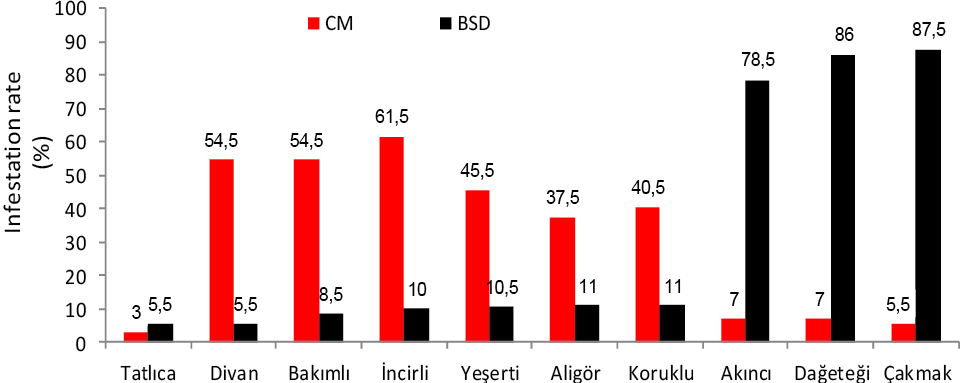
The rates of the infestation with CM and BSD in the orchards were given in Figure 1. Generally, CM infestation rates were low in the orchards where BSD damage was high. As a two year average, the highest CM damage (61.5%) was observed in İncirli village located in Şanlıurfa center and the lowest CM damage (3%) was observed in Akçakale county. BSD infestation rate was highest in Çakmak Village of Bozova county and followed by Dağeteği village located in Şanlıurfa center (87.5% and 86%, respectively) while the lowest infestation was in Akçakale and Siverek counties (5.5%).
In a study conducted in pomegranate orchards in Hatay province (in the Mediterranean Region of Turkey) the rate of pomegranate fruits contaminated with CM was found to be between 13 and 40% while in this study the lowest infestation rate was 3%, and the highest was 63%. Mart and Altın (1992) stated that CM caused yield losses in Southeastern Anatolia region up to 70%. However, Öztürk and Ulusoy (2011) reported that CM damage in pomegranate orchards was insignificant and always less than 1%. Al-Izzi et al. (1985) reported that CM damage was higher in uncared orchards and the damage rate was between 20-80%. In addition, the damage rates caused by CM were 25-30% in pomegranate and 5-32% in citruses ; PPTI, 2008).
In Greece, it has been reported that pomegranate heart rot, a different disease caused by A. alternata, could cause yield losses up to 40-50% . In a study conducted in pomegranate orchards in Cyprus, in varieties of Acco, Herskovitz and Wonderful, fruit rots were 20.31, 14.91 and 9.82% respectively . Gat et al. (2012) reported that the disease caused by A. alternata was different compared to the ones in Israeli’s pomegranate orchards and symptoms of the disease appeared generally as black spots on leaves and fruits and damage was mostly observed on the outer skin rather than the edible part which mainly remained unspoiled. In a study performed in pomegranate orchards of Adana and its counties, A. alternata was isolated from pomegranate stem and fruits as 22.4% and 21.1%, respectively . Wide spread of A. alternata around the world have been reported and it causes economically important infections in pomegranate orchards in Israel, India and Spain ; .
Results of this study indicated a reverse interaction between CM and BSD infestation rates. If the orchard was highly invaded by one of these pest or pathogen, the rate of infestation of the other factor was lower (Fig. 1). In another word, CM infestation rate was low in orchards where BSD infestation rate was high in fruits. We believe that hardened pomegranate fruit skin by BSD makes it difficult for CM larvae to penetrate into fruits thus it reduces the infestation.
According to the regression and correlation analyses, In terms of infestation rate in pomegranate fruits, a statistically strong negative relationship was determined between BSD and CM (R (BSD, CM)= -0,724; Y=46.312-0.467*X ). In this study, BSD infestation rate explained the variance of CM infestation with 52,5% ratio (R2= 0.525). As a result, CM infestation rate was low in orchards where BSD infestation rate was high in fruits. In other words, the coefficient of regression indicates that approximately 52.5% of CM infestation could vary as BSD infestation rate fluctuate.
In this study, to determine the relationship between CM and BSD infestation in pomegranate orchards, 100 fruits infested by the BSD disease harvested from each orchard, were separately controlled to see whether they are also infested by CM (Table I). The results indicate that when all fruits infested with BSD in general infestation with CM, at most 4% level of infestation, were low (Table I).
In both years of the study, except Akçakale town, infestation with CM was found to be over the economical injury level which is set as 5 % (PPTI, 2008). This situation showed that if CM is not controlled and managed well, it can cause significant yield losses. Results of this study are in agreement with other studies which showed that each week the removal of invaded fruits until harvesting time was effective in lowering the of the pest population ; PPTI, 2008). It is extremely important to take measurements in order to prevent fruit cracks which lead to increase CM population and damages. In the region, CM population shows an increment after the end of July and the damage was low in August and thus chemical control program should be started at the beginning of August and based on residual effect of the pesticides it should be repeated in 2-3week intervals .
Table I. The rate of CM infestations of the fruits invaded with BSD in pomegranate orchards in Şanlıurfa.
| County | Village | Infestation rate (%) | ||||||
| 2013 | 2014 | Average | ||||||
| CM | BSD | CM | BSD | CM | BSD | |||
| Akçakale | Tatlıca | 0 | 100 | 0 | 100 | 0,00 | 100 | |
| Bozova | Çakmak | 0 | 100 | 1 | 100 | 0,50 | 100 | |
| Harran | Koruklu | 0 | 100 | 0 | 100 | 0,00 | 100 | |
| Hilvan | Yeşerti | 3 | 100 | 2 | 100 | 2,50 | 100 | |
| Central | Dağeteği | 1 | 100 | 0 | 100 | 0,50 | 100 | |
| Bakımlı | 3 | 100 | 4 | 100 | 3,50 | 100 | ||
| İncirli | 3 | 100 | 1 | 100 | 2,00 | 100 | ||
| Siverek | Divan | 2 | 100 | 1 | 100 | 1,50 | 100 | |
| Suruç | Aligör | 2 | 100 | 2 | 100 | 2,00 | 100 | |
| Akıncı | 0 | 100 | 1 | 100 | 0,50 | 100 | ||
Results of our study show that there is a strong negative correlation between BSD and CM infestation therefore we could expect low infestation of CM to pomegranate fruits in the orchards where high level of BSD found (Table I). In general, in pomegranate fruits infested with BSD were not attacked by CM. We believe it is very likely that the reduced CM infestation in the presence of BSD is due to hardened fruit skin by the disease. Pomegranate fruits with hard skin can be attacked by CM only when cracks through fruit peel are present. Based on our observations during the study we found that CM larvae cannot make an entry into pomegranate fruits when crown parts of pomegranate fruits infested by BSD. However, our findings would need more detail investigation of the relation between CM infestation and pomegranate fruit’s skin characteristics.
In summary, this study is the first reporting inverse relationship between BSD and CM infestation on pomegranate fruits. These results could be important guidelines for pomegranate breeders when developing resistant cultivars against CM damage. Although it was not a subject of this study we believe there are some pomegranate cultivars that have hard fruit skin which may impede the entrance of CM larvae and these kind of pomegranate cultivars could be improved for other desired qualities such as yield, taste etc. and recommended to growers for CM management.
Acknowledgement
This study was presented as an oral presentation and published as an abstract in the Turkey 6th Plant Protection Congress with International Participation in Konya, Turkey on 5-8 May 2016.
Supplementary material
There is supplementary material associated with this article. Access the material online at: https://dx.doi.org/10.17582/journal.pjz/20170823200843
Statement of conflict of interest
The authors declare there is no conflict of interest.
Figures
Average infestation rates of carob moth (CM) and brown spot disease (BSD) in pomegranate orchards in Şanlıurfa.
References
- Alrubeai, H.F., 1987. J. Stored Prod. Res., 23: 133-135. https://doi.org/10.1016/0022-474X(87)90039-7[CrossRef]
- Al-Izzi, M.A.J., Al-Maliky, S.K., Younis, M.A. and Jabbo, N.F., 1985. Environ. Ent., 14: 149–153. https://doi.org/10.1093/ee/14.2.149[CrossRef]
- Azeem, A.A., El Shahat, A.N. and Mounir, A.M., 2019. Pakistan J. Zool., 51: 347-353. http://dx.doi.org/10.17582/journal.pjz/2019.51.1.347.353[Full text][CrossRef]
- Berbegal, M., Lopez-Cortes, I., Salazar, D., Gramaje, D., Perez-Sierra, A., Garcia-Jimenez, J. and Armengol, J., 2014. Pl. Dis., 98: 689-689.
- Çetin, H., 2008. Determination of phytopathological problems on the pomegranate plantations of çukurova and investigation of the effectivity of some fungicides applications against postharvest diseases [master’s thesis]. Adana (Turkey): Çukurova University.
- Elsayed, G. and Bazaid, S.A., 2001. Arch. Phytopath. Pl. Protec., 44: 28 - 36. https://doi.org/10.1080/03235400902831075[CrossRef]
- Ezra, D., Gat, T., Skovorodnikova, Y., Vardi, Y. and Kosto, I., 2010. Australas. Pl. Dis. Notes, 5: 1-2. https://doi.org/10.1071/DN10001[CrossRef]
- Gat, T., Liarzi, O., Skovorodnikova, Y. and Ezra, D., 2012. Pl. Dis., 96: 1513-1518. https://doi.org/10.1094/PDIS-12-11-1041-RE[CrossRef]
- Hatta, R., Ito, K., Hosaki, Y., Tanaka, T., Tanaka, A., Yamamoto, M., Akimitsu, K. and Tsuge, T., 2002. Genetics, 161: 59-70.
- Ito, K., Tanaka, T., Hatta, R., Tamamoto, M., Akimitsu, K. and Tsuge, T., 2004. Mol. Microbiol., 52: 399-411. https://doi.org/10.1111/j.1365-2958.2004.04004.x[CrossRef]
- Kahramanoğlu, İ., Usanmaz, S. and Nizam, İ., 2014. Afr. J. Agric. Res., 9: 905-907.
- Kashkuli, A. and Eghtedar, E., 1976. Ent. Pathol. Appl., 41: 21-32.
- Kohmoto, K., Akimitsu, K. and Otani, H., 1991. Phytopathology, 81: 719-722. https://doi.org/10.1094/Phyto-81-719[CrossRef]
- Mamay, M., 2013. Determination of population development and infestation ratio of carob moth Apomyelois ceratoniae Zell. (Lepidoptera: Pyralidae) in pomegranate orchards in Şanliurfa Province and using mating disruption technique for its control [dissertation]. Şanlıurfa (Turkey): Harran University.
- Mamay, M. and Ünlü, L., 2013. Turkish Bull. Ent., 3: 121-131.
- Mamay, M., İkinci, A., Ünlü, L. and Doğan, E., 2014. Turkish J. Ent., 38: 101-110. https://doi.org/10.16970/ted.89680[CrossRef]
- Mart, C. and Altın, M., 1992. Species of insects and mites determined in the Southeastern Anatolia Region. Proceedings of Turkish II. Entomology Congress; Jan 28-31; Adana (Turkey). pp. 725-735.
- Mart, C. and Kılınçer, N., 1993. Turkish J. Ent., 17: 77-86.
- Mehrnejad, M.R., 1995. Acta Horticul., 419: 365-372. https://doi.org/10.17660/ActaHortic.1995.419.61[CrossRef]
- Mozaffarian, F., Sarafrazi, A. and Ganbalani, G.N., 2007. J. Insect Sci., 7: 11.
- Nay, J.E. and Perring, T.M., 2006. Environ. Ent., 35: 237-244. https://doi.org/10.1603/0046-225X-35.2.237[CrossRef]
- Nishimura, S. and Kohmoto, K., 1983. Annu. Rev. Phytopathol., 21: 87-116.
- Öztürk, N. and Ulusoy, M.R., 2011. Turkish Bull. Ent., 1: 79-89.
- Pala, H., Tatlı, A., Yılmaz, C. and Özgüven, A.I., 2009. Acta Hortic. (ISHS), 818: 285-290. https://doi.org/10.17660/ActaHortic.2009.818.42[CrossRef]
- Park, J.J., Perring, T.M. and Mafra-Neto, A., 2008. Pheromone application for mating disruption of carob moth, Ectomyelois ceratoniae, in commercial date gardens. ESA Annual Meeting, Nov 16-19.
- Peyrovi, M., Goldansaz, S.H. and Jahromi, K.T., 2001. Afri. J. Biotechnol., 10: 380-385.
- [PPTI] Plant Protection Technical Instructions (Turkey). 2008. Volume: 5. Turkish Republic, Ministry of Agriculture and Rural Affairs General Directorate of Agricultural Research, Ankara, Turkey 301.
- Tokmakoğlu, C., Soylu, O.Z. and Devecioğlu, H., 1967. Pl. Protect. Bull., 7: 91-106.
- Turkstat, 2016. Turkish Statistical Institute Database. http://www.tuik.gov.tr/PreTablo.do?alt_id=1001 (November 2016).
- Tziros, G.T., Lagopodi, A.L. and Tzavella-Klonari, K., 2008. Pl. Pathol., 57: 379. https://doi.org/10.1111/j.1365-3059.2007.01668.x[CrossRef]
- Uluç, F.T. and Demirel, N., 2011. Detecting and monitoring the carob moth, Ectomyelois ceratoniae by using sex pheromone traps to determine its distribution, population density and damage level in pomegranate orchards in Hatay Province. Proceedinds of Turkish VI. Entomology Congress; Jun 28-30; Kahramanmaraş (Turkey). pp. 202.
- Vetter, R.S., Millar, J.G., Vickers, N.J. and Baker, T.C., 2006. Southw. Entomol., 31: 121-129.
- Warner, R.L., Barnes, M.M. and Laird, E.F., 1990. J. econ. Ent., 83: 2357-2361.
Supplementary material
Services
Article usage statistics
Loading…