Short Communication · Volume 10, Issue 5, 4 April 2022 · Open Access
The Reduction of Bacterial Load and Total Solid in Drinking Water Qualified as “Clean†for Livestock, Increases Growth Performance and Reduce Diarrhea Frequency in Finishing Lambs
· · · · · · ·
Affiliations & Notes ⌄
1Instituto de Investigaciones en Ciencias Veterinarias, Universidad Autónoma de Baja California, México
2Facultad de Medicina Veterinaria y Zootecnia, Universidad Autónoma de Sinaloa, México
3Departamento de Ciencias Naturales y Exactas, Universidad Autónoma de Occidente, México. *Correspondence | Alejandro Plascencia, Departamento de Ciencias Naturales y Exactas, Universidad Autónoma de Occidente, Unidad Regional Guasave, Avenida Universidad S/N, Flamingos, 81048, Sinaloa, México
The Reduction of Bacterial Load and Total Solid in Drinking Water Qualified as “Clean” for Livestock, Increases Growth Performance and Reduce Diarrhea Frequency in Finishing Lambs.
Abstract |Twenty four Pelibuey × Katahdin male intact lambs (33.22±4.02 kg) were used in order to evaluate the effect of filtering-sanitization of water offered as drink water on growth performance, dietary energetics, carcass traits, and diarrhea frequency in finishing lambs.
Lambs drank FILT shown lower relative weight of stomach complex and tended (P=0.06) to have lower relative intestinal weight.
It is concluded that reduction of TDS and the bacterial load in water qualified as “clean and safe” decreases frequency and days of diarrhea during diet period adaptation, promoting better diet energy utilization, improving weight gain, and HCW and LM area.
Selected from the article's own text.
Abstract
Twenty four Pelibuey × Katahdin male intact lambs (33.22±4.02 kg) were used in order to evaluate the effect of filtering-sanitization of water offered as drink water on growth performance, dietary energetics, carcass traits, and diarrhea frequency in finishing lambs. Lambs were fed with a cracked corn-based high-energy diet during 89-d. Treatment consisted in filtering and sanitization of raw dam water qualified as “clean and safe” comparing it as follows: 1) dam water (RAW), and 2) dam filtered-sanitized water (FILT). Water filtered-sanitized decreased three-fold total solids and remove coliforms, E, coli, and salmonella. Filtered-sanitized water increased 10% water intake, 8% daily gain, and 3% dietary net energy utilization. There was no evidence of infectious diarrhea during the experiment. Non-infectious diarrhea frequency and days on diarrhea were decreased 33% by FILT. Hot carcass weight (HCW) and longissimus muscle area (LM) were increased by FILT. Lambs drank FILT shown lower relative weight of stomach complex and tended (P=0.06) to have lower relative intestinal weight. It is concluded that reduction of TDS and the bacterial load in water qualified as “clean and safe” decreases frequency and days of diarrhea during diet period adaptation, promoting better diet energy utilization, improving weight gain, and HCW and LM area.
Keywords | Water quality, Finishing lambs, Growth-performance, Carcass traits, Diarrhea
separated using the “honestly significant difference test” (Tukey’s HSD test).Treatment effects were considered significant when the P-value was ≤ 0.05 and were identified as trends at P >0.05≤0.10.
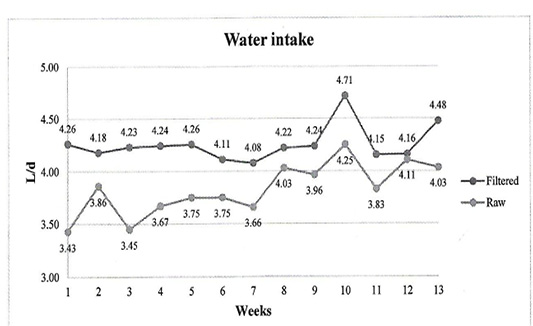
Chemical characteristics of RAW and FILT water are shown in Table 1. According to the chemical composition, RAW and FILT meets the characteristics to be qualified as “clean and safe water for livestock” .The main effects of water filtration-sanitization were decreased three-fold total solids and the totally removal of bacterial. This confirms the effectivity of UV and chlorination of water as disinfection treatments . Filtered-sanitized water increased (P≤0.04) 10% water intake, 8% daily gain, and 3% dietary net energy utilization (Table 2). The behavior of a higher water consumption for FILT was maintained throughout the experiment (Figure 1). When compared low TDS (<1000) vs high TDS (>8000) it have been reported increases of water intake by low TDS in cattle . However, there are no information about comparing water intake between groups that drink water containing lower than 1000 mg/L TDS, even so, the result obtained here could be more associated with acceptability of water . In healthy animals grown under non-stressful ambient conditions, the expected ratio of observed-to-expected dietary NE would be 1.0. That is, lamb ADG is consistent with DMI and energy density of the diet. If ratio is greater than 1, the observed dietary NE is greater than anticipated based on diet composition NRC (2007), and efficiency of energy utilization is enhanced. In this case, RAW lambs performed as expected (ratio=0.99), but FILT lambs enhanced the energy utilization of diet (ratio=1.02). Improves on diet energy utilization by FILT was not expected. However, this could be promoted by better nutrient utilization as consequence of greater nutrient dilution and passage rate by greater water intake and by healthy and thinner gastrointestinal walls by lower bacterial load in water. There was no evidence of diarrhea caused by infectious agents during the experiment. All cases of diarrhea were minor and declared by a practicing veterinarian as “moderato-to-low feed scours” and were majority presented (>90%) in the first 14-d of the experiment. The frequency of non-infectious diarrhea during the first days of fattening (i.e. first 14 days) when cattle fed with high-energy diets is variable but, it is to be expected . In this case, diarrhea frequency and days on diarrhea were decreased 33% by FILT. The faster recovery in FILT lambs could be promoted by reduction of guts stressors such the lower bacterial load in FILT lambs .
Hot carcass weight (HCW) and longissimus muscle area (LM) were increased (P≤0.04) 5.2 and 9.2% by FILT (Table 3). This increases were a direct reflection of the greater daily gain rate resulted in greater (3.7%, P=0.02) final weight observed to FILT lambs , in addition, the tendency (P=0.06) of greater (10.4%) KPH deposition could be an indicative to a greater energy utilization of the diet with FILT . Lambs drank FILT shown lower (7.2%, P=0.02) relative weight of stomach complex and tended (P=0.06) to have 3.9% lower relative intestinal weight (Table 3). The lower relative weight of stomach complex observed to FILT was a direct reflex of 9% lower of rumen fill (data not shown). This is uncertain since lambs received the same diet and no difference on DMI was observed. The relative reduction in intestinal mass observed in the present study may be evidence of decreased inflammation of the intestinal wall by absent infectious bacterial in water with FILT treatment .
It is concluded that increasing water quality of the water qualified as “clean and safe” by reduction of total solid and elimination of the bacterial load as consequence of filtering and sanitization decreased diarrhea duration promoting better energy utilization of diet, increasing weight gain, as well as HCW and LM area. Due to the cost of water filtering and sanitization, it is necessary evaluate the economic feasibility to applied in lambs feedlot system.
AUTHOR’S CONTRIBUTION
ACN, NLU, and BICP, run the experiment; ELB, evaluated carcass traits; AB analyzed the data. AEA designed the research work, advice the experiment. AC and GLV designed the research work; AP designed the research work, data curation, corrected, interpreted and write the manuscript.
Figures
Figure 1. Figure 1.
Average daily water intake (L/lamb) behaviour during the 13 week of the experiment
References
AOAC (2000) Association of Official Analytical Chemists. Official Methods of Analysis. Gaithersburg, MD.
APHA (2017). American Journal of Public Health. Baird RB, Eaton AD, Rice EW (Ed) Standard Methods for the Examination of Water and Wastewater, 23rd Edition. APHA, press. Washington, DC.
Arteaga-Wences YJ, Estrada-Angulo A, Gerardo Ríos-Rincón FG, Castro-Pérez BI, Mendoza-Cortéz DA, Manriquez-Núñez OM, A. Barreras A, Corona-Gochi L, Zinn RA, Perea-Domínguez XP, Plascencia A (2021).The effects of feeding a standardized mixture of essential oils vs monensin on growth performance, dietary energy and carcass characteristics of lambs fed a high-energy finishing diet. Small Rum. Res., 205: 106557. https://doi.org/10.1016/j.smallrumres.2021.106557.[CrossRef]
Beede D K (2019). Evaluation of Water Quality and Nutrition for Dairy Cattle. DAIReXNET. Extension Foundation. https://dairy-cattle.extension.org/evaluation-of-water-quality-and-nutrition-for-dairy-cattle/
Castro-Pérez BI, Núñez-Benítez VH, Estrada-Angulo A, Urías-Estrada JD, Gaxiola-Camacho SM, Rodríguez-Gaxiola MA, Angulo-Montoya C, Barreras A, Zinn RA, Perea-Domínguez XP, Plascencia A (2021). Evaluation of standardized mixture of synbiotic-glyconutrients supplemented in lambs finished during summer season in tropical environment: Growth performance, dietary energetics, and carcass characteristics. Can J. Anim. Sci., Online https://doi.org/10.1139/cjas-2020-0202[CrossRef]
Estrada-Angulo A, Zapata-Ramírez O, Castro-Pérez BI, Urías-Estrada JD, Gaxiola-Camacho S, Angulo-Montoya C, Ríos-Rincón F, Barreras A, Zinn RA, Leyva-Morales JB, Perea-Domínguez X, Plascencia A (2021). The effects of single or combined supplementation of probiotics and prebiotics on growth performance, dietary energetics, carcass traits, and visceral mass in lambs finished under subtropical climate conditions. Biology, 10:11:1137. https://doi.org/10.3390/biology10111137[CrossRef]
Fraley SE, Hall MB, Nennich TD (2015). Effect of variable water intake as mediated by dietary potassium carbonate supplementation on rumen dynamics in lactating dairy cows. J. Dairy Sci., 98:3247-3256. http://dx.doi.org/ 10.3168/jds.2014-8557
Gouws RF (2019) The potential of buffers (Acid Buf) or plant extracts (Xtract 7035) as natural alternatives for ionophores in lamb feedlot diets. MSc Thesis. Faculty of Natural and Agriculture Science, University of Pretoria, SA. https://repository.up.ac.za/handle/2263/72734.
Hruskova T, Sasakova N, Bujdosova Z, Kvokacka V, Gregova G, Verebova V, Valko-Rokytovska M, Takac L (2016). Disinfection of potable water sources on animal farms and their microbiological safety.Vet. Med. (Praha), 61: 173–186. https://doi.org/0.17221/8818-VETMED
López A, Arroquy JI, Distel RA (2016). Early exposure to and subsequent beef cattle performance with saline water. Livest. Sci., 85: 68–73. https://doi.org/10.1016/j.livsci.2016.01.013[CrossRef]
NRC (2007). National Research Council. Nutrient requirement of small ruminant. Sheep, Goats, Cervids, and New World Camelids. National Academy Press, Washington, DC, USA.
Rinella MJ, Muscha JM, Reinhart KO, Petersen MK (2021).Water quality for livestock in northern Great Plains rangelands. Rangel. Ecol. Manag., 75:29-34. https://doi.org/10.1016/j.rama.2020.11.005[CrossRef]
Rivera-Villegas A, Estrada-Angulo A, Castro-Pérez BI, Urías-Estrada JD, Ríos-Rincón FG, Rodríguez-Cordero D, Barreras A, Plascencia A, González-Vizcarra VM, Sosa-Gordillo JF, Zinn RA (2019). Comparative evaluation of supplemental zilpaterol hydrochloride sources on growth performance, dietary energetics and carcass characteristics of finishing lambs. Asian-Australasian J. Anim. Sci., 32:209-216. https://doi.org/10.5713/ajas.18.0152[CrossRef]
Salvin HE, Lees AM, Café LM, Colditz IG, Lee C (2020). Welfare of beef cattle in Australian feedlots: a review of the risks and measures. Anim. Prod. Sci., 60:1569-1590. https://doi.org/10.1071/AN19621[CrossRef]
SAS (2007). Statistical Analytical System. Institute Inc. SAS Proprietary Software Release 9.3; SAS Institute Inc. Cary, NC, USA.
Sharma A, Kundu SS, Tariq H, Kewalramani N, Yadav RK (2017). Impact of total dissolved solids in drinking water on nutrient utilisation and growth performance of Murrah buffalo calves. Livest. Sci., 198:17-23. http://dx.doi.org/10.1016/j.livsci.2017.02.002[CrossRef]
Van Eenige MJEMI, Counotte GHMII, Noordhuizen JPTM (2013). Drinking water for dairy cattle: always a benefit or a microbiological risk? Tijdschr. Diergeneesk., 138: 86-99. PMID: 23457917.