
The Ordos Relict Gull National Nature Reserve (Taolimiao-Alashan Nur, TAN) was once the most important breeding place for the Ordos sub-population of relict gulls Ichthyaetus relictus, but there were no more gulls breeding here since the lake dried up in the early 21st century. Since the water diversion started in 2018, five and 35 nests have been recorded breeding here in 2020 and 2021, but the arthropod community in the wetland has not been completely rebuilt. Whether its diversity and biomass can provide sufficient food during the breeding period is the key to the recovery of the relict gull. Here we investigated aquatic arthropods in the TAN and Hotong Qagan Nur (HQN) to compare the food supply and predict the capacity of the reserve after the lake water was restored. The results showed that the arthropod communities are low abundant in two lakes with a total of 16 taxa, but their biomass in TAN was significantly lower than HQN. According to the breeding records of relict gulls in HQN, we roughly estimate that up to 400 relict gulls pairs may be able to breed in TAN. The low availability of food supply during the brooding period might still be a limiting factor for the restoration of the TAN relict gull population in the following years.
Short Communication · Volume 56, Issue 4, 15 June 2024 · Open Access
The Potential Food Supply of Relict Gulls and the Preliminary Prediction of its Population Size after the Lake Restoration in Ordos Relict Gull National Reserve, Inner Mongolia, China
· · · · ·
Affiliations & Notes ⌄
- 1Baotou Teachers College, Baotou 014000, China 2Ordos Relict Gull National Reserve, Ordos 017000, China 3Wushen Banner Forestry and Grassland Bureau, Ordos 017000, China 4College of Life Sciences, Henan Normal University, Xinxiang 453007, China * Corresponding author: 2019117@htu.edu.cn
Article Info ⌄
- Journal:
- Pakistan Journal of Zoology
- Published:
- 15 June 2024

From the article
- The amount and biomass of the main arthropods in the two lakes were investigated three times during the brooding period of the relict gulls (Table I), the remaining species are scattered because their number were very low.
- The biomass densities of water fleas and damselflies in HQN were significantly higher than that of TAN (p < 0.05), but there was no significant difference in the biomass density of Chironomids and water flies between the two wetlands.
- The current lake area of HQN is about 2.93 times that of TAN, so the amount of food supply for relict gulls in TAN is about 13.52% of that in HQN.
- As the water volume of TAN and the arthropod community continue to recover, it is believed that the wetland could potentially carry more breeding relict gulls.
Selected from the article's own text.
Abstract
Materials and methods
Ordos Relict Gull National Reserve (39°46’–39°48’N, 109°17’–109°21’E) is located in TAN, south of Bojianghaizi Town, Ordos, Inner Mongolia, China, at an elevation of 1,365 m. The lake area is about 7.5 km2, and the pH is 8.64. HQN (39°11’–39°14’N, 108°57’–109°02’E) is located in the south of Wushenzhao Town, Ordos, Inner Mongolia, at an elevation of 1,260 m. The alkali lake has an area of 22 km2 with a pH of 9.89. The brooding period of relict gulls is from late May to mid-June. Field work was conducted three times during the brooding period, dividing it into early, middle, and late stages at an interval of 7-10 days. 27 and 44 sampling sites were selected on the shores around TAN and HQN, respectively, to investigate aquatic arthropods in both lakes in 2021 (Fig. 1).
The aquatic arthropods of each 1 m2 sample site were collected using the standard sweeper for 20 times sweeping and counted. A 40 cm diameter sample sieve (60 mesh) was used to collect the aquatic arthropods in upper layer water at a depth of 20 cm. Additionally, a 20 cm2 with 5 cm in depth mud was dug, washed, and filtered to collect animals in the mud. All collected arthropods were microscopically inspected, sorted, and weighed.
The data were analyzed and plotted using the R statistical software 3.6.3. The data sets were checked for normality tests using the Shapiro-Wilk test before performing analyses of variance. The population parameters were analyzed using one-way ANOVA and Tukey’s post-hoc tests to statistically identify differences among groups. All comparisons were two-tailed, and statistical differences were considered significant at p < 0.05.
Results and discussion
A total of 16 species of aquatic arthropods were collected from two wetlands. Of these, Diptera was the most diverse arthropods including three species of Chironomids (Chironomus sp., Procladius sp., and Psectrocladius sp.), one species of biting midge (Ceratopogonidae sp.), and three species of flies belonging to the infraorder Muscomorpha within suborder Brachycera (Lispe neimongola, Ephydra sp., and Philophylla sp.). Besides, other insects, including one species of damselfly (Coenagrionidae sp.), Sigara lateralis, Ylodes reuteri, and two species of ants (Cataglyphis sp. and Camponotus sp. within Formicidae), and a species of mole cricket (Gryllotalpidae sp.), were also abundant in the wetlands. In addition, two species of water fleas (Daphnia magna and Calanidae sp.) and brine shrimps (Artemia sp.) were also observed. The amount and biomass of the main arthropods in the two lakes were investigated three times during the brooding period of the relict gulls (Table I), the remaining species are scattered because their number were very low. The sampled taxa of arthropods in the wetlands were more abundant than in the previous study before the lake dried up .
The benthic animal communities in both studied wetlands are dominated by aquatic arthropods, with a lower abundance of taxa than in the wintering sites in Bohai Bay and Laizhou Bay ; . A notable difference in species composition between them is that brine shrimps were very abundant in HQN but absent in TAN. This may be due to the input of freshwater that hindered the population of the halophilic shrimps.
We divided the main arthropods into 4 categories to compare their biomass (Fig. 2). The biomass densities of water fleas and damselflies in HQN were significantly higher than that of TAN (p < 0.05), but there was no significant difference in the biomass density of Chironomids and water flies between the two wetlands. It is worth noting that the total biomass density of arthropods in HQN is about 2.52 times that in TAN. Such a large difference may be closely related to the ecosystem reconstruction of the TAN wetland. Because the lake had dried up for more than ten years until being restored in 2019, its ecosystem is still reconstructing and the arthropod community had not been fully established yet. The current lake area of HQN is about 2.93 times that of TAN, so the amount of food supply for relict gulls in TAN is about 13.52% of that in HQN. If only the food supply was taken into account, knowing that the average number of relict gulls breeding in HQN in recent years is about 3000 pairs , we roughly estimate that the food supply in TAN could potentially afford about 400 nests of relict gulls for breeding. This population size estimate based on the potential availability in the food supply is just a crude approximation because data on the diet and food requirements of the gulls at both breeding sites are currently lacking. Even so, the present work provides a first crude estimation of the number of pairs that may settle in TAN in the following years and thus helps to assess the potential of this historically important site for the restoration of relict gulls’ populations in China. Clearly, additional studies on the feeding ecology of the relict gull in TAN are urgently needed to conveniently address this question knowing its poor conservation status. Additionally, our estimate is far away from the historic number of more than 3,000 nests. As the water volume of TAN and the arthropod community continue to recover, it is believed that the wetland could potentially carry more breeding relict gulls. However, ours results suggest that the total biomass of arthropods in TAN decreased in the middle and late brooding periods. Knowing that as chicks grow up their food intake increases, the food supply available during the brooding period might become an important factor restricting chicks’ survival and limiting the colony size. Again additional ecological studies are needed to soundly address this question.
Table I. The density and biomass of arthropods during the brooding period of relict gulls in TAN and HQN.
| TAN (individuals/m2, mg/m2 dry weight) | HQN (individuals/m2, mg/m2 dry weight) | |||||||||||
| Early | Middle | Late | Early | Middle | Late | |||||||
| 1 | 2 | 1 | 2 | 1 | 2 | 1 | 2 | 1 | 2 | 1 | 2 | |
| Daphnia magna | 652 | 25.5 | 170 | 8.2 | 840 | 36.3 | 2888 | 216.1 | 1060 | 75.1 | 1700 | 107.9 |
| Calanidae sp. | 1730 | 20.3 | 2270 | 51.2 | 2400 | 43.6 | 3094 | 98.3 | 41830 | 708.2 | 14420 | 362.1 |
| Chironomid larvae | 235 | 55.0 | 143 | 27.1 | 124 | 35.5 | 225 | 55.9 | 127 | 23.6 | 145 | 29.3 |
| Chironomid adults | 28 | 22.3 | 9 | 11.1 | 40 | 37.5 | 196 | 113.3 | 180 | 100.2 | 184 | 98.5 |
| Chironomid pupae | 171 | 50.4 | 154 | 46.1 | 140 | 49.3 | 124 | 50.6 | 194 | 68.1 | 247 | 86.7 |
| Chironomid puparium | 1416 | 122.5 | 206 | 27.5 | 1024 | 123.9 | 652 | 71.9 | 750 | 86.3 | 1014 | 92.0 |
| Damselfly | 48 | 503.6 | 36 | 304.3 | 25 | 220.5 | 73 | 966.9 | 62 | 702.8 | 83 | 872.8 |
| Damselfly puparium | 310 | 161.0 | 380 | 205.2 | 240 | 168.4 | 950 | 385.6 | 1150 | 460.8 | 1430 | 510.8 |
| Sigara lateralis | 67 | 23.3 | 84 | 31.8 | 76 | 32.7 | ||||||
| Ephydrid | 137 | 171.7 | 170 | 140.4 | 162 | 171.2 | 149 | 162.0 | 200 | 247.7 | 379 | 407.4 |
| Artemia | 5436 | 598.3 | 5790 | 426.0 | 1530 | 21.5 | ||||||
In conclusion, the wetland ecosystem will be gradually rebuilt with the restoration of lake water, but it will take a long way to restore the historic number of relict gulls breeding here. At present, food supply might still be a limiting factor for the relict gulls in the wetland. In the near future, we will pay attention to the recovery of the arthropod community and the relict gull population in this potentially important wetland.
Acknowledgements
The study was supported by the Inner Mongolia Natural Science Foundation 2021MS03023 and the project of Baotou Teachers College Yellow River Basin Ecological Protection and High-Quality Development Research Institute (BSYHY202215).
Statement of conflict of interest
The authors have declared no conflict of interest.
Figures
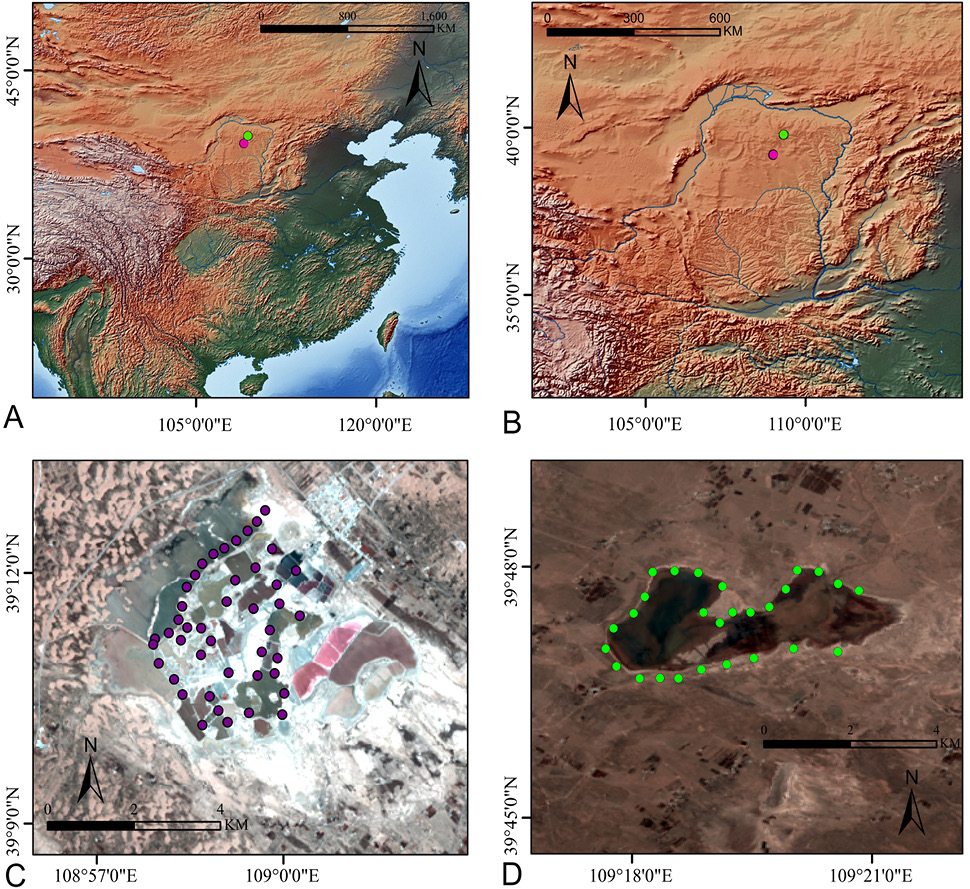
Maps of Taolimiao-Alashan Nur (TAN) and Hotong Qagan Nur (HQN) in Ordos, China (A and B), and the sampling sites in TAN (C) and HQN (D).
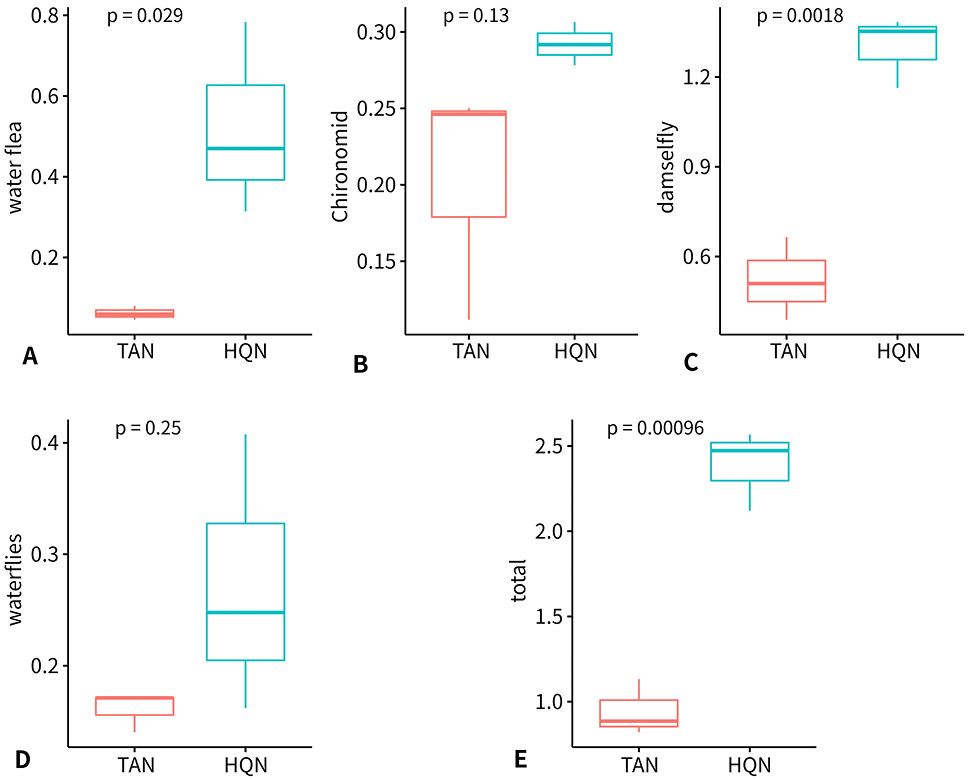
The biomass of dominant taxa in Taolimiao-Alashan Nur (TAN) and Hotong Qagan Nur (HQN), including water flea (A), Chironomid (B), damselfly (C), waterflies (D), and the total (E).
References
- Auezov, E.M., 1971. Zool. Zh., 50: 235–242.
- Bird Life International, 2021. Species factsheet: Larus relictus. Available at http://datazone.birdlife.org/species/factsheet/relict-gull-larus-relictus (accessed 25 Aug 2021).
- Bo, Q., Lu, Y., Mi, H., Yu, Y., Gu, D., You, H. and Hao, S., 2020. Mar. Ecol., 41: e12594. https://doi.org/10.1111/maec.12594[CrossRef]
- Duff, D.G., Bakewell, D.N. and Williams, M.D., 1991. Forktail, 6: 43–65.
- He, F., Melville, D., Xing, X. and Ren, Y., 2002. Chinese J. Zool., 37: 65–70.
- He, F., Ren, Y. and Bai, X., 2010. Chinese Birds, 1: 80–81. https://doi.org/10.5122/cbirds.2009.0007[CrossRef]
- He, F., Ren, Y. and Guo, Y., 2015. Wetland Sci. Manag., 11: 54–58.
- He, F., Ren, Y. and Xiao, H., 2020. Wetland Sci. Manag., 16: 51–52.
- He, F., Zhang, Y. and Wu, Y., 1994. Chinese Biodivers., 2: 88–90. https://doi.org/10.17520/biods.1994016[CrossRef]
- Liu, W., Zhang, Q., Xing, X., Bao, X., Su, Y., Bai Z., Ren, Y. and Gao, R., 2008. J. Arid Land Resour. Environ., 22: 185–192.
- Liu, Y., Holt, P.I., Lei, J.Y., Zhang, Y. and Zhang, Z.W. 2006. Waterbirds, 29: 375–380. https://doi.org/10.1675/1524-4695(2006)29[375:DNAASO]2.0.CO;2[CrossRef]
- Wang, Q., Xiao, H. and Ren, Y., 2021. Sichuan J. Zool., 40: 270–274.
- Zhang, Y., Bai, L., Tian, L., Wu, Y., Chen, R., Sun, Z., Buhe and Liang, S., 1991. Chinese J. Zool., 26: 32–33.
Services
Article usage statistics
Loading…