
Anisakis simplex is a zoonotic disease-causing parasitic nematode belonging to the Anisakidae family. In this study, the nematode samples of A. simplex were collected from rockfish Sebastes sp. From the comparison and analysis of the mitochondrial genome of Anisakis simplex, the results revealed a full-length genome with 13,903 bp, including 12 protein-coding genes, 2 rRNAs and 22 tRNAs. There was no encoding gene of atp8, which was consistent with the genome characteristics of Anisakis nematodes. Additionally, 25 related nematodes belonged to 5 different families served as study subjects for the construction of phylogenetic trees.
Research Article · Volume 42, Issue 1, 7 July 2024 · Open Access
The Mitochondrial Genome of the Anisakis simplex (Nematoda: Anisakidae) from Rockfish Sebastes sp.
·
Affiliations & Notes ⌄
- 1Department of Medical Parasitology, Wannan Medical College, Wuhu 241002, China. *Correspondence | Jinhong Zhao, Department of Medical Parasitology, Wannan Medical College, Wuhu 241002, China
- 2Email: zhaojh@wnmc.edu.cn
Article Info ⌄
- Journal:
- Pakistan Journal of Nematology
- Published:
- 7 July 2024
From the article
- The entire length of A. simplex mt DNA is 13,903 bp (Table 1), with a base composition of A 22.8%, T 48.3%, C 9.8%, G 19.1%, and a high percentage of A + T (71.1%).
- The 12 mitochondrial PCGs of A. simplex in this study were compared with those of other nematode species downloaded from GenBank (Table 2) through the systematic evolutionary tree with the outgroup of the Wuchereria bancrofti.
- The phylogenetic tree showed that A. simplex in this study belonged to the family Anisakidae, and it forms a clade with Anisakis simplex (NC007934), Anisakis pegreffii (NC034329) and Anisakis simplex (AP017678) as a monophyletic group with 100% boot strap, and then clustered with Pseudoterranova azarasi (NC027163).
- In this study, the mitogenome of A. simplex was sequenced, and the total length was 13,903 bp and the related phylogenetic tree was established.
Selected from the article's own text.
Abstract
Introduction
Anisakis simplex (Rudolphi, 1809) (Nematoda: Anisakidae) is a parasitic nematode that can cause zoonotic diseases (Lopienska et al., 2019). Since the pathogenic role of Anisakis in humans was reported in 1960 (Van et al., 1960), there has been increasing understanding of parasitic diseases transmitted by fish ; . Anisakiasis is gradually becoming a growing issue in epidemiology as the number of globally identified cases increases ; Llorens et al., 2018). The planktonic crustaceans, sea-fish, cephalopods, and marine mammal are all the part of the complicated life cycle of A. simplex . The larvae of A. simplex are frequently parasitic in the fish’s ventral muscle . The tendency to enjoy raw or undercooked fish strongly enhances the risk of Anisakiasis due to the dietary habits, the most common nematode infection is the third-stage larvae (L3) of A. simplex ; . A. simplex can cause gastrointestinal and allergic reactions to human .
As we all know, for the maternal inheritance and relatively conserved genomic architecture of mitochondrial genomes, the information of mitochondrial genomes can provide useful molecular markers for studying the ecology, population genetic structure, and phylogeny of organisms ; .
Materials and Methods
Samples collecting and sequencing
The A. simplex samples were collected from rockfish Sebastes sp. in Santa Barbara, California, USA (119°42’ W, 34°25’ N). The nematode samples were washed by sterile distilled water, then clipped off the head and tail and the remaining part of nematodes were ground and crumbled. The total genomic DNA was extracted from nematode samples using the TIANamp Genomic DNA Kit (TIANGEN, Beijing, China) and followed the manufacturer’s directions. We used 9 pairs of PCR primers (Supplementary Table 1) to amplify the whole mitochondrial genome of the A. simplex, and sequenced the PCR products by GENERAL BIOL Co. (Chuzhou, China) using Sanger sequencing technology.
Sequence analysis
The resulting multiple sequences were manually corrected, edited and spliced using DNAMAN software (Version 8) and annotated after alignment with other existing sequences in the GenBank DNA database. The sequence of complete mitochondrial genome was uploaded to NCBI under the accession number OQ354213.
The mitochondrial genome map of A. simplex was visually analyzed via CGView Serve (http://cgview.ca), then manually corrected to ensure annotation accuracy. The colors of the circle represented different genetic traits. The phylogenetic sequences were constructed with 12 protein-coding genes (PCGs) of A. simplex and 24 other nematodes, of which Wuchereria bancrofti (GenBank accession No. NC016186) was selected as the outgroup. The PCGs of 25 nematodes species were compared using MEGA X software for sequencing results and manually trimmed for end-uniform sequences. Then, the topology structure of the obtained PCGs sequence was subsequently analyzed using the Maximum Likelihood (ML) method with 1,000 bootstrapping times.
Results and Discussion
The entire mitochondrial genome of A. simplex is a circular DNA molecule structure, lacking the atp8 gene, and all genes are transcribed in the same direction, which is consistent with the general characteristics of most other nematodes . The entire length of A. simplex mt DNA is 13,903 bp (Table 1), with a base composition of A 22.8%, T 48.3%, C 9.8%, G 19.1%, and a high percentage of A + T (71.1%). There are a total of 36 genes (Figure 1), including 12 protein-coding genes (PCGs), 22 transfer RNA genes (tRNAs), and 2 ribosomal RNA genes (rRNAs), which are labeled on the entire mitochondrial genome in the same arrangement as the mitochondrial genomes of other Anisakis . The start codons of 12 PCGs are TTG (nad1, atp6, nad2, cox3, nad4, cox1, cox2, nad3, nad6), ATT (nad5, nad4L) and ATA (cytb), respectivly. Additionally, 7 PCGs are predicted to end in TAA (nad1, atp6, nad2, nad4, nad6) and TAG (cox2, nad3), while 5 PCGs are predicted to terminate in the incomplete stop codon T (cytb, cox3, cox1, nad5, nad4L). The 22 tRNAs, with a length range of 52bp (tRNA-Ser(AGN)) to 62 bp (tRNA-Lys), and two rRNAs, small subunit rRNA (12S; 699 bp) and large subunit rRNA (16S; 957 bp) are each positioned between tRNA-His and nad3 and between tRNA-Glu and tRNA-Ser(UCN), respectivly.
The 12 mitochondrial PCGs of A. simplex in this study were compared with those of other nematode species downloaded from GenBank (Table 2) through the systematic evolutionary tree with the outgroup of the Wuchereria bancrofti. The phylogenetic tree showed that A. simplex in this study belonged to the family Anisakidae, and it forms a clade with Anisakis simplex (NC007934), Anisakis pegreffii (NC034329) and Anisakis simplex (AP017678) as a monophyletic group with 100% boot strap, and then clustered with Pseudoterranova azarasi (NC027163). The other nematodes in the family Ascarididae, Toxocaridae, Heterocheilidae, Ascaridiidae and Heterakidae have stronger bootstrap value supportting (Figure 2).
Since the discovery of Anisakis in humans (Van et al., 1960), there has been a growing researching of fished vector-borne parasitic diseases and an increase in the study of A. simplex ; . In this study, the mitogenome of A. simplex was sequenced, and the total length was 13,903 bp and the related phylogenetic tree was established. The most mitogenome characteristics of A. simplex in this study was consistent with other A. simplex reported before , while there just shared a 98.70% identity with A. simplex (GenBank accession No. NC007934) by comparing the GenBank DNA database in NCBI. We hope that the mitochondrial genome of A. simplex in the study would
Table 1: Organization of the Anisakis simplex mitochondrial genome.
| Gene | Position From To | Size (bp) | AA (bp) | Spacer(+) Overlap(-) | Start codon | Stop codon | anticodon |
| nad1 | 1 873 | 873 | 290 | 13(+) | TTG | TAA | |
| atp6 | 887 1486 | 600 | 199 | 6(+) | TTG | TAA | |
| trnK | 1493 1554 | 62 | 8(+) | TTT | |||
| trnL2UUR | 1563 1617 | 55 | 0 | TAA | |||
| trnS1AGN | 1518 1669 | 52 | 0 | TCT | |||
| nad2 | 1670 2515 | 846 | 281 | 7(+) | TTG | TAA | |
| trnI | 2523 2583 | 61 | 0 | GAT | |||
| trnR | 2584 2642 | 59 | 1(-) | ACG | |||
| trnQ | 2642 2696 | 55 | 0 | TTG | |||
| trnF | 2697 2756 | 60 | 0 | GAA | |||
| cytb | 2757 3855 | 1099 | 366 | 0 | ATA | T | |
| trnL1CUN | 3856 3910 | 55 | 0 | TAG | |||
| cox3 | 3911 4676 | 766 | 255 | 0 | TTG | T | |
| trnT | 4677 4732 | 56 | 0 | TGT | |||
| nad4 | 4733 5962 | 1230 | 409 | 0 | TTG | TAA | |
| NCR | 5963 6088 | 126 | 0 | ||||
| cox1 | 6089 7664 | 1576 | 525 | 0 | TTG | T | |
| trnC | 7665 7720 | 56 | 0 | GCA | |||
| trnM | 7722 7782 | 61 | 1(+) | CAT | |||
| trnD | 7791 7849 | 59 | 8(+) | GTC | |||
| trnG | 7856 7911 | 56 | 6(+) | TCC | |||
| cox2 | 7912 8610 | 699 | 232 | 0 | TTG | TAG | |
| trnH | 8609 8665 | 57 | 2(-) | GTG | |||
| rrnL | 8672 9628 | 957 | 6(+) | ||||
| nad3 | 9629 9964 | 336 | 111 | 0 | TTG | TAG | |
| nad5 | 9965 11546 | 1582 | 527 | 0 | ATT | T | |
| trnA | 11548 11604 | 58 | 0 | TGC | |||
| trnP | 11621 11677 | 57 | 16(+) | TGG | |||
| trnV | 11680 11735 | 56 | 2(+) | TAC | |||
| nad6 | 11736 12170 | 435 | 144 | 0 | TTG | TAA | |
| nad4L | 12171 12402 | 232 | 77 | 0 | ATT | T | |
| trnW | 12403 12460 | 58 | 0 | TCA | |||
| trnE | 12469 12528 | 60 | 8(+) | TTC | |||
| rrnS | 12529 13227 | 699 | 0 | ||||
| trnS2UCN | 13231 13283 | 53 | 3(+) | TGA | |||
| AT | 13284 13782 | 499 | 0 | ||||
| trnN | 13783 13839 | 57 | 5(+) | GTT | |||
| trnY | 13845 13903 | 59 | 0 | GTA |
AA: Amino acid; AT: AT rich region; NCR: Non-coding region.
Table 2: The species used to construct the phylogenetic tree and their GenBank accession numbers.
| Family | Genus | Species | GenBank accession number | Reference |
| Ascarididae | Baylisascaris | Baylisascaris ailuri | NC015925 | Xie et al., 2011b |
| Baylisascaris transfuga | NC015924 | Xie et al., 2011b | ||
| Baylisascaris schroederi | NC015927 | Xie et al., 2011b | ||
| Baylisascaris procyonis | NC016200 | Xie et al., 2011a | ||
| Ascaris | Ascaris suum | NC001327 | Wolstenholme et al. 1994 | |
| Ascaris lumbricoides | NC016198 | Park et al., 2011 | ||
| Ascaris ovis | KU522453 | Unpublished | ||
| Toxascaris | Toxascaris leonine | NC023504 | Liu et al., 2014 | |
| Toxocaridae | Toxocara | Toxocara cati | NC010773 | Li et al., 2008b |
| Toxocara canis | AM411108 | Li et al., 2008b | ||
| Toxocara malaysiensis | NC010527 | Li et al., 2008b | ||
| Heterocheilidae | Ortleppascaris | Ortleppascaris sinensis | KU950438 | Zhao et al., 2018 |
| Anisakidae | Pseudoterranova | Pseudoterranova azarasi | NC027163 | Liu et al., 2015 |
| Anisakis | Anisakis simplex | AP017678 | Unpublished | |
| Anisakis simplex* | OQ354213 | this study | ||
| Anisakis simplex | NC007934 | Kim et al., 2006 | ||
| Anisakis pegreffi | NC034329 | Yamada et al., 2017a | ||
| Contracaecum | Contracaecum osculatum | NC024037 | Mohandas et al., 2014 | |
| Contracaecum rudolphii B | NC014870 | Unpublished | ||
| Ascaridiidae | Ascaridia | Ascaridia galli | NC021642 | Liu et al., 2013 |
| Ascaridia galli | OQ286042 | Shuai et al., 2023 | ||
| Ascaridia columbae | NC021643 | Liu et al., 2013 | ||
| Heterakidae | Heterakis | Heterakis beramporia | NC029838 | Wang et al., 2016 |
| Heterakis | Heterakis gallinarum | NC029839 | Wang et al., 2016 | |
| Onchocercidae | Wuchereria | Wuchereria bancrofti | NC016186 | McNulty et al., 2012 |
Note: * means the species of Anisakis simple in this study.
gives some more valuable genetic information for phylogenetic analysis, molecular epidemiology, and the biological evolution of related species.
Acknowledgements
We are grateful to professor Armand Kuris and his research group from Evolution and Marine Biology, University of California, Santa Barbara, USA, for assistance in collecting the nematode samples from fish.
Novelty Statement
The mitochondrial genome of A. simplex in the study would gives some more valuable genetic information for phylogenetic analysis and the biological evolution of related species.
Author’s Contributions
Funding
This work was granted by Anhui Provincial Natural Science Foundation of China (1608085MC77), Academic Aid Program for Top-notch Talents in Provincial Universities (gxbjZD2020071) and Wuhu Key Research and Development Program of China (2021yf39).
Data Availability Statement
The genome sequence data that support the findings of this study are openly available in GenBank of NCBI at https://www.ncbi.nlm.nih.gov/nuccore/OQ354213.
Supplementary Material
There is supplementary material associated with this article. Access the material online at: https://dx.doi.org/10.17582/journal.pjn/2024/42.1.81.87
Conflict of interest
The authors have declared no conflict of interest.
Figures
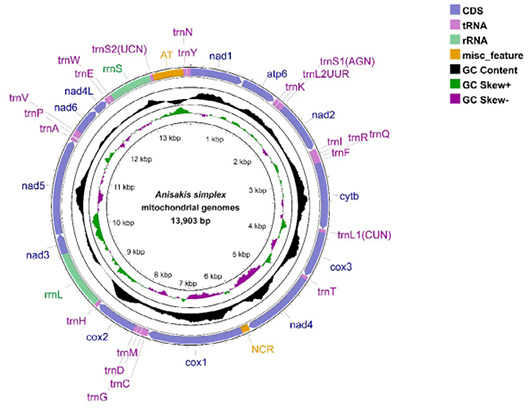
Mitochondrial genome map of Anisakis simplex in this study.
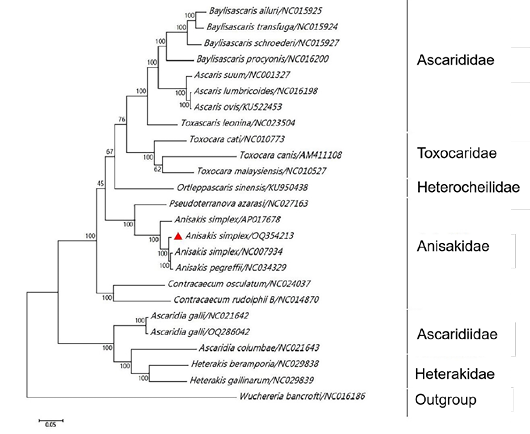
Maximum Likelihood (ML) trees were composed of nucleotide sequences from 12 mitochondrial PCGs of 25 nematode species and were replicated 1,000 bootstrapping times using MEGA X software.
References
- Audicana, M.T., Kennedy, M.W., 2008. Anisakis simplex: from obscure infectious worm to inducer of immune hypersensitivity. Clin. Microbiol. Rev. 21: 360-379. https://doi.org/10.1128/CMR.00012-07[CrossRef]
- Cipriani, P., Palomba, M., Giulietti, L., Bao, M., Mattiucci, S., Levsen, A., 2021. Anisakis simplex (ss) larvae (Nematoda: Anisakidae) hidden in the mantle of European flying squid Todarodes sagittatus (Cephalopoda: Ommastrephidae) in NE Atlantic Ocean: food safety implications. Int. J. Food Microbiol., 339: 109021. https://doi.org/10.1016/j.ijfoodmicro.2020.109021[CrossRef]
- Fæste, C.K., Jonscher, K.R., Dooper, M.M., Egge-Jacobsen, W., Moen, A., Daschner, A., Egaas, E., Christians, U., 2014. Characterisation of potential novel allergens in the fish parasite Anisakis simplex. EuPA open proteomics 4: 140-155. https://doi.org/10.1016/j.euprot.2014.06.006[CrossRef]
- Grant, J.R., Stothard, P., 2008. The CGView Server: a comparative genomics tool for circular genomes. Nucleic Acids Res., 36: W181-W184. https://doi.org/10.1093/nar/gkn179[CrossRef]
- Kim, K.H., Eom, K.S., Park, J.K., 2006. The complete mitochondrial genome of Anisakis simplex (Ascaridida: Nematoda) and phylogenetic implications. Int. J. Parasitol., 36: 319-328. https://doi.org/10.1016/j.ijpara.2005.10.004[CrossRef]
- Li, M.W., Lin, R.Q., Song, H.Q., Wu, X.Y., Zhu, X.Q., 2008. The complete mitochondrial genomes for three Toxocara species of human and animal health significance. BMC genomics, 9: 1-10. https://doi.org/10.1186/1471-2164-9-224[CrossRef]
- Liu, G.H., Shao, R., Li, J.Y., Zhou, D.H., Li, H., Zhu, X.Q., 2013. The complete mitochondrial genomes of three parasitic nematodes of birds: a unique gene order and insights into nematode phylogeny. BMC Genomics, 14: 414. https://doi.org/10.1186/1471-2164-14-414[CrossRef]
- Liu, G.H., Zhou, D.H., Zhao, L., Xiong, R.C., Liang, J.Y., Zhu, X.Q., 2014. The complete mitochondrial genome of Toxascaris leonina: Comparison with other closely related species and phylogenetic implications. Infect. Genet. Evol., 21: 329-333. https://doi.org/10.1016/j.meegid.2013.11.022[CrossRef]
- Liu, S.S., Liu, G.H., Zhu, X.Q., Weng, Y.B., 2015. The complete mitochondrial genome of Pseudoterranova azarasi and comparative analysis with other anisakid nematodes. Infect. Genet. Evol., 33: 293-298. https://doi.org/10.1016/j.meegid.2015.05.018[CrossRef]
- Llorens, C., Arcos, S.C., Robertson, L., Ramos, R., Futami, R., Soriano, B., Ciordia, S., Careche, M., González-Muñoz, M., Jiménez-Ruiz, Y., 2018. Functional insights into the infective larval stage of Anisakis simplex ss, Anisakis pegreffii and their hybrids based on gene expression patterns. BMC Genomics, 19: 1-21. https://doi.org/10.1186/s12864-018-4970-9[CrossRef]
- Lopienska-Biernat, E., Jastrzebski, L., Myszczynski, J.P., Polak, K., Stryinski, I., Robert. 2019. Genome-wide analysis of Anisakis simplex sensu lato: the role of carbohydrate metabolism genes in the parasite’s development. Int. J. Parasitol. 49. https://doi.org/10.1016/j.ijpara.2019.06.006[CrossRef]
- McNulty, S.N., Mullin, A.S., Vaughan, J.A., Tkach, V.V., Weil, G.J., Fischer, P.U., 2012. Comparing the mitochondrial genomes of Wolbachia-dependent and independent filarial nematode species. BMC Genomics, 13: 145. https://doi.org/10.1186/1471-2164-13-145[CrossRef]
- Mohandas, N., Jabbar, A., Podolska, M., Zhu, X.-Q., Littlewood, D.T.J., Jex, A.R., Gasser, R.B., 2014. Mitochondrial genomes of Anisakis simplex and Contracaecum osculatum (sensu stricto) comparisons with selected nematodes. Infect. Genet. Evol. 21: 452-462. https://doi.org/10.1016/j.meegid.2013.10.026[CrossRef]
- Park, Y.C., Kim, W., Park, J.K., 2011. The complete mitochondrial genome of human parasitic roundworm, Ascaris lumbricoides. Mitochondrial DNA, 22: 91-93. https://doi.org/10.3109/19401736.2011.624608[CrossRef]
- Pravettoni, V., Primavesi, L., Piantanida, M., 2012. Anisakis simplex: current knowledge. Eu. Ann. Allergy Clin. Immunol., 44: 150.
- Ramilo, A., Rodríguez, H., Pascual, S., González, Á.F., Abollo, E., 2023. Population Genetic Structure of Anisakis simplex Infecting the European Hake from North East Atlantic Fishing Grounds. Animals, 13: 197. https://doi.org/10.3390/ani13020197[CrossRef]
- Roca-Geronès, X., Segovia, M., Godínez-González, C., Fisa, R., Montoliu, I., 2020. Anisakis and Hysterothylacium species in Mediterranean and North-East Atlantic fishes commonly consumed in Spain: Epidemiological, molecular and morphometric discriminant analysis. Int. J. food Microbiol., 325: 108642. https://doi.org/10.1016/j.ijfoodmicro.2020.108642[CrossRef]
- Shuai, Y., Xue, Q., Zou, M., Zhao, J., 2023. The complete mitochondrial genome of the chicken roundworm Ascaridia galli (Nematoda: Ascaridiidae). Mitochondrial DNA B Resour., 8: 1029-1031. https://doi.org/10.1080/23802359.2023.2261638[CrossRef]
- Suzuki, J., Murata, R., Kodo, Y., 2021. Current status of Anisakiasis and Anisakis larvae in Tokyo, Japan. Food Saf. 9: 89-100. https://doi.org/10.14252/foodsafetyfscj.D-21-00004[CrossRef]
- Van Thiel, P., Kuipers, F., Roskam, R., 1960. A nematode parasitic to herring, causing acute abdominal syndromes in man. Trop. Geog. Med., 12: 97-113.
- Wang, B.J., Gu, X.B., Yang, G.Y., Wang, T., Lai, W.M., Zhong, Z.J., Liu, G.H., 2016. Mitochondrial genomes of Heterakis gallinae and Heterakis beramporia support that they belong to the infraorder Ascaridomorpha. Infect. Genet. Evol., 40: 228-235. https://doi.org/10.1016/j.meegid.2016.03.012[CrossRef]
- Wolstenholme, D.R., Okimoto, R., Macfarlane, J.L., 1994. Nucleotide correlations that suggest tertiary interactions in the TV-replacement loop-containing mitochondrial tRNAs of the nematodes, Caenorhabditis elegans and Ascaris suum. Nucleic Acids Res. 22: 4300-4306. https://doi.org/10.1093/nar/22.20.4300[CrossRef]
- Xie, Y., Zhang, Z., Niu, L., Wang, Q., Wang, C., Lan, J., Deng, J., Fu, Y., Nie, H., Yan, N., Yang, D., Hao, G., Gu, X., Wang, S., Peng, X., Yang, G., 2011a. The mitochondrial genome of Baylisascaris procyonis. PloS One, 6: e27066. https://doi.org/10.1371/journal.pone.0027066[CrossRef]
- Xie, Y., Zhang, Z., Wang, C., Lan, J., Li, Y., Chen, Z., Fu, Y., Nie, H., Yan, N., Gu, X., Wang, S., Peng, X., Yang, G., 2011b. Complete mitochondrial genomes of Baylisascaris schroederi, Baylisascaris ailuri and Baylisascaris transfuga from giant panda, red panda and polar bear. Gene, 482: 59-67. https://doi.org/10.1016/j.gene.2011.05.004[CrossRef]
- Yamada, A., Ikeda, N., Ono, H., 2017. The complete mitochondrial genome of Anisakis pegreffii Campana-Rouget & Biocca, 1955, (Nematoda, Chromadorea, Rhabditida, Anisakidae) - clarification of mitogenome sequences of the Anisakis simplex species complex. Mitochondrial DNA B Resour., 2: 240-241. https://doi.org/10.1080/23802359.2017.1318678[CrossRef]
- Zhao, J.H., Tu, G.J., Wu, X.B., Li, C.P., 2018. Characterization of the complete mitochondrial genome of Ortleppascaris sinensis (Nematoda: Heterocheilidae) and comparative mitogenomic analysis of eighteen Ascaridida nematodes. J. Helminthol., 92: 369-378. https://doi.org/10.1017/S0022149X17000542[CrossRef]
Services
Article usage statistics
Loading…