Incidences of different types of teat and udder affections
The results of the teat and udder affections in goats revealed that a total of 78 goats (4.96%) had asymmetrical udder with two teats out of 1572 lactating and non-lactating female goats (Table 1). In total, 281 (17.88%) animals were observed with pathological conditions. Among the pathological conditions, the prevalence of mastitis was in 66 (4.20%) cases, followed by udder abscess 57(3.63%), udder fibrosis 51 (3.24%), teat laceration 43 (2.74%), teat fistula 27 (1.72%), supernumerary teats 26 (1.65%) and teat obstruction 11 (0.70%) (Figure 1).
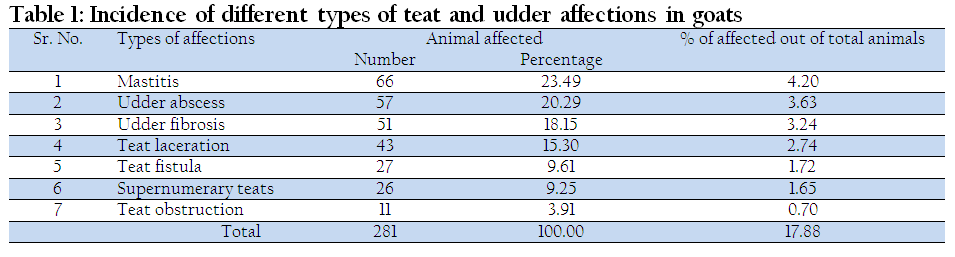
Table 1: Incidence of different types of teat and udder affections in goats
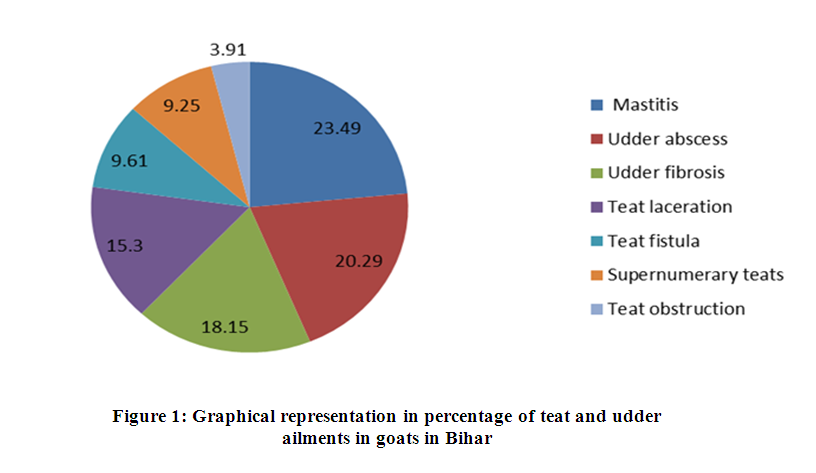
Figure 1: Graphical representation is percentage of teat and under udder ailments in goats in Bihar
The present findings of normal two teats with symmetrical order corroborates with the findings of Ozoje (2002), Amao et al., (2003) and Kashyap et al., (2014). But, Amao et al., (2003) observed higher incidences of asymmetrical udder in does which may be due to difference in goat breeds in study areas. However, the incidences of pathological conditions like mastitis, udder fibrosis, udder abscess etc were more in present findings than the findings of Kashyap et al., (2014) but, supernumerary teats were found less. The incidences of more pathological conditions in udder and teat affections in this case may be due to lack of awareness in clean milk production, unhygienic condition of animal shed and poor health status of goats in particular. Kashyap et al., (2014) also opined that potential risk factors for pathology of mammary glands include previous mastitis history, increased parity, poor body conditions etc. He also observed that cases of udder fibrosis could be attributed to the negligence by the owners with delayed presentation in the clinics or not noticed that lead to chronic mastitis resulting in fibrosis of the udder. O’Connor (2005) also opined that chronic mastitis may arise independently or follow the acute form, infection usually occurs by the secretary ducts, rarely by way of the blood and lymph stream. Tyagi and Singh (2012) also observed that it may sometimes lead to gangrenous mastitis. In this study the incidence of teat laceration may be due to crossing of thorny fencing which are applied by the farmers to protect their crops. The pendulous udder comes in contact with fencing and lead to teat laceration. Tyagi and Singh (2012) and Kashyap et al., (2014) also opined that the fencing was the predisposing factor for teat laceration and it may be due to pendulous udder and long teats. They also observed that teat obstruction was due to faulty milking and suckling that causes trauma of teat and obstruction of milk flow due to growth inside the teat canal.
Supernumerary teats were found to be congenital in nature by O,Conner (2005), Bemji and Popoola (2011), Adebayo and Chineke (2011).In present study, less number of supernumerary teat was observed but Ozoje (2002), Amao et al., (2003) and Kashyap et al., (2014) reported higher incidences of supernumerary teats than the present findings. The occurrence of supernumerary teats could be attributed to the presence of recessive mutant allele in the homozygous state.

Table 2: Teat and udder affections in relation to lactating status and age group of goats
Statistical analysis revealed that the effects of lactating status on the occurrence of teats and udder disorders (Table 2) are highly significant (P < 0.01). Animals which were lactating were found to be affected significantly higher than the animals which were dry. However, no comparable data is available for variation in relation to lactating status of animal. High incidence of udder lesions during lactation stage could be due to anatomical positioning of the mammary glands and lactation stress. Pendulous udder in lactating stage also predisposes the chances of injury and further complications. Increased milk production, late lactation stage, long teats and housed goats are the factors which lead to prevalence of teat and udder affections in the advanced age.
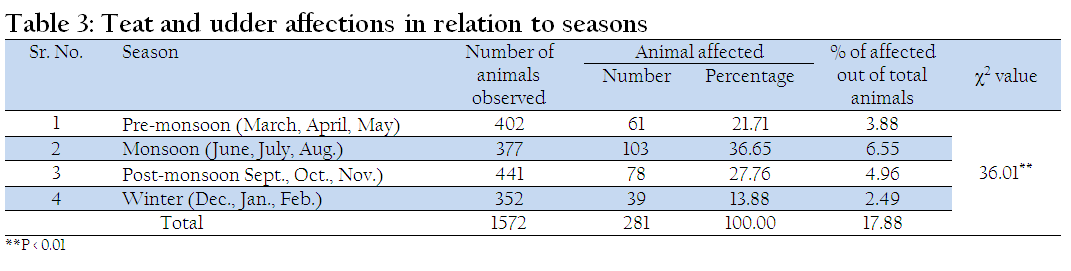
Table 3: Teat and udder affections in relation to seasons
Effect of season on the incidence of udder and teat affects (Table 3) was also highly significant (P < 0.01). The occurrence of disorder was more in monsoon season (June, July and August) followed by post monsoon (September, October and November) and pre monsoon (March, April and May). However, the incidence was less during winter season (December, January and February). This might again be due to the unhygienic conditions of animals and animals’ sheds during monsoon and post monsoon seasons due to improper drainage systems at many places