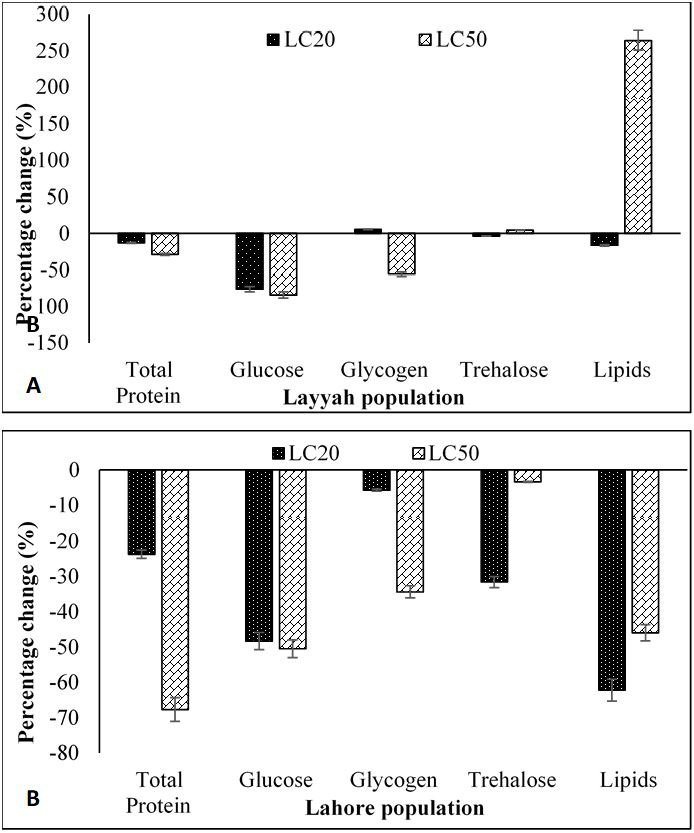
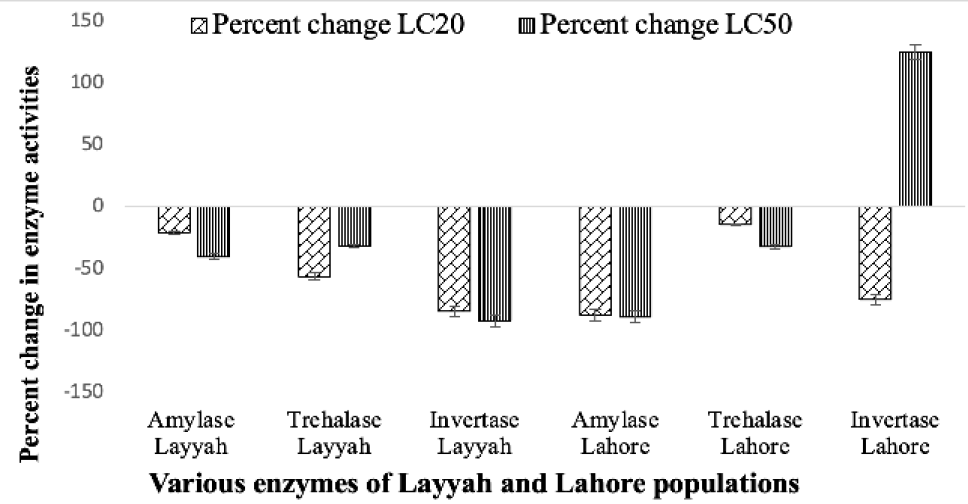
The main objective was to search for a new chemical insecticide to control the stored grain insect pest Trogoderma granarium particularly when this pest developed resistance against the currently used insecticides. Clove oil has been traditionally considered as an effective pesticide. The present study aimed at determining the efficacy of clove oil against the 4th instar larvae of insecticide resistant populations of T. granarium collected from different regions of Punjab i.e., Layyah, Okara, Gujranwala and Lahore. The Layyah population of Khapra beetle was identified as the most susceptible population (LC50= 0.1%), and the Lahore population as the resistant one (LC50= 0.78%) after exposure to various oil concentrations. The energy reserves and degradation enzymes needed to breakdown these energy stores were the main focus of this study. The alterations in the levels of carbohydrates, proteins and lipids were remarkable after treatment with clove oil at LC20 and LC50 doses. In Layyah population, a considerable loss of total protein (28.93%), glucose (84.1%) and glycogen (55.71%) while an increase in trehalose (4.48%) and lipids (264.22%) were recorded after exposure to LC50 doses compared with unexposed group. In Lahore population, a reduction in lipid contents (45.97%), total protein (67.67%), glucose (50.45%), glycogen (34.36%) and trehalose (31.59%) were observed after treatment with LC50 doses in comparison with untreated group. In case of LC20 doses, a decline in all the tested energy stores of both populations were observed in comparison with their respective unexposed groups. The total activities of degradation enzymes i.e., trehalase, amylase and invertase in Layyah population decreased (56.25, 21.10 and 84.62%, respectively) and in Lahore population reduction in activities were 14.62, 87.45 and 75%, respectively after exposure to their respective LC20 doses as compared to their respective unexposed groups. The activities of all tested enzymes were decreased after exposure to LC50 doses except for invertase activity that increased after exposure to LC50 dose in Lahore population. The trends observed at LC20 doses were milder compared to that of LC50 dose. The clove oil can be used effectively against khapra beetle to control its damage.
Article Information
Received 02 January 2023
Revised 23 February 2023
Accepted 10 March 2023
Available online 08 September 2023
(early access)
Published 16 January 2024
Authors’ Contribution
FRS and TR designed and supervised the study, and prepared final draft. AI performed experimental work. SR, AHB and UR performed statistical analysis. SR prepared the first draft.
Key words
Trogoderma granarium, Amylase, Clove oil, Glycogen, Trehalase, Stored grains
DOI: https://dx.doi.org/10.17582/journal.pjz/20230102141080
* Corresponding author: farah.zool@pu.edu.pk, dr.tanzeela@ucp.edu.pk
0030-9923/2024/0002-0561 $ 9.00/0
Copyright 2024 by the authors. Licensee Zoological Society of Pakistan.
This article is an open access article distributed under the terms and conditions of the Creative Commons Attribution (CC BY) license (https://creativecommons.org/licenses/by/4.0/).