Research Article · Volume 12, Issue 7, 28 May 2024 · Open Access
Study the Effect of Allicin Nanoparticles In Thyroid Activity in Hyperthyroidism Experimental Induced Female Rats
·
Affiliations & Notes ⌄
1Department of Physiology, College of Veterinary Medicine, University of Al-Qadisiyah, Al-Qadisiyah, Iraq. *Correspondence | Amal M.A.A. Al-Marmadhi, Department of Physiology, College of Veterinary Medicine, University of Al-Qadisiyah, Al-Qadisiyah, Iraq
In conclusion, there are Use of thyroxine at dose 300mg/kg of B.W for 28 day in induction female rats for hyperthyroidism has negative effect and caused imbalance in oxidation.
The utilization of Allicin nanoparticles at dose 50 mg/kg of B.W appears to enhance its bioavailability and effectiveness combating oxidative stress associated with hyperthyroidism.
Selected from the article's own text.
Abstract
The present study has been designed to investigate impact of allicin nanoparticles on female rats with induction of the hyperthyroidism. Fifty mature female rats (aged 90 days and weighted 150±10 g) have been randomly assigned to 5 equal groups (10 each),control (C) group , T1,T2,T3 and T4 groups were drenched with thyroxine (300mg/kg of B.W for 28 days ) for hyperthyroidism induction, T2 was drenched with methimazole (2.5 mg/kg of B.W for 30 days), T3 was drenched with allicin nanoparticles (50 mg/kg of B.W for 30 days) and T4 was drenched with methimazole and allicin nanoparticles for 30 days. The results showed a significant increase in thyroid hormones (triiodothyronine (T3) and thyroxine (T4)) and iodine levels in T1 as compared with control group while decreasing these parameters in T2, T3 and T4 as compared with T1. Thyroid stimulating hormone (TSH) decrease in T1 while increase in T2,T3 and T4. The histopathological changes in thyroid gland showed normal thyroid tissue in control group whereas, in T1 thyroid tissue showed normal with dilated thyroid follicles and it contains colloid in their lumen. T2 showed small in thyroid follicles size and empty for colloid with hyperplasia of epithelial cells. T3 showed high dilation of thyroid follicles with large amount of colloid . we can conclud that allicin nanoparticles at dose 50 mg/kg of B.W appears to enhance its bioavailability and effectiveness combating oxidative stress associated with hyperthyroidism.
Hyperthyroidism occurs when the thyroid gland produces and secretes too much hormone. As levels of free thyroxine (FT4), free triiodothyronine (FT3) or both rise, a condition known as thyrotoxicosis is connected with the hypermetabolic state. Indirectly or directly, thyroid hormones regulate nearly every physiological process, including metabolism and breathing . Abnormalities in physiology and /or medicine are caused by changes in hormone levels, particularly thyroid hormone changes . Scientists often look for alternatives to pharmaceutical drugs, such as natural plant compounds, in an effort to cure various diseases . Despite the growing popularity of herbal medications as a result of their safety and accessibility, there has been an increase in scientific study into the use of plant extracts to treat thyroid tissues (Kara et al., 2002) garlic, scientifically known as Allium sativum, is rich in several nutrients, including protein, carbohydrates, vitamins, fats, and minerals ; . According to Rahman and Lowe (2006), there are several organo-sulfur compounds, including alliin, allicin alone, diallyltrisulfide, S-allylcysteine, vinyldithiines, S-allylmercaptocystein and others. But new studies are looking at how to employ chemicals found in plants as medicines . Plant’s sulfur compounds are mostly responsible for its biological and pharmacological effects . Allicin has signifiantly greater bioactivity than other chemical constituents of garlic, particularly antioxidant activity .
MATERIALS AND METHODS
Preparation of allicin nanoparticles
50 g of China Allicin dissolved solution of BBS phosphate, and placed for five minutes in the Vortex Mixer and then it placed in the intellingnt ultrasonic processor using a device of UP 200 ht Hielscher at the internal medicine Laboratory/Al-Qadisiyah University, College of Veterinary Medicine at a temperature of 50 watts for 30 miuntes, a solution was obtained research to convert the solution into Nana size. After that stored in 4oC until use .
Nanoparticales characterization
UV–visible spectroscopy
Absorbance of the synthesized nanoparticles was measured at wave length 200-800 nm with 1nm wave length intervals by means of UV-visible spectrophotometer (Agilent-Cary 60, United States) .
Scanning electron microscopic analysis (SEM)
Scanning electron microscopy was carried to recognize the surface morphology, shape, and size of the nanoparticles. Briefly, willing nanoparticles suspension was air dry before loading them to sample holders. Later, the sample were covered with gold by means of sputter coater in a vacuum and more, imaged were taken at 20kV and unlike magnifications by means of SEM .
X-ray diffraction analysis (XRD)
XRD analysis was done to distinguish the composition for the crystalline compound .
Fourier transform infrared (FTIR) spectroscopy
Fourier transform infrared spectroscopy was used to determine the chemical composition For nanoparticles, it is one of the techniques used to characterize nanomaterials, by collecting Data for maximum values in specific ranges of surface activity absorption and reflection spectra were determined and inhomogeneous nature, and to interpret the data collected from the wavelengths that pass into the spectrum ; .
Experimental design and sample collection
The study has been conducted on adult female rats at the branch of physiology and pharmacology, College of Veterinary Medicine, Al-Qadisiyah University through the period October 2022-Feb-2023. Fifty mature female rats (old 90 days and weight 150±10 g) were separated accidentally into five identical collections: The first group (C) was given 1ml of distilled water daily for 30 days considers as positive control group. The second (T1), third (T2), fourth (T3) and fifth (T5) groups were given L-thyroxine orally at dose 300 mg/kg of body weight liquefied in 1ml distilled water once daily for 28 days for hyperthyroidism induction . T1 group considers as negative control, T2 was given methimazole orally at dose 2.5mg/kg of body weight 2.5 mg/kg of B.W liquefied in 1ml distilled water once daily for 30 days. T3 was given allicin nano-particles orally at dose 50 mg/kg of body weight liquefied in 1ml distilled water once daily for 30 days (Kashef et al., 2017). T4 group was given methimazole and allicin nano-particles once daily for 30 days .
Animals sacrificing
Female rats were anesthetized, dissected, and blood samples were taken from the heart using non-heparinized tubes at the end of each treatment and control. Blood was centrifuged at 3000 rpm for 5 minutes and stored at -20 degrees Celsius for determining antioxidant (SOD, GSH, CAT and MDA), Lipid profile (Cholesterol, Triglyceride, HDL and LDL) TSH, T3, and T4 levels and iodine levels. A sample of thyroid gland was taken for histological study.
Laboratory measurements
Iodine estimated by using kits from Company BioSolar Country China .
T3, T4 and TSH were estimated by using ELISA Kits from Company CUSABIO Country China.
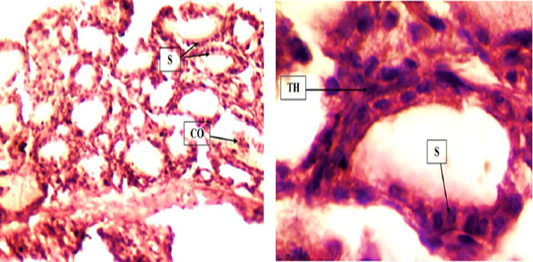
Histopathological study was done according to process suggested by Luna (1968).
Statistical analysis
The data was summarized using a mean±standard deviation format (SEM). One-way analysis of variance (ANOVA) with Least Significant Difference (LSD) were used to compare the means of the different groups the cutoff for significance was set at (P<0.05). All analyses were statistically analyzed using (SPSS Institute, Inc., USA) .
RESULTS and Discussion
Characterization of nano-particles
UV- visible spectrophotometer
A paired beam UV-visible spectrophotometer (Shimadzu, model 1800) having two coordinated quartz cells with 1 cm light path length and overloaded with UV probe software used for recording of spectra and assessing absorbance for routine enlargement and validation study. The wave length of nanoparticles was measured from 220 to 1100 nm for wave length by recording UV-visible spectrum of standard solution. Maximum absorbance (λ max 0.403) exposed at 301nm (Figure 1).
SEM analysis
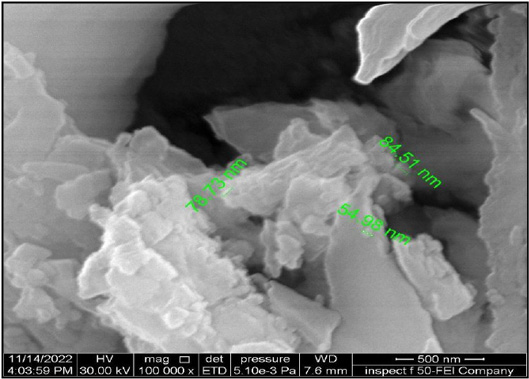
The morphology of nanoparticles was also confirmed in terms of nano size utilizing scanning electron microscopy (SEM). The SEM pictures revealed in Figure 2 displayed those particles have unequal shape with a smooth exterior. The average diameter of acquired NPs evaluated by SEM showed diameter range from 54 to 84 nm.
Ftir spectroscopy
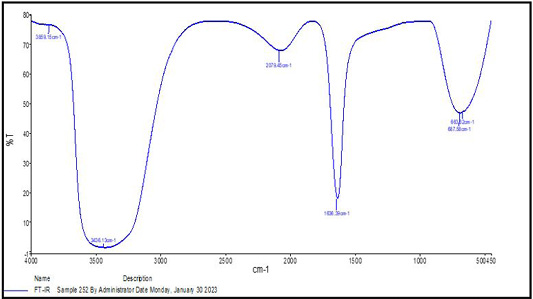
FTIR spectroscopy showed the existence of bending vibration of the aliphatic CH bond at the peaks 2079.45 cm-1. As for the peaks at numbers 1636.39 cm-1, they may be due to the existence of a vibrational bending of C=O and C-O, due to the aromatic amine group, respectively. As OH was originate at the wave numbers 3859.15 and 3436.13 cm-1, was attributed to the carboxylic groups. The FTIR spectra for indicating look like new functional groups, employed to predict the chemical and biological activities of biomolecules. Next imageries are FTIR results that could be understood for effective usage of the plant produces. The existence of esters (S-OR) group at 687.58 cm-1.
X-ray diffraction
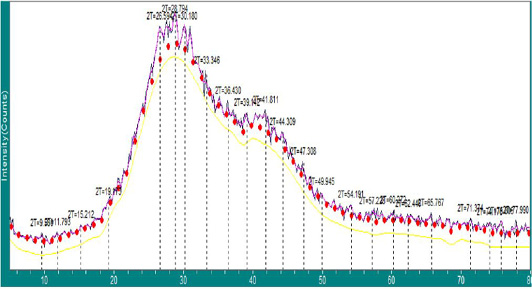
Paul scherer equation used to determination of size crystals in the form of powder. The Scherer calculation can be written as: Dp = (0.94 Χ λ)/(β Χ Cosθ), Where, Dp = Average Crystallite size, β = Line broadening in radians, θ = Bragg angle, λ = X-Ray wavelength. The current data of XRD allicin noted four chief peak 2Theta at 15.212, 33.346, 47.308 and 77.99 with their FWHM 0.666, 0.619, 0.549 and 0.848 to noted size at 13, 14, 17 and 13 nm, respectively Figure 3. In common, the material in crystalline state look a series of sharp peaks, while amorphous materials produce broad and non-defined peaks Figure 4 shows a very broad peak, representing that the bilayer illustrations displayed 2-3 strong peaks (Figure 4). The happening of the second peak indicative of more structured systems, proposes that the extracts are interposed between the chains of phospholipid bilayer and offers a better flow ability. XRD analysis exposed the crystalline nature of the extracts within the which shown better.
Iodine level
The results illustrated in Table 1 exhibited a substantial progression (p<0.05) at T1 (422.75±0.836) that was dosed with thyroxine compared with the control group (299.87 ±0.516), While the results showed a significant decrease at T2 (333.75±2.316) which was dosed with methimazole, related to T1, also exhibited an important reduction at T3 (285.25±1.752) which was dosed with allicin nanoparticles compared to T1 and T2, also the results showed a significant increase (p<0.05) at T4 which was dosed with mix methimazole and allicin nanoparticles compared with T2 and T3. The results also showed a significant decrease at T4 (357.25±1.074) which was dosed with mix methimazole and allicin nanoparticles compared with T1.
Table 1: Effect of thyroxine, methimazole and allicin nanoparticles on iodine level in mature female rats.
Groups
Iodine level
C
299.87 ± 0.516D
T1
422.75 ± 0.836A
T2
333.75 ± 2.316C
T3
285.25 ± 1.752E
T4
357.25 ± 1.074B
LSD
9.214
*The results represented as mean ± SEM. Different letters denote the presence of significant differences (P<0.05) between groups. C: female rats drenched orally with drinking water (1 ml). T1: female rats drenched orally with thyroxine (300mg/kg of B.W suspended in 1 ml of drinking water) for 28 days. T2: female rats drenched orally with thyroxine and treated with methimazole (2.5 mg/kg of B.W suspended in 1 ml of drinking water) for 30 days. T3: female rats drenched orally with thyroxine and treated with allicin nano particles (50 mg/kg of B.W suspended in 1 ml of drinking water) for 30 days. T4: female rats drenched orally with thyroxine and treated with methimazole (2.5 mg/kg of B.W) and allicin nanoparticles (50 mg/kg of B.W) for 30 days.
Thyroid hormones
The results demonstrated in Table 2 displayed a noteworthy difference (p<0.05) in the levels of thyroid hormones in the experimental groups when it comes to the T3 hormone. Specifically, the results demonstrated a notable rise in T1 (11.49±0.125) when thyroxine was administered compared to the control group (1.41±0.084). On the other hand, the results demonstrated a notable decline in the T2 group (4.60±0.267) when methimazole was administered, as compared to T1. Compared to T1 and T2. T3 that was given allicin nano had a significant decrease in the current study’s results (2.25±0.101). On the other hand. T4 that was given a mix of methimazole and allicin nano particles had a significant increase (7.76±0.111) compared to T2 and T3. Additionally, when contrasted with T1. T4 group, which received a dosage of a combination of methimazole and allicin nanoparticles, demonstrated a statistically significant reduction. Table 2 displays the results of the study, which indicate a significant difference (p<0.05) in the levels of T4 hormone between the experimental groups. Specifically, the thyroxine-dosed T1 had a significantly higher level (71.47±2.586) compared to the control group’s level (32.36±0.304). On the other hand, the methimazole-dosed T2 had a significantly lower level (43.70±1.149) than the T1. In this study, we found that in T3, which received an allicin nano dose, there was a significant decrease (25.31±0.699) when compared to the T1 and T2 groups. On the other hand, in T4, which received a dose of mix methimazole and allicin nano particles (51.73±0.854), there was a significant increase when compared to T2 and T3, and an important reduction when compared to T1. There was an important difference (p<0.05) in the TSH hormone levels of the experimental groups, as shown in Table 2 of the results. Specifically, the thyroxine-dosed T1 had a significantly lower level (1.13±0.039) compared to the control group (4.67±0.063). On the other hand, the methimazole-dosed T2 had a significantly higher level (7.59±0.176) than T1. The current study found that there was a notable drop at T3 (3.35±0.039) when allicin nano was administered compared to T2. On the other hand, there was a notable rise at T4 (10.70±0.203) when a combination of methimazole and allicin nano particles was administered compared to T1, T2, and T3.
Table 2: Effect of thyroxine, methimazole and allicin nano on thyroid hormones in mature female rats.
Groups
T3 (pg/ml)
T4 (ng/ml)
TSH (ng/ml)
C
1.41 ± 0.084E
32.36 ± 0.304D
4.67 ± 0.063C
T1
11.49 ± 0.125A
71.47 ± 2.586A
1.13 ± 0.039E
T2
4.60 ± 0.267C
43.70 ± 1.149C
7.59 ± 0.176B
T3
2.25 ± 0.101D
25.31 ± 0.699E
3.35 ± 0.039D
T4
7.76 ± 0.111B
51.73 ± 0.854B
10.70 ± 0.203A
LSD
0.854
2.564
1.241
The results showed a notable variation in iodine levels, which might be explained by the effects of the drugs given on iodine metabolism. The metabolic demand for iodine rises in response to an increase in thyroxine production. Particulars pertaining to the method’s time or the iodine measurement’s kind. Compared to the T1 group, the thyroxine-induced iodine increase was significantly reduced in the methimazole group (T2). Depletion of the thyroid’s iodine reserves causes a rise in TSH and may result in hypothyroidism and increased TSH levels . this investigation, the animals body weight significantly decreased after receiving L-thyr oxin; nevertheless, Allium sativum extract’s positive effects on allicin caused the weight to almost revert to the control value. Rats body weight increased when exposed to aqueous extract; this effect may have been caused by the plant’s antioxidant properties, which shield vital organs and boost weight. In the current investigation, rats with thyroxin-induced hyperthyroidism showed lower TSH levels and elevated plasma T3 and T4 levels. Because of this, the authors hypothesized that methimazole would only work on extracellular antioxidant defenses and would only be an effective antioxidant for a brief period of time.
T3 group had the most significant reduction in iodine levels when compared to all other groups. The outcome was difficult since it was a mixture of two different nanoparticles methimazole and allicin (T4). Iodine levels were greater than T2 and the control group, but lower than T1. According to Wang et al. (2012), methimazole mitigates the allicin-induced reduction to a certain degree, suggesting that the medicines may be used in conjunction. Remember that the study’s duration, animal model, and sample size are crucial factors to consider. With larger samples and longer periods of observation, future investigations may shed light on the observed patterns and provide stronger statistical support for them . According to Pearce et al. (2020), the interplay between thyroxine, Methimazole, allicin nanoparticles, and iodine metabolism is puzzling in light of these findings pertaining to iodine. Methimazole functions as for thyroid peroxidase, preventing thyrosine residues within thyroglobulin. This results in a decrease in the hormone levels in blood serum .The experimental group of rats showed a significant decrease in T3, T4, and an increase in TSH blood levels, indicating that the amount and duration of therapy was adequate to induce hypothyroid state.
The results of this study supported earlier research that found significantly higher levels of T3 and T4 hormones (p<0.05) in the positive control group T1, which developed hyperthyroidism, as compared to the control group (T1). Possible explanations for the action of L-thyroxine might be revealed by this increase (Atici et al., 2018; . Because methimazole blocks the generation of thyroid hormone, the levels of T3 and T4 were significantly lower in the group that took methimazole compared to the group that took thyroxine. We can now confirm that it can impede thyroxine production and lower circulating hormone levels. T3 and T4 levels were significantly lower in the allicin treatment group compared to the others, which is an interesting finding. This process involves increasing the enzymatic activity of target cells and speeding up the utilization of ATP to provide enough energy for salt and potassium. Increased hormone release as a result of this increased ATP utilization causes hypothyroidism and hyperthyroidism in vitro . Hypothyroid women with primary hypothyroidism who take thyroxine for less than four months had increased amounts of T4 and T3 hormones, according to research on hormonal alterations produced by thyroid hormone replacement by Jabbar et al. (2013). As a result of its combination with selenenyl iodide, the medication methimazole was able to transform T4 into T3 . It mainly influences thyroid hormone levels in two ways, since it accounts for 18% of it. Furthermore, modifications to the procedure are implemented directly and without intermediaries. The second is an easy and quick adjustment to the process, while the first is a response from the braided lipids in cell membranes. Research by Quzzaz and Colleagues (2020) lends credence to earlier conclusions drawn by Francis and Greensan (2001) on the effective duplication of genes regulating intra- and extra-thyroid hormone levels. Participate in a wide range of metabolic processes and also function, according to research by . Methimazole (2.5 mg/kg of body weight) caused a substantial drop (P<0.05) in hormone levels (T4, T3). The result was hypothyroidism due to a notable rise (P<0.05) in TSH. The hormone’s blood levels are reduced because methimazole inhibits thyroglobulin’s iodination of thyrosine residues. According to Abou-Zeina et al. (2015), the feed additives given to neonatal goats caused a notable increase in T3 levels and a barely noticeable decrease in T4 growth. The aforementioned hormonal alterations can be alleviated by garlic extract, according to strong data. Further, the flavonoids Eteng and Aletan (2012) found in garlic inhibit the conversion of T4 to T3, which in turn affects thyroid function. As a result of a feedback loop involving the hypothalamic-pituitary-thyroid axis, the anterior lobe of the pituitary gland is stimulated to produce more TSH in an effort to compensate for the decreasing thyroid gland function, leading to an increase in TSH following oral methimazole administration. A hormone that is structurally similar to TSH reduces TSH levels, this was demonstrated by Panda et al. (2020), who also demonstrated that thyroid hormones are linked to nuclei. T4 levels rise, which impacts hypothalamic cells, while TSH levels fall, which affects pituitary cells. As a result, the amount of TRH receptors on the membranes of pituitary cells changes, leading to lower TRH levels. Pirahanchi et al. (2022) states that TSH secretion leads to a drop in concentration (TSH) as a result of these cells diminished response to TRH. Magnesium is an essential element, as demonstrated by Ulianich et al. (2004). Garlic, which is recognized as a production inhibitor , may have a role in the observed changes in serum levels. The reason behind this is that garlic might enhance the production of TSH. These regions also displayed the majority of the histological alterations. The induction of hypothyroidism in was confirmed biochemically by serum level in the current investigation.
These findings corroborated those of Ahmed et al. (2010), who discovered that thyroxine may influence thyroid follicular regularity and speed up cell division and death through its roles in thyroid cell differentiation, secretion, and reducing the level of secretion of TSH hormone. These findings corroborated those of Panda et al. (2020) and Rajab et al. (2017). Hyperthyroidism evolves throughout the histology phase of the inquiry, as demonstrated by Hwang (2017). The imbalance between free radical production and antioxidant defenses is what leads to oxidative stress in hyperthyroidism . Thyroid tissue is damaged and activity drops because of its impacts on lipids, proteins, and nucleic acids, which are crucial components of cells (SOD, GST, and CAT). It damages cell membranes by oxidizing fat-soluble unsaturated fatty acids, say Panda et al. (2020). As a consequence of its regulatory qualities and ability to control thyroid hormone release, the drug raises thyroid hormone levels through a negative feedback mechanism. Additionally, its serum secretion controls thyroid stimulating hormone release, leading to advancement. The beneficial impact of methimazole on animal thyroid tissue was validated by Park and Lee (2021). Because of their stability or their capacity to interact with other radicals to become stable again, free radicals cannot attach to non-fatty acids. Their ability to contribute an electron to the chemical chains that make lipids means that they can stop fats from becoming peroxidized. The quantity of saturated lipids in cell membranes impacts cellular and tissue function . Cellular processes and the tissues that make them up are impacted by saturated lipids found in cell membranes .
The discovery of methimazole altered the stages and mechanisms of antioxidant enzymes and processes suggests that MDA was increased as a defense strategy. When aerobic organisms carry out their metabolic processes, they produce reactive oxygen species (ROS). When organisms experience an increase in ROS formation, their antioxidant defense systems can be activated, according to Hejazian et al. (2021). Lipid peroxidation, which occurs in cell membranes, is the reaction that produces MDA as stated by Taso et al. (2019). An increased MDA level is a key marker of lipid peroxidation. The results are in agreement with those of Hussein (2022). Researchers have shown that elevated levels of thyroid autoantibodies may originate from an upregulation of apoptotic markers. Some of the follicles had desquamated cells in their lumen and others seemed to have merged; others showed aberrant shape and inflammatory lymphocytic infiltration .
CONCLUSIONS AND RECOMMMMENDATIONS
In conclusion, there are Use of thyroxine at dose 300mg/kg of B.W for 28 day in induction female rats for hyperthyroidism has negative effect and caused imbalance in oxidation. Antioxidants homeostasis. The utilization of Allicin nanoparticles at dose 50 mg/kg of B.W appears to enhance its bioavailability and effectiveness combating oxidative stress associated with hyperthyroidism. In this current study, we recommend study how Allicin nanoparticles and Methimazole interact at various dosages for a long time and study effect of Allicin and Nano-allicin by another technique like western blot and gene expression.
ACKNOWLEDGMENTS
The author is thankful to head and all staffs of the branch of Physiology and Pharmacology, College of Veterinary Medicine, Al-Qadisiyah University for all amenities and assisting in this work.
NOVELTY STATEMENT
The novelty of the study is focus on physiologically action of Allicin Nanoparticles in enhancement the damage caused by thyroxin in female rats.
Author’s Contribution
These authors each contributed equally.
Ethical approval
The academics acquired ethical approval from the research Ethical Approval Committee of the College of Veterinary Medicine, University of Al-Qadisiyah.
Conflict of interest
The authors have declared no conflict of interest.
Figures
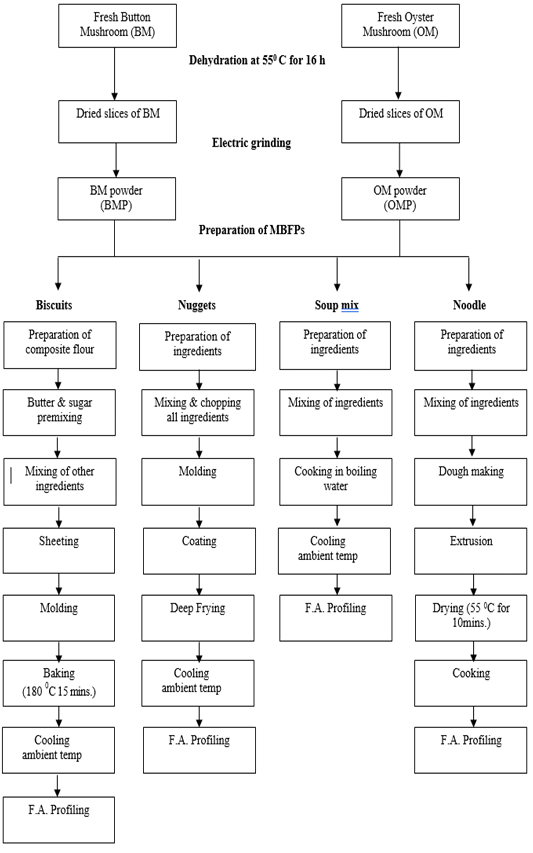
Figure 1:.
Product preparation flow chart of mushroom by products.1.
Figure 2:.
SEM of nanoparticles of appear elongated to irregular shape of allicin nanoparticles with particle size around 500 nm.
Figure 3:.
FTIR spectra.
Figure 4:.
A very broad peak.
Figure 5:.
(A) Control group: Note normal thyroid follicles which lining with simple cuboidal epithelium (S) and these follicles contain few colloids (CO). 10X H & E. (B) Control group: Higher magnification, the thyroid follicles lined by single layer of simple cuboidal epithelium (S) and thin of interstitial tissue (TH). 40X H & E.
Figure 6:.
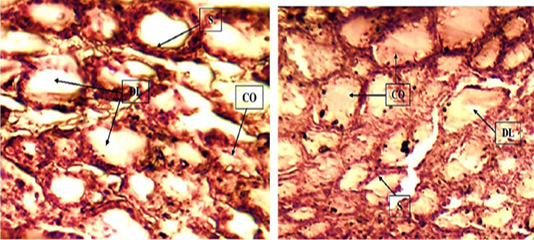
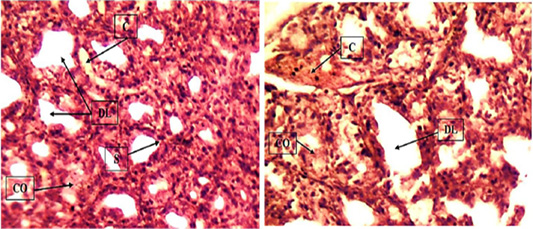
(A) T1 group: Thyroid tissue showed normal with dilated thyroid follicles (DL) and it contains colloid in their lumen (CO). Also these follicles line by simple cuboidal epithelium (S). (B) T1 group: There is dilation of thyroid follicles (DL) with large amount of colloid (CO), thin interstitial tissue and normal simple cuboidal epithelium which lined thyroid follicles (S). 10X H & E.
Figure 7:.
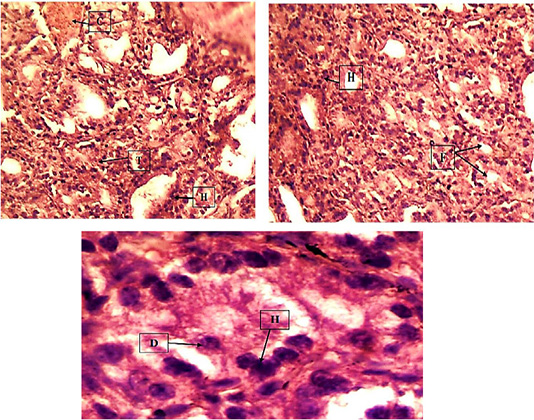
(A) T2 group: All thyroid follicles showed small in size and empty for colloid with hyperplasia of epithelial cells (H) which lined follicles, also there is high congestion of the blood vessels (C) and thickening of the interstitial tissue (T). 10X H & E. (B) Hyperplasia of epithelial cells which lining the follicles (H). The follicles showed small in size and devoid colloid (F). 10X H & E. (C) Higher magnification, the thyroid follicle showed hyperplasia (H) with desquamation (D) within the lumen of epithelial cells and thickening of interstitial tissue of thyroid. 40X H & E.
Figure 8:.
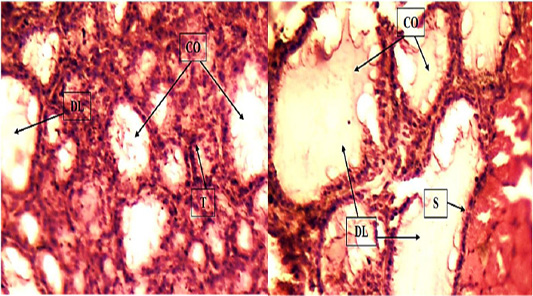
(A) T3 group: The thyroid follicles were dilated (DL) and contain large amount s of colloid (CO). Also there is thickening of the interstitial tissue of thyroid (T). 10X H & E. (B) Note high dilation of thyroid follicles (DL) with large amount of colloid (CO) and these follicles lined by simple cuboidal epithelium (S). 40X H & E.
Figure 9:.
(A) T4 group. Some thyroid follicles showed dilation (DL) and lined by simple cuboidal epithelium (S) and it contains few colloid (CO). Other follicles were small in size with narrowed lumen and mild congestion of the blood vessels (C). 10X H & E. (B) Mild congestion of the blood vessels (C) and the thyroid follicles showed dilated (DL) and contain few colloids (CO). 10X H & E.
References
Abdullah A, Shteiwi (2012). Physiology. First edition. Dar Al-Maysara for Publishing, Distribution and Printing, 5(4): 361-368.
Abou-Zeina H, Nasr S, Abedel-Azem (2015). Effect of different dietary supplementation with antioxidants on Gene expression and blood Antioxidant markers as well as thyroid hormones statusin Gota Kids. J. Sci. Res., 23(23): 993-1004.
Ahmed O, Abd El-Tawab S, Ahmed R (2010). Effects of experimentally induced maternal hypothyroidism and hyperthyroidism on the development of rat offspring: I. The development of the thyroid hormones–neurotransmitters and adenosinergic system interactions. Int. J. Dev. Neurosci., 28(6): 437-454. https://doi.org/10.1016/j.ijdevneu.2010.06.007[CrossRef]
Aldulemy QLM, Muhammad Mubarak A. Abdul-Razak M MA (2021). Effect of Nano Seaweed Extract on Tillaring Pattrin growth and yield of Barley Varieties. Int. J. Aquatic Sci., 12(2): 5385-5400.
Amirkhani Z, Alavi M, Kalani M, Alavianmehr A, Farjadian S (2022). Immunomodulatory effects of omega-3 fatty acids in patients with differentiated thyroid cancer before or after radioiodine ablation. Iran. J. Immunol., 19(1): 71-90.
Asker M, Hassan W, El-Kashlan A (2015). Experimentally induced hyperthyroidism influences oxidant and antioxidant status and impairs male gonadal functions in adult rats. Andrologia, 47(6): 644-654. https://doi.org/10.1111/and.12312[CrossRef]
Asker ME, Hassan WA, Ei-Kashlan AM (2014). Experimentally induced hyperthyroidism influences oxidant and antioxidant status and impairs male gonadal functions in adult rats. J. Ugslov. Med. Biohem., 5(2): 22-89.
Atic E, Mogulkoc R, Baltaci AK, Menevse E (2018). Both hypothyroidism and hyperthyroidism increase plasma irisin levels in rats. Horm. Mol. Biol. Clin. Invest., 33(3). https://pubmed.ncbi.nlm.nih.gov/29405728, https://doi.org/10.1515/hmbci-2017-0054[CrossRef]
Chaalal A, Poirier R, Blum D, Laroche S, Enderlin V (2019). Thyroid hormone supplementation restores spatial memory, hippocampal markers of neuroinfammation, plasticity-related signaling molecules, and β-amyloid peptide load in hypothyroid rats. Mol. Neurobiol., 56(1): 722–735. https://pubmed.ncbi.nlm.nih.gov/29796989, https://doi.org/10.1007/s12035-018-1111-z[CrossRef]
Chen XZ, Haitao Z, Qiang A (2015). TIR, XRD and SEM analysis of ginger powders with different size: Structure characteristic of ginger powders. J. Food Proc. Preserv., 39(6): 55-89. https://www.researchgate.net/publication/286848323_Chen_et_al_2015, https://doi.org/10.1111/jfpp.12442[CrossRef]
Cobas AC, Soria AC, Martinez MC, Villamiel M (2010). A comprehensive survey of garlic functionality. Nova Sci. Publ., 978(1): 60741-642.
Cochran B, Lunday D, Miskevich F (2008). Kinetic analysis of amylase using quantitative benedict’s and iodine starch reagents. J. Chem. Educ., 85(3). https://pubmed.ncbi.nlm.nih.gov/18832286. https://doi.org/10.1021/ed085p401[CrossRef]
David B, Diplomate A (2014). Internal medicine. Nutrition, 3(8): 67-78.
El-Kashef DH, El-Kenawi AE, Suddek GM, Salem HA (2017). Allicin ameliorates kidney function and urinary bladder sensitivity in cyclosporine A treated rats. Hum. Exp. Toxicol., 36(7): 681-691. https://doi.org/10.1177/0960327116660864[CrossRef]
Eman GE, Helal, Rasha AA, El-Sayed, Sara E, Mohamed A (2018). Mustafa department of zoology, faculty of science (Girls), R University, Cairo, Egypt. Egypt. J. Hosp. Med., 71(4): 3049-3055. https://www.researchgate.net/publication/323513584.
Eteng MBEHU, Aletan-Uduak I (2012). Interaction with iodine metabolism following ingestion of Allium cepa and Allium sativum by albino Wistar rats. Res. Lib. J. Nat. Prod. Plant Resour., 2(3): 344-349. https://www.scholarsresearchlibrary.com/archive/jnppr-volume-2-issue-3-year-2012.html
Fouad E, Ashraf H, Ahmed A, Elshoura FO (2022). Histopathological and biochemical study of toxic effects of the chronic administration of bisphenol a on the pituitary and thyroid glands of adult albino rats. Basic Clin. Endocrinol., 19(2): 112-116. https://pubmed.ncbi.nlm.nih.gov/35619798/, https://doi.org/10.21608/aimj.2022.101454.1616[CrossRef]
Francis S, Greenspan MF (2001). The thyroid gland by (eds. Francis S, Greenspan MDF, David GG) basic and clinical endocrinology, 6 ed., McGraw. Hill, New York, pp. 201-272. https://accessmedicine.mhmedical.com/book.aspx?bookID=2178
Gomaa AMS, Abd El-Aziz EA (2016). Omega-3 fatty acids decreases oxidative stress, tumor necrosis factor-alpha, and interleukin-1 beta in hyperthyroidism-induced hepatic dysfunction rat model. Pathophysiology, 23(4): 295-301. https://pubmed.ncbi.nlm.nih.gov/27793418/, https://doi.org/10.1016/j.pathophys.2016.10.001[CrossRef]
Hayat NQ, Tahir M, MunirB, Sami W (2010). Effect of methimazoleinduced hypothyroidism on histological characteristics of parotid gland of albino rat. J Ayub Med College Abbottabad, 22(3): 22-27.https://www.researchgate.net/publication/234162710
Hassan WA, Aly MS, Abdel- Rahman T, Shahat AS (2013). Impact of experimental hypothyroidism on monoamines level in discrete brain regions other peripheral tissues of young and adult male rats. Int. J. Dev. Neurosci., 31: 22-233. https://pubmed.ncbi.nlm.nih.gov/23411049, https://doi.org/10.1016/j.ijdevneu.2013.09.003[CrossRef]
Hejazian SM, Khatibi SMH, Barzegari A, Pavon-Djavid G, Soofiyani, SR, Hassannejhad S, Vahed SZ (2021). Nrf-2 as a therapeutic target in acute kidney injury. Life Sci., 264: 118581. https://pubmed.ncbi.nlm.nih.gov/34604382/, https://doi.org/10.1016/j.lfs.2020.118581[CrossRef]
Hussein DK (2022). Determination of the level of IL-6 and vaspin in hyperthyroid patients treated with carbimazole. Iraqi J. Sci., 63(5): 1909-1917. https://www.researchgate.net/publication/365195596, https://doi.org/10.24996/ijs.2022.63.5.5[CrossRef]
Hwang JH, Kang SY, Kang AN, Jung HW, Jung C, Jeong JH, Park YK (2017). MOK, a pharmacopuncture medicine, regulates thyroid dysfunction in L-thyroxin-induced hyperthyroidism in rats through the regulation of oxidation and the TRPV1 ion channel. BMC Complement. Altern. Med., 17(1): 1-13. https://www.ncbi.nlm.nih.gov/pmc/articles/PMC5732465/, https://doi.org/10.1186/s12906-017-2036-1[CrossRef]
Jabbar ZS, Al-Shamma KJ, Taher MA (2013). Some hormonal changes in women with primary hypothyroidism under the effect of thyroid hormone replacement therapy. Iraqi J. Pharma. Sci., 22(1): 56-64. https://doi.org/10.31351/vol22iss1pp56-64[CrossRef]
Jiang H, Xing Z, Wang Y, Zhang ZL, Mintah BK, Dabbour M, Ma HL (2020). Preparation of allicin-whey protein isolate conjugates: Allicin extraction by water, conjugates ultrasound-assisted binding and its stability,solubilityand emulsibility analysis. Ultrasonics Sonochem., 63: 104981. https://doi.org/10.1016/j.ultsonch.2020.104981[CrossRef]
Kar A, Panda S, Bharti S (2002). Relative efficacy of three medicinal plant extracts in the alteration of thyroid hormone concentrations in male mice. J. Ethnopharmacol., 81: 281-285. https://doi.org/10.1016/S0378-8741(02)00048-X[CrossRef]
Kemper KJ (2000). Garlic (Allium sativum). Longwood Heral task force and the center for holistic pediatric education and research, 7(5): 34-46. http://www.mcp.edu/herbal/default.htm.
Khalid R, Gordon ML (2006). Significance of garlic and its constituents in cancer and cardiovascular disease. Am. Soc. Nutr., 136: 736–740. https://doi.org/10.1093/jn/136.3.v[CrossRef]
Kumbhat S, Kumar N (2016). Essentials in nanoscience and nanotechnology. Psychol. Test Assess. Model., 6(3): 67-78. https://www.scirp.org/reference/referencespapers?referenceid=2375858
Lankalapalli S, Tenneti V, Adama R (2015). Preparation and evaluation of liposome formulations for poorly soluble drug itraconazole by complexation. Der. Pharma. Lett., 7: 1-17. https://www.sciencedirect.com/science/article/abs/pii/S0009308417303043
Lei J, Wendt CH, Fan D, Mariash CN, Ingbar DH (2007). Development acquisition of T3 sensitive Na+-K+ATPasestimulation by rat alveolar epithelial cells. Lung Cell Mol. Physiol., 292: 16-14. https://pubmed.ncbi.nlm.nih.gov/16951134/, https://doi.org/10.1152/ajplung.00078.2006[CrossRef]
Luna LG (1968). Manual of histologic staining methods of the armed for CES institute of pathology. 3rd Edn. Mcgraw-Hill Book Company. New York, pp. 258.
Mahmoodi M, Hosseini Zijoud SM, Hassanshahi GH, Toghroli MA, Khaksari M, Hajizadeh MR, Mirzajani E (2011). The effects of consumption of raw garlic on serum lipid level, blood sugar and anumber of effective hormones on lipid and sugar metabolism in hyperglycemic and/or hyperlipidemic individuals. Adv. Biol. Chem. 1: 29-33.https://www.researchgate.net/publication/286050093
Majeed MS, Al-Azzawie HF (2012). Effect of red cabbage extract on oxidative stress and some cytokines levels in hyperthyroid rabbits induced thyeoxine. Iraqi J. Sci., 53: 298-307.
Melike E, Aydin Y, Orta B, Nebahat Y, Yildizbayrak T (2021). Chapter 42- protective effects of vitamin C against fluoride toxicity. Toxicol. Oxid. Stress Dietary Antioxid., pp. 435-445. https://www.sciencedirect.com/science/article/ abs/pii/B9780128190920000431, https://doi.org/10.1016/B978-0-12-819092-0.00043-1[CrossRef]
Panda S, Sharma R, Khan A, Kar A (2020). Ameliorative effect of Aloe gel against L-T4-induced hyperthyroidism via suppression of thyrotropin receptors, inflammation and oxidative stress. Mol. Biol. Rep., 47(4): 2801-2810. https://pubmed.ncbi.nlm.nih.gov/32242301/, https://doi.org/10.1007/s11033-020-05405-7[CrossRef]
Melina S, Melisa C, Alicia J (2021). Regulation of the cellular redox state and the expression of DNA methyltransferase-1 in peripheral blood mononuclear cells from patients with Graves disease. Diabetes Nutr., 69(6): 409-417. https://doi.org/10.1016/j.endinu.2021.07.011[CrossRef]
Moder K (2010). Alternatives to F-test in one way ANOVA in case of heterogeneity of variances (a simulation study). Psychol. Test Assess. Model., 52(4): 343 https://jcopew.uobaghdad.edu.iq/index.php/sport/issue/view/28
Pan Z, Cui T, Chen W, Gao S, Pearce EN, Wang W (2019). Serum iodine concentration in pregnant women and its association with urinary iodine concentration and thyroid function. Clin. Endocrinol., 90(5): 711–718. https://pubmed.ncbi.nlm.nih.gov/30724372, https://doi.org/10.1111/cen.13945[CrossRef]
Panda S, Sharma R, Kar A (2019). Chavibetol corrects thyrotoxicosis through alterations in thyroid peroxidase. Naunyn-Schmiedeberg’s Archives of Pharmacol, 392: 541-550. https://pubmed.ncbi.nlm.nih.gov/30610248/, https://doi.org/10.1007/s00210-018-01606-x[CrossRef]
Park JS, and Lee SH (2021). Effects of maternal hypothyroidism on the pubertal development in female rat offspring. Dev. Reprod., 25(2): 83. https://www.ncbi.nlm.nih.gov/pmc/articles/PMC8328481/, https://doi.org/10.12717/DR.2021.25.2.83[CrossRef]
Pearce EN, Gutierrez-Hartmann A (2020). Update on mechanisms of thyroid iodine uptake and release. Curr. Opin. Pharmacol., 54: 85-91.
Pirahanchi Y, Toro F, Jialal I (2022). Physiology, thyroid stimulating hormone. StatPearls, 6(8): 2-7.
Qazzaz ME, Alfahad M, Alassaf FA, Abed M N, Jasim MH, Thanoon IA (2020). Effects of omega-3 on thyroid function tests in healthy volunteers. Syst. Rev. Pharm., 11(7): 10-14.
Rahman R, Lowe GM (2006). Significance of garlic and its constituents in cancer and cardiovascular disease. Am. Soc. Nutr., 136: 736–740. https://doi.org/10.1093/jn/136.3.v[CrossRef]
Rajab NM, Ukropina M, Cakic-Milosevic M (2017). Histological and ultrastructural alterations of rat thyroid gland after short-term treatment with high doses of thyroid hormones. Saudi J. Biol. Sci., 24(6): 1117-1125. https://doi.org/10.1016/j.sjbs.2015.05.006[CrossRef]
Shahat AS, Hassan WA, El-Sayed WM (2022). N-Acetylcysteine and Safranal prevented the brain damage induced by hyperthyroidism in adult male rats. Nutr. Neurosci., 25(2): 231-245. https://pubmed.ncbi.nlm.nih.gov/32264788/, https://doi.org/10.1080/1028415X.2020.1743917[CrossRef]
Taso OV, Philippou A, Moustogiannis A, Zevolis E, Koutsilieris M (2019). Lipid peroxidation products and their role in neurodegenerative diseases. Ann. Res. Hosp., 3(2). https://doi.org/10.21037/arh.2018.12.02[CrossRef]
Ulianich L, De Micheli S, Trim S, Pacific F, Liguoro D, Moscat F, Marsigliante S, announced L, Formisano S, Council and, Jeso B (2004). TSH/Camp up update sarco/ endoplasmic reticulum Ca ++ appases expression and activity in Pc Cl3 Therroid Cells. Eur. J. Endocrinol., 150(6): 851-861. https://doi.org/10.1530/eje.0.1500851[CrossRef]
Vandana B, Kavya N, Shubhashree MN, Sulochana B (2017). Herbal approach to management of thyroid disease. A review. J. Ayurvedic Herbal Med., 1: 48-52. https://doi.org/10.31254/jahm.2017.3109[CrossRef]
Wang D, Sun X, Wu Y, Liu Y (2012). Antithyroid effect of allicin in vivo and in vitro. Molecules, 17(3): 2958-2968.
Zhang W, Chou X, Shi T, Ma Z, Bao H, Chen J, Chen L, Li D, Xue C (2016). Measurement technology for micro-nanometer devices. Wiley Online Library, 6(3): 67-98. https://doi.org/10.1002/9781118717974[CrossRef]