
The storage of bacteriophages is tricky as no ideal common practice is available and the storage conditions may differ from phage to phage. There is disparity among the scientific community regarding bacteriophage storage conditions and various conditions (4 oC, -20 oC, -80 oC and liquid nitrogen freezing at -196°C) are used by different laboratories. In this study, the storage stability of five bacteriophages, JHP, RLP, RSP, SaPL, and IttPL, at distinct temperatures for complete one year is described. Our results indicated that storage of bacteriophages at 4oC was most appropriate, followed by storage at -20oC and -80oC as no drop in viral titer was witnesses in bacteriophage samples stored at 4oC for up to one year. The results of this research indicated, that a standard refrigeration is suitable and economical means of long term storage with no fall of phage activity.
Short Communication · Volume 50, Issue 6, 10 November 2018 · Open Access
Storage of Bacteriophages at 4°C Leads to no Loss in Their Titer after One Year
· · · ·
Affiliations & Notes ⌄
- 1Department of Microbiology and Molecular Genetics, University of the Punjab, Lahore 54590 , * Corresponding author: shafiq.mmg@pu.edu.pk
Article Info ⌄
- Journal:
- Pakistan Journal of Zoology
- Published:
- 10 November 2018

From the article
- Interestingly, we detected no decrease in bacteriophage titer of all investigated viruses when the bacteriophages were stored at 4oC.
- None of the bacteriophages under study demonstrated significant viability after one year of storage at room temperature and 37oC, except JHP where a 30 % viability was observed.
- Based on this study, it was concluded that 4oC is the best storage temperature for bacteriophages, followed by -20oC and -80oC, in terms of minimally impacting viability suitability.
- To further enhance our knowledge regarding storage stability of bacteriophages, storage stability studies of more than 1-year are required.
Selected from the article's own text.
Abstract
Materials and methods
Lauria Bertani (LB) broth was employed as the storage medium of the bacteriophages. For preservation, at -20°C and -80°C, 30% v/v of glycerol (50%), was utilized with a final 15% glycerol concentration. Each sample (1mL) was stored in 1.7 ml Eppendorf tubes in triplicates.
Bacteriophages were stored in triplicate at 37°C, 25°C, 4°C, -20°C and -80°C for 12 months. The titers of bacteriophages JHP, RLP, RSP, SaPL and IttPL before storage was 1.6x10¹³, 4.6x10¹¹, 4.0x10¹⁷, 9.3x10¹⁵ and 2.0x10⁸, respectively, for storage at 37 oC, 25 oC and 4 oC, while, the titer for storage at -20 oC and -80 oC for bacteriophage JHP, RLP, RSP, SaPL and IttPL was 1.1x10¹³, 3.2x10¹¹, 2.8x10¹⁷, 6.5x10¹⁵ and 1.4x 10⁸, respectively.
The titer of the all the bacteriophages before and after storage was counted utilizing double layer agar overlay method . In double layer agar overlay method, dilution of bacteriophage, incubated with host bacterium for 10-15 min, was overlaid on the agar plate followed by addition of 3-5 mL of semi solid agar and incubated overnight. The plaques were counted after incubation.
Results
The titer of tested bacteriophages diminished from 8 to 17 logs when the bacteriophages were stored at 37oC and this loss in titer was from 84 to 100 percent. Similarly, a 69-100 percent titer decrease (8-15 logs) was noted when put at 25oC. Interestingly, we detected no decrease in bacteriophage titer of all investigated viruses when the bacteriophages were stored at 4oC. Surprisingly, the bacteriophage titer also decreased (5-12 log; 25 to 70 percent) and (5-12 logs; 45 to 100 %) when stored at -20oC and -80oC, respectively (Table I).
In our investigation, the most reasonable condition observed for bacteriophage storage with minimal titer drop was 4 oC, which is in agreement with others working with tailed bacteriophages . At 4oC temperature, no substantial drop in the titer occurred and zero log decrease across. In contrast, freezing conditions of -20 oC and -80 oC appeared to substantially reduce bacteriophage titer. Storage at 25oC or 37oC, however, had the greatest impact on phage titer as few infectious virions were recovered from these phage suspensions after 12 months. Except for SaPL and JHP, zero percent survival was observed in other investigated bacteriophages (RLP, RSP, and ITTPL) at 37 oC, while at 25 oC, zero percent survival was observed in case of SaPL. The reductions in phages titer stored at 37, 25, 4, -20 and -80 oC is presented in Figures 1 and 2.
The comparative detail in terms of percent log decrease at 37, 25, 4, -20 and -80 oC for the 5 bacteriophages under investigation is presented in Figure 2.
Table I.- Titers of bacteriophage lysates before and after (one year) storage at 37, 25, 4, -20 and -80oC for bacteriophage JHP, RLP, RSP, SaPL and IttPL.
| Name* | Titer (PFU/ml) of bacteriophage at storage temp. | ||||
| 37oC | 25oC | 4 oC | -20 oC | -80 oC | |
| Before storage | |||||
| JHP | 1.6×10¹³ | 1.6×10¹³ | 1.6×10¹³ | 1.12×10¹³ | 1.12×10¹³ |
| RLP | 4.6×10¹¹ | 4.6×10¹¹ | 4.6×10¹¹ | 3.2×10¹¹ | 3.2×10¹¹ |
| RSP | 4.0×10¹⁷ | 4.0×10¹⁷ | 4.0×10¹⁷ | 2.8×10¹⁷ | 2.8×10¹⁷ |
| SaPL | 9.3×10¹⁵ | 9.3×10¹⁵ | 9.3×10¹⁵ | 6.51×10¹⁵ | 6.51×10¹⁵ |
| IttPL | 2.0×1008 | 2.0×1008 | 2.0×1008 | 1.4×1008 | 1.4×1008 |
| After storage | |||||
| JHP | 1.8x10² | 2.3x10⁴ | 2.0×10¹³ | 5.7×1008 | 6.53x10³ |
| RLP | 00 | 1x10² | 1.4×10¹¹ | 3.5x10⁶ | 2.0x10⁶ |
| RSP | 00 | 5.7x10² | 2.2×10¹⁷ | 4.45x10⁵ | 3.8x10⁵ |
| SaPL | 6.9x10⁴ | 5.34x10⁴ | 2.0×10¹⁵ | 1.2x10⁵ | 1.0x10⁴ |
| IttPL | 00 | 00 | 1.3×1008 | 1.53x10² | 00 |
* name of bacteriophage.
Discussion
Bacteriophages have been studied for over 100 years, which served us to understand many modern biological aspects, however, no common method for their preservation is available and in use. Despite this, there are very few published studies, focusing on this issue. It is perhaps owing to the disparate nature of bacteriophages that fewer efforts on this aspect of the bacteriophage biology are available. In this investigation, the activity of five tailed bacteriophages JHP, RLP, RSP, SaPL and IttPL, isolated from different sewage water sources of Lahore, Pakistan, was examined after their long-term storage. The novelty of this research is that no special preservatives were used in our phage solutions. The medium chosen for long-term storage was standard LB broth, which is regularly employed for the propagation of bacteriophages.
In earlier studies, different conditions for bacteriophage preservation were documented, including storage at 4, -20, -80oC and even Nitrogen freezing at -196oC, however, the suitable storage temperature vary with phage type ; ; . In this study, 4oC was found to be the suitable temperature for storage of these bacteriophages, similar to results described by others working with tailed bacteriophages . They found that the tailed and filamentous phages without lipids can be stored for over 5-10 years, but their results varied with different bacteriophages. The results of our study are in accordance with another study which revealed no change in titer of bacteriophages Staphylococcus aureus and P. aeruginosa after one year of storage at 4oC .
There are reports of bacteriophages sensitivity to low temperatures, including seven log reductions in titer observed after only t three months of storage. Interestingly, the Bacillus phage CP-54Ber showed the most stability at room temperature . None of the bacteriophages under study demonstrated significant viability after one year of storage at room temperature and 37oC, except JHP where a 30 % viability was observed. Sometimes, bacteriophages are also stored at chilling conditions with the addition of glycerol. It has also been documented that freezing with glycerol was not as effective as preservation at 4oC, which is evident in the current study . We observed a 25 to 71% and 45 to 100% decrease in bacteriophage titer, when phages were stored at -20oC and -80oC, respectively for 1year.
Conclusion
Based on this study, it was concluded that 4oC is the best storage temperature for bacteriophages, followed by -20oC and -80oC, in terms of minimally impacting viability suitability. Whereas, the temperature between 25 and 37oC were not suitable for bacteriophage storage. To further enhance our knowledge regarding storage stability of bacteriophages, storage stability studies of more than 1-year are required.
Statement of conflict of interest
The authors declare no conflict of interest.
Figures
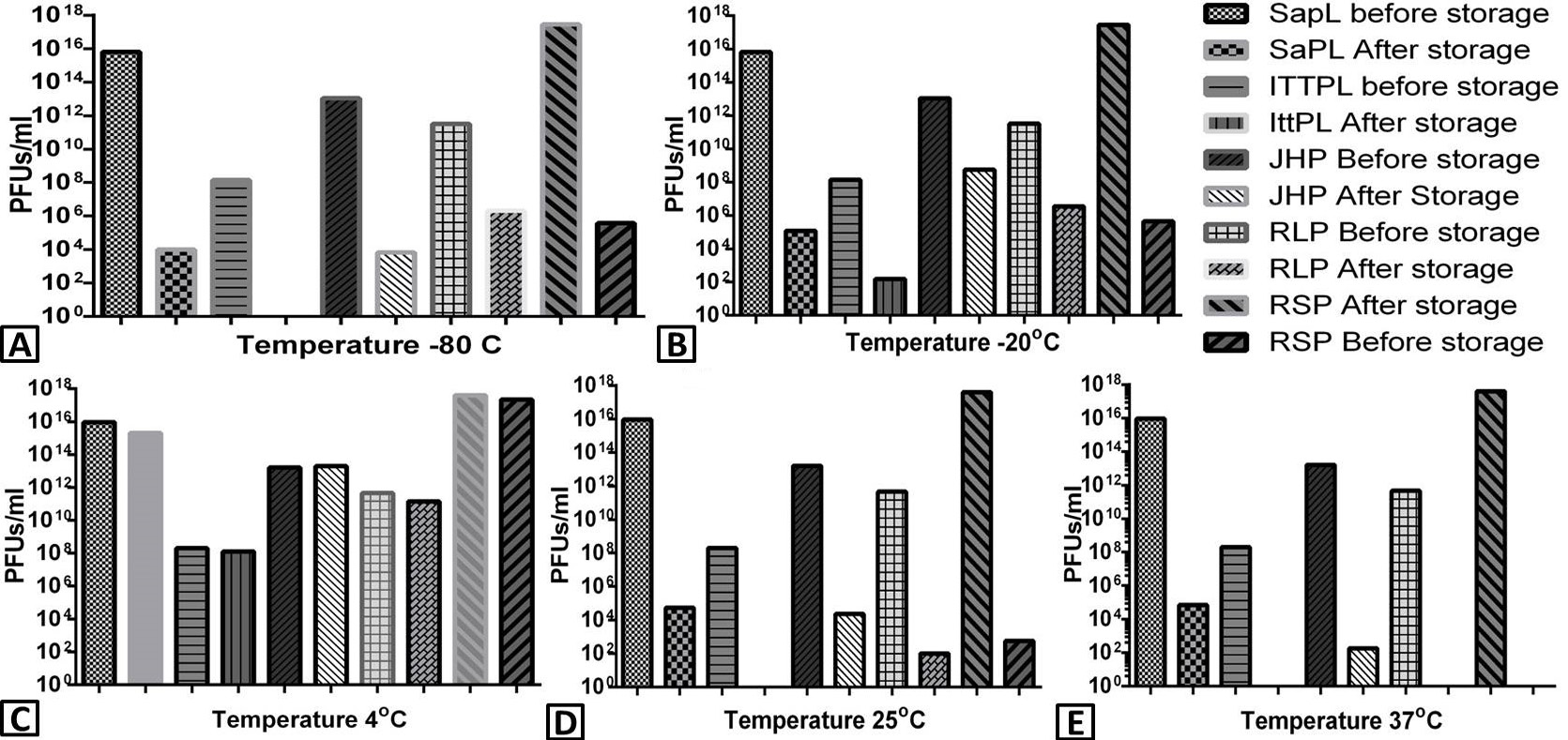
Effect of specific storage conditions on the viability of acteriophages SaPL, IttPL, JIIP, RLP and RSP, after one year storage. Phage titre before and after storage at -80°C (A), at -20°C (B), at 4°C (C), at 25°C (D) and at 37°C (E).
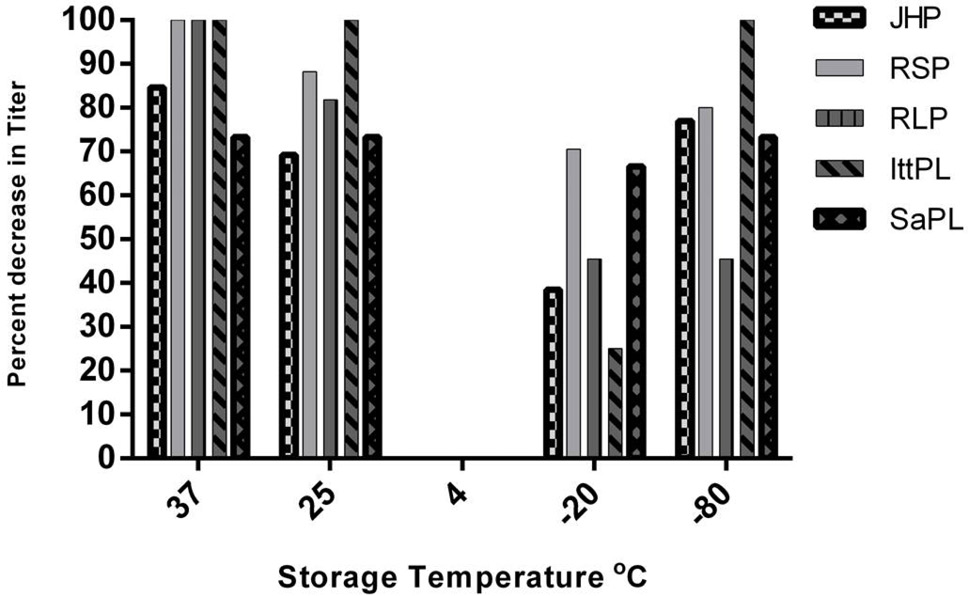
Decrease (%) in the titers of bacteriophages JHP, RSP, RLP, IttPL and SaPL after one year of storage at different temperatures.
References
- Ackermann, H.W., Tremblay, D. and Moineau, S., 2004. WFCC Newsl., 38: 35-40.
- Carlson, K., 2005. Working with bacteriophages: Common techniques and methodological approaches, Vol. 1. CRC Press Boca Raton.
- Clark, W.A., 1962. Appl. Microbiol., 10: 466-471.
- Clark, W.A. and Geary, D., 1973. Cryobiology, 10: 351-360. https://doi.org/10.1016/0011-2240(73)90057-6[CrossRef]
- Clark, W.A., Horneland, W. and Klein, A., 1962. Appl. Microbiol., 10: 463-465.
- Cuevas, J.M., Duffy, S. and Sanjuán, R., 2009. Genetics, 183: 747-749. https://doi.org/10.1534/genetics.109.106005[CrossRef]
- Doss, J., Culbertson, K., Hahn, D., Camacho, J. and Barekzi, N., 2017. Viruses, 9: 50. https://doi.org/10.3390/v9030050[CrossRef]
- Drake, J.W., 1991. Proc. natl. Acad. Sci., 88: 7160-7164. https://doi.org/10.1073/pnas.88.16.7160[CrossRef]
- Fortier, L.C. and Moineau, S., 2009. Phage production and maintenance of stocks, including expected stock lifetimes Bacteriophages. Springer, pp. 203-219.
- Khawaja, K.A., Rauf, M. and Abbas, Z., 2016. J. Basic Microbiol., 56: 1090-1097. https://doi.org/10.1002/jobm.201500764[CrossRef]
- Merabishvili, M., Pirnay, J.P., Verbeken, G., Chanishvili, N., Tediashvili, M., Lashkhi, N. and van Parys, L., 2009. PLoS One, 4: e4944. https://doi.org/10.1371/journal.pone.0004944[CrossRef]
- Santos, M.E. and Drake, J.W., 1994. Genetics, 138: 553-564.
- Serwer, P., Hayes, S.J. and Lieman, K., 2007. Virol. J., 4: 131. https://doi.org/10.1186/1743-422X-4-131[CrossRef]
- Serwer, P., Hayes, S.J., Lieman, K. and Griess, G.A., 2007. J. Microsci., 228: 309-321. https://doi.org/10.1111/j.1365-2818.2007.01855.x[CrossRef]
- Tahir, A., Asif, M., Abbas, Z. and Rehman, S.U., 2017. Pakistan J. Zool., 49: 529-533. http://dx.doi.org/10.17582/journal.pjz/2017.49.2.529.533[CrossRef]
- Warren, J.C. and Hatch, M.T., 1969. Appl. Microbiol., 17: 256-261.
- Weber-Dąbrowska, B., Jończyk-Matysiak, E., Żaczek, M., Łobocka, M., Łusiak-Szelachowska, M. and Górski, A., 2016. Front. Microbiol., 7: 1177. https://doi.org/10.3389/fmicb.2016.01177[CrossRef]
- Wichman, H.A., Millstein, J. and Bull, J.J., 2005. Genetics, 170: 19-31. https://doi.org/10.1534/genetics.104.034488[CrossRef]
- Zierdt, C.H., 1988. Appl. environ. Microbiol., 54: 2590.
Services
Article usage statistics
Loading…