
Rice leaffolder, Cnaphalocrocis medinalis (Guenée), is one of the most destructive and key pests of rice in Asian countries. Effective insecticides are available to cope with this pest, but this solution is not a long-term strategy because of apprehensions about health and environmental hazards, exposure risks, residual perseverance and development of resistance. So there is a need to find out an alternate practice for the management of this pest. Pest damage may be reduced through the proper management of nutrients requirements and modifications with mineral nutrients such as Silicon (Si). In this experiment, Si amendments, at the rate of 1.25 and 2.50 g Sikg-1 soil were applied under controlled conditions to investigate the resistance impact on developmental stages and food consumption rate of C. medinalis. Results indicated that Si addition at both low and high levels to rice plant significantly extended the larval development and reduced survival rate of both larvae and pupae. Si amendments reduced larval and pupae weight as compared to control treatment. However, the consumption of green matter increased in Si treated plants by 3rd instar larvae of C. medinalis. Results also showed that enhanced Si level in rice plants reduces food quality and increases plant resistance to the C. medinalis in rice variety. This study concluded that Si fertilizers may play an effective role in C. medinalis management for rice crop protection.
Research Article · Volume 54, Issue 2, 6 January 2022 · Open Access
Silicon Plays an Effective Role in Integrated Pest Management against Rice Leaffolder Cnaphalocrocis medinalis Guenée (Lepidoptera: Pyralidae)
· · · · · · ·
Affiliations & Notes ⌄
- 1Rice Research Institute, Kala Shah Kaku, Punjab, Pakistan 2Department of Biology, Government College for Women, Emanabad, Gujranwala, Punjab, Pakistan 3Department of Entomology, University College of Agriculture and Environmental Sciences, The Islamia University of Bahawalpur, Punjab, Pakistan 4College of Plant Health and Medicine, Qingdao Agricultural University, China , * Corresponding author: muhammad.rizwan@aari.punjab.gov.pk
Article Info ⌄
- Journal:
- Pakistan Journal of Zoology
- Published:
- 6 January 2022

From the article
- Results of the present study indicated that Si amendments enhanced larval developmental duration, reduced larval survival rate as well as bodyweight of 3rd instar larvae, also reduced pupal duration, pupation rate and pupal weight of C. medinalis.
- Results of the present study also indicated that Si addition led to the high consumption rate of green matter by 3rd instar larvae.
- Increased feeding by the larvae represents more damages to the rice plant in terms of green matter consumption.
- Si applications reduced larval survival, extended growth period and reduced the efficiency of C. medinalis larvae to convert ingested green matter into bodyweight.
Selected from the article's own text.
Abstract
INTRODUCTION
Over the centuries, insect pests have remained a limitation for agriculture and pest outbreak incidences have been observed often with the transformation of pest complexities . Over time, the status of insect pests has been changed. Some insects grew in significance whereas others have dropped in importance. There are conclusive pieces of evidence that ‘minor pest species’ have gained momentum by specific cropping culture and patterns or crop intensification . Intensification describes the modification in cultural practices such as cropping intensity, increased usage of chemicals (both fertilizers and pesticides), development of irrigation services and improvement of higher plant densities .
Several biotic and abiotic factors are responsible to reduce the rice yield. The main reason of the reduction of the yield of the rice crop is the damage caused by different insect pests including stem borers (Yellow stem borer Scirpophaga incertulas Walker, White stem borer Scirpophaga innotata Walker and Pink stem borer Sesamia inferens Walker), rice leaffolder Cnaphalocrosis medinalis Guenée and rice planthoppers (Whitebacked planthopper Sogatella furcifera Horváth and Brown planthopper Nilaparvata Lugens Stål) , 2019; Atta et al., 2019b; ; . The yield losses caused by these insect pests were estimated at up to 18% of the expected rice crop yield ; Ahmad et al., 2016b). Among all these insect pests, Cnaphalocrocis medinalis (Lepidoptera: Pyralidae), has become the key pest of rice crop ; . Leaves are longitudinally stitched by the 2nd instar larvae of C. medinalis for accommodation and it feeds voraciously on the green matter of leaves which results in papery dry structures . Due to the feeding activity, paddy leaves often result in twisting or yellowing of rice green foliage . The plant may be damaged completely in case of severe infestation . Infested leaves become susceptible to bacterial and fungal infections . It is among the pests that posed severe damages to aromatic paddy areas in Asian countries ; . It may cause 30-40% leaf infestation and 20-30% yield losses. In favorable conditions, 63-80% yield losses have been reported . Peak activity of C. medinalis moth has been observed from the end of August to the end of September . Control measures for C. medinalis primarily include the use of insecticides which disturb the beneficial insect fauna and bring environmental contamination .
Integrated pest management (IPM) approaches have facilitated the insect pest management and environmental safety . IPM is the integrated use of all techniques in a compatible manner with the least dependence on synthetic insecticide. Among crop management techniques, one is the silicon (Si) fertilizer. Si is an important component of plant tissues and its scarcity may result in growth anomalies, development and reproduction abnormalities. Si fertilizer can improve the control of insect pests . It is not considered an essential part of the plant but its deficiency may result in abnormalities in growth, development and reproduction ; , moreover, the plant may become more susceptible to biotic and abiotic factors ; . There is much work reported a positive association between Si high contents and variety resistance to herbivores insects in monocots and dicots ; ; . Induced resistance against herbivory can be improved in plants through Si contents amendments ; ; ; ; Atta et al., 2019a).
Si contents can affect herbivory in several ways. It accumulates in the leaf sheath and blade’s epidermal layer to develop silica double layer . It also accumulates in the vascular bundle and other tissues associated with protection , thus provides physical obstruct to herbivory. Si addition in rice plants for rice borer, Chilo suppresalis (Walker) prevents larval boring, expanded larval growth and impaired weight gain ; . Immatures of African armyworm, Spodoptera exempta (Walker) and locust, Schistocera gregaria (Forskål), when raised on Si added plants, their ability of conversion ingested food and growth rate reduced .
Rice plant is a typical example of Si accumulating plant and takes through roots in bio-available form Silicic acid, Si(OH)4 . Rice varieties resistant to C. medinalis have been found with higher Si contents. It has been reported that C. medinalis larvae nourished on Si-treated paddy plants obtained less mass .
In this study, effects of Si doses/addition in rice variety (originally susceptible to the C. medinalis infestation) through a comprehensive assessment of development, food consumption and weight gain/loss parameters were assessed. This study may help the researchers in establishing evidence of Si-mediated resistance in susceptible rice lines/varieties to the C. medinalis and advance management tactics of this insect pest in rice production.
MATERIALS AND METHODS
Study site
The present study was conducted at Rice Research Institute, Kala Shah Kaku (31.7213° N, 74.2700° E), Ministry of Agriculture, Government of Punjab, Pakistan under controlled conditions during the year 2019.
Rice plant and Si treatments
Seeds of Basmati 515, susceptible to C. medinalis (Ahmad et al., 2016a) were soaked at room temperature for 24 h and germinated for 72 h in a growth chamber at 30°C before seeding. Seeds were sown in the soil for raising plants. The soil of the research institute is calcareous with impervious subsoil. The pH of the soil was 7.5, organic matter C = 0.3-0.6%, N = 0.35 gkg-1, available P = 1 gkg-1, available Si = 0.11 gkg-1 and available K = 67.12 mgkg-1. The seedlings were transplanted to plastic pots (22 cm diameter × 15 cm height). Two seedlings were transplanted in a single pot. Each pot contained 3.8 kg dry soil, amended with Si source, potassium silicate (soluble Si ≥ 12%) at different rates before 3 days of transplanting. Si concentrations were used at 1.25 and 2.50 g Sikg-1 soil along with an untreated check (control).
All the pots were treated with urea (N ≥ 46.4%), diammonium phosphate (N = 16.0%; P2O5 = 44.0%) and potassium chloride (K2O ≥ 60.0%) at the rate of 0.37 gkg-1 soil, 0.25 gkg-1 soil and 0.35 gkg-1 soil, respectively. Urea was applied into soil 3 days before transplanting or top dressing at tillering, heading and milking stages at the ratio of 4:3:2:1. Pots then placed in cages and water level of 2 cm maintained in the pots. The pots were arranged randomly in the greenhouse. Watering was administered as necessary and water level in the pots was always below the upper edge. No pesticide was used throughout the experiment.
Collection and mass culture of C. medinalis
Larvae of C. medinalis were collected during early July 2018 from the nursery of the experimental area. The larvae were fed on Basmati 515 cultivar in cages for rearing. The stock culture was maintained following the method of Rizwan et al. (2019). The ovipositional cages were kept under observation till the hatching of 3rd instar larvae and were used in this experiment (< 24 h).
Larval and pupal developmental rate, survival rate and weight of C. medinalis on Si treated plants
The single leaf segment method was used to check the effects of Si doses on the development and survival of the C. medinalis. A segment of half feet (9 cm long) of the fresh leaf was cut down from a rice plant of 40 days after transplanting (40-DAT) and spread in a petri dish on a moistened filter paper. Five leaf segments were used in a dish and moistened wool was used at the ends of segments. Thirty newly transformed 3rd instar larvae (slightly dark green in color and a brownish patch on either side of pronotum) starved for 3 h were transferred to each petri dish with the help of a camel hairbrush. The larvae were developed in a growth chamber at 28 ± 1°C, 75 ± 5% R.H. and a constant photoperiod of 16:8 (L:D) h. Petri dishes were observed twice a day to check the developmental stages. Dead and survived larvae were counted daily and dead were removed. Leaf segment was replaced daily after 24 h until the pupation period. Data regarding larval duration, pupal duration and survival rate was recorded. Larvae and pupae were weighed individually using an electronic balance (NAPCO, JP-410) to the nearest of 0.001 g. The study was replicated thrice.
Food consumption efficiency of 3rd instar C. medinalis larvaeon Si treated plants
Newly molted 3rd instar C. medinalis larvae starved for 3 h were placed in a growth chamber for 72 h to feed on the leaf segment inside the petri dish. Then larvae were weighed and dried till constant weight achieved and then weighed again. Remained leaf segments were dried and weighed. Feces were also dried and weighed. Dry weight for before feeding was calculated Ten pieces (9 cm long) of the reciprocal 4th leaves from a 40-DAT of treatment were cut. The segment was dried to a constant weight and then weighed. Based on the difference between fresh and dry weight water contents of the leaf segment were calculated. Food consumption per day was recorded for comparison. The study was replicated thrice.
Statistical analysis
Data was subjected to Analysis of variance (ANOVA) using statistical package Statistix® (version 8.1). Treatment means were separated using Tucky’s HSD test at α = 0.05.
RESULTS
Development rate, survival rate and weight of 3rd instar C. medinalis larvae
Larval development duration of C. medinalis differed significantly between the treatments (P < 0.01, F2, 8 = 19). Si used at low and high rates enhanced the larval development period as compared to control. Larval development duration was enhanced by 17.00±0.47% and 18.33±1.09% at low and high Si dose applications, respectively (Fig. 1A). The larval survival rate of C. medinalis was insignificant between the treatments (P > 0.05, F2, 8 = 4.20) which was reduced as much as 26.67±1.92% and 23.33% from control to Si application at a low and high Si dose application, respectively (Fig. 1B). However, the 3rd instar larval weight was significantly different among treatments (P < 0.01, F2, 14 = 17.3) which was reduced by 32.71±0.27% and 22.22±0.57% as compared to control at low and high Si application rate, respectively (Fig. 1C).
Pupal duration, pupation rate and pupal weight of C. medinalis
Pupal duration of C. medinalis differed insignificantly among treatments (P > 0.05, F2,8 = 1.00) which was reduced by 5.11±0.03 and 5.00±0.05 as compared to control at low and high Si dose rate, respectively (Fig. 1D). Similarly, pupation rate differed insignificant among treatments (P > 0.05, F2,8 = 5.03) which was reduced by 40.00±4.34% and 33.33±2.11% at low and high Si dose applications, respectively (Fig. 1E). However, the pupal weight differed significantly among treatments (P < 0.01, F2,8 = 33.8) which was reduced by 19.60±0.30% and 17.68±0.44% as compared to control at low and high rate of Si application, respectively (Fig. 1F).
Food consumption rate of C. medinalis
Food consumption rate per day of C. medinalis among treatments was highly significant (P < 0.01, F2,29 = 401) which was increased by 16.01±1.95% and 25.02±2.47% as compared to control at the low and high dose rate of Si, respectively. Higher the Si dose, the higher the consumption rate. While a less green matter of rice leaf was consumed by C. medinalis in the control treatment (Fig. 1G).
DISCUSSION
Plants are vulnerable to biotic and abiotic stresses. Insects are among biotic stressors that cause damage to economic plants and produce quantitatively and qualitatively ; . Plants respond to these factors directly and indirectly. Morphological characteristic is among direct responses and indirect responses include metabolites. Both are responsible for induced resistance against biotic factors. Induced resistance is the key element of IPM. Si amendments are an effective way to produce induced resistance (Atta et al., 2019a).
Rice plant is a typical Si accumulating economic plant . It is absorbed by roots in bioavailable form silicic acid, Si(OH)4 . Si confers resistance to the C. medinalis as indicated by less larval survival rate. Enhanced Si assists in plant defense against C. medinalis ; and also reported for other pests such as desert locust, S. gregaria and the Asiatic rice borer, Chilo suppressalis Walker . In addition, rice varieties resistant to C. medinalis have closer silica chains and high epidermal silica deposition in contrast to susceptible varieties .
Results of the present study indicated that Si amendments enhanced larval developmental duration, reduced larval survival rate as well as bodyweight of 3rd instar larvae, also reduced pupal duration, pupation rate and pupal weight of C. medinalis. Han et al. (2015) concluded that Si amendments reduced net reproductive rate, intrinsic rate of increase and finite rate of increase which indicates the decreasing population trend. However, Si reduced the quality of food and efficiency/ability of the larvae to convert ingested food into body mass. Reduced larval bodyweight of S. exempta, S. gregaria and C. medinalis were also reported previously.
Results of the present study also indicated that Si addition led to the high consumption rate of green matter by 3rd instar larvae. This increased rate of consumption has also been reported by Peterson et al. (1988) for Spodoptera eridania (Cramer), Massey et al. (2006) for S. gregaria and Han et al. (2015) for C. medinalis. This is in contrast to C. suppressalis, where Si amendments reduced the boring activity of studied insect. This may be due to the different feeding behavior of the two pests. Increased feeding by the larvae represents more damages to the rice plant in terms of green matter consumption.
Si addition leads to activities of plant enzymes ; . This mechanism paves the way for the increased accumulation of defensive metabolites such as phytoalexins, phenolics and momilactones ; , and is also associated with volatiles which is part of the plant’s defense mechanism to herbivory and attracts natural enemies of herbivore insects . Si addition improves the soil for paddy production in Si deficient soils. Better growth and development paddy for sustainable production can be expected ; . This addition could be helpful in pest management against herbivory.
CONCLUSION
Si applications reduced larval survival, extended growth period and reduced the efficiency of C. medinalis larvae to convert ingested green matter into bodyweight. It also reduced the pupal duration, pupation rate and pupal weight. Hence, it came to know that Si fertilizer can reduce the susceptibility of rice varieties to herbivore and could be effective for IPM programs.
Statement of conflict of interest
The authors have declared no conflict of interest.
Figures
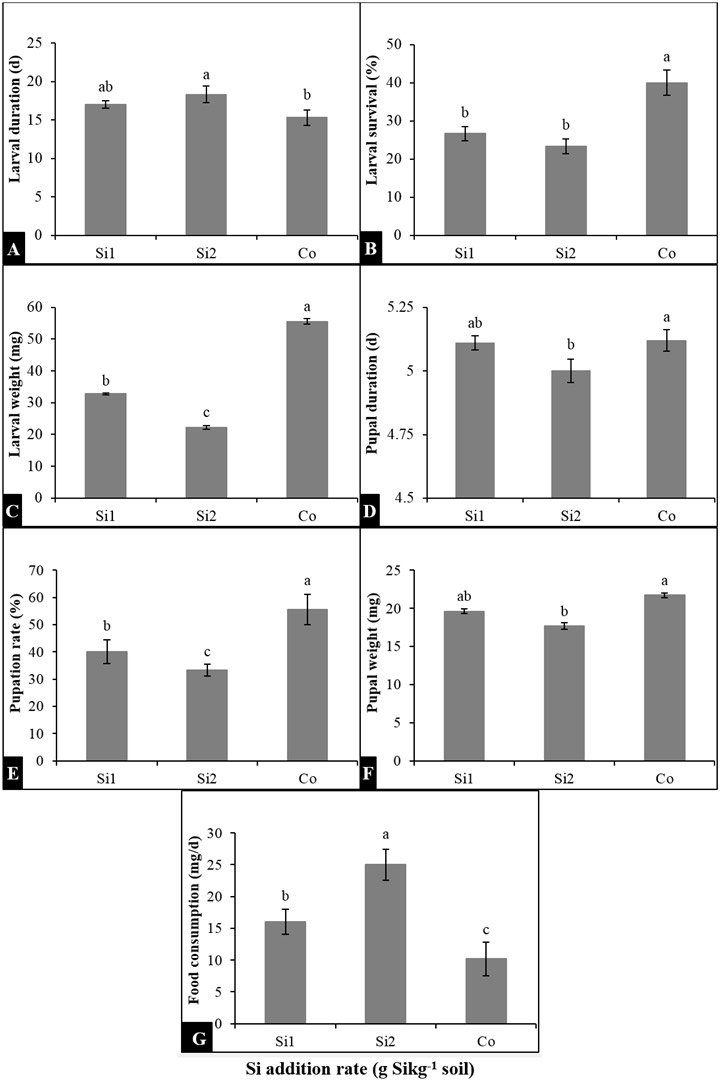
Larval duration (A), larval survival (B), larval weight (C), pupal duration (D), pupation rate (E), pupal weight (F) and food consumption rate per day (G) of Cnaphalocrocis medinalis raised on silicon treated (Si1 = 1.25 g Sikg-1 soil, Si2 = 2.50 g Sikg-1 soil) and untreated rice plants (Co, Control).
References
- Ahmad, I., Rehman, A., Ehsan-ul-Haq and Mahmood, A., 2016a. Resistance response of rice (Oryza sativa L.) germplasm against rice leaf folder (Cnaphalocrocis medinalis G.) under greenhouse condition in Pakistan. Pak. J. Agric. Res., 29: 268-272.
- Ahmad, M., Ahmad, Z., Talfoor-ul-Hassan, Latif, M., Hussain, M., Iqbal, M.F., Shahzad, M.J., Farooq, M., Sajjid, A.R. and Ali, M.J., 2016b. Entomological survey of pests of rice nursery and crop in district Sialkot Punjab-Pakistan. Int. J. Adv. Res. biol. Sci., 3: 159-164.
- Alvarez, J. and Datnoff, L.E., 2001. The economic potential of silicon for integrated management and sustainable rice production. Crop. Prot., 20: 43-48. https://doi.org/10.1016/S0261-2194(00)00051-X[CrossRef]
- Alvi, M.S., Alvi, M.A., Chaudhary, S.U. and Iqbal, S., 2003. Population trends and chemical control of rice leaf-folder, Cnaphalocrocis medinalis on rice. Direct. Adap. Res. Punjab Lahore. Int. J. Agric. Biol., 5: 615-617.
- Asghar, M., Suhail, A., Afzal, M. and Khan, M.A., 2009. Determination of economic threshold levels for the stem borers (Scirpophaga sp.) and leaf folder (Cnaphalocrosis medinalis) of rice (Oryza sativa) in the Kallar tract of Punjab, Pakistan. Int. J. Agric. Biol., 11: 717-720.
- Atta, B., Rizwan, M., Sabir, A.M, Gogi, M.D. and Ayub, M., 2019a. Silicon mediated induced resistance in plants for the management of agricultural insect pests: A review. World J. Biol. Biotechnol., 4: 19-28. https://doi.org/10.33865/wjb.004.01.0192[CrossRef]
- Atta, B., Rizwan, M., Sabir, A.M., Gogi, M.D., Farooq, M.A. and Batta, Y., 2019b. Efficacy of entomopathogenic fungi against Brown planthopper Nilaparvata lugens (Stål) (Homoptera: Delphacidae) under controlled conditions. Gesunde Pflanzen, 72: 101-112. https://doi.org/10.1007/s10343-019-00490-6[CrossRef]
- Bajya, D.R., Monha, D., Meena B.L. and Tyagi, M.P., 2010. Insecticide resistance management strategies for managing cotton pest complex. Ann. Pl. Protec. Sci., 18: 1-5.
- Bashir, K., Husnain, T., Fatima, T., Latif, Z., Mehdi, S.A. and Riazuddin, S., 2004. Field evaluation and risk assessment of transgenic indica basmati rice. Mol. Breed., 13: 301-312. https://doi.org/10.1023/B:MOLB.0000034078.54872.25[CrossRef]
- Bilal, M., Hussain, M., Umer, M., Ejaz, N., Noushahi, H.A., Atta, B. and Rizwan, M., 2019. Population incidence and efficacy of chemical control against rice leaffolder (Cnaphnalocrocis medinalis Guenée) (Pyralidae: Lepidoptera). Asian Pl. Res. J., 2: 1-7. https://doi.org/10.9734/aprj/2019/v2i230040[CrossRef]
- Cai, K.Z., Gao, D., Luo, S.M., Zeng, R.S., Yang, J.Y. and Zhu, X., 2008. Physiological and cytological mechanisms of silicon-induced resistance in rice against blast disease. Physiol. Pl., 134: 324-333. https://doi.org/10.1111/j.1399-3054.2008.01140.x[CrossRef]
- Chatterjee, P.B., 1979. Rice leaf folder attack in India. Intl. Rice Res. News., 4: 21.
- Epstein, E. 2009. Silicon: Its manifold roles in plants. Ann. Appl. Biol., 155: 155-160. https://doi.org/10.1111/j.1744-7348.2009.00343.x[CrossRef]
- Farooq, M.A., Arif, M.J., Gogi, M.D., Atta, B. and Nawaz, A., 2019. Impact of different Integrated Pest Management Modules on pest infestation, pesticide residue and yield in mango fruits. J. Innov. Sci., 5: 72-82. https://doi.org/10.17582/journal.jis/2019/5.2.72.82[Full text][CrossRef]
- Farooq, M.A., Atta, B., Gogi, M.D., Arif, M.J. and Arain, Q.A., 2020. Compatibility of entomopathogenic fungi and Azadirachta indica extract against the cotton pink bollworm, Pectinophora gossypiella (Saunders) (Lepidoptera: Gelechiidae) under controlled conditions. Egypt. J. Biol. Pest Contr., 30: 63. https://doi.org/10.1186/s41938-020-00260-x[CrossRef]
- Fawe, A., Abou-Zaid, M., Menzies, J.G. and Bélanger, R.R., 1998. Silicon-mediated accumulation of flavonoid phytoalexins in cucumber. Phytopathology, 88: 396-401. https://doi.org/10.1094/PHYTO.1998.88.5.396[CrossRef]
- Han, Y., Lei, W., Wen, L. and Hou, M., 2015. Silicon mediated resistance in a susceptible rice variety to the rice leaffolder, Cnaphalocrocis medinalis Guenée (Lepidoptera: Pyralidae). PLoS One, 10: e0120557. https://doi.org/10.1371/journal.pone.0120557[CrossRef]
- Han, Y.Q., Liu, C. and Hou, M.L., 2010. Silicon-mediated effects of rice plants on boring behavior of Chilo suppressalis larvae. Acta Ecol. Sin., 30: 5967-5974.
- Hao, L.X., Han, Y.Q., Hou, M.L. and Liao, X.L., 2008. Resistance of japonica rice varieties in Liaohe Valley to Chilo suppressalis and its underlying mechanisms. Acta Ecol. Sin., 28: 5987-5993.
- Heong, K.L., 2005. Strategies to attain ecologically sustainable pest management in rice systems. Adv. Rice Sci., Proc. Int. Rice Sci. Conf., Suwon, Koera. pp. 111-123.
- Hou, M.L. and Han, Y.Q. 2010. Si-mediated rice plant resistance to the Asiatic rice borer: effects of silicon amendment and rice varietal resistance. J. econ. Ent., 103: 1412-1419. https://doi.org/10.1603/EC09341[CrossRef]
- Hussain, M., Ali, M.Y., Umer, M., Ejaz, N., Bilal, M., Salim, M.A., Noushahi, H.A., Atta, B. and Rizwan, M., 2018. Study of paddy stem borers population dynamics and influencing environmental factors through light trap. Asian J. Res. Crop Sci., 2: 1-10. https://doi.org/10.9734/ajrcs/2018/v2i430035[CrossRef]
- Hussain, M., Rizwan, M., Atta, B., Waqeel, K., Noushahi, H.A., Bilal, M., Salim, M.A. and Liaqat, N., 2019. Influence of environmental factors on population dynamics of yellow stem borer (Scirpophaga incertulas), white stem borer (Scipophaga innotata) and pink stem borer (Sesamia inferens). Am. Eur. J. Agric. environ. Sci., 19: 23-30.
- Keeping, M.G. and Meyer, J.H., 2002. Calcium silicate enhances resistance of sugarcane to the African stalk borer Eldana saccharina Walker (Lepidoptera: Pyralidae). Agric. For. Ent., 4: 265-274. https://doi.org/10.1046/j.1461-9563.2002.00150.x[CrossRef]
- Kogan, M. and Lattin, J.D., 1999. Agricultural systems as ecosystems. In: Handbook of pest management (eds. J. Ruberson and M. Dekker). New York, NY, USA. pp. 1-34.
- Kvedaras, O.L., An, M., Choi, Y.S. and Gurr, G.M., 2010. Silicon enhances natural enemy attraction and biological control through induced plant defences. Bull. entomol. Res., 100: 367-371. https://doi.org/10.1017/S0007485309990265[CrossRef]
- Laing, M. and Adandonon, A. 2005. Silicon and insect management review. In: Korndörfer GH, editor. Proceedings of the III silicon in agriculture conference, 22–26 October 2005. Minas Gerais: Federal University of Uberlândia, Brazil. pp. 41-50.
- Li, X., Xu, X.X., Han, L.Z., Wang, M. and Hou, M.L., 2013. Effects of different rice varieties on larval development, survival, adult reproduction and flight capacity of Cnaphalocrocis medinalis (Guenée). Acta Ecol. Sin., 33: 4370-4376. https://doi.org/10.5846/stxb201204130529[CrossRef]
- Ma, J.F., 2004. Role of silicon in enhancing the resistance of plants to biotic and abiotic stresses. Soil Sci. Pl. Nutr., 50: 11-18. https://doi.org/10.1080/00380768.2004.10408447[CrossRef]
- Ma, J.F. and Takahashi, E., 2002. Soil, fertilizer and plant silicon research in Japan. Elsevier, Amsterdam, the Netherlands. pp. 281. https://doi.org/10.1016/B978-044451166-9/50009-9[CrossRef]
- Ma, J.F., Miyake, Y. and Takahashi, E., 2001. Silicon as a beneficial element for crop plants. In: Silicon in agriculture (eds. L.E. Datnoff, G.H. Snyder and G.H. Korndörfer) Elsevier, Amsterdam, the Netherlands. pp. 17-39. https://doi.org/10.1016/S0928-3420(01)80006-9[CrossRef]
- Ma, J.F., Tamai, K., Yamaji, N., Mitani, N., Konishi, S. and Katsuhara, M., 2006. A silicon transporter in rice. Nature, 440: 688-691. https://doi.org/10.1038/nature04590[CrossRef]
- Massey, F.P. and Hartley, S.E., 2009. Physical defences wear you down: progressive and irreversible impacts of silica on insect herbivores. J. Anim. Ecol., 78: 281-291. https://doi.org/10.1111/j.1365-2656.2008.01472.x[CrossRef]
- Massey, F.P., Ennos, A.R. and Hartley, S.E., 2006. Silica in grasses as a defence against insect herbivores: Contrasting effects on folivores and a phloem feeder. J. Anim. Ecol., 75: 595-603. https://doi.org/10.1111/j.1365-2656.2006.01082.x[CrossRef]
- Mishra, B.K., Senapati, B. and Mishra, P.R., 1998. Chemical control of rice leaf folder, Cnaphalocrocis medinalis in Orissa. J. Insect Sci., 11: 137-140.
- Nakano, K., Abe, G., Taketa, N. and Hirano, C., 1961. Silicon as an insect resistant component of host plant, found in the relation between the rice stem borer and rice plant. Jpn. J. appl. Ent. Zool., 5: 17-27. https://doi.org/10.1303/jjaez.5.17[CrossRef]
- Peterson, S.S., Scriber, J.M. and Coor, J.G., 1988. Silica, cellulose and their interactive effects on the feeding performance of the southern armyworm Spodoptera eridania (Cramer) (Lepidoptera: Noctuidae). J. Kansas entomol. Soc., 61: 169-177.
- Ramasubbiah, K., Rao, P.S. and Rao, A.G., 1980. Nature of damager and control of rice leaf folder. Indian J. Ent., 42: 214-217.
- Rizwan, M., Atta, B., Sabir, A.M., Yaqub, M. and Qadir, A., 2019. Evaluation of the entomopathogenic fungi as a non-traditional control of the rice leaf roller, Cnaphalocrocis medinalis (Guenée) (Lepidoptera: Pyralidae) under controlled conditions. Egypt. J. Biol. Pest Contr., 29: 10. https://doi.org/10.1186/s41938-019-0111-2[CrossRef]
- Rodrigues, F.A., McNally, D.J., Datnoff, L.E., Jones, J.B., Labbé, C. and Benhamou, N., 2004. Silicon enhances the accumulation of diterpenoid phytoalexins in rice: A potential mechanism for blast resistance. Phytopath, 94: 177-183. https://doi.org/10.1094/PHYTO.2004.94.2.177[CrossRef]
- Salim. M., Rehman, A. and Ramzan, B., 1991. Leaffolder (LF) outbreak in Punjab, Pakistan. Int. Rice Res. Newsl., 16: 22-24.
- Sangster, A.G., Hodson, M.J. and Tubb, H.J., 2001. Silicon deposition in higher plants. In: Silicon in agriculture (eds. L.E. Datnoff, G.H. Snyder and G.H. Korndörfer) Elsevier, Amsterdam, the Netherlands. pp. 85-113. https://doi.org/10.1016/S0928-3420(01)80009-4[CrossRef]
- Savant, N.K., Snyder, G.H. and Datnoff, L.E., 1997. Silicon management and sustainable rice production. Adv. Agron., 58: 151-199. https://doi.org/10.1016/S0065-2113(08)60255-2[CrossRef]
- Sidhu, J.K., Stout, M.J., Blouin, D.C. and Datnoff, L.E., 2013. Effect of silicon soil amendment on performance of sugarcane borer, Diatraea saccharalis (Lepidoptera: Crambidae) on rice. Bull. entomol. Res., 103: 656-664. https://doi.org/10.1017/S0007485313000369[CrossRef]
- Singh, H.M., Srivastava, R.K., Rizvi, S.M.A., Elazegui, F.A., Castilla, N.P. and Savary, S., 2003. Yield reduction due to brown spot and leaf folder injuries and various levels of fertilizers and water supply to rice crop. Annls Pl. Protec. Sci., 11: 16-19.
- Suresh, P.J. and Venugopal, M.S., 1992. Yield loss due to major rice pests in Tamil Nadu, India, Int. Rice Res. Newsl, 17: 9-10.
- Ye, M., Song, Y.Y., Long, J., Wang, R.L., Baerson, S.R. and Pan, Z.Q., 2013. Priming of jasmonate-mediated antiherbivore defense responses in rice by silicon. Proc. natl. Acad. Sci., 38: E3631-E3639. https://doi.org/10.1073/pnas.1305848110[CrossRef]
Cited by 2 articles
In journals published by ResearchersLinks.
- Influence of Fertilizer Combinations on Agronomic Traits and Yield of Basmati variety in Direct Seeded RiceSarhad Journal of Agriculture · 2024
- Manipulating Rice Planting Geometry and Nutrient Levels has an Effect on Brown Planthopper, Nilaparvata lugens (StÃ¥l) (Hemiptera: Delphacidae) IncidencePakistan Journal of Zoology · 2022
Services
Article usage statistics
Loading…