
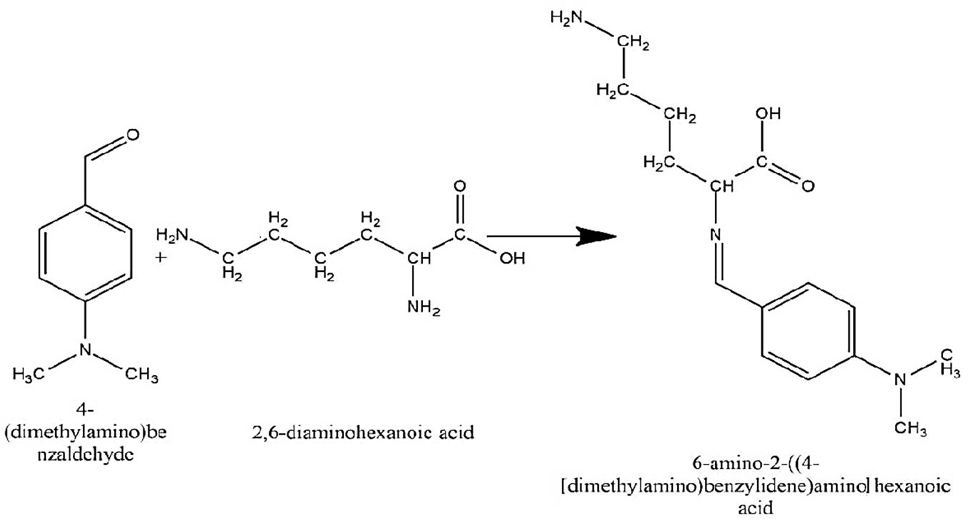
The titled Schiff base, 6-amino-2-[(4-(dimethylamino)benzylidene)amino]hexanoic acidwas synthesized by condensing N,N-dimethyl aminobenzaldehyde and Lysine together using ethanol as a solvent. The Schiff base was isolated and further reacted with Ce(NO3)3.6H2O and La(NO3)3.6H2O, to afford their respective complexes. FTIR, 1H NMR, UV-Vis and ICP techniques were used the characterization and structure elucidation of the prepared Schiff base and its La (III) and Ce (III) complexes. The proposed geometries of the complexes were established on the basis of metal ligand ratio through ICP. Schiff base showed antioxidant activity against diphenylpicrylhydrazyl (DPPH). The results showed that metal complexes are good antioxidant agents as compared to Trolox (standard) and ligand was less active as compared to Trolox. The Schiff base ligand and its metal (III) complexes showed antibacterial activity against E. coli, S. aureus by disc diffusion method and antifungal activity against Macrophomina phaseolina, Fusarium oxysporum. The metal (III) complexes are highly active under permissible limits.
Research Article · Volume 51, Issue 1, 5 December 2018 · Open Access
Schiff Base, 6-Amino-2-[(4-(Dimethylamino)Benzylidene)Amino]Hexanoic Acid and its Lanthanide (III) Complexes have Antioxidant and Antimicrobial Activities
· · · · ·
Affiliations & Notes ⌄
- 1Institute of Chemistry, University of the Punjab, Lahore , * Corresponding author: tariqm06@yahoo.co.uk
Article Info ⌄
- Journal:
- Pakistan Journal of Zoology
- Published:
- 5 December 2018

From the article
- For culture measuring conductance of metal complexes, the ligand and its metal (III) complexes were dissolved in DMSO to prepare 10-3 M molar solution.
- The conductance values are very small which showed that M (III) complexes are non-ionic in nature and non-electrolytes (Table I).
- The present study provides an easy protocol for the production of Schiff base 6-amino-2-[(4-(dimethylamino)benzylidene)amino]hexanoic acid and its lanthanide (III) complexes.
- Anti-oxidant and anti-microbial activities of the synthesized Schiff base ligand and its metal complexes were studied.
Selected from the article's own text.
Abstract
Introduction
Schiff base was first of all prepared by Hugo Schiff in 1864 by reacting aldehyde and ketones with primary amine. These compounds have a specific functional azomethine group represented by -C=N- in which the nitrogen atom is bonded to aryl or alkyl group . The Schiff bases are usually crystalline solids, which are slightly basic but few of them form insoluble salts by reacting with strong acids. Schiff bases prepared from aromatic amines and aromatic aldehydes show diversity of applications in many fields, e.g., analytical chemistry, biological and inorganic ; ; ; . Schiff base ligands play important role in the synthesis of Schiff base complexes, since they have ability of forming stable complexes with metal ions . Free amino acids in living body play an important role in many physiological activities of the human body, for example D,L-homocysteic acid (DLH) initiate cerebral activities and has been proposed as an agonist of endogenous glutamate receptors in the mammalian central nervous system ; ; ; . Amino acids have the ability to coordinate with the metal ions because of two donor sites i.e. amino group and carboxyl group . It is known that the presence of metal ions bonded to ligand which is biologically active compound increases their working efficiency ; ; ; ; . Novel Schiff bases have been shown to have anti-cancer and anti-inflammatory activity . The Schiff base prepared here has anti-oxidant and anti-microbial activity.
Materials and methods
Synthesis of ligand (L)
The ligand was prepared with reacting lysine with aldehyde. The amino acid used was lysine and the aldehyde N, N-dimethyl aminobenzaldehyde (Fig. 1).
In a test tube 2-3 drops of dimethyl amine and 0.146 g of lysine was added in 10 ml of distilled water. In the second test tube 0.149 g of aldehyde (N,N-dimethyl aminobenzaldehyde) was added in 10 ml ethanol to make 0.01 M solution. This mixture was taken in round bottom flask and refluxed in round bottom flask at 80oC for 4-8 h. The orange color precipitates formed was washed recrystallized in DCM:Methanol (2:3 ratios) in a test tube. These crystals were used for formation of metal complexes.
Preparation of metal- L complexes
To make complex with La (III), two solutions 0.476 g of La(NO3)3.6H2O dissolved in 10 ml ethanol in was mixed with 0.554 g of Schiff base was dissolved in 10 ml a round bottom flask and was refluxed at 90oC for 4 h precipitates of dark brown color was formed after 4 h.
For complexing with Ce (III), two solutions 0.434 g of Ce(NO3)3.6H2O dissolved in 10 ml ethanol and 0.554 g of Schiff base dissolved in 10 ml ethanol were mixed in a round bottom flask and then refluxed at 90oC for 8 h on a hot plate/magnetic stirrer with constant stirring using water condenser. Light brown color precipitates formed after 4 h, were filtered off and washed with ethyl alcohol. These were dried at 60oC and used for characterization of the metal complexes.
Characterization of metal complexes
For estimation of La (III), sample solutions were prepared by dissolving 0.1 g of complex in 0.9 ml water to which then 2 to 3 drops of HNO3 were added; 1ml of this solution was diluted up to 5 ml with distilled water. Metal complexes were characterized by using ICPES, FTIR and NMR spectroscopy. Standard solutions of 1, 3, 5 ppm were prepared from the Stock solution (1000 ppm) of La+3 and Ce+3.
Antibacterial activity
The ligand and its metal complexes were tested for their anti-bacterial activity against two bacterial species i.e. E. coli and Staphylococcus aureus by using disc diffusion method ; . The ligand and metal complexes were dissolved in 30 µg/ml. DMSO was applied to a paper disc using micropipette. These discs were placed in autoclave for two hours. Transferred in the center of each Petri plate with the help of sterilized forceps and incubated for overnight at 37°C. The zone of inhibition was measured in mm around the center of the disc.
Antifungal activity
All of the ligands and their metal complexes were tested for their anti-bacterial activity against tow bacterial species i.e. Macrophomina phaseolina and Fusarium oxysporum. The ligand and its metal complexes were dissolved in 30 µg/ml of DMSO, and then transferred into a test tube containing 10 ml of malt extract media. Incubation of the test tube was performed for 3-6 days at a temperature 28°C in the incubator. Then comparative studies of fungal growth in control and sample test tubes were recorded.
Antioxidant activity
0.15ml of ten different concentrations of Trolox viz., 1000 mM, 500 mM, 250 mM, 125 mM, 62.5 mM, 31.25 mM, 15.62 mM, 7.81 mM, 3.9 mM and 1.95 mM was taken in 12 brown bottles of 20ml. To each bottle 1.85ml of 0.05 mM ethanolic solution of DPPH (2,2-diphenyl-1-picrylhydrazyl) was added. The OD of mixture was taken at 517nm after 15 min, 30 min, 45 min, 1 h and then 2 h to prepare a standard curve. Similar types of dilutions of samples were prepared.
Results and discussion
The ligand (L) and its metal complexes were crystalline solid. Their colors and melting points and percentage of compounds are shown in Table I.
The ligand and its complexes are insoluble in water but soluble in organic solvents like alcohol, chloroform, acetone and DMSO. They are partially soluble in methanol and ethanol.
For culture measuring conductance of metal complexes, the ligand and its metal (III) complexes were dissolved in DMSO to prepare 10-3 M molar solution. The conductivities of these solutions were measured at room temperature. The conductance values are very small which showed that M (III) complexes are non-ionic in nature and non-electrolytes (Table I).
Table I.- Physical properties and conductance of ligand and its complexes.
| Compound | Physical properties | Conductance (µS/cm) | ||
| Color | Melting point | Yield (%) | ||
| Ligand (L) | Orange Red | 49oC | 75 | 12.67 |
| La-Ligand | Shiny Yellow | 103oC | 60 | 32.4 |
| Ce-Ligand | Dark Brown | 98oC | 72 | 26.78 |
FTIR spectra of Schiff base and its metal complexes
A comparative study of the FTIR spectra was made between the prepared ligand and its metal complexes. The confirmation of azomethine group (HC=N) was made possible by the appearance of a new band at 1595-1610 cm-1.It confirmed the formation of Schiff base. FTIR data obtained for the ligand and its metal complexes depicted strong absorption bands for C-H(stretch), C-N(stretch), C-O-C (stretch) with high absorption intensities indicated the complex formation. The peaks shifted to lower wave number in case of many synthesized metal complexes (Table II).
Table II.- FTIR bands of ligand (L) and its metal complexes.
| Band frequency | Ligand (L) | Ce-Ligand (L) | La-Ligand (L) |
| C-H | 727(s) | 690(s) | 596(s) |
| C-C | 2908(s) | 3093(m) | 3047(m) |
| C-N | 1068(s) | 1226(s) | 1065(s) |
| C=N | 1670(m) | 1676(m) | 1666(m) |
| C=C | 1560(m) | 1580(m) | 1580(m) |
| N-H | 3315(m) | 3327(m) | 3321(m) |
| COO- | 1597(m) | 1560(m) | 1580(m) |
Estimation of metals by ICP
In order to determine the metal to ligand ratio, the concentration of metals in the synthesized metal complexes was determined by inductively coupled plasma (ICP) spectrophotometer (Table III). Then the metal complex was determined by comparing theoretical percentage with experimental percentage. This ratio has also helped in processing the structure of metal complexes.
Table III.- Emission of La-Ligand (L) and Ce-Ligand (L) complexes by ICP.
| Concentration (ppm) | Emission(cps) | |
| La-Ligand (L) | Ce-Ligand (L) | |
| 1 | 1218773.2 | 1275364.4 |
| 3 | 7790006.8 | 4320076.6 |
| 5 | 14093181.5 | 6744202.7 |
| LaL and CeL2 | 49199362.9 | 67879659.2 |
Table IV shows metal to ligand ratio for La (III) and Ce (III) complexes. For La (III), the experimental percentage of 17.00% is very close to 17.0%. So metal to ligand ratio is 1: 2. For Ce (III), the experimental percentage of 31.5% is very close to 33.5%. So the metal to ligand ratio is 1:1.
1H NMR spectra
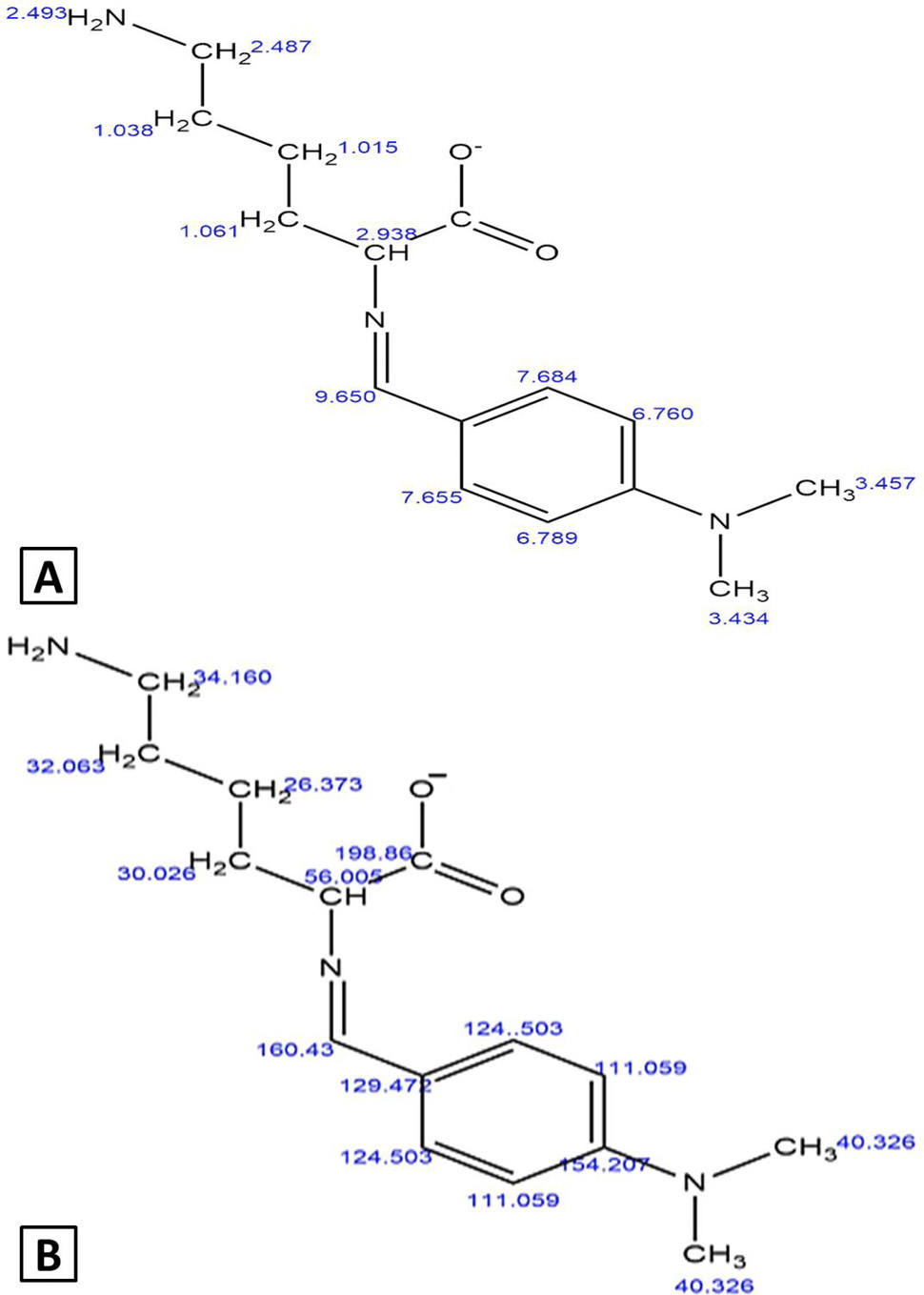
The NMR spectra of Schiff bases were recorded in dimethylsulfoxide (DMSO) solution, using tetramethylsilane (TMS) as standard. The signals observed in the Schiff bases under study are shown in Table V. The spectra exhibit a multiplet at 7.684, 7.655, 6.760 and 6.789 ppm for the hydrogen of the aromatic rings. The azomethine hydrogen (-CH=N-) produces a singlet to a singlet of intensity equivalent to one hydrogen at 8.32-9.71 ppm . The spectra of ligand showed the singlet peak at 9.650 ppm which confirmed the formation of azomethine group or Schiff base. In metal complexes this peak is shifted to 9.657 ppm in Ce(L) complex and 9.654 ppm in La(L) complex this is because the presence of lanthanide which had empty shell and hydrogen atom of azomethine group is deshielded. The spectra of showed quartet due to presence of CH2 at 1.061ppm 1.015 ppm, 1.038 ppm and 2.487 ppm. In spectra CH peak appear at 2.938 ppm. The peak of the CH3 group appeared at 3.547 ppm and 3.434 ppm. The peak of N-H2 appears in the spectra of ligand at 2.493ppm. The hydrogen of the free OH-group didn’t appear due to the formation of carboxylate ion during salvation process.
Table IV.- Metal to ligand ratio for La(III) and Ce(III) complexes.
| M:L (Metal to ligand ratio) | Theoretical percentage | |
| La(III) complex | Ce(III) complex | |
| 1:1 | 33.31 | 33.50 |
| 1:2 | 17 | 20.12 |
| 1:3 | 11.10 | 14.379 |
Table V.- Proton NMR spectral data of the Schiff base.
| Chemical shift, (δ) ppm | |
| Functional groups | Ligand (L) |
| CH3-N | 3.457 |
| Benzene H | 7.648 |
| Benzene H | 6.798 |
| HC-N | 2.938 |
| CH- | 2.493 |
| CH2- | 1.038 |
| CH=N | 9.650 |
| NH2- | 2.493 |
| 2HN-CH2 | 2.487 |
| CH2- | 1.051 |
13C NMR spectra
The 13CNMR spectra (Fig. 2B) of the ligand verify the results of 1HNMR. In spectra the peak of azomethine group appears at 160.43. the carbon atom of the benzene ring appear at 111-124 the peak of methyl carbon appear at 40.326 the peak of carboxylate carbon appear at 198 the peak of CH2 appear at 26-34.
Antioxidant activity
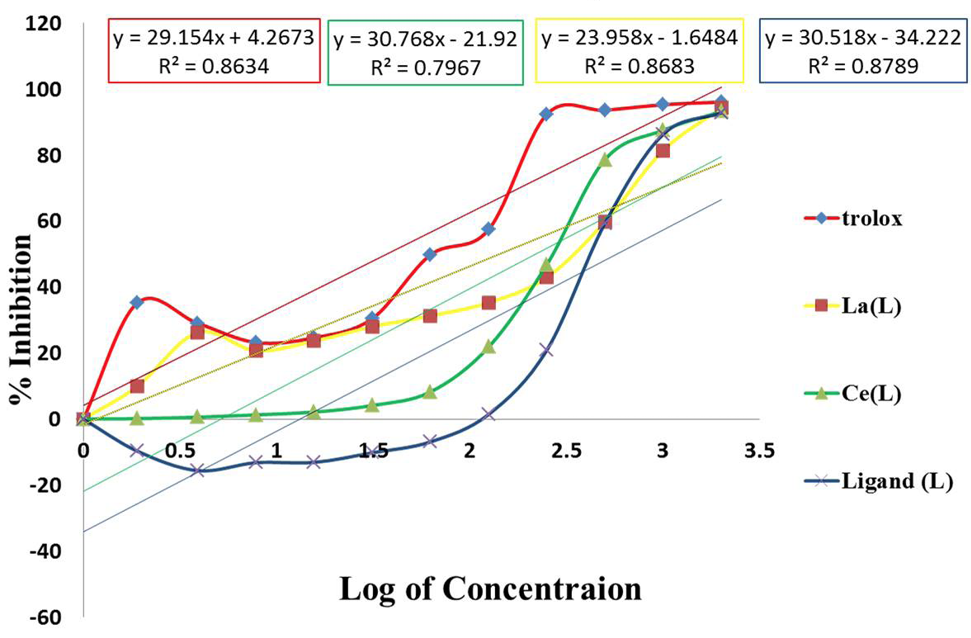
Figure 3 shows that complexes of lanthanum and cerium were more active as compared to their parent ligand. The increased antioxidant activity of the metal complexes due to electron withdrawing effect of metals which accelerates the discharge of hydrogen to reduce the DPPH radical. The DPPH radical scavenging capacity of the compounds could be represented in order of increasing anti-oxidant activity.
La-Ligand (L)>Ce-Ligand (L)>Trolox>Ligand (L)
Due to high inhibition showed on the DPPH radical by the ligand and its metal complexes exhibit that these compounds had ability of donating electrons and neutralize free radicals so these could be used as drugs for the treatment of pathological diseases which are produced by excess free radicals in case of stress.
Anti-microbial Activity
The results showed that antimicrobial activity tested for ligand as well as their metal complexes and inhibition zone diameter was noted in mm. Ligand and their complexes are biologically active. Ligand L is moderately active while its complexes are highly active against bacterial species and moderately active against fungal species. Table VI shows concentration of various compounds having IC50 values at different times. Table VII shows antimicrobial activities of various ligands and their metal complexes.
Table VI.- Comparison of IC50 of all compounds at different time.
| Compounds | Variation of IC50 (µg) with different time | ||||
| 15 min | 30 min | 45 min | 60 min | 120 min | |
| Trolox | 225.12 | 216.25 | 223.17 | 209.39 | 252.73 |
| Ligand (L) | 526.12 | 502.65 | 496.24 | 451.20 | 425.15 |
| La-Ligand (L) | 209.36 | 195.2 | 190.08 | 138.177 | 136.73 |
| Ce-Ligand (L) | 222.50 | 221.36 | 238.30 | 234.44 | 215.55 |
Table VII.- Antimicrobial activity of ligand and its metal complexes.
| Compounds | M. phaseolina | F. oxysporum | E. coli | S. aureus |
| Ligand (L) | + | + | + | + |
| La-Ligand (L) | ++ | ++ | +++ | +++ |
| Ce-Ligand (L) | ++ | ++ | +++ | +++ |
+, 1-10 mm zone of inhibition; ++, 11-20 mm zone of inhibition; +++, 21-40 mm zone of inhibition.
Conclusion
The present study provides an easy protocol for the production of Schiff base 6-amino-2-[(4-(dimethylamino)benzylidene)amino]hexanoic acid and its lanthanide (III) complexes. The mode of bonding and overall structures of the complexes were determined through physico-chemical and spectroscopic methods. Spectroscopic techniques well supported to our proposed structure. Complex formation study via molar ratio was investigated and results were consistent to those found in the solid complexes with a ratio of (M:L). Anti-oxidant and anti-microbial activities of the synthesized Schiff base ligand and its metal complexes were studied.
Acknowledgement
The authors are grateful to Higher Education Commission (HEC), Government of Pakistan, for access to Scientific Instrumentation.
Statement of conflict of interest
Authors have declared no conflict of interest.
Figures
Synthesis of ligand molecule.
Values of 1H NMR (A) and 13C NMR (B) in ligand molecule.
DPPH scavenging activity of ligand (L) and its metal complexes.
References
- Adabiardakani, A., Hakimi, M. and Kargar, H., 2012. Cinnamaldehyde Schiff base derivatives: A short review. World appl. Program., 211: 472-476.
- Amiri-Rudbari, H., Iravani, M.R., Moazam, V., Askari, B., Khorshidifard, M., Habibi, N. and Bruno, G., 2016. Synthesis, characterization, X-ray crystal structures and antibacterial activities of Schiff base ligands derived from allylamine and their vanadium(IV), cobalt(III), nickel(II), copper(II), zinc(II) and palladium(II) complexes. J. mol. Struc., 1125: 113-120. https://doi.org/10.1016/j.molstruc.2016.06.055[CrossRef]
- Arquero, A., Souza, P., García-Vázquez, J.A. and Masaguer, J.R., 1985. Complexes of TiCl4, VCl4 and SnX4 (X = Cl or Br) with Schiff bases derived from 2-aminobenzimidazole. Trans. Metal Chem., 10: 424-426. https://doi.org/10.1007/BF01096751[CrossRef]
- Assfeld, X., Lopez, R., Ruiz-Lopez, M.F., Gonzalez, J., Sordo, T.L. and Sordo, J.A., 1995. Comments on Ab initio studies on the mechanism of the cycloaddition reaction of fluoroketene with imines: Substituent effects. J. mol. Struc., 331: 1-2. https://doi.org/10.1016/0166-1280(94)03914-7[CrossRef]
- Chalifoux, W.A., 2016. Profile: Early excellence in physical organic chemistry. J. Phys. Organ. Chem., 29: 686-687. https://doi.org/10.1002/poc.3661[CrossRef]
- Chohan, Z.H., Mahmood-ul-Hassan, Khan, K.M. and Supuran, C.T., 2005. In-vitro antibacterial, antifungal and cytotoxic properties of sulfonamide-derived Schiff’s bases and their metal complexes. J. Enzyme Inhib. Med. Chem., 20: 183-188. https://doi.org/10.1080/14756360500043257[CrossRef]
- Do, K.Q., Herrling, P.L., Streit, P., Turski, W.A. and Cuenod, M., 1986. In vitro release and electrophysiological effects in situ of homocysteic acid, an endogenous N-methyl-(D)-aspartic acid agonist, in the mammalian striatum. J. Neurosci., 6: 2226-2234. https://doi.org/10.1523/JNEUROSCI.06-08-02226.1986[CrossRef]
- Dupont, B. and Drouhet, E., 1979. In vitro synergy and antagonism of antifungal agents against yeast-like fungi. Postgrad. med. J., 55: 683-686. https://doi.org/10.1136/pgmj.55.647.683[CrossRef]
- Elmali, A., Elerman, Y., Zeyrek, C.T. and Svoboda, I., 2003. Crystal structure and magnetic properties of a dinuclear iron(III) doubly oxygen bridged schiff base complex. Z. Naturforsch. Section B: J. chem. Sci., 58: 433-437.
- Frauscher, G., Karnaukhova, E., Muehl, A., Hoeger, H. and Lubec, B., 1995. Oral administration of homocysteine leads to increased plasma triglycerides and homocysteic acid - additional mechanisms in homocysteine induced endothelial damage? Life Sci., 57: 813-817. https://doi.org/10.1016/0024-3205(95)02009-8[CrossRef]
- Gulzar, A., Mahmud, T., Munir, R. and Anjum, A., 2018. Anti-cancerous and anti-inflammatory activities of some novel Schiff bases derived from 2-[(1,3-benzothiazol-2-yl)sulfanyl]. Pakistan J. Zool., 50: 1003-1009. https://doi.org/10.17582/journal.pjz/2018.50.3.1003.1009[Full text][CrossRef]
- Haglerød, C., Kapic, A., Boulland, J.L., Hussain, S., Holen, T. and Davanger, S., 2009. Protein interacting with C kinase 1 (PICK1) and GluR2 are associated with presynaptic plasma membrane and vesicles in hippocampal excitatory synapses. Neuroscience, 158: 242-252. https://doi.org/10.1016/j.neuroscience.2008.11.029[CrossRef]
- Issa, R.M., Khedr, A.M. and Rizk, H., 2008. 1H NMR , IR and UV / VIS spectroscopic studies of some Schiff bases derived from 2-Aminobenzothiazole and 2-Amino-3-hydroxypyridine. J. Chinese chem. Soc., 55: 875-884. https://doi.org/10.1002/jccs.200800131[CrossRef]
- IUPAC, 2014. Compendium of chemical terminology, 2nd ed-The Gold Book. Blackwell Scientific Publications, Oxford, pp. 1670.
- Jayabalakrishnan, C., Karvembu, R. and Natarajan, K., 2003. Ruthenium(III) Schiff base complexes: Catalytic activity in Aryl-Aryl coupling reaction and antimicrobial activity. Synth. React. Inorg. metal-organ. Chem., 33: 1535-1553.
- Jia, Y. and Li, J., 2015. Molecular assembly of Schiff base interactions: Construction and application. Chem. Rev., 115: 1597-1621. https://doi.org/10.1021/cr400559g[CrossRef]
- Perry, B.F., Beezer, A.E. and Miles, R.J., 1979. Flow microcalorimetric studies of yeast growth: Fundamental aspects. J. appl. Bact., 47: 527-537. https://doi.org/10.1111/j.1365-2672.1979.tb01214.x[CrossRef]
- Schiff, H., 1864. Mittheilungen aus dem Universit tslaboratorium in Pisa: Eine neue Reihe organischer Basen. Justus Liebigs Annls Chem., 131: 118-119. https://doi.org/10.1002/jlac.18641310113[CrossRef]
- Singh, R.V., Bansal, R.K. and Tandon, J.P., 1980. Mass spectral fragmentation of the Schiff base complexes of germanium-I. J. Inorgan. Nucl. Chem., 42: 921-923. https://doi.org/10.1016/0022-1902(80)80469-6[CrossRef]
- Temperini, C., Scozzafava, A., Puccetti, L. and Supuran, C.T., 2005. Carbonic anhydrase activators: X-ray crystal structure of the adduct of human isozyme II with l-histidine as a platform for the design of stronger activators. Bioorgan. med. Chem. Lett., 15: 5136-5141. https://doi.org/10.1016/j.bmcl.2005.08.069[CrossRef]
- Thaker, B.T., Patel, A., Lekhadia, J. and Thaker, P., 1996. Physicochemical studies of symmetrical tetradentate schiff base complexes of chromium(III), cobalt(II), nickel(II), copper(II), zinc(II), oxovanadium(IV) and dioxouranium(VI) derived from 4-acyl pyrazolone and 1,4-diamine. Indian J. Chem. Section A: Inorgan. Phys. Theoret. Analyt. Chem., 35: 483-488.
- Ul-Hassan, M., Chohan, Z.H., Scozzafava, A. and Supuran, C.T., 2004. Carbonic anhydrase inhibitors: Schiff’s bases of aromatic and heterocyclic sulfonamides and their metal complexes. J. Enzyme Inhib. med. Chem., 19: 263-267. https://doi.org/10.1080/14756360410001689595[CrossRef]
- Wang, Q.H., Weng, W., Liu, J.M., Cai, L.Z. and Guo, G.C., 2006. Synthesis, crystal structure, and fluorescence properties of several schiff-base compounds. J. Coord. Chem., 59: 485-492. https://doi.org/10.1080/00958970500356981[CrossRef]
Services
Article usage statistics
Loading…