
Over last ten years a total of 1300 imported ornamental fish,belonging to 10 different species were examined for parasitic, fungal and bacterial infection. The fish species studied were; Carassius auratus and its six varieties (shubunkin, comet, black moor, oranda, double tail and fantail); molly Poeciliasphenops; platy Xiphophorus maculates; sword tail Xiphophorus helleri; guppy Poecilia reticulata; tiger oscar Astronotus ocellatus; koi carp Cyprinus carpio; giant gourami Osphronemus goramy; blue line shark Pangasianodon hypophthalmus and silver shark Balanitiocheilos melanopterus. The health status of these fishes ranged from being healthy, moribund and infected. The parasites observed from these fish were: seven protozoans species (Chilodonella sp, Trichodina sp; Ichthyobodo sp. Epistylis sp. Tetrahymena sp. Ichthyophthirius multifiliis; Piscinoodinium pillulare;); three monogeneans species including (Dactylogyrus extensus, D. vastator; Gyrodactylus turnbulli,); one digenean (Cryptocotyle sp.), two nematode (Capillaria sp., Camallanus sp.); two crustaceans (Argulus foliaceus and Lernaea cyprinacea,), one mollusca (Glochdium). The pathogenic fungal genera isolated were: Aspergillus, Alternaria, Penicillium, Mucor. Blastomyces, Rhizopus and Fusarium. Ten bacterial genera were also isolated; Aeromonas, Pseudomonas, Streptococcus, Enterococcus, Acinetobacter, Bacillus, Moraxella, Lactobacillus, Staphylococcus,. Carnobacterium. There has not been a single case of topically acquired infection among students, laboratory staff and the author throughout the whole period due to contact with these fish. One reason for this is the use of safety measures and precautions by the concerned; such as use of disposable gloves, thorough hand washing, using sterilized equipment, keeping work place clean and disinfecting it regularly. The possibility of isolation of fewer pathogenic agents in this study cannot be ruled out. There has not been any report of zoonotic infection in ornamental fish handlers in Lahore. There is one message that it should be assumed that zoonotic organisms are always present and safety measures should be used to limit the spread of these infections. Potential risk of zoonotic infections through contact with ornamental fish is discussed.
Research Article · Volume 33, Issue 2, 18 December 2018 · Open Access
Risk of Importing Zoonotic Diseases through Infected Ornamental Fish
· ·
Affiliations & Notes ⌄
- 1Fish Disease and Health Management Laboratory, Department of Zoology, University of the Punjab, Quaid-i-Azam Campus, Lahore. Pakistan. , *Corresponding author: Zafar Iqbal dr.zafariqbal.pu@gmail.com
Article Info ⌄
- Journal:
- Punjab University Journal of Zoology
- Published:
- 18 December 2018
From the article
- A total of sixteen species of parasites were observed from various organs (skin, fins, gills) of these fish.
- Ten bacterial genera were isolated from various organs from three species of fish; C.auratus goldfish and shubunkin a variety of goldfish (Figure 1) and koi carp C. carpio (Figure 1).
- However, none of these parasites species and fungal genera can be stated to have potential risk of zoonotic infection in the fish handler (in this case the students and staff).
- The topically acquired zoonotic infections from fish seem very less, but individual cases can be serious.
Selected from the article's own text.
Abstract
Introduction
People keep ornamental fish as pet worldwide since ages. Southeast Asiancountries supply nearly 85% aquarium fish throughout the world .
An estimated global retail value of this trade is worth US$ 3 billion .The presence of pathogens on these pet fishes is a fact. The infected ornamental fishes and their transportation into other countries such as: Germany, Australia, Korea, Sri Lanka, Norway, Brazil and Pakistan have been documented . Some fish pathogenshave threat to clinical staff, veterinarians, fish producers, fish handler and pet owners .
There are few reports about the zoonotic infection by parasitic, fungal and viral pathogens from aquatic organisms including fish . Zoonotic larval nematode Capillaria sp. has been reported from goldfish Carassius auratus in Pakistan . Zoonotic trematode, Centrocstus sp. has been reported in imported ornamental fish Xiphophorus maculates in Denmark . The culturable fish, Iranian grass carp and common carp have also been reported to have gill infection by zoonotic parasite Centrocestus formosanus . These pathogens are communicable to human from fish during handling, treatment and consumption.
Bacteria can be stated as the main etiological agents of zoonotic infections.These infections appear as a result of contact and association with aquatic animals.The pathogenic bacteria infect human and disease develop in immune-compromised humans. Aeromonas hydrophila has been implicated in human diseases . Another bacteria Vibrio vulnificus cause infection in humanthrough fish too . Zoonotically potential bacteria also include; Edwardsiella, Escherichia Salmonella and Klebsiella spp. . Mycobacterium sp. affect fish handlerand such infectionsistermed as fish handler’s disease” (Humineret al., 1986; . Dvorska et al. (2004) have reviewed the fish as source of bacterial pathogens in human beings. Iqbal (2016a) has reviewed parasitic, fungal and bacterial diseases of cultivable carps and imported ornamental fishes in Pakistan. The aims of this study was to observe infection in the ornamental fishes and isolate pathogenic bacteria from selected fish species and observe probable risks of zoonotic infection in fish handlers in Laboratory.
Materials And Methods
Over last ten years a total of 1300 imported ornamental fish were obtained from local supplier in Lahore. The experimental fishes werebelonging to 10 different species. These fishes were examined for fungal and bacterial infection according to Kabata (1985); Willoughby (1994); Roberts (2003). The skin, fins and gills and external surface were screened according to the procedures detailed by Iqbal (2016a); Iqbal and Imtiaz (2016).
The experimental fish species were; Carassius auratus (n=490) and its six varieties (shubunkin (n=93), comet (n=50), black moor (n=30), oranda (n=30), double tail (n=30) and fantail n=30), molly Poecilia sphenops (n=100); platy Xiphophorus maculates (n=115); swordtail Xiphophorus helleri (n=50); guppy Poeciliareticulata (n=45); tiger Oscar Astronotus ocellatus (n=75): koi carp Cyprinus carpio (n=22); giant gourami Osphronemus goramy (n=30); blue line shark Pangasianodon hypophthalmus (n=30); silver shark Balanitiocheilos melanopterus (n=80).
The bacterial pathogens were isolated from three fish species (C. auratus goldfish and shubunkin; C. carpio koi carp) by standard Laboratory procedures and followed these steps: Preparation of Culture Media,Isolation of Bacterial Samples; Preparation of Serial Dilutions; Inoculation of Plates; Pure Culturing. Biochemical Characterization was done by Gram’s Staining; Catalase Activity Test; Oxidase Test; Oxidative Fermentative Reaction; Simmon’s Citrate Agar Test; Gelatin Hydrolysis.
Results
A total of sixteen species of parasites were observed from various organs (skin, fins, gills) of these fish. These were categorized as: seven protozoans (Chilodonella sp, Trichodina sp; Ichthyobodo sp. Epistylis sp. Tetrahymena sp. I.multifiliis; P.pillulare;); three monogeneans species (Dactylogyrus extensus., D. vastator; Gyrodactylus turnbulli,); one digenean (Cryptocotyle sp.), two nematode (Capillaria sp., Camallanus sp.); two crustaceans (A. foliaceus, L.cyprinacea,) one mollusca (Glochidium) species. Seven pathogenic fungal genera were also isolated from fins, skin, eyes, gills, of these fishes. These fungi were: Fusarium, Aspergillus, Alternaria, Penicillium, Mucor, Blastomyces, Rhizopus. The detail of parasites and fungi isolated is given elsewhere , 2016b, 2017).
Ten bacterial genera were isolated from various organs from three species of fish; C.auratus goldfish and shubunkin a variety of goldfish (Figure 1) and koi carp C. carpio (Figure 1). These bacterial genera were: Aeromonas, Pseudomonas. Bacillus, Enterococcus. Streptococcus, Acinetobacter, Moraxella, Lactobacillus, Staphylococcus and Carnobacterium (Figure 2, 3 and 4; Table 1) ; .
Table I: Bacterial genera isolated from three ornamental fish species.
| Fish species | Aero mo-nas sp. | Pseudo-monas sp. | Bacill-us sp. | Strepto coccus sp. | Enteroc-occus sp. | Acineto-bacter sp. | Mora –xella sp. | Lacto- bacill us sp. | Staphylo coccus sp. | Carno- bacter ium sp. |
| Carassius auratus goldfish | + | + | + | + | - | - | - | - | - | - |
| Carassiusauratus, Shubunkin | + | _ | + | _ | + | + | + | + | + | + |
| Cyprinus. carpio, koi carp | + | + | + | _ | _ | _ | _ | _ | _ | _ |
(From
Discussion
The parasites and fungal genera isolated from these fish are described separately by Iqbal (2016a). However, none of these parasites species and fungal genera can be stated to have potential risk of zoonotic infection in the fish handler (in this case the students and staff). Although, food borne zoonotic metacercarea of some trematode; Opisthorchis, Clonorich and Heterophyid have been reported in major and Chinese carps in Pakistan . Since, the raw fish consumption is not practiced in the country so the risk of zoonotic infection is almost none in Pakistan. Haroon (2015) recovered zoonotic larval Capillaria sp. from imported goldfish but no report of any public health issue. However, there may be potential risk of zoonotic infection as causing agent like C. formosanus has been reported in culturable carps reported by Rezaie et al. (2017).
Bacteria are the major zoonotic infections causing agents. In the present study ten bacterial species were isolated from three ornamental fish. Three out of ten bacterial isolates (Aeromonas sp. Staphylococcus sp. Streptococcus sp.) may cause zoonotic infections. Aeromonas hydrophila, A. caviae, A. sobria, A. Schuberiicause human diseases and are associated with finfish. Streptococcus iniae is another serious zoonotic pathogen and attack human by ingestion of toxin produced by the bacteria during unhygienic food handling and cooking .
According to Haenen et al. (2013) topically acquired pathogens from fish and shell fish is through lesions and open wounds. The pathogenic bacteria are V. vulnificus,V. damsel, Streptococcus iniae, Mycobacterium marium, E. tarda, A. hydrophila. Most fish-associated infections are self-limiting. However, serious cases are linked to factors such as: weak and poor immunity in the patient, virulent pathogen strains, high inoculums, deep skin penetration. In case of V. vulnificus patients may develop mild to serious infection which may become lethal as stated by Austin (2010).
Interestingly there was not a single case of topically acquired infection, among students and laboratory staff who worked on series of fish disease and health management projects in ten years.The reason for non-zoonotic infections in students is the strict use of safety measures; such as useof disposable gloves, thorough hand washing, using sterilized equipment, keeping work place clean and disinfecting it regularly. The possibility of isolation of fewer pathogenic agents in this study cannot be ruled out. There has not been any report of zoonotic infections in ornamental fish handlers in pet shops in the city of Lahore (Iqbal personal communication, 2017).
The prevention from topically acquired infections through fish needs more improvement in medical diagnostic. It is important to develop zoonosis data sheet to all the concerned like, veterinarians, doctors, hospitals, veterinary services. Further research is needed into issues of drug resistance and disinfection procedures.
Conclusion
The topically acquired zoonotic infections from fish seem very less, but individual cases can be serious. Although, zoonotic infection have not been observed in this study. Yet it must be kept in mind that zoonotic organisms are usually present and safety measures should be adopted to limit the spread of these infections.
Acknowledgement
This work was presented at 2nd International Conference on Zoonoses at BZU, Multan, 20-21st October, 2016.The University of the Punjab, Lahore provided funds for these studies and also supported to attend the conference.This is very gratefully acknowledged.
Figures
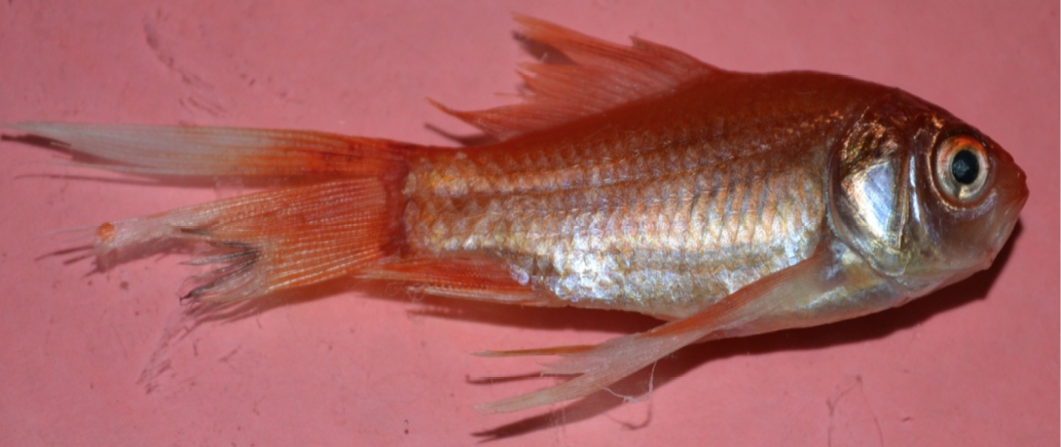
A shubunkin fish with damaged tips of dorsal, caudal and pectoral fin.
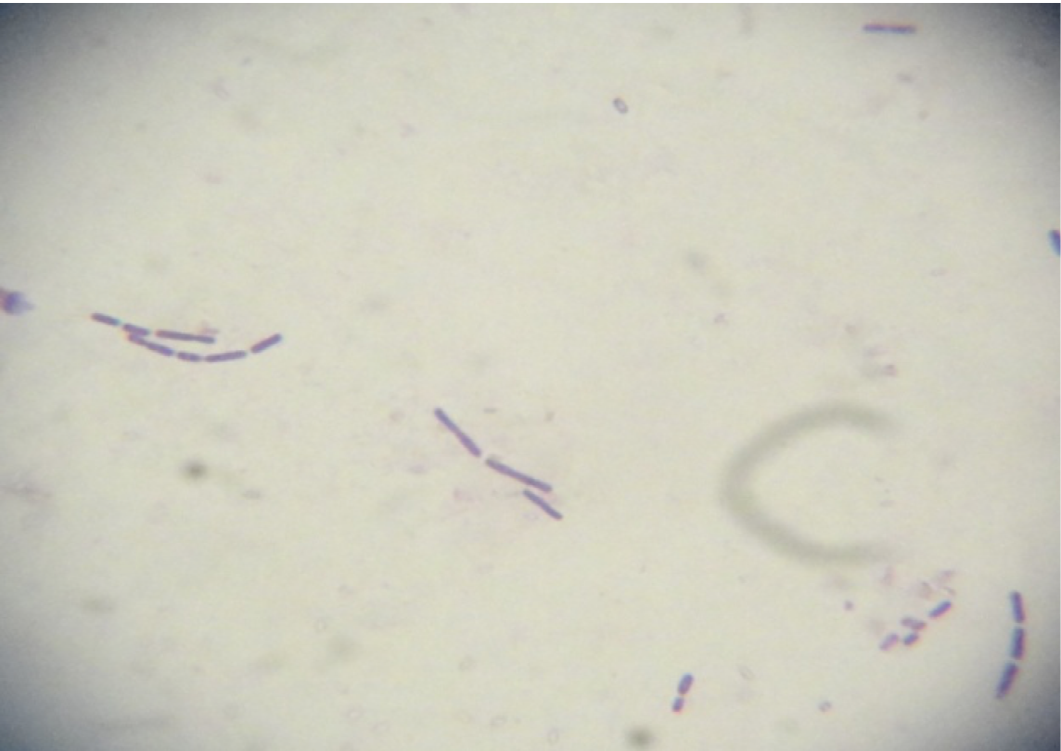
Lactobacillus sp. isolated from kidney of shubunkin.
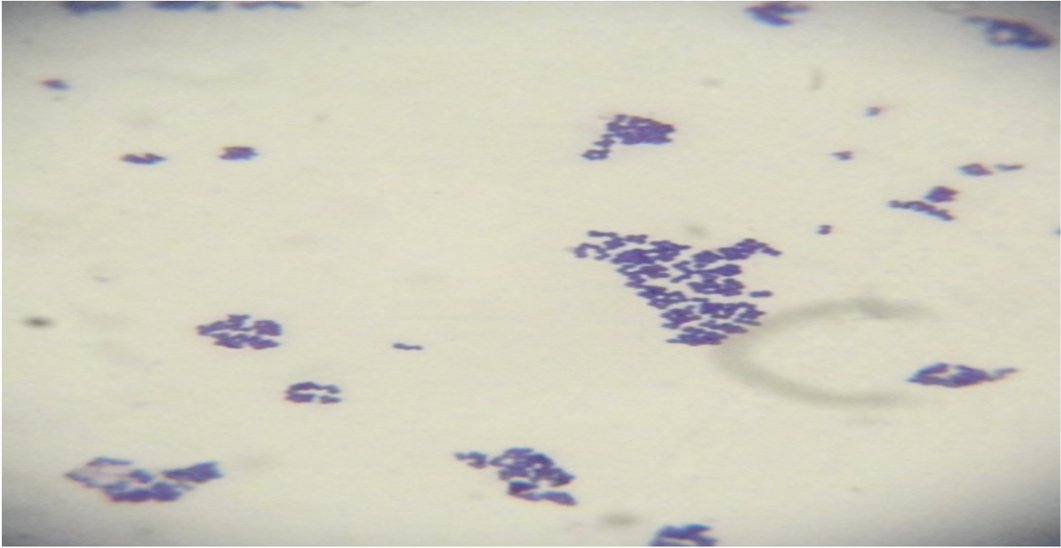
Staphylococcus sp. isolated from heart of shubunkin.
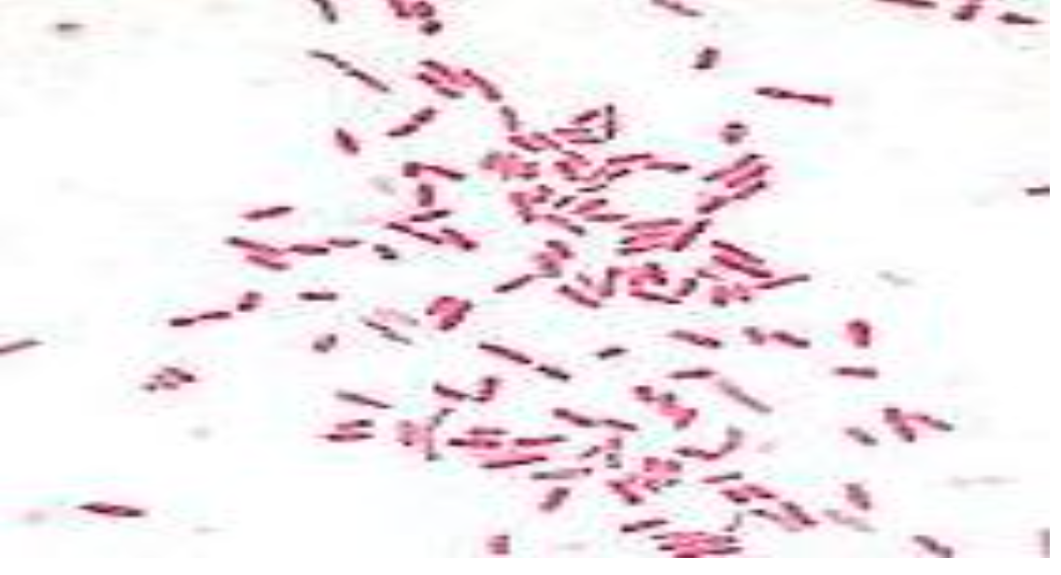
Aeromonas sp. isolated from gills of shubunkin.
References
- Andras, V., 2012. Ornamental Fish-Product / Market Report. Thai Trade Center, Budapest. Hungry. pp 1-13.
- Ansar, F., 2013. Bacterial infection in imported shubunkin, a variety of goldfish Carassius auratus L. MS. Thesis Department of Zoology, University of the Punjab, Lahore. Pakistan. pp 93.
- Austin, B., 2010. Vibrio, as causal agent of zoonosis. Vet. Microbiol., 140(3-4): 310-317. https://doi.org/10.1016/j.vetmic.2009.03.015[CrossRef]
- Dvorska, L.N., Lorencova A., Beran, V. and Pavlik, I., 2004. Fish: a potential source of bacterial pathogens for human being. Vet. Med-Czech., 49(9): 443-458.
- Haenen, O. L. M., Evans, J. J. and Berth, F., 2013. Bacterial infection from aquatic species: Potential for and prevention of contact Zoonosis. Rev. Sci. Off. Int. Epiz., 32(2): 497-507. https://doi.org/10.20506/rst. 32.2.2245[CrossRef]
- Haroon, F., 2015. A study on some parasites of ornamental fishes imported to Pakistan. PhD Thesis. Department of Zoology, University of the Punjab, Lahore. Pakistan. pp 234.
- Huma, Zil-E., 2013. Isolation and characterization of Bacterial Pathogens from some freshwater fishes. M.Phil. Thesis, Department of Zoology, University of the Punjab, Lahore. Pakistan. pp 108.
- Huminer, D., Pitlik, S.D. and Black, C., 1986. Aquarium-borne Mycobacterium marium skin infection. Report of a case and review of literature. Arch. Dermatol.,122: 698-703. https://doi.org/10.1001/archderm.1986.01660180104026[CrossRef]
- Iqbal, Z., 2016a. An overview of diseases in commercial fishes in Punjab, Pakistan. Fish Pathol., 51(Special Issue): S30-S35. https://doi.org/10.3147/jsfp.51.S30[CrossRef]
- Iqbal, Z., 2016b. Import of ornamental fishes: A potential danger to local aquatic biodiversity in Pakistan. Plenary Lecture in: 36th Pakistan Congress of Zoology, 16-18thFeb. 2016, at University of Sindh Jamshoro. Pakistan. Abstract book pp 4-5.
- Iqbal, Z., 2017. Parasitic Diseases of some ornamental fishes imported into Pakistan. 37th Pakistan Cong. Zoology (Inter.), 28th Feb – 2nd March 2017 atGCU, Faisalabad, Pakistan. Abstract Book pp 344.
- Iqbal, Z. and Haroon, F., 2014. Parasitic infection of some freshwater ornamental fishes imported to Pakistan. Pakistan J. Zool., 46: 651-656
- Iqbal, Z. and Imtiaz, H.M., 2016. Parasites of double tail goldfish, Carassiusauatus L. imported to Pakistan. Punjab Uni. J. Zool., 31: 223-228.
- Kabata, Z., 1985. Parasites and Diseases of fish cultured in Tropics. Taylor and Francis, London. pp 285.
- Khalil, M.I., El- Shakawy, I. S. and Abdelkade, H.S., 2014. Studies on some fish Parasites of public health importance in the Southern area of Saudi Arabia. Braz. J. Vet. Parasitol. Jaboticabal., 23(4): 435-442. https://doi.org/10.1590/S1984-29612014082[CrossRef]
- Lacaille, F., Blanche, S. and Bodemor, C., 1990. Persistent Mycobacterium mariuminfection in a child with a probable visceral involvement. Pediatr. Infect. Dis., 9: 698-703.
- Lehane, L. and Rawlin, G., 2000. Topically acquired bacterial zoonoses from fish, a review. Med. J. Aust., 173: 256-259.
- Lowry, T. and Smith, S.A., 2007. Aquatic zoonosis associated with food, bait, ornamental and tropical fish. Vet Med Today: Zoonosis Update: JAVMA., 231(6): 876-88.
- Marcus, S., Maqbool, A.,Khan, N., Iqbal,K. J., Ashraf, K. and Ahmad, N., 2012. Food borne parasitic zoonosis with special reference to metacercaria infection in fish. J. Anim. Plant Sci., 22(3): 619-621.
- Mehrdana, F., Jensen, H.M., Kania, P.W. and Buchmann, K., 2014. Import of exotic zoonotic trematodes (Heterophyidae: Centocestus sp.) in Xiphorus maculates: Implications for ornamental fish import control in Europe. Acta Parasitol., 59(2): 276-83 https://doi.org/10.2478/s11686-014-0237-z[CrossRef]
- Nemetz, T.G. and Sotts, E.B. Jr., 1993. Zoonotic diseases. In. Fish Medicine (Ed. Stoskopf, M. K) WB Saunders Co., Philadelphia. pp 760.
- Rezaie, A., Tulabydezfuly, Z., Mesbah, M. and Ranjbar, Amin., 2017. Histopathologic reportof infestation by Centrocestus formosanus in Iranian grass carp and common carp. Iranian J. Vet. Sci. Tech., 910: 49-53.
- Robert, R.J. 2003. Fish Pathology (2nd Ed.). Bailliere Tindall, London. pp 467
- Willoughby, L.G. 1994. Fungi and Fish Diseases. Pisces Press Stirling, UK. pp 57
Services
Article usage statistics
Loading…