
Soil moisture deficit in the rainforest agroecology of Nigeria emanates from altered rainfall pattern caused by climate variability and change. Selected maize (Zea mays) varieties developed for drought tolerance were evaluated over two years to identify those which could be included in the strategy for adapting to climate variability and change in the rainforest agroecology of Nigeria. The treatments were ten (10) maize varieties (eight drought tolerant varieties, an improved hybrid adapted to the location and a landrace) and two planting years. The experiment conducted in the field was according to split-plot arrangement in a randomized complete block design. Treatments were established in three (3) replicates. The time to anthesis, time to silking, interval between anthesis and silking (ASI), time to maturity and time to filling of grains were measured. Other parameters measured were the rows of grain per cob, grains per row, grains per cob, 100 seed weight and grain yield. Results showed difference in the time of occurrence of maize developmental stages (flowering and maturity) between the years (2010 and 2011). This was attributed to inter-annual variability in climatic factors within the study area. Maize grown in 2011 flowered (anthesis) 3 days earlier and matured 5 days later than maize grown in 2010.Therefore, grain filling duration was 6 days greater in 2011 and led to 33.1 % higher yield when compared to 2010. Based on superior grain yield and kernel number in addition to lower ASI, five varieties (TZECOMP3C2DT, DTSYN-11-YF2, DTSYN-7-WF2, OBA SUPER 2, and DTSR-WCQ) were selected from this set of drought tolerant maize varieties. These were recommended for planting as part of strategy for adapting to climate variability and change in the rainforest agroecology.
Research Article · Volume 37, Issue 1, 16 April 2024 · Open Access
Reproductive Characters and Yield of Selected Drought Tolerant Maize Varieties in a Rainforest Agroecology of Nigeria
· · · ·
Affiliations & Notes ⌄
- 1Federal University of Technology, PMB 1526 Owerri Imo State, Nigeria
- 2Alex Ekwueme Federal University, Ebonyi State, Nigeria. *Correspondence | Ndubuisi Chinedu Adikuru, Federal University of Technology, PMB 1526 Owerri Imo State, Nigeria
- 3Email: adikuru15@gmail.com
Article Info ⌄
- Journal:
- Pakistan Journal of Agricultural Research
- Published:
- 16 April 2024
From the article
- Second, planting of DTM varieties is clearly a strategy for increasing maize yield under the uncertain climatic conditions prevalent in the location.
- In this regard, five varieties (TZECOMP3C2DT, DTSYN-11-YF2, DTSYN-7-WF2, OBA SUPER 2, and DTSR-WCQ) were selected from this set of DTM varieties.
- Selection was based on superior grain yield and kernel number in addition to lower ASI.
- As a matter of policy DTM varieties should be adopted as part of strategy for adapting to climate variability and change in the region and should depend on location specific varietal screening.
Selected from the article's own text.
Abstract
Introduction
In Nigeria, maize (Zea mays L.) has transformed from an insignificant crop which is found within the home stead, to a cereal of national significance in competition with sorghum and millet . While significant increase in maize production was reported in Nigeria ; , consumption was estimated to rise annually by 37 M t worldwide by 2050 . This surge in consumption was expected largely from increase in population, and demand for livestock and poultry feed as well as industrial raw material.
Maize production is currently threatened by climate variability and change across the world generally and in Nigeria particularly. Several reports from studies conducted in the rainforest agroecology in Nigeria ; ; ; ; allude to the fact that this threat emanates from alteration in the pattern of rainfall which had existed over the years. Among the parameters of climate change in Nigeria, rainfall is the most important ; . Consequent upon the reported alteration in rainfall pattern, the humid areas in Nigeria (including the location of the present study) have become prone to spells of moisture deficit . To avoid the period of moisture deficit, most farmers now delay planting till between end of April and early May when the rain is established. Prior to this time, planting in the study location conventionally started in March.
Moisture deficits occur when the water loss through transpiration exceeds absorption or when there is difficulty in water supply to the roots . This causes several changes in plants, which are mostly resistance mechanisms that allow the plant to survive under the unfavourable environment. In maize, moisture deficit affects growth at all stages of development and ultimately leads to yield reduction ; . But with regard to sensitivity the reproductive stage is the most important. Moisture deficit during tasseling and silking in maize reduces yield two times as much as when the same level of stress occurs during the period of vegetative growth or ear development .
Attempts to reduce yield losses arising from moisture deficits and improve African farmers’ livelihoods led to a project (DTMA) intended to promote drought tolerant maize (DTM) in sub-Saharan Africa . This effort led to the development of a number of DTM varieties with different maturity (early and intermediate) . Available DTM varieties have shown good performance in the field with yield of 2.44 – 3.69 t/ha under rainfed conditions . Simulation studies indicate that optimum yield in excess of 4.0 t/ha for early maturing varieties can be attained using 90 to 120 kg/ha N depending on location. For intermediate varieties, optimum yields in excess of 5.0 t/ha can be attained using 120 kg/ha N . According to Kamara et al. (2023) adoption of DTM has increased maize yield significantly and impacted positively on household income.
Introduction of DTM varieties to the rainforest agroecology may be necessary as an adaptation strategy. In Nigeria, reports show that adoption of DTM varieties by farmers is on the increase in the northern region (savannah agroecology) ; . In the southern region (rainforest agroecology) however, adoption of DTM varieties is more in the southwest ; , while there is no evidence of adoption in the southeast. Consequently, the study intended to assess the performance of some DTM varieties with a view to identify those which could be included in the climate change adaptation strategy for Owerri southeast Nigeria. Therefore, the objectives of the study were to assess the DTM varieties for reproductive characteristics, select DTM varieties with high yield after exposure to a period of low moisture (under rainfed conditions) and determine if the productivity of DTM varieties are affected by the year of cropping.
Materials and Methods
Location of experiment and soil analysis
The experiment took place at the Federal University of Technology Owerri, Nigeria which is geographically situated between latitudes 5o 20” N and 5o 27” N and Longitude 7o 00” E and 70 07” E. Owerri is the capital of Imo state in the South east region of the country (Figure 1).
The location experiences rainfall between 2300 and 2700mm annually, while average temperatures are 18oC (minimum) and 33oC (maximum) with the month of March as the warmest month. Soil samples from the location of experiment were taken from several points (0 – 20 cm depth) to form a composite. Physicochemical analysis was later conducted on the composite sample. Determination of sand, silt and clay fractions was achieved using the procedure of Gee and Or (2002), pH in water by means of glass electrode pH meter, available P , total N , organic matter and exchangeable cations .
Treatments and experimental design
The treatments comprised ten (10) maize varieties and two planting years (2010 and 2011). Eight (8) of the varieties were among DTM varieties developed and released as part of the DTMA project. The other varieties were an improved hybrid adapted to the location (OBA SUPER 2) and a landrace (OKA AWAKA). The maize varieties and some of their characteristics are presented in Table 1.
Table 1: Characteristics of Maize varieties used in the study.
| Varieties | Color | Duration (days) | Type |
| 2008DTMA- YSTR | Yellow | 90 | Early |
| DTSR-WCQ | White | 110 | Late |
| IWDC2SYN-F2 | White | 110 | Intermediate |
| EVDTY2000 STRCO | Yellow | 90 | Early |
| DT-SYN-7-WF2 | White | 110 | Late |
| IWDC3SYN/ DTSYN | White | 110 | Intermediate |
| DT-SYN-11-YF2 | Yellow | 110 | Late |
| TZECOMP 3C2DT | White | 90 | Early |
| OBA SUPER2 | Yellow | 110 | Late |
| OKA AWAKA | Yellow | 120 | Late |
The experiment conducted in the field was according to split-plot arrangement in a randomized complete block design. Treatments were established in three (3) replicates. Planting year constituted the main plot treatments while varieties of maize were in the subplots. The main plots were 112.5 m2 (37.5 x 3.0m) in size while each subplot measured 11.25 m2 (3.75 x 3.0m) with 1.0m alley maintained between main plots and subplots. Planting took place in both years on the 5th of March. The reason for planting at this time was to expose the maize varieties to dry spells (low soil moisture) which usually occur at this time due to alteration in the rainfall pattern. This provided the opportunity to select best performing DTM varieties under the prevailing low moisture condition. Two seeds were planted per hole using zero tillage at 0.75 x 0.25 m spacing. At 3 weeks after planting (WAP) the seedlings were reduced to 1 per stand giving 53,333 plants per hectare (60 plants per plot). Fertiliser (NPK 20:10:10) application was in split doses (2WAP and tasseling). The rate of application was 0.675 kg per plot (600 kg per hectare).
Collection and analysis of field data
The reproductive characters of the maize varieties were evaluated by measuring the time to anthesis, time to silking, interval between anthesis and silking (ASI), time to maturity and time to filling of grains. The time to anthesis and silking were reckoned from sowing to time of occurrence of anthesis and time of occurrence of silking in half of the plants in each plot. The time of occurrence of silking minus time of occurrence of anthesis was determined as ASI. To measure time to maturity, the days from sowing to the occurrence of black layer in the grains was reckoned, while the difference between the days to black layer formation (physiological maturity) and time to silking was reckoned as time to filling of grains. At harvest, rows of grain per cob, grains per row, grains per cob, 100 seed weight and grain yield were measured for determination of maize yield and yield components. All data were statistically analysed using Genstat (Discovery Edition 4) software. Separation of the means was conducted by employing the least significant difference (LSD).
Results and Discussion
Pre-planting soil properties
The pre-planting properties of the soil as presented in Table 2, showed a slightly acidic soil reaction (pH 5.0 in water). It was also sandy (> 80 %), low in nitrogen (0.1 %) and phosphorus (< 18 mg kg-1). This is typical of the soils in Owerri southeast Nigeria . Therefore, maize grown in the location will benefit from application of soil amendments.
Table 2: Some physical and chemical properties of soil from the study site (0 – 20 cm).
| Soil property | 2010 | 2011 |
| Sand (%) | 84.1 | 87.5 |
| Silt (%) | 5.1 | 5.88 |
| Clay (%) | 10.8 | 6.62 |
| pH (H20) | 5.0 | 5.0 |
| P (mg kg-1) | 17.8 | 17.6 |
| N (%) | 0.1 | 0.1 |
| Organic carbon (%) | 1.6 | 1.6 |
| Organic matter (%) | 2.8 | 2.5 |
| C mol Kg -1 | ||
| Ca | 1.6 | 1.5 |
| Mg | 1.2 | 1.1 |
| K | 0.02 | 0.1 |
| Na | 0.3 | 0.55 |
Effects of variety and planting years on maize reproductive characters
All reproductive characters except time to silking were significantly influenced by years. Maize grown in 2011 attained 50 % anthesis 3 days earlier and attained physiological maturity 5 days later than the maize grown in 2010. ASI and grain filling duration were greater in 2011 than 2010 by 2 and 6 days respectively (Table 3). Significant differences occurred among maize varieties in the reproductive characters (Table 3). All DTM varieties attained anthesis, silking and maturity earlier than the landrace. The varieties EVDTY2000STRCO and TZECOMP3C2DT attained 50 % anthesis in 58 days. They were significantly earlier than all other varieties except DTSYN-7-WF2. The ASI in DTSYN-11-YF2 (4 days) was the lowest and significantly lower than the ASI in TZECOMP3C2DT (5 days), DTSR-WCQ (6 days),
Table 3: Reproductive characters of drought tolerant maize varieties in 2010 and 2011.
| Year | Maize varieties | ||||||||||
| 2008D TMA- YSTR | DTSR-WCQ | IWDC 2SYN- F2 | EVDTY 2000 STRCO | DTS-YN7- WF2 | OBA SUP-ER2 | IWDC 3SYN/ DTSYN | DTSYN-11-YF2 | TZEC OMP 3C2DT | OKA AW-AKA | Mean | |
| 50 % Anthesis (in days) | |||||||||||
| 2010 | 66.33 | 68.33 | 65.00 | 58.00 | 63.67 | 65.00 | 65.67 | 63.67 | 58.00 | 83.67 | 65.73 |
| 2011 | 61.00 | 61.67 | 60.00 | 58.33 | 58.67 | 63.00 | 61.00 | 64.33 | 58.67 | 83.33 | 63.00 |
| Mean | 63.67 | 65.00 | 62.50 | 58.17 | 61.17 | 64.00 | 63.33 | 64.00 | 58.33 | 83.50 | |
| LSD(0.05): Year=1.33; Variety=2.98; Year x Variety=n.s | |||||||||||
| 50 % Silking | |||||||||||
| 2010 | 71.00 | 72.67 | 69.67 | 61.00 | 67.00 | 68.67 | 70.67 | 67.00 | 60.67 | 93.33 | 70.17 |
| 2011 | 68.00 | 68.67 | 67.00 | 64.33 | 64.00 | 68.00 | 67.67 | 68.00 | 66.00 | 92.67 | 69.43 |
| Mean | 69.50 | 70.67 | 68.33 | 62.67 | 65.50 | 68.33 | 69.17 | 67.50 | 63.33 | 93.00 | |
| LSD(0.05): Year=n.s; Variety=3.45; Year x Variety=n.s | |||||||||||
| Anthesiss-silking interval | |||||||||||
| 2010 | 4.67 | 4.33 | 4.67 | 3.00 | 3.33 | 3.67 | 5.00 | 3.33 | 2.67 | 9.67 | 4.43 |
| 2011 | 7.00 | 7.00 | 7.00 | 6.00 | 5.33 | 5.00 | 6.67 | 3.67 | 7.33 | 9.33 | 6.43 |
| Mean | 5.83 | 5.67 | 5.83 | 4.50 | 4.33 | 4.33 | 5.83 | 3.50 | 5.00 | 9.50 | |
| LSD(0.05): Year=0.59; Variety=1.32; Year x Variety=1.87 | |||||||||||
| Physiological maturity | |||||||||||
| 2010 | 107.67 | 114.33 | 110.67 | 99.33 | 107.33 | 112.33 | 108.00 | 109.00 | 98.00 | 138.67 | 110.53 |
| 2011 | 113.67 | 117.00 | 111.33 | 110.67 | 110.67 | 115.00 | 111.33 | 115.00 | 110.00 | 141.33 | 115.60 |
| Mean | 110.67 | 115.67 | 111.00 | 105.00 | 109.00 | 113.67 | 109.67 | 112.00 | 104.00 | 140.00 | |
| LSD(0.05): Year=2.02; Variety=4.51; Year x Variety=n.s | |||||||||||
| Grain filling duration | |||||||||||
| 2010 | 36.67 | 41.67 | 41.00 | 37.00 | 39.67 | 43.67 | 37.33 | 42.00 | 37.33 | 45.33 | 40.17 |
| 2011 | 45.33 | 48.67 | 44.33 | 47.00 | 46.00 | 46.33 | 44.67 | 47.67 | 46.67 | 48.67 | 46.53 |
| Mean | 41.00 | 45.17 | 42.67 | 42.00 | 42.83 | 45.00 | 41.00 | 44.83 | 42.00 | 47.00 | |
| LSD(0.05): Year=1.25; Variety=2.80; Year x Variety=n.s | |||||||||||
Table 4: Grain yield and yield components of drought tolerant maize varieties in 2010 and 2011.
| Year | Maize varieties | ||||||||||
| 2008D TMA- YSTR | DTSR-WCQ | IWD C2SYN- F2 | EVDTY 2000 STRCO | DTS-YN7- WF2 | OBA SUP-ER2 | IWDC3 SYN/ DTSYN | DTSYN-11-YF2 | TZE-COMP 3C2DT | OKA AW-AKA | Mean | |
| Grain rows per cob | |||||||||||
| 2010 | 11.31 | 12.17 | 10.90 | 12.73 | 11.97 | 12.22 | 10.94 | 12.33 | 12.05 | 11.93 | 11.86 |
| 2011 | 11.47 | 12.27 | 10.53 | 12.93 | 12.53 | 12.27 | 10.53 | 13.20 | 12.13 | 11.33 | 11.92 |
| Mean | 11.39 | 12.22 | 10.72 | 12.83 | 12.25 | 12.24 | 10.74 | 12.77 | 12.09 | 11.63 | |
| LSD(0.05): Year=n.s; Variety=1.15; Year x Variety= n.s | |||||||||||
| Grains per row | |||||||||||
| 2010 | 24.00 | 24.00 | 21.67 | 22.00 | 27.67 | 26.00 | 20.67 | 25.33 | 27.67 | 16.33 | 23.53 |
| 2011 | 21.87 | 22.53 | 21.13 | 22.47 | 27.60 | 24.87 | 20.93 | 25.00 | 27.73 | 15.80 | 22.99 |
| Mean | 22.93 | 23.27 | 21.40 | 22.23 | 27.63 | 25.43 | 20.80 | 25.17 | 27.70 | 16.07 | |
| LSD(0.05): Year=n.s; Variety=2.47; Year x Variety= n.s | |||||||||||
| Grains per cob | |||||||||||
| 2010 | 265.70 | 287.90 | 226.00 | 252.30 | 345.60 | 313.10 | 216.20 | 307.30 | 377.10 | 184.10 | 277.50 |
| 2011 | 250.70 | 276.40 | 222.60 | 290.70 | 345.90 | 305.20 | 220.60 | 330.00 | 336.50 | 179.10 | 275.80 |
| Mean | 258.20 | 282.10 | 224.30 | 271.50 | 345.70 | 309.10 | 218.40 | 318.70 | 356.80 | 181.60 | |
| LSD(0.05): Year=n.s; Variety=43.53; Year x Variety = n.s | |||||||||||
| Weight of hundred seeds (g) | |||||||||||
| 2010 | 17.03 | 21.29 | 21.75 | 20.63 | 24.67 | 23.48 | 19.13 | 22.71 | 25.63 | 22.14 | 21.85 |
| 2011 | 23.97 | 25.43 | 23.87 | 25.07 | 25.50 | 25.03 | 25.13 | 26.17 | 27.10 | 20.73 | 24.80 |
| Mean | 20.50 | 23.36 | 22.81 | 22.85 | 25.08 | 24.26 | 22.13 | 24.44 | 26.36 | 21.44 | |
| LSD(0.05): Year=1.36; Variety=3.04; Year x Variety = n.s | |||||||||||
| Grain yield (t ha-1) | |||||||||||
| 2010 | 2.34 | 3.16 | 2.20 | 2.26 | 3.31 | 3.08 | 1.88 | 3.61 | 3.76 | 2.21 | 2.78 |
| 2011 | 3.20 | 3.74 | 2.83 | 3.98 | 4.71 | 4.07 | 3.02 | 4.61 | 4.86 | 1.98 | 3.70 |
| Mean | 2.77 | 3.45 | 2.52 | 3.12 | 4.01 | 3.58 | 2.45 | 4.11 | 4.31 | 2.10 | |
| LSD(0.05): Year=0.32; Variety=0.71; Year x Variety= n.s | |||||||||||
IWDC2SYN-F2 (6 days), 2008DTMA-YSTR (6 days), IWDC3SYN/DTSYN (6 days) and OKA AWAKA (10 days). The varieties DTSYN-7-WF2 and OBA SUPER 2 had significantly lower ASI (4 days) when compared to DTSR-WCQ, 2008DTMA-YSTR, IWDC2SYN-F2, IWDC3SYN/DTSYN and OKA AWAKA. The landrace OKA AWAKA matured later (140 days) than all other varieties, while TZECOMP3C2DT matured earlier (104 days) than all other varieties except EVDTY2000STRCO (105 days). Maturity period of 105 days in EVDTY2000STRCO was significantly earlier than 110 days in IWDC3SYN/DTSYN, 111 days in 2008DTMA-YSTR and IWDC2SYN-F2, 112 days in DTSYN-11-YF2, 114 days in OBA SUPER 2 and 116 days in DTSR-WCQ. The greatest grain filling duration of 47 days observed in the landrace, was significantly greater than the grain filling duration in DTSYN-7-WF2 (43 days), IWDC2SYN-F2 (43 days), EVDTY2000STRCO (42 days), TZECOMP3C2DT (42 days), 2008DTMA-YSTR (41 days) and IWDC3SYN/DTSYN (41 days). The year x variety interaction had significant effect on the ASI. The ASI in DTSYN-7-WF2, EVDTY2000STRCO, 2008DTMA-YSTR, DTSR-WCQ, IWDC2SYN-F2 and TZECOMP3C2DT were greater in 2011 when compared to 2010.
Effects of variety and planting years on maize yield and yield components
The weight of 100 maize seeds in 2011 (24.80 g) was significantly greater than the weight of 100 maize seeds in 2010 (21. 85 g). Similarly, the grain yield produced in 2011 (3.70 t ha-1) was significantly greater than grain yield produced in 2010 (2.78 t ha-1) (Table 4). Maize varieties differed in grain yield and yield components (Table 4). The variety EVDTY2000STRCO had the greatest grain rows cob-1 (12.83) which was significantly greater than the grain rows cob-1 in OKA AWAKA (11.63), 2008DTMA-YSTR (11.39), IWDC3SYN/DTSYN (10.74) and IWDC2SYN-F2 (10.72). The grains row-1 was greatest in TZECOMP3C2DT (27.70) and this was significantly greater than the grains row-1 in all other varieties except DTSYN-7-WF2 (27.63) and OBA SUPER 2 (25.43). The landrace had the lowest grains row-1 (16.07). The greatest grains cob-1 (kernel number) was produced by TZECOMP3C2DT (356.80). This was significantly greater than the grains cob-1 in other varieties except DTSYN-7-WF2 (345.70) and DTSYN-11-YF2 (318.70). The landrace had the lowest grains cob-1 (181.60) and this was significantly lower than all other varieties except IWDC2SYN-F2 (224.30) and IWDC3SYN/DTSYN (218.40). The weight of hundreds of seeds was greatest in TZECOMP3C2DT (26.36 g). This value was significantly greater than the weight of hundred seeds in all other varieties except DTSYN-7-WF2 (25.08 g), DTSYN-11-YF2 (24.44 g), OBA SUPER 2 (24.26 g) and DTSR-WCQ (23.36 g). The variety 2008DTMA-YSTR had the lowest (20.50 g) weight of hundred seeds. Grain yield was highest in TZECOMP3C2DT (4.31 t ha-1) and this was significantly higher than grain yield in other varieties except DTSYN-11-YF2 (4.11 t ha-1) and DTSYN-7-WF2 (4.01 t ha-1). The landrace had the lowest grain yield (2.10 t ha-1). Grain yield and yield components were not affected by year x variety interaction.
The difference between 2010 and 2011 in the time of occurrence of maize developmental stages (flowering and maturity) indicates inter-annual variability in climatic factors within the study location. This variation in climatic conditions must have been responsible for the 33.1 % difference in grain yield between the years.
In Nigeria, rainfall is the most critical climatic variable affecting crop growth and development. Analyses of rainfall patterns over decades, ; have revealed a progressive change in climatic conditions and in particular with regard to inter-annual rainfall variability across the country ; . Due to variability in rainfall, especially in the onset , time of planting is being altered with the consequence being a reduction in maize yield . Oluwaranti et al. (2015) reported that climatic factors (particularly temperature) had significant effects on maize development in the rainforest agroecology. According to Adikuru et al. (2020) a shift in the pattern of rainfall in the study location introduced soil moisture deficit conditions at the early growing season when maize was at the early vegetative stage of development. Consequently, maize was more affected by change in climatic factors during vegetative growth than reproductive growth . This was because at the reproductive stage the rains had established.
Anthesis was delayed in 2010 when compared to 2011, while silking remained unaffected. Therefore, ASI increased by 45.1 % in 2011. In maize, increase in ASI usually occurs in response to stress factors like soil moisture deficit and soil acidity (Adikuru et al., 2019). The difference in time of anthesis between the years which resulted in an increase in ASI suggests a difference in the severity of soil moisture deficit due to inter-annual variability in rainfall. A reduced ASI is usually associated with increase in yield . Therefore, selection for ASI has been the basis for increasing maize drought tolerance . On the basis of reduced ASI therefore, the drought tolerant varieties all performed significantly better than the landrace. When the average ASI (5 days) was considered, five varieties (with the lowest ASI) were the best performing in the order DTSYN-11-YF2 (4 days), DTSYN-7-WF2 (4 days), OBA SUPER 2 (4 days), EVDTY2000STRCO (5 days) and TZECOMP3C2DT (5 days). Grain yield was 33.1 % greater in 2011 than 2010. This may be attributed to a 15.8 % greater period available for grain filling and a 13.5 % greater weight of 100 seeds in 2011.
The differences among maize varieties in all parameters measured provide evidence of variability in drought tolerance capacity among DTM varieties . This provides opportunity for selection. Therefore, with regard to yield, the maize varieties may be categorized into low yielding (2.0 – 2.99 tons ha-1), medium yielding (3.0–3.99 tons ha-1) and high yielding (4.0 tons ha-1 and above). Based on this categorization TZECOMP3C2DT, DTSYN-11-YF2 and DTSYN-7-WF2 are high yielding, OBA SUPER 2, DTSR-WCQ and EVDTY2000STRCO are medium yielding and 2008 DTMA-YSTR, IWDC2SYN-F2, IWDC3SYN/DTSYN and OKA AWAKA are low yielding. The drought tolerant varieties all out yielded the landrace but only six of these varieties (TZECOMP3C2DT, DTSYN-11-YF2, DTSYN-7-WF2, OBA SUPER 2, DTSR-WCQ and EVDTY2000STRCO) were significantly higher in yield. These are the varieties categorized as high and medium yielding. When the average yield (3.24 tons ha-1) was considered, five varieties were the best performing in the order TZECOMP3C2DT (4.31 tons ha-1), DTSYN-11-YF2 (4.11 tons ha-1), DTSYN-7-WF2 (4.01 tons ha-1), OBA SUPER 2 (3.58 tons ha-1), and DTSR-WCQ (3.45 tons ha-1). These five varieties were also the best relative to average kernel number (276.64) and in almost exactly the same order- TZECOMP3C2DT (356.80), DTSYN-7-WF2 (345.70), DTSYN-11-YF2 (318.70), OBA SUPER 2 (309.10), and DTSR-WCQ (282.10). This confirms that kernel number is most closely associated with grain yield among the yield components in maize .
Conclusions and Recommendations
Soil moisture deficit at the early season has become a problem in maize production within the humid region of Nigeria. This study produced two major findings. First, productivity of maize in this region differed from year to year depending on the severity of moisture deficit. Second, planting of DTM varieties is clearly a strategy for increasing maize yield under the uncertain climatic conditions prevalent in the location. In this regard, five varieties (TZECOMP3C2DT, DTSYN-11-YF2, DTSYN-7-WF2, OBA SUPER 2, and DTSR-WCQ) were selected from this set of DTM varieties. Selection was based on superior grain yield and kernel number in addition to lower ASI. As part of measures to combat the problem of moisture deficit in the location, we recommend that seasonal rainfall predictions by the meteorological agency be strictly followed in determining the appropriate time for planting maize in the region. As a matter of policy DTM varieties should be adopted as part of strategy for adapting to climate variability and change in the region and should depend on location specific varietal screening. Further work should now focus on popularizing the use of DTM varieties among local farmers in the rainforest of Nigeria.
Acknowledgements
We acknowledge the support received from the International Institute for Tropical Agriculture, Ibadan, Nigeria in providing seeds used in the study. We also thank Professor Iheanyi Ogoke, Federal University Technology, Owerri for his suggestions during the conceptual stages of this study.
Novelty Statement
No data exists to promote the adoption of DTM varieties by farmers in Southeast Nigeria where moisture deficit is a problem during the early season. This study provides data to fill this gap.
Author’s Contribution
Ndubuisi Chinedu Adikuru: Conceived the idea, arranged the study, compiled the data and prepared the initial manuscript.
Paul Inyang: Supervised the field experiment and data collection, contributed to literature review and writing of manuscript.
Abraham Agwu Ngwuta: Assisted in selection of appropriate design and conducted the statistical analysis.
Chinyere Prisca Anyanwu: Read and made input into the preparation of the manuscript.
Rosemond Adaohuru Alagba: Executed the last reading of the manuscript.
Conflict of interest
The authors have declare that there is no conflict of interests regarding the publication of this article.
Figures
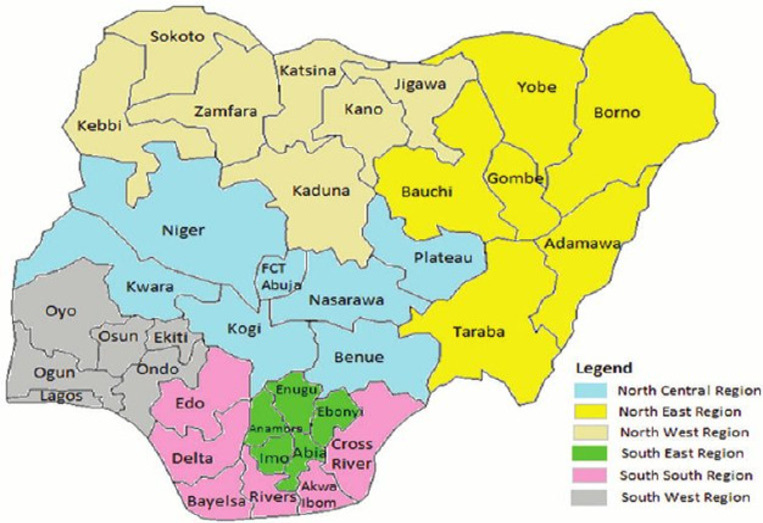
Map of Nigeria showing the 36 states and Federal Capital Territory (FCT), Abuja.
References
- Adikuru, N.C. and I.J. Ogoke. 2021. Maize vegetative growth response to poultry manure and sowig date during delayed onset of rainfall in a humid agroecology of Nigeria. Glob. J. Sci. Front. Res., 21(1): 13-19.
- Adikuru, N.C., I.J. Ogoke, C.P. Anyanwu and B.U. Uzoho. 2019. Liming effects on reproductive growth and yield components of maize grown on an acid rainforest soil. J. Agric. Rural Dev. Trop. Subtrop., 120(2): 141–147.
- Adikuru, N.C., I.J. Ogoke, I.I. Ibeawuchi, A.A. Ngwuta and T.U. Madu. 2020. Adaptation to delayed onset of rainfall for maize production in a humid tropical environment. Int. J. Agric. For., 10(1): 11-18.
- Ajani, O.T., A. Oluwaranti and A.I. Awoniyi. 2016. Assessment of water-use efficiency of drought tolerant maize (Zea mays L.) varieties in a rainforest location. J. Agric. Ecol. Res. Int., 8(3): 1-10. https://doi.org/10.9734/JAERI/2016/25857[CrossRef]
- Anjum, S.A., X.Y. Xie, L.C. Wang, M.F. Saleem, C. Man and W. Lei. 2011. Morphological physiological and Biochemical responses of plants to drought stress. Afr. J. Agric. Res., 6(9): 2026-2032.
- Ayanlade, A., M. Radeny, J.F. Morton and T. Muchaba. 2018. Rainfall variability and drought characteristics in two agro-climatic zones: An assessment of climate change challenges in Africa. Sci. Total Environ., 630: 728–737. https://doi.org/10.1016/j.scitotenv.2018.02.196[CrossRef]
- Ayedun, B., 2018. Drought tolerant maize adoption and its determinants in West Africa. Acta Sci. Nutr. Health, 2(1): 21-30. https://www.actascientific.com/ASNH/pdf/ASNH-02-0045.pdf
- Ayinde, O.E., O.O. Ajewole, I. Ogunlade and M.O. Adewumi. 2010. Empirical analysis of agricultural production and climate change: A case study of Nigeria. J. Sustain. Dev. Afr., 12(6): 275-282.
- Beah, A., A.Y. Kamara, J.M. Jibrin, F.M. Akinseye, A.I. Tofa and A.M. Adam. 2021. Simulating the response of drought–tolerant maize varieties to nitrogen application in contrasting environments in the Nigeria savannas using the APSIM model. Agronomy, 11: 76. https://doi.org/10.3390/agronomy11010076[CrossRef]
- Bello, O.B., S.Y. Abdulmaliq, S.A. Ige, J. Mahamood, F. Oluleye, M.A. Azeez and M.S. Afolabi. 2012. Evaluation of early and late/intermediate maize varieties for grain yield potential and adaptation to a Southern Guinea Savanna agro-ecology of Nigeria. Int. J. Plant Res., 2(2): 14-21. https://doi.org/10.5923/j.plant.20120202.03[CrossRef]
- Bello, O.B., O.J. Olawuyi, S.Y. Abdulmaliq, S.A. Ige, J. Mahamood, M.A. Azeez and M.S. Afolabi. 2014. Yield performance and adaptation of early and intermediate drought-tolerant maize genotypes in guinea savanna of Nigeria. Sarhad J. Agric., 30(1): 53–66.
- Benchikh-Lehocine, M., P. Revilla, R.A. Malvar and A. Djemel. 2021. Response to selection for reduced anthesis-silking interval in four Algerian maize populations. Agronomy, 11: 382. https://doi.org/10.3390/agronomy11020382[CrossRef]
- Bremner, J.M., 1996. Total nitrogen. In: Sparks, D. L. (eds), Methods of soil analysis. ASA. SSSA. Madison, Wisconsin, USA. pp. 1085–1122.
- Erenstein, O., M. Jaleta, K. Sonder, K. Mottaleb and B.M. Prassana. 2022. Global maize production consumption and trade: trend and R and D implications. Food Secur., 14: 1295–1319. https://doi.org/10.1007/s12571-022-01288-7[CrossRef]
- Gbode, I.E., O.E Adeyeri, K.P Menang, J.D.K Intsiful, V.O Ajayi, J.A Omotosho and A.A Akinsanola. 2019. Observed changes in climate extremes in Nigeria. Meteorol. Appl., 26(4): 642–654. https://doi.org/10.1002/met.1791[CrossRef]
- Gee, G.W. and D. Or. 2002. Particle size analysis. In: Dane, J.H. and Topps, G.C. (eds.). Methods of soil analysis, Part 4. Physical methods. Soil Sci. Soc. Am. Book Ser No. 5, ASA and SSSA, Madison, WI. pp. 255–293. https://doi.org/10.2136/sssabookser5.4.c12[CrossRef]
- Huang, C., A. Qin, Y. Gao, S. Ma, Z. Liu, B. Zhao, D. Ning, K. Zhang, W. Gong, M. Sun and Z. Liu. 2023. Effects of water deficit at different stages on growth and ear quality of waxy maize. Front. Plant Sci., 14: 1069551. https://doi.org/10.3389/fpls.2023.1069551[CrossRef]
- Kamara, A.K., O. Oyinbo, J. Manda, A. Kamara, E.O. Idowu and J.J. Mbavai. 2023. Beyond average: Are the yield and income impacts of adopting drought-tolerant maize varieties heterogenous? Clim. Dev., https://doi.org/10.1080/17565529.2023.2178840[CrossRef]
- Layi-Adigun, B.O., G.C. Ufoegbune, A.A. Makinde, S.M. Ahmad, J.F. Oyelakin and V.O. Dada. 2020. Rainfall characteristics in the humid and transition zones southwest Nigeria. J. Meteorol. Clim. Sci., 18(1): 62–69.
- Munyiri, S.W., R.S. Pathak, I.M. Tabu and D.C. Gemenet. 2010. Effect of moisture stress at flowering on phenotypic characters of selected local maize landraces in Kenya. J. Anim. Plant Sci., 8(1): 892-899.
- Nelson, D.W., and L.E. Sommers. 1996. Total carbon, organic carbon and organic matter. In: Sparks, D.L. (eds), Methods of soil analysis. ASA. SSSA. Madison, Wisconsin, USA. pp. 961–1010. https://doi.org/10.2136/sssabookser5.3.c34[CrossRef]
- Obayelu, O.A., O.M. Fakolujo and B. A. Awotide. 2019. What impact does the adoption of drought-tolerant maize for Africa have on the yield and poverty status of farmers in the arid region of Nigeria? J. Agric. Sci., 64(3): 303-317. https://doi.org/10.2298/JAS1903303O[CrossRef]
- Obot, N.I., M.A.C. Chendo, S.O. Udo and I.O. Ewona. 2010. Evaluation of rainfall trends in Nigeria for 30 years (1978-2007). Int. J. Phys. Sci., 5(14): 2217-2222.
- Odjugo, P.A.O., 2010. Regional evidence of climate change in Nigeria. J. Geogr. Reg. Plann., 3(6): 142-150.
- Ogbu, K.N., N.R. Hounguè, I.E. Gbode and B. Tischbein. 2020. Performance evaluation of satellite-based rainfall products over Nigeria. Climate, 8: 103. https://doi.org/10.3390/cli8100103[CrossRef]
- Okeowo, T.A., A. Ogunbameru and O.I. Ogunyemi. 2015. The effect of rainfall variability on maize production in Lagos Nigeria. Niger. J. Agric. Econ., 5(1): 12–16.
- Olaoye, G., O.B. Bello, A.Y. Abubakar, L.S. Olayiwola and O.A. Adesina. 2009. Analyses of moisture deficit grain yield loss in drought tolerant maize (Zea mays L.) germplasm accessions and its relationship with field performance. Afr. J. Biotechnol., 8(14): 3229-3238. http://www.academicjournals.org/AJB
- Olasehinde, T.S., F. Qiao and S. Mao. 2023. Impact of improved maize varieties on production efficiency in Nigeria: Separating technology from managerial gaps. Agriculture, MDPI 13(3): 1-14. https://doi.org/10.3390/agriculture13030611[CrossRef]
- Olsen, S.R. and L.E. Sommers. 1982. Phosphorus. In: Page, A.L., R.H. Miller and D.R. Keeney (eds). Methods of soil analysis. Part 2. Chemical and microbiological properties. Am. Soc. Agron. Madison, WI. pp. 403–430. https://doi.org/10.2134/agronmonogr9.2.2ed.c24[CrossRef]
- Oluwaranti, A. and O.T. Ajani. 2016. Evaluation of drought tolerant maize varieties under drought and rain-fed conditions: A rainforest location. J. Agric. Sci., 8(7): 153–162. https://doi.org/10.5539/jas.v8n7p153[CrossRef]
- Oluwaranti, A., M.A.B. Fakorede, A. Menkir and B. Badu-Apraku. 2015. Climatic conditions requirements of maize germplasm for flowering in the rainforest Agro-ecology of Nigeria. J. Plant Breed. Crop Sci. 7(6): 170-176. https://doi.org/10.5897/JPBCS2015.0505[CrossRef]
- Sah, R.P., M. Chakraborty, K. Prasad, M. Pandit, V.K., Tudu, M.K. Chakravarty, S.C. Narayan, M. Rana and D. Moharana. 2020. Impact of water deficit stress in maize: Phenology and yield components. Sci. Rep. 10(1): 2944. https://doi.org/10.1038/s41598-020-59689-7[CrossRef]
- Sam, M., I. Nwaogazie, C. Ikebude, C. Dimgba and D. El-Hourani. 2023. Detecting climate change trend, size, and change point date on annual maximum time series rainfall data for Warri, Nigeria. Open J. Modern Hydrol., 13: 165-179. https://doi.org/10.4236/ojmh.2023.133009[CrossRef]
- Shaibu, M.U., S.J. Ibitoye and O.J. Saliu. 2015. Output projections for maize in Nigeria (2015 – 2030) implications on its importation. Curr. Res. J. Commerce Manage., 1(1): 24-28.
- Thomas, G.W., 1996. Soil pH and soil acidity. In: Sparks, D.L. (eds.), Methods of soil analysis. Part 3. Chemical methods. Soil Science Society of America, Madison, WI. pp. 475–490. https://doi.org/10.2136/sssabookser5.3.c16[CrossRef]
- Uzoho, B.U. and N.N. Oti. 2005. Estimation of phosphorus requirement of maize in selected soils of southeastern Nigeria using P-Sorption Isotherm. Niger. Agric. J., 36: 157–168. https://doi.org/10.4314/naj.v36i1.3218[CrossRef]
- Wossen, T., A. Menkir, A. Alene, T. Abdoulaye S. Ajala, B. Badu-Apraku, M. Gedil, W. Mengesha and S. Meseka. 2023. Drivers of transformation of maize sector I Nigeria. Glob. Food Secur., 38. https://doi.org/10.1016/j.gfs.2023.100713[CrossRef]
- Yamusa, A.M., I.U. Abubakar and A.M. Falaki. 2015. Rainfall variability and crop production in the North-western semi-arid zone of Nigeria. J. Soil Sci. Environ. Manage., 6(5): 125–131.
Services
Article usage statistics
Loading…