Research Article · Volume 12, Issue 1, 8 January 2024 · Open Access
Reproductive Behavior and Hormone Metabolite Profiles in Captive Breeding Female Sumatran Slow Lorises (Nycticebus hilleri)
· · ·
Affiliations & Notes ⌄
1Department of Biology, Faculty of Mathematics and Natural Sciences, Universitas Indonesia, Depok, Indonesia
2Primate Research Center (PSSP), IPB University, Indonesia. *Correspondence | Luthfiralda Sjahfirdi, Department of Biology, Faculty of Mathematics and Natural Sciences, Universitas Indonesia, Depok, Indonesia
A study of the reproductive behavior of the sumatran slow loris (Nycticebus hilleri), along with measurements of estrone conjugate (E1C) and pregnanediol-3-glucuronide (PdG) metabolite hormone levels in feces, was performed as a success parameter of ex-situ conservation in the breeding facility. Behaviors of two adult female N. hilleri (K2 and K5) were observed in their cages from 17:00 to 05:00 WIB from September to November 2015. Feces were collected during the observation period and the levels of E1C and PdG were analyzed by enzyme-linked immunosorbent assay (ELISA). Our results showed that the average percentage of behavior observations (K2 and K5), namely was behavior moving 61%, unseen 15%, resting 8%, social behavior 8%, autogrooming 5%, feeding 4%, and reproductive behavior (1%). The presence of reproductive behaviors (1%), such as sniffing and licking the genitalia of a mate, indicates pair harmony that could lead to copulation. Although copulation was not clearly observed, the presence of unseen behavior (15%) when lorises were in sleeping cages maybe a time when copulation occurred. The highest E1C concentration was 1181.18 pg/g for K2 and 919.93 pg/g for K5. The lowest E1C was 5.75 pg/g for K2 and 29.95 pg/g for K5. The highest PdG was 19995.81 pg/g for K2 and 18168.68 pg/g for K5. The lowest PdG was 20.85 pg/g for K2 and 504.97 pg/g for K5.
The sumatran slow loris (Nycticebus hilleri) is a prosimian of the Nycticebus genus living on the Indonesian islands of Sumatra ; ; . This primate species lives in trees (arboreal) and tends to inhabit various types of strata and sub-strata ; . Slow lorises can be found in primary forests, secondary forests, bamboo forests, mangrove forests, and in protected forest area even was widely distributed in plantations ; . As slow lorises are more likely be found in forests in good condition, they can be used as an indicator of forest quality . The International Union for Conservation of Nature (IUCN) classified it as Endangered . Simultaneously, it is listed as Appendix I (trade prohibited) in the Convention on International Trade in Endangered Species of Wild Fauna and Flora (CITES) .
The factors that cause it are, since their habitat is rapidly disappearing and becoming fragmented, and demand from the exotic pet trade and from traditional medicine, has been the greatest cause for their decline. For these reasons, efforts to conserve this species are necessary ; . Various efforts to protect and increase the population of the sumatran slow loris have been taken, both in situ and ex-situ ; . Through ex-situ conservation, different aspects of monitoring are easier to perform . Ex-situ conservation, in the form of a breeding center, has attracted much research attention due to the advantages of breeding centers . Breeding centers have several functions, namely as a place to rear the animals, to conduct research, and to educate the public. According to Kleiman et al. (1996) and Greggor et al. (2018), the purpose of captive breeding is to restore the animal’s physical condition and daily behavior patterns, which are likely to have been disrupted due to irresponsible rearing or poaching.
The success of a conservation effort can be represented by the success of the animal’s reproduction. Intensive care and treatment at a breeding center is expected to restore the animal’s ability and opportunity to reproduce and, in time, the animals can be returned to their natural habitat. According to Wiens (2002) and Nekaris et al. (2022), reproductive behavior is a form of social behavior. At a breeding center, social behavior is maintained by pairing females and males in one cage. The pairing of the animals aims to maintain their social behavior as it is in the wild, especially reproductive behavior. Generally, unpaired animals tend to show negative behavior, and even stereotyped behavior ; ; . Paired male and female animals, in general, do not face many obstacles. Once paired, the animals will begin to engage in social behaviors progressing towards reproductive behavior ; . However, not all pairs will exhibit reproductive behavior. This can occur if the pairing is not suitable ; and may depend on the influencing conditions and levels of reproductive hormones .
Research on the behavior patterns of N. hilleri is limited to direct observations in nature ; daily observations of the behavior patterns of N. hilleri in captivity, including reproductive behaviors and hormonal profiles that may indicate reproductive status, are yet to be conducted ; . Such research is essential for the success of captive breeding, as estrogen and progesterone hormonal measurements in females can provide information on basic reproductive parameters such as cycle length and duration of pregnancy ; . Non-invasive measurement of the steroid metabolite of E1C and PdG in fecal samples was shown to be useful for assessing the profile of estrogen and progesterone in Javanese gibbons . According to Heistermann (2010), the study of behaviors and hormonal interactions can explain reproductive strategies in females. Thus, this study aims to observe the reproductive behavior and to measure estrone conjugate (E1C) and pregnanediol-3-glucuronide (PdG) metabolites from fecal samples in the sumatran slow loris. The results obtained can be useful to increase the success of captive breeding programs, thereby promoting conservation.
MATERIALS AND METHODS
Description of the research location
The study was conducted at the Primate Research Center (PSSP), IPB University, Bogor, Indonesia during the 3-month period from September to November 2015. The research center has enforced animal welfare procedures for all animals that are used for research subjects. The animal welfare procedures must be adhered to by every researcher.
Study subjects
The research subjects were 2 sumatran slow loris (N. hilleri) females in cages No. 2 and No. 5 were assigned the symbols K2 and K5 respectively. both more than 24 months old. According to Izard et al. (1988) and Fitch-Snyder (2020), that female slow lorises are sexually mature at more than 18 months. It observed from 17:00–05:00 WIB time zone. The placement of research animals is in pairs. The K2 pair had already produced offspring, but the offspring were not the focus of the observations. Feces collected from both slow lorises during the observation period were analyzed to measure the levels of E1C and PdG metabolites.
Observations of behavior
As nocturnal animals, slow lorises are most active from 17:00 to 05:00 WIB. Prior to the intensive observations, a habituation process was performed for 3 days during the 17:00–05:00 WIB active period. As the room containing the cages was not lit during this time, behavior observations were aided by red light from headlamps worn by the researchers. Observations were conducted every three times a week on Tuesday (17:00–22:00 WIB), Friday (22:00–02:00 WIB), and Sunday (02:00–05:00 WIB).
The recording method was the focal-animal sampling method , for 20-minute observation without any intervals for each loris. Each female was observed three times. The observations were categorized as individual daily behaviors (moving, resting, grooming, and feeding), and social behaviors (social playing, allogrooming, approach, and reproductive behaviors) according to Fitch-Snyder et al. (2001) and Musing et al. (2015). When a behavior could not be observed, because the animals are in hidden places, protected from observers, it was recorded as unseen. Observations were made alternately between the observation cages every two weeks. The observation data were converted to frequency and percentage and then compared to assess behavior patterns. Henceforth, feces collection, lyophilization, E1C and PdG analysis refer to Maheshwari et al. (2010) and will be described below.
Collection of feces
Feces were collected during the second month of observation (October 2015). Researchers wearing the appropriate personal protective equipment entered the cage and collected the feces using a shovel. The feces were collected every day shortly after females defecated at the same place of defecation to ensure the accuracy of the sampled feces. Thirty feces samples weighing 5 g each were collected from each female, for a total of 60 fecal samples. The feces samples were placed in zip-locked plastic bags and stored in a freezer at −18 °C until analysis.
Lyophilization
Lyophilization was performed at the laboratory of the Faculty of Veterinary Medicine IPB. First, the collected feces of 1-2 g were turned into powder. The powder 50 mg dry weight was taken and then extracted using 80% methanol solvent at a 1:1 ratio and vortexed . The resulting solution was centrifuged at 2200 x g for 10 minutes . The supernatant was collected in a microtube and frozen until assay.
E1C and PdG analysis
Enzyme linked immunosorbent assays (ELISAs) were performed by the researchers under the supervision of laboratory staff. E1C was assessed using the Arbor Assays DetectX® Estrone Enzyme Immunoassay Kit and PdG was assessed using the ArborAssays DetectX® Pregnanediol-3-Glucuronide (PdG) Enzyme Immunoassay Kit according to the manufacturer’s instructions. Optical density was read at a wavelength of 450 nm. Microsoft Excel 2021 was used to generate the standard curves, which were then used as a reference to obtain the E1C and PdG concentrations.
Results and Discussion
Behavior of captive female N. hilleri
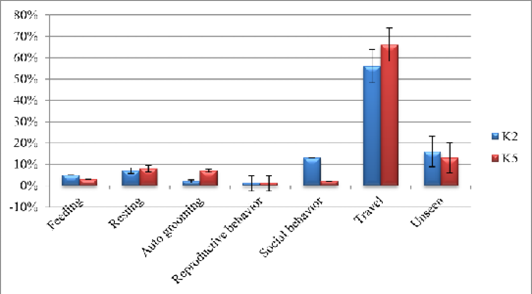
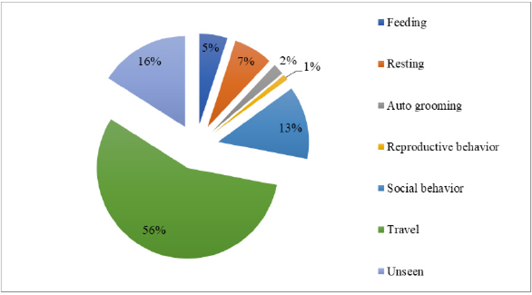
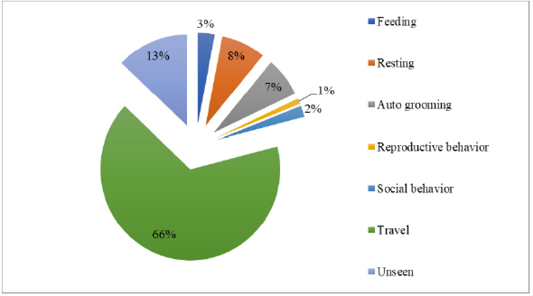
In total, 1.300 min of observation were performed. The observed behaviors included moving (travelling), resting, autogrooming, feeding, reproductive and social behaviors, and unseen behaviors (Figure 1). Unseen behavior indicates the slow loris has entered its cage. Moving (travelling) was the most frequently observed activity for both subjects, accounting for 56% of observations for K2 (Figure 2) and 66% for K5 (Figure 3).
For K2, the most to least frequently observed behaviors were moving (travel) > unseen > social behavior > resting> feeding > autogrooming > reproductive behavior. For K5, they were moving (travel) > unseen > resting > autogrooming > feeding > social behavior > reproductive behavior. On average, the order of behaviors was moving (61%) > unseen (15%) > resting (8%) > social behavior (8%) > autogrooming (5%) > feeding (4%) > reproductive behavior (1%).
Table 1: The table provides reproductive behavior from both female Nycticebus hilleri with their partners in captivity.
Day of observation
Female N. hilleri
from cage no. 2 (K2)
Female N. hilleri
from cage no. 5 (K5)
1 - 4
-
-
5
Sniffing and licking
Sniffing
6
Sniffing
-
7-10
-
-
11
Licking
-
12-13
-
-
14
-
Sniffing
15-17
-
-
18
Licking
-
19-24
-
-
25
Sniffing and licking
-
26
-
-
27
-
Sniffing
28-30
-
-
31
Sniffing and licking
Sniffing
32-38
-
-
Note: reproductive behavior observed is sniffing and licking only.
The observed reproductive behaviors were only genital sniffing and genital licking (Table 1). Genital sniffing is when the female slow loris’s genitals are sniffed by male. Genital licking is the behavior of licking the partner’s genitals. Genital sniffing was observed four times for each animal: on days 5, 6, 25, and 31 for K2 and days 5, 14, 27, and 31 for K5. Genital licking was observed on days 5, 11, 18, 25, and 31 for K2, and was not observed for K5. Copulation was not observed on both subjects.
Measurement of E1C
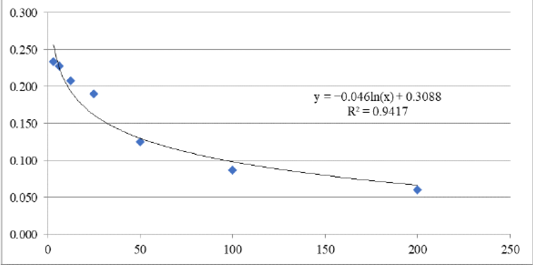
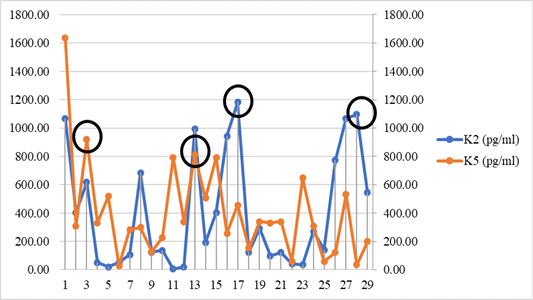
The standard E1C hormone curve equation was y = −0.046 ln (x) + 0.3088 with R² = 0.9417 (Figure 4) as a reference to obtain the E1C concentrations. The E1C concentrations in fecal samples are shown in Figure 5.The highest concentrations of E1C were observed on day 17 and 28 (1181.18 pg/g and 1095.84 pg/g) for K2 and days 3 and 13 (919.93 pg/g and 811.84 pg/g) for K5 (Figure 5). The lowest concentration was observed on day 11 (5.75 pg/g) for K2 and day 6 (29.95 pg/g) for K5 (Figure 5).
Measurement of PdG
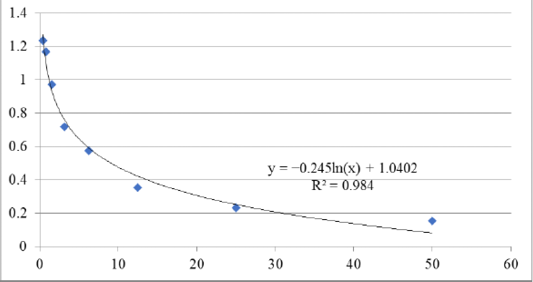
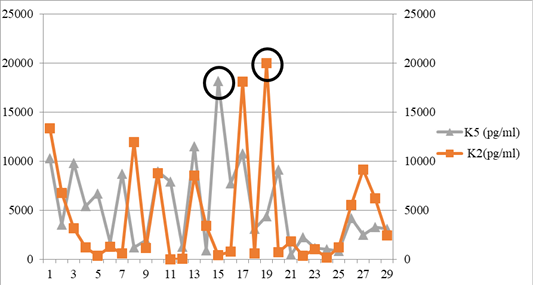
The standard PdG hormone curve equation was y = −0.245 ln (x) + 1.0402 with R2 = 0.984 (Figure 6) as a reference to obtain the PdG concentrations. The PdG.concentrations in fecal samples are shown in Figure 7.The highest PdG concentration was observed on day 19 for K2 (19995.81 pg/g) and on day 15 for K5 (18168.68 pg/g). The lowest PdG concentration was observed on day 11 for K2 (20.85 pg/g) and day 21 for K5 (504.97 pg/g) (Figure 7).
Behavior of captive female N. hilleri
The observed female slow lorises were active from 17:00 until 5:00 WIB, which is consistent with their counterparts in the wild ; . Moving (travel) was the most frequently observed behavior (Average K2 and K5 = 61%) and mostly occurred between 20:00 and 22:00 WIB, which is consistent with observations of free-ranging animals ; . Unseen is of considerable value (15%)
when compared to some of the other behaviors, although it is smaller percentage than moving. In this study, maybe copulation occurs in this unseen state. Unseen behavior occurred because the pair entered the sleeping cage so that behavior in the sleeping cage could not be observed. Often these animals are not seen by observers due to their sensitive nature to human activities . Both female lorises generally performed resting behavior after performing moving (travel) behavior. In contrast to Lavanya and Gokula (2023), during the study period, five such copulations were recorded and in all five cases only a pair was involved. No other males or females were found in the vicinity.
The mean proportion of resting behavior was 8%, which is comparable to the 5.4% reported by Wiens and Zitsmann (2003) for N. coucang in the Malaysian rainforest. K2 was observed to commonly rest in front of the cage, whereas K5 commonly rested on left front side of the cage near the cage door. In contrast to the pygmy slow loris (Nycticebus pygmaeus) at the Slow Loris Conservation Center at the Japan Monkey Center, the behavior of resting with other females in a wooden nest box ; . Autogrooming behavior, which included scratching, licking, or pulling the subject’s own hair, accounted for 5% of the observed behavior. Similar to research by Sinaga and Masyud (2017), in the sumatran Slow Loris female in Pematang Siantar Zoo autogrooming behavior was 4.08%. Autogrooming was commonly observed before the animals rested and after they defecated. Both animals conducted thorough autogrooming while they were above a branch or iron bar.
Feeding accounted for 4% of the observed behavior. The same as which feeding behaviour in sumatran Slow Loris female which 6.29% . The proportion was small because according to keeper feeding usually took place inside the sleeping box nevertheless observer was not able to ensure both female lorises performed feeding behavior inside the sleeping box. Feeding behavior was observed and calculating when slow lorises were caught with food. Based on the observations, the observed feeding behavior begins if the subject sniffing the feed, takes the feed with one hand and then puts the feed into its mouth.
Only 1% of the observed behavior was reproductive behavior, which included genital licking and genital sniffing. Reproductive behavior was observed more frequently for K2 than K5. This maybe because of the pairing process, as K2 has been paired with its partner since 2010 whereas K5 has only been paired since 2015. K2 also has a history of giving birth, which means that K2 has copulated with its partner (Dr. H. Suryo, Personal Communication, 2016). Replaced with (Source: Personal Communication). Copulation was not observed, but it may have been unseen. The male partner was observed to follow K2 into the resting box while sniffing K2’s genitals, where copulation could have occurred but was not observable.
Both K2 and K5 demonstrated reproductive success, defined as the females accepting the males and not displaying any excessive agonistic behaviors. Furthermore, the occurrence of genital sniffing and genital licking suggest that copulation will occur in the N. hilleri pairs. According to Zimmermann (1989), copulation in slow lorises starts with the male licking the female’s genitals (genital licking). The female then walks in front of the male while urinating, stops walking, and makes noises to see the reaction of the male. When the male is interested, the male will sniff the female’s urine and approach the female. The female will perform the upside-down behavior on the branch as a ready sign of mating. The male then mounts the female for copulation. According to Lavanya and Gokula (2023), the sexual play of the slender loris consists largely of dangling. After sniffing the female’s genitals, the male tries to mount. If the female is receptive, it clung quadrupedally and the male clings to the female and mounts. The male keeps its entire ventral portion on the dorsal of the female, thrust several times, and completes the ejaculation. Only in one event, the male makes lateral wiping movements on the female’s back with his chin after ejaculation.
Social behavior was distinguished from reproductive behavior in this study and accounted for 8% of the observed behavior. Social behaviors observed in the female and male pairs included playing, grappling by holding the other individual’s body without causing harm, walking close to the other individual, being adjacent to another individual smaller in size, and grooming other individuals (allogrooming). Agonistic events were not observed, indicating that the pairs were compatible . Social behavior was more frequently observed for K2 (13%) than K5 (2%). This difference maybe because of K2 and its partner being parents that still provide parental care to their offspring.
Relationship between E1C and reproductive behaviour
Estrone conjugate (E1C) is a derivative of estrogen hormone, which is produced by the ovaries ; . Estrogen affects the emergence of sexual instinct (estrus) in females and coordinates behavior responses with specific goals, one of which is reproduction. Peak estrogen indicates a mature follicle and readiness to ovulate in female slow lorises .
The detected peaks indicate an estrous cycle in captive female N. hilleri. Schatten and Constantinescu (2007), reported that peak estrogen occurs when the female is receptive to the male (estrus condition). Based on the peak intervals of day 13, 10, and 11 of the estrous cycle, the estrous cycle is estimated to range from 10 to 12 days coincided with observed reproductive behavior i.e genital sniffing and genital licking (Table 1). The peaks, and therefore estrus, lasted one day. To the best of our knowledge, this study reports the first measurements of E1C levels in captive N. hilleri females. In contrast to the results of research by Fitch-Snyder et al. (2001) the estrous cycle was approximately 42.3 days. According to Izard et al. (1988), the estrous cycle in slow lorises (N. coecang) of females lasts 29 to 45 days, with an average value of 36.4 days, and estrus itself lasts approximately 5 days. This research is similar to Zimmermann (1985). The difference in the estrous cycle is, possibly because in captivity nutrition, especially protein, is maintained and health is monitored, so the estrus cycle is faster.
The time of genital sniffing and licking behavior in slow lorises is related to the female’s estrus cycle . According to Barnett et al. (2006), in female primates, the day of estrogen peak is associated with changes in sexual behavior. Estradiol peak plays a crucial role in influencing sexual motivation and receptivity in primates. Research suggests that sexual proceptivity, which includes behaviors like genital sniffing and licking, is strongly influenced by the estrus phase and generally enhanced by estradiol ; .
Relationship between PdG and reproductive behavior
The clear midluteal peaks in PdG indicated the formation of the corpus luteum. This indicates that both females ovulated and that reproduction in both captive slow loris pairs was possible. Although copulation was not observed, the relatively high proportion of social behavior (8%) of both females with their partner indicate that both females can promote their reproductive interests with their partners. In general, the period of estrus for the female slow lorises is characterized by swelling and redness of the vaginal area . In this study, sexual swelling was not observed clearly, which maybe because of the short estrus or unseen swelling.
CONCLUSIONS and Recommendations
The presence of reproductive behaviors (1%), such as sniffing and licking the genitalia of a mate, indicates pair harmony that could lead to copulation. Although copulation was not clearly observed, the presence of unseen behavior (15%) when lorises were in sleeping cages maybe a time when copulation occurred. The highest E1C concentration was 1181.18 pg/g for K2 and 919.93 pg/g for K5. The lowest E1C was 5.75 pg/g for K2 and 29.95 pg/g for K5. The highest PdG was 19995.81 pg/g for K2 and 18168.68 pg/g for K5. The lowest PdG was 20.85 pg/g for K2 and 504.97 pg/g for K5.
ACKNOWLEDGEMENT
The work was supported by Hibah Riset Kolaborasi Nasional 2015, DRPM Universitas Indonesia. We sincerely thank Mita from the Laboratory of Microbiology and Immunology, and PSSP IPB for their generosity in providing the ELISAs and reading the ELISA output. We also thank Dr. H. Suryo for valuable information about slow loris health and the keepers at the slow loris breeding center for their ongoing assistance. We are very grateful to Dr. Rizki Fitrawan Yuneldi, M.Si. for helping us prepare the manuscript submission.
NOVELTY STATEMENT
This study completes data on the reproductive aspects of sumatran Slow Lorises (Nycticebus hilleri), especially profile of hormone E1C and PdG, and reproductive behavior in captivity.
AUTHOR’S CONTRIBUTION
LS, LN, DFW and EI contributed equally to field observations, and analyzed, wrote and edited the article. All authors read and approved the final manuscript.
Conflict of interest
The authors have declared no conflict of interest.
Figures
Figure 1:.
Proportion of nocturnal behaviors (travel, resting, auto grooming, feeding, reproductive, social, and unseen behaviors) in female slow lorises in cage no. 2 (K2) and in cage no. 5 (K5) during study.
Figure 2:.
Pattern of female sumatran slow loris behavior in cage no.2 (K2) observed daily from 17:00 to 05:00 WIB during study.
Figure 3:.
Pattern of female Sumatran slow loris behavior in cage no.5 (K5) observed daily from 17:00 to 05:00 WIB during study.
Figure 4:.
Standard curve of Estrone Conjugate (E1C) at 450-nm optical density (OD). Description: X axes = Concentration and Y axes = Absorbance.
Figure 5:.
Estrone Conjugare (E1C) hormone profiles of the female sumatran slow loris in cage no. 2 (K2) and in cage no.5 (K5) in captivity (pg/g) during study. Note: Black circles (O) indicate E1C peaks. Description: X axes = days and Y axes = E1C level (pg/g).
Figure 6:.
Standard curve of Pregnaneolone Glucuronide (PdG) at 450-nm optical density (OD). Description: X axes = Concentration and Y axes = Absorbance.
Figure 7:.
Pregnenolone Glucuronide (PdG) hormone profiles of the female sumatran slow loris in cage no.2 (K2) and in cage no.5 (K5) in captivity (pg/g). Note: Black circles indicate PdG peaks. Description: X axes = days and Y axes = PdG level (pg/g).
References
Alejandro J, Yamanashi Y, Nemoto K, Mouri K, Huang CW, Bercovitch FB, Huffman MA (2023). Reducing stress and stereotypic behaviors in captive female pygmy slow lorises (Nycticebus pygmeaus). Am. J. Primatol., 85: e23495. https://doi.org/10.1002/ajp.23495[CrossRef]
Altmann J (1974). Observational study of behavior: Sampling methods. Behav., 49: 227–266. https://doi.org/10.1163/156853974X00534[CrossRef]
Astuti P, Yusuf TL, Hayes E, Maheshwari H, Sjahfirdi L, Sajuthi D (2006). Pola diurnal metabolit testosteron dan kortisol di dalam feses Owa Jawa (Hylobates moloch) di penangkaran: Diurnal patterns of testosterone and cortisol metabolites in fecal of Javan Gibbons (Hylobates moloch) in captivity. Hayati J. Biosci., 13: 69-72. https://doi.org/10.1016/S1978-3019(16)30384-9[CrossRef]
Barnett DK, Bunnell TM, Millar RP, Abbott DH (2006). Gonadotropin-releasing hormone II stimulates female sexual behavior in marmoset monkeys. Endocrinology, 147: 615-623. https://doi.org/10.1210/en.2005-0662[CrossRef]
Behringer V, Deschner T (2017). Non-invasive monitoring of physiological markers in primates. Horm. Behav., 91: 3-18. https://doi.org/10.1016/j.yhbeh.2017.02.001[CrossRef]
Blair ME, Cao GTH, López-Nandam, EH, Veronese-Paniagua DA, Birchette MG, Kenyon M, Md-Zain BM, Munds RA, Nekaris KA, Nijman V, Roos C, Thach HM, Sterling EJ, Le MD (2023). Molecular Phylogenetic relationships and unveiling novel genetic diversity among slow and pygmy lorises, including resurrection of Xanthonycticebus intermedius. Genes.14: 1-26. https://doi.org/10.3390/genes14030643[CrossRef]
Brown ER, Imron MA, Campera M, Nekaris, KAI (2020). Testing efficacy of a multi-site environmental education programme in a demographically and biologically diverse setting. Environ. Conserv., 47: 60-66. https://doi.org/10.1017/S0376892919000389[CrossRef]
Dolman PM, Collar NJ, Scotland KM, Burnside RJ (2015). Ark or park: the need to predict relative effectiveness of ex situ and in situ conservation before attempting captive breeding. J. Appl. Ecol., 52: 841-850. https://doi.org/10.1111/1365-2664.12449[CrossRef]
Elliot O, Elliot M (1967). Field notes on the slow loris in Malaya. J. Mammal., 48: 497-498. https://doi.org/10.2307/1377803[CrossRef]
Farida WR, Sari AP, Astuti WD (2017). The addition of potato biscuit in the feed of sumatran slow loris (Nycticebus coucang Boddaert, 1785) and Javan Slow Loris (Nycticebus javanicus Geoffroy, 1812): The effects on digestibility and feed efficiency. J. Biol. Indonesia, 12: 309-312.
Fitch-Snyder H, Schulze H, Larson LC (2001). Management of Lorises in captivity: A husbandry manual for Asisn Lorisines (Nycticebus and Loris sp.). Center for reproduction of endangered species (CRES), Zoological Society of San Diego.
Fitch-Snyder H (2020). Husbandry and reproductive management recommendations for captive lorises and pottos (Nycticebus, Loris and Perodicticus). Evolution, Ecology and Conservation of Lorises and Pottos; Nekaris, KAI, Burrows, AM, Eds, 263-276. https://doi.org/10.1017/9781108676526.026[CrossRef]
Fuller G, Eggen WF, Wirdateti W, Nekaris KAI (2018). Welfare impacts of the illegal wildlife trade in a cohort of confiscated greater slow lorises, Nycticebus coucang. J. Appl. Anim. Welf. Sci., 21: 224-238. https://doi.org/10.1080/10888705.2017.1393338[CrossRef]
Greggor AL, Vicino GA, Swaisgood RR, Fidgett A, Brenner D, Kinney ME, Farabaugh S, Masuda B, Lamberski N (2018). Animal welfare in conservation breeding: Applications and challenges. Front. Vet. Sci., 5: 323. https://doi.org/10.3389/fvets.2018.00323[CrossRef]
Gursky S (2002). The population density of the Javanese Slow Loris. Nycticebus coucang. Department of Anthropology, Texas A and M University, College Station.
Heistermann M (2010). Non-invasive monitoring of endocrine status in laboratory primates: Methods, guidelines and applications. Adv. Sci. Res., 5: 1-9. https://doi.org/10.5194/asr-5-1-2010[CrossRef]
Izard MK, Weisenseel KA, Ange RL (1988). Reproduction in the slow loris (Nycticebus coucang). Am. J. Primatol., 16: 331–339. https://doi.org/10.1002/ajp.1350160405[CrossRef]
Jolles JW, King AJ, Killen SS (2020). The role of individual heterogeneity in collective animal behaviour. Trends Ecol. Evol., 35: 278-291. https://doi.org/10.1016/j.tree.2019.11.001[CrossRef]
Kavaliers M, Clipperton-Allen A, Cragg CL, Gustafsson JÅ, Korach KS, Muglia L, Choleris E (2012). Male risk taking, female odors, and the role of estrogen receptors. Physiol. Behav., 107: 751–761. https://doi.org/10.1016/j.physbeh.2012.03.017[CrossRef]
Kleiman DG, Allen ME, Harris H, Thompson KV, Lumpkin S (1996). Wild Mammals in Captivity: Principles and Techniques. University of Chicago Press: Chicago.
Lavanya R, Gokula V (2023). Activity budget and behavioral repertoire of mysore slender loris loris lydekkerianus lydekkerianus in Keelaveliyur, Tamil Nadu, India. Uttar Pradesh J. Zool., 44: 41-50. https://doi.org/10.56557/upjoz/2023/v44i23401[CrossRef]
Lima ABF, Sobral G, Martins GS, Pissinatti A, Viau P, de Oliveira CA (2021). Reproductive and stress response hormones of the critically endangered southern muriqui (Brachyteles arachnoides: Atelidae) under captive conditions. Int. J. Primatol., 42: 781-801. https://doi.org/10.1007/s10764-021-00240-4[CrossRef]
Maheshwari H, Sjahfirdi L, Astuti P, Purwantara B, Alikodra HS, Sajuthi D, Widjajakusuma R (2010). Fecal steroid profile of female Javan Gibbons (Hylobates moloch) maintained in pairing-typed cage. Hayati J. Biosci., 17: 43-49. https://doi.org/10.4308/hjb.17.1.43[CrossRef]
Moore RS, Cabana F, Nekaris KAI (2015). Factors influencing stereotypic behaviours of animals rescued from Asian animal markets: A slow loris case study. Appl. Anim. Behav. Sci., 166: 131-136. https://doi.org/10.1016/j.applanim.2015.02.014[CrossRef]
Musing L, Suzuki K, Nekaris KAI (2015). Crossing international borders: the trade of slow lorises, Nycticebus spp., as pets in Japan. Asian Primates J., 5: 12-24.
Nekaris A, Bearder SK (2007). The lorisiform primates of Asia and mainland Africa. Primates Perspect. pp. 24-45.
Nekaris KAI, Campera M, Chimienti M, Murray C, Balestri M, Showell Z (2022). Training in the dark: Using target training for non-invasive application and validation of accelerometer devices for an endangered primate (Nycticebus bengalensis). Animal, 12: 1-12. https://doi.org/10.3390/ani12040411[CrossRef]
Nekaris KAI, Jaffe S (2007). Unexpected diversity of slow lorises (Nycticebus spp.) within the Javan pet trade: implications for slow loris taxonomy. Contrib. Zool., 76: 187-196. https://doi.org/10.1163/18759866-07603004[CrossRef]
Nekaris KAI, Munds RA, Pimley EP (2020). Trapping, collaring, and monitoring the Lorisinae of Asia (Loris, Nycticebus) and Perodicticinae (Arctocebus, Perodicticus) of Africa. In Evolution, ecology and conservation of lorises and pottos. Cambridge University Press Cambridge, UK. pp. 279-294. https://doi.org/10.1017/9781108676526[CrossRef]
Nekaris KAI, Poindexter S (2020). Nycticebus hilleri. The IUCN Red List of Threatened Species 2020: e.T163019804A163020000.
Nekaris KAI (2001). Activity budget and positional behavior of the Mysore slender loris (Loris tardigradus lydekkerianus): Implications for slow climbing locomotion. Folia Primatol., 72: 228-241. https://doi.org/10.1159/000049942[CrossRef]
Ni Q, Wang Y, Weldon A, Xie M, Xu H, Yao Y, Zhang M, Li Y, Li Y, Zeng B, Nekaris KAI (2018). Conservation implications of primate trade in China over 18 years based on web news reports of confiscations. PeerJ, 6: 1-18. https://doi.org/10.7717/peerj.6069[CrossRef]
Pfefferle D, Heistermann M, Pirow R, Hodges JK, Fischer J (2011). Estrogen and progestogen correlates of the structure of female copulation calls in semi-free-ranging Barbary macaques (Macaca sylvanus). Int. J. Primatol., 32: 992-1006. https://doi.org/10.1007/s10764-011-9517-8[CrossRef]
Poindexter SA, Nijman V, Imron MA, Nekaris KAI (2023). Goal-directed travel in the Nocturnal Javan slow loris (Nycticebus javanicus). Ecology, 4: 568-579. https://doi.org/10.3390/ecologies4030037[CrossRef]
Schwartz KR, Parsons ECM, Rockwood L, Wood TC (2017). Integrating in-situ and ex-situ data management processes for biodiversity conservation. Front. Ecol. Evol., 5: 120. https://doi.org/10.3389/fevo.2017.00120[CrossRef]
Schwarzenberger F, Möstl E, Palme R, Bamberg E (1996). Faecal steroid analysis for non-invasive monitoring of reproductive status in farm, wild and zoo animals. Anim. Reprod. Sci., 42(1-4): 515-526. https://doi.org/10.1016/0378-4320(96)01561-8[CrossRef]
Sinaga MWA, Masyud B (2017). Pemanfaatan ruang dan perilaku harian Kukang Sumatera (Nycticebus coucang Boddaert, 1785) Di Taman Hewan Pematang Siantar (Thps) Sumatera Utara. Space Utiliztion and behaviours of Sumatran Slow Loris (Nycticebus coucang Boddaert, 1785) in Pematang Siantar Zoo. Media Konservasi, 22: 304-311.
Sodik M, Pudyatmoko S, Yuwono PSH, Tafrichan M, Imron MA (2020). Better providers of habitat for Javan slow loris (Nycticebus javanicus E. Geoffroy 1812): A species distribution modeling approach in Central Java, Indonesia. J. Biol. Divers., 21: 1890-1900. https://doi.org/10.13057/biodiv/d210515[CrossRef]
Strang K, Rusli N (2021). The challenges of conserving biodiversity: A spotlight on Southeast Asia. In: Wildlife biodiversity conservation: Multidisciplinary and forensic approaches. Cham: Springer International Publishing. pp. 47-66 https://doi.org/10.1007/978-3-030-64682-0_3[CrossRef]
Strier KB, Ziegler TE (1997). Behavioral and endocrine characteristics of the reproductive cycle in wild muriqui monkeys, Brachyteles arachnoides. Am. J. Primatol., 42: 299-310. https://doi.org/10.1002/(SICI)1098-2345(1997)42:4<299::AID-AJP5>3.0.CO;2-S[CrossRef]
Supriatna J, Wahyono EH (2000). Panduan Lapangan Primata Indonesia. Yayasan Obor Indonesia: Jakarta. [Indonesian]
Sushadi PS, Wirdateti W, Phadmacanty NLPR, Wahyudin M (2021). Infanticide of Javan slow loris (Nycticebus javanicus) in captivity. Biodiver. J. Biol. Diver., 22: 1606-1611. https://doi.org/10.13057/biodiv/d220403[CrossRef]
Svensson MS, Nekaris KAI, Bearder SK, Bettridge CM, Butynski TM, Cheyne SM, Das N, de Jong YA, Luhrs AM, Luncz LV, Maddock ST, Perkin A, Pimley E, Poindexter SA, Reinhardt KD, Spaan D, Stark DJ, Starr CR, Nijman V (2018). Sleep patterns, daytime predation, and the evolution of diurnal sleep site selection in lorisiforms. Am. J. Phys. Anthropol., 166: 563–577. https://doi.org/10.1002/ajpa.23450[CrossRef]
Vilela JD, Miranda-Vilela AL, Stasieniuk EVZ, Alves GM, Machado FN, Ferreira WM, da Silva, NA (2012). The influence of behavioral enrichment on dry food consumption by the black tufted-ear marmoset, Callithrix penicillata (Mammalia: Callithricidae): A pilot study. Zool. (Curitiba), 29: 1-6. https://doi.org/10.1590/S1984-46702012000100001[CrossRef]
Vitale A, Manciocco A (2004). Environmental enrichment techniques in non-human primates. The case of Callitrichids. Ann. Ist. Super Sanità, 40: 181-186.
Wiens F (2002). Dissertation, University of Bayreuth, Frankfurt.
Wiens F, Zitzmann A (2003). Social structure of the solitary slow loris Nycticebus coucang (Lorisidae). J. Zool., 261(1), 35-46. https://doi.org/10.1017/S0952836903003947[CrossRef]
Yamanashi Y, Nemoto K, Alejandro J (2021). Social relationships among captive male pygmy slow lorises (Nycticebus pygmaeus): Is forming male same-sex pairs a feasible management strategy? Am. J. Primatol., 83: 1-13. https://doi.org/10.1002/ajp.23233[CrossRef]
Zimmermann E (1989). Reproduction, physical growth and behavioral development in slow loris (Nycticebus coucang, Lorisidae). Hum. Evol., 4: 171-179. https://doi.org/10.1007/BF02435445[CrossRef]
Zimmermann E (1985). Vocalizations and associated behaviours in adult slow loris (Nycticebus coucang). Folia Primatol., 44: 52–64. https://doi.org/10.1159/000156197[CrossRef]