ResearchersLinks

Research Article · Volume 12, Issue 1, 7 January 2024 · Open Access

Pyometra Treatment in Bitches with Different Protocols

· · ·

Affiliations & Notes ⌄
  1. 1Surgery and Obstetric Department, College of Veterinary Medicine, Al -Qasim Green University, Al-Qasim Town, Babylon, 51013, Iraq
  2. 2Pathology and Poultry Diseases Department, College of Veterinary Medicine, Al-Qasim Green University, Al-Qasim Town, Babylon, 51013, Iraq
  3. 3Veterinary Directorate, Iraq. *Correspondence | Sulake Fadhil Al-Zubaidi, Surgery and Obstetric Department, College of Veterinary Medicine, Al -Qasim Green University, Al-Qasim Town, Babylon, 51013, Iraq
  4. 4Email: sulakeobst@vet.uoqasim.edu.iq
Article Info ⌄
Journal:
Advances in Animal and Veterinary Sciences
Published:
7 January 2024

From the article

  • Bitches with pyometra showed clinical signs such as fever, loss of appetite, lethargy, and vaginal discharge in the case of open pyometra.
  • We concluded that combined Aglepristone with PGF2α effectively treated pyometra in bitches.
  • We recommended for treatment pyometra to use a combination of Aglepristone and misoprostol in bitches.

Selected from the article's own text.

Abstract

The focus of the present study was to evaluate various methods of treatment of pyometra in bitches. For this purpose, the study was conducted in a private clinic and veterinary hospital in Baghdad. The study included seventeen different breeds bitches. The ages of bitches range from 12-132 months with an average of 38 months. Bitches are diagnosed with pyometra (open and closed) depending on clinical signs, ultrasound, and complete blood count (CBC). Bitches were allocated into four groups: Group I: five bitches received only Aglepristone (Alizin®) given at 10 mg/kg Sc. Group II: four bitches received Aglepristone (Alizin®) was given at 10 mg/kg Sc and PGF2α at 1 mcg/kg B.W. after vaginal discharge appeared and continue until discharge disappeared. Aglepristone was repeated after 24 hours and seven days if needed for groups I and II. Group III: six bitches with open pyometra received Misoprostol (Cytotec®) given intravaginally as 200 mcg/bitch. All groups received a course of antibiotics. Group IV: two bitches treated by ovariohysterectomy under general anesthesia. Bacterial isolation was made on chromogenic agar to identification of bacteria associated with pyometra. In group I after 24 hr. from giving Aglepristone there was vaginal discharge, in some cases, we need to give a second dose of Aglepristone to bitch. In group II, PGF2α was injected after pus came out from the vulva, there was a rapid evacuation of pus from the uterus in comparison with group I with many side effects such as tachycardia, panting, and hypersalivation. In group III Misoprostol was used intravaginal, and evacuation of pus was seen after 1 hr. from administration, the evacuation was more than in groups I and II without side effects such as tachycardia and increased panting that occurred in group II. In group IV recovery occurred after surgery. E -Coli and Enterococcus were the most dominant bacteria in bitches with pyometra. We concluded that combined Aglepristone with PGF2α effectively treated pyometra in bitches. Misoprostol also increased uterine contractions with quick evacuation of uterine content. 
 
Keywords | Bitches, Pyometra, Aglepristone, Misoprostol, PGF2α, Different protocols
INTRODUCTION

Pyometra is considered one of the most diseases that threaten the life of bitches, which reveals as life-threatening . Many factors like bacterial and hormonal, are essential for the pathogenesis of pyometra ; . An increase in estrogen level during the estrous phase plays a role in enhancing the endometrial response to progesterone, while in diestrus, an increase in progesterone concentration causes an elevation in endometrium proliferation, endometrial glands secretion and a decrease in the contraction of myometrium and cervix ; . Several complications related to the pyometra were pointed out. For example, peritonitis, cervical stump abscess, hemorrhage, sepsis, swelling of wound, fistulous tract development, uveitis, conjunctivitis, pyelonephritis, urinary tract infection, myocarditis arrhythmia, ; . Many medical treatments have been used for treating pyometra in small animals with different protocols. Aglepristone is a progesterone antagonist, binds to progesterone receptors without stimulating any of the hormone’s effects and causes relaxation of the cervix over 48 hours ; . Many researchers reported using prostaglandin-F2 alpha (PGF2a) due to the luteolytic and uterotonic effects to treat pyometra ; . Misoprostol (a synthetic analogue of PGE1) can be given orally at a dose of 10 mcg/kg BID or intravaginally, which can increase uterine contraction that helps to evacuate the uterine contents during treatment of pyometra , 2014). Fransson (2018) regarded ovariohysterectomy as an appropriate method for treating pyometra. This research assesses different medication methods for pyometra in bitches in Iraq.

MATERIALS AND METHODS

The work was conducted in a private clinic and veterinary hospital in Baghdad. The study involved seventeen bitches of various breeds (German Shephard, Terrier, Husky, Belgian Malinois and Doberman). The ages of bitches range from 12-132 months with an average of 38 months. Bitches diagnosed with pyometra (open and closed) depending on clinical signs, ultrasound examination by Sonosite 180 device (USA) with convex probe, and complete blood count (CBC) HumaCount 30TS (Germany). Bitches were allocated into four groups:

Group I: five bitches received only Aglepristone (Alizin®) given at 10 mg/kg Sc.

Group II: four bitches received Aglepristone (Alizin®) was given at 10 mg/kg Sc and PGF2α at 1 mcg/kg B.W. after vaginal discharge appeared and continued until discharge disappeared.

- Aglepristone was repeated after 24 hours and seven days if needed for groups I and II.

Group III: six bitches with open pyometra received Misoprostol (Cytotec®) given intravaginally as 200 mcg/bitch

- All groups received a course of antibiotics.

Group IV: two bitches treated by ovariohysterectomy under general anesthesia.

- After ovariohysterectomy, samples from the uterus were taken for histopathological sections by routine processing described by Bancroft and Gamble (2008).

Sixteen samples from pus were taken to detect the most common bacteria associated with pyometra in bitches by using chromogenic agar according to methods described by .

Statistical analysis

To disclose the difference between normal and pyometra groups statistically, we used a one-way analysis of variance (ANOVA) on probability P-value below 0.05.

RESULTS AND DISCUSSION

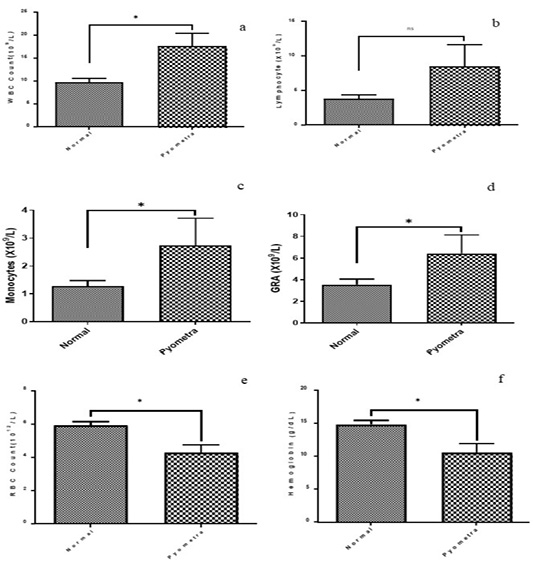
Bitches with pyometra showed clinical signs such as fever, loss of appetite, lethargy, and vaginal discharge in the case of open pyometra. In an ultrasound examination, there was an accumulation of pus in the uterus with increased uterine wall thickness. Table 1 shows the haematological values for healthy bitches and bitches with pyometra. Statistically significant differences (P<0.05) were observed for all bitches with pyometra compared to healthy ones for WBC, monocyte, RBC and hemoglobulin (Table 1).

Table 1: Complete blood count (mean±SD) in normal bitches and bitches with Prometra.

CBC

Normal

Pyometra

Unit

WBC

9.69±3.91

17.61±5.64*

109/l

LYM

4.26±3.24

8.45±6.32

109/l

MON

1.28±0.89

2.74±1.95*

109/l

GRA

4.15±2.95

6.42±3.45

109/l

LYM%

41.96±23.51

42.08±18.96

%

MON%

12.54±4.48

13.95±7.26

%

GRA%

45.50±25.88

43.95±25.87

%

RBC

5.92±1.09

4.29±0.88*

1012/l

HGB

14.87±2.63

10.60±2.59*

g/dl

HCT

40.98±7.34

30.31±6.52*

%

MCV

69.70±6.79

70.75±2.31

Fl

MCH

25.32±2.65

24.60±2.18

Pg

MCHC

36.37±2.51

34.78±1.99

g/dl

RDWs

30.72±5.92

34.20±2.52

fl

RDWc

15.44±1.98

16.60±1.35

%

PLT

321.20±63.60

364.50±88.22

109/l

PCT

0.46±0.10

0.52±0.16

%

MPV

14.15±1.45

14.00±1.03

fl

PDWs

21.18±4.29

21.10±5.53

fl

PDWc

41.50±2.24

41.48±2.35

%

P-LCC

130.17±43.36

154.50±58.86

109/l

P-LCR

42.04±6.34

41.11±5.51

%

* Significant differences (P value < 0.05) between normal and pyometra groups.

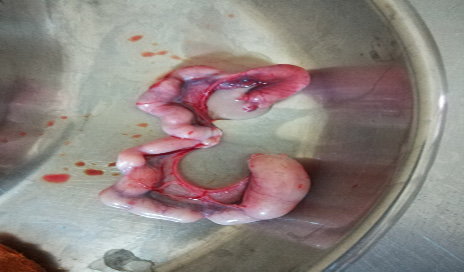
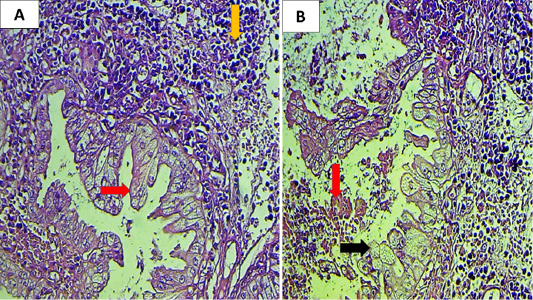
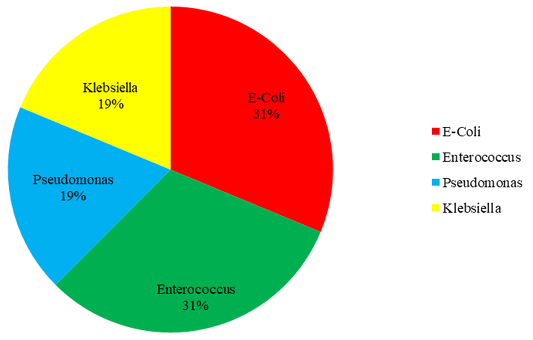
In group I after 24 h from giving Aglepristone there was vaginal discharge, in some cases, we need to give a second dose of Aglepristone to bitch. In group II, PGF2α was injected after pus came out from the vulva, there was a rapid evacuation of pus from the uterus compared with group I with many side effects such as tachycardia, panting, and hypersalivation. In group III Misoprostol was used intravaginal, and evacuation of pus was seen after 1 h. from administration, the evacuation was more than in groups I and II without side effects such as tachycardia and increased panting in group II. In group IV recovery occurred after surgery (Figure 2). The examination section of the bitch uterus infected with pyometra showed extensive thickening of the endometrium due to cystic endometrial hyperplasia (CEH) appeared as a papillary growth complex with pyometra, also extensive inflammatory reaction seen in the endometrial stroma (Figure 3A). Other sections showed sloughing of epithelial cells surrounded by inflammatory cells and the epithelial cells appeared large foamy cytoplasm (Figure 3B). According to the isolation and detection of bacteria, our results showed that the numbers and percentages of E. coli, Enterococcus, Pseudomonas and Klebsiella distributed as {5 (31) %, 5 (31) %, 3 (19)% and 3 (19) %}, respectively (Figure 4).

In this study, the average age of bitches with pyometra was 38 months, this age was younger than that reported by ; ; in which they found that the average age was (8.5, 5.1, 9.3) years, respectively, this result may be due to bad management during mating by the owners and use different hormones without veterinarian consultation. Clinical signs such as fever, lethargy, loss of appetite, polyuria, and polydipsia are similar to those conveyed ; ; . Bitches with pyometra suffered from leukocytosis, which results due to an inflammatory response to pyometra , while anemia is also reported and this result in an agreement with ; . According to group I and group II, Aglepristone acts as a block to progesterone receptors, leading to cervical opening and evacuating uterine contents ; . Also, Aglepristone permits follicular maturation by binding to progesterone’s receptors in the hypothalamus, which removes negative feedback on gonadotropin-releasing hormones . Our results agree with other research dealing with the effectiveness of aglepristone in the treatment of pyometra ; ; ; . In group II, PGF2α was given subcutaneously after appearing of vaginal discharge led to an acceleration in evacuating of the uterus from the pus due to its uterotonic, luteolytic, and stimulation of the muscle musculature . Further, our findings are in harmony with many papers associated with the efficacy of PGF2α in treating pyometra in dogs ; ; ; . In group III, Misoprostol given intravaginally is a synthetic analogue of natural prostaglandin E1 , the pharmacological action of misoprostol on uterine contractions by increased frequency and amplitude, also causes expulsion of uterine contents and cervical dilatation ; . Misoprostol is used to treat pyometra without side effects when using PGF2α, especially when given intravaginal which results in agreement with ; Sharma, 2022). In group IV, after ovariohysterectomy, the bitches recovered after one day and returned to normal health. Many researchers considered ovariohysterectomy as the best choice for the treatment of pyometra in dogs and cats with only the risk of surgical operation and its cost ; ; . Our results for bacterial isolation showed that E-Coli that was the most dominant bacteria which is incoordinate with other studies ; .

CONCLUSIONS AND RECOMMENDATIONS

We concluded that combined Aglepristone with PGF2α effectively treated pyometra in bitches. Misoprostol also increased uterine contractions with quick evacuation of uterine content. We recommended for treatment pyometra to use a combination of Aglepristone and misoprostol in bitches.

ACKNOWLEDGEMENT

The authors gratefully thank the veterinarian of Central Baghdad Veterinary Hospital for their cooperation.

NOVELTY STATEMENT

The novelty of this study is that using a combination Aglepristone with PGF2α and misoprostol for the treatment of pyometra in bitches.

AUTHORS CONTRIBUTION

All authors equally contributed.

Conflict of interest

The authors have declared no conflict of interest.

Figures

Figure 1:
Figure 1:.

Hematological parameters of normal bitches and bitches with pyometra.

Figure 2:
Figure 2:.

Uterus of bitch with pyometra.

Figure 3:
Figure 3:.

Histopathological section of bitch uterus (A) showing cystic endometrial hyperplasia (CEH) appeared as papillary growth complex with pyometra (red arrow), also extensive inflammatory reaction seen in the endometrial stroma (yellow arrow) (B) showing sloughing of epithelial cells (red arrow), the epithelial cells appear large foamy cytoplasm (black arrow) (H & E, 400X).

Figure 4:
Figure 4:.

Distribution of isolated bacteria associated with pyometra in 16 bitches.

References

  1. Agaoglu AR, Aslan S, Emre B, Korkmaz O, Ozdemir Salci ES, Kocamuftuoglu M, Seyrek-Intas K, Schäfer-Somi S (2014). Clinical evaluation of different applications of misoprostol and aglepristone for induction of abortion in bitches. Theriogenology, 81(7): 947–951. https://doi.org/10.1016/j.theriogenology.2014.01.017[CrossRef]
  2. Agaoglu AR, Schäfer-Somi S, Kaya D, Kucukaslan I, Emre B, Gultiken N, Mulazımoglu BS, Colak A, Aslan S (2011). The intravaginal application of misoprostol improves induction of abortion with aglepristone. Theriogenology, 76(1): 74–82. https://doi.org/10.1016/j.theriogenology.2011.01.019[CrossRef]
  3. Attard S, Bucci R, Parrillo S, Pisu MC (2022). Effectiveness of a modified administration protocol for the medical treatment of feline pyometra. Vet. Sci., 9(10): 517. https://doi.org/10.3390/vetsci9100517[CrossRef]
  4. Bagri HK, Sharma M, Sethi M, Shah N, Baishya A, Kumar P, Mohanty TK (2022). An overview on etiopathogenesis of canine pyometra and its management. Pharma Innov. J., SP-11(6): 1184-1188. https://www.thepharmajournal.com/special-issue?year=2022&vol=11&issue=6S&ArticleId=13149
  5. Bancroft JD, Gamble M (2008). Theory and practice of histology techniques. Churchill livingstone Elsevier. London. pp. 83-134.
  6. Bartoskova A, Vitasek R, Leva L, Faldyna M (2007). Hysterectomy leads to fast improvement of haematological and immunological parameters in bitches with pyometra. J. Small Anim. Pract., 48: 564–568. https://doi.org/10.1111/j.1748-5827.2007.00345.x[CrossRef]
  7. Contri A, Gloria A, Carluccio A, Pantaleo S, Robbe D (2015). Effectiveness of a modified administration protocol for the medical treatment of canine pyometra. Vet. Res. Commun., 39(1): 1–5. https://doi.org/10.1007/s11259-014-9619-9[CrossRef]
  8. Dadona NF, Pereira DA, de Oliveira VJ, de Carvalho ACF, Sanarelli NP, Reis LCN, Borges LW (2023). Tratamento conservador para piometra aberta com aglepristone em matriz reprodutiva premiada da raça Buldogue Francês. Res. Soc. Dev., 12(2). https://doi.org/10.33448/rsd-v12i2.40337[CrossRef]
  9. Fieni F (2006). Clinical evaluation of the use of aglepristone, with or without cloprostenol, to treat cystic endometrial hyperplasia-pyometra complex in bitches. Theriogenology, 66(6–7): 1550–1556. https://doi.org/10.1016/j.theriogenology.2006.02.009[CrossRef]
  10. Fieni F, Marnet PG, Martal J, Siliart B, Touzeau N, Bruyas JF, Tainturier D (2001). Comparison of two protocols with a progesterone antagonist aglepristone (RU534) to induce parturition in bitches. J. Reprod. Fertile. Suppl., 57: 237–242.
  11. Fransson BA (2018). Disorders of the uterus. In: Johnston SA, Tobias KM, editors. Vet Surg small Anim. 2nd ed. Elsevier: Amsterdam, pp. 2109–2130.
  12. Garris RE, Kirkwood CF (1989). Misoprostol: A prostaglandin E1 analogue. Am. J. Health-Syst. Pharm., 46(10): 2162–2170. https://doi.org/10.1093/ajhp/46.10.2162[CrossRef]
  13. Gogny A, Fiéni F (2016). Aglepristone: A review on its clinical use in animals. Theriogenology, 85(4): 555–566. https://doi.org/10.1016/j.theriogenology.2015.10.010[CrossRef]
  14. Hagman R (2017). Canine pyometra: What is new? Reprod. Domest. Anim., 52(S2): 288–292. https://doi.org/10.1111/rda.12843[CrossRef]
  15. Hagman R (2018). Pyometra in small animals. J. Vet. Clin. Small Anim. Pract., 48: 639-661. https://doi.org/10.1016/j.cvsm.2018.03.001[CrossRef]
  16. Hagman R (2022). Pyometra in small animals 2.0. Vet. Clin. North Am. Small Anim. Pract., 52: 631–657. https://doi.org/10.1016/j.cvsm.2022.01.004[CrossRef]
  17. Hagman R (2023). Pyometra in small animals 3.0. Vet. Clin.: Small Anim. Pract., 53(5): 1223-1254. https://doi.org/10.1016/j.cvsm.2023.04.009[CrossRef]
  18. Hoffmann B, Schuler G (2000). Receptor blockers general aspects with respect to their use in domestic animal reproduction. Anim. Reprod. Sci., 60–61: 295–312. https://doi.org/10.1016/S0378-4320(00)00129-9[CrossRef]
  19. Jena B, Rao K, Reddy K, Raghavender K (2013). Physiological and haematological parameters of bitches affected with pyometra. Vet. World, 6(7): 409. https://doi.org/10.5455/vetworld.2013.409-412[CrossRef]
  20. Jitpean S, Ambrosen A, Emanuelson U, Hagman R (2017). Closed cervix is associated with more severe illness in dogs with pyometra. BMC Vet. Res., 13(1). https://doi.org/10.1186/s12917-016-0924-0[CrossRef]
  21. Jitpean S, Ström-Holst B, Emanuelson U, Höglund OV, Pettersson A, Alneryd-Bull C, Hagman R (2014). Outcome of pyometra in female dogs and predictors of peritonitis and prolonged postoperative hospitalization in surgically treated cases. BMC Vet. Res., 10(1): 1-12. https://doi.org/10.1186/1746-6148-10-6[CrossRef]
  22. Kumar A, Saxena A (2018). Canine pyometra: Current perspectives on causes and management a review. Indian J. Vet. Sci. Biotechnol., 14(1): 52–56. https://doi.org/10.21887/ijvsbt.v14i1.12998[CrossRef]
  23. Lansubsakul N, Sirinarumitr K, Sirinarumitr T, Imsilp K, Wattananit P, Supanrung S, Limmanont C (2022). First report on clinical aspects, blood profiles, bacterial isolation, antimicrobial susceptibility, and histopathology in canine pyometra in Thailand. Vet. World, 15(7): 1804–1813. https://doi.org/10.14202/vetworld.2022.1804-1813[CrossRef]
  24. Liao AT, Huang WH, Wang SL (2020). Bacterial isolation and antibiotic selection after ovariohysterectomy of canine pyometra: A retrospective study of 55 cases. Taiwan Vet. J., 46(02n03): 1–8. https://doi.org/10.1142/S1682648520500067[CrossRef]
  25. Limmanont C, Lertwatcharasarakul P, Ponglowhapan S, Sirinarumitr K (2021). Molecular studies on estrogen α and progesterone receptors and histomorphometric analysis of canine uteri following aglepristone treatment. Reprod. Domest. Anim., 56(7): 1015–1023. https://doi.org/10.1111/rda.13945[CrossRef]
  26. Melandri M, Veronesi MC, Pisu MC, Majolino G, Alonge S (2019). Fertility outcome after medically treated pyometra in dogs. J. Vet. Sci., 20(4). https://doi.org/10.4142/jvs.2019.20.e39[CrossRef]
  27. Misk TN, El-sherry TM (2020). Pyometra in cats: Medical versus surgical treatment. J. Curr. Vet. Res., 2(1): 86-92. https://doi.org/10.21608/jcvr.2020.90228[CrossRef]
  28. Molina D (2015). Aglepristone efficiency with and without the canine pyometra cloprostenol. Rev. MVZ córdoba, 20(2): 4636-4645. http://www.scielo.org.co/scielo.php?script=sci_arttext&pid=S0122-02682015000200015, https://doi.org/10.21897/rmvz.67[CrossRef]
  29. Oliveira OM, Amorim GBDAG, Oliveira RA, Oba E (2023). Use of prostaglandin E1 analog (misoprostol) to aid cervical dilation in birth induction (a case report). J. Equine Vet. Sci., 125: 104814. https://doi.org/10.1016/j.jevs.2023.104814[CrossRef]
  30. Plumb DC (2018). Plumb’s veterinary drug handbook: Desk. John Wiley & Sons.
  31. Rodrigues da Rosa Filho R, Morales Brito M, Gomes Faustino T, Lima de Almeida L, Correia Manoel V, Cogliati B, Vannucchi CI (2021). Prostaglandin and antigestagen in pyometra bitches: Vascular and stereological effect. Reprod. Fertil., 2(2): 95–105. https://doi.org/10.1530/RAF-20-0020[CrossRef]
  32. Romagnoli S (2017). Practical use of hormones in small animal reproduction. Rev. Bras. Reprod. Anim., 41(1): 59-67.
  33. Rosa Filho RRD, Brito MM, Faustino TG, Almeida LLD, Gardés TP, Leite RF, Vannucchi CI (2020). Clinical changes and uterine hemodynamic in pyometra medically treated bitches. Animals, 10(11). https://doi.org/10.3390/ani10112011[CrossRef]
  34. Rungphattanachaikul S, Akatvipat A, Chia MPC, Lampang KN, Sthitmatee N (2021). A retrospective study of suspected pyometra causing systemic illness in 348 dogs. Vet. Integr. Sci., 19(2): 141-152. https://he02.tci-thaijo.org/index.php/vis/article/view/245663, https://doi.org/10.12982/VIS.2021.013[CrossRef]
  35. Samra Z, Heifetz M, Talmor J, Bain E, Bahar J (1998). Evaluation of use of a new chromogenic agar in detection of urinary tract pathogens. J. Clin. Microbiol. 36(4): 990-994. https://doi.org/10.1128/JCM.36.4.990-994.1998[CrossRef]
  36. Sethi GPS, Gandotra VK, Honparkhe M, Singh AK, Arora AK and Ghuman SPS (2020). Efficacy of Antiprogesterone and PGF2α Therapy for Treating Canine Pyometra. Int.J.Curr.Microbiol.App.Sci. 9(02): 2117-2123. https://doi.org/10.20546/ijcmas.2020.902.240[CrossRef]
  37. Shah MA, Pande N, Shah IA, Agrawal R, Sharma U, Ghuman SPS (2016). Treatment of pyometra in female dogs using prostaglandin PGF2α ± Antiprogestin (Mifepristone). Indian J. Anim. Reprod., 37(1): 23-26. https://acspublisher.com/journals/index.php/ijar/article/view/3499
  38. Sharma A (2022). Open Pyometra in Cocker Spaniel Female: Diagnosis, Treatment, and Management using Mifepristone and Misoprostol. Acta Scientific Veterinary Sciences 4(10): 24-27. https://actascientific.com/ASVS/pdf/ASVS-04-0511.pdf
  39. Zheng HH, Du CT, Zhang YZ, Yu C, Huang RL, Tang XY, Xie GH (2022). Identification of Canine Pyometra-Associated Metabolites Using Untargeted Metabolomics. Int. J. Mol. Sci., 23(22): 14161. https://doi.org/10.3390/ijms232214161[CrossRef]

Services

Article usage statistics

Loading…

Pyometra Treatment in Bitches with Different Protocols · ResearchersLinks