
MicroRNAs (miRNAs) are small non-coding RNA molecules that play a crucial role in gene regulation. This review focuses on the recent advancements in understanding the involvement of miRNAs in atherosclerosis. Atherosclerosis, a major cause of cardiovascular diseases, involves the accumulation of lipid-laden macrophages and immunological cells, leading to plaque formation and artery blockage. This review details the intricate pathogenesis of atherosclerosis, from endothelial dysfunction to the development of atherosclerotic plaques and plaque rupture. The role of miRNAs in atherosclerosis is highlighted, with a focus on both pro-atherogenic and anti-atherogenic miRNAs. Pro-atherogenic miRNAs, such as miRNA-155, miRNA-200b, and miRNA-33, contribute to inflammation, lipid accumulation, and vascular damage. Conversely, anti-atherogenic miRNAs, including miRNA-218-5p, miRNA-98, miRNA-126, and miRNA-223, exhibit protective effects by regulating inflammation, endothelial function, and plaque stability. Recent studies from 2023 are specifically addressed, emphasizing the dynamic landscape of miRNA research in atherosclerosis. The review explores potential therapeutic interventions targeting miRNAs for the treatment of atherosclerosis, providing insights into the promising role of miRNA-based therapies in cardiovascular health.
Review · Volume 58, Issue 3, 11 April 2026 · Open Access
Pro-Atherogenic and Anti-Atherogenic Role of MicroRNAs in Pathobiology of Atherosclerosis
Affiliations & Notes ⌄
- 1Department of Biotechnology, University of Sargodha, Sargodha, Pakistan 2Institute of Cardiovascular and Medical Sciences, University of Glasgow, UK * Corresponding author: misbah.hussain@uos.edu.pk, misbahussain@yahoo.com
Article Info ⌄
- Journal:
- Pakistan Journal of Zoology
- Published:
- 11 April 2026

From the article
- In conclusion, the intricate regulatory role of microRNAs (miRNAs) in atherosclerosis has emerged as a dynamic and promising area of research.
- Recent studies from 2023 underscore the ongoing advancements in miRNA research, focusing on their specific roles and potential applications in cardiovascular health.
- The exploration of miRNA-based interventions, including anti-miRNA therapeutics and delivery systems, opens avenues for innovative strategies to address the complexities of atherosclerosis.
- Overall, the evolving landscape of miRNA research in atherosclerosis offers new possibilities for refining treatment strategies and reducing the global burden of cardiovascular diseases.
Selected from the article's own text.
Abstract
Introduction
MicroRNAs are small non-coding RNA molecules usually coded from different parts of genome. Most commonly they are transcribed from intron however, they can be coded by exons of other genes . Initially, microRNAs (miRNA) are transcribed as primary-miRNA which are then processed by Drosha and Dicer and converted to miRNA duplex which are incorporated to miRNA-induced silencing complex (miRISC) where Argonaut direct miRNA maturation and help in binding to its target mRNA (usually on 3` UTR region) . MiRNA can travel as free circulatory miRNA and/or encapsulated in extracellular vesicles (EV) ; . Various cellular proteins help in selective sorting of miRNAs in their respective EVs for nearby and distant targets . Studies have also found that endogenous circulatory miRNA are highly stable and escape RNase present in circulation. Now these circulatory miRNAs are targeted to find biomarkers and therapies for cardiovascular diseases. A recent study have found enhanced expression of circulatory miRNA-126-5p, miRNA-126-3p, miRNA-181b-5p, and miRNA-29b-3p in serum of coronary artery disease patients . While EV encapsulated miRNA-155 is found to be a culprit for lipid accumulation and atherosclerosis progression . These miRNAs help in cell communication and control expression of ~60% of human genes.
MiRNAs were discovered as unique regulatory components in C. elegans in 1993. These small regulatory molecules play a significantly important role in gene regulation and influence the translation of transcriptome . Increased understanding of RNA-interference and microRNA (miRNA) mediated gene regulation revealed that miRNA exhibit their gene regulatory role by either mRNA degradation or translational repression resulting in downregulation of target gene. In rare cases, miRNA can upregulate the target genes ; . MiRNA expression is highly cell specific, and studies of human cells found that some miRNAs are unique to a single class of cells Owing to their cell and/or tissue specificity, miRNAs are presented as important modulators of physiological and/or pathological cell signaling pathways. In 2006, for first time, Van Rooji et al. (2006) explained the role of miRNA in development of cardiovascular diseases (CVDs) (Van Rooij et al., 2006) which evoked further studies to delineate the regulatory role of miRNA in pathophysiology of CVDs.
CVDs are second major cause of deaths worldwide with an annual death rate of ~17 million (WHO, 2021). In-spite of huge morbidity and mortality rate, it is tricky to treat CVDs due to their complex etiology and pathology. CVDs include various pathologies like atherosclerosis, coronary artery disease, cerebrovascular diseases, heart failure, congenital heart diseases and venous diseases. Scientists are continuously trying to find new potential drug targets to improve the treatment strategies and reduce the burden of CVDs. 32% of all cause mortalities are caused by atherosclerosis . Atherosclerosis is an inflammatory disease characterized by the development of atherosclerotic plaque in coronary arteries, which supply blood to hearts muscles. Obstruction in these arteries owing to development of atherosclerotic plaque causes coronary artery disease (CAD). CAD can leads to myocardial infarction due to rupturing of atherosclerotic plaque and complete blockage of blood flow .
PATHOGENESIS OF ATHEROSCLEROSIS
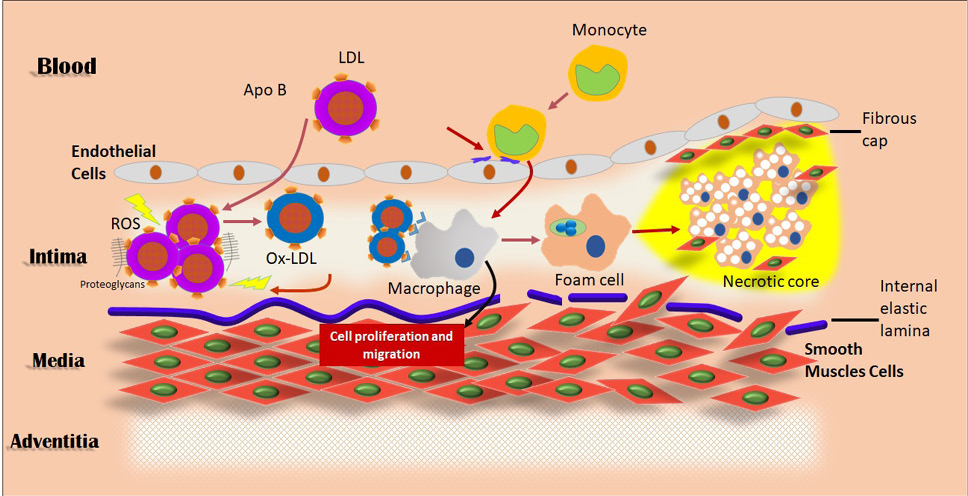
Atherosclerosis starts with the endothelial dysfunction and proceed with accumulation of immunological cells (monocytes and macrophages) and lipid molecules. Activation of atherogenic proteins damage endothelial cells and allow entry of low-density lipoproteins (LDL) into the intima (innermost layer of blood vessels), where proteoglycans (major component of extracellular matrix) bind to Apolipoprotein B-100 (Apo B-100, a surface protein of LDL) and help in LDL accumulation in sub-endothelial region. Different stimuli activate endothelial cells to express surface adhesion molecules which recruit monocytes from blood and transmigrate them to intima where they are matured to macrophages. In intima, LDL is oxidized (Ox-LDL) by cellular and enzymatically produced reactive oxygen species (ROS) and endocytosed by macrophages forming foam cells. Apoptotic cell death of these lipid laden macrophages release lipids and cellular debris establishing necrotic core. Macrophage secreted inflammatory factors stimulate smooth muscle cell proliferation and migration from media to intima where they form fibrous cap which is very important for the stability of atherosclerotic plaque. Growing necrotic core size and thinning of fibrous cap results in plaque rupture which subsequently form thrombus and block artery ; (Fig. 1).
microRNA AND ATHEROSCLEROSIS
Scientist are trying hard to find the risk factors and potential therapeutic agents for treatment of atherosclerosis. Recently, microRNA(miRNA), either circulatory or encapsulated in EVs, are highlighted for their predominant role in regulating atherosclerosis related genes . This is also raising hope for using anti-miRNA therapeutics for improving cardiac health. Comprehensive review articles on the role of microRNA in atherosclerosis have been published in previous years by various researchers ; ; ; ; ; ; . These manuscripts are summarizing the data of previous years. Even review articles published on said topic in 2023 are discussing the data majorly published in 2022 and previous years ; . Current review article is mainly focusing on the recent studies reported in 2023. PubMed and Google scholar were searched for microRNA and atherosclerosis related article. PubMed retrieved 130 publications with following search query [(microRNA (Title/Abstract) AND atherosclerosis (Title/Abstract)]. Among these, 27 were review articles and four manuscripts were discussing the potential drugs for treating atherosclerosis by modulating microRNAs ; ; ; . Some of the manuscripts were about other pathologies or discussing the delivery systems. Figure 2 shows the pro-atherosclerotic and anti-atherosclerotics miRNAs.
PRO-ATHEROGENIC microRNAs
Previous studies have concluded that miRNA-206 plays an anti-atherosclerotic role by down-regulating the atherogenic proteins in vascular smooth muscle cells and macrophages ; ; . Contrary to these studies, Cimen et al. (2023) reported that miRNA-206 promotes atherosclerosis by interacting with CXCR4 (a chemokine receptor) gene and repressing its expression in advanced atherosclerotic lesions. Vascular cell specific down-regulation of miRNA-206 up-regulates the CXCR4 expression and ameliorates the atherosclerosis in mice model.
Endothelial dysfunction is first step towards the development of atherosclerosis. Endothelial dysfunction is characterized by impaired vasorelaxation owing to decreased production of nitric oxide (NO) by endothelial nitric oxide synthase (eNOS). Endothelial dysfunction further start a series of atherosclerotic events including increased endothelial permeability, release of adhesion molecules, recruitment of monocytes and lipoproteins to the sub-intimal region, phenotype switching of vascular smooth muscle cells (VSMC) and foam cell formation by macrophages.
Majority of the previous studies report beneficial role of microRNA (miRNA) in regulating NO release from eNOS ; , however, some studies have reported that miRNA-200b induce endothelial dysfunction by deregulating NO release from eNOS ; . Another family member of miRNA-200, miRNA-200a-3p, also promote endothelial dynsfunction by inducing pyroptosis of H2O2 treated human aortic endothelial cells (HAEC) by activating SIRT1/NF-κB/NLRP3 pathway . MiRNA-24 induce endothelial dysfunction by down-regulating the PI3K/AKT/eNOS signaling pathway . MiRNA-182-5p mediate proinflammatory effects in endothelial cells by upregulating MYD88 (myeloid differentiation factor 88) and activating NF-ĸB/NLRP3 signaling pathway during sleep deprivation . MiRNA-509-3p induce apoptosis in mouse aortic endothelial cells under oxidative stress conditions . The similar apoptotic effect in HAEC was induced by miRNA-338-3p, acting downstream to circ_0026218 and targeting SIRT6 . miRNA-29a also promotes inflammation driven apoptosis in human umbilical vein endothelial cells (HUVEC) by down-regulating PI3K/AKT/Bcl-2 axis . Nicotine induced miRNA-155 rich extracellular vesicles from monocytes trigger endothelial dysfunction by modulating the TIMP3, BCL2, BCL6, MCL1. MicRNA-155 also activates NF-κB mediated vascular inflammatory response leading to vascular damage . Anti-miRNA-155 nanotherapy efficiently downregulated miRNA-155 in endothelial cells of atherosclerotic lesion and helped in inhibiting inflammation .
An in-vitro experiments conducted by Zhu et al. (2023) revealed critical role of miRNA-483-5p in inducing endothelial dysfunction and impairing endothelial autophagy by modulating the expression of TIMP-2 gene. Upregulation of this miRNA in response to oxidized-low density lipoprotein (ox-LDL; an indicator of oxidative stress) also increased the expression of proinflammtory cytokines, interleukin 6, interleukin 1β, intercellular adhesion molecule 1(ICAM-1) and vascular cell adhesion molecule 1(VCAM-1). Increased expression of ICAM-1 and VCAM-1 stimulate recruitment and transmigration of monocytes to sub-intimal region , where these monocytes mature into macrophages and start formation of foam cells by taking up ox-LDL.
MiRNA-33, encoded from introns of sterol regulatory element-binding protein (SREBP)-1 and SREBP-2 genes, affect the lipid metabolism and increase risk of atherosclerosis by post-transcriptionally regulating ABCA1 and ABCG1 genes which are mainly involved in reverse cholesterol transport and high-density lipoprotein (HDL; a.k.a good cholesterol) synthesis ; . A recent study by Montaño-Samaniego et al. (2023) showed that hepatocyte (main hub of lipid metabolism) specific down-regulation of miRNA-33 by antimiR-33 sponge can help in reducing the onset of atherosclerosis. Even precise inhibition of miRNA-33 in pro-inflammatory endothelial cells can reverse atherogenic changes by increasing the expression of ABCA1 and Apo-AI (HDL specific surface protein) . Doxorubicin, a well-known drug used for cancer treatment, also uses miRNA-33 as linking piece of puzzle for causing cardiac toxicity by impairing lipid metabolism . Another potential drug, Astaxanthin, is also reported to promote reverse cholesterol efflux in macrophages by modulating CircTPP2/miR-3073b-5p/ABCA1 Pathway . MiRNA-30a-3p also trigger atherosclerosis in non-alcoholic fatty liver disease (NAFLD) patients by ameliorating the expression of ABCA1 gene and abolishing the cholesterol efflux .
Initiation of these proinflmmatory pathways also trigger phenotype switching of VSMC from contractile to proliferatory phenotype leading to proliferation and migration of VSMC to sub-intimal region. Sheng et al. (2023) observed an increased expression of miRNA-499-5p in ox-LDL treated mice aortic tissues and VSMC. Experiments proved that miRNA-499-5p induce VSMC proliferation and migration by targeting SOX6 gene. MiRNA-499-5p/SOX6 axis leads to overexpression of PCNA, cyclin D1, and matrix metalloproteinase (MMP2) and down-regulates the expression of p21, an inhibitor of VSMC proliferation. Increased level of serum miRNA-499-5p and miRNA-26a were also observed in patients of acute myocardial infarction (which is a consequence of atherosclerosis plaque rupturing) and coronary artery disease, respectively ; . Contrary to the pathological role of miRNA-499-5p in atherosclerosis and myocardial infarction, interaction between miRNA-499-5p and SOX6 gene play beneficial role in arterial fibrillation by suppressing the proliferation, migration and invasion of atrial fibroblasts due to activation of transforming growth factor β (TGF- β) induced Smad2 signaling ; .
MiRNA-130a-3p also promotes atherosclerosis by disturbing the plasma lipid balance. This miRNA binds with LDLR (low density lipoprotein receptor) gene and down-regulates its expression resulting in increased concentration of circulatory LDL, which is a risk factor for atherosclerosis . A recent study by Xu et al. (2023) have shown that Proprotein convertase subtilisin/kexin type 9 (PCSK9) inhibitors down-regulate the production of miRNA-130a-3p in hepatocytes and play a positive role in lipid metabolism to alleviate atherosclerosis in coronary arteries. This finding is in-line with the study of Sun et al. Thus, it could be said that PCSK9 inhibitors paly anti-atherosclerotic role by hindering the binding between miRNA-130-3p and LDLR gene.
MiRNA-34a-5p also increases lipid uptake in macrophages by targeting MDM4 gene . Ox-LDL (an indicator of oxidative stress) stimulated macrophages also release miRNA-320b enriched exosomes which induce VSMC viability, invasion and phenotype switching .
Differentiation of VSMC from stem cells is an important physiological mechanism in blood vessels. Recent study by Zhang et al. (2023) reported that along with other differentiation promoting factors, miRNA-146a also induce VSMC differentiation from embryonic stem cells by targeting Kruppel-like factor 4 (KLF4) and increasing the expression of VSMC specific markers genes (SMαA, SM22, SMMHC and h1-calponin) . Expression of these VSMC specific markers decreases with the phenotype switching from contractile to proliferatory form . Overexpression of Lectin-like oxidized low-density lipoprotein receptor-1 (LOX-1) in hepatocytes protects from phenotype switching of VSMC by up-regulating ALOX15-SRBI/ABCA1 axis . Liposome based delivery of exogenous miRNA-146a to HAEC, aortic VSMC and macrophages reduce inflammatory responses by decreasing adhesion of monocytes, reducing ox-LDL uptake and foam cell formation .
miRNA-1268b acts downstream to circSCRG1 (a circulatory RNA) and promotes ox-LDL induced angiogenesis by increasing the expression of nuclear receptor subfamily 4 group A member 1 (NR4A1) . Oxidative stress induced angiogenesis causes plaque instability and increases the chances of plaque rupture . It is also experimentally proved that miRNA-202-5p induce atherosclerotic plaque formation with less collagen and thin fibrous cap by targeting Bcl-2 in macrophages .
ANTI-ATHEROGENIC microRNAs
MiRNA-218-5p, miRNA-98 plays a protective role in atherosclerosis by regulating inflammation and endothelial dysfunction ; . MiRNA 126 and miRNA-223 are associated with increased carotid plaque stability ; . MiRNA-30b-3p is mostly expressed in vascular smooth muscle cells and plays an important role in ameliorating atherosclerosis induced myocardial injury by down-regulating the Brd4 gene. These protective effects of miRNA-30b-3p are ameliorated by taurine upregulated gene 1 (TUG1; long non-coding RNA) which inhibit its binding to Brd4 gene . This microRNA also targets Rho-related spiral coil 2 containing protein kinase (RHO2) in patients of arteriosclerosis obliteran and reduce the disease progression by inhibiting vascular smooth muscle cell proliferation, migration and phenotype switching . MiRNA-145 and miRNA-122-3p also regulates phenotype switching of VSMCs and reduce atherosclerosis ; . Precise delivery of miRNA-145 to VSMC in-vitro and in-vivo promotes contractile phenotype of VSMCs and reduce atherosclerotic plaque area by 48% . A single dose of miRNA-145 micelle provides long term efficacy against atherosclerosis . Proliferation and migration of VSMCs under oxidative stress is also inhibited by miRNA-663/HMGA2, circ_0007478/miRNA-638/ROCK2 and miRNA-137/TRPC3 signaling pathways ; ; . On the other side, MiRNA-129-5p decreases proliferation of endothelial cells by targeting fibroblast growth factor 2 (FGF-2) ; .
Human umbilical vein endothelial cells (HUVEC) and human aortic endothelial cells (HAEC) are commonly used in cardiovascular research. A study by Lau et al. (2021) has proved that both venous or arterial endothelial cells are equally suitable for cardiovascular research and no significant differences were found in membrane integrity and biochemical molecules produced by these cells . At physiological state, expression level of miRNA-21, miRNA-126, let-7a, miRNA-23a, miRNA-221, miRNA-125b, miRNA-26a, miRNA-29a, miRNA-16, and miRNA-100 is also almost same in both cell types . However, two independent studies published by Ge et al. (2023) and Zhang et al. (2023) showed differences in the upstream and downstream regulation of same miRNA (miRNA-637) in ox-LDL induced HUVEC and HAEC. In HUVEC, ox-LDL increase the expression of LINC00346 which act as sponge for miRNA-637 and increase vascular injury. Overexpression of miRNA-637 helps in mitigating vascular endothelial injury by modulating the expression of NLRP1 . While in ox-LDL induced HAEC, miRNA-637 promotes cell proliferation and angiogenesis and inhibited inflammation and cell apoptosis by modulating the expression of TRAF6 by acting downstream to Circ-0003575 . Ox-LDL induced HUVEC also down-regulate the expression of miRNA-491-5p by up-regulating LINC002381. miRNA-491-5p mitigate the vascular injury, cell apoptosis and inflammation by suppressing the transcription factor 7 (TCF7) . MiRNA-3620-5p also reduce oxidative stress induced endothelial cell dysfunction by binding to the 3` untranslated region (UTR) of MAOB (monoamine Oxidase, a regulator of oxidative stress in endothelial cells) gene.
MiRNA-126 is another protective microRNA, it suppress the foam cell formation by reducing the phygocytosis of ox-LDL by macrophages. Furthermore, it also promotes the switching of M1 macrophage (proinflammatory) to M2 macrophage (anti-inflammatory) . Macrophage M2 polarization was also promoted by miRNA-22-3p by targeting JAK1 gene resulting in reduced expression of downstream protein, NLRP3 .
MiRNA-107 also reduce plaque size and increase plaque stability by down-regulating the expression of mitochondrial dynamics protein of 51 kd (MiD51) and hypoxia-inducible factor-1a (HIF-1a) . miRNA-223-3p reduces necroptosis of foamy macrophages in unstable nacrotic cores of larger size by targeting Ripk3 (receptor-interacting protein kinase 3) gene . Increased expression of miRNA-204 in macrophages also inhibit the pathological atherosclerotic changes induced by cyclosporine-A, by targeting ApoB II gene and down-regulating the expression of CD-36 in nucleus .
Most of the miRNAs either decrease ApoB II (surface protein of LDL) or increase ApoAI (surface protein of HDL) to improve lipid metabolism and ameliorating atherosclerosis. However, miR-541-3p play dual function; 1) decrease apoB II and 2) increase apoA1 expression by targeting mRNA of Znf101 (increase ApoB expression) and Casz1 (decrease ApoAI expression) . MiRNA-106b-5p also reduces lipid deposition (in sub-intimal region), atherosclerotic plaque number, and size in ApoE knockdown mice by acting in PVT1(long non-coding RNA)/miRNA-106b-5p/ACSL4 axis . miRNA-449a also help in reducing the burden of atherosclerosis in elderly patients by repressing the accumulation of senescent cells during aging .
Conclusion
In conclusion, the intricate regulatory role of microRNAs (miRNAs) in atherosclerosis has emerged as a dynamic and promising area of research. Recent studies from 2023 underscore the ongoing advancements in miRNA research, focusing on their specific roles and potential applications in cardiovascular health. The exploration of miRNA-based interventions, including anti-miRNA therapeutics and delivery systems, opens avenues for innovative strategies to address the complexities of atherosclerosis. Overall, the evolving landscape of miRNA research in atherosclerosis offers new possibilities for refining treatment strategies and reducing the global burden of cardiovascular diseases. Future studies are likely to uncover additional intricacies of miRNA involvement in atherosclerosis, paving the way for personalized and targeted therapeutic approaches in cardiovascular medicine.
Declarations
Acknowledgement
I really appreciates all the scientists and researchers trying hard to find the microRNAs involved in ather-osclerosis.
Funding
Author declare that no funds, grants, or other support were received during the preparation of this manuscript.
Generative AI and AI-assisted technology statement
The author declares that no generative artificial intelligence (AI) tools or AI assisted technologies were used in the preparation, writing, data analysis or editing of this manuscript.
Statement of conflict of interest
The authors have declared no conflict of interest.
Figures
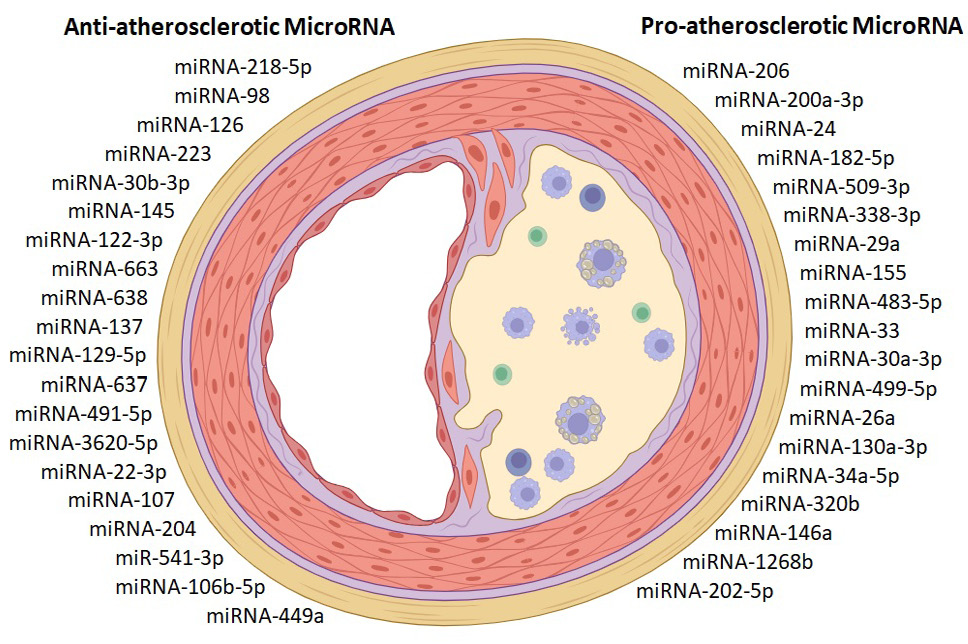
Pro-atherogenic and anti-atherogenic MicroRNAs
References
- Abdel-Hamed, A.R., Nasser, E.D.M., Abo-Elmatty, G., Nasr, M. and Salem, A.S., 2023. Serum microRNA-499-5p expression and its correlation with chemokine (CC motif) ligand 18 in acute myocardial infarction. Egypt. J. Hosp. Med., 90: 2839-2846. https://doi.org/10.21608/ejhm.2023.287338[CrossRef]
- An, L., Gao, L., Ning, M., Wu, F., Dong, F., Ni, X., Wu, Y., Jing, Q. and Gao, Y., 2023. Correlation between decreased plasma miR-29a and vascular endothelial injury induced by hyperlipidemia. Herz, 48: 301-308. https://doi.org/10.1007/s00059-022-05121-x[CrossRef]
- Ansari, A., Yadav, P.K., Zhou, L., Prakash, B., Gangula, L., Ijaz, A., Christiano, A., Ahmad, S., Rimbert, A. and Hussain, M.M., 2023. MicroRNA-541-3p alters lipoproteins to reduce atherosclerosis by degrading Znf101 and Casz1 transcription factors. bioRxiv, pp. 2001.565110. https://doi.org/10.1101/2023.11.01.565110[CrossRef]
- Bennett, M.R., Sinha, S. and Owens, G.K., 2016. Vascular smooth muscle cells in atherosclerosis. Circ. Res., 118: 692-702. https://doi.org/10.1161/CIRCRESAHA.115.306361[CrossRef]
- Bergström, G., Persson, M., Adiels, M., Björnson, E., Bonander, C., Ahlström, H., Alfredsson, J., Angerås, O., Berglund, G. and Blomberg, A., 2021. Prevalence of subclinical coronary artery atherosclerosis in the general population. Circulation, 144: 916-929. https://doi.org/10.1161/CIRCULATIONAHA.121.055340[CrossRef]
- Bi, R., Bao, C., Jiang, L., Liu, H., Yang, Y., Mei, J. and Ding, F., 2015. MicroRNA-27b plays a role in pulmonary arterial hypertension by modulating peroxisome proliferator-activated receptor γ dependent Hsp90-eNOS signaling and nitric oxide production. Biochem. Biophys. Res. Commun., 460: 469-475. https://doi.org/10.1016/j.bbrc.2015.03.057[CrossRef]
- Bian, X., Peng, H., Wang, Y., Guo, H. and Shi, G., 2023. MicroRNA-22-3p alleviates atherosclerosis by mediating macrophage M2 polarization as well as inhibiting NLRP3 activation. J. Int. med. Res., 51: 03000605231197071. https://doi.org/10.1177/03000605231197071[CrossRef]
- Blaser, M.C., Buffolo, F., Halu, A., Turner, M.E., Schlotter, F., Higashi, H., Pantano, L., Clift, C.L., Saddic, L.A. and Atkins, S.K., 2023. Multiomics of tissue extracellular vesicles identifies unique modulators of atherosclerosis and calcific aortic valve stenosis. Circulation, 148: 661-678. https://doi.org/10.1161/CIRCULATIONAHA.122.063402[CrossRef]
- Boyd, S.D., 2008. Everything you wanted to know about small RNA but were afraid to ask. Lab. Invest., 88: 569-578. https://doi.org/10.1038/labinvest.2008.32[CrossRef]
- Camaré, C., Pucelle, M., Nègre-Salvayre, A. and Salvayre, R., 2017. Angiogenesis in the atherosclerotic plaque. Redox Biol., 12: 18-34. https://doi.org/10.1016/j.redox.2017.01.007[CrossRef]
- Chen, J., Tang, Z., Chen, Z., Wei, Y., Liang, H., Zhang, X., Gao, Z. and Zhu, H., 2023. MicroRNA-218-5p regulates inflammation response via targeting TLR4 in atherosclerosis. BMC Cardiovasc. Disord., 23: 1-9. https://doi.org/10.1186/s12872-023-03124-y[CrossRef]
- Chen, X., Chen, S., Pang, J., Huang, R., You, Y., Zhang, H., Xiao, J., Xue, H. and Ling, W., 2023. Hepatic steatosis aggravates atherosclerosis via small extracellular vesicle-mediated inhibition of cellular cholesterol efflux. J. Hepatol., 79: 1491-1501. https://doi.org/10.1016/j.jhep.2023.08.023[CrossRef]
- Chin, D.D., Patel, N., Lee, W., Kanaya, S., Cook, J. and Chung, E.J., 2023. Long-term, in vivo therapeutic effects of a single dose of miR-145 micelles for atherosclerosis. Bioactive Mater., 27: 327-336. https://doi.org/10.1016/j.bioactmat.2023.04.001[CrossRef]
- Churov, A., Summerhill, V., Grechko, A., Orekhova, V. and Orekhov, A., 2019. MicroRNAs as potential biomarkers in atherosclerosis. Int. J. mol. Sci., 20: 5547. https://doi.org/10.3390/ijms20225547[CrossRef]
- Cimen, I., Natarelli, L., Kichi, A.Z., Henderson, J.M., Farina, F.M., Briem, E., Aslani, M., Megens, R.T., Jansen, Y. and Mann-Fallenbuchel, E., 2023. Targeting a cell-specific microRNA repressor of CXCR4 ameliorates atherosclerosis in mice. Sci. Trans. Med., 15: eadf3357. https://doi.org/10.1126/scitranslmed.adf3357[CrossRef]
- Coban, N., Erkan, A.F., Ozuynuk-Ertugrul, A.S. and Ekici, B., 2023. Investigation of miR-26a-5p and miR-19a-3p expression levels in angiographically confirmed coronary artery disease. Acta Cardiol., 78: 945-956. https://doi.org/10.1080/00015385.2023.2227484[CrossRef]
- Creemers, E.E., Tijsen, A.J. and Pinto, Y.M., 2012. Circulating microRNAs: Novel biomarkers and extracellular communicators in cardiovascular disease? Circ. Res., 110: 483-495. https://doi.org/10.1161/CIRCRESAHA.111.247452[CrossRef]
- Deng, Z. and Li, L., 2023. Effect of miR-663 on atherosclerosis by regulating the proliferation of vascular smooth muscle cells in lipid plaques. Vascular, 31: 1240-1252. https://doi.org/10.1177/17085381221098826[CrossRef]
- Ekedi, A.V.N.B., Rozhkov, A.N., Shchekochikhin, D.Y., Novikova, N.A., Kopylov, P.Y., Bestavashvili, A.A., Ivanova, T.V., Zhelankin, A.V., Generozov, E.V. and Konanov, D.N., 2023. Evaluation of microRNA expression features in patients with various types of arterial damage: Thoracic aortic aneurysm and coronary atherosclerosis. J. Personal. Med., 13: 1161. https://doi.org/10.3390/jpm13071161[CrossRef]
- Engels, B.M. and Hutvagner, G., 2006. Principles and effects of microRNA-mediated post-transcriptional gene regulation. Oncogene, 25: 6163-6169. https://doi.org/10.1038/sj.onc.1209909[CrossRef]
- Garmy-Susini, B., Delmas, E., Gourdy, P., Zhou, M., Bossard, C., Bugler, B., Bayard, F., Krust, A., Prats, A. and Doetschman, T., 2004. Role of fibroblast growth factor-2 isoforms in the effect of estradiol on endothelial cell migration and proliferation. Circ. Res., 94: 1301-1309. https://doi.org/10.1161/01.RES.0000127719.13255.81[CrossRef]
- Ge, J.Y., Yan, X.J., Yang, J., Jin, H., Sun, Z.K., Guo, J.L., Zhu, Y. and Wang, F.F., 2023. LINC00346 regulates NLRP1-mediated pyroptosis and autophagy via binding to microRNA-637 in vascular endothelium injury. Cell. Signall., pp. 110740. https://doi.org/10.1016/j.cellsig.2023.110740[CrossRef]
- Groot, M. and Lee, H., 2020. Sorting mechanisms for MicroRNAs into extracellular vesicles and their associated diseases. Cells, 9: 1044. https://doi.org/10.3390/cells9041044[CrossRef]
- Guan, Z., Lu, R., Sun, Y., Wang, X., Yu, C. and Song, T., 2023. Regulation of oxidized LDL-induced proliferation and migration in human vascular smooth muscle cells by a novel circ_0007478/miR-638/ROCK2 ceRNA network. Vasc. Med., 28: 6-17. https://doi.org/10.1177/1358863X221137617[CrossRef]
- Habas, K. and Shang, L., 2018. Alterations in intercellular adhesion molecule 1 (ICAM-1) and vascular cell adhesion molecule 1 (VCAM-1) in human endothelial cells. Tissue Cell, 54: 139-143. https://doi.org/10.1016/j.tice.2018.09.002[CrossRef]
- Hajibabaie, F., Kouhpayeh, S., Mirian, M., Rahimmanesh, I., Boshtam, M., Sadeghian, L., Gheibi, A., Khanahmad, H. and Shariati, L., 2020. MicroRNAs as the actors in the atherosclerosis scenario. J. Physiol. Biochem., 76: 1-12. https://doi.org/10.1007/s13105-019-00710-7[CrossRef]
- Han, X., Wang, S., Yong, Z., Zhang, X., Wang, X. and You, P., 2023. Effect of miR-499-5p/SOX6 axis on atrial fibrosis in rats with atrial fibrillation. Open Med., 18: 20230654. https://doi.org/10.1515/med-2023-0654[CrossRef]
- Ho, D., Lynd, T.O., Jun, C., Shin, J., Millican, R.C., Estep, B.K., Chen, J., Zhang, X., Brott, B.C. and Kim, D.W., 2023. MiR-146a encapsulated liposomes reduce vascular inflammatory responses through decrease of ICAM-1 expression, macrophage activation, and foam cell formation. Nanoscale, 15: 3461-3474. https://doi.org/10.1039/D2NR03280E[CrossRef]
- Horie, T., Baba, O., Kuwabara, Y., Chujo, Y., Watanabe, S., Kinoshita, M., Horiguchi, M., Nakamura, T., Chonabayashi, K., Hishizawa, M., Hasegawa, K., Kume, N., Yokode, M., Kita, T., Kimura, T. and Ono, K., 2012. MicroRNA-33 deficiency reduces the progression of atherosclerotic plaque in ApoE−/− mice. J. Am. Heart Assoc., 1: 1-13. https://doi.org/10.1161/JAHA.112.003376[CrossRef]
- Hu, X., Ma, R., Fu, W., Zhang, C. and Du, X., 2019. LncRNA UCA1 sponges miR-206 to exacerbate oxidative stress and apoptosis induced by ox-LDL in human macrophages. J. Cell. Physiol., 234: 14154-14160. https://doi.org/10.1002/jcp.28109[CrossRef]
- Huang, K., Pitman, M., Oladosu, O., Echesabal-Chen, J., Vojtech, L., Esobi, I., Larsen, J., Jo, H. and Stamatikos, A., 2023. The impact of MiR-33a-5p inhibition in pro-inflammatory endothelial cells. Diseases, 11: 88. https://doi.org/10.3390/diseases11030088[CrossRef]
- Janaszak-Jasiecka, A., Siekierzycka, A., Bartoszewska, S., Serocki, M., Dobrucki, L.W., Collawn, J.F., Kalinowski, L. and Bartoszewski, R., 2018. eNOS expression and NO release during hypoxia is inhibited by miR-200b in human endothelial cells. Angiogenesis, 21: 711-724. https://doi.org/10.1007/s10456-018-9620-y[CrossRef]
- Jia, Y., Cheng, L., Yang, J., Mao, J., Xie, Y., Yang, X., Zhang, X., Wang, D., Zhao, Z. and Schober, A., 2024. “miR-223-3p prevents necroptotic macrophage death by targeting Ripk3 in a negative feedback loop and consequently ameliorates advanced atherosclerosis. Arterioscl. Thromb. Vasc. Biol., 44: 218-237. https://doi.org/10.1161/ATVBAHA.123.319776[CrossRef]
- Kong, J., Liu, L., Song, L., Zhao, R., and Feng, Y., 2023. MicroRNA miR-34a-5p inhibition restrains oxidative stress injury of macrophages by targeting MDM4. Vascular, 31: 608-618. https://doi.org/10.1177/17085381211069447[CrossRef]
- Lau, S., Gossen, M., Lendlein, A. and Jung, F., 2021. Venous and arterial endothelial cells from human umbilical cords: Potential cell sources for cardiovascular research. Int. J. mol. Sci., 22: 978. https://doi.org/10.3390/ijms22020978[CrossRef]
- Li, D.L., Zheng, B.B., Zeng, X., Li, J. and Dai, R.Z., 2023. Silencing of long noncoding RNA TUG1 ameliorates atherosclerosis-induced myocardial injury by upregulating microRNA-30b-3p and downregulating Brd4. J. Cardiovasc. Pharmacol., 81: 45-54. https://doi.org/10.1097/FJC.0000000000001367[CrossRef]
- Li, J., Wang, M., Wu, X., Xie, N., Wang, H., Huang, J., Sheng, F. and Ma, W., 2023. miR-129-5p/FGF2 axis is associated with homocysteine-induced human umbilical vein endothelial cell injury. Combinatorial Chemistry & High Throughput Screening. https://doi.org/10.2174/1386207326666230509100019[CrossRef]
- Li, W., Gao, Z. and Guan, Q.L., 2023. Tan IIA mitigates vascular smooth muscle cell proliferation and migration induced by ox-LDL through the miR-137/TRPC3 axis. Kaohsiung J. med. Sci., 39: 596-604. https://doi.org/10.1002/kjm2.12663[CrossRef]
- Li, X., Cao, Y., Xu, X., Wang, C., Ni, Q., Lv, X., Yang, C., Zhang, Z., Qi, X. and Song, G., 2023. Sleep deprivation promotes endothelial inflammation and atherogenesis by reducing exosomal miR-182-5p. Arterioscl. Thromb. Vasc. Biol., 43: 995-1014. https://doi.org/10.1161/ATVBAHA.123.319026[CrossRef]
- Li, Z., Zhao, Y., Suguro, S. and Suguro, R., 2023. MicroRNAs regulate function in atherosclerosis and clinical implications. Oxid. Med. Cell. Long., 2023. https://doi.org/10.1155/2023/2561509[CrossRef]
- Liu, J., Yan, Y., Zheng, D., Zhang, J. and Wang, J., 2023. Inhibiting microRNA-200a-3p attenuates pyroptosis via targeting the SIRT1/NF-κB/NLRP3 pathway in H 2 O 2-induced HAEC. Aging, 15: 11184-11200. https://doi.org/10.18632/aging.205121[CrossRef]
- Liu, Y., He, M., Yuan, Y., Nie, C., Wei, K., Zhang, T., Chen, T. and Chu, V., 2023. Neutrophil-membrane-coated biomineralized metal–organic framework nanoparticles for atherosclerosis treatment by targeting gene silencing. ACS Nano, 17: 7721-7732. https://doi.org/10.1021/acsnano.3c00288[CrossRef]
- Ludwig, N., Leidinger, P., Becker, K., Backes, C., Fehlmann, T., Pallasch, C., Rheinheimer, S., Meder, B., Stähler, C. and Meese, E., 2016. Distribution of miRNA expression across human tissues. Nucl. Acids Res., 44: 3865-3877. https://doi.org/10.1093/nar/gkw116[CrossRef]
- Lusis, A.J., 2000. Atherosclerosis. Nature, 407: 233-241. https://doi.org/10.1038/35025203[CrossRef]
- Montaño-Samaniego, M., Sánchez-Cedillo, J., Lucas-González, A., Bravo-Estupiñan, D.M., Alarcón-Hernández, E., Rivera-Gutiérrez, S., Balderas-López, J.A. and Ibáñez-Hernández, M., 2023. Targeted expression to liver of an antimiR-33 sponge as a gene therapy strategy against hypercholesterolemia: In vitro study. Curr. Issues Mol. Biol., 45: 7043-7057. https://doi.org/10.3390/cimb45090445[CrossRef]
- Natarelli, L. and Schober, A., 2015. MicroRNAs and the response to injury in atherosclerosis. Hämostaseologie, 35: 142-150. https://doi.org/10.5482/HAMO-14-10-0051[CrossRef]
- Nedkoff, L., Briffa, T., Zemedikun, D., Herrington, S. and Wright, F.L., 2023. Global trends in atherosclerotic cardiovascular disease. Clin. Ther., 45: 1087–1091. https://doi.org/10.1016/j.clinthera.2023.09.020[CrossRef]
- Nilsen, T.W., 2007. Mechanisms of microRNA-mediated gene regulation in animal cells. Trends Genet., 23: 243-249. https://doi.org/10.1016/j.tig.2007.02.011[CrossRef]
- Noureddine, S., Nie, J., Schneider, A., Menon, V., Fliesen, Z., Dhahbi, J., Victoria, B., Oyer, J., Robles-Carrillo, L. and Nunes, A.D.D.C., 2023. microRNA-449a reduces growth hormone-stimulated senescent cell burden through PI3K-mTOR signaling. Proc. natl. Acad. Sci., 120: e2213207120. https://doi.org/10.1073/pnas.2213207120[CrossRef]
- O’Brien, K., Breyne, K., Ughetto, S., Laurent, L.C. and Breakefield, X.O., 2020. RNA delivery by extracellular vesicles in mammalian cells and its applications. Nat. Rev. Mol. Cell Biol., 21: 585-606. https://doi.org/10.1038/s41580-020-0251-y.[CrossRef]
- Ren, J., Liu, J., Zhang, J., Hu, X., Cui, Y., Wei, X., Ma, Y., Li, X. and Zhao, Y., 2023. Dynamin-related protein 1 binding partners MiD49 and MiD51 increased mitochondrial fission in vitro and atherosclerosis in high-fat-diet-fed ApoE-/-Mice. Int. J. mol. Sci., 25: 244. https://doi.org/10.3390/ijms25010244[CrossRef]
- Ren, L., Chen, S. and Liu, W., 2024. OxLDL-stimulated macrophages transmit exosomal MicroRNA-320b to aggravate viability, invasion, and phenotype switching via regulating PPARGC1A-mediated MEK/ERK pathway in proatherogenic vascular smooth muscle cells. Tohoku J. exp. Med., 262: 13-22. https://doi.org/10.1620/tjem.2023.J082[CrossRef]
- Schober, A. and Weber, C., 2016. Mechanisms of microRNAs in atherosclerosis. Ann. Rev. Pathol. Mech. Dis., 11: 583-616. https://doi.org/10.1146/annurev-pathol-012615-044135[CrossRef]
- Sheng, Y., Yang, Z., Feng, Z., Wang, Y. and Ji, N., 2023. MicroRNA-499-5p promotes vascular smooth muscle cell proliferation and migration via inhibiting SOX6. Physiol. Genom., 55: 67-74. https://doi.org/10.1152/physiolgenomics.00165.2021[CrossRef]
- Shou, X., Wang, Y., Jiang, Q., Chen, J., and Liu, Q., 2023. miR-126 promotes M1 to M2 macrophage phenotype switching via VEGFA and KLF4. PeerJ, 11: e15180. https://doi.org/10.7717/peerj.15180[CrossRef]
- Sidorkiewicz, M., 2023. “Is microRNA-33 an appropriate target in the treatment of atherosclerosis? Nutrients, 15: 902. https://doi.org/10.3390/nu15040902[CrossRef]
- Skeoch, S. and Bruce, I.N., 2015. Atherosclerosis in rheumatoid arthritis: Is it all about inflammation? Nat. Rev. Rheumatol., 11: 390-400. https://doi.org/10.1038/nrrheum.2015.40[CrossRef]
- Su, J.H., Hong, Y., Han, C.C., Yu, J., Guan, X., Zhu, Y.M., Wang, C., Ma, M.M., Pang, R.P., Ou, J.S., Zhou, J.G., Zhang, Z.Y., Ban, T. and Liang, S.J., 2023. Dual action of macrophage miR-204 confines cyclosporine A-induced atherosclerosis. Br. J. Pharmacol., pp. 1-13. https://doi.org/10.1111/bph.16240[CrossRef]
- Sun, H., Krauss, R.M., Chang, J.T. and Teng, B.B., 2018. PCSK9 deficiency reduces atherosclerosis, apolipoprotein B secretion, and endothelial dysfunction. J. Lipid Res., 59: 207-223. https://doi.org/10.1194/jlr.M078360[CrossRef]
- Sun, H.X., Zeng, D.Y., Li, R.T., Pang, R.P., Yang, H., Hu, Y.L., Zhang, Q., Jiang, Y., Huang, L.Y. and Tang, Y.B., 2012. Essential role of microRNA-155 in regulating endothelium-dependent vasorelaxation by targeting endothelial nitric oxide synthase. Hypertension, 60: 1407-1414. https://doi.org/10.1161/HYPERTENSIONAHA.112.197301[CrossRef]
- Sun, X., Belkin, N. and Feinberg, M.W., 2013. Endothelial microRNAs and atherosclerosis. Curr. Atherosc. Rep., 15: 1-13. https://doi.org/10.1007/s11883-013-0372-2[CrossRef]
- Tabaei, S. and Tabaee, S.S., 2021. Implications for MicroRNA involvement in the prognosis and treatment of atherosclerosis. Mol. Cell. Biochem., 476: 1327-1336. https://doi.org/10.1007/s11010-020-03992-4[CrossRef]
- Tanashyan, M.M., Shabalina, A.A., Kuznetsova, P.I. and Raskurazhev, A.A., 2023. miR-33a and Its association with lipid profile in patients with carotid atherosclerosis. Int. J. mol. Sci., 24: 6376. https://doi.org/10.3390/ijms24076376[CrossRef]
- Theofilis, P., Oikonomou, E., Vogiatzi, G., Sagris, M., Antonopoulos, A.S., Siasos, G., Iliopoulos, D.C., Perrea, D., Vavouranakis, M. and Tsioufis, K., 2023. The role of microRNA-126 in atherosclerotic cardiovascular diseases. Curr. Med. Chem., 30: 1902-1921. https://doi.org/10.2174/0929867329666220830100530[CrossRef]
- Van-Rooij, E., Sutherland, L.B., Liu, N., Williams, A.H., McAnally, J., Gerard, R.D., Richardson, J.A. and Olson, E.N., 2006. A signature pattern of stress-responsive microRNAs that can evoke cardiac hypertrophy and heart failure. Proc. natl. Acad. Sci., 103: 18255-18260. https://doi.org/10.1073/pnas.0608791103[CrossRef]
- Wang, C., Liu, C., Shi, J., Li, H., Jiang, S., Zhao, P., Zhang, M., Du, G., Fu, S. and Li, S., 2023. Nicotine exacerbates endothelial dysfunction and drives atherosclerosis via extracellular vesicle-miRNA. Cardiovasc. Res., 119: 729-742. https://doi.org/10.1093/cvr/cvac140[CrossRef]
- Wang, X. and Bai, M., 2021. CircTM7SF3 contributes to oxidized low-density lipoprotein-induced apoptosis, inflammation and oxidative stress through targeting miR-206/ASPH axis in atherosclerosis cell model in vitro. BMC Cardiovasc. Disorders, 21: 1-14. https://doi.org/10.1186/s12872-020-01800-x[CrossRef]
- WHO, 2021. Cardiovascular diseases. Retrieved 22-1-2024, from https://www.who.int/news-room/fact-sheets/detail/cardiovascular-diseases-(cvds).
- Wu, Y., Deng, C., Xu, J., Wang, W., Chen, Y., Qin, X., Lv, Q. and Xie, M., 2023. Enhanced local delivery of microRNA-145a-5P into mouse aorta via ultrasound-targeted microbubble destruction inhibits atherosclerotic plaque formation. Mol. Pharma., 20: 1086-1095. https://doi.org/10.1021/acs.molpharmaceut.2c00799[CrossRef]
- Xing, T., Du, L., Zhuang, X., Zhang, L., Hao, J. and Wang, J., 2017. Upregulation of microRNA-206 induces apoptosis of vascular smooth muscle cells and decreases risk of atherosclerosis through modulating FOXP1. Exp. Therapeut. Med., 14: 4097-4103. https://doi.org/10.3892/etm.2017.5071[CrossRef]
- Xu, F., Yao, F. and Ning, F., 2023. MicroRNA-202-5p-dependent inhibition of Bcl-2 contributes to macrophage apoptosis and atherosclerotic plaque formation. Gene, 867: 147366. https://doi.org/10.1016/j.gene.2023.147366[CrossRef]
- Xu, J., Zuo, J., Han, C., Li, T., Jin, D., Zhao, F. and Cong, H., 2023. Proprotein convertase subtilisin/kexin 9 inhibitor downregulates microRNA-130a-3p expression in hepatocytes to alleviates atherosclerosis progression. Naunyn-Schmiedeberg’s Arch. Pharmacol., pp. 1-10. https://doi.org/10.1007/s00210-023-02708-x[CrossRef]
- Yang, H.H., Chen, Y., Gao, C.Y., Cui, Z.T. and Yao, J.M., 2017. Protective effects of MicroRNA-126 on human cardiac microvascular endothelial cells against hypoxia/reoxygenation-induced injury and inflammatory response by activating PI3K/Akt/eNOS signaling pathway. Cell. Physiol. Biochem., 42: 506-518. https://doi.org/10.1159/000477597[CrossRef]
- Yang, L., Chen, W., Li, B., Hu, Y., Lu, H., Zhang, P., Yang, H., Zhang, M. and Pan, D., 2023. Circular RNA circ_0026218 suppressed atherosclerosis progression via miR-338-3p/SIRT6 Axis. BioMed. Res. Int., 2023. https://doi.org/10.1155/2023/5647758[CrossRef]
- Yang, X., Yang, W., He, S., Ye, H. and Lei, S., 2023. Danhong formula alleviates endothelial dysfunction and reduces blood pressure in hypertension by regulating MicroRNA 24-Phosphatidylinositol 3-Kinase-serine/threonine kinase-endothelial nitric oxide synthase axis. J. Ethnopharmacol., pp. 117615. https://doi.org/10.1016/j.jep.2023.117615[CrossRef]
- Yu, H., Cao, H. and Yu, H., 2023. MicroRNA-98 inhibition accelerates the development of atherosclerosis via regulation of dysfunction of endothelial cell. Clin. exp. Hyperten., 45: 2206068. https://doi.org/10.1080/10641963.2023.2206068[CrossRef]
- Yuan, R., Xin, Q., Ma, X., Yu, M., Miao, Y., Chen, K. and Cong, W., 2023. Identification of a novel angiogenesis signalling circSCRG1/miR-1268b/NR4A1 pathway in atherosclerosis and the regulatory effects of TMP-PF in vitro. Molecules, 28: 1271. https://doi.org/10.3390/molecules28031271[CrossRef]
- Zhang, L., Huang, Q.W., Pu, Y.F., Xiao, X.Q., Song, B.J., Zhang, X.P., Yang, Y.S., Zhang, Y.S. and Gong, F.H., 2023. MiR-122 knockdown regulates vascular smooth muscle cells phenotypic switching through enhanced FOXO3 expression. Can. J. Physiol. Pharmacol., 101: 652-660. https://doi.org/10.1139/cjpp-2022-0549[CrossRef]
- Zhang, M., Chen, Y., Niu, F., Luo, X., Li, J. and Hu, W., 2023. MicroRNA-30a-3p: A potential noncoding RNA target for the treatment of arteriosclerosis obliterans. Aging (Albany NY). 15: 11875. https://doi.org/10.18632/aging.205154[CrossRef]
- Zhang, M., Yu, Z., Zhao, L. and Luo, H., 2023. Long non-coding RNA PVT1 regulates atherosclerosis progression via the microRNA-106b-5p/ACSL4 axis. Biochem. biophys. Res. Commun., 667: 170-179. https://doi.org/10.1016/j.bbrc.2023.05.037[CrossRef]
- Zhang, Q., Du, G., Tong, L., Guo, X. and Wei, Y., 2023. Overexpression of LOX-1 in hepatocytes protects vascular smooth muscle cells from phenotype transformation and wire injury induced carotid neoatherosclerosis through ALOX15. Biochim. Biophys. Acta Mol. Basis Dis., 1869: 166805. https://doi.org/10.1016/j.bbadis.2023.166805[CrossRef]
- Zhang, Q., Pan, R.R., Wu, Y.T. and Wei, Y.M., 2023. MicroRNA-146a promotes embryonic stem cell differentiation towards vascular smooth muscle cells through regulation of kruppel-like factor 4. Curr. med. Sci., pp. 1-9. https://doi.org/10.1007/s11596-023-2736-3[CrossRef]
- Zhang, R., Song, Y., Zhao, F., Liu, T., Cong, H. and Zhao, H., 2023. miR-509-3p promotes oxidized low-density lipoprotein-induced apoptosis in mouse aortic endothelial cells. Zhonghua wei Zhong Bing ji jiu yi xue, 35: 1291-1297.
- Zhang, Z., Qin, S., Wang, R., Fang, Z., Wang, Y. and Li, F., 2023. Circ_0003575 knockdown alleviates ox-LDL-induced human aortic endothelial cell dysfunction in atherosclerosis by miR-637/TRAF6 axis. Clin. Hemorheol. Microcirc., (Preprint): pp. 1-15. https://doi.org/10.3233/CH-231858[CrossRef]
- Zhang, Z., Qiu, Y., Li, W., Tang, A., Huang, H., Yao, W., Li, H. and Zou, T., 2023. Astaxanthin alleviates foam cell formation and promotes cholesterol efflux in Ox-LDL-induced RAW264. 7 cells via CircTPP2/miR-3073b-5p/ABCA1 pathway. Molecules, 28: 1701. https://doi.org/10.3390/molecules28041701[CrossRef]
- Zhao, Q., Yang, W., Li, X., Yuan, H., Guo, J., Wang, Y. and Shan, Z., 2023. MicroRNA-499-5p inhibits transforming growth factor-β1-induced Smad2 signaling pathway and suppresses fibroblast proliferation and collagen synthesis in rat by targeting TGFβ-R1. Mol. Biol. Rep., 50: 9757-9767. https://doi.org/10.1007/s11033-023-08755-0[CrossRef]
- Zhu, F., Chang, G., Tang, X., Gao, L. and Zhang, N., 2023. Doxorubicin inhibits cholesterol efflux through the miR-33/ABCA1 pathway. Biochem. biophys. Res. Commun., 644: 149-154. https://doi.org/10.1016/j.bbrc.2023.01.024[CrossRef]
- Zhu, H., Liang, H., Gao, Z., Zhang, X., He, Q., He, C., Cai, C. and Chen, J., 2023. MiR-483-5p downregulation alleviates ox-LDL induced endothelial cell injury in atherosclerosis. BMC Cardiovasc. Disord., 23: 521. https://doi.org/10.1186/s12872-023-03496-1[CrossRef]
- Zhu, L., Wang, Y. and Qiao, F., 2023. microRNA-223 and microRNA-126 are clinical indicators for predicting the plaque stability in carotid atherosclerosis patients. J. Hum. Hyperten., 37: 788-795. https://doi.org/10.1038/s41371-022-00760-3[CrossRef]
- Zhu, X., Xu, H. and Chen, B., 2023. Inhibition of ox-LDL-induced endothelial cell injury by LINC02381 knockdown through the microRNA-491-5p/transcription factor 7 axis. Immun. Inflamm. Dis., 11: e785. https://doi.org/10.1002/iid3.785[CrossRef]
Services
Article usage statistics
Loading…