Principal Component Analysis of Morphological Characteristics in Creole Sheep (Ovis aries)
· · · · ·
Affiliations & Notes ⌄
1Faculty of Veterinary Medicine and Animal Husbandry, National University of Altiplano. Av. Floral Nº 1153, Puno Perú
2Cattle and Sheep Research Institute. Av. Floral Nº 1153, Puno Perú
3National Amazon University Madre de Dios, Av Jorge Chávez N°1160 - Madre de Dios Perú
4Puno Health Network- MINSA. Av. The Sol Nº 1122, Puno, Perú
5Research Laboratory in Nutrition Science, Puno, Perú. *Correspondence | Edwin Ormachea V, Faculty of Veterinary Medicine and Animal Husbandry, National University of Altiplano. Av. Floral Nº 1153, Puno Perú
Characterization of creole sheep is essential for the conservation of their genes for breeding purposes as well as to meet future needs. The objective of the study was to determine the analysis of principal components for morphological characteristics in Creole sheep. A population of 380 sheep classified by age was used and body weight data and the following morphological measurements were recorded: Head length; Head width; Head depth; Ear length; Ear width; Neck length; Neck perimeter; Height at the withers; Longitudinal body diameter; Thoracic perimeter; Bicostal diameter; Sternal dorsal diameter; Rump width; Rump length; Height at the rump; Leg perimeter; Height at hock; Metacarpus perimeter and Metatarsus perimeter. Data were processed using R statistical software. The correlation of the main morphological characteristics were significant and high. Age significantly influences morphological characteristics, showing high correlations between characters. Two principal components were obtained for sheep morphological characteristics that were evaluated according to Kaiser’s criteria, PCA 1 and PCA 2 had high values for variables related to body size and body shape. The conclusion is that morphological characteristics can be useful for the selection of elite animals and the formulation of genetic improvement programs.
Currently, sheep are raised for different production purposes contributing to the family economy and since their domestication, they have provided man with meat, wool, skin, in addition to their desirable traits such as hardiness, high prolificacy, precocity, drought tolerance and adaptability to different environmental conditions . For this reason, many breeders tend to maintain a diversity of species in their production systems , and Creole sheep are part of the mixed flocks of the families of the rural population in the highlands and also of the small farmers in the valleys of Peru. In the country today, herds have been crossed with genetically improved breeds to obtain better productive characteristics, causing crossbreeding and reduction of purebred breeds, placing them in a status of threatened species with the loss of their genetic qualities .
In sheep breeding, morphological characteristics, together with body weight, are important to determine their productive potential. Therefore, efficiency in meat production and marketing depends on the specific dimensions of the carcass . In such a sense the study of morphological traits within a sheep population can provide useful information in conservation programs ; and from a linear combination of morphological characteristics, it is possible to obtain zoometric indexes, which allow to describe their ethnology and productive capacity of the sheep ; , as well as to estimate the body weight of the animals ; ; ; ; ; ; . In this regard, a morphological evaluation of the animals is obtained using multivariate statistical tools such as principal component analysis (PCA) .
Principal component analysis (PCA) is a multivariate statistical tool that can be used when morphological traits show exact linear relationship or multicollinearity , with which new variables are generated to explain interrelationships through zoometric measurements . In any case the results of principal component analysis are used in sheep breed characterization ; ; ; ; ; ; ; , in animal breeding programs through selection indexes ; ; .
Relevant aspects that motivated the study, with the objective of carrying out the morphological characterization, considering the age of the Creole sheep and providing an objective description of the shape and body structure of this population
Materials and Methods
Sampling
The research work was carried out at the Chuquibambilla Experimental Center, located in the district of Umachiri, province of Melgar, Puno Region, Peru. We worked with 383 Creole sheep, distributed by age (2 years = 131; 3 years = 88; 4 years = 91: 5 years = 25 and 6 years = 48).
Morphological variables
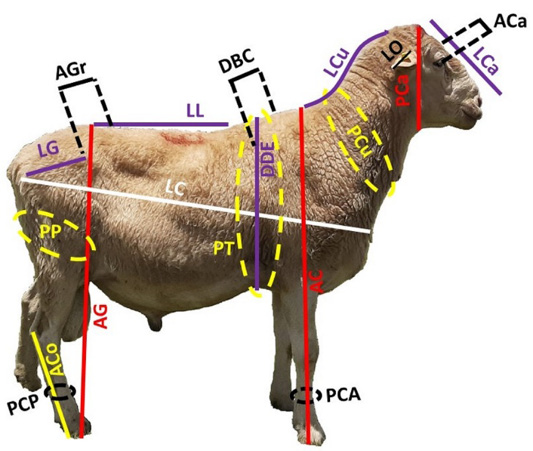
Body weight data were recorded along with the following morphological characteristics: Head length(cm); Head width (cm), Head depth (cm), Ear length (cm), Neck length (cm), Neck perimeter (cm), Height at the withers (cm), Sternal dorsal diameter (cm), Bicostal diameter (cm), Thoracic perimeter (cm), Longitudinal body diameter (cm), Loin length (cm), Height at the rump (cm), Rump length (cm), Rump width (cm), Leg perimeter (cm), Height at hock (cm), Metacarpus perimeter (cm); Metatarsus perimeter (cm) (Figure 1).
The body weight of the sheep was determined using conditioned scales and morphological characteristics were recorded by holding the animals while standing on level ground, using the zoometric ruler; thickness compass and tape measure. Body volume was determined according to the recommendations by ; .
Statistical analysis
The analysis of the effect of age on morphological measurements was obtained first from the matrix of data that were divided according to the age of the sheep, which consisted of records. The analysis of variance of the effect of age on morphological measurements and Pearson’s correlation were performed using programming language R.
A principal components analysis (PCA) was performed to reduce the matrix of morphological variables to a small number of non correlated variables called components. The main components obtained were evaluated based on Kaiser criterion was used to determine the number of factors extracted and it only retained factors that had Eigenvalues greater than 1 ; . Bartlett’s test of sphericity was used to verify if the correlation matrix was an identity or a sparse one.
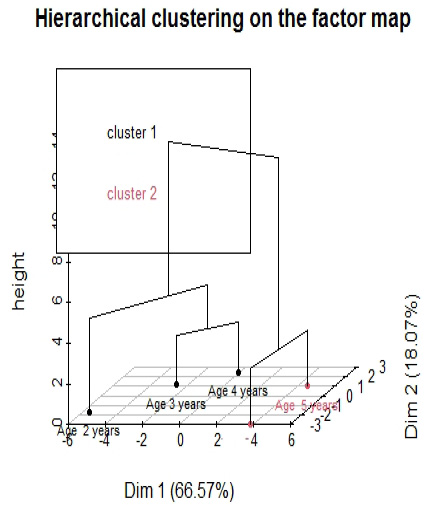
Similarly, a hierarchical analysis of the clusters was performed by Ward’s method, using the Euclidean distance to construct a dendogram and evaluate the distances between sheep ages. All statistical analyses were performed using the statistical programming language R (R Core Team, 2020).
Results and Discussion
Morphological characteristics in Creole sheep
Age significantly influenced body weight and morphological characteristics, as shown in Table 1. Animals from 3 years of age onwards showed increases in body weight; body volume; neck length; neck perimeter; Height at the withers; longitudinal body diameter; thoracic perimeter; rump width; height at the croup; loin length and height at hock. This result is likely to confirm the effect of environmental factors on the morphology of sheep. The results obtained showed important associations between morphological variables, which represents a first approximation for the characterization. Creole sheep are characterized by a marked increase in height at the rump compared to height at the withers, as is the case with other important breeds ; ; ; ; . The dimensions of the length and width of the head of sheep indicate that they are considered mesocephalic , they have a wide and heavy skull, similar to that of the Creole sheep of Argentina . The thoracic perimeter is slightly superior to that of the Colombian hair Creole sheep , Katjang does of Indonesia , Immature Uda Sheep , Zulu sheep , this shows that it is an animal with greater thoracic capacity, which allows it to adapt to the adverse environmental conditions of the altiplano and improve its production capacity in a given environment. With reference to the longitudinal body diameter was higher than that reported for West African Dwarf sheep , Immature Uda Sheep . Clearly there are differences found in the morphological characteristics of sheep, we can indicate that this variation is subject to genetic control , it is also subject to environmental influences and management practices ; . Figure 2 shows that the cluster analysis was formed by two groups, which would indicate that morphological characteristics have a relationship with growth and development in sheep, reaching its highest value at 4 years of age, after this age these characteristics are maintained.
Table 1: Effect of age on body weight and morphological characteristics in Creole sheep.
Morphological characteristics
Age in years
2 (nº = 131)
3 (nº = 88)
4 (nº = 91)
5 (nº = 25)
6 (nº = 48)
Body weight (Kg)
45.31 a
45.68 a
46.46 ab
46.8 b
47.06 b
Body volume (liters)
39.91 a
40.19 a
40.61 ab
41.46 b
41.66 b
Head length (cm)
22.14 a
22.23 a
22.26 a
22.45 a
22.54 a
Head width (cm)
12.9 a
13.06 a
13.12 a
13.48 a
13.18 a
Head depth (cm)
16.68 a
17.01 a
17.14 a
16.76 a
16.44 a
Ear length (cm)
11.78 a
11.80 a
11.60 a
11.52 a
11.19 a
Ear width (cm)
6.10 a
6.15 a
5.97 a
5.76 a
5.84 a
Neck length (cm)
19.38 a
19.91 a
20.23 ab
20.91 b
20.89 b
Neck perimeter (cm)
32.21 a
32.91 a
33.99 ab
34.32 b
34.0 b
Height at the withers (cm)
62.23 a
62.88 a
63.31 ab
64.12 b
63.48 b
Longitudinal body diameter (cm)
67.87 a
68.34 a
69.03ab
70.14 b
70.88 b
Thoracic perimeter (cm)
84.19 a
84.65 a
84.84ab
85.54 b
85.21 b
Bicostal diameter (cm)
24.54 a
24.67 a
24.81 a
24.36 a
24.33 a
Sternal dorsal diameter (cm)
32.05 a
32.6 a
32.19 a
32.30 a
31.71 a
Rump width (cm)
18.22 a
19.01 b
19.77 b
19.24 b
19.11 b
Rump length (cm)
22.01 a
21.98 a
21.95 a
22.16 a
21.74 a
Height at the rump (cm)
63.12 a
64.12 a
64.89 ab
65.5 b
65.12 b
Loin length (cm)
15.10 a
15.96 a
16.10 ab
16.44 b
16.20 b
Leg perimeter (cm)
42.21 a
41.68 a
42.02a
41.18 a
41.63 a
Height at hock (cm)
19.06 a
20.12 a
20.81ab
20.90 b
20.63 b
Metacarpus perimeter (cm)
7.8 a
7.73 a
7.8 a
7.66 a
7.68 a
Metatarsus perimeter (cm)
9.31 a
9.22 a
9.49 a
9.44 a
9.31 a
Different superscripts within rows indicate that the values were statistically significant (p<0.05).
Table 2: Pearson correlation coefficients morphological characteristics in Creole sheep.
Vari-able
1
2
3
4
5
6
7
8
9
10
11
12
13
14
15
16
Body weight
Body volume
0.96**
Head length
0.93*
0.98**
Head width
0.76
0.80
0.74
Neck length
0.96**
0.97**
0.95*
0.87
Neck peri-meter
0.94*
0.86
0.80
0.85
0.93*
Height at the withers
0.88*
0.87
0.81
0.96*
0.94*
0.95*
Longi-tudinal body dia-meter
0.96*
0.99**
0.99**
0.73
0.96*
0.84
0.82
Thora-cic peri-meter
0.90*
0.92*
0.89*
0.95*
0.97*
0.92*
0.98**
0.88*
Bi-costal dia-meter
0.48
0.68
0.72
0.49
0.56
0.27
0.41
0.66
0.54
Sternal dorsal dia-meter
0.44
0.46
0.47
0.07
0.29
0.18
0.03
0.52
0.12
0.50
Rump width
0.66
0.46
0.39
0.53
0.60
0.82
0.69
0.46
0.60
0.31
0.12
Rump length
0.28
0.23
0.32
0.35
0.15
-0.04
0.15
0.35
0.06
0.08
0.65
-0.07
Height at the rump
0.94*
0.88*
0.83
0.89*
0.95*
0.98**
0.97**
0.86
0.96**
0.33
0.11
0.78
0.03
Loin length
0.85
0.80
0.77
0.86
0.90*
0.92*
0.94*
0.77
0.92*
0.23
0.08
0.805
0.00
0.96**
Leg peri-meter
0.63
0.73
0.73
0.91*
0.80
0.67
0.85
0.67
0.88*
0.59
0.19
0.33
0.28
0.76
-0.0
Height at hock
0.87
0.76
0.71
0.80
0.87
0.96**
0.91*
0.74
0.87*
-0.10
0.00
0.90*
-0.05
0.97
0.96
0.76
Where statistically significant * indicates p < .05. ** indicates p < .01.
Pearson correlation of morphological characteristics in Creole sheep
The Pearson correlation coefficients obtained between body measurements are presented in Table 2. There are body measurements that correlated significantly with body weight (body volume r = 0.96; head length r = 0.93; neck length r = 0.96; longitudinal body diameter r = 0.96; thoracic perimeter r = 0.90). Likewise, very significant correlations were obtained for body volume with head length r=0.98; neck length r = 0.97; longitudinal body diameter r = 0.99 (p< 0.01), and significant with thoracic perimeter r=0.92 and height at the rump r=0.88 (p< 0.05). The results show that head length presents high correlations with significant correlations with neck length r=0.95; longitudinal body diameter r= 0.99, thoracic perimeter r= 0.89 (p< 0.05). Similarly, low associations were obtained between height at hock and bicostal diameter, sternal dorsal diameter and rump length. Los resultados obtenidos muestran correlaciones entre medidas corporales (altura a la cruz, diámetro longitudinal, perímetro torácico) presentaban altas correlaciones entre sí y con el peso corporal ; ; ; ; . The high correlations found between morphological characteristics demonstrate that body measurements can be useful for selection of animal body weight.
Principal component analysis of morphological characteristics in Creole sheep
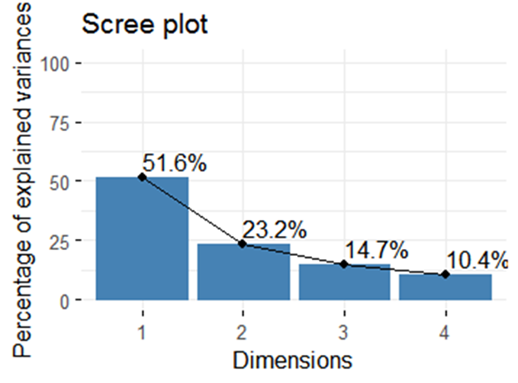
In the study, four principal components were obtained for the morphological characteristics in sheep as shown in the scarplot of Figure 3. The proportion of variance for component 1 (PCA1= 66.57%) and (PCA2= 18.07%). indicating that it identifies a more subtle pattern of variation in body shape.
Table 3: Eigenvalue, proportion of total variance of and principal component analysis for morphological characteristics in Creole sheep.
Morphological characteristics
PCA1
PCA2
Body weight (Kg)
0.291
0.091
Body volume (liters)
0.294
0.256
Head length (cm)
0.060
0.069
Head width (cm)
0.073
-0.039
Head depth (cm)
-0.024
-0.313
Ear length (cm)
-0.080
-0.144
Ear width (cm)
-0.059
-0.040
Neck length (cm)
0.259
0.069
Neck perimeter (cm)
0.344
-0.210
Height at the withers (cm)
0.267
-0.151
Longitudinal body diameter (cm)
0.468
0.483
Thoracic perimeter (cm)
0.200
-0.019
Bicostal diameter (cm)
-0.038
-0.182
Sternal dorsal diameter (cm)
-0.035
-0.297
Rump width (cm)
0.154
-0.413
Rump length (cm)
-0.008
-0.083
Height at the rump
0.370
-0.206
Loin length (cm)
0.188
-0.185
Leg perimeter (cm)
-0.119
0.020
Height at hock (cm)
0.278
-0.335
Metacarpus perimeter (cm)
-0.019
-0.021
Metatarsus perimeter (cm)
0.020
-0.051
Eigenvalues
14.64
3.97
Standard deviation
3.8271
1.9939
Proportion of Variance
0.6657
0.1807
Cumulative Proportion
0.6657
0.8465
The variation explained by the two components is shown in Table 3 and Figure 3. Variables that could not be explained by the first component could be picked up by the second. The variables that had the greatest contribution in component 1 were: longitudinal body diameter; height at rump; body weight; body volume; height at withers and thoracic perimeter. Component 2 consisted of longitudinal body diameter; sternal dorsal diameter; rump width and body volume. Showing the results of the principal component analysis (PCA), which identifies the variability of individual traits and their contribution to the morphological variance of Criollo sheep in general, these data provide valuable information on those traits that can be improved with great success through selection schemes. The percentages of accumulated variance in PCA 2 is 84.65%, these results are higher than the PCA obtained in Corriedale sheep . Principal component 1 (PCA1) explains 66.57% of the variance and principal component 2 (PCA2) explains 18.07%. Each of the 21 body measurements has a positive and negative factor loading on PCA1, indicating a positive and negative correlation (Table 3). However, PCA1 quantifies the body size of the sheep, where the head, neck, trunk and limbs increase in size in a coordinated manner . The results show that the first factor explains the largest percentage of the total variance ; ; ; ; ; .
Conclusion
Creole sheep adapted very well to the environmental conditions of the altiplano and to an extensive grazing system; in addition, the skeletal conformation of these animals mainly influenced the morphostructural development of these sheep. In principal component analysis, there are morphological traits that can be used in selection programs because they contribute significantly to the morphological variance of sheep.
Acknowledgment
The authors would like to thank the Chuquibambilla Experimental Center, the Universidad Nacional del Altiplano (UNAP) and all the people involved in the execution of the research work.
Novelty Statement
The research work highlights the analysis of principal components in Creole sheep, based on the results of morphological characteristics, for their conservation and productive characterization of this animal genetic resource.
Author’s Contribution
EOV and YMMG investigation, methodology, writing original draft, supervision, statistical analyses. BCC and BOV reviewing, formal analysis, and editing. HGC and EAS conceptualization, resources, writing, review.
Conflicts of interest
The authors have declared no conflict of interest.
Figures
Figure 1:.
Localization of morphological characteristics in sheep where: Head length (LCa); Head width (ACa), Head depth (PCa), Ear length (LO), Neck length (LCu), Neck perimeter (PCu), Height at the withers (AC), Sternal dorsal diameter (DDE), Bicostal diameter (DBC), Thoracic perimeter (PT), Longitudinal body diameter (LC), Loin length (LL), Height at the rump (AG), Rump length (LG), Rump width (AGr), Leg perimeter (PP), Height at hock (ACo), Metacarpus perimeter (PCA); Metatarsus perimeter (PCP).
Figure 2:.
Dendrogram of clusters of morphological characteristics by the effect of age in creole sheep.
Figure 3:.
Scarplot of principal component analysis for morphological characteristics in creole sheep.
References
Akbar MA, Javed K, Faraz A, Waheed A (2022). Principal component analysis of morphometric traits explain the morphological structure of thalli sheep. Pak. J. Zool., 54(1): 207-212. https://doi.org/10.17582/journal.pjz/20200220060257[Full text][CrossRef]
Alderson GLH (2018). Conservation of breeds and maintenance of biodiversity: Justification and methodology for the conservation of animal genetic resources. Arch. Zoot., 67(258): 300-309.
Brooks SA, Makvandi-Nejad S, Chu E, Allen JJ, Streeter C, Gu E, McCleery B, Murphy BA, Bellone R, Sutter NB (2010). Morphological variation in the horse: Defining complex traits of body size and shape. Anim. Genet., 41(Suppl 2): 159-165. https://doi.org/10.1111/j.1365-2052.2010.02127.x[CrossRef]
Campos D, Ikeobi CON, Olowofeso O, Smith OF (2014). Multivariate principal components analysis of the morphostructural traits of West African Dwarf sheep. Niger. J. Anim. Prod., 41(2): Art. 2. https://doi.org/10.51791/njap.v41i2.771[CrossRef]
Canaza-Cayo AW, Mota RR, Amarilho-Silveira F, Duarte DAS, Cobuci JA (2021). Principal component analysis for body weight prediction of corriedale ewes from Southern Peru. J. Anim. Hlth. Prod., 9(4): 417-424. https://doi.org/10.17582/journal.jahp/2021/9.4.417.424[Full text][CrossRef]
Ccora E, Condori A, Contreras JL, Curasma J, Cordero AG, Valencia N, Mayhua PH, McGregor BA (2019). Biometric characteristics in vicuñas (Vicugna Vicugna mensalis). Small Rumin. Res., 175: 52-56. https://doi.org/10.1016/j.smallrumres.2019.04.002[CrossRef]
Cerqueira JOL, Feás X, Iglesias A, Pacheco LF, Araújo JPP, Cerqueira JOL, Feás X, Iglesias A, Pacheco LF, Araújo JPP (2011). Morphological traits in Portuguese Bordaleira de Entre Douro e Minho sheep: Divergence of the breed. Anim. Prod. Sci., 51(7): 635-641. https://doi.org/10.1071/AN10147[CrossRef]
Domínguez-Viveros J, Rodríguez-Almeida FA, Burrola-Barraza ME, Callejas-Juárez N, Ortega-Gutiérrez JA (2019). Análisis con componentes principales y estimación de parámetros genéticos para medidas zoométricas en caballo pura raza española de México. Arch. Zoot., 68(263): Art. 263. https://doi.org/10.21071/az.v68i263.4205[CrossRef]
Dossa LH, Wollny C, Gauly M (2007). Spatial variation in goat populations from Benin as revealed by multivariate analysis of morphological traits. Small Rumin. Res., 73(1): 150-159. https://doi.org/10.1016/j.smallrumres.2007.01.003[CrossRef]
Eyduran E, Waheed A, Tariq MM, Iqbal F, Ahmad S (2013). Prediction of live weight from morphological characteristics of commercial goat in Pakistan using factor and principal component scores in multiple linear regression. J. Anim. Plant Sci., 23(6): Art. 6.
Flórez MJ, Hernández PM, Bustamante YM, Vergara GO, Flórez MJ, Hernández PM, Bustamante YM, Vergara GO (2020). Caracterización morfoestructural e índices zoométricos de hembras Ovino de Pelo Criollo Colombiano (OPC) Sudán. Rev. MVZ Córdoba, 25(3): 116-125. https://doi.org/10.21897/rmvz.1379[CrossRef]
Flórez JM, Hernández MJ, Bustamante MJ, Vergara OD (2018). Caracterización morfoestructural de tres poblaciones de Ovino de Pelo Criollo Colombiano “OPC”. Arch. Zoot., 67(259): Art. 259. https://doi.org/10.21071/az.v67i259.3789[CrossRef]
Gebreyowhens W (2016). Morphological Characterization of Indigenous Highland Sheep Population of Tigray, Northern Ethiopia. J. Natl. Sci. Res., https://www.semanticscholar.org/paper/Morphological-Characterization-of-Indigenous-Sheep-Gebreyowhens/6da38f26ffa5a004f9c7907f047e6c69fe857468
Kaiser HF (1960). The application of electronic computers to factor analysis. Educ. Psychol. Measur., 20: 141-151. https://doi.org/10.1177/001316446002000116[CrossRef]
Karacaören B, Kadarmideen H (2008). Principal component and clustering analysis of functional traits in Swiss dairy cattle. Turk. J. Vet. Anim. Sci., 32(3): 163-171.
Kirkpatrick M, Meyer K (2004). Direct estimation of genetic principal components. Genetics, 168(4): 2295-2306. https://doi.org/10.1534/genetics.104.029181[CrossRef]
Kirton AH, Carter AH, Clarke JN, Sinclair DP, Mercer GJK, Duganzich DM (1995). A comparison between 15 ram breeds for export lamb production 1. Liveweights, body components, carcass measurements, and composition. N. Z. J. Agric. Res., 38(3): 347-360. https://doi.org/10.1080/00288233.1995.9513136[CrossRef]
Legaz E, Cervantes I, Pérez-Cabal MA, Fuente LF, Mártinez R, Goyache F, Gutiérrez JP (2011). Multivariate characterisation of morphological traits in Assaf (Assaf. E) sheep. Small Rumin. Res., 100(2): 122-130. https://doi.org/10.1016/j.smallrumres.2011.06.005[CrossRef]
Leroy G, Besbes B, Boettcher P, Hoffmann I, Capitan A, Baumung R (2016). Rare phenotypes in domestic animals: Unique resources for multiple applications. Anim. Genet., 47(2): 141-153. https://doi.org/10.1111/age.12393[CrossRef]
Manly BFJ, Alberto JAN (2016). Multivariate statistical methods: A Primer, Fourth Edition (4.a ed.). Chapman and Hall/CRC. https://doi.org/10.1201/9781315382135[CrossRef]
Martinez RD (2015). Prejuicios que afectan a bovinos yovinos criollos en Argentina. Acta Iberoam. Conserv. Anim., 5: 26-35.
Mavule BS, Muchenje V, Bezuidenhout CC, Kunene NW (2013). Morphological structure of Zulu sheep based on principal component analysis of body measurements. Small Rumin. Res., 111(1): 23-30. https://doi.org/10.1016/j.smallrumres.2012.09.008[CrossRef]
Mirkena T, Duguma G, Haile A, Tibbo M, Okeyo AM, Wurzinger M, Sölkner J (2010). Genetics of adaptation in domestic farm animals: A review. Livest. Sci., 132(1): 1-12. https://doi.org/10.1016/j.livsci.2010.05.003[CrossRef]
Musa AM, Idam NZ, Elamin KM (2012). Regression analysis of linear body measurements on live weight in Sudanese Shugor sheep. Online J. Anim. Feed Res., 2(1): Art. 1.
Ormachea VE, Alencastre RGD, Olivera LVM (2020). Zoometric indices of the creole sheep in the Chuquibambilla Experimental Centre, Puno, Peru. Rev. Invest. Vet. Del Peru, 31(3): Art. 3. https://doi.org/10.15381/rivep.v31i3.17139[CrossRef]
Ormachea VE, Jahuira HF, Calsin CB, Olarte DU, Tapia IM, Olivera ML, Zanabria HV, Ormachea VB (2022). Estudio morfométrico y ecuaciones de predicción del peso corporal en llamas (Lama glama) Ch’aku y Q’ara. Int. J. Morphol., 40(5): 1247-1252. https://doi.org/10.4067/S0717-95022022000501247[CrossRef]
Peña S, López GA, Abbiati NN, Género ER, Martínez RD (2017). Caracterización de ovinos Criollos argentinos utilizando índices zoométricos. Arch. Zoot., 66(254): Art. 254.
R Core Team. (s. f.). European Environment Agency. 2020 [Methodology Reference]. Recuperado 8 de febrero de 2023, de https://www.eea.europa.eu/data-and-maps/indicators/oxygen-consuming-substances-in-rivers/r-development-core-team-2006
Rege JEO, Marshall K, Notenbaert A, Ojango JMK, Okeyo AM (2011). Pro-poor animal improvement and breeding. What can science do? Livest. Sci., 136(1): 15-28. https://doi.org/10.1016/j.livsci.2010.09.003[CrossRef]
Riva J, Rizzi R, Marelli S, Cavalchini LG (2004). Body measurements in Bergamasca sheep. Small Rumin. Res., 55(1): 221-227. https://doi.org/10.1016/j.smallrumres.2003.12.010[CrossRef]
Sabbioni A, Beretti V, Superchi P, Ablondi M (2020). Body weight estimation from body measures in Cornigliese sheep breed. Ital. J. Anim. Sci., 19(1): 25-30. https://doi.org/10.1080/1828051X.2019.1689189[CrossRef]
Salako AE (2006). Principal component factor analysis of the morphostructure of immature Uda sheep. Int. J. Morphol., 24(4): 571-774. https://doi.org/10.4067/S0717-95022006000500009[CrossRef]
Salako AE, Ngere LO (2002). Application of multifactorial discriminant analysis in the morphometric structural differentiation of West African Dwarf (WAD) and Yankasa sheep in South West. Niger. J. Anim. Prod., 29(2): Art. 2. https://doi.org/10.51791/njap.v29i2.1553[CrossRef]
Silva-Jarquin JC, Román-Ponce SI, Durán-Aguilar M, Vera-Ávila HR, Cambrón-Sandoval VH, Andrade-Montemayor HM (2019). Morphostructural characterization of the black creole goat raised in central Mexico, a currently threatened zoogenetic resource. Anim. Open Access J. MDPI, 9(7): 459. https://doi.org/10.3390/ani9070459[CrossRef]
Sowande OS, Sobola OS (2008). Body measurements of west African dwarf sheep as parameters for estimation of live weight. Trop. Anim. Health Prod., 40(6): 433-439. https://doi.org/10.1007/s11250-007-9116-z[CrossRef]
Taberlet P, Coissac E, Pansu J, Pompanon F (2011). Conservation genetics of cattle, sheep, and goats. C. R. Biol., 334(3): 247-254. https://doi.org/10.1016/j.crvi.2010.12.007[CrossRef]
Varun SYP, Thakur SK, Dogra PK, Rakesh T (2018). Morphological structuring using principal component analysis of Rampur-Bushair sheep under transhumance production in western Himalayan region, India. Indian J. Anim. Res., 52(6): 917-922.
Widya P, Ilham F (2019). Principal component analysis of body measurements and body indices and their correlation with body weight in Katjang does of Indonesia. J. Dairy, Vet. Anim. Res., 8(3): 124-134. https://doi.org/10.15406/jdvar.2019.08.00254[CrossRef]
Yakubu A (2013). Principal component analysis of the conformation traits of Yankasa sheep. Biotechnol. Anim. Husband., 29(1): 65-74. https://doi.org/10.2298/BAH1301065Y[CrossRef]
Zhang L, Wu P, Xuan C, Liu Y, Wu J (2016). Advances in body size measurement and conformation appraisal for sheep. Nongye Gongcheng Xuebao/Trans. Chin. Soc. Agric. Eng., 32: 190-197.