Dairy farming in Bangladesh getting popularity day by day and presently around 6 million dairy cattle of crossbred high yielding cows are distributed in both household and commercial farms across the country which produces around 9.4 million metric ton liters of milk per year (Alam and Sarder, 2010; DLS, 2019). Around 70% of farmers of Bangladesh are smallholders having 1-3 cows per farm and contribute to 70-80% of the total milk demand of the country (Hemme et al., 2008; Uddin et al., 2012). Dairy cows in the household farms produce around 200-250 liter of milk per 305 days lactation period (Hussain, 2013). Production disease like mastitis is the major hindrance to getting the optimum benefit from a dairy farm (Odhong et al., 2014). Mastitis impedes the dairy sector’s growth of this country due to affecting health, decreased production, and the welfare of dairy cows (Kee, 2012; Rahman et al., 2014). Mastitis generates a considerable loss to the dairy industry, which has been estimated for Bangladesh as Tk. 122.6 (US $2.11) million per year (Bari et al., 2014).
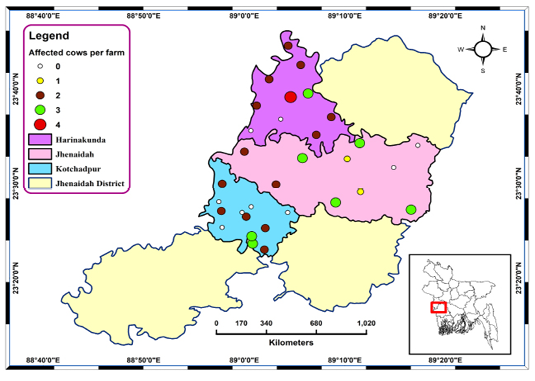
Though, many of the research on mastitis in dairy cows has been conducted in developed countries across the globe where intensive rearing system with machine milking provision is common (Kumar et al., 2013). Considerably exploration of mastitis in dairy cows of least developed countries like Bangladesh (Anon, 2020) is less likely, where the herd size is usually smaller with hand milking provision. Hence this study aimed to estimate the prevalence of subclinical mastitis among household farms of Jhenaidah, Bangladesh.
Clinical mastitis causes a negative economic impact on dairy farms through abnormal milk, deterioration of milk quality, reduced production (up to 70%), milk discharge after treatment (9%), treatment costs (7%), labor, premature culling (14%) and death (Halasa et al., 2007; Kee, 2012; Bari et al., 2014), whereas subclinical mastitis (SCM) is in the absence of clinical signs rather than an increase in somatic cell counts of the milk (Radostits et al., 2007; Kayesh et al., 2014). Subclinical mastitis is 15 to 40 times more prevalent than that of clinical mastitis, is of long duration (Almaw et al., 2008; Sarker et al., 2013; Kathiriya et al., 2014). Many earlier studies have been reported the SCM status in Bangladesh along with neighboring countries, including India, Sri Lanka, and Pakistan as well (Kathiriya et al., 2014; Qayyum et al., 2016; Sanotharan et al., 2016; Kabir et al., 2017). In Bangladesh, the prevalence of SCM in the crossbred dairy cows has been documented as 28.5-61.3% (Kayesh et al., 2014; Tripura et al., 2014; Badiuzzaman et al., 2015; Kabir et al., 2017). Unfortunately, no study has been found on SCM in the southwestern region, especially at the Jhenaidah district of Bangladesh.
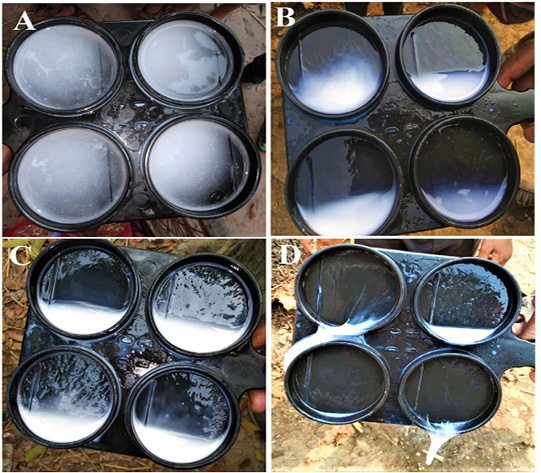
Several techniques including California Mastitis Test (CMT), Surf Field Mastitis Test (SFMT), Somatic cell Count (SCC), White Slide Test (WST) are used in field condition for SCM diagnosis (Kathiriya et al., 2014) among which SFMT has possessed a sensitivity of 72.8% and specificity 87.1% and available in field condition at a very reasonable cost (Muhammad et al., 2010; Kabir et al., 2017). So, this study has used the SFMT technique to popularize it in field conditions.
Multiple studies have been carried out to identify the risk factors of SCM in lactating cows in different countries, including Bangladesh (Sarker et al., 2013; Qayyum et al., 2016). The most-reported predisposing factor for SCM at farm level was the unhygienic environment, abnormally large udder, teat injury, udder wound, unclean milker’s hand, and mismanagement of milking machine (Bari et al., 2014; Kathiriya et al., 2014). Some other risk factors that can hardly be influenced through management are age, parity, stage of lactation, and housing; whereas breeding, teat shape, and body condition score (BCS) are included as manageable risk factors (Islam et al., 2011; Bari et al., 2014; Mpatswenumugabo et al., 2017). Again, teat end to floor distance, pregnancy, milk yield, ways of milking stimulation with milking technique, milk leakage, and type of floor has also been reported as the most significant risk factors of mastitis by different authors (Tripura et al., 2014; Qayyum et al., 2016). The knowledge of SCM risk factors is needed to provide farmers with advice to prevent clinical mastitis in their cows.
Besides Jhenaidah, a district of Bangladesh, where livestock farming is more common which is affected by different production diseases like mastitis (Sayeed et al., 2020). Therefore, the present study has been conducted to estimate the prevalence and risk factors associated with sub-clinical mastitis (SCM) in the Jhenaidah district of Bangladesh.