

ResearchersLinks

Short Communication · Volume 4, Issue 5, Pages 237–240, 2 June 2016 · Open Access

Prevalence of Sub-Clinical Mastitis in Cattle and Effect on Milk Quality

· · ·

Article Info ⌄
Journal:
Advances in Animal and Veterinary Sciences
Published:
2 June 2016

From the article

  • Prevalence of Sub-Clinical Mastitis in Cattle and Effect on Milk Quality.
  • Upon evaluation of 150 CB and 40 ND cattle,65 (43%) of CB cattle and 5 (12%) of ND cattle were found positive for SCM on California mastitis test and mastrip test.
  • Keywords | California mastitis test, Somatic cell count, Mastrip, Milk pH, Fat and SNF.
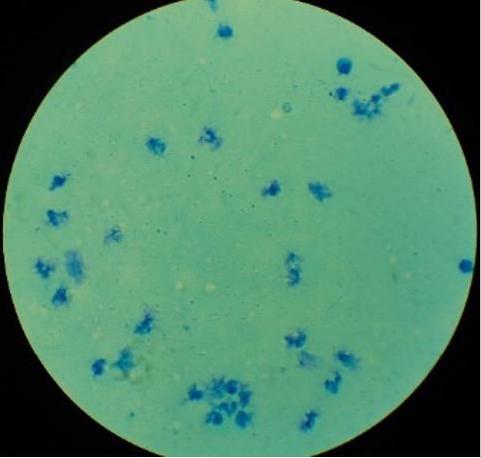
  • The Direct Microscopic Somatic Cell Count (DMSCC) for negative animals on CMT was 0.3-0.5 million per mL and 0.6-1.5 million SCC per mL for SCM positive milk (Figure 2).

Selected from the article's own text.

Abstract

Deepak Shankaregowdanakoppalu Jagadeesh1, Ravi Kumar Puttamallappa1*, Hemanth Gowda Keregallokoppalu2, Manjunath Lakshminarasimhiah3

1Department of Veterinary Public Health and Epidemiology, Veterinary College Hassan, KVAFSU; 2Department of Veterinary Physiology and Biochemistry, Veterinary College Hassan, KVAFSU; 3Department of Animal Husbandry and Extension, Veterinary College Hassan, KVAFSU, India.

Abstract | Present study was carried with an objective of finding prevalence of subclinical mastitis (SCM) and effect on milk quality in cross-bred (CB) and desi-dairy cattle (Zebu, Nondescript-ND) of Hassan district, Karnataka, India. Diagnosis was based on cow side tests - California mastitis test, and mastrip which substantiated by Direct Microscopic Somatic Cell Count (DMSCC). Upon evaluation of 150 CB and 40 ND cattle,65 (43%) of CB cattle and 5 (12%) of ND cattle were found positive for SCM on California mastitis test and mastrip test. Overall, 70 of 190 animals (37%) were positive for SCM. The DMSCC enumeration found 0.3-0.5 million SCC per mL for normal and 0.6-1.5 million SCC per mL for SCM positive milk. The milk pH, fat and Solids Not Fat (SNF) exhibited slight variance between normal and SCM positive animals. The prevalence was more common in hygiene and welfare compromised animals.

Keywords  | California mastitis test, Somatic cell count, Mastrip, Milk pH, Fat and SNF
For Fat, SNF and pH average calculated by standard mean

The pH of milk was found to be 6.7±0.1 in normal and 7.0±0.1 in SCM positive cases. The Direct Microscopic Somatic Cell Count (DMSCC) for negative animals on CMT was 0.3-0.5 million per mL and 0.6-1.5 million SCC per mL for SCM positive milk (Figure 2). The fat per cent was 3.5±0.1 in normal milk and 3.4±0.1 in SCM positive cases. The Solids Not Fat (SNF) content was 8.8±0.1 in normal milk and 8.6±0.1in SCM positive cases (Table 1).

Figure 2: Microscopic image of Somatic cell count showing epithelial cells and neutrophils and monocytes

India is self-reliant with milk production in terms of quantity but quality is inferior as per international standards.The need of the hour is to improve the quality of milk and in terms of Somatic cell count and bacteriological parameters. The Sub-clinical mastitis affected milk doesn’t pose any apparent physical changes but microscopically, bacteriological and chemical analysis shows significant variation with normal milk . The increased DMSCC and reduced milk quality parameters are evident in the result of present investigation. The degradation of proteins and fats in milk will often produce off color and odor making the acceptance rate low. The increased SCC denotes increased leucocytes and epithelial cell of bovine origin. Its consumption in human is objectionable on safety of human. The enzymatic action of SCC can also add synergistically for milk spoilage .

Milk acts as a vehicle for transmission of many pathogenic organism/disease to man known as milk borne zoonotic diseases. The interrupted cold chain during transport increases the number of pathogenic and spoilage causing organisms in milk and initiates the spoilage, lowering the keeping quality of milk. Bacterial invasion occurs mostly during the dry period, particularly during late gestation, and leads to glandular damage in parenchymatous tissue. The glandular tissue damage leads to increased SCC and reduced milk production . The prevalence of SCM is nearly four times more in CB cattle in comparison to ND cattle.

The increased bacterial concentration is more common in un-hygienically milking practices such as compromised udder and hind quarters cleaning, cow nutrition, pre- and post-milking teat disinfection, and clean milk parlor ; . The compromised floor and shed sanitation increases the chances of bacterial invasion to teat cannel . The climatic factors also contribute to prevalence of SCM in cattle by increasing SCC and crossbred cattle prevalence is more since its high milk yield and low inherent factors of immunity. Similarly inherent genetic capacity and adaptation to local environment by desi cattle is more. The CB cattle are more susceptible to environment and production stress is considerably high .

The diagnosis of sub-clinical mastitis is simple with California mastitis test (CMT), mastrip test and milk pH estimation which are cow side tests and confirmation by enumeration of DMSCC using simple compound microscope. The increased SCC proportionately decreases the milk quality suggesting increased damage to udder health. The effective management of SCM in bovine reduces the zoonotic disease transmission, increases milk yield, improvement in keeping quality of milk and physico-chemical characteristics of milk. The clean milk production promotion among the farmers helps decrease the prevalence of SCM in dairy animals and improve the animal health and welfare.

Acknowledgement

Authors thank the Dean of Veterinary College, Hassan, KVAFSU for the support, suggestion and providing necessary facilities to carry out the research.

Conflict of interest

The authors declare no conflict of interest.

Authors’ Contribution

Jagadeesh DS contributed for plan of research, manuscript preparation, sampling and experimentation. Puttamallappa RK planned the research, prepared, corrected and revised the manuscript. Keregallokoppalu HG and Lakshminarasimhiah L contributed for sample collection and experimentation.

References

  1. Badiuzzaman M, Samad MA, Siddiki SHMF, Islam MT, Saha S (2015). Subclinical mastitis in lactating cows: comparison of four screening tests and effect of animal factors on its occurrence. Bangl. J. Vet. Med. 13(2): 41-50. http://dx.doi.org/10.3329/bjvm.v13i2.26627[CrossRef]
  2. Bortolami A, Fiore E, Gianesella M, Corro M, Catania S, Morgante M (2015). Evaluation of the udder health status in subclinical mastitis affected dairy cows through bacteriological culture, somatic cell count and thermographic imaging. Polish J. Vet. Sci. 18(4): 799–805. http://dx.doi.org/10.1515/pjvs-2015-0104[CrossRef]
  3. Gordon PF, Van Den Borne BH, Reist M, Kohler S, Doherr MG (2013). Questionnaire-based study to assess the association between management practices and mastitis within tie-stall and free-stall dairy housing systems in Switzerland. BMC Vet. Res. 9: 200. http://dx.doi.org/10.1186/1746-6148-9-200[CrossRef]
  4. Hillerton JE, Bramley AJ, Staker RT, McKinnon CH (1995). Patterns of intramammary infection and clinical mastitis over a 5-year period in a closely monitored herd applying mastitis control measures. J. Dairy Res. 62: 39-50. http://dx.doi.org/10.1017/S0022029900033653[CrossRef]
  5. Miller GY, Bartlett PC, Lance SE, Anderson J, Heider LE (1993). Costs of clinical mastitis and mastitis prevention in dairy herds. J. Am. Vet. Med. Assoc. 202: 1230-1236.
  6. NDDB (National Dairy Development Board) (2016). Milk production in India. http://www.nddb.org/information/stats/milkprodindia. (Accessed: 25th April 2016).
  7. Nigel BC, Douglas JR (2007). A tool box for assessing cow, udder and teat hygiene. Annual meeting of the NMC, University of Wisconsin-Madison.
  8. Pleguezuelos FJ, De La Fuente LF, Gonzalo C (2015). Variation in Milk Yield, Contents and Incomes According to Somatic Cell Countin a Large Dairy Goat Population. J. Adv. Dairy Res. 3: 145.
  9. Santman-Berends IMGA, Swinkels JM, Lam TJGM, Keurentjes J, van Schaik G (2016). Evaluation of udder health parameters and risk factors for clinical mastitis in Dutch dairy herds in the context of a restricted antimicrobial usage policy. J. Dairy Sci. 99: 2930–2939. http://dx.doi.org/10.3168/jds.2015-10398[CrossRef]
  10. Saravanan R, Das DN, De S, Panneerselvam S (2015). Effect of season and parity on somatic cell count across zebu and crossbred cattle population. Indian J. Anim. Res. 49(3): 383-387. http://dx.doi.org/10.5958/0976-0555.2015.00127.2[CrossRef]
  11. Sharif A, Umer M, Muhammad G (2009). Mastitis control in dairy production. J. Agric. Soc. Sci. 5: 102-105.
  12. Sharma N, Singh NK, Bhadwal MS (2011). Relationship of Somatic Cell Count and Mastitis: An Overview. Asian-Aust. J. Anim. Sci. 24 (3): 429 – 438.
  13. Van den Borne BHP, Vernooij JCM, Lupindu AM, Van Schaik G, Frankena K, Lam TJGM, Nielen M (2011). Relationship between somatic cell count status and subsequent clinical mastitis in Dutch dairy cows. Prev. Vet. Med. 102:265–273. http://dx.doi.org/10.1016/j.prevetmed.2011.07.013[CrossRef]

Services

Article usage statistics

Loading…

Prevalence of Sub-Clinical Mastitis in Cattle and Effect on Milk Quality · ResearchersLinks