Escherichia coli (E. coli) a member of family Enterobacteriaceae is a short Gram ¬negative, non–spore forming and usually peritrichous and fimbriate bacillus. It serves as a major facultative anaerobe throughout its life as a harmless saprophyte but Larulle (1889) was the first to suggest the possible role of E. coli as a pathogenic organism. In debilitated or immunosupressed host or when gastrointestinal barriers are violated even normal non pathogenic strains of E. coli can cause infection.
The samples were collected aseptically in sterile vials from organized and unorganized farm of Assam. A total of 260 faecal samples, comprising 110 from cattle and 150 from pigs were examined for the presence of E.coli. All the samples were collected aseptically in sterile vials, immediately brought to the laboratory for bacteriological culture. The commercially available readymade Mac Conkey broth and Mac Conkey lactose agar media (HiMedia, Mumbai) was used for bacterial isolation, identification and characterization of E. coli. Faecal samples were first inoculated in Mac Conkey’s broth and incubated at 37°C overnight. For primary isolation of E.coli Mac Conkey lactose agar is used, samples were inoculated on Mac Conkey lactose agar plates and incubated at 37°C overnight. Morphological characteristics like shape, size, arrangement and staining reaction of the organisms of each isolates were studied after staining the fresh culture smears with Gram’s stain.
The prevalence of E.coli in diarrhoeic and non diarrhoeic adult cattle as well as calves was recorded. A total of 110 faecal samples were collected out of which 74 (67.27%) samples were found positive to E.coli. The prevalence was found to be 60% and 88.57% in diarrhoeic adult cattle and calves, respectively whereas it was found to be 53.33%and 60% in non diarrhoeic cattle and calves, respectively. The overall prevalence of E.coli in diarrhoeic cattle and non–diarrhoeic cattle was found to be 76.67% and 56.00%, respectively. Trend on the prevalence of E. coli in both diarrhoeic and non diarrhoeic adult cattle and calves is shown graphically in (Figure 1).
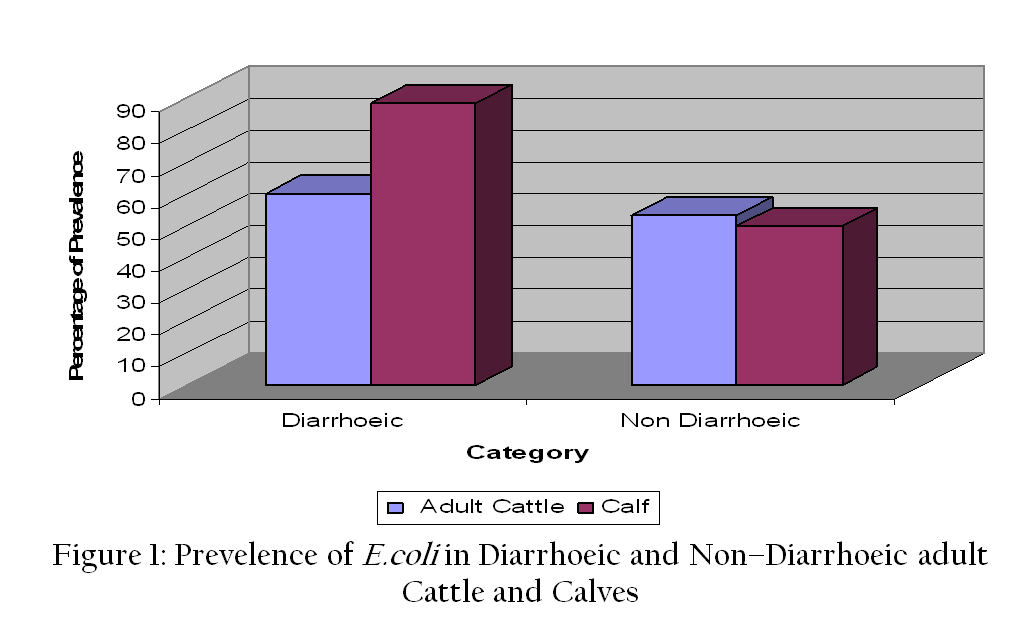
Figure 1: Prevelence of E.coli in Diarrhoeic and Non–Diarrhoeic adult Cattle and Calves
A total of 150 faecal samples from pigs were examined out of which 89 were found to be positive for E.coli. The prevalence was found to be 50% and 88.89% in diarrhoeic adult pigs and piglets, respectively whereas it was found to be 40% and 50% in non– diarrhoeic adult pigs and piglets. The overall prevalence of E.coli in diarrhoeic pigs and non diarrhoeic pigs were recorded as 70.59% and 44.62%, respectively. Trend on the prevalence of E.coli in both diarrhoeic and non diarrhoeic adult pigs and piglets as shown in (Figure 2)
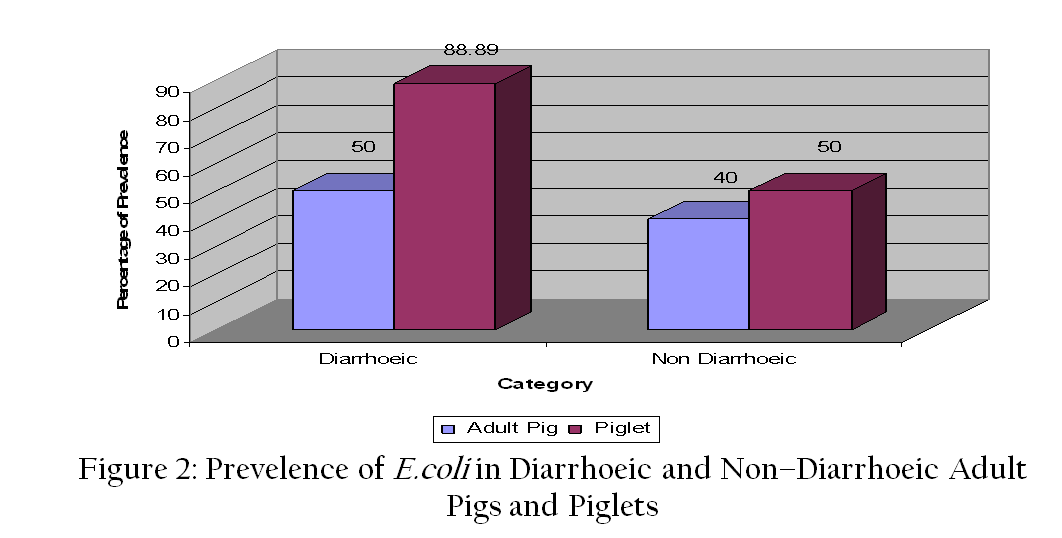
Figure 2: Prevelence of E.coli in Diarrhoeic and Non–Diarrhoeic Adult Pigs and Piglets
The present finding is similar with the findings of Sharma et al., (2004) who also reported highest (94.52%) prevalence of E.coli in comparision to non–diarrhoeic calves. Hussain and Saikia (2000) and Wani et al., (2003) however isolated E.coli from all cases of calf diarrhea. Shah and Jhala (1990) isolated E.coli from 61.2% of diarrhoeic calves. Scotland et al., (1990) recorded that non O157: H7 was isolated from 26.9% diarrhoeic calves, 10% asymptomatic carrier calves and 5.5% in healthy calves in Srilanka. Khang et al., (2004) recorded that out of 498 diarrhoeic and non diarrhoeic young calves from 115 different farms, out of which 254 non–diarrhoeic calves 24 (9.8%) were positive for EHEC O157 and 254 non–diarrhoeic calves 7 (2.8%) positive for EHEC O157.
The present findings also corrborate with the findings of Sikdar, (1991) who also reported that 51.95% of piglets from four different farms of North eastern region of India were affected with diarrhea where the main etiological agents was found to be E.coli. The present findings are almost similar with the findings of Borah (1994) who also isolated E.coli from 86.11% of pigs that died of gastroenteritis. Martins et al., (2000) reported prevalence of E.coli from three states of Brazil which was found to be 65.7% in diarrhoeic and 42.8% in non–diarrhoeic piglets. Do et al., (2006) from North Vietnam reported that diarrhoea was found to affect 71.5% of the litter born during that period. Ngeleka et al., (2003) reported the prevalence of E.coli pathotypes from diarrhoeic (40%) and non–diarrhoeic piglets (22.9%).
It was observed that the highest prevalence was which might be attributed to the fact that in newborn piglets and calves E.coli is found to be the predominant bacteria associated with diarrhea (Sikdar., 1991, Borah., 1994).The variation in prevalence as observed in the present study could be due to geographical variation of the studied area.

