
The study was conducted investigate the prvalence of surgical affections in calves and also to assess the influence of season in the affections in the Upazila Veterinary Hospitals of Fulbaria, Muktagacha, and Trishal of Mymensingh district of Bangladesh. Prevalences of surgical affections in calves from 2010 to 2019 were recorded from the register book of each veterinary hospital. A total of 2165 calves were recorded as general patients in those Upazila Veterinary Hospitals. Surgical affections were arranged based on sex, breed, and seasons. Similar distribution pattern was observed in all three Upazila. Most common surgical affections in calves were atresia ani, 30.82%, 32.64% and 31.75% followed by umbilical hernia 19.45%, 17.78% and 17.62%, navel ill 15.75%, 15.79% and 16.08%, umbilical abscess 14.38%, 15.28% and 14.27%, fracture 9.59%, 8.61% and 10.49%, myiasis 5.21%, 4.86% and 5.03%, dermoid cyst 2.47%, 2.78% and 2.66%, and knuckling of limb 2.33%, 2.36% and 2.10% in Fulbaria, Muktagacha, and Trishal Veterinary Hospitals, respectively. Different environmental factors and seasons influenced the prevalence of surgical affections. Heavy rainfall and high humidity have made this region a vulnerable place for the prevalence of surgical affections in calves. This study has correlated between different variables and the prevalence of surgical affections in Mymensingh district. Variables like sex, breed and season have found to be influenced the abundance of surgical diseases in the study area. The outcome of this study will add to the existing knowledge on the effects of biological and environmental variables on the prevalence of bovine surgical affections in Mymensingh and its surrounding localities.
Research Article · Volume 7, Issue 1, 30 May 2021 · Open Access
Prevalence and Associated Risk Factors of Surgical Affections in Calves in Mymensingh District of Bangladesh
· ·
Affiliations & Notes ⌄
- 1Department of Surgery and Obstetrics, Bangladesh Agricultural University, Mymensingh-2202, Bangladesh. *Correspondence | Md. Mahmudul Alam, Department of Surgery and Obstetrics, Bangladesh Agricultural University, Mymensingh-2202, Bangladesh
- 2Email: mahmud.dso@bau.edu.bd
Article Info ⌄
- Journal:
- Veterinary Sciences: Research and Reviews
- Published:
- 30 May 2021
From the article
- The prevalence was higher in the autumn season (33.733%) and lower in the summer season (16%).
- The influence of season was also evident in the prevalence of atresia ani.
- The prevalence of navel ill was higher in males (53.0%) than females (47%) and in the cross-breed (63%) than indigenous breed (37%).
- The prevalence was highest in the rainy season (46.01%) and lowest in the winter season (10.61%).
Selected from the article's own text.
Abstract
Introduction
The roles of ruminant animals, especially cattle, have paramount importance in the economy of Bangladesh. Veterinary practices are mostly concentrated in ruminant animals like cattle and goat, as they are still appreciated as the primary food sources of animal origin ; . Like other animals, ruminants are also prone to various infectious and metabolic diseases, as well as surgical disorders. Recognized surgical affections of ruminants are umbilical hernia, dermoid cyst, non-functional limb joints, supernumerary limbs, atresia ani, and navel ill ; . A considerable number of surgical affections in newborn calves have also been reported from the Veterinary Teaching Hospital of Bangladesh Agricultural University .
The acquired surgical affections of calves may include umbilical abscess, navel ill, myiasis, fracture, and wounds and so on. Newborn calves, along with older calves, may suffer from these diseases. Other acquired surgical affections may be complications of castration (like gut tie, scirrhous cord), malicious wounds, hematoma due to traumatic injury, breaking of the jaw and cutting of the tongue due to application of snare, injury at the cornea or the eye due to application of obstetrical hook for traction at the time of delivery .
In contrast, congenital disabilities are responsible for most of the surgical affections in newborn calves. Newborn calves frequently suffer from various surgical affections, e.g., umbilical hernia, atresia ani, dermoid cyst in Bangladesh . In addition to indigenous calves, a considerable number of cross-bred calves also suffer from various congenital abnormalities ; .
Surgical diseases in animals are very often associated with a decrease in production, performances, and even death of the animals. Therefore, a retrospective study was carried out to investigate the prevalence of surgical affections in association with the risk factors in calves. Despite its considerable economic importance and threats to trade, information on the sero-prevalence and distribution of surgical diseases in Mymensingh region, in particular, is absent. A better understanding of its prevalence and distribution would lead to improved disease control measures. Therefore, this study was aimed to estimate the prevalence, assess risk factors and distribution of major surgical affections in South-west part of Mymensingh.
Materials and Methods
Study location, period and population
The study was conducted in three Upazilas (Fulbaria, Muktagacha, and Trishal) of the Mymensingh district of Bangladesh. A retrospective data of different surgical affections in calves from 2010 to 2019 were collected from the patients’ register book of each Upazila Veterinary Hospital. A total of 2165 calves were recorded as general patients in all three Upazila, Fulbaria (n=730), Muktagacha (n=720), and Trishal (n=715).
Case classification
Surgical affections of animals were classified based on sex, breed type, and season of prevalence.
The calves were divided into two sex groups (Male and Female), two breed types (Indigenous and Crossbreed), and four seasons (Summer, April to June; Rainy, July to August; Autumn, September to October; and Winter, November to March). Distribution of surgical affections in the seasons round the year was evaluated based on the date of the cases recorded.
Statistical analysis
Data were entered in Microsoft office Excel version 2016 and imported to statistical software for social science (SPSS) version 20.0 for windows. Descriptive statics such as tables, graphs, averages and percentages were used to summarize and present the results of the collected data. Among the different groups, each surgical affection was compared using independent-samples t test and season variation were analysed using one way ANOVA. For all statistical comparisons, differences were considered significant when p value was <0.05.
Results and Discussion
As exhibited in Table 1, we found that the prevalence of atresia ani was higher in males (60%) than females (40%) and in the indigenous breed (65.63%) than cross-breed (34.37%). The prevalence was higher in the autumn season (33.733%) and lower in the summer season (16%). The umbilical hernia was found higher in males (61%) than females (39%) and in the cross-breed (55%) than indigenous breed (45%). The prevalence was highest in the summer season (35.91%) and lower in the autumn season (19.71%). Umbilical abscess was found higher in males (54%) than females (46%) and in the cross-breed (59.14%) than indigenous breed (40.85%). The prevalence was highest in the summer season (44.76%) and lowest in the rainy season (9.52%). Myiasis was found higher in females (53%) than males (47%) and in the indigenous breed (66.42%) than cross-breed (33.58%). The prevalence was highest in the summer season (42.10%) and lower in autumn and winter season (13.15%).
The overall details of surgical affections of calves in Muktagacha Upazila are presented in Table 2. In this study, we found that atresia ani was higher in males (62.0%) than females (38.0%). In terms of the breed, it was higher in the indigenous breed (63.63%) than cross-breed (36.37%). The influence of season was also evident in the prevalence of atresia ani. It was highest in the summer season (46.80%) and lower in the rainy season (9.36%). The prevalence of navel ill was higher in males (53.0%) than females (47%) and in the cross-breed (63%) than indigenous breed (37%). The prevalence was highest in the rainy season (46.01%) and lowest in the winter season (10.61%). The prevalence of fracture was found highest in males (54%) than females (46%) and in the indigenous breed (61.89%) than cross-breed (38.11%). Seasonal predisposition was also highly evident as it was highest in the rainy season (37.09%) and lower in the autumn season (11.29%).
Table 1: The occurrence of surgical affections of calves in Fulbaria Upazila based on age, sex and season (n=730).
| Affections | Sex | Breed | Season | |||||
| Male | Female | Indigenous | Cross | Summer | Rainy | Autumn | Winter | |
| Atresia ani | 135 (60%)a | 90 (40%)b | 148 (65.63%)a | 77 (34.37%)b | 36 (16%)a | 47 (20.88%)b | 75 (33.33%)c | 67 (29.77%)d |
| Umbilical hernia | 88 (61%)a | 55 (39%)b | 64 (45.0%)a | 78 (55.0%)b | 51 (35.91%)a | 28 (19.71%)b | 25 (17.60%)b | 38 (26.76%)c |
| Navel ill | 62 (55%)a | 52 (45%)b | 36 (39%)a | 79 (61%)b | 35 (30.43%)a | 39 (33.91%)a | 16 (13.91%)b | 25 (21.73%)c |
| Umbilicus abscess | 57 (54%)a | 48 (46%)b | 43 (40.85%)a | 62 (59.14%)b | 47 (44.76%)a | 10 (9.52%)b | 12 (11.42%)b | 36 (34.28%)c |
| Fracture | 36 (52%)a | 34 (48%)a | 44 (62.86%)a | 26 (37.14%)b | 6 (8.57%)a | 33 (47.14%)b | 24 (34.28%)c | 7 (10%)a |
| Myiasis | 18 (47%)a | 20 (53%)a | 25 (66.42%)a | 13 (33.58%)b | 16 (42.10%)a | 12 (31.57%)a | 5 (13.15%)b | 5 (13.15%)b |
| Dermoid cyst | 9 (49%)a | 9 (51%)a | 9 (50%)a | 9 (50%)a | 6 (33.33%)a | 5 (27.77%)a | 4 (22.22%)a | 3 (16.67%)a |
| Knuckling of limb | 9 (53%)a | 8 (47%)a | 8 (48%)a | 9 (52%)b | 2 (11.76%)a | 4 (23.52%)a | 5 (29.41%)a | 6 (35.29%)a |
Absolute values refer to total case number and values in parenthesis refer to the percentage of occurrence within the category. Values with different superscript letter in the same row of different catagery differed significantly at p<0.01
Table 2: The occurrence of surgical affections in calves in Muktagacha Upazila, based on sex, breed and season (n=720).
| Affec-tions | Sex | Breed | Season | |||||
| Male | Female | Indigenous | Cross | Summer | Rainy | Autumn | Winter | |
| Atresia ani | 146 (62%)a | 89 (38%)b | 150 (63.63%)a | 85 (36.37%)b | 110(46.80%)a | 22 (9.36%)b | 24 (10.21%) b | 79 (33.61%)c |
| Umbilical hernia | 82 (64%)a | 46 (36%)b | 60 (47%)a | 68 (53%)b | 30 (23.43%)a | 10 (7.81%)b | 18 (14.06%) c | 70 (54.68%)d |
| Navel ill | 60 (53%)a | 53 (47%)b | 42 (37%)a | 71 (63%)b | 33 (29.20%)a | 52(46.01%)b | 16 (14.155%)c | 12 (10.61%)d |
| Umbilicus abscess | 61 (55.30%)a | 49 (44.70%)b | 46 (41.83%)a | 64 (58.16%)b | 38 (34.54%)a | 21(19.09%)b | 33 (30%) a | 18 (16.36%)b |
| Fracture | 33 (54%)a | 29 (46%) b | 38 (61.89%)a | 24 (38.11%)b | 10 (16.12%)a | 23(37.09%)b | 7 (11.29%) a | 22 (35.48%)b |
| Myiasis | 15 (44%)a | 20 (56%)b | 23 (64.44%)a | 12 (35.56%)b | 5 (14.28%)a | 16(45.71%)b | 11 (31.42)b | 3 (8.57%)a |
| Dermoid cyst | 11 (53%)a | 9 (47%)a | 9 (47%)a | 11 (53%)a | 9 (45%)a | 2(10%)b | 7 (35%) a | 2 (10%)a |
| Knuck-ling of limb | 8 (49%)a | 9 (51%)a | 7 (43%)a | 10 (57%)a | 2 (11.76%)a | 1(5.88%)a | 6 (35.29%b | 8 (47.05%)b |
Absolute values refer to total case number and values in parenthesis refer to the percentage of occurrence within the category. Values with different superscript letter in the same row of different catagery differed significantly at p<0.01
Table 3: The occurrence of surgical affections in calves in Trishal Upazila, based on sex, breed and seasons (n=715).
| Affec-tions | Sex | Breed | Season | |||||
| Male | Female | Indige-nous | Cross | Summer | Rainy | Autumn | Winter | |
| Atresia ani | 107 (47.25%)a | 120 (52.75%)b | 140 (61.63%) a | 87 (38.37%) b | 45 (19.82%)a | 74 (32.59%) b | 77 (33.92%)b | 31 (13.65%)c |
| Umbilical hernia | 86 (68%)a | 40 (32%)b | 54 (43%) a | 72 (57%) b | 55 (43.65%)a | 15 (11.90%) a | 15 (11.90%)a | 41 (32.53%)c |
| Navel ill | 62 (54.20%)a | 53 (45.80%)b | 39 (34%) a | 76 (66%) b | 37 (32.17%)a | 26 (22.60%) b | 35 (28.69%)a | 17 (14.78)c |
| Umbilicus abscess | 59 (58%)a | 43 (42%)b | 32 (31.83%) a | 70 (68.16%) b | 13 (12.74%)a | 12 (11.76%) a | 45 (44.11%)b | 32 (31.37%)c |
| Fracture | 40 (53.58%)a | 35 (46.42%)b | 39 (51.89%) a | 36 (48.11%) a | 26 (34.66%)a | 29 (38.66%) a | 12 (16%)b | 8 (10.66%)b |
| Myiasis | 16 (43.55%)a | 20 (56.45%)b | 25 (70.44%) a | 11 (29.56%) b | 6 (16.66%)a | 11 (30.55%) b | 12 (33.33%)b | 7 (19.44%)a |
| Dermoid cyst | 11 (59%)a | 8 (41%)a | 9 (48%) a | 10 (52%) a | 5 (26.31%)a | 7 (36.84%) a | 4 (21.05%)a | 3 (15.78%)a |
| Knuck-ling of limb | 7 (46.43%)a | 8 (53.57%)a | 7 (45%) a | 8 (55%) a | 1 (6.66%)a | 4 (26.66%) a | 2 (13.33%)a | 8 (53.33%)b |
Absolute values refer to total case number and values in parenthesis refer to the percentage of occurrence within the category. Values with different superscript letter in the same row of different catagery differed significantly at p<0.01
Table 3 illustrated the prevalence of atresia ani was higher in females (52.75%) than males (47.25%) and in the indigenous breed (61.63%) than cross-breed (38.37%). In terms of season, the prevalence was highest in the autumn season (32.92%) and lowest in the winter season (13.65%). The prevalence of the dermoid cyst was higher in males (59%) than females (41%) and in the cross-breed (52%) than indigenous breed (48%). Dermoid cyst was found the highest in the rainy season (36.84%) and lowest in the winter season (15.78%). The prevalence of knuckling of the limb was recorded higher in females (53.57%) than males (46.43%) and in the cross-breed (55%) than indigenous breed (45%). Seasonal variations were remarkable in this case as the prevalence was recorded highest in the winter season (53.33%) and lowest in the summer season (6.66%).
Figure 1 exhibited that the most common surgical affection in calves was atresia ani, 30.82%, 32.64% and 31.75% followed by umbilical hernia, 19.45%, 17.78% and 17.62%, navel ill, 15.75%, 15.79% and 16.08%, umbilical abscess 14.38%, 15.28% and 14.27%, fracture, 9.59%, 8.61% and 10.49%, myiasis, 5.21%, 4.86% and 5.03%, dermoid cyst, 2.47%, 2.78% and 2.66% and knuckling of limb, 2.33%, 2.36% and 2.10% in Fulbaria, Muktagacha, and Trishal Upazila, respectively. Overall prevalences of surgical affections in these three upazila on the basis of sex, breeds and, seasons are shown in Figures 2, 3 and 4, respectively.
The geographical distribution of surgical diseases have been shown to extends from Mymensingh to different region of the country. Many authors have reported the prevalence of surgical affections in ruminant species and even in zoo animals ; ; . Questionnaire surveys and case reports indicate an prevalence of the diseases in different region of Bangladesh. Surgical diseases are associated with significant production losses because of stunted growth, decreased weight gain, and increased susceptibility to other diseases, while also being a direct cause of mortality and economic loss to farmers.
The highest proportion of prevalence of atresia ani, navel ill, and umbilical abscess was seen, which might be because of the poor hygienic management conditions of the farm as well as the surroundings ; Rassel et al., 2020a). In the case of atresia ani, the prevalences also depend on several genetic factors as this is a congenital disease.
This study reported that most of the surgical affections are common in male calves compared to the female, this may be because of the anatomical structure of male as there is more chance of getting infections like in navel ill (Rassel et al., 2020b) and umbilical abscess as reported by Hoda et al. (2018b) and Talukder et al. (2018). In contrast, Noman et al. (2013) reported opposite to these studies, and this may be because of site selection and the changes in the type of surgical affections.
The study also found that most of the surgical affections were observed in cross-breed rather than indigenous type. The reason for this difference may be of genetic variations. A similar finding was also observed by Jaman et al. (2018).
The study reported that the overall distribution of surgical affections, in general, was highest in the summer seasons, followed by the rainy season and least in the autumn season. This may be primarily because of the environmental factors as in summer, the rate of infection is generally high compare to others as temperature favours the growth of microorganisms. Also, the summer season is the most favourable season for the breeding of flies, which directly influences myiasis.
Conclusions and Recommendations
It is evident that the cattle industry is growing and could offer a significant contribution to the alleviation of the protein deficit in the human population of the country. The potential for improved cattle production lies in facilitating farmers with sufficient awareness of the diseases and proper management. Our findings revealed that different surgical affections are prevalent in calves in Mymensingh, which are promoted by several influential factors, although most of these affections are curable. This information will help the vet practitioners to understand the trend of various surgical anomalies in calves. Hence, regular surveillance and prompt surgical intervention may improve the situation and reduce the burden of the farmers.
Acknowledgements
We would like to thank Upazila Livestock Officer of Trishal, Fulpur and Muktagacha for their cordial help in collecting retrospective data. We also Thank Mr. Pravin Mishra, undergraduate student of the Faculty of Veterinary Science, BAU to assist in editing and data arrangement of the manuscript.
Novelty Statement
The study presents the overview of recent scenario of the surgical affections in calves in Mymensingh district. This will be useful in enriching the epidemiological data base of Bangladesh for better calf disease surveillance and control
Author’s Contribution
Md. Ariful Islam: Conducting the research, data acquisition.
Md. Badol Ashraf: Assisting in writing manuscript.
Md. Mahmudul Alam: Design of the study, writing manuscript, final approval, accountability.
Conflict of interest
The authors have declared no conflict of interest.
Figures
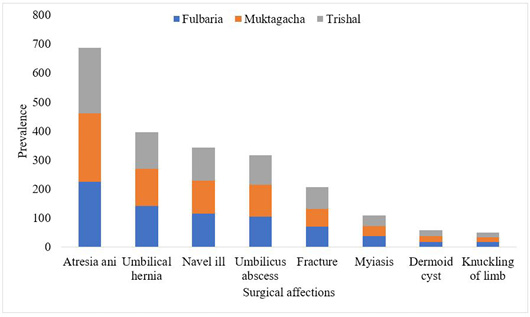
A Comparative analysis of the prevalence of surgical affections in Fulbaria, Muktagacha and Trishal.
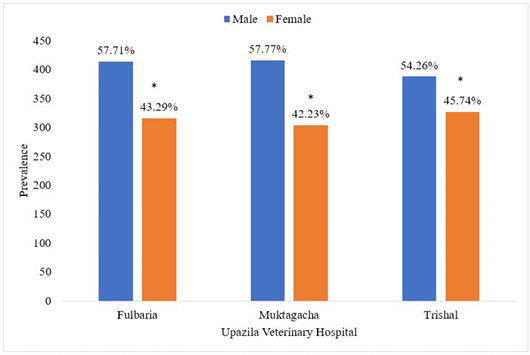
Comparative picture of the prevalence of surgical affections in Fulbaria, Muktagacha and Trishal on the basis of sex. * denotes significance at p<0.05
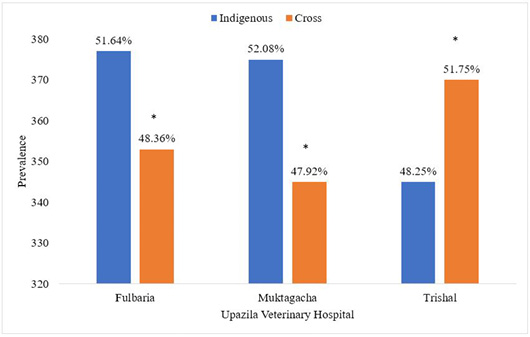
Comparative picture of the prevalence of surgical affections in Fulbaria, Muktagacha and Trishal on the basis of breeds. * denotes significance at p<0.05
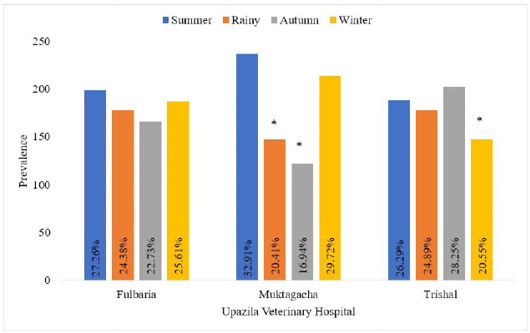
Comparative picture of the prevalence of surgical affections in Fulbaria, Muktagacha and Trishal on the basis of season. * denotes significance at p<0.05
References
- Abdel-Kawy, H.A., Misk, N.A., Abdel-Hady, A.A.A. and Sadan, M.A., 2015. Prevalence and management of some surgical affection in cattle and buffaloes at qena governorate in field situation. Int. J. Vet. Sci. Res., 1(4): 79-87. https://doi.org/10.18488/journal.110/2015.1.4/110.4.79.87[CrossRef]
- Alam, M.M., Hossain, M.A. and Mohammed, Y., 2005. Effects of plasma with minerals and vitamin on various haematobiochemical parameters of calves. Bangladesh Vet. J., 8(1-4): 15-24.
- Alam, M.M., Juyena, N.S., Alam, M.M., Ferdousy, R.N. and Paul, S., 2014. Use of wire suture for the management of fractures in calves. IOSR J. Agric. Vet. Sci., 7: 90-96. https://doi.org/10.9790/2380-07139096[CrossRef]
- Alam, M.M., Rahman, M.M., 2012. A three years retrospective study on the nature and cause of ocular dermoids in cross-bred calves. Open Vet. J., 2(1): 10-14. https://www.ncbi.nlm.nih.gov/pubmed/26623284.
- Hoda, N., Karim, M.R., Mishra, P. Shihab, M.M., Jaman, M.M., Alam, M.R. and Alam, M.M., 2018a. Prevalence of Schistosomus reflexus in neonatal bovine calves in certain areas of Bangladesh: A retrospective study. Bangladesh Vet. J., 52(1-4): 39-45. https://doi.org/10.32856/BVJ-2018.05[CrossRef]
- Hoda, N., Talukder, Z., Mishra, P., Jaman, M.M., Alam, M.M., 2018b. Prevalence of surgical affections in zoo herbivores: A retrospective study. Res. Agric. Livest. Fish., 5(2): 209-214. https://doi.org/10.3329/ralf.v5i2.38110[CrossRef]
- Islam, M.S., Hossain, M.A., Hashim, M.A. and Alam, M.M., 2006. Occurrence and clinical management of umbilical hernia in calves. Bangladesh Vet., 23(1): 17-22.
- Islam, M.A., Akter, M.A. and Alam, M.M., 2020. Prevalence and temporal distribution of surgical diseases in goats (Capra hircus) in Mymensingh district of Bangladesh. J. Adv. Vet. Biol. Sci. Tech., 5(2): 72-80. https://doi.org/10.31797/vetbio.753673[CrossRef]
- Islam, M.Z., Mishra, P., Runa, R.A. and Alam, M.M., 2020. Prevalence and risk factors analysis of bovine foot diseases in selective milk pocket areas of Sirajganj district, Bangladesh. Vet. Sci. Res. Rev., 6(2): 73-79. https://doi.org/10.17582/journal.vsrr/2020/6.2.73.79[Full text][CrossRef]
- Jaman, M.M., Mishra, P., Rahman, M. and Alam, M.M., 2018. Clinical and laboratory investigation on the recurrence of the umbilical hernia after herniorrhaphy in bovine calves. J. Bangladesh Agric. Univ., 16(3): 464-470. https://doi.org/10.3329/jbau.v16i3.39418[CrossRef]
- Naik, S.G., Ananda, K.J., Rani, B.K., Kotresh, A.M., Shambulingappa, B.E. and Patel, S.R., 2011. Navel ill in new born calves and its successful treatment. Vet. World, 4(7): 326. https://doi.org/10.5455/vetworld.4.326[CrossRef]
- Noman, A.S.M., Juyena, N.S., Alam, M.M., Ferdousy, R.N., Paul, S. and Haq, M.M., 2013. Prevalence of surgical affection of dairy cattle in aarong dairy area of Pabna. Prog. Agric., 24(1 & 2): 85-92. https://doi.org/10.3329/pa.v24i1-2.19110[CrossRef]
- Rassel, M.G.R., Mishra, P., Rahman, M. and Alam, M., 2020a. Exploring bacterial pathogens and risk factors associated with the prevalence of navel ill in calves. J. Istanbul Vet. Sci., 4(2): 37-42. https://doi.org/10.30704/http-www-jivs-net.722788[CrossRef]
- Rassel, M.G.R., Orchy, K.A.H., Khan, M.M.R., Rahman, M. and Alam, M.M., 2020b. Changes in hematological and serum biochemical profile in calves with navel ill. Vet. Sci. Res. Rev., 7(1): 14-18. https://doi.org/10.17582/journal.vsrr/2021/7.1.14.18[Full text][CrossRef]
- Talukder, Z., Hoda, N., Jha, P.K., Mishra, P., Momy, M.K. and Alam, M.M., 2018. A retrospective study on the occurrence of surgical affection in zoo carnivores of the national zoological garden at Dhaka, Bangladesh. Res. Agric. Livest. Fish., 5(3): 335-339. https://doi.org/10.3329/ralf.v5i3.39582[CrossRef]
- Tanwar, M. and Gahlot, T.K., 2015. Surgical affections of head region and its management in calves. Intas Polivet, 16(1) 72-77.
Cited by 1 article
In journals published by ResearchersLinks.
Services
Article usage statistics
Loading…